
Click here for a downloadable PDF version of this article.
First Article
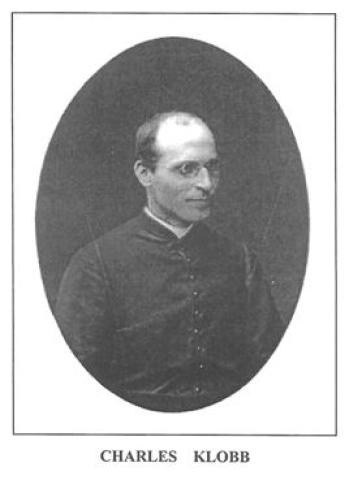
On November 16, 1906, at the sanitarium of Leysin, not far from Martigny {Switzerland}, Father Charles Klobb, Assistant of the Superior General of the Society of Mary, died. [1]
Twenty-five years have passed since that day. Though the memory of this religious remains very much alive among those who knew him, no record has yet been made to fix his features and to preserve them for future generations of the Society. This attractive personality and such a rich life deserve more than a simple notice. The L’Apôtre de Marie announced the death of Father Klobb, its founder. The Superior General [2] shared with the Society the void which this death produced in his Council. But they limited themselves to expressing a common sorrow in moving words, because, in response to the wishes of the Society, a more detailed biography of Father Klobb was to be written and published by one of his confreres. In fact, the work was undertaken and brought to a successful completion. But, at the time when the manuscript of Father Robert [3] reached the Superiors, the War {of 1914-18} had erupted. After the ending of the war other preoccupations required attention. Father Robert had fallen on the battlefield, and his work remained on its shelf.
While awaiting more favorable circumstances to permit its publication, we considered it a duty of the heart, on this twenty-fifth anniversary, to summarize briefly the life of this great religious, basing ourselves on the work of Father Robert. Father Klobb’s lifetime was short but its influence on his generation was profound and has left marks that will subsist throughout the history of the Society of Mary.
Charles Klobb was born on November 8, 1866, at Mulhouse, in Alsace, the youngest of six children. The eldest, Colonel Klobb, was to die heroically in the wastelands of the Sudan, victim of his military duties. Charles was not yet ten years old when the idea of dedicating himself to God first took root. His personality was naturally a serious one, and he was much influenced by a sister who was a religious. In the notes of his last annual retreat he retraced the gifts which he had received from God during the course of his lifetime. He thanked God for having “arranged my encounter with holiness in the person of my sister.”
At the age of twelve the boy became a boarding student at the Institution Sainte Marie in Belfort and then, to further his studies, at the Institution Sainte Marie of Besançon. In both places he distinguished himself by his lively intelligence, which enabled him to gain the most brilliant scholarly success. Because of his solid virtue he was chosen by his comrades as prefect of the Sodality during his year of philosophy.
Upon the completion of his studies, Charles Klobb asked for and obtained admission into the novitiate of the Society of Mary at Ris-Orangis, near Paris (1884). His vocation had matured during many years; a few days after his entrance, he wrote in his personal notes, Haec requies mea in saeculum saeculi: hic habitabo, quoniam mihi electa est a Matre. [4]
With devotion to the Most Blessed Virgin that he had practiced from his earliest years, the novice cultivated humility which, if we may take him at his word, he had almost neglected until that time. He would later devote an extraordinary energy to achieve it. During this first year of probation he also acquired the habit of an open conscience with frequent recourse to spiritual direction. This was not, of course, without struggle. From the very beginning his master of novices, Father Rebsomen, a deeply kind man but with a serious and reserved exterior, had provoked in Klobb’s soul a sense of diffidence. Once, deeply troubled in soul, this young man went to see his superior. He revealed to him the trouble he was experiencing; through that openness, he not only recovered interior peace but also embraced the sentiment of complete filial trust toward his superiors, which never left him after that.
Klobb began his novitiate only a few days after the death of Father de Lagarde, director of Collège Stanislas in Paris. Father Demangeon, then the general Head of Zeal and former fellow-novice with Father de Lagarde at Saint Anne in Bordeaux, went to Ris-Orangis to give some conferences. He loved to recall for the novices the eminent virtues of that saintly man. We may imagine how profound was the impression made on the soul of young Klobb by the example of that “ancestor.” Like him he had been a student at the Institution Sainte Marie in Besançon and, like him, he had entered the novitiate at the end of his secondary studies. Our novice was greatly interested also in historical details which, once a week, Father Rebsomen, future archivist of the Society, was accustomed to give on our venerated Founder and the origins of the Society. In the care which the novice gave to noting these recollections we already can see Good Father Simler’s future collaborator helping produce Father Chaminade’s biography.
On September 27, 1885, Klobb pronounced his first vows. The next day he went to Paris, put on clerical garb, and left for Cannes where he was to begin his duties at Institut Stanislas.
From his college years our young religious had manifested a very lively interest in history, and his superiors had oriented him in that direction. During his short career as a teacher—two years at Cannes, three at Besançon—he was charged with teaching history. He made no delay in excelling in that field because in him a natural gift had been cultivated by the care of eminent teachers. Among these latter must be mentioned, in Paris, Mgr Duchesne and Mgr Baudrillart. He was admired by his colleagues in the study of history. It was a pleasure to ask him, on the spur of the moment, the most detailed and the most clearly presented information on dates and facts and to see him lend himself most willingly to these little challenges. He accompanied his quick and precise response with a quizzical little smile that was as pleasing as his answer.
He also knew how to have his pupils profit from his knowledge and was very careful to place himself at the level of their intelligence. His courses were not dry enumerations of dates or facts. Very instructive and very well ordered, they presented the past in a clear picture. He pointing out cause and effect and vigorously laid out the major lines of events. One of his pupils wrote: “The first lesson of M. Klobb is still present to me. It concerned the relations between Philip the Fair and the pope: the synthetic view of the subject, the clear and logical division of the facts, the importance given to the presentation—those were a revelation of what a history course should be.”
This is not to say that all the pupils were captivated by the talent of the teacher. Klobb was more than once faced with disciplinary problems. Yet it must not be thought that it was from a weakness of character. His youth, his timidity, and his inexperience were no doubt part of the picture, but we must recognize another cause for these difficulties of a beginner: he wanted to remain faithful to the principle of gaining these young persons for the good. Well, among pupils aged 16 or even 18, time is needed to appreciate such behavior. Despite it all, far from expressing his disappointments in critical bitterness against the pupils, he always was ready to excuse them and even to take up their defense whenever they were attacked in his presence. He ended up, in fact, by attaching them to himself completely. It was because, without being fully aware of it, they sensed that they were dealing with a delicate and special soul, and they appreciated in him his open and simple cordiality.
The trust which he was able to incite allowed him to proceed even further and to exercise, despite his youth, an apostolic fruitfulness. At Cannes he had been charged with the children preparing for First Communion. It had been a joy for him to prepare those souls, still new, for their first intimate encounter with the Divine Host of the Tabernacle. He knew so well how to proceed that, according to his director at the time, the children danced with joy at his arrival. He passed out his catechisms with a smile, radiating good humor. They so loved the young and frail cleric who was concerned about them with such devotedness and who knew so well how to help them understand the importance of the act for which they were preparing themselves.
At Besançon, he had to deal with older pupils. After having himself been, some years before, a zealous member of the Sodality, he was now assistant to the director of the Sodality. He exercised his role with zeal, aware of how much such groups can, in a college, serve to strike down human respect and promote fervor. When it was his role to preside at the council of dignitaries, he took advantage of the occasion to awaken in this elite group a sense of generosity. In the words of one of those advisors, he reproached them, in his somewhat forthright manner, of not having done enough and pointed out to them some pious works; nor was he unwilling to speak to them of spiritual things.
In community, Klobb was the most charming of confreres: humble, modest, and anxious to render service and doing so with delicacy. As at the novitiate, he had the laughter, the gaiety, which people of the world envy in religious. He knew how to tell those mischievous little stories that bring a smile to even the most austere faces. Nor was he the last to play those innocent jokes which are the joy of all, without humiliating anyone.
As much as he was a community man, the young religious certainly wished to be a man of duty and sacrifice. In his personal notes he took as a rule of behavior never to act simply for the pleasure of it. “It was not for that that I was put into this world; even less is it for that that I have become a religious” (annual retreat of 1890). In fact, he who was so available to others showed himself without pity toward himself once it was clear where his duty lay. One day, after a long walk, he returned to the dormitory exhausted. A working brother offered to supervise the dormitory in his place. Klobb refused the offer. As his confrere earnestly renewed his offer, he was told that he, too, needed some rest, and that one must carry out his charge to the very end. Another time, in midwinter, the same brother saw Klobb, in the middle of the courtyard and in a bitter cold with freezing wind, supervising a prescribed movement of the pupils. “Why do you so expose yourself?” he asked. “You could supervise just as well from inside the house, through this glass door, and you would feel less cold.” “Not on your life,” Klobb answered. “The place assigned to the supervisor is outside, not inside. I do not wish the exercise to suffer through any fault of mine.” And he remained outside.
It was with such dispositions that Klobb prepared himself for the emission of perpetual vows. He pronounced them on August 3, 1888, in the chapel at Saint Remy. “O my God,” he wrote in his personal notes, “I have given myself to you completely and forever. Make my gift to be without reserve and without retraction. O my Jesus, I wish to be a saint. Not a notable saint whose holiness you would manifest on the outside, but a saint in your eyes, simple, hidden, and strict observer of his duties—and nothing more.”
From that moment on we can, in his notes, follow the work of sanctification which he pursued with constancy. He urged himself on to abnegation and carried on a vigorous struggle against pride, self-seeking, concern over the opinions of others, and natural views opposed to the spirit of faith. At each retreat there were severe reproaches, bitter regrets, accompanied by decisive resolutions—and also recourse with full abandon to the good Virgin, his Mother.
Then came preparation for the priesthood. Deeply aware of the dignity and responsibility of the priest, he asked whether he was truly meant for it, whether the burden might not be too heavy for his feeble shoulders. He opened himself with simplicity to his superiors: “I believe it is my duty,” he wrote to them on the eve of his subdiaconate, “to repeat for you the observations which I already made in Paris before I was sent to take minor orders. When entering the Society of Mary I had no thought at all of becoming a priest. Obedience imposed the clerical garb on me, as well as minor orders. Each time, I have presented my apprehensions. I question major orders even more. I hesitate especially in the face of the obligation of this holy state. I already feel myself so weak, so lax in the accomplishment of my religious duties. Must other burdens be added and the degree of holiness which God has the right to expect of me be increased? I fear too much a lack of correspondence on my part to accept with a joyful heart such redoubtable obligations. That is why I have never done anything to hasten my advancement to sacred orders. I always have been ready, as I still am, to retrace my steps and work out my salvation as a simple Brother of Mary.”
These sentiments were sincere. Perhaps they were to some extent from natural timidity. But they were even more inspired by truly Christian humility. They merely confirmed the superiors in their decision and, in October of 1891, Klobb set out for Rome where he would remain for three years.
Second Article
In October of 1891 the Society of Mary had just opened its Colegio Santa María on Viale Manzoni, between the two hills of Saint John Lateran and Saint Mary Major. [5] This was a private establishment of secondary education created in response to the insistence of Pope Leo XIII. It was organized as had been the former Collège Stanislas {of Paris}: religious of the Society directed the educational process, and the teachers, bearing their university diplomas, went there to conduct classes. That was where Klobb was assigned. While providing his cooperation in the work, he and others, destined like him for holy orders, devoted themselves especially to the study of theology.
The “theologians,” as they were called, registered at the Minerva with the Dominicans, or the Gregorian with the Jesuits. Klobb registered at the Gregorian. There he followed all the obligatory courses and earned his degrees at the end of each school year: bachelor of theology and of canon law in 1891; licentiate in 1892; at the end of his third year, doctorate in theology.
For Klobb those three years of his stay in Rome were three years of intensive and fruitful labor. While he assimilated the teaching at the faculty of theology with astonishing ease, his personal studies were clearly oriented toward history. He gave himself ardently to the study of Christian archeology. He also began studies of the Fathers, which he hoped to pursue further while acquiring a profound knowledge of Greek and of the oriental languages. History seemed to him a precious instrument of preservation and consolidation, able to shed a great light on the teachings of tradition.
Rome had no lack of teachers able to initiate him into the knowledge of Christian antiquities. He assiduously attended meetings of the Society of Sacred Archeology and soon even took an active part in its conferences and discussions. There he was at the school of Chevalier de Rossi and of de Marucchi; to these two masters he owed his passionate love of the catacombs. He never missed a celebration or a meeting organized by the Cultores Martyrum. But he was not content with these official acts where the crowd hampered any serious work. He often returned, with one or the other companion, to explore those sacred sites, in particular the catacombs of Saint Calixtus which he came to know perfectly. A companion on those archeological excursions recorded: “More than once we would remain there more than five hours at a stretch, searching through the nooks, deciphering the inscriptions, taking note in passing of whatever we met that seemed important: objects, paintings, emblems. Thanks to his deep knowledge of ecclesiastical history, Rev. Klobb knew how to render all this interesting through his conjectures and ingenious probabilities.”
At the same time as he was frequenting the masters of Christian archeology, Klobb encountered in Rome his former professor at the Catholic Institute of Paris, Mgr Duchesne. He had just been named to head the École Française. Their relationship grew and the learned historian developed a special esteem for his disciple to the extent that he, at one time, thought of having him as his secretary.
Through Mgr Duchesne Klobb came into contact with two young Bernardine priests, Fathers Savi and Semeria, both dedicated students. The first, very distinguished of manner and mind, and already very learned in all questions of Christian archeology and patrology, died very young at the moment that the richest hopes had been placed on him. Klobb felt the loss keenly. His friendship with Semeria became even closer, and he admired him very much. They met often and worked together. Klobb translated for his friend articles appearing in English and German magazines. Semeria, with the warmth that distinguished him, would in return share with him the results of his research, and he opened new horizons for Klobb. That friendship, developed in the mysterious silence of the catacombs, would continue until Klobb’s death.
A subdeacon when he arrived in Rome, Klobb received the diaconate in holy week of April 1892. He prepared for it with a retreat in the house of the Passionists. For him those were such “delicious days passed in that quiet solitude, but also days of fruitful recollection.” He resolved to work more energetically than ever before at personal reform, at acquiring the virtues which he would have to teach, both by his example and by his word. He decided to take humility as the object of his effort, believing that for him that was perfection and holiness. He placed under the auspices of Mary all his reflections and his resolutions. “Kind and tender Mother,” he said to her on the eve of his diaconate, “you who have helped me so much during this retreat, you to whom I pray and whom I love so little, so very little, but in whom I place my trust because of your more than natural love, and because of the blessings with which you have overwhelmed me—Mary, my Mother, direct all my steps in the way of holiness which I embrace with firm resolve. I know that, without you, I cannot advance, but you love me and that is sufficient for me.”
At first Klobb had thought he would receive priestly ordination the year after the diaconate, but the date was set for the last year of his studies. He saw in this delay a grace from God, allowing him to better prepare himself. With holy week of 1894 the day arrived for him, the most solemn day in the life of a priest. He prepared for his ordination with a ten-day retreat, once again with the Passionists. His reflections during those days of quiet recollection brought him again and again to the same thoughts: the greatness of the priesthood and his personal unworthiness; the need, in order to become a minister of Jesus Christ totally devoted to the Master and to souls, to renounce himself, to purify himself from all trace of self-love; finally, to have recourse to Mary, to this good Mother for whom he regretted having done so little, “more through timidity than from lack of love.”
On Good Friday he renewed for his priestly life the great resolution of renunciation which he had made on the occasion of his perpetual profession: “Deign, most beloved Savior, to set a seal on this blessed retreat by approving and granting me to observe this simple and single resolution: Faced with a duty, I shall not hesitate, casting my eyes on you with confidence, with love, and on Mary, my Mother. Far from me, then, must be timidities and self-love, fear of the world and of things here below, and, finally, the laxity of a nature that flees pain. For you, O Jesus, all shall be a light burden for me. In life, in death, I am yours, through you and for you.”
The following day, Holy Saturday, he received ordination at the hands of His Eminence Cardinal Parocchi. On Easter day, at the Colegio Santa María, he ascended for the first time the steps to the holy altar. “I could not have desired a more beautiful day,” he wrote, “that of the resurrection of our Lord, the day on which rests, as upon an unshakable basis, the entire Christian religion of which I was becoming a minister. At the same time, this day was March 25, Feast of the Annunciation, and thus it reminded me that I was also a priest of Mary.”
After these days of celebration, Klobb returned to his habitual occupations. But, quite soon after, God was pleased to test his new elect. God, it would seem, wished to remind him of his ministry and to lower the hopes which everyone was placing on him. In May, Klobb passed his examinations for a doctorate. He was soon to go to Alsace, among his own people, to celebrate there a “first Mass.” Suddenly, after catching a cold, he was stricken with a very serious pleurisy. We might imagine the alarm and the emotion produced in the community where the good priest had only friends. His brothers kept watch over him day and night, giving him their most devoted care. But it all seemed in vain. The doctor considered him lost, and he received the last rites. He received them with joy and great edification, showing himself as filially resigned to the dispositions of Providence. He was convinced that he was about to die. As the director of the community asked him what he might want, he answered with the simplicity of abandonment: “I regret nothing; I desire nothing. May the will of God be accomplished.” One day, when a confrere who was keeping vigil was unable to restrain his tears, he became aware of it and summoned enough strength to console him.
Everything showed that he was ready to respond to the call of the Divine Master. But God, it would seem, wanted only to add one more grace to those which he had already showered on his servant. Having had him look death in the face, he gave this generous soul an unmistakable stimulant for the rest of his religious life. The Most Blessed Virgin listened to the prayers of her children and, according to a religious who was there, it was on the day when Mary is honored under the title of Our Lady of Prodigies that the illness took a turn for the better.
After such a rude shock, his doctor thought a healthier climate was needed. Klobb was sent to Cannes, a favored place for convalescence. Slowly his health improved. The illness had attacked an already fragile nature, and his intellectual and bodily strength was restored only with great difficulty.
That year of required rest was nonetheless of use for the priest. The warning which Providence had just given him remained as a presentiment that he would not have a long period of service to the Society, his mother, by means of an active apostolate. That was one more reason for him to give himself with renewed energy to his resolution of showing his esteem, his love, and his fidelity to that Society, more by example than by word, more by the holiness of his life than by a direct apostolic work. That also was the year when he had the happiness of contracting with a confrere, an invalid like himself, a sacred friendship that is among the most precious supports in religious life.
Midway in the second semester there occurred in the Institut Stanislas a violent outbreak of scarlet fever. It was necessary to isolate the affected pupils, some eight of them, and to find a religious who would be willing to be sequestered with them and to supervise them for several long weeks. Klobb, despite his still feeble condition, claimed the difficult task and succeeded in getting it. He transformed this supervision into an apostolate. He took pleasure in giving the recovering pupils instructive and interesting lessons. He recited for them edifying events. He so well gained their affection that, in the morning, all awaited him impatiently and greeted with joy the arrival of their infirmarian.
At the end of the scholastic year Klobb went to the establishment at Merles (Seine-et-Oise) to give, during the vacation, some theology courses to the young clerics of the Society who were preparing for the subdiaconate and the diaconate. The courses were followed with a retreat during which he gave the conferences: all on the need for a priest to practice renunciation. Then he was called to Paris to serve as secretary to the Superior General.
Third Article
For almost ten years, from December 1895 to February 1905, Klobb carried out the functions of secretary to Good Father Simler. [6] As has been noted, the precarious condition of his health had much to do with that assignment. But he regained his strength, little by little, thanks to the kind attention of the Superior General who had for his secretary the tenderness of a father; thanks also to the scrupulous care which Klobb took to observe his personal regimen, though those exceptions to common life were certainly a trial for him. Soon even his health, though never fully restored, would improve enough to allow the work of active collaboration in producing the biography of the Founder, Good Father Chaminade.
At the same time, Klobb reached that period of maturity when a man frees himself from the more or less disorderly impulses of youth and assumes complete possession of his faculties. He felt himself grasping more clearly the processes of his mind and his character, as also the directive tendencies of his personal life. In June of 1898, approaching his thirty-third year, he wrote: “The totality of my personal life had undergone a modification—a greater openness of character; a growing ability to pass without effort from spiritual things to material things, and contrariwise; a greater ease and a greater equilibrium in the use of my faculties. I thank God who has given me, together with time, new means for serving him better.”
At this time Klobb was achieving a greater mastery of himself, a greater harmony and greater unity in his life, and he was becoming more clearly aware of it. This seems the suitable moment to pause in the recital of events to attempt to identify and organize the principal traits of his moral personality.
As to the physical, it has been said that “Father Klobb was not much to look at.” In fact, his exterior betrayed the weakness of his constitution. He gave the impression of a feeble and puny man. He was, indeed, subject to frequent and prolonged headaches and fierce migraines that sometimes rendered him completely unable to work. He also had stomach problems. Because of his nervous temperament he would often fall into a state of profound physical depression. His personal notes have more than a few examples, while also displaying his strength of will. He was constantly striving to react and to prevent physical weakness from dragging along with it some moral weakness. Klobb was one of those brave persons whose example proves that a great soul is always master of the body it animates.
Though he was poorly favored as to his body, he possessed an abundance of true riches, those of the soul. In order to be convinced of that, it is enough to consider for a moment his appearance during a conversation. What liveliness animated his face! For his listener, all his other physical traits disappeared: his broad forehead and prominent cheekbones, his furrowed jaws and hooked nose, his angular chin and the pallor of his skin. All the listener saw were his look and his smile. Oh, how sparkling were his eyes, how brilliant behind his eyeglasses! Always moving, always very open, they seemed to be like the mirror of the soul, of an intensely living soul, which reached out through them to enter into full communication with the speaker or the listener. Above all else, what an expressive smile on his thin lips! This smile, which he already displayed in college and which he retained till the very end, expanded at times, in the gaiety of recreation, into an almost explosive laugh. Most of the time, though, it was a very fine smile betraying an exquisite goodness or the sneaky mischievousness of a most attentive mind. Klobb sometimes reproached himself for those mischievous smiles which, he said, betrayed a lack of more intelligent procedures. “I do not know what to say or what to do,” he wrote humbly in his personal notes, “and I hide behind this kind of gesture which seems natural but can only be hurtful.” This weakness became progressively less frequent with time. But, having experienced it, one remembered this beautiful and goodly smile which made of him, in his last years, a true charmer, and which drew upon him much sympathy: for one could sense the presence of a truly beautiful and very rich soul.
And rich it truly was, for its gifts of mind and heart and will. Over the course of years, assiduous work had added to these natural qualities. Klobb has received from God a wonderful intelligence. Just as some are never satisfied with their condition, he often complained of the slowness of his mind. But what was, for him, slowness, seemed to the eyes of others as a rich vivacity and a remarkable penetration. He excelled in understanding men and things of the past, while not neglecting to pass his observant gaze over the present. To both cases he brought a very lively curiosity which its tenacity rendered inexhaustible. To these gifts he added that of not being crushed by his observations or his research. He managed, rather, to classify them, to organize them, and to clarify them with a broader view. A penetrating mind, a curiosity about the past and the present—those were the gifts which predestined him to a vocation of historian. Providence had placed him, as we have seen, in very favorable conditions for their development, first as a student and professor of history, then as student of theology in Rome.
From the beginning of his stay in Paris he dreamed of profiting from the leisure allowed by his work to continue the archeological and patristic studies begun in Rome. For that purpose, he took courses in the Syriac language given at the Institut Catholique by Mgr Graffin. Persistent headaches obliged him to interrupt them several times and finally to withdraw from them. He saw in this obstacle an indication of Providence; his activity moved to other studies, more in harmony with his health and the requirements of his work.
His situation placed him into contact with persons whose conversations were most instructive. He listened to them with great attention and kept notes on what he had learned. He also had to undertake with the Good Father, or in his name, numerous trips to Italy, Spain, and Belgium. He wished to learn the languages of the countries he visited. Thus he learned Italian, German, English, Spanish; he even began to study Flemish. He gave himself to this work with energy and often encouraged others to do the same. “Without languages,” he wrote to a young disciple, “we are enclosed within our own country. As a consequence, we do not benefit from the experience of the rest of humanity, and we form strangely limited ideas on all things.” So provided, it was much easier for him to profit by his trips and to acquire an ample harvest of observations. He has left us precious accounts, very detailed and very instructive.
In any case, whether by means of personal study or by means of trips, Klobb developed more and more his aptitude as an historian to such an extent that he gave an historical tone to everything he touched. Whether it was asceticism, the interior life, the monastic life, theology, retreats, spiritual readings, or Mariology, he always loved to give history its place in presenting the subjects. Thanks to this methodology in his courses and in his conferences, he always knew how to present new insights that entertained his hearers as much as instructed them. So it was that he based his teaching on the solid foundation of history. At the same time, by examples from the past, he communicated to that teaching an inestimable and rare gift of life.
There is no need to point out that these ceaseless observations did in no way proceed from a simple need to know and to understand, or from the desire to satisfy a purely scientific hunger. They were attached to an idea that he had had in mind for a long time: the apostolate in all its forms.
It might be said that the notion of an apostolate haunted Klobb’s mind. The word of the Master: “The harvest is great but the laborers are few,” always true, seemed to him particularly agonizing in our day. Wherever he cast his gaze, whether on Europe or on countries just emerging into civilization, he was stricken painfully by the clear opposition between the immensity of the work to be accomplished and the small number (and sometimes the small value) of the workers dedicated to it. That is why, with a full heart and in a thousand different ways, he preached to all the need of the apostolate, the need to become and to form true apostles.
This need for the apostolate he based on the words of scripture: Unicuique mandavit Deus de proximo suo, Of each, God will demand an accounting of his brother (Sir 17:12). He based it also on that law of solidarity which presides, by the will of God, over human destinies. [7] Faced with this obligation imposed by God, and faced with the pressing needs of the Church, he thought all—priests and laity, Christians living in the world or religious devoted to the apostolate—should bring their contribution to this great work.
To young people living in the world he counseled them to reject all timidity and to be apostles, above all in that time when apostles were so rare and when religious were expelled and priests persecuted. One of the most serious things to be hoped for, in his eyes, was the apostolate among workers that he was witnessing in Paris. Though the Sillon movement, at that time in full swing, did not inspire in him complete confidence, he willingly praised the apostolic ardor and the methods of generalized instruction of its adherents.
Of course, he recommended the apostolate even more to priests and religious, insisting especially on the conditions of such an apostolate. This subject is often the subject of his notes and letters. In this regard, the notion which was most dear to his heart was that quality in this matter was more important than quantity. “The number,” he said, “is not needed, but the quality is indispensable in the present condition of the Church.” He also loved to repeat the word of an important Catholic (Fonsegrive, Quinzaine, Nov. 1903, p. 25): “Ten determined men are worth a thousand who are not.” With a picturesque vivacity not rare in his letters, he wrote: “I place little value in those stay-at-home religious who have no understanding of their mission and who think only of passing their life with the least possible disturbance.” Along the same lines, he pushed hard for a value culture among religious: “Each day I become more convinced of the indispensable need for an intensive form of personal and religious life in the kind of apostle which the religious of Mary should be.”
By this concern for quality and by this culture of value, Klobb hoped to form true apostles recognizable by these two characteristic traits: understanding of their times, and intensity of their religious life.
One day, during the Exposition of 1900, he had arrived at the Grand Palace to view, with a friend, the display of portraits. They stood contemplating the famous portrait by Chartran: Saint Francis of Assisi at work. “See how unbelievers represent a mystic,” he said, “passionless, no feet on the ground!” He would have preferred something more vigorous, a greater insertion into the realities of his times. That is the idea he had of an apostle. For him, a condition of success was an exact knowledge of the present moment, of its resources, and of its needs.
His conclusion was that one must study the present age. “We must have lived the agonizing problems of the day. Not that they be other than they are, but that they constrain us the more, because contrary solutions are adopted by a whole legion of minds.” He himself undertook that kind of study and pressed others to do the same. From one he would require a report on the present tendencies in his part of the country, and that report should become the point of departure for new studies; from another, he advised to be up-to-date on religious and economic problems of his province so that his pupils could draw profit from the study circles. For a third one, he directed historical studies for the same purpose: “I believe that it would be advantageous to put all your efforts on the modern and contemporary periods. We must keep in mind the practical; must seek to understand well and know the Spain of today. Make yourself more productive by knowing profoundly the elements which constitute its current religious situation.”
Yet if, for Klobb, the “present” is one of the conditions for a fruitful apostolate, it is not the most necessary. More indispensable is a religious living, an intense interior life; he went so far as to say “holiness.” He returned often and insistently to this point in his conferences, his interviews, his letters of direction. After presenting the nature of the interior life—a consistent life, a life within the self, a life in permanent contact with living forces (that is, God), a life oriented toward action, he never tried to hide what might lead into detours. It is nice to allow ourselves to be fed by the senses; we love to cover our spiritual laziness with a mantle of charity and duty. But, at the same time, he pointed out forcefully the motives which were of imperative necessity: the constant cost of spiritual forces that have to be restored; our natural impotence in the face of a spiritual work; the fear we should have, in the absence of a strong interior life, of hampering the divine action; the need, in order to present Christ to our neighbor, of an intimate and personal knowledge of him; and, in order to show others the road to the interior life, the obligation of having first covered it ourselves. Finally, he indicated the means to acquire and develop that interior life: he pointed out its principle in the life of faith, its nourishment in the life of prayer, its goal of spiritual progress, and its fruit in action. [8]
These thoughts on the two conditions necessary for every fruitful apostolate Klobb summarized one day in a letter to a young religious:
You can work prodigies should you wish to. But for that, two things are needed: one, the most indispensable, is to base your apostolate on the unshakable foundation of a profound life, of an interior life with Jesus, for it is only in that way that you can accomplish this divine work. The other is to accept resolutely the contemporary aspirations in all that they have that is noble and legitimate, to take them to yourself, to conquer them, to kneed them with Christianity, and then to return them to the world.
Fourth Article
Apostolic devotedness, so characteristic of the intellectual activity of Klobb, also was the center of his moral life. [9]
It was to the service of the divine Master and of his holy Mother that he consecrated his existence without reserve: it was in view of raising apostles for them, ready for actual combat as we see so clearly in his notes on the interior life. He worked with untiring perseverance at watching, repressing, and destroying imperfections … the dreams of his natural qualities … whatever he saw (and how humbly and painfully) as being an obstacle to the action of grace. His spiritual work and even his studies, in the final analysis, were oriented toward the salvation of souls.
We might apply to him these words that he wrote concerning Father Chaminade: “He was not a speculative person in the proper sense of the word: his speculations never remained in the domain of abstract speculation pursued for its own sake. All the tendencies of his nature moved toward the practical; in a sense, we might say that he was above all a man of action.”
It is true that, for many years, Klobb did not think himself called by God to an active apostolate. Apart from a certain timidity which he spent considerable time dominating, the frailty of his health seemed opposed to it. Following the grave illness that struck him in Rome, he thought that God was asking of him to serve especially by the holiness of his life. He preserved that conviction even after he was able to again devote himself to action. “From the time God chose me, since the time he made me his priest,” he wrote in his personal notes of 1901, “he has let me understand, by ever clearer signs, that I would be an apostle only to the extent that I would be a saint.”
Though his constant efforts toward holiness remained his most effective mode of apostolate, it was nonetheless true that he was really, in the ordinary sense of the word, an apostle given and dedicated to souls. The kind of apostolate to which Providence called him was certainly conditioned by his temperament and his character. He rarely had occasion to extend his influence through direct contact with large groups of young people or young brothers, by teaching or preaching. But in small circles or through individual action, which was more specific and also more profound, he exercised over chosen souls a fruitful and decisive action. It is still felt today in the Society of Mary along with that other influence, much more general, which is perpetuated by his work on our origins.
Natural gifts of the soul were given liberally by God to Klobb. We have seen that gifts of the mind were not lacking. To them were joined a lively sensitivity and a strong will.
His sensitivity, flowing from his high-strung temperament, was manifested from his early childhood by his impatience; he was warned of this by his sister, Valérie. During adolescence it was hidden under a rather marked timidity. During his years in secondary school he suffered more than once from the somewhat rough treatment of his classmates, but he remained silent. With time, that sensitivity, far from being diminished, became more pronounced as an effect of his physical weakness. It remained for him a source of constant preoccupation. “The condition of my nerves,” he indicates in his notes, “time, fatigue, etc., turning me inward on myself, slows me down, upsets me. A tendency to exaggeration, to unfavorable or pessimistic interpretations are the conditions of my soul which I recognize all too often.” But he was careful not to allow these impressions to dominate. His spiritual director wrote: “He wanted to remain calm, master of himself. That was the object of his unceasing and very meritorious efforts. Should he experience a movement of impatience, quickly repressed, he profited by it to better moderate his strength in preparation for the next occasion.” He also was careful not to let himself be overcome by those excesses of sadness which are the natural consequence of such a state; he reacted by placing his confidence in God.
His great sensitivity naturally contributed to his development as a man of heart, with lively affections, attentiveness, delicacy, and discretion. All agreed in praising in him the qualities of a man of community: his gaiety, his joviality in recreation, his discretion in keeping to himself his suffering or his sadness. This was true even in the most painful moments, such as the tragic end of his brother, the colonel, who died a victim of his duty in the drama of France’s colonial history. No less praiseworthy were his modesty, his friendly simplicity, which effaced any distance between him and the least of his brothers, and his haste in rendering untiring service to all.
With regard to his friends, he was absolute in his faithfulness and devotedness. If they were in some difficulty he spared no effort to come to their aid: distances covered, prolonged conversations, and lengthy and numerous letters to console and enlighten them. If they needed some service, he rendered it without calculating the hardship to himself. He remembered all, wrote to them even in the midst of his most pressing occupations or when very sick. Such faithfulness and devotion were all the more meritorious, for his friends multiplied as he advanced in years. To his childhood friends, to those of his generation in the religious life, were added those to whom he was attached by services rendered, as well as the more and more numerous phalanxes of young religious and young people of the world who placed themselves under his spiritual guidance. In fact, with him direction quickly became true friendship. Though he placed nuances in his friendship, he knew how to render it so cordial that each one could think he had the better part. To all, he gave himself wholeheartedly and without counting the cost.
To this lively sensitivity Klobb joined a strong will. From his infancy and youth this strength of will was apparent and impressed those who saw him. His director at Belfort, Father Wendling, already pointed it out in him as a dominant trait. He declared that, through it, he impressed not only his comrades, but even his teachers; in defense of the rule, he was able to stand up even them. The firmness with which he followed his vocation was just as remarkable. His sister, Valérie, congratulated him for it in a letter. On his arrival at the novitiate, it impressed his confreres. After his profession, it manifested itself in an inviolable attachment to the rule.
Klobb was, then, quite a remarkable person. His was not the kind of personality, often more apparent than real, that parades itself before others by sparkling words or exuberant gestures. It was, rather, the real personality which consists in giving value to our natural gifts, ordering and unifying them; it consists in the constant pursuit of the end which is assigned to us by divine Providence. Using his own words, we can say “thanks to that personality, we do not depend on what others might say or on the atmosphere in which we live or on our passing impressions, but on our conscience.” Thus it was with Klobb in community life or in the exercise of his duties: under the reserve of religious obedience and of Christian charity, he was always himself.
In him, his personality also was fortified by a great righteousness. We are told that “he applied himself to giving to his word, in the measure possible, the exact reflection of his thought. On this point, as with everything else, he was concerned with respecting his soul by being as sincere with others as he was with himself. He strongly reproached himself for the slight exaggerations which sometimes escaped spontaneously into his conversations, and which were usually noticed only after the fact.”
There was, as might be expected, a tendency toward pride: the other side of a personality so keen and of a righteousness so carefully watched. Klobb was well aware of this. He can be seen during almost his entire life directing to it the efforts of his spiritual work. His strong personality, together with the penetrating nature of his intellect, also led him, in his teaching as in the habitual expressions of his opinions, to use absolute formulas, or even to adopt a cutting tone of voice, almost destructive, for which he would afterward bitterly reproach himself. In his spiritual notes we find, almost on every page, traces of his struggle against self-love, pride—the most deceptive of concupiscences and the most redoubtable of them all. Klobb had not been long in recognizing that this was the greatest obstacle to his union with Jesus Christ and to the success of his apostolate. He therefore waged a fierce struggle against it from the first years of his religious life until his death. In 1888, the year of his perpetual vows, he wrote: “O my God, help me to understand that the opinion of men is nothing, and that as long as I am not independent of it, as well as of my own passions, I cannot freely fly toward you nor enjoy the holy freedom of the children of God.”
At the eve of his ordinations: “O Jesus! transform me, snatch me from myself, so that I may become your priest, a docile instrument in you hands for the good of souls and the salvation of the world. I have no other ambition, O my Jesus. Stifle in me every other desire: you alone, you alone, and for all eternity.”
Later, following a trial: “You have pointed out to me a new road, that of humiliation and mortification. It is in the shattering of my own will, in the contradiction of all my desires, in the opposition to my tastes, that I shall find peace, union with God, humility, perfection, and holiness. I await the strength from you, O my Jesus.”
In all his retreats we find the same aspiration: “May my life not be useless for your cause, O Jesus; that is my most ardent wish for the future. May I repair, by the intensity of my zeal, the negligences of the past, the insufficiencies of all kinds, and the grasp of self-love. May nothing in me place any more obstacles to your action!”
At the end of his life, in a monthly retreat at Durango (Mexico), he again wrote: “The thought that has most struck me during this illness is that of the obstacle I place before the operations of God in my mission, by my self-love and my excessive self-centeredness.”
As is quite evident, Klobb, in this struggle against self-love, never lost sight of the purpose of his religious life or his priesthood: the apostolate. Once he had made some serious progress in humility, he turned his principle effort, as his retreat notes indicate, to charity and all the associated virtues suited to give him access to souls. “Give me a burning thirst for souls. May I be your apostle in the obscurity of a completely hidden life; that would be a safeguard of humility.” To that end he oriented his resolution of the retreat toward charity: “I sense both an attraction and the need of that virtue. I need it to prepare myself for a fruitful apostolate. I also need it in order to fashion my soul to the likeness of Jesus and Mary and to advance in the perfection of the virtues proper to a Brother of Mary. I will apply myself successively to the different phases of the virtue, in particular to kindness toward my brothers and to availability in all its forms” (1899). Those same resolutions—precise, adapted to circumstances—will develop and manifest themselves outwardly by the influence of a heart captured by divine love and the desire, above all else, of finding souls to be embraced in that same love. “Goodness, charity, complete condescendence with regard to my brothers, so as to gain them, to lead them to Jesus, my dear Savior, the reason for my life and for my priesthood.”
Fifth Article
After having considered some of the most striking features of Klobb’s intellectual and moral physiognomy, we shall enter more deeply into his interior life in order to indicate the broad lines of his action in directing others. [10]
We note, first of all, his attitude in the intellectual crisis that raged in the Church from 1895 on, the date of his return to Paris; it was resolved only after his death, by the encyclical on “modernism.”
Though quite interested in philosophical speculation, Klobb never got involved in the discussions with which minds were preoccupied at that time. In his direction, he advised that one seek to penetrate before all else into the traditional philosophy of the Church before approaching the questions of the day. He likewise remained outside the polemics concerning questions of exegesis and the history of dogmas. Guided by his apostolic spirit, he devoted his leisure to study of the origins of religious orders and of their development across the ages. The attacks waged for the suppression of teaching congregations made this subject especially relevant. It had been the topic of his course at the seminary of the Society at Antony—a course unfortunately many times interrupted by his trips as Good Father Simler’s companion and by his research for Father Chaminade’s biography. He nonetheless found time to sketch out the broad lines, insisting above all on the progressive evolution toward a life more and more devoted to the apostolate. He traced the transformation of monastic exercises in view of maintaining an intense interior life.
If Klobb remained on the margin of the polemics then taking place in the press and in education, he followed them attentively. Quite often he had to give advice to young men seeking his opinion. The direction which he strove to inculcate was the same as what he had traced for himself. We find this expression in his retreat aboard the Polynesian: “Humility, and submission of the mind and the heart to the Church; distrust of my own ideas, without scrupulosity; uniquely to sentire cum Christo et Ecclesia. It is his underlining. Among the mysterious problems of all times, Klobb was especially impressed by that of predestination (often mentioned in his notes) and the insufficiency of apostolic action. On these grave questions he placed himself with abandon into the hands of God: “Mysteries always surround me. When I think I have penetrated one, another appears before me, and so on. Trust in the wisdom of God, in a final solution, good and equitable, of all the antinomies of this strange world. O my God! How tiny is our mind, and what an enigma is the universe for us! How good it is, in this obscurity which envelops us, in this labyrinth of ideas and contradictions, to rest ourselves on the soft pillow of your Providence, and to confide in you when all seems hopeless! Etiam si occiderit me, in ipso sperabo (Jb 13:15). [11] That is where there is peace, where there is strength, where there is the true principle of all generous action” (1902).
This loving resignation to the all-lovable will of a good Master marked the crowning of his spiritual work: “Fiat, laudétur, I repeat this unceasingly, my Jesus. I have to realize it in fact. I abandon myself trustingly to your holy will, and that, not only for the ensemble of my life, but for all the details of my conduct. Every morning I will renew into your hands this complete offer, and I will study to conform my will to your good pleasure.”
We do not have a collection of his letters (most of which have not been retrieved) to help us penetrate further into Klobb’s inner life. But we do have their source, precious above all. It is in his notes already freely quoted. Almost from the beginning of his religious life, Klobb had taken the habit of jotting down on paper each day some quick notes bearing on that day, with the intent of arousing in himself a more religiously consistent life. His spiritual director said: “I have rarely seen such a concern for spiritual progress. He who was such a firm and sure guide for many, wished to be guided in all things where his own life is involved.” Each evening he noted briefly the main points of his day, judging in summary form whether he saw progress or retreat. He used those notes for his weekly confession, as he wished to comment and complete them in direction. At the month’s end, on the day of retreat, he submitted to his director what he had written; then, usually, he destroyed everything. He said it was a matter between God and his director and himself. He did not wish that some preoccupation might keep him from saying the truth, the whole truth, without any thought of self-love. However, he did sometimes retain a monthly report and all his notes from the annual retreats. For him, such notes served as guides, as reference points in his progressive ascent toward perfection. For us, the reading of them is most touching and sanctifying. There we see the evolution of the inner life of an elect soul, singularly attractive in his continued efforts toward an ever greater perfection and a more disinterested apostolate.
To those notes we can add, to complete a study of his soul, the summaries of retreats preached by him in his last years, at Fribourg and at Fayt (Belgium). That last retreat (1904) is thoroughly penetrated with the teaching of the Founder. There he insists especially on the characteristic virtues of the Society according to the writings of Father Chaminade. It is like a draft of a deeply studied work edited after his death under the title of The Spirit of Our Foundation, now in the hands of the religious of the Society.
For Klobb, as for all masters of the spiritual life, the interior life is essentially a life of recollection and of union with God, the indispensable condition of any progress in virtue and of all apostolic fruitfulness. It is especially by the exercises of piety that the religious can arrive at “creating for himself this texture of life completely infused with God.” The condition of his health obliged Klobb to rise later than the community. Such singularity only served to show better his fidelity to the exercises. Though illness obliged him to remain in bed, he was found, every morning, crucifix in hand, profoundly absorbed in his meditation despite the painful sufferings of the night.
As was right, mental prayer was for him the object of a particular care. He wrote out the subjects of mental prayer extracted from his spiritual readings; he made in writing his preparation for the evening mental pray, and, as far as possible, also his accounting of it. His examinations of retreat, though so severe, indicate no negligence on that point. As a habitual theme of his meditations we note the Gospels, the liturgical prayers, and especially the Imitation of Jesus Christ.
We must mention his method of particular examen: he tried to reduce it to a short prayer on the point of the spiritual life, which was its object—a practical prayer, well applied, consisting of an immediate and precise resolution, and also a sanction.
He was much concerned about spiritual reading. He had explored a goodly part of ascetical literature, from Saint Augustine to the Pratique progressive de la Confession et de la Direction of Beaudenom, a recent work in his day. Saint Bernard, Thomas à Kempis, Henry Suso and the Rhine mystics, Saint Francis de Sales … were his preferences. In order to be able to read {John of} Ruysbroeck and the Flemish in the original, he had set to work to learn the Flemish language.
But the Imitation of Christ was his preferred book. He knew it thoroughly, had read, and had meditated on it often. A moving detail: his small copy, piously returned from Leysin after his death, had a maker at chapter 49 of book III: “Of the desire of eternal life and the great goods promised to those who combat during this life.” Charged with a course on asceticism for the students at the higher scholasticate in Paris, he had tried to attach all his presentation to the book of the Imitation. Later, treating of the manuals of asceticism, of which there was at the time a great lack, he again advised to begin with the Imitation, though arranging the doctrine according to a more logical plan.
To his directees he advised books that were neither properly apologetic nor purely spiritual, but moral and pious. Among the lives of the saints he recommended in particular those of the great apostles. There, too, he wanted biographies looking to piety and not simply recounting history without reference to the spiritual life. It was along this line that he was much interested in a plan to produce an orderly catalog of ascetical works, and he contributed to it a number of titles.
Through these spiritual exercises Klobb maintained an intense interior life. It remains for us to say a word of what was its source: friendship with Jesus and a tender devotion toward the most holy Virgin.
His director tells us: “He thought of his spiritual life as a friendship with the divine Master, a friendship which inspired in him a strong need to establish in himself an empty space in order to place there only Our Lord. He often meditated on the words of Saint John the Baptist: He must increase; I must decrease.” This life of intimacy with Jesus was founded on the school of the Imitation, where precisely are presented in this way all the relations of Jesus and the faithful soul. It was forcefully developed in daily contact with Jesus the Host. “It is there that you have revealed yourself to me as friend, and where I have understood what I owed you. If only I had understood it earlier! Oh, may I repair, by the fervor of my zeal and by the delicacy of my affection, so much coldness and negligence! … Oh, how many insistent and piercing complaints of your divine heart sound in my ear! Oh, most true friend, you have my love, and I shall seek all means not to give you pain, to console you, to cause you joy as best I can” (1896).
From this friendship with Jesus there resulted a truly filial piety, of touching simplicity, toward the most holy Mother. In the memorial of his novitiate, of his definitive profession, and of his priesthood, he wrote: “Devotion to Mary should be characteristic of your life. … If Mary is not the soul of your life, you have not responded to her call.”
His illness in Rome gave new impetus to this devotion. One of his confreres said: “He had the impression that his cure was a clear gift of Mary. I could sense that there was developing in him a more lively sense of our Marian character. In our conversations on Sunday and in our short walks, he loved very much to return to that subject.” Indeed, the retreat of 1895 is consecrated entirely to it. It may be termed the retreat on devotion to Mary, as the retreat of 1893 may be called that of humility. By his own admission, it was for him a revelation and led to a complete renewal of his devotion to Mary. His ordinary life had to be impregnated with it, according to the rules which he set forth in that regard. These rules, four pages in length, were all entitled with the saying: “All for Mary.” There he explains how Mary should preside: 1) over his relations with God: rising, morning prayer, holy Mass; 2) over his various occupations: recreation, study, above all, exercise of zeal. Finally, it is of Mary that he should constantly ask for the grace to triumph over his excessive reserve and his timidity, great obstacles to his apostolate.
From then on we see him confiding everything to Mary, great decisions and little details of his life. He had recourse to her constantly in the events of his trips as in the accomplishment of his mission. Yet his delicate soul was never satisfied. His notes of the retreat of 1902 end with this prayer, “Shamed and confused, but confident and loving, I come to you, O Jesus and Mary. I implore you that your graces may have a different result, that they may make something else of me, that they may find me at last faithful and disinterested, that they may cast me into your bosom with abandon and with a confidence that is total, total, total.”
His favorite subjects of conversation were devotion to the most holy Virgin and the spirit of apostolate to which she is closely tied in the traditions of the Society. He returned to them repeatedly, orally and in writing. Here, as always, his counsels were the fruit of his research and of his meditations. Living at a time of intense theological ferment, he much loved and willingly advised the reading of the celebrated answer of {John Henry} Newman to the attacks of {Edward Bouverie}Pusey. He regretted that, alongside many theological ascetical works on the holy Virgin, there were so few serious historical studies. Since then the lack has been well overcome. If, within the Society of Mary, an entire movement has arisen in favor of a more profound study of our Marian doctrine, Klobb’s research on our origins has not been foreign to it.
One of his friends thought he had noticed … a weakening of this devotion. Several excerpts from the correspondence which followed will give some idea of Klobb’s style and of the expression which he gave to his profound convictions:
Devotion to Mary, intimate union with Mary, is a necessity in our vocation; she is an integral part of it. Let there be no discussion about its appropriateness. Say simply: If I do not give myself to it, I shall not attain my end; I shall not accomplish the fullness of my vocation; I shall have only a diminished apostolate—for I am called to sanctify myself and to bring salvation to others by this means. It is given to me as my personal resource, my specific and efficient weapon. To neglect it is to be a horseman fighting on foot, or the contrary. To the petty rationalists who would tell me that Jesus suffices for them, I would answer that there is a good change they have created for themselves a rather petty religion. On that point I cannot see why they do not content themselves with God alone, without Jesus. Religion is quite more complex, above all quite richer. To reduce it to such small frames, as Calvin did, is to understand nothing of our marvelous solidarity in Christ with all justified souls—of the communion of saints, and, in that communion of saints, of the infinite degrees which bring them closer to Christ or distance them further from him. It is not to sense that there reigns in this world the unity of a profound solidarity and that we can move around at ease in it, not only without harming the sovereign homage due God but also drawing from it the greatest profit to the very advantage of our relations with God. I call them to the practice; I await them with confidence. Let them act, and they will discover without any difficulty that their objections have no foundation and that devotion to Mary not only does not harm our love of Jesus, but reinforces it, multiplies it.
I refer them to Saint Bernard, to Saint Bonaventure, to Saint Francis de Sales, to the mystics of the Middle Ages (Thomas à Kempis has some extraordinary prayers to Mary), to all the saints. I do not know that, for any of them, devotion to Mary harmed their love of Jesus; rather, the contrary is true. And Father Chaminade! With what ease, with him, was the alliance contracted! and what tenderness crowned his love for Mary to his very last days!
Now, after having tried to sketch the religious physiognomy of Klobb, let us try to draw a general impression that we might characterize by these words: “The soul of a true Brother of Mary.” His humility, his simplicity, his modesty, and his charity compete among our characteristic virtues. So, too, his complete submission to the will of God, the jealous care he brought to mental prayer, the spirit of faith which ought always to direct our behavior. There is his filial piety toward Mary (the “gift of God” for us), and the apostolic zeal which became in him a true passion—the two essential ends of our life. Indeed, what Klobb had proposed to himself was to be penetrated with the spirit proper to the Society and such as it is presented in the Constitutions and the tradition of the Institute. Father Chaminade could see him as one of his true sons, and he must have rejoiced when Father Simler associated him in his works on the origins and the spirit of the Society.
Sixth Article
For quite some time Good Father Simler, very much aware of the needs of the Society, had thought of writing a biography of the Founder. [12] Of all his works, we are told by his biographer, it was the one he most desired to bring to a successful end. He had begun it in the winter of 1870-1871 {Franco-Prussian War}, during the leisure granted him by the two sieges of Paris. After that, despite the weighty occupations of his office of Superior General, he had never lost sight of it. Soon after having completed the delicate and laborious work of the revision and approbation of the Constitutions, he returned to the task.
Until 1899 he worked on it almost alone, gathering the documents in the archives of the Society and pursuing or having others pursue research at Périgueux, Bordeaux, and the National Archives in Paris. He was thus able to clarify various parts of the life of the Founder, especially the precise period of his sojourn in Spain. Good Father Simler thought he had acquired sufficient information to compose a first draft of the life of the Founder. A part is preserved in the archives of the Society.
But there were still many points that needed clarification. The Superior General then thought of confiding the study of one dossier to his secretary. Until then, Klobb had had no part in that work. He studied the documents, organized the information, and came up with such a precise clarification and so clear a report that the Superior General determined to associate him in this work. He immediately confided to him further research. Klobb was now definitively engaged on that route.
He began immediately a program to collect new documentation. Nothing was more necessary. On the one hand, there still was little information on Father Chaminade’s activities before the foundation of the Society of Mary, that is, during the years of his full maturity. Even after 1817 his life presented more than one obscure point. And, on the other hand, it was necessary to move quickly before the last survivors of that distant period disappeared, those who had been witnesses of the work accomplished by the Founder.
Klobb began a first voyage of research in the Midi during the winter of 1899, on the occasion of a trip to Spain with the Superior General. Klobb spent considerable time at Agen, and then he went to Auch, to Tarbes, and as far as Toulouse. The following spring was devoted to arranging the documentation at hand and doing further research in the National Archives.
Determined to complete the work as soon as possible, Good Father Simler resolved to pass the end of the year 1900 in Bordeaux, or, rather, at the Institution Sainte Marie located in the beautiful property of Grand Lebrun in a suburb of that city. Before drafting a definitive version, the Superior General gave his secretary full liberty to roam about the various centers where Good Father Chaminade had exercised his activities. Profiting by the information he had gathered in his prior visit, Klobb made close contact first of all with persons specializing in local history and the knowledge of civil and church archives. He was welcomed everywhere, and all research facilities were placed at his disposal.
In Bordeaux he visited Reverend Lelièvre, archivist for the archdiocese and very knowledgeable of the religious history of the city during the Revolution; then Reverend Bertrand, very learned author of the Histoire des Séminaires de Bordeaux and de Bazas, of the Histoire littéraire de la Compagnie de Saint Sulpice, and of the Bibliographie sulpicienne. Through their kindness and with their collaboration, he was able to reconstruct the milieu of Bordeaux where Father Chaminade had passed most of his lifetime.
Outside of Bordeaux, he wished to complete his visit, all too short in his view, of the previous winter. He therefore made prolonged and repeated stays at the principal centers of the Founder’s activity and that of his first disciples. At Agen he became acquainted with Canon Durengue, the man most abreast of the affairs of the diocese in the nineteenth century. At Auch, the superior of the major seminary, Reverend Lalagüe, extended him hospitality and had copies made, at his own expense, of selected documents. At Périgueux, he met the Canon Chaminade, a member of the Historical and Archeological Society of Périgord. In 1894 he had consecrated a placard to Father Chaminade, his compatriot. He continued to remain in contact with Klobb and would write to him through the last years of his life.
In addition to searching out the archives, Klobb questioned all the persons who had known Father Chaminade, including visits to the families of former sodalists. By means of fascinating interviews he was able to arouse memories and to collect even the least details. He wrote, “I roamed around Bordeaux, gleaning patiently and profitably.” He took great pleasure in those meetings and, on returning from his expeditions, willingly recounted what he had learned from elderly persons, former sodalists of Father Chaminade. There were exclamations of surprise and joy in hearing them speak of their former director, and of pleasure and pride when they displayed a diploma or a medal or a scapular which he had blessed for them. The same inquiries were made of the religious of the Society, still numerous, who had been under the Founder’s direction or who could provide some helpful information on the origins.
Klobb was passionate about his subject and addicted to increasing his information, which was becoming more and more abundant. He said that “one cannot imagine the patience it takes to clarify the least detail.” Along the road he collected multiple documents on the history of the first years of the Society and sketches of future works that he was already projecting in his mind.
Despite this intensive work his strength maintained itself. He wrote the following: “I can only be amazed that the most blessed Virgin and Father Chaminade have given me during this winter a strength for work which I did not have the preceding years. Despite a truly excessive workload I am better of head and of nerves.” For this difficult labor he had placed his trust in Mary, and in the one whose life he was to write—one he venerated as a saint. He often made a pious pilgrimage to the cemetery of the Carthusians in Bordeaux, to the tomb of the Founder. He was happy to see it always surrounded by flowers and visitors. It pleased him to find there, at any hour of the day, faithful persons at prayer.
Aware of the missing items that are so much a part of a work of this kind, Klobb would have wished to push his research even further. But, within the Society of Mary, the biography promised long ago was awaited impatiently. Besides, outside the Society, religious passions were becoming more and more violent, rendering the future uncertain. Prudence urged the completion of a work for which, perhaps soon, there would not be the leisure needed to produce it. Good Father Simler therefore decided to move on to a definitive draft.
As his correspondence makes clear, the Superior General at first thought there was need only of a revision of his earlier work: correct some inexactitudes, insert some new details, and make a final review of the text. But, as he soon realized, in the presence of the new documents that had been accumulating during these searches, it was really necessary to begin a new text, based on new foundations.
The work now had to take on a new character. Good Father Simler hesitated for a time. In order to conform more to the spirit of the Founder, he would have preferred to give the work a note of simplicity, without the apparatus of those numerous footnotes typical of modern histories. Klobb, on the contrary, was convinced that only serious documentation could ensure to the work its true value. A work should be provided which could be the basis of future studies and permit rectifications which the discovery of new documents might render appropriate. Any suspicion of tendentious interpretation was to be avoided in judgments made on the questions which had disturbed the first thirty years of the Society. The Good Father gave in to these judgments. It was therefore decided that the biography would contain a thorough indication of sources.
Simler’s intention, for this work as for his other writings, was to move forward himself on a first draft. After a new division of materials and seeing the result, he set to work using the documents prepared by his secretary. After having composed the first few chapters, he became aware of the fact that his health would not permit him to move ahead quickly enough. Besides, he was finding it somewhat difficult to keep himself within the procedures of detailed exactitude favored by Klobb. At that point he decided to forego his own attempt and to entrust the work to his secretary.
Klobb felt keenly the responsibility imposed on him by this fact. He thought himself insufficiently prepared to write such a lengthy work. He would have preferred to think it over at his leisure. His was a mind so clear, a style so precise, that it found just the right words to express his thought. He would have preferred to further perfect himself by studying more closely the composition and style of some great biographies by Mgr Baunard, a true master whose works even H. Taine [13] himself chose to admire. But time was pressing. Trusting in God and in the virtue of obedience, he set to work with courage and love.
Simler had taken over the elegant pavilion of Grand Lebrun, on the second floor, above the oval office. Klobb had at his disposal a large, almost unfurnished, room next to the Good Father. On long temporary tables the diverse documents had been methodically arranged. On the walls were some representations from the times of Father Chaminade: a portrait of Mlle de Lamourous, a work on the young chimney sweeps; on the working desk, a portrait of Father Chaminade. There the various chapters of the biography were written and revised.
It was there, also, that Klobb loved to receive the young religious of the community, happy to come there to relax with him after a lengthy session with their pupils. He was pleased to share with them the progress in his work, his impressions, his every greater veneration for Father Chaminade, as well as the great difficulties and all the good which he foresaw for the Society in the publication of the biography and the diffusion of the Founder’s teachings.
If the writing was at first rather difficult, it moved along quite rapidly. Klobb was even able to write some chapters without preliminary rough drafts, simply jotting down on loose sheets some ideas to be developed. When each chapter was finished, he showed it immediately to the Good Father. Generally, any touching up was of minor detail.
On one point, however—presentation of the Founder’s teaching—Klobb moved more slowly. The knowledge he had already acquired, rather profound, of the various schools of spirituality had led him to discern the affinity of that teaching with the French School, especially the writing of Father Olier. Though recognizing some similarities, he also noted some differences—especially those where Father Chaminade was separating himself from some teachings tainted with Jansenism—from the religious environment in which he had received his formation. The Founder had left many manuscript notes. Klobb had to summarize that thought into a few pages. He had to determine the principal lines of thought and point out clearly the essential elements of a teaching spread throughout the letters of direction or notes for instruction, often jotted down on the spur of the moment. He realized that such a summary would be insufficient for religious who would like to draw from it the spirit of the Founder. He hoped to provide, later, a separate study, more profound and more detailed, of the subject that, for the time being, he would have to be satisfied with merely sketching.
This first biography of Father Chaminade has been the foundation of all others which have followed. It was by recourse to the same procedures of rigorous exactitude that it has been possible to shed complementary light on some points which remained in shadows, especially the painful trials which placed the seal of the cross on the final years of the Servant of God and completed his sanctification. Through this biography the influence of the venerated Founder was able to be deeply felt in the internal life of the Society. Soon it expanded outwardly, together with that of other founders, to show the vitality of the Church in the aftermath of the revolutionary torments.
All this work of composition had been energetically pursued throughout the winter and spring of 1900-1901. The members of the General Chapter of 1901, meeting in April at Antony, were its first recipients. During the summer retreats it was read aloud to the religious. Finally, in September of that year, the work was published with a laudatory presentation by His Eminence Cardinal Lecot, archbishop of Bordeaux.
It came just in time. The year 1901 was the year of the Law on Associations. In France the Society was to experience the ruin, by then judged almost inevitable, of its works of education, the secularization of its religious, and the dispersal of its members. The publication was seen unanimously as a merciful act of Providence, a proof of the maternal watchfulness of Mary over her “little society.”
Seventh Article
Klobb had learned to love Father Chaminade; he would work to have him loved. [14] That would be his road, and he entered upon it with resolve. From then on, all his apostolate would have as its purpose to make better known the teaching and the spirit of the Founder and to draw from them the principles of behavior adapted to the difficult times which the Society was about to experience.
First, it was necessary to complete the information provided by the biography of Father Chaminade. Klobb’s work had brought to his attention a wealth of important documents concerning the first disciples of the Founder. He had dedicated himself piously to collecting all the writings from the Founder’s pen: notes and summaries of conferences and sermons that would permit the reconstruction of his thought and his teachings. He wanted to set to work immediately to put order into all those materials. He confided to a friend:
This winter, beginning with November 1901, we will try to publish the writings of Father Chaminade, if we can find the leisure. There is enough material for one or two volumes, depending on how much we decide to publish. I also will do my best to have published some complementary biographies on the first religious of the Society. I am gathering at the moment the necessary documents for these specific works.
Among those works we may mention a memorandum, rather lengthy, on La congrégation de l’Immaculée Conception de Bordeaux, sent to the Marian Congress of Rome on the occasion of the fiftieth anniversary of the proclamation of the dogma of the Immaculate Conception. That work, to which was joined a study on Le Culte de l’Immaculée Conception dans la Société de Marie et dans les Congrégations qui lui ont donné naissance, was honored with a silver medal. We might also cite, by way of example, the very interesting “notice” on Léon Lapause, the “temporal father” of the Society, published in the March 1902 issue of the Messager de la Société. Moving ahead rapidly, Klobb concentrated his efforts on three subjects: a biography of Mother Adèle de Trenquelléon, the letters of Father Chaminade, and the “Teachings of the Founder.”
Many times, when speaking of the life of his hero, Klobb had mentioned the kind and energetic Mother Adèle, Foundress, under the direction and watchful eye of Father Chaminade, of the Institute of the Daughters of Mary. He thought her worthy of a special study. In 1861, under the signature of Dom J. B. Pradié, there had appeared a life of the Venerable Mother. There were no longer any copies on the market. Besides, Klobb did not think it a true physiognomy of the privileged Daughter of the Founder. He therefore planned to redo the work. He gladly accepted the proposal made by the Institute of the Daughters of Mary to produce a new edition. As he advanced in the study of the virtues and the work of the Foundress, he became more and more enthusiastic about the project. His work was greatly facilitated by the very numerous and still unpublished documents at hand. He found her a nature so upright, so elevated, so disinterested, so dedicated to the interests of God, so desirous of making apostles of each of the little children confided to her that she aroused in his heart a veritable admiration. Did he not confide to one of the superiors of the Daughters that he had the firm hope of seeing the day when the cause of this apostolic woman would be introduced into the Roman court, and that he was sure the cause would reach its end without difficulty?
By February 1902 the biography of Mother Adèle, entirely reworked, had been almost completed. Klobb had the manuscript read by a religious of the Institute. [15] She recalled:
After the reading he wanted my opinion. I gave it in all simplicity. You have taken, I said, the best parts of this beautiful life, and, it seems to me, the division of chapters could not have been better made. There remains, though, quite a work of revision, for there are a great number of useless repetitions from the writings of the Good Mother which might weary the reader. With what a fine smile he responded to my observation! You will help me in the new work, he replied.
But the Lord had counted the days of his faithful servant. As we know, after Klobb’s death, the work was taken up again, after some new research and on new bases. Its publication has given us a worthy companion to the biography of Father Chaminade. [16]
Another work, much advanced by Klobb, concerned the letters of Father Chaminade. Those letters, so filled with supernatural spirit, perhaps do more to make him known than all else that might be said of him. In them Chaminade paints his own portrait. Their publication, therefore, aroused much interest, both for the history at their base and for the direction of souls. Klobb had drawn up a catalog of them, as complete as possible. For each one he indicated the date, the place where it had been written, the recipient, the place of destination; whether it was an original or a copy, an autograph letter or a dictated one; where it is preserved, and its principal contents.
Thanks to our Good Father, [17] this first work, resumed and completed, and accompanied with important notes, is being published; two volumes already have appeared, and a third is now {1932} at the printer. It is truly the most beautiful monument that could be raised in honor of our venerated Founder.
Klobb also drew up a catalog of “writings on spiritual direction,” composed or inspired by Father Chaminade. The accompanying notes give a comparison of the texts, their sources, their authenticity, and their worth.
These learned works were to serve for the composition of a collection already promised and for which Klobb had dreamed for a long time; it was asked of him from all sides and would respond to a pressing need. He had named it Les Enseignements du Fondateur par rapport à la Société et à son esprit. The first documents which Klobb had collected with this in mind were composed of two orderly notebooks. They were the principal subject of the conferences and retreats which he gave during the final years of his life. The impression they produced, enhanced even more by his warm and ardent word, was very profound on all his audiences. Its eventual publication was eagerly awaited. But that work, before it could be completed, required a long period of preparation, and it was still very incomplete at the time of Klobb’s death. It was taken up again and pursued zealously, producing the three beautiful volumes of The Spirit of Our Foundation, now in the hands of the religious of the Society. It is a most precious mine of well-arranged documents, placing at the disposal of each the doctrine of the Founder on the various questions of religious perfection and the apostolate.
While Klobb was devoting himself to all these works, grave political events were taking place and raising doubts about the very existence of religious life on French soil. The Law of Associations had no doubt left the door open for authorizations, but the spirit of sectarianism that had dictated it gave little grounds for hope. In fact, on March 18, 1903, the Chamber of Deputies completely refused the authorization of all teaching congregations. On April1, the General Administration received from the minister of the interior, Combes, notice of the refusal. On April 9, a decree annulled all authorizations which had been accorded by preceding governments to various teaching congregations and in particular to the Society of Mary.
In anticipation of such developments the Superior General had assured a foothold outside of France for the General Administration and for the houses of formation for the French provinces. Brother Cousin, member of the Council of the Superior General, was charged, together with Klobb, to undertake a mission of exploration in Belgium and in Switzerland. In Belgium it resulted in the installation of the motherhouse at Nivelles; of the scholasticate at Rèves; of the novitiate at Monstreux-les-Nivelles; of the postulate at Saint Remy Signeulx.
In Switzerland the negotiators visited Fribourg. There they were welcomed by Jean Brunhes, noted creator of “humane geography.” His family relations touched those of Klobb. He presented the Frenchmen to M. Python, director of the department of public instruction. The breadth of vision of this political figure, and even more his great Christian spirit, struck them immediately. On the basis of their favorable report the General Administration decided to transfer the seminary from Antony to Fribourg. Negotiations were continued with the government of the canton and resulted in foundations well suited to the apostolate of the Society. The works at present are very prosperous. They influence not only France and Switzerland but also, because of their international flavor, a great diversity of countries.
Returning to Paris, Klobb took an active part in transferring into Belgium the archives of the General Administration. On April 17 {1903}, amid the confusion of a hasty relocation, a last ordination of deacons and priests took place in the chapel of the General Administration. It was after this ceremony (reassertion of confident and energetic vitality) that the Superior General, accompanied by his secretary, departed for Belgium.
Eighth Article
The impression these events made on Klobb’s sensitive spirit is known to us from his notes and his letters. [18] He was deeply afflicted in his heart as a Frenchman, a religious, and a priest. It was a sharp break with the environment in which he had given of himself and a painful isolation for a soul absorbed by direct action. From Rèves he wrote on May 3, 1903:
It was my first retreat in a foreign land. My body is exhausted; I have been stricken in the life-giving works of my existence. Apparent uselessness of my life, obstacles to the good I would want to do, isolation, sterility—such is how my existence apparently seemed.
But, O my Jesus, must I remain under the blow of these depressing reflections? Does not that insult you? My condition will inspire in you compassion and love; you will lift me out of it and you will make of me your apostle. Whether the apostolate be for me that of silence and of suffering, or that of activity, may your good and benevolent will be done! I give myself over to you, certain that you will give me whatever is befitting me. The past is my assurance for the future.
The end of the school year 1903 was especially critical for the religious of France. It was a matter of a complete about-face in the very middle of the scholastic period. The task of the General Administration was heavy with responsibilities. Little by little, however, new directions emerged. With the help of the Lord and the devotedness of religious faithful to the spirit of their vocation, the schools were reorganized on new foundations so as to be able to survive the crisis despite the trials not spared them by a sectarian government determined to destroy them. In October 1903 the administration judged the situation sufficiently settled down for the Good Father, on the suggestion of his doctors, to go pass the winter in Spain. His secretary accompanied him there.
Apart from the reasons of health, the Superior General wished to learn on site the arrangements made following the transfer into Spain of the houses of formation of the Province of Midi. There were some important matters to be resolved. At Escoriaza the scholasticate of that province already had been joined to the scholasticate of the Province of Spain. Similarly, the two novitiates had been merged into a single one in Vitoria. Such unions required some changes in the programs.
The matters were discussed in council meetings presided over by Good Father Simler. Klobb was on call. Often the Superior General charged him with presenting the question to be considered. He gained the attention of them all by his clarity and the breadth of his vision. At the novitiate he had long consultations with the novice master, suggesting initiatives for the course on the interior life. He also insisted on the social role of the religious life and on the practical means of already preparing the young novices for that action. He everywhere placed himself at the disposal of the young brothers. He quickly gained their attention and directed their personal studies of history and the living languages.
After the Feast of Saint Joseph, March 19, 1904, the Good Father took the road back to Belgium, accompanied by his secretary. It was with regret that Klobb left the Province of Spain, so rich in promise and where he had sown fruitful grains. But departure was simply a new occasion for him to spend himself at the novitiate of Monstreux, near Nivelles.
At that novitiate, with a quite reduced number, the young religious of the French provinces underwent their formation. The times were gone when the days of the novitiate, such as Klobb had known them, were passed peacefully, without worries about the future. What the Society of Mary now needed in order for the novices to be useful instruments for a regeneration were young men awake, ardent, “very open and very penetrated with enthusiasm for their future mission.” They needed a deep interior life, a life with Jesus and Mary, “proud to know they were enrolled under the standard of the Immaculate Virgin to battle against the reigning heresy of religious indifference.” To form such young men, the novice master, recently named, devoted himself totally to that purpose. He was pleased to find a precious aide in Klobb, his close friend. As he had loved the novices of Vitoria, so Klobb now loved the novices of Monstreux. At Monstreux he was closer; he could give of himself even more. He determined to go once a month to preach the monthly retreat at the novitiate. Despite severe headaches, he never failed to be there. That day was a feast for the novices. They awaited their preacher with impatience. Listening to him, one would have said that his word, quick and warm, always without affectation, seemed to him too slow to communicate the strong convictions which animated him. One day he might speak to them of personality, on another day of the apostolic spirit and of how the novice could develop it in himself. Most often, his conferences and conversations dealt with the spirit of the Society such as Father Chaminade had conceived of it, such as his ardent apostle saw it rejuvenated for new combats.
He suggested and favored the establishment of a study circle where religious, ascetical, pedagogical, and social questions were in turn studied and discussed by the novices. He was happy to preside at these small cenacles from time to time. It was there that, under the direction of the novice master, there was elaborated a very complete exposé of devotion to Mary according to the spirit of the Society of Mary. It was a veritable commentary on the total consecration of the person and his life that the religious of the Society made to his good Mother when emitting his vow of stability.
A year after the assault leveled against the works in France, reorganization had advanced enough that thought was given to publishing a new magazine for the family. The Messager de la Société de Marie had disappeared in the turmoil. It was to be replaced by L’Apôtre de Marie, Echo des Oeuvres et des Missions de la Société de Marie. Klobb had been involved in the birth of the Messager. He contributed a fine article, which was alive with apostolic ardor and confident enthusiasm in the destiny of the Society of Mary, to the first issue of L’Apôtre. The title was a text from the Salve Regina: Spes nostra. The article began with a comparison suggested to the author by his love of nature: “In springtime, when the grain is germinating, the laborer passes through the fragile plants with his heavy wooden roller. It is thus that the divine laborer comes to our brothers in France, and to all of us with them, to pass the weighty instrument of his designs over them.” Klobb then enumerates the reasons for confidence, drawn from the history of the Society, its expansion during recent years, and especially that family spirit which animates it and which has its source in our love for the Immaculate Virgin. “To you then, O Mary, the homage of our strength, of our life, of our very selves. Under your auspices we shall fight; under your auspices we shall win: Spes nostra.”
Klobb already had expressed this same trust and these same hopes in a memorandum written at the request of his superiors on La Mission actuelle de la Société de Marie. After having shown that the primitive mission of the Society of Mary remained whole and entire, and that its Constitutions were well suited to achieving it, he advised not to hesitate to go beyond the borders of the classroom (where we had been almost exclusively contained until then) to devote ourselves to other works, post-scholastic or social. For that purpose he returned to ideas which were dear to him: the need to retain our young religious in the scholasticate for several years so as to achieve greater unity and solidarity in their formation. There was need to cultivate among them—in addition to intensive piety—intelligence, conscience, and the spirit of initiative and to reinforce their religious studies with well-conceived programs and suitable examinations.
We may point out another article, of a somewhat later time, on “Religious life and the practice of the evangelical counsels in France at the present time.” It was published after his death in the Recrutement sacerdotal (issue of March 1907). The presentation is vigorous and manifests a perfect grasp of the subject as well as a profoundly apostolic person. It ends with the following passage. “Not only is the religious life possible, but it exists, and it will exist, despite all persecutions.”
Klobb was not satisfied merely to voice these opinions. For some time already he had been helping to realize them within his sphere of activity which was being enlarged day by day. He had a special opportunity to present them in July 1904 in the retreat he preached at the seminary of the Society newly established in Fribourg. The entire retreat was on the apostolate. He told his young listeners of the supernatural and universal love with which they were to love souls, those of their brothers first of all, then those of their pupils. He hid neither the trials of the apostle nor his responsibilities. He insisted on the moral conditions that should render their activity fruitful: intimate union with Jesus, the interior life, the spirit of sacrifice, united to a considered optimism and a wisely regulated initiative.
Certainly the sensitivity that united him to his audience would have sufficed to dispose them favorably to his ideas. But the profound conviction that they sensed in him and the apostolic flame which animated him, as well as his complete forgetfulness of himself to think only of the ideas and sentiments which he was so anxious to engrave on their hearts, completely conquered the seminarians. He charmed them; he amazed them; above all, he touched them interiorly and enflamed them with the ardent zeal with which he was himself enflamed.
That retreat was to be the last one he preached while secretary. On the following August 1904, Good Father Simler took up residence in Fribourg to examine the status of the construction needed in the new communities. September 19, 1904, was the fiftieth anniversary of his religious profession. From all parts of the Society arrived touching demonstrations of filial love. But the health of the venerated superior suddenly became grave. A heart problem, from which he had suffered for many years, produced more frequent crises. The planned celebrations were postponed to a later date. During the first days of October his general condition inspired serious disquietudes. Perhaps the final moments had come. On October 20 the Good Father received the last sacraments, surrounded by the religious of the community. In moving words, recounted by his biographer, a witness to the event, he made his farewells to his brothers, giving them last recommendations: union, faithfulness to the rule, confidence in the Society as a work of the Most Blessed Virgin.
Contrary to all expectations an improvement took place. During November the invalid, at his own request, was taken back to Nivelles by his devoted secretary. On December 8 he was again able to celebrate the Holy Sacrifice. However, his strength was gradually slipping away. On February 4, 1905, the Good Father died peacefully, surrounded by members of the General Administration. He was in his seventy-second year, having exercised for twenty-nine years the charge of Superior General.
With the death of Father Simler was ended one of the most fruitful generalates of the Society. In particular, among the many important works realized during that period was the definitive approbation of the Constitutions; the reorganization of the houses of formation; the introduction and expansion of the Society into Spain, Japan, and Italy; the composition of ascetical works and of important circulars; and several biographies, including that of Father de Lagarde in two large volumes and, above all, that of the Founder.
Klobb had been closely associated in these works during the final ten years. As we have noted, Simler had complete confidence in him and treated him as a father does a son. Klobb, for his part, had a true veneration for his superior. He found in him a model of that spirit of the Founder which he had studied with much care and love. He appreciated his great heart and his intelligence very open to all the needs of the Church and of the apostolate. In such a daily contact he had been able to learn the secrets of that great heart as well as all the details of the General Administration. Having himself arrived at full maturity of age and full development of his faculties, Klobb was animated with ardent zeal. Being in close contact with many of the young religious of France and Spain, he strove to initiate them all into an apostolate inspired by the methods of the Founder. There was reason to hope that he would have a long and productive future. But Providence had decided otherwise. He would soon join Good Father Simler in the presence of the venerated Founder whom they both had done so much to make known and appreciated as a noted champion of the Immaculate Virgin.
Ninth Article
During the few months which followed the death of Good Father Simler until August, Klobb remained at the disposal of the General Administration. [19] He was assigned to preach a retreat to the directors of the works of France, scheduled to meet at Fayt (Belgium) during Easter week. That task caused him some apprehension, as is clear from his correspondence. He prayed and asked his friends to pray. In exchange, Mary heard the prayers of her humble servant beyond his expectations. The retreat was a veritable revelation, according to the expression of one of the participants. It resulted in highlighting his person in the eyes of the principal members of the Society.
Its subject matter was drawn from the work closest to his heart: “The teachings of the Founder concerning the Society of Mary.” Some of the ideas he developed already had been touched upon in the biography of the Founder. But the preacher had the gift of reawakening them by giving them a completely novel appearance. On each thought that he wished to develop he had gathered characteristic traits, taken from the life or the writings of the Founder. These he had noted on various pieces of paper. At each conference, he arrived with his notes, opened the folder that contained them, and began to speak. In an instant he had captured his audience, and he held them captive to the very end.
The liveliness he put into his expressions, joined to a perfect knowledge of his subject, gave all his ideas a captivating attraction. Each retreatant relived with him the first years of the Society and thought he heard Father Chaminade exhorting his first disciples. Each could admire in the speaker a mind of great culture, fully master of his ideas, knowing how to use and unify all his moral and religious knowledge. Klobb could call equally well upon modern philosophers and upon ancient ascetical authors to justify the doctrines being presented, showing forth at the same time their antiquity and their modernity. One could sense in him an ardent spirit that had been developed in silence and intimacy with God, his zeal bursting forth with a force all the more powerful for having been until then more concentrated and more contained.
Would such zeal remain unused? Was this shining light to disappear again under a basket? His superiors did not think so. Because the health of this veritable apostle of Father Chaminade’s adequately continued, despite labors they confided to him anew, two more important retreats were planned for the month of August. However, in the interval between the first and the second, the General Chapter of the Society had gathered in Rèves for the election of a new Superior General and to renew the other members of the General Administration. On August 5, 1905, Klobb was elected Second Assistant, Head of Instruction. A telegram to Fribourg so informed him and invited him to join the Chapter to take up his new functions.
We shall not follow him in his reflections on this matter. Having been in contact with the General Administration for ten years, he could appreciate more than anyone else the heavy responsibilities that were awaiting him. As always, he abandoned himself to Providence and into the hands of Mary Immaculate. He turned all his resources and all his energies to the accomplishment of his task.
One of Good Father Hiss’ first concerns after his election as Superior General was to provide a Visitor to our establishments in Japan. It was eighteen years since a first colony of five religious of the Society had departed to work at the conversion through education of the Empire of the Rising Sun. In 1905 the number of religious had risen from five to fifty-five and four institutions had been opened in Tokyo, Yokohama, Nagasaki, and Osaka. The development of those works raised important questions of organization. They required an on-site study. For this task the Good Father thought of Klobb. However, would the delicacy of his health be for the new Assistant an invincible obstacle? The doctors consulted found his constitution healthy. According to them, nothing presented any obstacle to this mission. On this favorable advice, the decision was taken by the Superior General and his council. Klobb also received the charge to visit, on his return, the establishments of America.
The young Head of Instruction did not take part in the deliberations for fear of acting contrary to the views of Providence. But, in confidence he did mention his fears to some of his friends: the fatigues of travel, the isolation, the separation from his brothers, the gravity of the decisions to be made. Once appointed, however, he abandoned all to the protection of the most Blessed Virgin, certain that he would be doing the will of God. He devoted the few weeks remaining to his preparations for departure. On November 21, 1905, the Good Father presented him with a lengthy “obedience,” containing precious advice and paternal best wishes. On November 26, under the protection of Notre Dame de la Garde, he embarked at Marseille for a voyage that was to be his voyage “toward eternity.”
The steamer on which he embarked, the Polynesian, made 15 knots; it was the fastest of all the ships making the route from Europe to the Far East. Klobb occupied a second-class cabin together with a Marist priest and a brother. We have noted that he had some apprehension about the trip, but he did not suffer much from it. Many times our religious heading for Japan had made the trip before him. Klobb was aware of the various precautions to be taken on the voyage. They had been recommended to him at his departure by Good Father Hiss; he conformed to them in complete obedience and managed very well.
The trip to the Far East has been recounted too often for us to repeat here. Klobb’s letters though are rich in observation and humor. With the temperament of an historian, he gathered in them remarks of the highest interest on the countries covered and on the people, the customs, and the social organizations. But what occupied him the most were questions of the apostolate. Profiting from the presence of numerous missionaries, the voyager carried on with them varied discussions on the conditions of evangelization in the diverse countries of the Far East, especially on the orientations to be given in his days to the missionary apostolate. The various stops on the trip permitted him to complete his information by direct observations.
After Djibouti, he had before him some eight days to pass on the open seas to Colombo; he took advantage of the time to make his annual retreat. We have before us his notebook, from which we have already borrowed much. Despite the heat and the fatigue which it provoked, the spiritual program was followed faithfully. All his efforts were to adapt himself to his new functions: to set aside his self-interest in order to be a supple and docile instrument in the hands of God.
At Colombo, at Singapore, there was direct contact with the Far East and the great works accomplished by the missionaries. For a moment Klobb thought of paying a visit to the small community of the Society established at that time in Yen-Tchu-Fu (China), but that would have taken too much time away from other more important visits. He contented himself with summarizing his notes and his impressions in an article entitled L’Evolution de la Chine, for L’Apôtre de Marie. [20]
On January 2, 1906, he caught sight of the Japanese islands. He disembarked at Nagasaki, awaited on the dock by his confreres, Brothers Perrin, Genet, and Rambach.
The following day he wrote:
I have arrived, blessing God and Mary for having brought me healthy and safely to this promised land. I saluted this bay, which I easily recognized thanks to photos depicting the Hill of Martyrs. I saluted our college, the Kaiseigakko, which crowns the city, the two Catholic churches which raise their bell towers at the two extremities of the city, and the great convent of the Holy Infant. I found myself with true joy in the midst of my brothers and already, you may be sure, we have spoken of all sorts of affairs. … The Visitor will have much work to do; everywhere question marks, but the holy Virgin will be there to direct his work.
Without hesitation, Klobb set to work to study the situation of our works and the needs of the apostolate in Japan. The visit had been planned to last three months. That time seemed to him too short. But, conforming to his “obedience,” the Visitor divided that time among the different establishments: one month each at Tokyo and Nagasaki, two weeks each for Yokohama and Osaka.
His attention was directed, first of all, to the interior life of the brothers and their fidelity to the rule. According to him, “religious qualities take precedence over all else when the question is the service of God.” While sanctioning the customs required by the differences of climate and environment, he did not hesitate to ask for modifications in the hourly schedule in favor of the religious exercises. In his conferences he exposed the teachings of Father Chaminade, and he produced on his listeners in Japan the same impression that he had made previously in Europe. One of his listeners said: “He returned repeatedly to the teachings left by the Founder and by his first disciples. It was evident that the mouth spoke from the abundance of the heart. He did not run dry.”
The conditions of teaching in Japan were, from his side, the object of serious study. Called by the priests of the Foreign Missions to cooperate with them in the conversion of Japan, our religious had founded schools which were already very prosperous. Yet, the number of conversions obtained seemed quite sparse. Some had even suggested that other forms of apostolate might be more efficacious. But if the number of conversions was indeed small, in reality a profound work of penetration was on the way to being accomplished. The colleges had young men called to occupy important positions in industry, commerce, administrative careers, and the army. From their contact with Christian teachers they carried with them an esteem for religion with a mind freed of all sorts of prejudices. Only in that way could numerous systematically closed social environments be touched. Klobb quickly understood that, and he had no difficulty in having his opinion accepted, that is, to maintain the direction taken by our apostolate: teaching in all its forms in keeping with the resources available.
For that purpose, though, it was fitting to give an ever greater attention to the formation of our teachers. First of all, improve the study of Japanese for the Europeans, an indispensable condition for penetration and apostolate. Then, stress the secular studies of our young Japanese students so as to arm them with useful diplomas and to enable them to act with greater authority and efficacy on their compatriots. All that, while intensifying religious studies which must remain the soul and directive principle of all this formation.
In addition, in order to increase the influence of our apostolate, Klobb envisaged the creation of normal schools even if, to achieve that, appeal must be made to auxiliaries. It was with that in mind that he proposed the idea of a new foundation at Kumamoto, near a famous university. That foundation, however, proved of short duration. His efforts also led to the creation of works suitable for completing the formation given to the pupils of the colleges and to assure their fruits: an upper class with help from extern teachers; a study circle which was instituted shortly after his departure; a family room whose necessity was keenly felt at that time.
But one of the things he had most at heart was organizing the recruitment of the Japanese. It was realized with the opening of an “apostolic school” destined to receive young Japanese who desired to devote themselves to the apostolate in all its forms, as priests, religious, teachers, etc. No location appeared to him better suited for this work that the region of Nagasaki, scene of the almost miraculous conservation of the faith, despite the disappearance of the first apostles and the bloody persecutions. Even before his departure, land had been purchased at Urakami. Thanks to the zeal and devotedness of one of the first directors of L’Apôtre de Marie, the work was brought to the attention of a fairly extensive clientele. The monies collected permitted the erection of constructions very adapted to the needs. Since then the work has developed and continues to form generations of generous persons for the evangelization of Japan. They strive to be worthy successors of the martyrs who graced the hill of Nagasaki.
In the midst of this intensive work, the three months passed quickly. The major issues had been studied. What remained was to submit the conclusion of the discussions to the principal religious of the mission. To that end, an assembly was convoked at Tokyo. After a renewed examination and a useful exchange of ideas, the decision was reached to submit all to the approbation of the Superior General with a view to strengthening and developing the work already so well done up to that time.
On April 4, Klobb embarked at Yokohama on La China, the vessel that was to take him to the Hawaiian Islands. He wrote:
I have left Yokohama, accompanied to the boat by Brothers Heinrich, Beuf, Stoltz, and Spenner, and by M. Saburo Yamamoto (later well known). Two procurators of the mission, Father Guérin and Father de Noailles, also were there. The separation was painful. For a long time I was able to see, first the launch which was taking ours back to shore, then the Bluff, on the summit of which can clearly be seen, if one knows of it, College Saint Joseph and its terrace. During these three months I had the time to love Japan. I already truly loved it when first arriving; living there, I better understood the reasons for that love, and my affection grew accordingly.
Tenth Article
When embarking on La China, Klobb thought his only companions would be Americans or Chinese; he therefore kept his distance. [21] However, he soon made the acquaintance of a Protestant pastor on mission to Japan; they engaged in prolonged conversations. He also had the pleasure of meeting a Belgian who was much aware of affairs in his own country. But he became especially friendly with two young Frenchmen, Henri and Georges Roulleaux-Dugage, who were engaged in a round-the-world tour. Georges, the younger, had asked on Saturday whether there was a Catholic priest who might celebrate Mass the following day, and he was referred to Klobb. They thus became acquainted with one another and thereafter passed a good part of their journey together discussing social, philosophical, and religious questions. The two young men, well-informed about the movement of ideas, had just passed three months in India, China, and Japan. Their contacts with oriental religions and philosophies required some clarification. There was conversation, there was discussion. Klobb, as usual, gave his full attention to his questioners and, by that and by his own great culture, made a profound impression on them. On April 13, in view of the Hawaiian Islands, he bade farewell to his young friends, not without some regret. Both were to occupy important positions: Georges Roulleaux-Dugage, as administrator of La Revue Hebdomadaire; his older brother, Henri, as deputy from Orne.
When Klobb disembarked in Honolulu it was Good Friday. He was able to attend the final offices of Holy Week and to celebrate the feast of Easter with his brothers. Without delay, he began his visitation of the three houses directed by the Society of Mary in the Hawaiian Islands: Saint Louis College in Honolulu, and the primary schools of Hilo and Wailuku. He found himself in the presence of works established some time ago; they no longer had to seek out their road. He spent a good three weeks studying them, but more especially as observer, as is clear from his report. Yet, in Hawaii as in Japan, he encouraged his brothers toward secular and religious studies. He also exhorted them to gather their former pupils for post-school action in order to anticipate effectively the indifference and abandonment of religious practices which were to be deplored among a too great number of them.
This time spent in Hawaii was recuperative for Klobb whose time in Japan had drained much of his strength. An extension of his stay would have helped his health; it might have spared him the onslaught of the ill which was stalking him. But the religious made it his duty to follow exactly the itinerary traced by his letter of obedience. On May 9 he embarked on the Manchurian for San Francisco.
This portion of his voyage would prove fatal to his health. The temperature suddenly dropped. Klobb, despite his efforts to protect himself, could not avoid a cold. This simple attack, centered on an already weak organ, provoked a bronchitis that would eventually result in a violent recurrence of his former illness. From then on, it was with suffering that he continued his mission as Visitor until the approaching day when the illness would reduce him to helplessness. That was the extreme purification for one so given to activity and so desirous to use all his energy for the salvation of others.
On May 15, at dawn, the Manchurian dropped anchor in San Francisco Bay. Just the month before, the city had been to a great extent destroyed by an earthquake and the fires that followed it. Brother Schleich, Inspector of the Province of the United States, was awaiting him at the dock. From this point on he would accompany Klobb in all his travels and would render him unending care. The apparent fatigue of the Visitor immediately troubled him. The doctors saw there only the effect of the bronchitis contracted on shipboard. No doubt it would all soon disappear thanks to the warm and dry climate of California and Mexico.
Since our school in San Francisco had been destroyed by the fire, Klobb was received into a house of the Brothers of Christian Schools, where our brothers had been fraternally welcomed. With satisfaction he saw them providing help to the population without resources. Besides, soon a magnificent expression of American solidarity would develop and prepare a prompt resurrection of the city.
From San Francisco the Visitor went to Stockton, then to San Jose. He had planned to stay there only two or three days, but he developed a fever. The doctor diagnosed an intestinal infection and insisted he take to his bed. Thanks to the devoted care of the brothers, the fever soon left him, and Klobb was able to continue his journey toward Mexico. The warm sunlight of California was doing him some good.
On June 1, arriving at Hermosillo, a small community recently founded in Mexico in the region of the Gulf of California, he considered himself cured. From there he continued south to the community of Durango. He planned on staying there for a week, then to devote himself completely to the visit of our establishments in the United States. But his health remained precarious; his cough persisted, and his appetite lessened. Five days after his arrival the fever returned, and he had to submit himself once again to the hands of physicians. The doctor diagnosed a form of typhoid fever, special to that area; it was suffered by many residents of that city. He ordered complete rest. Klobb had to give up saying Mass and even reciting the breviary. His mind could not prevent itself from recalling the malady which, eleven years before, had brought him to death’s door. To the quite limited measure that he could, he continued to occupy himself with the matters for which he was responsible. From his sickbed he wrote to his friends in Europe, especially to the seminarians who were to be ordained in Fribourg, those who had been participants at the retreats of 1904 and 1905. He exhorted them to be faithful to their vocation:
You will be faithful on the twofold condition that you be penetrated, to the greatest intimacy of your soul, on the one hand, with apostolic spirit, a spirit of zeal and of abnegation, and, on the other hand, with the spirit of the Society, an interior spirit of total belonging to Mary. At such a price you will work miracles.
In early July the illness abated. On the fourteenth he had the happiness of being able, again, to offer Holy Mass. But the bronchitis persisted, and the doctor thought the climate of the United States to be preferable to that of Mexico where the rainy season had arrived. The Visitor therefore left Durango on July 18, accompanied by Schleich. On the evening of July 19 the two travelers arrived in San Antonio and went to Saint Mary’s College. The following day there was a solemn reception. Klobb, visibly moved, wished, despite his condition, to say a few words in answer to the address of the director. There was some question of keeping him in Texas. The doctor consulted had noted that, as a consequence of the typhoid and the bronchitis, there was an inflammation of several lobes of the left lung. He expressed his concern that, as a result of overwork or of a lack of care, this infection might spread, and with very severe consequences. However, he did not object to his traveling, and Klobb went on to Dayton where the annual retreat was about to begin.
He arrived on the twenty-fourth, in the morning, exhausted by the trip and worsened in health. Absolute rest was obligatory. After a few days, there was some improvement; the lung experienced some relief. But his weakness continued to increase. During this time, the retreat of the brothers gathered in Dayton took place. It was clear that Klobb suffered from not being able to take part in it. Yet he did preside over a provincial council meeting. At the end of the retreat, he wished to address some words to the directors and to meet with some of the communities before they dispersed. But there was no longer any question of a visitation of the establishments, even if the patient should show some sign of improvement. The General Administration, advised of his condition, decided that he return to Europe as soon as his condition enabled him to travel again.
It was a great trial for Klobb to have to leave the United States without having completed his mandate. All that he had seen of the vitality of Catholicism in that country, and of the spirit of our communities so well marked by the spirit of the Founder, had captivated him. He would have liked to communicate to his brothers some of what overflowed his own heart as a consequence of his works and his long meditations. But the Lord had pointed out a different route. He wrote in his notes:
These sufferings are not of no value; I am convinced of that. And if God, in his unsearchable plans, does not permit me to do anything in America, he makes me suffer, in that way supplying, no doubt, with abundance for the good which might have been expected of me by other roads. … The future belongs to God; whether I die or I live, I am in his hands. He is the Master, and the loving Master. I find myself in a black obscurity, but the day will come in his own time. And is it not through the maternal hands of Mary that all tribulations and graces of these last months have passed? O my Mother! I cast myself into your arms, in life and in death! Whatever you choose will be the best for me.
At the end of September the doctor judged the crossing of the Atlantic feasible. Klobb made his goodbyes and expressed his gratitude to all the brothers in Dayton who had been so full of care for him. On October 3 he left for New York and, on the sixth, embarked with Schleich aboard the Zeeland.
The voyage across the Atlantic was calm enough. “Providence,” he wrote while on board, “has been good to us. We have enjoyed a good sun, but, it is true, with an icy wind. … To this point the trip has not bothered me. On the contrary, it has rather done me some good in allowing me to breathe the pure air of the sea.”
On October 16, the steamer docked at Anvers. Brother Kim, member of the General Administration, was there to greet them. He had difficulty in recognizing Klobb, so deteriorated was his condition. However, during the trip by train, the invalid did not want to dispense himself in the least from the breviary and his religious exercises. That evening, at 6:00 o’clock, he was at Nivelles—happy, despite all, to be able to say he had not in any way neglected the fulfillment of his mission.
Klobb’s stay at Nivelles was not to last longer than two weeks. The first days there he still had the strength to put some order into his affairs and to write some letters, but his health continued to decline.
The Sunday after his return was a day of monthly retreat. He gave himself to it with his habitual care:
This last week has been so far from Jesus; I lived it from the senses and on the outside. Draw me again into the interior; I find that so difficult in the condition of semi-prostration I experience habitually! What has been wrong is that I have opened myself too much to my sufferings, complained too much of them, sought too much pity for them. Silence is preferable, except to those who have the right to know. If only I could add a smile to silence! Mary, would you not allow me that? One would see less the suffering, and I would have less reason to speak of it. But who will grant me that silence, to me who am so prone to groaning? You, O Mary! under whose wing I take refuge today once again. I beg of you this flower of humility and of charity; it is most appropriate for your children. I shall work with purpose in that direction.
With the first news of his illness, prayers had been offered for the intention of the Visitor. On his return to Nivelles, Klobb noticed that an Our Father and a Hail Mary were being added to the prescribed prayer for the visit to the Blessed Sacrament. He asked the Good Father: “Why these prayers?” He was told: “For you. It was for the Visitor as long as he was away; now it is for the invalid until he is cured.” Klobb said, “That is good, but then they will have to be said for a long time.” He hardly expected to be cured of his illness.
But then, he was asked to pray for his cure, uniting his case to another one that he so cherished: the cause of Father Chaminade. The proposal was made to him at the novitiate of Monstreux, the object of his affection where he had been taken by car. He had a long conversation with the novice master, to whom he was bound by a profound and religious friendship, nurtured some twelve years before by shared sufferings. The novice master told him: “From all parts of the Society all are united in a fervent novena to obtain your cure through the intercession of Good Father Chaminade. You, who have done so much for the Venerable Founder, should enter into those views and associate yourself to these prayers.” He responded:
More than anyone else, I believe in the holiness of the Founder; more than anyone else I hope that the Society will some day venerate him on the altars. … But, for what concerns me, the inactivity and the painful sacrifices of these past months have made of me a more useful instrument in the hands of God than I could ever have been through all the works of a life passed in good health. Because God and Mary seem to me to be asking for the sacrifice of my life, I think I can more efficiently serve my dear Society by this sacrifice generously offered than by the exercise of a function disproportionate to my strength.
These words betray a true happiness in dying in the service of Mary, consumed by works accomplished in her honor. His friend did not insist and left Klobb with his sentiments of loving resignation.
Two days later, on October 29, the invalid left Nivelles for Switzerland. According to the opinion of the doctors there was only one chance of a cure: a convalescence at a sanatorium in the high mountains. The Superior General, anxious to try every resort to save the invalid, agreed with that recommendation. He chose the location of Leysin, which also had the advantage of proximity to our establishments in the Valais. Klobb, though having to suffer one more separation from his brothers, abandoned himself as always to the direction of his superiors. Accompanied by his faithful infirmarian, Schleich, he set out for Switzerland. On leaving he had for the members of the General Administration an indefinable look that deeply impressed them all: it was farewell, it was a Christian farewell, with a momentary sadness and eternal perspective.
Upon arriving at Leysin, Klobb took a room at the hotel of Mont Blanc. The doctor of the establishment, a profoundly Christian medical man, went to see him the day after his arrival. He did a thorough examination. Then, seated at his bedside, he hid nothing of the seriousness of his condition: “Theoretically,” he said, “you might be cured, for we have here whatever is needed to kill the germ. But, in fact, I guarantee nothing, in view of the ravages that the disease has already done. There is a probability but the probability is rather against you.” Klobb was pleased with such frankness: “That is what I love,” he said to Schleich. “May the holy will of God be done; I am satisfied.”
After having made sure that all necessary care would be provided for the patient, Schleich left him. From then on Klobb was alone in preparing himself for death, while observing conscientiously all the prescriptions of the facility.
The next day, Feast of All Saints, he wrote a short letter to the Good Father. In it he spoke a little of his condition, of his life, now semiconscious and sleepy. “I confide myself to the great Doctor who will do what is best. Here, I am given almost no hope for a cure. How good it is to place oneself into the hands of God!” Three days later was the Feast of Saint Charles, his patron. He received renewed greetings. All the letters spoke of the prayers being offered for his recovery. He said, “They are not useless, on condition that I be a good receptacle.” But he continued not to take part in the novenas, thinking it “was not his affair.”
On November 8 there was a last letter to the Good Father:
Venerated Good Father,
When dating this letter, I realized that today I am 40 years old. When I was younger, I never thought to reach them for I felt myself so weak! Now, if that is enough, I willingly accept it. If only these forty years had accomplished something! Tuesday, the sixth, the Reverend Provincial was here from noon until 4:00 o’clock. … He gave me much information on the condition of the province and of his hopes. There are many reasons to be grateful to Mary, here as elsewhere. Wednesday, I had an even more consoling visit, that of Our Lord, which the chaplain was kind enough to bring me. … That was for me a great consolation which I will experience, I hope, at least once a week.
His health became progressively worse. He was transferred to a more sunlit room. In the midst of his sufferings, he continued to edify all. He did not alter that scrupulous fidelity to all his spiritual exercises which had been one of the salient traits of his life. He had brought with him La Journée des Malades by Father Perroyve and his beloved Imitation.
On the afternoon of November 15 he experienced a fainting attack that lasted almost three hours. The doctor has recourse to the strongest remedies to have the patient revive. When recovery occurred, the chaplain administered final anointing, Viaticum, the indulgence “at the moment of death,” and had him renew his perpetual vows. That very evening the provincial and inspector arrived, having been informed by telegram. Klobb retained consciousness and was able to speak with them for a few moments.
On the following morning, November 16, the director of a nearby house also arrived. He found the patient making his spiritual reading. “I do this in the morning,” he said, “for in the evening it is more burdensome.” He added a few more words, but his breathing, more and more painful, obliged him to interrupt himself. “I still have some things to tell you,” he added, “but the good God can tell you better than I can.”
The afternoon was interrupted by frequent sighs. Toward 6:30, he fell asleep, and at 7:00 o’clock he calmly expired. On his body the work of death was completed; for his soul was completed, in a definitive and eternal manner, the work of union with Mary which he had sought for forty years in prayer, devotedness, and sacrifice.
***
Klobb’s remains were transported to the establishment of the Society not far from there, in Martigny. The Superior General himself came to preside over the funeral. Timothée Klobb, professor at the School of Pharmacy of Nancy, the sole survivor of the other five siblings, represented the family. In their presence the casket was opened. One witness stated: “I shall never forget the expression of ineffable serenity that his features had retained. There was also an I-know-not-what of shimmer of immortal life which was reflected on this lovable face. It brought a consoling peace to our emotion.” His remains were buried in the old cemetery of Martigny.
In 1925 the Society acquired a plot in the new cemetery. The remains of Father Klobb were transferred there. That is where they now are, in the crypt reserved for religious of the Society, at the feet of a statue of Mary Immaculate, which seems to watch over the remains of her children of predilection while awaiting the day of the glorious resurrection.
Sources and Notes:
- {Notes from the translator are in {brackets}. First Article is from vol. 23, no. 241, Nov. 1931, pp. 207-13.}
- {Joseph Hiss.}
- {Gabriel Robert, born 1879, died July 10, 1917.}
- This is the place of my rest forever; it is here that I shall live, for it is my mother who has chosen this dwelling place for me.
- {Second Article is from vol. 23, no. 242, Dec. 1931, pp. 254-58.}
- {Third Article is from vol. 23, no. 244, Feb. 1932, pp. 335-41.}
- He would develop these ideas in a retreat conference at Stanislas in 1900, a manuscript of which has been preserved.
- For further development of these ideas, see the collection of his conferences, nos. 6 to 12.
- {Fourth Article is from vol. 23, no. 245, Mar. 1932, pp. 379-84.}
- {Fifth Article is from vol. 23, no. 246, Apr. 1932, pp. 407-14.}
- {Even should he kill me, I will trust in him.}
- {Sixth Article is from vol. 24, no. 247, May 1932, pp. 14-20.}
- {Hippolyte Taine (1828-93), philosopher, historian, and critic who studied the influence of race, environment, and times on literary and artistic works.}
- {Seventh Article is from vol. 24, no. 248, June 1932, pp. 56-60.}
- {Mother Marie Mechtilde Pouilh, FMI, was the seventh Superior General of the Daughters of Mary. See her biography by Lucia Baillet, FMI, available at NACMS}
- Adèle de Trenquelléon, Fondatrice de l’Institut des Filles de Marie Immaculée, by H. Rousseau, Paris, Beauchesne.
- {Francis Kieffer, Superior General.}
- {Eighth Article is from vol. 24, no. 249, Jul. 1932, pp. 91-96.}
- {Ninth Article is from vol. 24, no. 250, Aug.-Sept. 1932, pp. 136-42.}
- Vol. 2, p. 305.
- {Tenth Article is from vol. 24, no. 251, Oct. 1932, pp. 164-72.}