
Click here for a downloadable PDF version of this article.
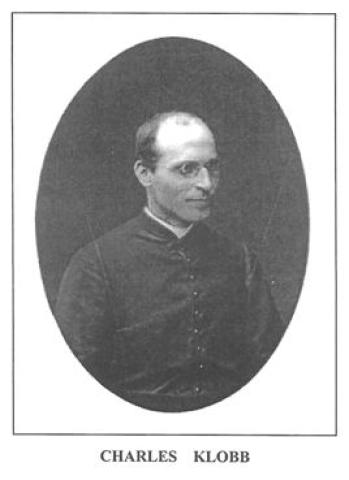
A friend of Father Klobb's told us, “He discovered Father Chaminade and he admired him as a saint.” With reason we might add that he made him known and admired by the entire Society of Mary, so active was the part he played in the writing of the life of the Founder, so great was the zeal he exercised to make clear to the eyes of his amazed brothers the virtues, spirit, and nature of the work of this priest who, at the beginning of the nineteenth century, opened new roads to perfection within the Church.
Father Klobb, in 1899, had been for four years the secretary to Good Father Simler. Reports of Catholic social works, study circles, worker clubs, and rejuvenated conferences of Saint Vincent de Paul arrived before him from all sides. He asked himself whether he, too, should not think of an apostolate. An apostle he had certainly been and was, since his entire life was consecrated to the salvation of souls and edification of his brothers. But he dreamed of a more direct contact with souls, of a more visible influence exercised on lives whose inspiration and guide he might become. He thought of a more profound action that would snatch young men from the delights of a life which was unconsciously egotistical and unfruitful to make of them in turn apostles. “I still do not know,” we read in his notes, “how Mary wants to use me. What I do know is that she wishes me to be, first of all, a perfect religious, then a priest, and an apostle. I do little as an apostle and I have little opportunity to be one.” [1]
He hesitated for several days. Would he direct his efforts to a kind of apostolate for which he “felt himself to have little aptitude” and in which “he had not succeeded up to that day”? Or should he be satisfied with striving to acquire more completely “the characteristic virtues of a Brother of Mary: the spirit of faith, modesty, and affability toward the outside”? As to the second part, he made his decision: “I do not yet feel that I have the strength,” he said humbly, “to reach for the great virtues of an apostolate and renunciation, virtues to which I sense that I should tend more and more.” [2] It was at that very moment that an incident occurred which opened to him the way which he refused to take on his own: the way of apostolate, and of an apostolate within the very bosom of his religious congregation.
For twenty years Good Father Simler had been working at a biography of Father Chaminade, Founder of the Society of Mary. He began his work the very day after the approbation by Pius IX of the constitutive statute of the Society. [3] Directly or through others he had carried on a slow-but-persevering research across all of France. The approbation, at first temporary, then definitive, [4] of the detailed Constitutions as well as the approach of events that were being anticipated and feared, [5] had presented the occasion, eagerly grasped, to move ahead more quickly with the work and to bring it to a successful conclusion.
A first draft already had been finished some months before when a collection of a considerable number of new documents was confided to Father Klobb with a request to review them and to summarize the contents. Father Klobb liked that kind of work. He set himself to the task and studied the material carefully. He presented a report so precise, so clear, so illuminating that the Superior General decided to confide to him the new documents and new research. He was an avid investigator of firsthand sources and a researcher of extreme exactitude for the least details. In touch, both in Rome and in Paris, with outstanding scholars such as Duchesne, [6] Semeria, [7] and Baudrillart, [8] he learned the most rigorous methodology of the professional historian. He gained a licentiate in history [9] and became an excellent professor in the field. Father Klobb in every way justified the confidence placed in him. [10] Besides, his deep love for the Society of Mary and his burning desire to highlight each of the characteristics of the original image that he had glimpsed must have reinforced his natural abilities and attitudes.
He very soon realized the need of a new campaign of discoveries; he gave it all his energy. In November of 1899 he profited by a trip to Spain where he had been sent on visitation of the houses of the Society. He spent several days at Agen, as well as at Auch, Tarbes, and Toulouse, everywhere discovering new documents. He continued his work during the following year in Paris, where he passed entire days deciphering and copying documents preserved in the National Archives. When, in September of 1900, the Good Father decided to take up residence in Bordeaux to complete his work, Father Klobb could write: “The appearance of the life and works of Father Chaminade will produce much good: it will be a revelation. I am working at it unceasingly.” [11]
Their travels took them to Lapeyrouse to visit an orphanage recently confided by Mme Tocque to the Society of Mary. From there, Father Klobb went to Mussidan where Father Chaminade had been successively student, teacher, and very respected superior; then to Périgueux where he had been born. As companion of the Good Father, he returned to Auch and Agen. There he was able to peruse the episcopal archives leisurely while receiving all sorts of useful information from the very learned Canon Brugière, the cleric most learned in the religious affairs of the diocese in the nineteenth century. There he was most cordially received by the superior of the major seminary, Father Lalaguë, [12] and was able to uncover the Casteran papers, replete with information (until then unknown) on Chaminade‟s sojourn in Spain. From Bordeaux, to which he had returned, he once more traveled to Périgueux where a Reverend Chaminade (no relation to the Founder) was able to share with him some interesting information. [13] From there he went to Pessae where he was able to hold and to contemplate at leisure the medal of Lafon, the fourth prefect of the Sodality of Bordeaux. [14]
But it was especially in Bordeaux that his efforts were multiplied. “There is so much more research to be done than anyone had suspected,” he wrote. “I have no idea of when we will come to the end. You cannot imagine what patience it takes to clarify the smallest elements of detail.” [15] He uncovered unedited documents conserved in the archives of the archdiocese that dealt with the most interesting details of the rehabilitation of the constitutional clergy of 1795. [16] In the library of the Madeleine he found new details on Mussidan. [17] From the Procurator of the Republic he obtains authorization to make certified copies of the interrogation submitted to by Father Chaminade in 1830. [18] In between his research in archives and libraries, even in the worst of weather, Father Klobb visited families of former sodalists and descendants of families that had had some relationship with the Founder. He even spoke in the last days of Brother Justin Dumontet, [19] as much as the latter's health permitted. This brother was one of the oldest survivors of the first years of the Society of Mary, and Klobb learned from him many new facts!
The neighborhoods of Bordeaux attracted him. “I also roam around Bordeaux,” he wrote, “patiently gleaning, and sometimes with some profit.” [20] He took great pleasure in evoking memories from the elders and, on his return from these expeditions, he willingly recounted what he had learned from the wonderful old-timers, former sodalists of Father Chaminade: their exclamations of surprise and joy in hearing him speak of their former director, the pleasure they had in showing him a certificate of sodalist, or a medal, or a scapular that he had blessed. What he did not speak of was the profound impression that he himself made everywhere he went, especially in the presbyteries and ecclesiastical meetings which he attended in the hope of awakening some new remembrances. Especially admired were his simplicity, his spirit of mortification, [21] his affability, and his filial curiosity. Others went to these meetings for the pleasure of speaking with him, for he had the gift of evoking conversation, of arousing trust, and of recalling the smallest event. No doubt, if he had been able to do twenty years earlier what he was then doing, he would have uncovered a crowd of witnesses of the greatest interest. But, in 1900, it was too late. [22]
Klobb replenished his strength for this arduous work [23] by frequent visits to the tomb of Father Chaminade. He always found it “decorated with flowers and frequently visited.” [24] “At whatever moment I go there, there are people praying there,” he said to a friend. “May you also pray to him that we might speak well of him.” [25] What he asked of others he no doubt did himself, for he had a kind of feeling of responsibility for souls when thinking of his future readers. We have clear evidence of this in his notes of the retreat of August 1901. “I have done a supremely holy work this year, but I have done it more for me than for you. I sense the imperfection; I see that the good is not the one which you were expecting. What a responsibility, O my God! If this work had been more yours, what fruits might I not expect from it!” [26]
Certainly he wanted to make the biography of the Founder not only a work of edification but also a work of science, as richly documented as the tardy circumstances of its composition might permit. This was especially necessary in view of the strangest rumors, which had never ceased being circulated in certain elements of the Society of Mary, concerning the last years of the Founder. Secretly, some older members recited mysterious and strange stories; nor were they far from suspecting that the authors were seeking to cast a veil over the beginnings of the Society to which there seemed to be attached a kind of impression of false shame. Nor did they hesitate to say that many revelations would come after the fact to contradict the prepared recital and that no one would ever dare to tell the whole truth. [27] It was, therefore, of supreme importance to base everything on the best proofs. “We are all working feverishly at the Vie du P. Chaminade. It is the work of a giant for an old man and an impotent secretary. But, with the grace of God, we shall finish it this winter.” [28] The intent was to present the first fruits to the General Chapter convoked for the month of April. [29]
The writers were lodged in the former chȃteau of Cauderan [30] with a large room facing the park. Innumerable manuscripts were spread out, according to subject matter, on new long tables arranged along a bare wall on which Klobb had fastened a painting representing a group of small chimney sweeps. It reminded him of one of the favored works of the Madeleine. [31] It was now a question of grouping everything and of rearranging everything according to a new outline as required by the abundance of late discoveries and drafting a new text. The earlier draft, in fact, was discarded, and the titles of the new chapters were decided upon. The Good Father wanted to redo the first ones, but he soon decided against this because of excessive fatigue and also to give in to the desires of Father Klobb who wanted a truly historical text [32] with the full apparatus of the many references which it would include. The Good Father had hesitated much on that point for he wished to give his book a marked character of simplicity. But Father Klobb had insisted respectfully, and the Good Father, with complete confidence in him, gave in in the end.
The first chapters were difficult and were written on scrap paper. Father Klobb says of himself: “I sweat blood and water to bring forth a sentence.” [33] Little by little he was content to group the documents by chapters, to sketch the ideas, then develop them and revise as he wrote. Completed chapters were presented to the Good Father. We can image the edifying picture of a man of literary, religious, and social attributes which Simler was, transcribing the manuscript of his secretary in order to present readable copies to the members of the Administration called to give their advice on the proposed text. Those who have carefully read the Vie du P. Chaminade can have some idea of the enormity of the work it supposed: “I am up to my neck in work,” he wrote in March, “and I can only be amazed and thank the holy Virgin and venerated Father Chaminade for having given me during this winter such stamina in my work which I did not have the preceding years. Despite a truly excessive load, I am better than the previous years as to my head and my nerves. Fortunately the first chapters have been completed; but there is still so much to be done between this and the end that I dare not think of it.” [34]
Two points in particular necessitated considerable work. It was necessary, first, to give an exact as well as succinct presentation of Father Chaminade's spiritual doctrine. The sources were multiple and perfuse. They had to be carefully analyzed so as to discover and extract the truly original elements which could be assimilated so as to share in the interior life, ideas, tendencies, dispositions, and spiritual ways of the Founder. This work was conscientiously carried out. But, at the view of such richness, Father Klobb was quickly led to form a project for a complete publication which he set about preparing at that very time. [35]
The second point that occupied the authors for a long time was the history of the last years. A very large folder was composed of exchange correspondence on this matter. Once the matter was clarified it was presented discretely but with full loyalty. Father Klobb wrote to a friend: “The last chapter is a faithful summary of the situation and nothing has been hidden.” [36] And, after having reviewed at length the history of those painful years, he added: “You can see that there is nothing to what imaginations have invented. It was ignorance of the truth of the facts that troubled so many heads.” [37] Those last years had been a trial not unheard of in the history of religious foundations, but it seemed that, in this case, nothing had taken place that was dishonorable either for the Founder or for his successors. This also marked the end of the “mysterious storytellers” to which we alluded before. We can trust Father Klobb's good faith, science, and documentation. We know, of course, that he was never involved, for obvious reasons, in the difficulties which had marked the growth of the Society at its beginnings.
The Vie du P. Chaminade was read to the members of the General Chapter of 1901 and at the annual retreats of France that year. It appeared in print in September with a presenting letter of Cardinal Lecot, archbishop of Bordeaux. After some natural hesitation it was placed on sale to the general public. [38] For the Society of Mary the timing was appropriate: it was the very year of the “Associations,” [39] at the eve of the ruination, judged almost certain, of the works in France. It also was on the eve of the dispersion and secularization of the religious.
This publication was, therefore, considered unanimously as a merciful act of Providence, a new proof of the watchfulness of Mary over her small Society. Even before the storm had exploded, one could see on the waves, already swelling, the plank of salvation. The works of education might disappear under the flood, but the mission of the Society would remain untouched; it would continue under another form. Did it not have a single purpose—form Christians, true Christians? Could not the missionaries of Mary Immaculate attain that end in a thousand different ways? That is the hope which the reading of the biography of their Founder aroused in the hearts of the religious of the Society.
But something else also attracted them, as it had Father Klobb himself during those long months of intimate conversation with Father Chaminade. It was the prodigious intensity of the interior life of that priestly soul, an interior life constantly renewed by ongoing contact with the living sources of the faith and with the love of our Lord Jesus Christ. It was the absolute confidence of the Founder in the resources that regular and continual mental prayer preserve in simple and generous souls. It was the little value he attached to exterior forms and regulations as soon as he saw in them an obstacle to the good to be realized. It was the gentle and persevering effort he devoted to insisting on the interior dispositions and on the unrestricted giving of oneself to God. It was the profound conviction that he had developed of the absolute necessity of having recourse to Mary Immaculate in order to fight victoriously against the resurging heresy of religious indifference. It was the determination to form, for the service of this Queen of Heaven, an elite corps which she could use to achieve her modern victories.
Father Klobb barely had touched the interior life of such a rich soul. He said he had given only a skeleton of the Founder. So, pressured by the very demands of the work undertaken and requested from all sides, he decided from that moment to do better and to do more. The first edition of the Vie du P. Chaminade was still at the press when he already was preparing a second one. There is, in fact, a draft, completely covered with erasures, corrections, and enrichment from new discoveries. [40] He asks for feedback: “Thanks for the corrections that you have had the kindness to indicate to me. There are certainly many others to be made. I take note of them as I uncover them.” [41] But he was preparing himself to give even more. “This winter,” he confided to a friend as early as November 1901, “we shall try to publish the writings of Father Chaminade if we should have the leisure. There would be material for one or two volumes depending on how much we want to publish.” [42] He added: “I also will do whatever is possible to publish some complementary biographies of the first religious of the Society. [43] I am right now assembling materials for those particular works.” [44]
In December he wrote the following: “I am busy this winter preparing the publication of the letters and writings of Father Chaminade. It would be the needed complement to the Vie.” Alas, he had to stop with the preparations. The forced exile of 1903, the numerous trips to Spain, Italy, Switzerland, Germany, Belgium, and Holland imposed on him in order to care for the interests of the Society, the death of Good Father Simler, and his own election to the position of Second Assistant [45] prevented him from bringing to term the dreamed-of work. At the end of May 1905 he wrote, as he had in December 1901, “I continue to prepare the publication of the letters and writings of Father Chaminade.” [46] And he added, sorrowfully, in April: “As to my work, it is a lengthy one and God knows when I shall reach the end. I do not yet work on it consistently.” [47]
Let us point out briefly the status of these works. Father Klobb could not study the origins of the Society of Mary as he had without having numerous occasions to meet the kind and energetic person of Mlle Adèle de Trenquelléon, foundress, under the direction and the eye of Father Chaminade, of the Institute of the Daughters of Mary. A biography of this venerated mother had appeared in 1861 under the signature of a Benedictine of the Congrégation de France (Dom Jean-Baptiste Pradié). [48] Besides the fact that the edition was out of print, Father Klobb had not been able to find in it a reliable figure of this privileged daughter of the Founder. He quickly decided to do that work. Innumerable unedited documents facilitated the task. This person, so simple, so elevated, so devoted to God's interests, so disinterested, and so desirous of making apostles of each of the children confided to her without their even suspecting it, had aroused in his soul a true admiration. [49] Did he not confide to Mme Mauriez that he cherished the hope of seeing the cause of Mother Adèle introduced into the Roman Court? He was certain it would move forward without any difficulty.
The biography of Adèle, entirely rewritten, was almost complete. In February of 1902 he had the manuscript read by one of the Daughters. [50] “After reading it,” Mother M[auriez] recalls, “he wanted my impression. I gave it in all simplicity. You have taken, I said, the best parts of this beautiful life, and, it seems to me, the division of chapters could not have been better made. There remains, though, quite a work of revision, for there are a great number of useless repetitions from the writings of the Good Mother that might weary the reader. With what a fine smile he responded to my observation! You will help me in the new work, he replied. But, alas! the Lord had counted the days of his faithful servant.”
At the same time Father Klobb had most energetically pushed two other works. The one was a simple Recueil des lettres of the Venerated Founder, published in chronological order, [51] briefly annotated and followed by a detailed and very useful analytical table. The other, in his thought, was destined to highlight the spiritual riches scattered about and somewhat loosely contained in the letters. Innumerable texts were extracted from Father Chaminade's correspondence and then grouped in a logical order in such a way as to emphasize the Founder's true thought on the organization, end, means of apostolate, and spirit of the Society of Mary. In this work, completely objective in what it presents without any addition and without any commentary, the ideas of Father Chaminade acquire a worth all the greater because of the idea which determined the arrangement of these citations. As the short preface dedicated to the reader puts it: “not forgetting that a society is a living being which, in its development, manifests the true nature contained in its germ. This work will take notice of the later history of the Society to bring out the worth, without ever altering them, of the conceptions of the Founder and to indicate their relationship to later events and situations.” [52]
This work was to complete, by developing them, the too-succinct teachings provided in the Vie du P. Chaminade (chapters 23, 25, and 26) on the nature of the new foundation, the doctrine of the Founder, and the formation of the religious. It has as title Les enseignements du Fondateur par rapport à la Société et à son esprit. [53] It was ready for the printers.
Finally, under the title Extraits méthodiques de la correspondance du B. P. Chaminade, [54] we have, with the precise indications of Father Klobb, a collection that would be of incomparable usefulness to preachers and directors of the Society of Mary. On innumerable slips of paper Father Klobb had noted, with admirable perseverance, in the midst of his discoveries, references which permit one to find in the writings of the Founder his thought on the religious life, on authority, on piety, on salvation, on prayer, on the will of God, on peace of the soul, on humility, etc. He himself had extracted all the texts to which they refer, and the work moved ahead quickly.
All these works, awaited with impatience, would not fail—we have every reason to believe—to see the light of day and to furnish to the members of the little Society of Mary the sane and abundant nourishment which the recent events had caused them to desire so fervently. [55]
Is it now necessary to emphasize the spirit which inspired these works to the dear departed? Should we have any hesitations on this subject, the following wishes would suffice to cause them to vanish. They are from the annual retreat of 1901; [56] they show, once more, the jealous care which this delicate soul took not to take anything away from grace. “For whom have I worked?” he wondered when thinking of the Vie du P. Chaminade. “If I had worked only for God, I would have had, I would still have now, concern for the judgment of men and, doing a divine work, writing the life of a saint, [57] I would have acted like a saint with the detachment that was preached so strongly by my subject. Instead of that, a wholly human manner of doing and of thinking; and was it not reflected in my work itself, deprived of this vivifying divine breath with which God would have surrounded it if the work had been his?”
Does not this reproach which he addresses to himself point to a too great concern for the historical tone, though still judging it indispensable? [58] We see in those lines the tenacious preoccupation of this soul so avid for perfection: pursuing self-love to its deepest core, never allowing it the least respite, begging God to destroy even its least traces so that he alone might be in the forefront and glorified! “I humbly ask your pardon, O my God. It was a unique opportunity which you offered me both to sanctify myself through contact with so much holiness, and to sanctify others in exposing them to the same virtues. I have seen in it only my miserable self-love, reducing all things to the level of my pettiness. Pardon, O my God!” [59] This complete distrust of himself, this perfect awareness which he now had of the origins of the Society and of the true spirit of the Founder, enabled Father Klobb to play, in his religious congregation, the role of a true apostle.
Many religious orders, in the course of centuries, had had the need of reforms, of transformations, or, at least, of adaptations to new circumstances. The Society of Mary, after forty-eight years of existence, saw itself, on the contrary, in the need, under pain of death, of returning purely and simply to the spirit of its foundation, so well had its Founder intuited the needs of the modern world after the shocks of the French Revolution! Father Klobb understood that. The law on the Associations had just been voted by the French Chamber on July 1, 1901. The facts, easily enough to foresee, developed quickly in 1903. On March 18, the Chamber of Deputies refused legal authorization to thirteen teaching congregations, among which was the Society of Mary. On April 1 this refusal was officially communicated by M. Emile Combes, first minister, to the motherhouses of those congregations. A decree, signed by the President of the Republic on April 9, annulled all royal authorizations and any others that had been granted in good and due form, and whose validity and legality had, until then, not been questioned by anyone, including the Third Republic. [60]
On April 17, after a final ordination of deacons and priests made in the chapel of the General Administration of Paris amidst the turmoil of a hasty move, the Superior General of the Society of Mary and his personal secretary took the train into exile. They sought residence in Nivelles, in the hospitable land of Belgium. We must add that the material ruin in France was total: the Society of Mary, having exhausted all appeals, was defeated at every point and, definitively, on December 6, 1905 by a binding decision of the Court of Final Recourse. Ninety-six houses were closed, including elementary and secondary schools and Collège Stanislas {Paris}. The religious were expelled from their residences to wander on the streets or to go into exile. Some were of an age when they might have laid claim to a calm and well-earned retirement.
But nothing could disturb Father Klobb. In 1900 he had seen clearly the Masonic plot taking shape against the religious congregations. [61] He had said, in 1902, that we were on the brink of the most serious disasters. [62] And now, when one catastrophe followed another, all his letters were filled with a comforting and viral trust in the future of his dear congregation:
I do not know, but I cannot believe that the year will be bad for us. It will be terrible, perhaps, because of the ruins that it accumulates. But the crisis is forceful, unavoidable. In every age of the Church the envoy of God must disengage himself from the mud of the street to resume his march forward, purer and lighter. And what I am saying of the Church is true of the Society which was falling asleep in its indifference and forgetfulness of its apostolic mission. The shock will be salutary. Perhaps we shall perish as the first witnesses of the crisis but after us others will brandish the muskets and will multiply in Mary's camp. [63]
He clearly saw that “the crime has been carried out to its end.” [64] On August 4 he wrote: “The horizon is extremely somber as to France, and the tempest will not be as temporary as some think. All our works will be systematically destroyed, and the hope of reconstructing them is only in the far distance.” [65] In the same month he pointed out the first results of the storm. “Many have defected from us. They have fallen, or soon will fall, like dead leaves. The greater number is faithful, and many are facing the test courageously.” [66] Five months later he returned to those defectors. The seduction of wealth and worldly pleasures have attracted many hesitant souls and many of limited generosity. Yet, he rejoiced in all this.
My God! how the persecution has shed light on the true worth of men! How much they show themselves for what they are! There have been many defections. A very small number had astonished the people who knew them. The half-religious, the sensual ones, those who had compromised with poverty and the Rule, the malcontents—these, or almost all of them, have been “good-riddance.” No one regrets their leaving. How right was Fonsegrive in his article of November 1, 1903 (La Quinzaine) when he said that ten resolute men were worth more than a thousand hesitant ones! The Society gains in valor what it loses in numbers; and in the subsisting houses or new ones, there is an intensity of religious life that is truly remarkable. [67]
Is there not, in these stirring words, an echo of the supplications of Father Chaminade to Brother Clouzet: “My dear son, let us not be religious by halves. Such religious finish by not being religious at all. Even if they were religious by three quarters and a half, they could scarcely hope for heaven because only the just enter there, and just is synonymous with saint.” [68]
All his activity from then on, in the areas where he was given to exercise it, would be inspired by this single desire: to bring his brothers closer to the Founder, to reveal to them the interior life which animated him, to resituate them in some way in the circumstances in which the Society was born, and to have them become more truly aware of the importance and the necessity of their special form of apostolate. It was to transform them into apostles. “A small kernel of apostles is worth more than a legion of people without energy,” [69] he wrote with conviction. He repeated: “I am every day more and more convinced of the indispensable need of an intense flame of personal and religious life in each one of the apostles which the religious of Mary ought to be. What will our zeal be in the future? It is the personal valor of the members that will determine it, for the good direction of the body, no doubt an indispensable element, will be assured by the fact that the body will be composed of individuals each having his own valor.” [70]
We have passed quickly over the years 1901 and 1902 on purpose. Those years, as we said earlier, were not fruitless . . . far from it! But we wanted to place in clear evidence the good that unites—on the one hand, the vigorous language which we have just heard falling from the lips of Father Klobb and his so-clear understanding of the lessons of persecution—with, on the other, the long and intimate conversation he had held with the Founder. Would he have spoken in this way if he himself had not drawn deeply from that source of supernatural light and ardent generosity? Certainly not. The hesitations of 1899 had begun to disappear in 1901; there are no traces left at the moment the tempest burst forth in 1903.
That year marked a new step in his life. Circumstances (where he recognized, as always, the hand of Providence) will push him onto a more vast stage and will permit him to exercise an ever more profound influence. He contributed, first of all, by a minor but real part, in the reorganization of the seminary of the Society. It had been forced to transport itself, in its turn, into a foreign land. [71] But it was especially in Spain that he had to become quite closely involved in the reorganization of studies. In October of 1903, Good Father Simler went to Escoriaza, to flee, on orders of his doctor, the fogs of the north. Father Klobb followed him there. The scholasticate of the Province of Midi had been transferred there, and the novitiate had been joined to the novitiate of Spain, at Vitoria. These changes required a readjustment of the programs of studies. All set to work. Father Klobb was called to all the council meetings, and the Superior General often commissioned him to prepare the subjects to be treated. He attracted the attention of everyone by the amplitude of his personal views and by the clarity of his presentation. He became, consequently, aware of the status of studies and of the worth of the methods employed in that country. [72] His curiosity was aroused.
Sent to Madrid to investigate the possibility of a foundation there, he profited by the occasion to pay visits to important members of society and to study at close-hand Spanish ideas and customs. He returned enchanted. “Spain has very powerful energies. In order to be given true value they need only a political, intellectual, and social organization able to utilize them. Intelligence is not lacking, and most of the persons we have seen have a very clear and very just idea of the needs of the country as well as the general aspirations of our day.” [73] From the very first moments of this investigation, [74] he understood that the Society of Mary would be, “if it please God, for Spain a useful instrument of regeneration. We have a very special role in Spain: progress is invading the country and our congregation, young and without prejudices, takes part in it more easily than the older works and loyalties to antiquated systems.” [75] A little later he added, “Spain is for us a province of the future.” [76] But, on one condition: “That we have strong personalities, and only at that price.” [77] He therefore pressed with all his strength for the introduction of obligatory Latin for all the postulants and all the scholastics. He willingly gave in to the desire of the young brothers (whom he quickly won over by learning their language) to be directed by him in their personal work of contemporary languages, history, and philosophy.
Was it possible for him not to take an interest in the novitiate of Vitoria? He therefore had long discussions with the brother-master in which he exposed the ideas he had long cherished on the awareness the religious ought to have on the social role of the religious life. He said: “Many religious do not have a proper idea of the religious state. They are not aware of the influence it has exerted over the centuries on the movements of human societies. They are ignorant of its glorious and good deeds; they do not know the geniuses who have illuminated the cloisters. All that must be taught to the novices so as to make them aware of their social function and also, at the same time, to help them know and esteem the marvelous adaptation of their own congregation to the exigencies of the modern world.” And, emphasizing his words with action, he drew up an analytical summary of L’histoire de la vie monastique à travers les siècles [78] for the brother-master and the novices.
Another course also drew his attention, that of the interior life. He would have preferred, instead of an abstract exposition of the directive principles of the spiritual and supernatural life, a living illustration of the nature and power of that life. The novice master was content with having the novices read, comment, and study the first two books and some chapters of the third book of the Imitation of Christ. He expanded this theoretical teaching with specific examples taken from biographies of saints. That was a work, he said, which demanded many books and many hours, but which would have for result the fashioning of modern apostles in contact with authentic apostles of times passed. It was a great idea whose fruits he was not permitted to see! But he did succeed in having the Gospel put into the hands of the novices, and he applauded wholeheartedly the project of the formation of study circles on socioreligious themes.
He had to leave that province, for which he had developed a great affection because it was rich in all sorts of promise. He returned to Belgium with Good Father Simler whose health had been restored. Near Nivelles he found a new opportunity to continue his internal apostolate. The former novitiate of Ris-Orangis had been transported, in October 1903, to Monstreux under the wings of the General Administration. Alsatians, Belgians, Swiss, and a few French formed there a greatly reduced contingent where the Province of the North was thereafter to find its recruits. It is easy to understand with what jealous care this nest was surrounded from its origin. The times were over when the months of the novitiate, such as Father Klobb himself had known them, passed peacefully without any serious worry for tomorrow. What the rejuvenated Society of Mary needed was some wide-awake and ardent young men who would be “the useful instruments of regeneration.” [79] What was needed were young men gifted with a sense of the future and with an understanding of the transformations that were taking place around them, [80] They not only had to be “quite open and well penetrated with enthusiasm for their future mission” [81] but also overflowing with abundant vitality and with a strong interior life, with a life with Jesus known and loved as the best of friends. They were too proud to see themselves enrolled under the standard of the Immaculate Virgin to fight against the reigning heresy of religious indifference.
Father Klobb had loved the novices of Vitoria; he loved the novices of Monstreux. In both places he was loved in return. But now he was closer; he could give more abundantly. And he did. Would he not travel for the future of his dear Society? He, therefore, took upon himself the pleasant obligation of going every month to preach the monthly retreat at Novitiate Sainte Anne. Such days were feasts for the novices. They awaited their preacher with impatience; they welcomed his arrival with joy; they listened to him with avidity for, despite violent headaches, Father Klobb spoke. Listening to him, one might say that his word, rapid and warm, without any embellishment, seemed to him too slow in communicating the strong convictions which animated him.
Conferences and private conversations infallibly dealt with the spirit of the Society of Mary such as Father Chaminade had conceived it, such as his ardent apostle saw it being rejuvenated for new wars. He obtained from the novice master, his close friend, the resumption of Mariology adapted to the Society of Mary. He suggested and favored the establishment of study circles where social, religious, ascetical, or pedagogical questions could be studied one after the other and discussed by the novices. He was happy to preside, from time to time, at the small cenacles where, under the direction of the novice master, a very complete exposition of a topic was presented: on devotion to the Blessed Virgin and on the meaning of the consecration when taking the vow of stability. [82] He advised, as at Vitoria, the introduction of the reading of the Gospel text, assuring that through this direct contact with the person of our Lord Jesus Christ the piety of the novices could only be enflamed.
The ideas which animated Father Klobb in these efforts of internal apostolate took on progressively a more precise form in his thought. They had maturated when the opportunity presented itself to express them publicly in two documents of which we must give some indication.
The first is a note which was asked of him by the General Administration in April 1904 “on the present mission of the Society of Mary and the means to realize it.” [83] The second is an article given to the Apôtre [de Marie] and reedited on his initiative in 1904 [84] under the title of Spes nostra. These two writings are alive with youthful experience and confident enthusiasm for the future hopes of the Society of Mary. Let us listen to the beginning of this article: is it not a song of triumph?
In springtime, when the grain is germinating, the laborer passes through the fragile plants with his heavy wooden roller. It is thus that the divine laborer comes to our brothers in France, and to all of us with them, to pass the weighty instrument of his designs over them. Designs of life, or of death? of goodness, or of anger? A question fraught with anguish, tormenting many souls who have sought far off the answers that, in fact, are very nearby. Let us see, rather, what the peasant's roller does as it passes by: it packs the soil disturbed by the frosts; it presses the roots into the living soil; it gives them support, nourishment, fecundity. And we, likewise, were formerly plants disturbed and flogged, bending head down under the blows of trials. For a moment we had turned in upon ourselves. But we already have found ourselves shaken out of our languor and reanimated by the sap of springtime. We seem to hear a voice murmuring near us: see the fields already green and promising only distant harvests.
Well, I say to you: open your eyes and you will see that they are already ready for the harvest. And we have heard the voice of our Mother, the voice of Mary, and we have risen better and stronger.
Then, in seven pages too short for the marveling reader, [85] the secretary of the Good Father showed how the history of the Society of Mary had been simply a weave of the gifts of the Immaculate Virgin for her children. He then explained the reasons for his unshakeable trust in Mary. He ended with these words: “To you then, O Mary, the homage of our strength, of our life, of our very selves. Under your auspices we shall fight; under your auspices we shall win: Spes nostra, salve.” [86]
He declared the following at the beginning of the note cited above:
[T]he work of the Society is not compromised; on the contrary, the persecution and the present problems themselves reveal the hand of Providence on us: a shock which we needed to reanimate ourselves in the spirit of our vocation. A comfortable lifestyle had invaded some houses; poverty was menaced by the too-human confidence that we were tempted to place in the resources coming from Stanislas; even the houses of formation lived too well. In short, the religious and apostolic sense were declining in France without anyone being able to indicate a specific remedy. The present crisis is the remedy adapted and proportioned to the evil. There can only come from it a good for the totality of the Society.
The Society, then, is in no way disarmed in the face of the new manifestations of the anti-Christian spirit. Far from it: the arms which our Founder has left us seem, on the contrary, to have been forged precisely in view of today's struggles. We possess three kinds of advantage marvelously adapted to the present needs: 1) the apostolate of the laity which responds exactly to the anticlerical tendency of our time and supplies for the inefficaciousness of the role of the priest in a great number of places; 2) the absence of monastic symbols in our dress, names, practices, and in the very spirit that animates us, and extreme ease for penetrating everywhere, even in those milieus where prejudices have taken the deepest roots; 3) the pliability of our works, an incomparable resource that permits us to diversify our action depending on the places and the times, and to attain our end despite changes of external circumstances. These three characteristics, stamped by a reflective will of the Founder onto the apostolate of the Society of Mary, assure us of a superiority over most of the present congregations, with a view to the conquest of souls to the faith.
But, Father Klobb immediately added, “they create for us, at the same time, a heavy responsibility.” We must determine how to resolutely escape the educational circle into which we have confined ourselves too extensively [87]; how to lessen the exterior signs of the congregation where they have become too characteristic [88]; how to draw a greater good from our composition which is nine-tenth lay, and from our ability to adapt to all milieus.
The first thing necessary, then, was to assure for the members of the Society, more and better than ever before, the needed energies. In the first novitiate, with reworked programs, they would be initiated into a personal and intensive form of religious life. Then, there would be a second novitiate. It would have to be created and should be close to the major superiors. There, six months before their perpetual profession, all those who would commit themselves forever to the service of Mary Immaculate would come together from all parts of Europe.
What has paralyzed many works and discouraged many good volunteers is the toleration given for months and even years to two sorts of failings, both serious and destructive of religious life and any apostolic fruitfulness: criticisms on one side, and neglect of religious exercises on the other. Good religious must know that the Rule will always be protected and defended by the superiors. All religious also must know that they will be constantly supported in the accomplishment of their personal duties and that they will find in the superiors a source of support against temptations to relaxation, as well as against those to discouragement.
With religious formation better assured, thought also must be given to raising the intellectual level:
Science is the refuge and the highway of unbelief. Our role is to penetrate into it and to install ourselves there as solidly as our adversaries. In order to do that, we need to strength our system of studies by having the postulants, without distinction, participate in the advantages of secondary studies. All should study the language of the country, the sciences, contemporary languages, and Latin. General culture would gain by that, and specializations in primary, commercial, or secondary studies would not at all suffer as a result. Far from that; it would be to their benefit. The scholasticate would be in common for two years. Then, after some years of active life and after the second novitiate, for example, the more gifted would complete their formation. The religious instruction of the lay members also would complete its course.
The child, more than ever in our day, must not be satisfied with a routine teaching. If he does not live his religion, if he does not know how to defend his belief by a continual reaction against objections and influences of the milieu, he will be lost to the Church. But, how are we to communicate an active and enlightened faith if we do not possess it ourselves? A very promising initiative in Spain, inspired, in fact, by America, has created for that Province a diploma of religious instruction to be conferred by a special commission. It provides a rather extensive culture that comprises, besides dogma, morality, and liturgy, precise notions on Sacred Scripture, on general and national history of the Church, and on apologetics. It would be good to have this edifice founded on a philosophical basis, however rudimentary it might be, for the religious who will not have had it before. Such an institution could become general with great advantage. The studies of the second novitiate would render its realization easier.
We can no longer remain strangers to commercial instruction; it would be for us a powerful means of influencing the present social circles. Night schools and worker clubs are equally apostolic instruments that have become indispensable. Finally, social works call on us from all sides, but we are very little prepared for them. A certain number of good volunteers should be oriented in that direction.
This remarkable text was given serious consideration in high places, and it contributed to the constantly increasing worth accorded to Father Klobb. He became, certainly without wanting it, the sought after and listened to advisor. That was because, with his natural good sense and his sharp perspicacity he had gone immediately to the root of the insufficiencies revealed by the persecution. He had compared the present reality with the ideal contemplated and unceasingly studied with the Founder. Above all, after many years of hesitation, obscure efforts, and a life hidden in God, he had found his niche. Within the limits laid out by obedience, he had felt himself charged by God and by Mary with a mission to which he would thereafter sacrifice his life: the mission to make the spirit of Father Chaminade alive again in the heart of his sons.
Sources & Notes:
- {The footnotes to this work are from Ambrogio Albano, SM.} Personal notes of the annual retreat of 1899 made from June 27 to July 4 at Bellevue (AGMAR, 187.4.2, p. 12).
- Notes from the same retreat (AGMAR, 187.4.2, p. 15).
- Pope Pius IX, Breve quo Societas Mariae approbatur et confirmatur, Aug. 11, 1865.
- July 10, 1891.
- Separation of Church and State, secularization of religious, spoliation of religious properties, etc.
- Duchesne, Louis (1843-1922), director of the French School in Rome. Author of a Histoire ancienne de l’Eglise, which became normative in that field.
- Semeria, Giovanni (1867-1931), Barnabite scholar, author of Dogme, hierarchie et culte dans l’Eglise primitive.
- Baudrillart, Alfred (1859-1942). In 1909 he was named rector of the Institut Catholique of Paris. His work, among others: L’Eglise catholique, la Renaissance, le Protestantisme et Quatre cents ans de Concordat [1904]. He continued as rector of the Institut from 1907 {1909?} to 1942.
- At the faculty of letters of the University of Bordeaux, July 30, 1889. See his diploma at AGMAR, Klobb, RSM19.
- Klobb was very conscious of these providential preparations: “God prepared me for my duties; he wanted me to be apt for works relative to Father Chaminade,” he wrote in December 1905, on board the Polynesian on route to Japan (AGMAR, 188.1.45).
- Letter to Father Maurice, Sept. 10, 1900 (AGMAR, 187.2.69.10). He added: “Unfortunately I have little good health and I find the work very tiring.” But his health continued adequate during that winter.
- He sent him, in gratitude, the Vie de M. de Lagarde. Lalaguë graciously offered to send him copies of any documents he would indicate.
- Like all true researchers, Klobb had a sometimes happy hand. During this trip to Périgueux, he had been taken by a guide to the archives of the town. In an attic he found himself in the presence of a stack of old papers, bundled, but with no special order to them; the documents he was seeking were somewhere in there. But how to find them? Without hesitation, he went to work. He bent down just where he was, grasped at random the first bundle at hand, opened it; it was just what he was looking for. The archivist was totally dumbfounded!
- This medal is described in the Vie du P. Chaminade (p. 197, note 2). We cite this example to show with what devotion Klobb collected the least traces of the Founder.
- Letter of Nov. 8, 1900, to Father Maurice (AGMAR, 197.2.69.11).
- Used in chap. 5 of the Vie du P. Chaminade. See pp. 62-81, and the note on p. 64.
- See AGMAR, 11.14.1-52.
- See AGMAR, 12.10.81.
- See AGMAR, 17.4.196; 17.4.294-300.
- Letter of Nov. 8, 1900, to Father Maurice (AGMAR, 187.2.69.11).
- The pastors apparently found him very frugal; they named him “the priest who does not eat.”
- By then most witnesses had died.
- Letter of Nov. 8, 1900, to Father Maurice (AGMAR, 187.2.69,11), “I am the only one actually working at this, the Good Father being busy with his text.” It will soon become clear that the work on the final text also will fall to him.
- Ibid.
- Ibid.
- Personal notes from the annual retreat of 1901 (AGMAR, 187.4.3).
- See the report read by the Superior General, Father Joseph Simler, at the General Chapter, May 28, 1896 (AGMAR, 56.2.5).
- Letter of Dec. 12, 1900, to Father Maurice. This letter has not been found in AGMAR.
- This General Chapter met at Antony Apr. 10-20, 1901.
- The commune of Gironde which was attached to Bordeaux in 1964.
- On the work of the chimney sweeps, also known as “little Savoyards,” see AGMAR, 46.6.1-13, 46.7.1-45.
- Klobb did not think himself really ready to write immediately a new work of such length. He would have preferred to meditate it at leisure; he also wanted to develop his style by studying some notable authors. Cardinal Lavigerie would have been his preferred model for the stylistic form.
- Letter of Mar. 14, 1905, to Father Coulon (AGMAR, 187.2.92.24). He said that with regard to the notice on Father Simler that he might have been asked to write. It must have been even truer in 1901.
- Undated letter, probably of March 1901, to Father Maurice (AGMAR, 187.2.69.13).
- Aperçu des documents concernant les ensignements de notre vénéré Fondateur (AGMAR, 20.59.1).
- Letter of Feb. 20, 1902, to Father Maurice (AGMAR, 197.2.69.16).
- Ibid.
- Joseph Simler, Guillaume-Joseph Chaminade, fondateur de la Société de Marie et de l’Institut des Filles de Marie, ed. Féret, Bordeaux, 1901. In our text here it is referred to simply as Vie du P. Chaminade.
- The law of Apr. 1, 1901, presented a statute on diverse associations, of which only a small minority were granted juridical personality.
- It is preserved in the workroom of AGMAR. On the back, in addition to the author and the title, there are written the words: “Notes. Suppléments. Rectifications.”
- Letter of Feb. 20, 1902, to Father Maurice (AGMAR, 187.2.69.16).
- Letter of Nov. 6, 1901, to Father Maurice (AGMAR, 187.2.69.14). He was alluding, no doubt to possible surprises of the revolution.
- He was thinking especially and above all of a life of Father Lalanne, which had not yet been written. It was Father Pierre Humbertclaude who wrote it in 1932: Un éducateur Chrétien de la jeunesse, l’abbé Lalanne (1795-1879), Bloud/Gay, Paris.
- Letter of Nov. 6, 1901, to Father Maurice (AGMAR, 187.2.69.14).
- By the General Chapter of Rèves, Aug. 1-10, 1905.
- Letter of Mar. 14, 1905, to Father Coulon (AGMAR, 187.2.92.24). {March? or May? The text favors March; the AGMAR references would favor May.}
- Letter of Apr. 17, 1905, to Father Coulon (AGMAR, 187.2.92.19).
- Vie de la révérande mère De Trenquelléon, fondatrice et première supérieure de l’Institut des Filles de Marie, avec ses avis spirituels et ses lettres. Poitiers/Paris, 1861, p. 388 (AGMAR, 35.7.7).
- “Little by little, as I enter into the life of this worthy Foundress, he told me the other day, I am passionate for this work. He therefore wasted no time in presenting the characteristic traits of our admirable Mother de Trenquelléon: her devotion to Mary, her supernatural spirit, her overwhelming zeal, her exquisite charity—all touched him deeply. … He took pleasure in invoking her and had great confidence in her credit with God.” Testimony of Mother … (the note is incomplete, but the rest of the text makes it clear that it is from Mother Marie-Mechtilde Pouilth, called, during the period of secularization, Mme Mauriez, her mother‟s name).
- Adèle de Trenquelléon, nouvelle edition entièrement refondue par M. l’abbé Klobb. The 716 pages are all handwritten by Klobb (AGMAR, 35.5.1.1-34).
- Klobb had drawn up a complete catalog (AGMAR, 191.1.1-3) indicating, for each of them, the point of departure, the date, the location of the recipient, the kind of manuscript (original or copy), the genre of the writing (autograph or dictated), the place where it is preserved, and the principal subject matter of the letter. This first catalog was complemented by a second (AGMAR, 191.1.1-21, 192.2.1-31), which lists all the proper names mentioned in Chaminade‟s letters, with the pertinent referrals; and by a third (AGMAR, 192.3.1-15) analog to the second for the names of establishments of the Society of Mary.
- Les enseignements du Fondateur par rapport à la Société et à son esprit (AGMAR, 1100.33).
- AGMAR, 1100.33.
- AGMAR, 181.2.1-6.
- These works are still unedited today, 1999.
- AGMAR 187.4.3. That retreat took place in Paris, from Aug. 30 to Sept. 5, 1901.
- In employing this word, and, below, the word “holiness” with regard to Chaminade, Klobb certainly did not mean to express any prior judgment to the authority of the Church (see the preface of the Vie du P. Chaminade).
- At the beginning of chapter 1 of the Vie, in the copy annotated in his hand, Klobb wrote: “Several readers have found the erudition exaggerated in this book.” This did not prevent him from covering this copy with notes and new precisions! The need of serious documentation always carried the day.
- Personal notes of the annual retreat of the month of August 1901 (AGMAR, 187.4.3). That retreat took place in Paris, from Aug. 30 to Sep. 5, 1901.
- The Society of Mary, founded in Bordeaux in 1817, had been recognized as of public usefulness in 1825 (Vie du P. Chaminade, pp. 540-69). It had civil statutes and enjoyed the rights of civil personality which no one, until then, had ever thought to challenge.
- Letter of Dec. 12, 1900, to Father Maurice (AGMAR, 187.2.69.12): “We await with anxiety the developments in France. The Freemasonry has sworn the death of the congregations and, humanly speaking, I do not see what can be done to save ourselves. The ministry has in the Chamber a servile majority that will follow it anywhere.”
- Letter of Nov. 9, 1902, to M. Leclerc (AGMAR, 187.2.56.9): “I recommend to your good prayers the fate of Christian education in France. We are on the brink of the most serious disasters. They do not know what they are doing!”
- Letter of Jan. 10, 1903, to Father Maurice (AGMAR, 187.2.69.18).
- Letter of Apr. 24, 1903, to M. Leclere (AGMAR, 187.2.56.17).
- Letter of Aug. 4, 1903, to Father Sutter (AGMAR, 187.2.93.2).
- Letter of Aug. 19, 1903, to Father Maurice (AGMAR, 187.2.69.19).
- Letter of Nov. 7, 1903, to Father Maurice (AGMAR, l87.2.69.20).
- Letter of Sept. 21,1838, to Brother Clouzet. See Retraite de Fayt (AGMAR, 188.2.2, p. 21).
- Letter of Dec. 10,1903, to Father Maurice (AGMAR, 187.2.69.21).
- Letter of June 18, 1904, to Father Coulon (AGMAR, 187.2.92.11). The “body” is the structure of the religious congregation.
- To Fribourg in Switzerland.
- He found that the Society of Mary had made progress in Spain since his previous visit of 1899: “Spain, where I now am, has made enormous progress since 1899 {not 1879, as in Albano}, when I visited it for the first time. There is a kernel of solid elements which has replaced the moving sands of the first days; all the houses are therefore in good shape.” Letter of Nov. 7, 1903, to Father Maurice (AGMAR, 187.2.69.20).
- Letter of Nov. 7, 1903, to Father Coulon (AGMAR, 187.2.92.7).
- “The short stay he made in Spain was sufficient for him to form a remarkably exact idea of the social condition of that country from which he expected much.” Note of Francisco Martinez.
- Letter of Nov. 7, 1903, to Father Maurice (AGMAR, 187.2.69.20).
- Letter of Jan. 22, 1904, to Father Coulon (AGMAR, 187.2.92.9).
- Letter of Nov. 7, 1903, to Father Coulon (AGMAR, 187.2.92.7).
- AGMAR, KLOBB, RSM91.
- Letter of Nov. 7, 1903, to Father Coulon (AGMAR, 187.2.92.7).
- Expressions drawn from the report on the Hawaiian Islands given by Klobb to the General Administration (AGMAR, 188.1.23, 188.1.27).
- Letter of Feb. 21, 1906, to Father Rauch (AGMAR, 187.2.47).
- These conferences produced a Traité succint de la dévotion à la sainte Vierge. This tract has two parts: on devotion to Mary in general; on devotion to Mary in the Society of Mary. This was the most complete work among us of that kind. Unfortunately the tract cannot be found in AGMAR.
- This note (AGMAR, 188.3.3) was studied and adopted by the General Administration in April of 1904.
- Between 1889 and 1902 this magazine had been named Le Messager de la Société de Marie.
- Marveling, despite the judgment the author himself made of this writing, “I have, for the Apôtre, an article with which I am most dissatisfied.” Letter of May 14, 1904, to Father Coulon (AGMAR, 187.2.92.10).
- See Apôtre de Marie, May-June 1904, p. 6. The article is signed XX.
- Klobb admitted that this confinement also had its good points: “You have every good reason to believe that our Founder did not want us to be exclusively restricted to schools. We are beginning to understand that and to sense it. The hour is not far off when education properly so-called will escape us in part. We would do well, then, to use other means for attaining our end. However, we must not too easily cast a stone at our predecessors. I may perhaps be mistaken, but I believe it is by a special providence for us that we have remained so housebound until we found our true place. With important external works, matters would not have been so easily arranged, and schisms might have arisen. As it was, the unity of thought and action has been better preserved, and we have felt ourselves stronger in the storm. Now, we can think of other things and expand our horizons.” Letter of Feb. 20, 1902, to Father Maurice (AGMAR, 187.2.69.16).
- “Our costume was given us with the clearly determined purpose of not attracting the attention of the world. Does it realize that end? I would be led to doubt it when, while walking through a town where we are not known, with a religious who is clearly wearing our costume, I find that people stop politely to let him pass; or when I hear the pastor of Cuesmes cry out: „Oh, if you have chosen this costume so as not to be noticed, you have certainly not succeeded!‟ It would be enough to require great simplicity and perfect modesty, joined to an irreproachable cleanliness.” Note of April 1904 (AGMAR, 187.4.8).