
Click here for a downloadable PDF version of this book.
Introduction
Three religious congregations in the Catholic Church bear the proud title of Society of Mary, and they are not always clearly differentiated in the popular mind. The source of confusion lies not only in the similarity of names but also in the fact that all three organizations originated in France and at virtually the same time. The Society of Mary of Lyons was established in 1816 by Father John Claude Colin; composed of both priests and brothers, its members are known as Marists. The following year, at Lavalla, Father Benedict Marcellin Champagnat organized an association called the Marist Brothers or Little Brothers of Mary. The same year (1817) marked the founding by Father William Joseph Chaminade of the Society of Mary of Bordeaux, called after 1860 the Society of Mary of Paris. Its members are sometimes referred to as the Brothers of Mary. The designation, however, is misleading because it seems to exclude the important clerical element in the Society. The proper title of these religious, as approved by Rome, is the Marianists.
It is with this last-named group, the Marianists, founded by William Joseph Chaminade, that the present study is concerned.
Originally dedicated to a broad apostolate, described by the Founder as the re-Christianization of France and the entire world, the Marianists, impelled by the urgent needs of the times, entered almost immediately into the field of education. This early orientation has endured, so the Society usually is characterized as an educational organization, although other works of zeal are permitted by its Constitutions and are, in fact, part of its general program.
In the 148 years of its history, the Society of Mary has made notable contributions to education. Some of the contributions can be expressed in terms of statistics. It has been calculated, for example, that the 2,380 members who died between 1820 and 1950 represented an aggregate of 89,726 years of consecrated service to the apostolate of education. Literally millions of students in all parts of the world have been the beneficiaries of that service, the recipients of an education not only thoroughly Catholic in character but also distinctively Marianist in spirit. Today [1965] the Society conducts schools of all kinds on all the continents, imparting an education annually to approximately 90,000 pupils. [Editor’s note: In 2012, more than 118,000 people were involved internationally in Marianist education. This statistic is taken from personal correspondence between Brother Stephen Glodek, SM, and NACMS.]
The Society of Mary also has made other, less tangible, contributions to education that can be appreciated fully only when viewed in proper historical perspective. These achievements were not brilliant or spectacular, but they lay rather in the direction of sound and orderly progress. Perhaps for that very reason they have escaped notice. At any rate, one will search in vain through the general histories of education, and even in Catholic treatises on the subject, for more than a passing reference to the Society and its work.
The Marianists themselves are partly to blame for this omission. The accounts of their early educational efforts were buried for many years in books and documents that were not readily accessible to research scholars. And the Society itself, imbued with the spirit of the Founder, who, in the opening article of the Constitutions, speaks of “the little Society of Mary” and refers to the “modest services which it renders to God and the Church,” has been reluctant to publicize its achievements. Nevertheless, the story of the pioneer members and their contributions to education deserves to be told, if for no other reason than to preserve and transmit the traditions of the Society.
In conservative circles, at least, education and traditions always have been closely allied. For unless education is firmly anchored in the past, it loses its dignity as a stable science; it is forever starting over again or borrowing from among theories long since tried and discarded. True education, Otto Willmann contends, owes much to the intellectual movements of the present, but it has its roots embedded deeply in the past. It is essentially organic in character, and it ought never to be reduced to a shallow eclecticism or a random joining together of isolated elements. [1]
What is true of education in general applies with even greater force to the education given by an institution such as the Society of Mary, which claims to possess a distinctive spirit that colors all of its activities. For such an organization to ignore or discard its traditions and to attempt to graft onto itself customs and usages that are borrowed indiscriminately from other systems, would be to court a kind of self-destruction, or at least to jeopardize the unique contribution that it is peculiarly adapted to make. For this reason Pope Pius X exhorted all religious to follow closely in the footsteps of their founders and the first members of their Orders. “Who does not understand,” he inquired, using the same figure as Willmann, “that the more a tree draws pure and abundant life sap from its roots, the more it will extend its branches and bear generous fruit.” [2]
With similar insistence, Marianist superiors frequently have called attention to the importance of preserving the Society’s traditions. They have emphasized that every religious congregation has received, as “its proper gift from God,” a unique mission and adequate resources to fulfill it. These resources are the dominant thoughts and the principles of action conceived by the founder and transmitted by him to his first disciples. Embodied eventually in the traditions of the Society, they become the sources of inspiration, the motivating forces, the vitalizing elements that distinguish the organization from all other corporate bodies and give it a character of its own.
Loyalty to tradition, therefore, is not a matter of choice, but an imperative necessity if a society is to maintain its individuality and carry out successfully the apostolate to which it has been called. The spirit of an organization is its very soul, the life-giving principle, and the guarantee of fruitfulness. Hence, superiors and General Chapters have repeatedly urged the Marianists to revert to the origins of the Society, to study the early documents, to follow in the footsteps of the pioneer members, and to respect and uphold the family traditions. Thus Father Joseph Hiss, fifth Superior General, wrote in one of his official circulars: “Let us adhere to, nay perfect, as a precious heritage, the processes and methods which our ancestors in religion have bequeathed to us. To act otherwise would be to drift into mediocrity.” [3]
Inspired by such exhortations, the writer has attempted to synthesize Marianist educational traditions, particularly as they crystallized in the first fifty years of the Society’s history. Some of these traditions were borrowed by the pioneer members from prevailing systems; others were in the nature of adaptations or complete innovations. In order to emphasize these distinctions, an effort was made to trace the developments in Marianist education against the background of nineteenth century educational theory and practice.
The study includes a sketch of the origin of the Society, with special attention to the motives that inspired its foundation and the characteristics that distinguish it from similar organizations; an investigation of the factors that induced the Society to choose education as its principal activity; an analysis of the concept of education developed by the Founder and the pioneer members; and a survey of the educational work of the Marianists, with detailed reference to the character of their schools and the curricula and methods which they adopted.
It is the writer’s hope that the study will be of special value to his fellow Marianists—first, by bringing together data now scattered through many documents, some of which have a restricted circulation, while others are in French and therefore have meaning only for those who can read the language; secondly, by interpreting this data in light of the theory and practice that prevailed when Marianist traditions were being formed; and, finally, by directing attention to the rich educational heritage of the Society, thus setting up a standard whereby current efforts can be evaluated. The study also should be of interest to students of educational history, because it makes available new materials on developments during the nineteenth century, and also illustrates the effective work done by religious organizations of the Catholic Church in the turbulent period following the French Revolution.
The writer gratefully acknowledges his indebtedness to the late Doctor John D. Redden, chairman of the graduate division of history and philosophy of education, Fordham University, who directed the study; and to Doctor Martin J. Smith, SJ, professor of the history of education at Fordham University, who read the original manuscript and offered valuable suggestions. A special word of thanks is likewise due to Brother Leo Sieben, SM, director of the Archives of the Cincinnati Province, Society of Mary, through whose cooperation the essential materials for the study were made available. Finally, the author wishes to express his gratitude to the Very Reverend Raymond A. Roesch, SM, president of the University of Dayton, and the Reverend Thomas A. Stanley, SM, provost of the university, who encouraged and made possible the publication of the study; and to Mrs. Barbara A. Fuchs, who, with careful and painstaking effort, prepared the copy for printing.
1. The Society of Mary
The early Marianist schools were scattered over a wide geographical area at a time when the means of transportation and communication were extremely poor. Yet the traditions developed in these institutions followed a uniform pattern. The explanation, of course, is that the pioneers were all members of the same religious family and shared in a common heritage of ideals, values, attitudes, and interests. To understand the Marianist educational traditions, it is necessary, therefore, to know something about the nature of the Society and about the man who conceived it and bequeathed to it the riches of his own personality.
This chapter offers such orientation, by presenting a brief sketch of the life and character of the Founder, by explaining the origin and purpose of the Society, and by describing its salient characteristics.
I: The Founder
It has been well said that “an institution is the lengthened shadow of one man.” The man to whom the Society of Mary, under God, owes its existence, its mission, and its distinctive spirit is Father William Joseph Chaminade.
Until recent years, the work of this zealous French priest was relatively unknown, save in the religious societies which he founded. His name is not mentioned in any manual of history. Yet, despite the comparative obscurity in which he lived and died, he was a man “visibly raised up by God for the good of Holy Church.” [1] Together with Champagnat and Colin, Lamenais and Chateaubriand, “he belongs to that galaxy of apostles who reconstructed Christian France” [2] after the destructive fury of the Revolution.
Early Career
William Joseph Chaminade was born at Périgueux, France, on April 8, 1761, the thirteenth child of Blaise Chaminade and Catherine Bethon. The thoroughly religious character of his family was evidenced by the fact that three members, besides himself, entered the service of the Church. His oldest brother, John Baptiste, was admitted to the Society of Jesus in 1759. When the Order was suppressed in France three years later, the young Jesuit completed his theological studies at Périgueux and then became a professor at the nearby Collège of Mussidan. Another brother, Blaise, joined the Recollects, a reformed branch of the Franciscans, and served for many years as a parish priest. Louis Xavier, three years older than William, became a diocesan preset and enrolled in the Congregation of St. Charles at Mussidan. After the Revolution, he was appointed rector of the major seminary at Bordeaux. [3]
William was given a solid Christian education. He received his elementary training at a parish school, or possibly at the minor seminary known as the Petit Mission, which was attached to the cathedral of Périgueux. When he was ready for classical studies, he was sent to Mussidan, where his brother John became both his teacher and his spiritual guide and exerted an enduring influence on his formation.
The Collège of Mussidan had been established in 1744 by Father Peter Dubarail for the express purpose of counteracting the pernicious effects of the French Enlightenment. It was hoped that from the school would come men of staunch faith who would help to stem the growing tide of rationalism and skepticism. Actually the collège became in time a kind of ecclesiastical seminary. The professors were all members of the Congregation of St. Charles, an organization modeled after the “Missions” of St. Vincent de Paul. They lived in community, without religious vows, but followed a common rule of life. [4]
In this favorable environment William’s spirituality deepened. At the age of fourteen he was permitted to take private vows of poverty, chastity, and obedience. On the completion of his classical course, he joined the Congregation of St. Charles. Together with his brother Louis he studied philosophy and theology, first at Mussidan, then at the Collège of Guyenne in Bordeaux. There he came under the influence of the saintly Father Noël Lacroix of St. Columba’s Parish, who not only took an interest in his spiritual progress but also permitted him to share in several works of zeal. This was excellent preparation for the apostolate which the young cleric was himself to carry on at a later date. At the time, however, William was far from certain about his future career. He visited several monasteries in Bordeaux, but none of them seemed to measure up to the ideal which he had in mind.
In 1782, the two Chaminade brothers left for Paris to continue their theological studies at the Collège of Lisieux. There, under the guidance of the Sulpician Fathers, the future Founder of the Marianists came into contact with the French School of Spirituality and learned the Marian doctrine of Olier and Bérulle. [5] How long he remained in Paris is not certain. The exact date of his ordination to the priesthood is also in doubt, though it must have been between 1783 and 1785. Sometime during the same period he received the degree of doctor of theology, probably from the University of Bordeaux. [6]
In 1885, the head of the Collège of Mussidan, Father Henry Moze, decided to resign and to turn over to the three Chaminade brothers the direction of the institution. John was named superior, Louis became prefect of studies, and William took over the duties of business manager. Under this happy arrangement, the collège prospered and earned a considerable reputation in the southern part of France. Later, in a pamphlet published in 1797, the Constitutional Bishop of Périgueux, Pierre Pontard, was to write: “The three Chaminade brothers were the saints of Mussidan; everybody regarded them, and justly so, as models of edification.” [7]
John Chaminade died in 1790. Louis and William continued to operate the collège, but events leading to the outbreak of the Revolution soon made their position untenable. In June of 1791, despite the protests of the city administration and the townspeople, the two brothers withdrew, and the institution was closed.
The important thing to note in this study is that for six years the Founder of the Marianists was directly engaged in the work of education and learned firsthand the operation of a successful school. As previously noted, the members of the staff lived under a common rule—a rule, which, according to Father Simler, bore the double imprint of the spirit of St. Charles Borromeo and St. Ignatius Loyola. While it was designed primarily to regulate the interior, spiritual life of the priest-professors, it also contained some prescriptions relative to the work in which they were engaged.
After declaring that the priests should regard the education of youth as one of the first and principal means of procuring the salvation of souls, and that they should be satisfied to spend their entire lives in this apostolate in preference to other works of zeal, the rule offered some pointed and practical advice for their guidance as teachers. It counseled them (1) to be solicitous that their pupils frequented the sacraments, learned the catechism, and conducted themselves properly in church; (2) to seize every opportunity in all the courses to produce in their pupils a love and esteem for virtue; (3) to utilize private conversations to draw them to what was good; (4) to pray for them always, but especially before and after class; (5) to follow the rules of politeness in dealing with them and insist that they use the same rules in their relations with each other; (6) to never display ignorance, anger, or undue familiarity; (7) to prepare faithfully the lessons to be presented and explained in class; (8) to foster emulation among the pupils; (9) and to do nothing exceptional, especially with regard to discipline, without the advice of the Superior. [8]
As a young teacher Father Chaminade was undoubtedly impressed by these rules and endeavored conscientiously to put them into practice. It is not surprising, therefore, to find some of them echoed in the Constitutions and early educational documents of the Society of Mary.
The French Revolution
One of the prerevolutionary events that forced Louis and William Chaminade to abandon the Collège of Mussidan was the passage in July1790 of the Civil Constitution of the Clergy. The two brothers not only refused to take the schismatic oath of fidelity, but also publicly opposed it, and William, in the name of the administration of the collège, issued a pamphlet denouncing it. Summoned officially in August 1792 to take the oath, Louis refused and was ordered into exile. William could not be located; he had departed secretly for Bordeaux.
There followed the most dramatic phase of Father Chaminade’s eventful life. The young priest had determined to remain in France, despite the impending persecution, and to minister to the faithful of Bordeaux. He set up two separate residences in the city, and during the next five years, using a variety of disguises, he moved about at the peril of his life, saying Mass, administering the sacraments, and exhorting Catholics to remain steadfast in the faith. Within a year after the outbreak of the Revolution, twenty of the forty priests who had remained in Bordeaux were captured and sent to the guillotine. But Father Chaminade, although a marked man, remained free, thanks to a series of narrow escapes, some of which were so incredible as to seem miraculous. [9]
There was a brief respite from persecution in 1795, when the fury of the Reign of Terror had worn itself out. During that period Father Chaminade was given the delicate task of reconciling with the Church those unfortunate priests who had taken the oath of the Civil Constitution. Very shortly, however, the decrees against nonjuring priests were renewed, and he again went into hiding, continuing his secret ministrations and devoting himself, with increasing interest, to the guidance of youth.
In the spring election of 1797 the conservatives came into power. The banished priests were allowed to return to France, and the churches were reopened. Father Chaminade once more appeared in public and set about establishing a small oratory as a meeting place for groups of young people. Then came the unexpected Jacobin reaction of September 4, 1797, which nullified the elections and restored the anticlerical decrees. All priests were ordered to leave France within fourteen days. The suddenness of the stroke caught Father Chaminade unprepared. He was served with a summons to depart and given a passport for Bayonne and Spain.
The three-year exile that followed proved to be providential. Father Chaminade settled in the city of Saragossa, and it was there at the shrine of Our Lady of the Pillar that he conceived the idea of founding the Society of Mary. During long hours of meditation in the “Santa Capilla,” he had ample time to reflect on the sad condition of his native land and to realize that only by means of a planned and persevering program of reconstruction could France be brought back to the practice of the ancient faith. This, he felt, was a task not only for the older Orders but also for new institutions, specially designed to meet the problems of a bewildered society, just emerging from a great religious and moral upheaval.
How much of this conception was due to direct inspiration and how much to human wisdom, it is difficult to say. Father Caillet, second Superior General of the Society, referring to Father Chaminade’s stay at Saragossa, wrote in 1850:
We do not hesitate to say that there also, by divine inspiration, he conceived the project, which later he would carry out so successfully, of establishing in France, on his return, sodalities in honor of the Queen of Heaven, and a religious Order specially consecrated to her. [10]
The Founder himself was characteristically reticent about the graces he received at Saragossa. On one occasion, however, he seems to have departed from this studied silence. While giving a conference to his first religious on the subject of “interior lights,” and recalling the hours he had spent in the sanctuary of Our Lady of the Pillar, he said quite unexpectedly: “Such as I see you now before me, such I saw you long before the foundation of the Society. Mary Immaculate conceived the idea of this Society; it is she that laid its foundations.” [11]
The Bordeaux Sodality
In any event, after Napoleon had come into power in France, and Father Chaminade returned to Bordeaux in September 1800 his former uncertainty about his career had vanished. Although he resumed the office of penitentiary and agreed to serve temporarily as vicar-general and administrator of the Diocese of Bazas, he was determined not to take on any work that would incorporate him with the diocesan clergy and hinder him from carrying out the special vocation to which he felt he was called. And when in June 1802 he was relieved of the above duties and, in acknowledgment of his services, was offered the choice of several honors from the Holy See, he accepted the title of Missionary Apostolic because it accorded so well with the work which he had in mind.
That work was to concern itself primarily with the religious and moral formation of youth. The need for it was apparent on all sides. “The year 1800,” wrote Georges Goyau, “at the same time that it opened a new century also reopened the churches, which, according to the boast of Jacobin philosophism, were to have been closed forever.” [12] While there was cause for rejoicing at this triumph of religion, there was even greater reason to be alarmed at the havoc wrought by the Revolution. For eight years Catholic worship had been completely disrupted, and the forces of irreligion had had free rein. The resulting demoralization was particularly harmful in a country where the faith had already been seriously undermined by the false philosophy and the lax morality of the Enlightenment. It was in this baneful atmosphere that the new generation was growing up, and there was little hope for the future unless something could be done to save these young people for the Church.
The conditions which Father Chaminade found on his return to Bordeaux were graphically described by John Baptiste Lalanne, one of the pioneer members of the Society:
The churches had just been reopened, but they were still deserted and bore the marks of the Revolutionary ravages; the Catholics were still timid and had been so long isolated and so long excluded that, among all men of the great city of Bordeaux who had preserved the faith, each one felt like Tobias when he went to the temple, for each one thought he was going alone. [13]
Father Chaminade realized that what was needed to offset this sense of isolation was some kind of organization in which young people would have the inspiration of good example and the support that comes from the mutual pursuit of the same ideals. He therefore set about, in a modest way at first but with mounting confidence and success, to establish sodalities of the Blessed Virgin Mary for young men and for young ladies, and eventually for married men and women as well.
The Sodality of Our Lady was not, of course, an invention of Father Chaminade. Its origin dates back to 1563, when Father John Leunis of the Society of Jesus organized the students of the Roman Collège into an association pledged to honor the Mother of God by prayer and other pious exercises. The movement, encouraged by generous indulgences and privileges accorded by the Holy See, spread rapidly throughout the Catholic world. There were many such organizations in France prior to the Revolution.
Nor was Father Chaminade the only one who saw in the sodality a powerful instrument for effecting the regeneration of France. In other parts of the country, notable in Paris, Lyons, and Marseilles, zealous priests were reestablishing the old associations. For the most part, however, they were content to reproduce what had existed before, whereas Father Chaminade was interested in adapting the sodality to the needs of the times. As Goyau wrote:
The seventeenth and eighteenth centuries had known similar sodalities, and some of them now resumed their activity. . . . But for Father Chaminade’s attempt there was no precedent in Bordeaux; the sodality for young people which he founded was, properly speaking, his own personal work, it was not so much a restoration as a new creation. [14]
Father Chaminade himself believed that his sodality differed from the older type in five important respects: in its democratic membership, since all men of good will were eligible, regardless of social position; in the public character of the meetings and the opportunities thus afforded for an open profession of faith; in the apostolic spirit inculcated in the members; in the careful screening of applicants and the formal preparation for membership; and, finally, in the concept of the sodality as a militia fighting under the banner of Mary, rather than merely an association founded in her honor. [15]
Evidently there was considerable appeal in this type of organization, for by 1804 there were more than 700 members in Father Chaminade’s sodality. [16] The small oratory which he had erected on his return to France proved wholly inadequate. Fortunately, the Sodality had gained such prestige that the Archbishop of Bordeaux did not hesitate to turn over for its use the large chapel of the Madeleine in the very heart of the city. From this new, prominent location, the Sodality not only gave greater edification, but it also became a powerhouse of spirituality and religious activity for the entire diocese. “It comprised,” according to the testimony of a contemporary priest, “all that was best and Christian in the city.” In 1863 Cardinal Donnet, looking back on the history of his diocese, could say: “Trace any pious work, any benevolent institution of Bordeaux, to its beginnings, and there, at the head of every one of them, you will find the name of Father Chaminade.” [17]
The record of achievement of the Bordeaux Sodality is truly amazing. A mere listing of the activities in which it engaged is impressive even in these days of dynamic Catholic Action. Within the Sodality itself there were, in addition to the regular meetings and devotions, programs of religious and secular instruction; arrangements of games and walks for Sundays and holy days; the operation of social clubs, reading rooms, and employment bureaus; provision for assistance in cases of illness and death. Outside the Sodality there was a wide variety of activities, almost too numerous to mention. The sodalists taught catechism, prepared children for first Holy Communion, visited hospitals and prisons, provided clothing for the poor, disseminated good books, and helped to organize all manner of societies, from associations of boarding school students to associations for the care of ragged and dirty chimney sweeps. [18]
But the outstanding contribution of the Bordeaux Sodality to the regeneration of France was the large number of religious vocations that it produced. The Sodality for Young Ladies became a veritable nursery for the convents in and around Bordeaux. Many of the sodalists joined the Sisters of the Miséricorde, a congregation of which Father Chaminade himself was co-founder. [19] Others joined the Sisters of Providence, the Reunion of the Sacred Heart, the Daughters of the Sacred Heart, the Sisters of St. Vincent de Paul, the Ursulines, the Ladies of Nevers, and the Carmelites. In 1816 the Young Ladies Sodality gave rise to a new society, the Institute of the Daughters of Mary, founded by Adéle de Trenquelléon, under the guidance and direction of Father Chaminade. [20]
The Sodality for Young Men had an equally remarkable record. When Archbishop d’Aviau reorganized his diocesan seminary in 1804, the entire personnel—director, professors, and students—came from the Sodality. In succeeding years additional candidates were provided, so that by 1808, the seminarians who attended the meetings of the Sodality were so numerous that they were organized into a separate section. The preparatory seminary of the Diocese of Bazas was likewise reestablished by members of the Sodality. [21]
When, after the Revolution, the Christian Brothers returned to France and set up a community at Lyons, Father Chaminade invited them to Bordeaux. He had already encouraged two former prefects of the Sodality to open a free school in the city and had given them the Rule of St. John Baptist de la Salle to follow. Now he offered the brothers the use of his own villa on the outskirts of Bordeaux and helped them to start their first regular novitiate since the Revolution. The Sodality furnished the novices, and Father Chaminade served for a time as spiritual director. [22]
But the crowning glory of the Young Men’s Sodality was the Society of Mary. The Society not only grew out of the Sodality; it was, as it were, its prolongation, so that it is difficult to see where the Sodality ends and the Society of Mary begins. [23] Before describing the gradual transition that took place, it will be well to insert here a brief analysis of the character of the man who left the strong imprint of his personality on both the Sodality and the Society.
Character of Father Chaminade
From what has already been said about the achievements of Father Chaminade, it may be inferred that he was primarily a man of action. That impression, generally speaking, is correct. He was not, however, an extrovert, but was rather of a meditative frame of mind. As previously noted, he was well-educated, and he never lost his love of books and his interest in study. Lalanne, who was a scholar in his own right, once described him as being “not only a saint but also a savant.” But it is significant that his favorite subjects of study were those which would best aid in his ministry—apologetics, dogma, morality, and ascetics. And though he read widely, he was primarily interested in the practical application of what he learned. He was creative rather than imitative, more concerned about the future than about the past.
He was a respecter of tradition as much as it became him to be, and while faithfully preserving the essence and the elements that never vary, he often ran the risk of challenging the surprise and sometimes the opposition of the devotees of routine, by boldly modifying forms and methods that are never fixed and ought not to be unchangeable, but which should be adapted to variations in time and place and manner. [24]
His predominant intellectual virtue was prudence rather than wisdom or understanding. Thus his biographer wrote:
He was not a speculative thinker in the proper sense of that term; his speculation never remained in the realm of abstract truth, pursued for its own sake; it was for him a means rather than an end. The whole bent of his nature leaned toward the practical, and in this sense it is true that he was first and foremost a man of action. [25]
For this role he was endowed with rare gifts of grace and nature. He was a born leader, but in a unique sort of way. He was not dynamic, in the sense that he could sway large groups. He was not a forceful speaker; his delivery, in fact, was slow, monotonous, and somewhat embarrassed. Moreover, he was retiring and unobtrusive, reluctant to appear in public. His influence was rather on individuals, and they in turn carried out the work which he knew needed to be done.
The qualities that attracted others, particularly the young, were his affability, his kindness, his modesty, and his simple-yet-distinguished manners. According to Lalanne, he possessed in the highest degree the skill of gaining hearts; “he fascinated those who approached him for spiritual advice, but he exercised this charm with such candor and charity, that he influenced all without their being aware of it.” [26]
Once people knew him intimately, the characteristic that aroused the deepest admiration and inspired the strongest confidence was his unalterable serenity. This trait stands out preeminently in all the evaluations of his character made by contemporaries, in his reactions to all kinds of events, and in the tone of his voluminous correspondence. His patience in the face of the most trying circumstances was remarkable. In the midst of disheartening failures, bitter misunderstandings, and unjust criticisms, he went his quiet, peaceful way, so that not even those who were closest to him could judge of his inner feelings.
The same equanimity was apparent in his conduct of affairs. He refused to be hurried, even when his advisers urged the need of haste. He weighed matters with a calculating prudence, arriving at a decision slowly but surely. Once he had reached a solution, however, and particularly when he felt assured that it was conformable to the will of God, he moved with bold determination and without compromise.
Such serenity may have been the result of a certain natural disposition, but ultimately it was based on a supernatural virtue that was also markedly characteristic of his life—faith. The expression “man of faith” recurs repeatedly in appraisals that have been made of him. He lived habitually in an atmosphere of the supernatural. For him faith was far more than an intellectual conviction; it colored every act and circumstance of his life, so that he viewed all things in its light and judged them accordingly. Thus Cardinal Baudrillart once said of him:
He was a man of God, not the mere natural man, however intelligent, active, and energetic he may be, but the man who lives in God, depends on God alone, sees God alone in all his works and acts, in all his words, in all his being; a man of God, a supernatural man, a divinized man, who realizes entirely the plan of the Creator in his chosen creature. [27]
Father Simler sums up the Founder’s character in the following glowing tribute:
All the aspects of this personality—his kindness, discretion, moderation, prudence, energy—were rooted and summed up in one trait which was definitely distinctive, the serenity of his soul and of his countenance. It is striking to note how closely the type of character exemplified by Father Chaminade approaches the ideal of the man of wisdom proposed by philosophy and the ideal of the saint proposed by Christianity. [28]
II: Origin and Purpose of the Society
The Sodality Staff
The success of Father Chaminade’s Sodality was bound to attract admirers and imitators. Associations modeled after that of Bordeaux soon sprang up in towns and cities throughout the southwestern part of France. In 1812, Father Chaminade obtained from Pope Pius VII the faculty of erecting such new sodalities. The expansion entailed considerable work and emphasized the necessity of finding co-laborers animated not only by the same enthusiasm but also by the same basic ideals.
This need was coupled in Father Chaminade’s mind with another vital concern. So convinced was he that the sodality as he conceived it was the answer to the religious problems of the modern age, that he was most anxious to assure its continuance. He dreaded the thought that in the hands of some future successor, his sodalities might lose their distinctive spirit and eventually languish and die. When later, in 1824, he drew up a report detailing the qualities required of a good sodality director, he added these significant words:
Experience has taught us that for the Director of a sodality more is necessary than has already been said; he must be a man not subject to death, i.e., an association of men, consecrated to God, who propose to devote themselves to this enterprise, infuse into it the experience gained by age, after having been trained by holy obedience, and then transmit the same spirit and the same means to their successors. [29]
Father Chaminade partly solved the problem that confronted him by creating within the Sodality a kind of “inner circle,” a group of elite members, variously referred to as “the Staff,” “the State,” and “the Center.” In some of his personal notes the following description appeared:
The Center is composed of those sodalists who are profoundly solicitous regarding the importance of their salvation, the diffusion of the glory of God, the devotion to the Blessed Virgin, and who have, besides, taken an unalterable resolution to advance in virtue, and to labor for the success and spread of the Sodality. [30]
In course of time, some of these sodalists took private vows and adopted a common rule of life, so that they actually lived like religious, though remaining in the world. Thus “the State” bore a striking resemblance to modern “Secular Institutes.” [31]
There were decided advantages to this form of religious life, but there were also difficulties. While it appealed to Father Chaminade, it did not fully satisfy his desire to found a real religious Order. It proved, therefore, to be merely a transitional step toward the establishment of the Society of Mary. Lalanne outlined the development of the Founder’s thought in the following words:
Father Chaminade’s original idea was to train his disciples to live as the first Christians, possessing everything in common; but he soon realized that this mode of life was impractical, and without abandoning the idea altogether of founding a secular Order, he strove to accomplish the same plan by means of religious communities. Full of this project, he patiently awaited the time when Divine Providence would send him the men to prepare the way. [32]
On May 1, 1817, Lalanne came forward to offer himself unreservedly to his spiritual director. With unusual enthusiasm, Father Chaminade confided to his young disciple the ambitious plans that had filled his mind during the twenty years since his return from Spain. In the ensuing weeks, other members of “the Staff” were consulted, and several of them were found to be interested. On October 2, 1817, at the close of a private retreat, Lalanne and four other outstanding sodalists confirmed their willingness to place themselves at Father Chaminade’s disposal and to take public vows. Shortly after, two others asked to join the group. Thus the Society of Mary, conceived by Father Chaminade during his exile at Saragossa, became a reality.
Need for a New Religious Order
At the memorable interview with Lalanne on May 1, Father Chaminade expressed the conviction that underlay all his plans:
The religious life is to Christianity what Christianity is to humanity. It is just as imperishable within Christianity as Christianity is imperishable in the world. Without the religious life, the Gospel could never be applied in its entirety to human society. It is therefore all in vain that we are laboring to restore Christianity without restoring the vows. [33]
The vows, however, could be revived, and were in fact being revived, without the creation of a new Order. It is pertinent, therefore, to ask why Father Chaminade, while correctly emphasizing the need for religious life, should have thought in terms of a new institution. He was certainly aware that it is not the policy or the practice of the Catholic Church to multiply religious Orders indiscriminately. To do so would be to invite a wasteful duplication of effort, useless confusion, and perhaps unseemly rivalries. The Church, therefore, demands that a new Order justify its existence by demonstrating that it possesses either some unique characteristic or some ability to meet an urgent need of the times. Father Chaminade, prudent and cautious as he was, must have been convinced that the society which he proposed to found could meet these requirements.
This conviction was the more remarkable as few religious founders in the Church have had a more comprehensive and thorough knowledge of other Orders than Father Chaminade. [34] He knew of the Jesuits and their work through his brother John; he was acquainted with the Franciscans through his brother Blaise; he had contact with the Sulpicians during his studies at Paris. As a young man he investigated most of the religious houses in Bordeaux in an effort to discover his vocation. At Saragossa he found practically all the older Orders represented—Benedictines, Franciscans, Dominicans, Augustinians, Hieronymites, Trappists, Carmelites, Trinitarians, and Clerks Regular of the Pious Schools; he visited their convents and carefully studied their Rules. [35] After the Revolution he helped several communities, notably the Christian Brothers, to reestablish themselves in France. His acquaintance, therefore, with other religious congregations was far from superficial. He understood their aims, their spirit, and their work. And yet he judged that the Order which he intended to found could make a new and distinctive contribution of its own.
This belief was strengthened by the realization that all great cataclysms of history have called forth new institutions to meet the challenge of changed conditions. [36] Was it not reasonable to expect that God would now raise up religious congregations to counteract the harmful effects of the French Revolution? “Who does not see,” he inquired on one occasion, that since the Revolution a new fulcrum must be found to move the modern world?” [37]
To his mind the situation was not unlike that which followed the Protestant Revolt and which brought forth a new group of Orders, particularly the Society of Jesus. He had a great admiration for the Jesuits [38] and was deeply impressed by their mission and their spirit of conquest. He frequently employed a terminology that is strongly reminiscent of the military character with which Ignatius had invested the Company of Jesus. Thus, in the important interview with Lalanne, he proposed a motto for his new institute, a motto which now appears on the official insignia of the Society—“Nova Bella Elegit Dominus”: “The Lord Has Chosen New Wars.” In 1839, in a circular letter to his religious, he made a direct comparison between the Marianists and the Jesuits:
As the pseudo-reform of Luther and his accomplices was met by an Order justly renowned, assuming the name and standard of Jesus, so too Providence will now assign to its militia the name and standard of Mary, enabling the knights of the new crusade to hike to and fro at the beck of their Queen to diffuse her worship and thus to extend the kingdom of God in souls. [39]
The Challenge of Philosophism
One obvious point of similarity between the Protestant Reformation and the French Revolution is that neither was a spontaneous reaction; both resulted from causes that can be traced back historically for a century or more before their accumulated impact effected a catastrophe. The Revolution, for example, was merely the final eruption of forces, some good, some evil, that had been seething underneath the surface of society for several generations. Father Chaminade was by no means ignorant of that fact. When, therefore, he proposed to found a new society whose purpose would be to counteract the baneful influence of the Revolution, he was not content to speak in vague generalities. He identified the evil forces that were responsible for the near-ruin of France and that threatened equally serious harm to the rest of the modern world, unless they were vigorously opposed.
These forces he summed up in the French work philosophisme or, at times, philosophie and philosophie moderne. Thus, writing to one of the early members of the Society, he declared:
I am so convinced that we have found the way to reestablish Christian morals, to propagate the spirit of faith, and to oppose a strong barrier to the seductive and corrupting torrent of philosophism (philosophisme) that I will not consent that it ever be altered either substantially or in part. [40]
When in 1825 he attempted to obtain legal recognition for the Society, he prefaced his letter to Monsignor Frayssinous, the Minister of Ecclesiastical Affairs, with the following words:
Heaven continues to shower its blessings on the Society of Mary, which it inspired me to found for the purpose of cooperating in the regeneration of our beloved country, which appeared to be doomed because of the triumphs of modern philosophy (philosophie moderne). [41]
Again, in seeking the approbation of the Society from Pope Gregory XVI in 1838, he explained the conditions which led him to found the Institute of the Daughters of Mary and the
Society of Mary:
Philosophy (philosophie) and Protestanism, favored in France by the powers that be, have taken hold of public opinion and of the schools, determined to spread in all minds, and particularly in those of children and youth, that license of thought which is so much more harmful than that of the heart, from which it is inseparable. [42]
The words philosophisme, philosophie, and philosophie moderne obviously have a connotation in French and at that particular time in French history, which is difficult to convey in any direct English translation. In the Spirit of Our Foundation, they are interpreted as signifying “all the doctrines tending to ignore the supernatural action of God in the world,” and therefore as being roughly synonymous with naturalism, rationalism, and modernism. [43] More precisely, they would seem to be synthetic terms, embracing all the tenets which the so-called philosophes put forward and defended during the period of the French Enlightenment. To grasp their full import, it is necessary to examine that period more closely.
The eighteenth century has been variously described, particularly by its admirers, as “the age of reason,” the critical age,” “the age of nature,” and “the scientific age.” D’Alembert, editor of the famous Encyclopedie, once boasted: “Our century is called the century of philosophy par excellence,” and he justified the title by explaining that the era was characterized by “a lively fermentation of minds.”44 A kind of intellectual revolution did, in fact, take place, stirred up by the contention that a new touchstone had been found whereby the accumulated thought of the past could be reevaluated. Nothing escaped the critical analysis. To again quote d’Alembert:
From the principles of the profane sciences to the foundations of revelation, from metaphysics to questions of taste, from music to morals, from the scholastic disputes of theologians to commercial affairs, from the rights of princes to those of peoples, from the natural law to the arbitrary law of nations, in a word, from the questions that affect us most to those that interest us least, everything has been discussed, analyzed, disputed. [45]
Other contemporaries were found of referring to the century as “the enlightened age” (le siecle eclaire).
Taken literally, the term means the action of giving light, of dispelling darkness, breaking the clouds which obscure the sky; figuratively, from the Enlightenment viewpoint, the sky to be enlightened is the human mind, the clouds obscuring it are the traditions and beliefs which the past has bequeathed to us, and the light-bearer, the cloud-dispelling sun, is reason. [46]
The negative element in the so-called Enlightenment Movement, therefore, was the wholesale rejection of whatever was handed down from the past which failed to measure up to a new standard. The positive element was the glorification of reasons—“enlightened” reason—which, of course, constituted the new standard and was held up as the only safe guide in life, the supreme arbiter in all things.
Inevitably, religion became the prime target of attack. Christianity, it was said, had long since lost its simple, rational character; in the course of centuries, theologians had “encrusted it with dogma.” And dogma stood squarely in the way of free and independent thought; for it was not so much inadvertent error as it was a self-imposed delusion, which blocked all intellectual progress. In religion, as in other areas of thought, man must not be shackled by preconceived beliefs. He must be free to blaze his own path to truth. Dare to know! Have the courage to use your own understanding! This was the motto of the Enlightenment. [47]
Thus the movement was, fundamentally, a brash declaration of independence from the supernatural. Reason replaced faith as the supreme guide in religious. Whatever doctrines failed to meet the rationalistic text were discarded; others were altered to meet the new standard.
Had the advocates of “enlightenment” been avowed atheists or agnostics, they undoubtedly would have been publicly repudiated. Their influence was particularly pernicious because, while they violently attacked traditional Christianity, they set up instead a pseudo-religion, which had not only the attraction of novelty, but also a certain respectability, based on the claim to be thoroughly rational and on the pretense of interest in virtue and morality.
In this new religion, devoid of all supernatural elements and compounded of radical humanism and exaggerated science, it is not difficult to see the forerunner of modern secularism. Implicit in the Enlightenment approach was a whole new interpretation of history, wherein man assumed the stellar role. If God existed at all, he lived in “the shadowy place where absolute being dwells.” He had little immediate concern for the universe he had created. He never intervened through revelation or through miracles; still less did he guide the world through his Providence. It was man who ruled the earth by the power of his reason, and history was nothing more than the story of his progress. Because of the “infinite perfectibility” of his nature, he could, without the aid of Providence, establish a “heavenly city” here on earth. He need not be concerned at all about the mythical “City of God,” which men like Augustine and Bossuet had so fictitiously described.
These ideas were by no means restricted to France. The Enlightenment was a movement that transcended national boundaries. [48] If there is any credit attaching to the origin of its basic concepts, that distinction belongs to England, and particularly to the English philosopher John Locke. But “it was in France that the Enlightenment had its most lively career, and it was from France that such tenets of enlightenment as belief in progress were most widely disseminated. [49] In the words of Carl Becker, France became the mother country of the philosophical empire, with Paris as the capital. [50]
Thus it is that, whenever reference is made to eighteenth century philosophers, it is the names of the French philosophes that come most readily to mind—names like Montesquieu, Voltaire, Diderot, d’Alembert, Condorcet, and Rousseau. Actually, though the term has clung to them to the present day, they were not philosophers at all but men of letters, “knights of the pen,” as Bruun calls them. [51] They were far from having the disinterestedness and objectivity that is generally associated with the proud title of philosopher. They were propagandists, pure and simple, bent on disseminating a borrowed philosophic message to all whom they could reach. Thus Martin says of them:
Eighteenth century philosphes made no pretense of being detached seekers after the truth, and had the greatest contempt for what is usually called philosophy. The philosophes were humanists and journalists with a common object of propaganda. They wanted publicity and, unlike their Renaissance predecessors, they sought not for immortality in the praise of posterity, but for tangible and immediate influence. [52]
How great that influence actually was, it is not easy to determine. Certainly their message reached a large audience through their books, tracts, and pamphlets, and particularly through the Encyclopedie, published between 1751 and 1780. Their prestige was considerably enhanced and their success increased by the suppression of the Society of Jesus in 1762, for the Jesuits had been their most effective adversaries. Nevertheless, their responsibility for the Revolution remains problematical. Though they may not have foreseen fully the consequences of their propaganda, the agitation which they stirred up undoubtedly hastened the outbreak of the Revolution. [53] And it is certainly true that some of the extreme manifestations of Jacobin radicalism, such as the violent persecution of the clergy and the blasphemous worship of the Goddess of Reason, bear the unmistakable imprint of their influence.
The excesses of the Revolution did much to discredit the philosophes and the doctrines for which they stood. In this regard, Bruun writes:
By 1814 Europe had studied the fruits of this philosophy and found them to be discord, violence, and disillusionment. The result was an intellectual war of liberation, a deliberate campaign fought to turn back the march of those certitudes which had seemed so deceptively clear, so self-evident, to the generation of 1789. German thinkers, never profoundly convinced by the arguments of this school of thought, were the first to challenge and reject them. Even in France “the philosophy of reason” lost much of its vogue after 1800. [54]
However, it must not be thought that there was an immediate and spontaneous return to traditional Christianity. The pernicious tenets of philosophism had poisoned the blood-stream of French life, and the ensuing process of purification was exceedingly slow. It is, in fact, doubtful if the infection has been completely eliminated to this day. At any rate, Bruun himself admits that in 1814:
Though the French population was still Catholic in sentiment, it was the less vocal and less influential half; in intellectual circles, in the world of politics, and in the army, irreligion was the order of the day, millions in the lower ranks of society could best be described as indifferent. [55]
It was precisely this combination of active irreligion in the upper class, from which the leaders came, and passive indifferentism among the names that caused such concern to those who hoped for a Christian renewal in France and which led Father Chaminade to seek a solution in the creation of a new religious society, planned and organized with this very condition in mind.
III: Characteristics of the Society
The Spirit of Faith
It is an interesting coincidence that at the end of the year 1817, at the very time that Father Chaminade was organizing the Society of Mary, there appeared in France the first volume of de Lamenais’ Essai sur l’indifference en matiere de religion—a work which “brought to Catholic apologetics a new strength and a new brilliance and at once commanded public attention.” [56] The book was a vigorous attack against both philosophism and religious indifference. In it the author contended “that the struggle between the revolutionary and the counterrevolutionary forces was at bottom a way of conflicting evangels; that in the prophets of the rationalistic school the Roman Catholic Church was fighting not atheists but heresiarchs.” [57]
Father Chaminade shared the same conviction. In philosophism he saw the culminations of all heresies. It attacked not some particular doctrine but all dogma; it did not question this or that portion of the deposit of faith but flatly denied all revealed religion. Moreover, its mode of attack was diversified; it used every means at its disposal—education, books, the press, the public platform, the laws of the State. Finally, its methods were insidious, for it masked its real nature behind the deceptive front of reason and liberty, science, and progress.
It was futile to expect that indifferent and uneducated Catholics could cope with such a high-powered attack. And therein lay the challenge to the new society which Father Chaminade had founded. He was convinced that what was needed was a return to genuine Christianity, the full application of the Gospel in all its primitive force. And this was possible only through a return to religious life. According to Lalanne:
He was deeply imbued with the thought that Christianity would never really be reestablished in France but by the restoration of religious Orders. He recognized the full and complete practice of Christian virtue only in the religious profession, and he was firmly convinced that if Divine Providence desire the reestablishment of Christianity, it would also grant protection and success to an enterprise, the aim of which was to give back to Christianity its essential institutions. [58]
It would be the special mission of the members of his Society, therefore, to prove to the world, by their good example, “that Christianity was not an antiquated institution and that the Gospel was still as practicable today as it was eighteen hundred years ago.” [59] His religious were to appear before the world “as a spectacle for its confusion, to teach the world that Christianity, even in its perfect state, is not only possible, but also light and easy, and that impiety is maliciously inconsistent when it rejects the Gospel.” [60]
To carry out such an apostolate of example effectively, it was absolutely essential that the members of the Society be themselves convinced followers of the Gospel, that is, “men of faith.” Hence, of all the virtues which the Founder recommended to his religious, faith received the greatest emphasis in his conferences, in his private conversations, and in his letters of direction. During the retreat preceding the foundation of the Society, he impressed upon his first disciples that the religious life is essentially a life of faith, that the religious is a man who, believing in God, in Jesus Christ, and in the future life, has resolved never to perform any more actions unless they are a direct and immediate consequence of his faith. [61]
Faith, moreover, was the logical weapon to use in the “new wars” against philosophism and religious indifferentism. “From his earliest years,” wrote Father Chaminade’s biographer, “he had witnessed in the society around him a progressive weakening of faith in revealed truth, and he had carefully weighed the disastrous results.
He felt keenly this decline of the Christian spirit and the consequent harm to all true civilization, to all true progress. He determined, therefore, to apply the proper remedy to the Credo, to the Declaration of the Rights of Man. The Credo was the weapon with which he armed his religious; to teach them how to wield it effectively, he never tired of presenting it to them under all its aspects in order that they might learn all its secrets. He wished to so attune the souls of his disciples to revealed truth that it would become not only the guide in all their undertakings but also a kind of second nature, showing forth in all their words and actions, which would thus take on the character of living exemplifications of the Gospel. [62]
Devotion to Mary
Faith, then, is the fundamental virtue of the Society, “the immovable rock on which the Institute is built.” It is not, however, the characteristic virtue. It constitutes the foundation of the edifice but does not determine its architectural style. The distinctive virtue of the Marianists is devotion to the Blessed Virgin Mary.
Here again the Founder’s keen appraisal of the nature of the crisis faced by the Church is the “point of departure” for a clear understanding of the Society’s character. In his view, philosophism and all that it connoted was the great modern heresy. Its disastrous effects were visible on all sides—the loss of faith, the growth of religious indifference, the corruption of morals. “It seems,” he wrote on one occasion, “that the time is near when we are to witness what has been foretold, a general defection and an all-but-universal apostasy.” [63]
There are other, equally pessimistic, descriptions of the times from his pen, showing that he took a serious view of conditions in France and throughout the world. But no matter how dark the picture appears, his own confidence never wavered. The reason for this assurance of the ultimate triumph of the Church is the key to an understanding of his whole approach to the apostolate. Every period in the history of the Church,” he declared in the Circular of 1839, “has its record of the combats and glorious victories of the august Mother of God.”
Ever since the Lord has sown dissension between her and the serpent, she has constantly vanquished the world and the powers of hell. All the heresies, the Church tells us, have been subdued by the Blessed Virgin Mary, and little by little she has reduced them to the silence of oblivion. In our own day the prevailing heresy is religious indifference which blunts the souls of men and reduces them to a state of torpid egotism and of moral degradation . . . . It is our firm belief that she will subdue this heresy like all the rest, for she is today as she ever was, the incomparable Woman, the woman of promise who is to crush the head of the infernal serpent . . . To her, therefore, is reserved a great victory in our day, for to her belongs the glory of saving the faith from the destruction with which it is being threatened. [64]
Joined to this conviction was another, equally significant, that the Blessed Virgin had need of auxiliaries to aid her in the momentous struggle. The prevailing great heresy would be vanquished by Mary; the reformation of morals, the increase of faith, the extension of the kingdom of Christ would be her work, and it would be the more complete and brilliant as men cooperated more generously with her. [65] In founding the Society of Mary, it was Father Chaminade’s avowed purpose to provide her with such devoted assistants.
So basic was this intention of the Founder—to organize a kind of special militia to fight under Mary’s standard—that the members of his Society were to embrace the religious life and take the religious vows for this express purpose. All religious, it is true, are cooperators with Mary in the exercise of their apostolate; some even declare themselves explicitly to be such. But they do not make themselves religious in order to become apostles of Mary. Their religious profession is not a special engagement made precisely for her. The Marianists, however, have first and foremost the intention of consecrating themselves to Mary, and in order to make this consecration more complete, they take the three vows of religion. [66] In other societies the religious profession is accompanied by a consecration to Mary; in the Society of Mary it constitutes, it is, a consecration to Mary. [67] This explains why Father Chaminade could write:
What I regard as a really distinctive trait of our two Orders, and what seems to me to be without a precedent in all the religious Orders I know of, is the fact . . . that we embrace the religious life in the name and for the glory of the Blessed Virgin Mary and for the sake of devoting ourselves to her. [68]
To make this point even more explicit, Father Chaminade gave to his religious a fourth vow, called stability. Again, the members of other Orders and congregations take a similar vow, a solemn promise to persevere in the religious life. But in the Society of Mary the vow of stability has a special meaning. By it the Marianists manifest their determination, not only to persevere in the Society, but also “to constitute themselves, permanently and irrevocably, in the state of a servant of Mary.” It is therefore, in reality, “a consecration to the Blessed Virgin, with the pious design of making her known, and of perpetuating love and devotion to her.” [69]
This total consecration has a deep influence on the personal religious life of the Marianist as well as on his apostolate. As a religious, he is bound to strive for perfection, that is, make himself conformable to Christ. In Father Chaminade’s view, there was no surer, safer, and shorter way for him to attain such conformity than to give himself unreservedly to the Blessed Virgin that she might form him to the likeness of her firstborn. After all, the religious is himself a son of Mary, because she has brought him forth to the supernatural life and watched with her maternal care over his growth in grace. And by virtue of his membership in the mystical body, he is actually incorporated with Christ and forms with him but one son of Mary. It follows that his love for her ought to be patterned after that of Christ; in all his relations with her he ought to imitate Christ’s own filial piety. More than that—in adaptation of the bold phrase of St. Paul— he ought to “make up what is wanting” in the filial piety of Christ.
These ideas furnish the key to the Society’s most prominent characteristic. All religious are obligated by their profession to imitate the virtues of Christ. But because the ensemble of these virtues presents such a transcendent ideal, the Church allows religious Orders to single out particular virtues for a more conscious and closer imitation. Thus the Franciscans attempt to exemplify in their lives the poverty of Christ, the Jesuits his obedience, the Trappists his spirit of penance, the Carmelites his love of prayer, the Dominicans his Zeal in preaching. Father Chaminade, so to say, discovered a “new” virtue, not hitherto emphasized by any religious Order—the filial piety which Christ manifested towards his Blessed Mother—and this virtue he presented to his religious to be the object of their special imitation. For this reason filial piety has been called the “gift of God” to the Society of Mary, its distinctive seal, its characteristic virtue. As the Constitutions explicitly state:
All pious Institutes propose to themselves the same perfection, but not all have the same vocation. “Every one hath his proper gift from God; one after this manner, and another after that. . . . That which is, as it were, the gift of God for the Society of Mary, that which constitutes its physiognomy and forms its distinctive feature, in a truly filial piety to the Blessed Virgin Mary. [70]
Zeal for Souls
It is filial piety, then, which induces the Marianist to consecrate himself to Mary through the vow of stability, that she might form him to the resemblance of Christ and that thus, in the words of Father Chaminade, the expressions “child of Mary” and “saint” might become synonymous. But it is also filial piety which induces the Marianist to consecrate himself to the Blessed Virgin in order to aid her in the apostolate. Just as Christ became the Son of Mary to redeem mankind, so too the Marianist gives himself to Mary to work for the salvation of souls.
Zeal for souls, exercised under Our Lady’s guidance, is, therefore, another outstanding characteristic of the Society of Mary. Attention has already been directed to this fact, when in explanation of the purpose for which the Society was founded, it was pointed out that Father Chaminade desired above all to furnish the Blessed Virgin with a new company of apostles to help her win back the souls of those who were hostile or indifferent to religion.
The first article of the original Constitutions was explicit with regard to the role of the Society in the apostolate. Its members were “to labor in the world for the salvation of souls by sustaining and propagating, with means adapted to the needs and spirit of the age, the teachings of the Gospel, the virtues of Christianity, and the practices of the Catholic Church. [71] It should be noted that there was question not only of sustaining or preserving the faith, but also propagating it. Hence, the Marianists were to be apostles and missionaries in the true sense of those terms. “Our work is a mission,” the Founder declared, “a derivation of the apostolate of Jesus Christ and a participation in it. We are all missionaries.” [72]
The field of labor for the Society was not to be restricted to France or to Europe, but was to include the entire world. And the zeal of the members was to be such that they would not think in terms of scattered conversions but of great conquests. Their aim was to be—to quote a favorite expression of the Founder—“the multiplication of Christians.”
By this phrase he meant to imply that his religious were to form convinced Christians who, in their turn, would become zealous apostles in their own milieu, and thus there would be initiated a process of continuous multiplication, whereby the number of loyal adherents of the Church would be increased indefinitely. The advocacy of this technique placed Father Chaminade far in advance of his time and earned for him the title of “Precursor of Catholic Action.” [73]
One of the principal means to be used by the Marianists in their apostolate was edification by good example. They were to demonstrate by their conduct “the enduring efficacy of Gospel truths.” But they were also to “act upon the world by salvation of souls. Like the apostles of old, they were to “act upon the world by penetrating it with the Gospel.” The means to be used was instruction. This explains why, from the very beginning, Father Chaminade thought of his society as “essentially a teaching body,” and why he emphasized that fact by prescribing a fifth vow—the vow to teach the faith and Christian morals. It was to differ from a similar vow taken in other religious communities by its comprehensive scope, including as it did the teaching of “all classes of society, of both sexes and every age, but especially of the young and the poor.” [74] Because of the modern tendency of the Church to restrict the number of vows taken by religious, this vow of teaching faith and morals was suppressed in 1865. Its spirit, however, still endures in the Society.
Faith, filial piety to Mary, zeal for the salvation of souls—these, then, are the three primary characteristics of the Marianists. Other, secondary, characteristics derive from these and are, as it were, “complementary lineaments.” They are: humility, simplicity, the spirit of mental prayer, and family spirit. Humility enables the Marianists, in imitation of Mary, to attribute all that is good in himself and in the Society to God, and therefore to be modest about personal attainments or community success. Simplicity induces him to go straight to his goal, without guile or subterfuge; to be “simple in his manners, in his speech, and in all his habits, persuaded that this frank simplicity gains for him the esteem of men at the same time that it assures him of the friendship of God.” Mental prayer nourishes his life of faith, so that the divine mind, the mind of Christ, can be produced and developed in him. Family spirit enables him to live happily in community and to devote himself unselfishly to the works of the Society. [75]
Organizational Features
To complete the description of the Society given in this chapter, something must be said about what might be called its physical characteristics. It should be emphasized, in the first place, that Father Chaminade wanted to found a real religious Order, marked by “all the rigor of primitive times.” Since it is to be a permanent foundation, he insisted, despite the uncertainty of the times and the misgivings of some of his advisers, that the members take perpetual vows. He even tried to obtain permission for solemn vows. In his circular of July 22, 1839, announcing the Decree of Commendation from the Holy See, he wrote: “The Sovereign Pontiff gives us hope that later on he will raise the two Orders to the highest rank of canonical institutions, so that the vows which are now simple may become solemn.” [76] This hope, however, was never not realized. For, since the solemn vows involve a civil death, not recognized by modern States, the Church no longer grants such vows to modern Institutes.
To assure the stability of new religious congregations and to prevent a confusing diversity, the Church prescribes that their Constitutions be based on the older Rules, specifically designated as those of St. Basil, St. Augustine, St. Benedict, and St. Francis of Assisi. Father Chaminade chose that of St. Benedict, partly at least, because of its greater flexibility. When submitting the rules of both of his Foundations to the Holy See, he wrote:
Conformably to the sacred canons of the Fourth Lateran Council, the Constitutions have been drawn up in the spirit of the Rule of St. Benedict, but with those modifications which the time, the place, and the particular aims of the work have rendered necessary.” [77]
This is the second thing to note with regard to the nature of the Society. While it was to be a real religious Order, in the strictest traditional sense, it was also to be thoroughly “modernized” to meet the peculiar needs of the times. The Founder made this perfectly clear in the very first interview with Lalanne. After pointing out the necessity of restoring the religious life, he added:
It would be difficult, and especially in these days it would be inopportune, to attempt to reestablish religious institutions in the same form which they had before the Revolution. However, no particular form is essential to the religious life. One may be a religious under the external appearance of a secular. Wicked men will take less offense; it will be difficult for them to offer opposition; and both the world and the Church will only be the more edified. Let us therefore form a religious association having the three religious vows, but, as much as possible, without name, without costume, without civil existence: Nova Bella Elegit Dominus! [78]
It has been said of Father Chaminade that he “united to convictions of eternity a knowledge of the times.” More keenly than most of his contemporaries, he analyzed the current trends and planned the necessary adjustments. One such trend was the spread of anticlericalism. Much of the caustic satire of the philosophes was directed against priests. Supernatural religion was said to be their invention, used by them for personal advantage. They also were accused of encroaching in the secular sphere, instead of limiting themselves to strictly spiritual functions. Even among Catholics such propaganda was effective in driving an ever-widening wedge between clergy and laity. As society became increasingly secularized, the priest was more and more unwelcome in the very places where the Christian influence was most needed.
This situation obviously called for new tactics. Where the priest could not penetrate, perhaps the layman could; if he were properly trained, there was no reason why he could not carry the message of the Gospel into hostile areas. Hence, in the period after the Revolution, the importance of lay action began to be stressed. The following advice of Montalembert, addressed to one of his friends, was indicative of the trend:
I am convinced that you can do a thousand times more good for the Church as a layman than as a priest. It is laymen especially that we need today; for they above all are able to
disconcert the enemy, precisely because they cannot be suspected of protecting their own interests in this stupid century, when the greater number of “enlightened” men regard religion as the business of priests, their means of livelihood, and their exclusive inheritance. [79]
It is not difficult to understand, therefore, why Father Chaminade determined that his society should be comprised mostly of lay religious, who could carry the Christian apostolate into all areas of life, without arousing undue suspicions. It explains, too, why he decided that the costume of his religious should be similar to the conservative dress of the middle class. “The costume of the religious of the Society,” declared the early Constitutions, “differs little from that of seculars; nothing is sought for in it but cleanliness and modesty.” [80] In keeping with the same spirit, the lay religious commonly addressed each other, and were addressed by outsiders, as Monsieur, although the title of Frère was also used. [81]
The Society, however, was not to be composed exclusively of lay religious; there were also to be priests. The Founder had the broadest views with regard to the composition of the Institute. Its members were to be recruited from “all ranks and classes of society, priests and laymen, men of letters and laboring men.” This diversity was manifested at the very outset. Of the seven pioneers, two were preparing for Holy Orders, one was a professor, two were businessmen, and two were coopers by trade. Thus, from the beginning, three categories emerged: priests, lettered laymen (laices lettres), and laymen engaged in manual work.
This combination of several elements in one society was not unique in the Church. The Benedictine Rule, for example, provided for similar groups, and the monasteries of the Middle Ages were composed of all three categories, without any fundamental distinctions between them. In modern times, however, the tendency had been toward a complete separation of the ecclesiastical and lay elements. In this sense, the organization proposed by Father Chaminade, while not an innovation, was at least a departure from the practice that had prevailed for several centuries. But he justified the arrangement in the following words:
The cause of this seeming departure is not a spirit of innovation in a religion which forbids novelties, but it arises from new relations, new needs, and the new condition of men among whom we must labor. . . . We believe we ought to adopt a system that will enable us successfully to attack the corruption of the age. [82]
The adaptation to the times, of which the Founder spoke, was seen especially in the intermingling of the members of all three categories on an equal footing. This was a bold but wise concession to the new democratic spirit engendered by the Revolution. The old hierarchical order of society had passed away, and Father Chaminade accepted the change realistically. Just as he had admitted to the Sodality, in the spirit of equality and fraternity, members of all ranks and stations in life, so now he would make no distinction among his religious. Priests and laymen would live together in community, contributing of their talents and labors to the same apostolate and sharing in the same offices, whenever the functions of the sacred ministry were not involved. When in 1818, the Founder charged one of the early members of the Society, who had had extensive legal experience, to make a preliminary draft of the Constitutions, the latter drew a neat distinction between two “colléges” or “corporations”— the priests and the laymen. Father Chaminade objected and with good reason:
He did not aim at a mere juxtaposition of elements, much less at a vague and confused mixture; he wanted an organic and fundamental union. In other words, the Society was not an association of priests having lay religious for certain services, nor was it an association of lay religious having among them a few priests for those ministries which require the sacerdotal office. The two elements, ecclesiastical and lay, were to be so intimately united in the corporate body that one could not exist without the other, and each member ought to form an essential part, not only of one of the two principal elements of the Society, but of the entire Society itself. [83]
There were potential difficulties in the arrangement, as the Founder well knew. But he was satisfied that the inherent problems would be solved by his religious through the exercise of their characteristic faith and family spirit. The Church, however, was more skeptical, and in 1865 serious objections were raised and radical changes proposed by the Sacred Congregation of Religious. But an Apostolic Visitor, appointed by the Holy See, after interviewing all the religious, returned a favorable report, and in 1868 the composition of the Society received official sanction.
Unquestionably, in the close union between the three categories, the Marianists possess many unique advantages. Through the priests, they enjoy all the privileges of an ecclesiastical society; the blessing and convenience of having the functions of the sacred ministry performed within their communities and institutions by their own members; the assurance of sound formation and direction in the spirit of the Society; and facility in carrying out the necessary relations with ecclesiastical authorities. Through the brothers, they enjoy all the advantages of exclusively lay societies; the ability to extend the apostolate into areas and among people mistrustful of, or even hostile to, the clergy; the possibility of engaging in works not normally open to priests; and facility in dealing with civil authorities. Finally, thanks to the third category —the brothers engaged in manual labor—both the priests and the teaching laymen are freed from concern about temporalities; the Society is able to conduct such specialized institutions as agricultural and trade schools; and the entire Marianist apostolate benefits spiritually by the retired life of prayer and penance that these religious can more readily lead.
To anyone who grasps the priceless value of these advantages, the following appraisal will not seem exaggerated:
It would be difficult to find a Society better organized, better in condition to supply, without any outside help, all its wants, both interior, i.e., the formation and sanctification of its members, and exterior, i.e., the sanctification of others by the most varied and complete works. [84]
2. The Apostolate of Education
On November 23, 1817, the seven pioneer members of the Society of Mary moved into a small house near the Madeleine and established the first Marianist community. After their profession of vows on December 11, they spent the ensuing months in relative obscurity, while Father Chaminade initiated them into the spirit and practices of the religious life. The only external activities in which they engaged were those connected with the Sodality. There was still some doubt as to the precise work which they would undertake. In his Historical Notes, drawn up some years later, Lalanne wrote: “People in the world asked themselves what these young men were going to do. Nobody knew; they did not know definitely themselves; they were at the disposal of Divine Providence.” [1]
The purpose of the present chapter is to show how this initial uncertainty was resolved as the Society yielded to the urgent need for Catholic education. Part I discusses the Founder’s interest in a broad, universal apostolate, which, at first, seemed incompatible with specialization. Part II explains how education enjoyed a kind of preferred status even in the Sodality. Part III demonstrates that the chaotic condition of French education in the early decades of the nineteenth century constituted a challenge which the Marianists could not ignore.
I. The Principal of Universality
Lalanne’s statement that no one knew what the Marianists were to do must be properly interpreted. Certainly, the Founder had clearly in mind the broad purpose for which he was forming the Society. If there was an apparent indefiniteness about the work of the members, that too was part of his plan. He had no intention of tying them down to any specific task. What he envisioned was a universal apostolate, to be carried out in all parts of the world, by all kinds of workers, engaged in any type of activity, and using every available means at their disposal.
Obviously, this was a vast program, and to the uninitiated it may well have seemed like the plan of an impractical dreamer. It is not surprising that, even after the Founder had explained it patiently many times, there was still some resistance to it. Criticism ranged from mild dissent to bitter ridicule. “Every association ought to have an object in view, “commented Brother Dominic Clouzet, one of the pioneer members; “the object of the Society seems indefinite to me.” [2] John Baptist Estebenet, a prominent sodalist with some inclination to join the Society, finally decided that he was not “endowed with an encyclopedic vocation.” [3] In reporting Estebenet’s remark to the Founder, Father George Caillet respectfully expressed his own views, which he declared to be similar to those of the older members of the Society. The end of the Institute, he said, was “too extensive, too universal, and a little too vague to attain its object substantially, permanently, and in a determined manner.”[4]
But the sharpest attack came from John Baptist Collineau, another of the seven original Marianists. After listening to a conference by Father Chaminade on the purpose of the Society, he wrote with ill-concealed irony:
I thought that the Society and its own individual work just as any other organization has. It seems to me that the great benefits which society and religion derive from religious associations, result from the care the latter devote to some special work. The Jesuits apply themselves to giving missions and directing collèges, the Brothers of the Christian Schools educate the poor, the Sulpicians conduct seminaries, and each of these associations succeeds perfectly in its work, because it is careful not to include anything that does not conform to its end. . . . It appears that the Society is directed by principles altogether different. Whatever is offered, it accepts: missions, hospitals, schools, collèges, workshops, sodalities, the care of sacristies—in short, all kinds of enterprises. But may it expect to succeed in all these ventures? On the contrary, is there not cause to fear, that it verifies the proverb, “Who swallows too much will strangle himself”? Or that it will meet the fate of those panaceas, mistrusted by everyone, because they profess to be remedies for all ills? [5]
Father Chaminade, despite the obvious exaggerations in some of these criticisms, remained unruffled. He listened patiently to the complaints but steadfastly refused to retreat from his original position. The attacks were particularly heavy after the appearance of the first draft to the Constitutions in 1829. Yet the revision of 1839 made no change whatever in the controversial article 6, which set forth the universal character of the Society’s work. Both texts read as follows:
The Society of Mary does not exclude any kind of enterprise; it adopts all means which Divine Providence has ordered to attain the ends it has proposed. Quodcumque dixerit, facite: this is its maxim. It follows it as if the order which Mary gave to the servants at Cana had been addressed by the august Virgin to each of its members: “Whatever he shall say to you, do ye.” [6]
The Founder’s views were vindicated in the Decree of Commendation issued by the Holy See in 1839. The universal mission of the Society was carefully noted, for the decree expressly stated:
William Joseph Chaminade . . . has asserted that their end is excellent and very salutary; for the only object in receiving into these congregations members of either sex and every condition is to propagate everywhere the Catholic Religion, to diffuse the knowledge of faith, to labor for the good education of youth, and finally, to guide people in the path of justice—every member, according to his talents, position, and employment exercising the works of charity toward all men, in order to promote the eternal salvation of all. [7]
Encouraged by this approval, Father Chaminade undertook, in the Circular of 1839, to once again explain his idea of the Marianist apostolate. After pointing out how admirable the designs of Providence had been in the foundation of various religious Orders, each with its own unique mission, he continued:
And last of all, we too have been called, as we believe, by Mary herself, to assist her with all our might in the struggle against the great heresy of our times. To this end we have
taken as our motto, as our Constitutions tell us, these words of the Blessed Virgin to the attendants at Cana: “Do whatever he tells you.” We are convinced that our particular mission, despite our weakness, is to perform for the welfare of our neighbor all the works of zeal and of mercy. [8]
Father Chaminade was by no means unaware of the magnitude of the program which he proposed. But if lesser souls faltered at the prospect, he certainly did not. Given the original purpose of the Society, he did not see how any other course was possible. The Society was founded expressly to aid the Blessed Virgin in her mission of conquest. But that mission is universal; it is not restricted as to time or place or means. Should the Society, then, confine its cooperation to only part of that mission? To Father Chaminade such a qualification was unthinkable, because it would reveal a want of generosity and would be wholly inconsistent with the total consecration involved in the vow of stability. “Ours is indeed a grand work, a magnificent work,” he wrote in the circular quoted above, “and if it is universal in scope, it is because we are missionaries of Mary, who says to us, ‘Do whatever he tells you.’” [9]
This Gospel text, which Father Chaminade repeated so often, contains an important limitation which the critics of universality did not always take into account. Father Chaminade was not a speculative dreamer, but a practical man of action. He certainly did not intend that his society should launch simultaneously into all kinds of activities. As the Spirit of Our Foundation explains:
To embrace within its scope all the undertakings of other religious bodies is not the question, but rather not to attach itself to one particular enterprise to such an extent as to make it inseparably binding. In other words, the character of universality of its apostolate is less an invitation to diversify its activities, than one of adaptation to existing circumstances. [10]
What the Founder had in mind, therefore, was that the Society should have certain elasticity, so that if, at a given moment a type of work was urgently needed, his religious would be available. Such flexibility was already assured, in part at least, by the inclusion of several categories in the Society. The Founder meant to emphasize it further by insisting that the Society be adaptable to a wide variety of works so that its usefulness would be in no way curtailed. In the last analysis, however, it would be Divine Providence, through a manifest need of the times or through the call of legitimate authority, that would determine the proper enterprise to be undertaken here and now.
The same idea can readily be translated into the military phraseology that Father Chaminade was fond of using. He certainly did not for a moment imagine that his Society was the only organization called to fight the “new wars” against the great modern heresy. Other groups, as a matter of fact, were already entrenched on strategic fronts and were offering effective resistance to the enemy. It was never his desire or intention to supplant such forces. He thought of his religious rather as a core of mobile reserves who might be moved into action wherever a breach appeared in the line or whenever a new front needed to be opened. Such a corps, of necessity, had to be extremely versatile if it was to operate with any appreciable success.
The Marianist concept of universality bears a striking resemblance to the Jesuit approach to the apostolate, a fact which apparently escaped the notice of Father Collineau as well as of M. Estebenet, who eventually joined the Society of Jesus. The followers of Ignatius have a similar “elevation and largeness of aim.” By their special and distinctive vow of obedience to the pope, they pledge to be ready for any call, to engage in any kind of work, depending on the Church’s needs. It was typical of Father Chaminade to have borrowed that lofty aim, but to have given it a characteristic Marian turn, just as it was typical of him to have borrowed the Jesuit motto: Ad Majorem Dei Gloriam, but always to have added Virginisque Deiparae.
It must be admitted that the principle of universality, even when clearly grasped and fully accepted, is not easy to maintain in practice. There is always a strong tendency for an institution to specialize in whatever it has done well and to settle down to a complacent acceptance of a few favorite activities. Father Chaminade had to react constantly against this all-too-natural inclination. This explains in great measure why, particularly in the early years of the Society’s existence, he was so reluctant to make any definite commitments with regard to education. It is against the background of his determination to maintain the principle of universality that all his important decisions in this matter must be studied.
II: Education and the Sodality
In the Sodality Father Chaminade had found not only an ideal organization for fostering devotion to the Mother of God, but also a well-nigh perfect instrument for carrying out the universal apostolate that he had in mind. The sodality could readily admit persons of all ages, of both sexes, and from all classes of society; it could supply its members with all the help needed for a complete spiritual life; and it could engage in virtually every type of apostolic activity.
It was an accepted principle of the Bordeaux Sodality that no good work proposed for accomplishment should be considered outside its sphere of endeavor or beyond its competence. [11] Inevitably, however, among the many activities that were undertaken, certain ones came in time to assume a greater importance, either because of the larger scale on which they were conducted or because of their effectiveness in promoting the chief purposes of the Sodality. Education, under various aspects, enjoyed such a preferred status. Indirectly, it was involved in such activities as the maintenance of reading rooms, the dissemination of good books, the preparation of children for first Holy Communion, and the formation of such groups as the “Friends of Wisdom,” an association of boarding school students.
There was also, within the Sodality, a more formal program of education. Father Chaminade held strong convictions regarding the need of religious instruction for the young people of the time. He believed that since the age was one of philosophy and reasoning, of criticism and research, simple faith or pious sentiment was a poor support for religious convictions that had to withstand the vigorous assaults of irreligion. [12] Instruction, therefore, was a characteristic of his method. In a commentary which he wrote on the duties of a sodalist, after recommending certain subjects for study he remarked, “How is it possible for a young man to strengthen the practice of virtue or to find the proper reasons to win others of his companions to the faith, if he does not instruct himself?” [13]
Self-Instruction
Every sodalist, therefore, was expected to carry on a private program of study. Actually, he [or she] was to begin it even before admission to the Sodality. Candidates were placed in the charge of an “Inductor,” who, among other duties, was to become personally acquainted with each applicant, to question him [or her] with a view to judging mental aptitude, and then to prescribe an appropriate text for religious study. A list of such books was given in Father Chaminade’s own notes on the role of the “Inductor” and was followed by the following explicit directions:
He will exhort each one to provide for himself at least one of the above- mentioned books, accompanying the counsel with the advice to make a judicious choice. Not content with this exhortation, he will offer to explain the contents of the book, or avail himself of the good will of a confrere to do so. [14]
The study thus initiated was to be continued, and in fact intensified, after full membership was attained. In the rule of the Sodality, drawn up by Father Chaminade in 1817, the following was listed as one of the duties of a sodalist: “To earnestly endeavor to acquire a knowledge of religion proportionate to my intellectual ability and adequate to my state of life.” [15] Every sodalist was encouraged to draft a private rule of life in which some time was set aside each day for reading and study. It was one of the chief duties of the officers to supervise this program and to give whatever assistance was needed. [16]
Instruction of Others
Father Chaminade himself was most assiduous in imparting religious knowledge through his conferences and sermons. In addition, the public meetings of the Sodality included what might be called a continuous course of instruction. At every meeting there was a carefully prepared lecture by one of the sodalists on some topic relating to apologetics, morals, Church history, or the religious life of the times. Father Chaminade himself read the papers in advance to ensure their orthodoxy. More than one hundred of these addresses have been preserved, and they bear witness to the wide range of subjects selected and to the thorough and scholarly method of treatment. Occasionally, by way of variety, the presentations took the form of dialogues or panel discussions. [17]
From time to time, regular courses of religious instruction were organized by sodalists who enjoyed the advantage of a better education. These classes were held in the assembly rooms of the Madeleine and were open to all the members. To stimulate attendance, a business course was sometimes added and naturally proved popular in a city like Bordeaux. Other courses occasionally offered included geography, mathematics, and music. [18]
The assignments connected with these educational programs were handled by “advanced sodalists,” who were either elected to office or appointed by the director. When the Sodality staff was organized, it was natural that its members would hold many of these key positions. All of them were personally interested in education. In Father Chaminade’s notes on the nature of “the State,” [19] the means for the attainment of the end proposed were listed as: spiritual direction, union, good example, instruction, devotion to the Blessed Virgin, religious practices in common, and mortification. Under the heading of instruction, the following summary was given:
1. To be well instructed oneself; 2. To take advantage of all manner of means to propagate knowledge of religion. To attain the first, the advice of the director is of prime importance; for the second, it is necessary to place oneself as much as possible in relation with the Center. Acting in accordance with this plan procures not only the great advantage of doing all in union and with the same spirit, but it also draws down the blessing of heaven, promised to those who are not wise in their own conceit. [20]
Because, as was shown in the previous chapter, “the State” was merely a transitional stage between the Sodality and the Society, it is obvious that from its very inception the Society was involved, implicitly at least, in educational work. And when it is said that the Founder in the beginning proposed no other activity than the maintenance of the Sodality, and that the pioneer Marianists, during their year of probation, restricted their activity to cooperation in its works, education is by no means excluded. The problem that arose almost immediately, therefore, was not whether the Society should take on education as a new venture, but whether or not its educational work should be confined within the framework of the Sodality.
Appeal of the Educational Apostolate
There were at least three of the pioneer members—Lalanne, Collineau, and Brougnon-Perriere—who favored expansion beyond the limits of the Sodality. All three, prior to admission to the Society, had taught at a private secondary school conducted by John Baptist Estebenet, and they were all interested in such work. It seemed entirely reasonable for the Society to take advantage of their talent and experience and to open some kind of educational establishment. Those who supported the idea were quick to point out that the only reputable secondary institutions in the city of Bordeaux were the school of M. Estebenet and the minor seminary.
Considering the logic of the proposition and the Founder’s own experience in secondary education, it might be assumed that he would readily concur. It is somewhat surprising, therefore, to find in the early documents evidence of a certain reluctance on his part to give definite approval. His personal interest in education cannot be doubted. As a young priest, he had engaged happily and successfully in the work of teaching at the Collège of Mussidan. He was certainly aware of the vital need for Catholic education in France. As director of the Sodality, he had encouraged two of his most promising sodalists to open a free primary school in Bordeaux; he had also been helpful in reestablishing the Christian Brothers in France after the Revolution. Why, then, this apparent reluctance to lead his own Society into the educational field?
The answer to this question has already been suggested, the Founder was unwilling to jeopardize the principle of universality. Since the reforms of Napoleon, secondary education had become a virtual monopoly of the State. While private institutions were permitted, they were hedged about with all kinds of restrictions. It was useless, in his opinion, to enter into competition with the university, and as long as its monopoly endured, there seemed to be no real future for private secondary schools. It is true that private boarding schools were much in demand, but Father Chaminade feared that the many and varied duties involved in their operation would so occupy his religious that they would have little or no time for other works of zeal. He reserved the final decision, therefore, maintaining an open mind on the question and waiting for a clearer indication of Providence that the Society was called to such work.
Discussion of the matter, however, may well have served to clarify his views on the Sodality. He must have realized that, despite its undoubted advantages as an instrument of the apostolate, the Bordeaux Sodality was deficient in one important respect. It received applicants at the age of fourteen and admitted to full membership only those who were sixteen years of age or older. Under such a policy, the Sodality necessarily had to assume that those who applied for membership would already possess at least an inclination to piety and a certain amount of good will, as well as a preliminary training that would enable them to profit by the program of instruction that was offered. In default of such preparation, the Sodality was, in a sense, helpless.
The school, on the other hand, could reach the child from his earliest years, could shield him from the contagion of evil and implant in his soul the seeds of piety and virtue. Given sound Catholic schools, therefore, the Sodality would be assured of a continuous supply of members, and members who could carry out its ambitious program all the more effectively as they were solidly grounded in Christian teaching. But few such schools existed in France at that time.
Then, too, it must have occurred to Father Chaminade that the school, like the Sodality, had a kind of universal character, and it might conceivably become an equally suitable instrument for the Marian apostolate. Obviously, it also had one serious deficiency. It could accept the child at a much earlier age than the Sodality, but its direct influence was limited to the period of formal education. Why not, then, an alliance between the two? Why not an arrangement whereby the school and the Sodality could work together as complementary institutions, thus enabling the Society “to extend its influence over man during his whole life, taking charge of him from his most tender age and leaving him only to deliver him into the hands of God?” [21]
Whether or not the above attempt to reconstruct the Founder’s thought is accurate—it may be that he saw the solution in a flash of insight or inspiration rather than through any involved process of reasoning—the fact remains that sometime in the early years of the Society’s existence, he was able to reconcile to his own satisfaction what at first seemed to be conflicting interests. Actually, there was little, if any, alteration in his fundamental purpose, but merely a transposition of means. In the new scheme of things, the school took over the major aims and many of the important functions of the Sodality, because it was better fitted to deal with them; the Sodality assumed the subordinate, but by no means insignificant, role of completing the work of the school. [22]
This new relationship is plainly indicated in the statutes which the Founder drew up in 1825 in order to obtain legal recognition for the Society from the government. After pointing out that schools were its chief enterprises, he added: “The Society also founds sodalities for persons of every age. . . . The sodalities are established to safeguard the good moral results effected by the schools.” [23] The same idea was repeated, perhaps more clearly, in the accompanying petition to the king.
What distinguishes our schools are the complemental institutions which we attempt to establish everywhere, in order to maintain in the pupils who have left our schools the good habits and the religious sentiments which they have acquired. [24]
In the designs of Father Chaminade, the sodalities were to complete the work of education first of all within the school itself, by gathering together those pupils “on whom grace has made a deeper impression” and initiating them in the practice of mental prayer, urging them to frequent the sacraments, protecting them from dangerous amusements, fortifying them against human respect, and, above all, inspiring them with a true devotion to the Blessed Virgin. [25] In the second place, the sodalities were to maintain contact with the pupils after they had left school. Training children in school, according to Father Chaminade’s view, was excellent in itself, but it was incomplete if it stopped there; in fact, it ran the risk of being seriously compromised if other institutions did not step in and safeguard the good results that had been obtained. [26]
It is easy to see why this enlarged vision of the scope of Christian education should have appealed so strongly to the Founder. For it enabled him to enter upon the work of education without fear of sacrificing either the cherished principle of universality or his predilection for the Sodality, which for so many years had been “the very center of his life and existence.”
III: The Condition of French Education
In the foregoing discussion it was necessary, for the sake of clarity, to isolate some of the factors that influenced the gradual orientation of the Society from its initial preoccupation with the Sodality to its acceptance of the wider apostolate of Christian education. Other factors were temporarily ignored. Such a procedure is possible now in a theoretical analysis, but it must be remembered that all the influences presented themselves to Father Chaminade’s mind at practically one and the same time, and that it was their cumulative impact that affected his ultimate decision. Thus far, only incidental references have been made to one factor that certainly weighed heavily in his deliberations—namely, the educational conditions that prevailed in France at the time the Society was founded. This factor will now be studied in greater detail.
In the opening months of 1817, the year of the Society’s origin, Monsignor Denis de Frayssinous, then a distinguished councilor of the University of France and soon to become its grand master, gave a series of educational conferences in the Bordeaux Cathedral. The noted orator created a considerable sensation by the dark picture which he drew of the condition of the schools and by his eloquent plea for action. It is reasonable to suppose that Father Chaminade and his disciples, like others in the city, were deeply impressed and that they joined in the general discussion that ensued.
The chaotic condition of education in France during the period following the Revolution constituted a challenge that the Founder and the pioneer Marianists could hardly ignore. The Church itself, mindful of its divine mission to teach, and conscious of the historic role it had played in the development of French education, was marshalling its forces to meet the emergency. Naturally, it looked first and foremost to the religious Orders, both old and new, for support.
Conditions Prior to the Revolution
It is not easy, in these days of organized education, to realize the depths to which the French educational system had sunk in the early decades of the nineteenth century. Even prior to the Revolution, conditions had been anything but ideal. Primary education, despite the efforts of the Church, left much to be desired. The names of Demia, Fourier, and De la Salle, of course, stand out preeminently, and the work of the Brothers of the Christian Schools has received well-merited recognition. But in 1792, the Brothers, about 1,000 in number, conducted only 121 schools, with a combined enrollment of 36,000 pupils. If Cubberley’s estimate is correct, this would mean that only one child out of 150 received the benefits of their sound training. [27]
The other primary schools were mediocre, or worse. According to Marique:
The quality of the elementary school teaching body was, on the whole, of the poorest. Outside of the Catholic teaching congregations, very few teachers had received any professional training worth mentioning, and fewer still looked to teaching as their only, or at least their chief, occupation. In the common run of things, the elementary school teacher was the church sexton, or gravedigger, or some shoemaker, tailor, barber, crippled soldier, elderly woman, who considered teaching as a useful adjunct to their main employment, a means of making both ends meet. [28]
One might surmise that such conditions would arouse the crusading spirit of the patrons of the “Enlightenment.” The fact is, however, that the philosophes and their followers were far from being the champions of popular education. Learning for them was an aristocratic embellishment, to be reserved for the upper classes. “Workers should not learn to read,” wrote Voltaire; “only the good bourgeois class should be educated.” [29] On another occasion he conceded that it might be proper that some children should learn to read, write, and cipher. “But the great mass of them, and above all the children of laborers, should know only how to till the land. We need only one pen to every two or three hundred hands.” [30] This attitude helps to explain his lack of appreciation for the work of the religious Orders. “Above all,” he once wrote with his accustomed crudity, “I should like to harness those Christian Brothers to my plows.” [31]
La Chalotais shared the same views and sentiments but gave them more dignified expression. In his famous Essai d’education nationale, he complained:
The common people eagerly pursue studies. They send their children to collèges in small towns, where living is cheap. The Christian Brothers have come in to complete the work of ruin. They teach reading and writing to people who should only learn to handle the plane and the plumbline. [32]
Whatever enthusiasm the men of the “Enlightenment” had for education, therefore, was not expended on primary instruction. It was reserved almost exclusively for the secondary schools—even then their efforts were predominantly negative. They contented themselves, for the most part, with attacking the prevailing system, which they vigorously denounced for its adherence to tradition.
In the period between the Counter-Reformation and the middle of the eighteenth century, the Catholic Church had established a rather remarkable network of secondary schools. Some of them were in the charge of the older Orders—the Augustinians, the Barnabites, the Benedictines, the Carmelites, and the Premonstratensians—but by far the greatest number were conducted by the Oratorians and the Jesuits.
The Congregation of the Oratory, founded at the beginning of the seventeenth century by Cardinal de Berulle, originally excluded all forms of education except the training of clerical candidates, but it was eventually drawn into the secondary field. By 1716 the Oratorians had thirty-six collèges in France and were highly regarded as educators. Their best work, however, was accomplished in the seventeenth rather than in the eighteenth century. [33]
The Jesuits were generally regarded as the most efficient schoolmasters of the time. [34] Their first collège in France was opened in 1556, and others followed in rapid succession. “In every town of note, “Barnard wrote, “there sprang up a Jesuit collège staffed by expert teachers and administered with military precision. [35] By 1610 there were 39 such collèges in France; by 1750 the number had grown to 150. It has been estimated that in the years between 1556 and 1762 more than two million pupils passed through the French Jesuit collèges. [36]
The “conspicuous success” of the Society of Jesus in all parts of France during these two hundred years cannot be denied. But the success was not always easily won, nor was the period one of continuous triumph. While the Jesuits gained many admirers by the excellence of their educational work, they also aroused a considerable amount of secret envy and open hostility. Chief among their opponents were the philosophes, who allying themselves with other groups and conspiring with powerful factions at the Court, finally brought about the expulsion of the Society from France in 1762 and its suppression by Pope Clement XIV in 1773.
The expulsion dealt a serious blow to French secondary education. As Barnard pointed out: “It was easier to put an end to a great teaching institution than to find a newer and more suitable educational system ready-made to take its place.”37 The withdrawal of the Jesuits, therefore, left a gap which was hard to fill. Their departure “deprived France at a single blow of some hundreds of well-trained professional schoolmasters, and it was impossible to replace them with other teachers of equal ability.” [38] Some of the Jesuit collèges were turned over to other religious societies, especially to the Oratorians, but they could hardly be expected to staff such large schools at short notice, and they actually weakened themselves in attempting to do so. Thus there followed a period of virtual anarchy in French secondary education, which is usually overlooked because it was swallowed up by the greater disorders of the Revolution.
The Revolution, through the confiscation of church property and the banishment of all religious Orders, completed the ruination of both the primary and the secondary schools. On the positive side, the Revolution produced a seemingly endless succession of ambitious plans for a substitute system of education. But none of them ever passed the paper stage, mainly because both funds and teachers were necessary, and neither were available.
Conditions After the Revolution
After order had been restored, it was found necessary to build a system of schools from the very foundation. [39] Napoleon attempted to do so through a series of laws and decrees beginning in 1802 and extending to 1811. He was, however, a “true representative of the propertied middle class that made the Revolution under the leadership of the anti-Christian philosophers and the Jansenist men of law”; he made ample provision, therefore, for secondary education, but would give no money to elementary schools. [40]
The Law of 1802 left the reorganizing of the primary schools to the local communes. At the same time, Fourcroy, the director-general of public instruction, recommended that, in view of “almost total inefficiency of the primary schools,” some primary instruction be entrusted to the clergy and that “the Institute of the Brothers, which had formerly been of the greatest service,” be revived. [41] Accordingly, Napoleon not only recalled the Christian Brothers to France but also incorporated them into the University, granting them the teaching brevet without examination.
But this was only a partial solution. The Brothers did not have an unlimited personnel. Actually, the number of schools which they could accept was relatively small. In describing educational conditions at the close of the Empire, Bruun wrote:
Primary education was in the worst state. Relinquished to private initiative or confided to the care of political employees some of whom were semi-illiterate, it yielded but slowly to the attempts to extend its scope and elevate its standards. Religious Orders, as the laws against them were relaxed, reclaimed their leadership in this field, and the frères des écoles chrétiennes, one of the most successful teaching groups before 1789, had surpassed their former total of 106 schools by 1806. But it seems doubtful, even on the basis of the most sanguine calculations, that more than one-eighth of the French children of school age could have been accommodated in the 31,000 primary schools mentioned in the Exposé de la situation de l’Empire for 1813. [42]
Even those children who were fortunate enough to attend school were by no means sure of getting an education. For—again excepting the members of the religious Orders—most of the teachers were poorly prepared for their work. This act was clearly proved by the extensive investigation made under Guizot’s direction in 1833. The Inspectors reported that ignorance was widespread. Some of the teachers did not even know how to write; a large number used the mechanism of the three fundamental rules (the so-called Rule of Three) without being able to give a reasonable explanation of its operation. Moreover, the teachers were poorly paid and enjoyed no social standing whatsoever. “The teacher was often regarded in the community on the same footing as a mendicant, and between the herdsman and himself, the preference was for the herdsman.” Consequently, the position of schoolmaster was usually sought after by men who were infirm, crippled, or unfit for any other type of work. [43]
Such conditions, of course, would never have been tolerated had there been a genuine interest in education. In many places, however, particularly in the rural districts, the people themselves were indifferent because they saw no usefulness in education. And sometimes there was active opposition by those who claimed that education would induce the children to desert the farms, or that it would cause them to lose their simple faith in the truths of religion.
Secondary education fared much better. The State took a direct hand in restoring the schools and in financing them. In 1806 Napoleon founded the University of France, a central governing body comprising a grand master and twenty-six councilors, whose function it was to unify and direct all secondary education. To ensure rigid control and supervision, the country was divided into twenty-seven districts or “academies,” each presided over by a rector and a council of ten members and staffed by a corps of inspectors. Thus the state achieved a complete monopoly over the secondary schools— in fact, over all education. No one was permitted to open a school or to teach publicly without being a member of the university and without having graduated from one of its Faculties. No school could be established outside the university and without the authorization of the grand master. [44]
Eventually three types of secondary schools emerged: the lycées, established and maintained by the State; communal collèges, set up by the local governments; and private collèges, operated by individuals or religious Orders. Only the lycées were permitted to give the full seven-year course, including rhetoric and philosophy. The collèges had to give a six-year course and to send their pupils to the lycées to complete their secondary training.
Conflicting appraisals have been made of the effectiveness of the Napoleonic reforms. Willman declares that the Imperial University was “in a way, a magnificent creation, since it contained some of the best elements of the past: the cooperation of the clergy, the classical studies, the system of the faculties, and represented at the same time a centralized state system of education comprising the elementary school and the university.” [45] The State monopoly of education, however, was not generally acceptable, and the government schools were not popular. According to Bruun:
France boasted forty-six lycées in 1812, in addition to some 510 independent collèges. The collèges remained more popular, and a project instituted in 1811, to increase the number of lycées to one hundred by drawing students from the private establishments, failed to produce results. Despite all the attempts to enforce state supervision and uniform standards, public instruction in France at the close of the empire remained predominantly a matter of private initiative or clerical enterprise. [46]
The Church, of course, was opposed in principle to absolute State control. As events proved, her stand was fully justified, for, despite the clerical influence exerted in the administration of the University practically from its inception, the State schools fell an easy prey to the strong secularistic forces that were still active in France.
Secularism and Education
For several decades the philosophes and those who accepted their views had been interested in the secondary schools. Many considerations induced them to take up the matter of education. For one thing, their critical spirit, if nothing else, would have directed their attention to the collèges, where some reforms were undoubtedly needed. The schools, too, appeared to them to embody all the traditional, conservative tendencies against which they rebelled. But, most important of all, they saw in education the logical means to spread their principles and to reconstruct society upon a “rational foundation.”
There was no surer way, it was held, nor a more rapid one to realize that dream, than to take hold of the schools and instill the principles of “enlightenment” culture into the minds of the young. Once a generation had been brought up in a “new atmosphere,” the triumph of the Enlightenment, it was believed, would be assured. What this new atmosphere of the schools should be was not very clear as yet. Some “philosophers,” like the Frenchman Diderot, and many of his confreres of the Encyclopedie would have thrown all religious beliefs and dogma overboard, whereas the “naturalists,” following the lead of Rousseau, were in favor of some sort of a “natural religion.” [47]
Willmann, pointing to the fact that the “Philosophical Age” soon came to be known as the “Pedagogical Age,” likewise ascribes the interest of the philosophes in the schools to their desire to remake society:
For establishing a new basis of life—the dream of the Enlightenment—there could be no easier and smoother process than the instilling of the new principles into the young; for after the young generation had come to taste the new happiness, it would take only a short time until all the civilized world would be one in the enjoyment of the new boons. The principles of Christianity had been abandoned by society, and hence education must also be grounded on other principles than those of Christ. [48]
Prior to the Revolution, as already noted, the educational efforts of those who favored the Enlightenment had been largely negative in character, because the Church controlled the majority of the schools. The inauguration of the State system provided the opportunity which the secularists had hoped and worked for, and they were not slow in taking advantage of it.
The circumstances were unusually favorable for the promotion of their ideas. The anarchy of the Revolution and the unsettled conditions attendant on the Napoleonic Wars were hardly conducive to the pursuit of the traditional type of education. Moreover, the students who chose the State schools in preference to those under religious auspices were not likely to be either paragons of virtue or detached seekers after truth. A revealing picture of the youth of the time is contained in the following description offered by Bruun:
The Revolution, like all social disruptions, indoctrinated the young with individualistic ideals, and hostile critics deplored the impudence, irreverence, and independence of the new generation, declaring that children had come to rule the household and were growing more rash, moody, and undisciplined with each year. Friendlier observers detected maturity, a more realistic philosophy of life, and a keener sense of money values than their elders had presented. There can be little doubt that the relaxation of legal and parental authority, the emphasis upon personal liberty, the electric atmosphere of the early Revolution, and the dissolute society of the Directory turned part of the French youth giddy and set it flaming. [49]
It is not surprising, therefore, that the lycées often became centers of irreligion and moral corruption. In 1823 in an open letter to Monsignor Frayssinous, de Lamenais made a scathing attack on the system. “Under the protection of a venerable name,” he charged, “the pupils are brought up in practical atheism and hatred of Christianity; a terrible account will be demanded of the university for these young souls, whom God called in vain.” [50] So strong was De Lamenais’ indictment that the archbishop of Paris felt obliged to reprimand him, and the Correctional Tribunal punished him with a fine and imprisonment. And yet, Monsignor Frayssinous, according to his biographer, was heard to say: “M. de Lamenais has said much evil against the university; he does not even know it all! By what does he wish to replace this institution which he seeks to destroy? What is to become of 100,000 children?” [51]
Father Chaminade was a keen observer and a shrewd judge of contemporary events. The condition of the schools in France did not escape his notice. Like many of his fellow priests, he recognized the dangers inherent in the secularization of education, and he shared in the Church’s anxiety about the future. As one who was an avowed opponent of “philosophism,” and one who had organized a religious society to wage war against it, he could not stand idly by while the enemy infiltrated the schools and used them to indoctrinate the young in its false principles.
An indication of his reaction may be found in his letter to Pope Gregory XVI, dated September 16, 1838, in which he outlined the purpose for which he had founded both the Institute of the Daughters of Mary and the Society of Mary. After explaining how evil philosophy and Protestantism, favored by the higher powers in France, had seized upon public opinion and the schools, and were striving to spread in all minds, but especially those of youth, a license of thought far more dangerous than that of the heart, he solemnly added:
Before God, Most Holy Father, I thought that I must found two new Orders . . . to dispute this propaganda, hidden under a thousand and one forms, by establishing schools of every type and on all levels, but especially schools for the common people, who are the most numerous and the most neglected. [52]
In the Constitutions of 1839, the same purpose was clearly and forcefully expressed:
What conquests modern philosophy has made in the kingdom of Christ! Faith is enfeebled, its torch has gone out in a great number of individuals, and even in entire corporate bodies. The principles of religion are deteriorating more and more. How little Christian education there is! The new generation finds so few masters who try to form the mind and heart to Christianity! What remedies can be offered to oppose so many evils?
Among the means which the spirit of the Lord, in his mercy, has given to men in order to stop the progress of impiety and of a dissolute life, he has deigned to inspire an association, composed of all talents and of all states, priests and laymen, whose principal object is to form the children and the young of every class; this association is the Society of Mary. [53]
Once convinced that the services of his society were urgently needed to counteract the effects of “philosophism” in the schools, and that education, joined to the work of the Sodality, offered almost unlimited opportunities for effecting the Christian regeneration of France and of the whole world, Father Chaminade prepared to enter the educational field with all his accustomed energy and thoroughness. There can be no doubt whatever that, despite his initial hesitation, it was the Founder himself who led the Society into this promising apostolate. Even Lalanne, who might well have claimed some of the credit for himself, admitted this fact when, in his declining years, he wrote to a fellow Marianist:
Who was it that launched us in the career of education if not Father Chaminade himself, urged on by Brother David? And I do not say that they were wrong. Considering the present condition of the world, there is not, to reform it, a more universal means than education. [54]
3. Marianist Schools
The types of education in which the Marianists engaged during the period embraced by this study were many and varied. If there is a certain complexity, and at times even an apparent confusion in the educational program attempted by the Society, it must be ascribed, first of all, to the lack of definite organization within the French school system itself, and secondly, to the Society’s professed purpose of providing instruction “of every kind and of every grade,” wherever its services were needed. In general, it may be said that the early Marianists were active in four broad areas—in primary, intermediate, secondary, and normal school education. Under this classification, some of the principal Marianist institutions will be described in this chapter. First, however, an explanation of the Society’s basic attitude and policy with regard to the various types of schools will be presented.
I: Types of Schools
Initial Educational Ventures
In 1818, while Father Chaminade was deliberating whether or not to commit his religious to the work of education, two wealthy merchants belonging to the Married Men’s Sodality volunteered to help finance the establishment of a secondary school in the city of Bordeaux. Feeling that this unexpected development was an indication of God’s will in the matter, the Founder accepted. While sites for the proposed school were being investigated, M. Estebenet announced plans to transfer his institution to a new location and offered to rent to the Society a house adjacent to his old establishment on the Rue de Menuts. The proposition seemed advantageous to both parties. Accordingly, the Marianists moved into these new quarters in November, and Brother August Brougnon-Perriere, whom Father Chaminade appointed as director and in whose name the school was to be registered, immediately applied to the local rector of the university for the required permission. Authorization was received on May 11, 1819. Despite the fact that the scholastic year was almost at an end, it was decided to open the school at once. Classes began in the middle of June, with fifteen pupils in attendance.
During the ensuing summer, unforeseen complications arose. M. Estebenet failed to secure the lease on the property he had hoped to use. If he continued in his original location, competition with the Marianists was inevitable. Finally, it was agreed to merge the two schools, Estebenet ceding his institution in return for a life annuity. Thus, through a series of fortuitous circumstances, the Marianists acquired control of one of the oldest and best known schools in Bordeaux.
The initial educational venture of the Society, therefore, was in the secondary field. In the summer of 1820 Father Chaminade journeyed to Agen, a city about seventy-five miles southeast of Bordeaux, to conduct the annual retreat of the Daughters of Mary and to reestablish a sodality for young men. While there, he learned of the difficulties that the bishop was experiencing in attempting to set up a primary school for boys. The Christian Brothers had been invited to open the school and were willing to do so, but the “liberal,” anticlerical element in the city intervened, using as a pretext for their opposition the fact that the Brothers wore a religious garb. Because the same objection could not be raised against the Marianists, the bishop and the friends of Father Chaminade urged him to take over the school. It was a tempting offer. For here was precisely the kind of situation that the Founder had anticipated, a situation in which his religious, because they wore no distinctive costume, could move in where other communities were barred.
Moreover, if the Marianists conducted the school, they could at the same time direct the revitalized sodality which he had just erected and insure its continuance and success. These reflections sufficed to convince the Founder that once more Divine Providence was pointing the way, and so, before leaving Agen, he promised to send three of his brothers to start the school in the fall.
When Father Chaminade returned to Bordeaux and announced his decision, not all of the members were happy about it. Some of them represented to him that primary education was not the proper work for the Society. The Founder did not agree. Later, in recounting these early differences of opinion, Lalanne wrote:
Father Chaminade was a man with broad and deep views, who placed the essence of religious life, not in a few circumstances of form and work, but in the absolute reliance on the will of God, according to the spirit, the example, and the teaching of Jesus Christ. Besides, he had not yet wished to fix definitely the kind of work—a matter of secondary importance in his eyes—in which the little Society should engage. He kept himself in a state of expectancy and, so to say, on the watch for anything which might make known to him the designs of Providence. He was convinced that the call for his religious to a school of primary education, in an important city, which had refused the Brothers (popularly called the Ignorantins) on account of their habit, pointed out to the Society an enterprise demanded by religion, and which in certain localities his lay members alone could accomplish. [1]
The acceptance of the school at Agen inaugurated a discussion that was to continue for many years to come. Essentially the issue was always the same—specialization versus the principle of universality. Some of the religious could see the Society’s future only in terms of secondary education; others were equally convinced that primary instruction was its proper task. A third group favored neither of these types, but they suggested that the Society devote itself to intermediate education. [2] The Jesuits, they contended, would soon regain control of higher education; the Christian Brothers, as in the past, could manage the primary schools; the Marianists would then be free to pioneer in a field that was still practically unexplored, that of intermediate education. As late as 1829, Father Collineau vigorously promoted this idea. In his comments on the proposed Constitutions, he argued:
There is an intermediate position between the children educated by the Jesuits in their collèges that are found in all large cities, and those educated by the Ignorantins. How many of them are, nevertheless, called on to acquire an education, though not studying Latin, and receive instead knowledge of branches that relate to trade and business! As far back as ten years ago, we were sensible of the need of schools such as the government has called for with persistent demands since about two years. This swarm of children from the middle class of society falls within the scope of activity of the Institute. It will receive them into its schools and sustain them in the world by its sodalities. Thus, the Institute, in opposing evil, will close the dike, whose ends are already under the control of the Jesuits and the Ignorantins. [3]
Ambitious Plans of the Founder
Taken by itself, this plan undoubtedly had considerable merit, and a man without the vision of the Founder would probably have succumbed to its attractiveness. But its emphasis was on specialization, and Father Chaminade was unalterably opposed to any project that would limit his Society to one particular form of the apostolate.
His own idea of education, as already noted, was conceived in the broadest possible terms. He was interested in the children of all ages and of all social classes, and he wished to give them a complete education, not restricted to any particular time but including their entire lives. From this conception came what has been called the “Grand Plan” of the Founder, a comprehensive program that won the admiration of many distinguished contemporaries, who judged it to be “marked with the seal of virtue and genius.” [4] The following description of the plan was given by Father Collineau:
It is proposed to form such institutions that man, in passing from one to the other, might be welcomed by piety from childhood on, and conducted by it (i.e., the Society) to the tomb. The young would be received in the schools; they would pass into the sodalities destined for youth; then into those for maturer age. [5]
This explanation was accurate but lacking in some important details. The plan was comprehensive not only because it included every stage of life, but also because it envisioned schools of all kinds and on all educational levels —primary schools for the common people, intermediate schools for those who wished to learn a craft or trade, secondary schools for those interested in the professions, and, finally, normal schools to provide teachers for all of these types.
The “Grand Plan” was obviously the Founder’s adaptation of the principle of universality to the sphere of education. It was also his answer to the challenge of “philosophism.” In a letter written in 1824 and addressed to the rector of the seminary at Besançon, he declared:
The spirit of philosophy, insinuating itself even into the smallest hamlets, corrupts all ages, all classes, and both sexes, by ingeniously using all kinds of means. That is why we too engage in different types of work in which we form or cause to be formed, men who can meet this danger effectively. [6]
The Civil Statues
So anxious was the Founder to safeguard this plan of action that, for several years, he refused to seek official recognition for the Society from the state, fearing the restrictions that the government might impose. He was quite content to have the Society go its quiet way, accomplishing its mission without publicity or fanfare. The time came, however, when practical necessity intervened and forced his hand.
In March of 1818 the government passed a law exempting from military service all young religious who signed a pledge to engage in primary teaching for a period of ten years. Religious as such were not excused, but those who taught in recognized schools were regarded as rendering an equivalent service to the state. To rake advantage of this exemption and thus protect the vocations of his brothers, the Founder had no choice but to register his organization with the government.
Moreover, the state monopoly of education created by Napoleon had not been affected by the Restoration. Lack of legal recognition, therefore, proved to be embarrassing in other ways. Local officials, who were disposed to entrust their communal schools to the Society, usually inquired into its civil standing. At times, too, Marianist schools lost much-needed subsidies, as when the minister of the interior vetoed a sizeable appropriation for the normal school at St. Remy on the grounds that the beneficiary was not officially known to the government.
Hence, in August of 1822 Father Chaminade charged Brother Monier with the task of drawing up a set of statutes as the preliminary stop to seeking recognition. Due to a combination of circumstances, the petition was not submitted until April 1825. In one way, at least, the delay was fortunate, because in 1824 Monsignor Frayssinous was appointed minister of ecclesiastical affairs. He was not only a champion of Catholic education but also a personal friend of Father Chaminade and, therefore, could be counted on to favor the petition. Nevertheless, the matter was complicated—or at least was made so by the cumbersome bureaucracy of the time—and, as the negotiations dragged on, some of the Founder’s worst fears were confirmed.
One has only to compare the successive drafts of the statutes—there were as many as five revisions of the original—to note the gradual whittling downs of the Society’s ambitious program. [7] In the first edition, Father Chaminade, unwilling to curtail his plans in any way, included among the enterprises of the Society free schools, schools of lower, intermediate, and higher degrees, schools of arts and trades, industrial and commercial schools, preparatory schools for the priests of the Society, and normal schools for the brothers. In subsequent revisions, because some of the above were questioned or ruled out altogether, he added secondary schools, municipal collèges, boarding schools, normal schools, and sodalities.
But there was little sympathy for this pretentious program among the members of the council of state. The government was suspicious of sodalities, jealous of its monopoly of higher education, and willing to recognize only such institutions as would interest themselves in primary instruction. Even after the Society had made innumerable concessions, there was still opposition from the “liberal” members of the council, some of whom went so far as to suggest that possibly the Society seeking approval was merely the Jesuit Order under another name! [8]
It is not at all surprising that even Father Chaminade, despite his usual calm, became both exasperated and perturbed. After the deliberations had continued for several months and the council of state found fault with the fourth revision of the statutes, he wrote with some impatience to Father Caillet, who was handling the negotiations in Paris:
You seem to fear new restrictions by the council. If it demands any more important suppressions, any changes of consequence, or imposes any burdensome obligations, do not sign, but write to me immediately. . . . The Society of Mary has no absolute need of approbation; her existence, her organization, and her activities are in no way contrary to the law. Fundamentally, it is for what she does, rather than for what she is, that she is seeking approval. [9]
At one time the Founder seriously considered withdrawing the application altogether. He was dissuaded, however, by some of the favorably disposed councilors who told him that all this quibbling was standard procedure with the council, that it was merely following judicial traditions, that the changes and restrictions were mere formalities, and that in reality the work of the Society would not be affected at all. Reassured, he signed the final revision of the statutes on October 26, and the royal ordinance of approbation was issued on November 16, 1825. [10]
Once the ordeal was over, Father Chaminade’s discouragement yielded to his accustomed optimism. He ordered prayers to be said throughout the Society each year on November 16 in thanksgiving for the favor of recognition. [11] The reasons for this change of outlook were revealed in a letter to Brother David, dated January 9, 1826:
Take courage! Our Lord and his august Mother are with us. Although the royal ordinance is very meager and we are, to a certain extent, dependent on the government and even on the university, I cannot feel that this is to our disadvantage; on the contrary, I prefer to regard it as a favor which God has granted to religion in our unhappy country, and we ought to shape our conduct according to such views. Moreover, the statutes, regardless of the many modifications, place no obstacle, either in the civil or the ecclesiastical order, in the way of further possible requests. [12]
Nevertheless, the truncated system of education that emerged from the negotiations with the government was certainly a pitiful caricature of the “Grand Plan” which had been the product of Father Chaminade’s broad vision and undoubted genius. The revised statutes made no mention of secondary or intermediate education, of sodalities, or even of priests. The first article stated cryptically that the Society was devoted to primary instruction. The Founder insisted to the very last on qualifying the statement to read: “The Society is especially devoted to primary instruction”; but the Council would permit no loopholes. After noting these rigid restrictions it is ironic to read in article 15 that “the Society, to more readily attain the grand object of its institution, lends itself particularly to requests made by the reverend bishops and archbishops, by the academies and départements, to establish normal schools.”
The civil statutes and the royal ordinance afford an interesting example of how one may read official documents and yet get a completely misleading conception of an organization and its work. Fortunately for the Society of Mary, the assurances that had been given by the friendly members of the Council were entirely true. Despite the long, drawn-out discussions and the stubborn insistence on the letter of the law, the elaborate restrictions supposedly laid down by the government proved to be nothing but legal fictions. Officially, the Society could engage only in primary instruction and the conduct of normal schools; but quietly and unofficially it could carry on all of its other activities as well, on the grounds that nowhere in the statutes or the ordinance were they expressly forbidden. Proof of this fact was soon forthcoming. Hardly was the ink dry on the documents when Monsignor Frayssinous requested the Founder to appoint one of his priests as head of the Collége of Gray, thus implicitly sanctioning the Society’s work in secondary education. [13]
Because the statutes so completely misrepresented the Society, the Founder set to work to draw up a definite Constitution. In the preliminary draft of 1829 the “Grand Plan” was again in evidence. After stating, in the words of the statutes, that the Society devoted itself to primary instruction, the Constitutions continued: “in fact, its principal activities all relate to education. The Society takes charge of free primary schools, preparatory primary schools, higher schools, normal schools, and arts and trades schools.” There followed then a series of chapters devoted to each type. [14]
Despite the opposition of some of the members to this diversity, the same list appeared in the first official edition of the Constitutions, published in 1839. [15] The other chapters, however, were dropped in favor of a single chapter titled “Education in General,” which treated of broad principles rather than specific forms. Presumably in deference to the government, secondary education was not directly mentioned in either draft; in the 1839 edition, the section on the priests referred to their serving in collèges as superiors or professors; in the section on the teaching laymen, the statement was made that the Society conducted “schools of higher learning, schools of literature, and schools of science.” [16]
The next important revision of the Constitutions appeared in 1869. When the Society petitioned the Holy See for official approbation in 1865, the Rule was carefully studied by the Church, and a number of modifications were recommended. The statement in article 6 that the Society excluded no kind of work was found to be ambiguous, making the plan of the Institute indefinite and uncertain. Accordingly the article was changed to read as follows:
The Society of Mary proposes as its second object, to devote itself principally to the education of youth and also to preaching and the other works of the sacred ministry. If, later on, any work not approved by the Constitutions should present itself, it could not be undertaken without first obtaining the authorization of the Sacred Congregation of Bishops and Regulars. [17]
While this change weakened, to some extent, the principle of universality, it did not in any way limit the scope of education as Father Chaminade had conceived it. [18] As in the Constitutions of 1839, so, too, in the revision, the term “education” was said to include “all the means by which religion may be inculcated in the mind and heart of man . . . thereby to train them, from the tender years of childhood to the most advanced age, in the fervent and faithful practices of a true Christian life.” [19]
Article 254 was slightly changed, but only to include new types of schools which the Society had added in the intervening years. The revised text read as follows:
Because of its special predilection for youth and for those little children on whom Jesus showered his divine caresses, the principal works of the Society relate to primary instruction. The Society also conducts orphanages, agricultural schools, industrial schools, free primary schools, preparatory primary schools, special schools, normal schools, etc. These schools are established preferably in large centers of population. [20]
It will be noted that again secondary education was not explicitly mentioned, but it was clearly implied in the articles treating of the functions of the priests and the laymen. [21]
II: Primary Education
Importance
Although Father Chaminade vigorously defended the right of his Society to establish all types of schools, he unquestionably had a strong personal preference for primary education. Hence, the statement in the original draft of the civil statutes that the Society was especially devoted to primary instruction was not inserted merely to satisfy the government. The same expressions, or words of similar import, appear elsewhere in his writings. The Constitutions of 1829 were particularly emphatic:
The Society of Mary has always devoted itself and intends always to devote itself with predilection to the education of the youngest children; therefore, it attaches the greatest importance to elementary instruction; this instruction is reckoned among the works most dear to the Society and among its most efficacious means for attaining the second end. [22]
Several reasons for this preference may be given. Sufficient has already been said to demonstrate the great need existing in France at the time of the Society’s origin for common schools properly conducted and under Catholic auspices. The great interest of the Founder in religious instruction also has been noted. He was far from sharing the view of some of his contemporaries that the ignorance of the masses was a safeguard of the faith or a guarantee of economic and social stability. His convictions on this subject were clearly expressed in a “Prospectus of Model Preparatory Schools,” drawn up under his direction by Father Lalanne in 1830:
The Society of Mary does not believe that religion or morals have anything to gain, any more than have industry and the arts, by limiting to a minimum the instruction given to the people. On the contrary, the Society believes that the people of today cannot be brought back to the faith and the practice of virtue except by the higher development of the intellect and a broader instruction. [23]
As the concluding sentence of this quotation indicates, Father Chaminade’s interest in primary education was linked also to his unwavering determination to war against religious indifference and to revitalize Christianity in France. To a parish priest who wanted to found schools for the higher class of people, he wrote: “Establish schools for the lower classes, also. How can you expect to reform the city if you neglect the most numerous class? [24] The reformation of the great masses of people,” he declared on another occasion, “is one of the objects of the Society of Mary.” [25]
From the very beginning the Founder was highly optimistic that the primary schools conducted by his religious would contribute to such a renovation. Less than two years after the opening of the school at Agen, he wrote to Dom Flechard, founder of the Brothers of Christian Doctrine of Nancy:
Christian schools, directed according to the plan adopted by the Institute of Mary and conducted by religious prepared for such work, are a powerful means to effect the reformation of the people. There the children generally make such rapid progress and become such docile Christians that they carry the good influence of virtue and piety into their families. Thus they become, as it were, apostles to their parents and relatives, and their apostolate always produces happy results. This is why I regard the schools as a means to reform the people. [26]
Three years later, in the petition to the king requesting recognition, he was able to boast that these anticipated benefits were being realized. Referring to the three primary schools then in operation, he declared:
Everywhere, the schools of the Society have produced the greatest good. In them, the children, instructed in their duties, brought back to good habits, and subjected through persuasion to a strict discipline, have been a source of consolation to their families and of edification to young and old. The felicitous changes thus effected in the morality of the people have won for the schools the protection of officials and the esteem of all classes of society. . . . At the present time more than a thousand children from the working classes are receiving an education sufficient for their needs and, what is more important, eminently Christian. [27]
Primary instruction also appealed strongly to the Founder because it enabled the Society to exercise its influence on the children from their tenderest years. “What an advantage it is for us,” he exclaimed on one occasion, “to be able to educate the children from their earliest years, when their minds and hearts are still so impressionable!” [28] He developed this thought further in the Constitutions, when he explained that there are two ways of working at the salvation of souls: to preserve them from the contagion of the world, or to heal them after they have been contaminated.
Of these two methods, the Society adopts by preference the surest and the easiest of them. . . . It wishes then to preserve, and it does this by educating the poorest and the youngest children, without, however, depriving itself of the liberty to labor with the solicitude and sweetness of Jesus and Mary, as far as it is able, at the conversion of those whom error and vice have corrupted in a more advanced age or in a higher station of life. [29]
Finally, primary education meant, for the most part, education of the poor, and this was a work of charity and zeal that was dear to the Founder’s heart. The Constitutions of 1829 explain why:
The free primary schools are destined for the Christian education of the poor. Of all other activities, it is the one most dear to the Society, because it is most precious in the eyes of the savior, who desired that this religious education of the poor might be one of the marks of his divine mission: Pauperes evangelizantur. [30]
In the original draft of the civil statutes, therefore, Father Chaminade declared that the Society intended to provide free instruction for all those who could not otherwise obtain it, [31] and he never deviated from this policy. His solicitude as well as his delicate tact in this regard were revealed in a letter written in 1839 to the mayor of Castelsarrasin:
I shall be obliged to you if you will allow all those children whose parents cannot pay the required tuition to attend the primary schools gratuitously, without, however, subjecting them to any investigations that might prove too humiliating for them. [32]
Many of the early primary schools conducted by the Marianists were, therefore, free schools, supported either by the local government or by private charity. Some schools, however, charged tuition, and in this respect, the institutions of the Marianists differed from those of the Christian Brothers. In an official report to the archbishop of Bordeaux, drawn up in 1843, Father Chaminade wrote: “Our schools are not necessarily free schools, because in some circumstances the tuition of the pupils aids the founders of the schools, and diminishes, to some extent, the cost of the foundation.” [33]
These tuition schools were those designated in the Constitutions as primary preparatory schools; they were described as follows:
The primary preparatory schools have as their objective to educate in a Christian manner those children destined to prepare for, and take up, courses in collèges; they are not free, but on the contrary, a tuition fee is charged which should be adequate to maintain the house and the teachers. [34]
It is interesting to note that in cases where a school admitted both tuition and non-paying pupils, the Founder recommended that they be organized into separate classes. On the surface, such segregation seems undemocratic, involving a certain social discrimination against the poor. Father Chaminade’s justification of the policy, however, revealed a shrewd pedagogical insight. Writing on the subject to the vicar-general of Saint-Claude, he remarked:
Brother Gouverd has informed me that because there are not enough classes of nonpaying pupils, they have been combined with those who pay. How dissatisfied the parents of the latter will be with this arrangement! For they will soon perceive that the early education which they tried so hard to impart to the children at home is compromised by association with those who have received no home training at all. [35]
The potential harm, however, was not all on one side, as Father Chaminade well knew. By their affected manners, their love of ease and luxury, and their pride of birth, the wealthier pupils could arouse the dislike or the envy of the poor. The Founder’s policy, therefore, was well expressed by Father Benedict Meyer when he wrote: “Whenever there are pupils of different social standing in the same establishment, there should not be any connection between the two classes, as one would prove injurious to the other, thus impairing the education of both. [36]
Agen and the Schools of Southern France
The first primary school conducted by the Society—that at Agen—was a free school. The pupils who sought admission were required to present a “certificate of indigence, signed by their pastors. The school had been open less than a year, however, when something happened that had not been foreseen. Parents of well-to-do families, noting the quality of education given by the brothers, swallowed their pride and applied to their pastors for “certificates of indigence.” Brother Laugeay, the principal of the school, reporting these happenings to Father Chaminade, remarked that “Several respectable priests have told me that they recognize two kinds of indigence—one corporal, the other spiritual, and that they feel more obliged in conscience to issue a certificate for the second kind than for the first.” [37]
The resort to such broad-minded interpretations was a high compliment to the Brothers’ teaching, even if it was something less than a compliment to the prudence of the Founder’s policy of segregation.
The frequent letters of Brother Laugeay to Father Chaminade afford an interesting and detailed account of the school’s progress. [38] Almost every letter reported a sizeable increase in enrollment. Approximately 100 pupils reported when the school opened in December 1820; by May of the following year the number had grown to 289; within a few years it reached 500.
Considerable importance was attached to this school at Agen because, as the first venture of the Marianists in the field of primary education, it naturally became a model for those that followed, and thus it played an important part in establishing the Society’s traditions. Two members who served on the initial staff—Brothers Laugeay and Gaussens—became recognized authorities on primary instruction and later drew up the official treatises on methodology used by the Marianists. Both of these religious, therefore, deserve more than passing notice.
Brother Bernard Laugeay was born at Bordeaux in 1796. As a sodalist, he heard of the foundation of the Society of Mary; in 1818, he asked to join. So great was Father Chaminade’s confidence in his virtue that he was allowed to take perpetual vows the same year, along with the charter members of the Society. Two years later he inaugurated the school at Agen, and his success was such that the Founder in succeeding years used him to open schools at Villeneuve, Colmar, Sainte-Marie-aux-Mines, Brusque, and Cordes. He died in 1848. His refinement and amiability endeared him to his pupils and gained many candidates for the Society. [39]
Prior to joining the Marianists, Bernard Gaussens had been a soldier in the French army, serving with distinction in six different campaigns. In 1819, at the age of twenty-four, he enrolled in the sodality organized by Father Chaminade in Lebourne, and a year later he entered the Society. In February1821 he went to Agen, where the small staff, handicapped by illness, was struggling with the rising enrollment. He proved to be a valuable addition. A year later, in 1822, Brother Laugeay, ascribing the success of the school to the energy and qualifications of Brother Gaussens, wrote: “He certainly displays genius in teaching, as his class is excellent, and the effect is felt by all the others.” [40]
After taking a leading part in the development of the early normal schools managed by the Society, he served for sixteen years as principal of the large primary school at Colmar. [41] In 1859, he was appointed Inspector of Schools for the Province of the South (southern France), a position which he held until his death in 1873. In all these important posts his influence in shaping the early educational methods and policies of the Society cannot be exaggerated. He never lost his military bearing and was distinguished at all times by his neat appearance and dignified manners. The Founder once said of him that loyalty, frankness, and disinterestedness were the ingredients of his character. [42]
With such men on the staff, it is not surprising that the school at Agen flourished and soon attracted considerable attention. Even the “Liberals” who had opposed the opening were reconciled, as they noted the transformation in the children. In April 1821 Brother Laugeay reported to Father Chaminade:
We are absolute masters in the field of discipline and order. The good example given by the children mounts almost to enthusiasm among the people, whether it regards their silence and self-restraint, their conduct in church, or when they pass in ranks along the street. Before this school existed, these same children often engaged in bloody fights and insulted the passersby, even priests; today, on the contrary, they do not meet a clergyman without giving him a big salute by raising their caps, or if they have none, without at least simulating one by catching hold of a shock of their hair. When we go to or from Church, people stop to see us go by. It sometimes happens that one of the onlookers says to me: “Dear me, how do you manage to keep this crowd of boys in such good order? What pains and trouble you must be giving yourself! What a service you are rendering the city, for which we can scarcely be grateful enough!” [43]
In 1823 the Journal du Lot-et-Garonne, a local newspaper of “Liberal” persuasion, published four lengthy articles, describing the school at Agen.44 The author had visited the establishment, and judging by his report, very little escaped his notice. The articles are valuable documents because they afford an excellent description not only of the curriculum and methods employed by the pioneer Marianists, but also of the operation of a large primary school in the first quarter of the nineteenth century. The accounts are so enlightening that several selections are here quoted:
Four brothers are in charge of the establishment and are lodged, boarded, and clothed at their own expense. Scarcely anyone is concerned about them, and still less do they bother themselves with worldly affairs, being entirely devoted to God and their children. . . . We ourselves might not have known these good Brothers of the Free School, by which name their establishment is known, if a happy circumstance had not led us to discover this pearl of great price.
Quite naturally, some of our readers are anxious to put several questions to us. No doubt, these Brothers of the Free School are old men? No indeed, they are all young men in the prime of life and strength of age; the oldest is not yet thirty.
Then they must be fanatics or bigots, monks or Capuchins! Well, it seems they are members of some religious Institute; but let us say at once that there is nothing more captivating than their conversation, nothing serener than their expression, nothing more really genuine than their piety.
And what about their costume? With the exception of the color which is the same, there is no difference, either in the quality or cut of the goods, than in the clothes of persons of good standing.
How do they support themselves? For people who eat but to live, not much is required. I might say that they are prodigal purveyors of all that concerns education, but for their personal maintenance the expense is reduced to a minimum. They belong to a Society whose members reproduce in our own days that which constituted such a subject of admiration among the heathen in the early days of Christianity; they have combined their fortunes, their talents and their good will, to labor for the sublime ideal of the moral reformation of France, by beginning with the generation not yet perverted. [45]
Such a testimonial was undoubtedly gratifying and further enhanced the reputation of the school. Of more substantial benefit, however, was the financial support that the initial success of the school soon earned. The city council, forgetting its original hostility, granted a modest subsidy; and the general assembly of the département, after hearing a highly laudatory report on the school, voted an appropriation of 8,000 francs, and, at the same time, requested that similar schools be founded at Marmande, Villeneuve, and Nerac. [46]
Father Chaminade himself visited Agen in August 1821, and his impressions of the school were given in his letters:
The new primary school does not fall short of the reputation it enjoys. I have examined it from every angle; it can be improved here and there, but in general its foundations are solid. All of the authorities are well satisfied.
Some towns of the département are requesting similar institutions. I am inclined to accede to their desires, but slowly and according as the number of primary teachers increases. [47]
In the next two years, namely 1824-1825, the Society took over the direction of the communal collège, the primary schools, and the Sodality of Villeneuve—a combination of enterprises that fitted perfectly into the Founder’s plans. Brother Laugeay organized the lower schools, so that in a short time they rivaled the school at Agen. When the Society applied for civil recognition in 1825, and the prefect of Villeneuve was asked to write a testimonial letter supporting the petition, he replied: “I can only say in all truth that the good which this Institute has effected, through the edifying conduct of its teachers and its method of teaching the young, is almost incredible. [48]
History shows that in subsequent years Father Chamiande opened primary schools in other towns of southern France—namely, Moissac, Lauzerte, Noailles, Clairac, Castelsarrasin, Bardac, Brusque, Salles, Realmont, and Cordes. [49]
Expansion to the North
While the rapid development just described was taking place, the Society also expanded to the north. The instrument of this extension was Louis Rothea, an Alsatian, who joined the Marianists in 1819. Shortly after, his brother Charles, a parish priest at Sainte-Marie-aux-Mines, was recruited and he, in turn, invited a friend and classmate, Father George Caillet, to join. Through these vocations the Marianists became known in Franche-Comté and Alsace.
When Father Caillet arrived in Bordeaux, he brought a letter from the famous French missionary, Father John Stephen Bardinet, inviting the Marianists to Franche-Comté and offering to secure for them a large estate at St. Remy. The Founder was interested, but cautious. In 1823 he instructed Brother David Monier, who was going to Alsace on business, to stop off at St. Remy and inspect the property. He made it perfectly clear that he would be interested in the proposed transaction only if the diocesan missionaries, with whom Father Bardinet was associated, would purchase the property and work out some arrangement whereby it could be used or leased by the Society. Brother David visited St. Remy twice and was so carried away by his enthusiasm that, without consulting his superior, he signed a deed of purchase in the name of the Society. The very next day, filled with misgiving and remorse, he informed Father Chaminade of his action, failing, however, to give a true picture of the situation.
When the first brothers arrived to take over the property, they found a magnificent chȃteau, surrounded by 375 acres of woodland and farm. [50] But everything was in a state of disuse and disrepair, and its restoration would require not only a great deal of labor and time but considerably more money than the Society could afford. A general disillusionment and discouragement followed.
The Founder, however, did not share in this pessimism. “We thought we ought to undertake the enterprise,” he said, defending Brother David, “and now we have undertaken it. Our intentions were good, so let us go ahead.” [51] When appointing Father Caillet as superior of St. Remy in 1824, he referred to the foundation as a work of God, destined to become one of the Society’s principal establishments. [52] His statement was prophetic. Beginning modestly with a primary boarding school, St. Remy became in time a kind of epitome of the whole vast range of the Society’s enterprises, including among its activities sodalities, retreats for lay teachers, a secondary school, a normal school, and an agricultural and professional school.
Other developments in Franche-Comté were largely in the secondary field. Most of the collèges, however, like those of St. Hippolyte, Courtefontaine, and Besançon, had elementary departments. Independent primary schools were founded at Salins, Saint-Claude, Selliers, and Arinthod. [53]
The greatest, and in the light of later history, the most significant, expansion took place in Alsace. The Marianists first became known there through the vocations of Louis and Charles Rothea. In 1821, Father Ignatius Mertian, founder of a new congregation called the Brothers of Christian Doctrine, begged Father Chaminade to send him a religious who could train his candidates for their future work. This unusual request was granted, and Brother Louis Rothea took charge of the novitiate at Ribeauville. His success brought the Society of Mary into further prominence, and soon requests for the establishment of schools reached Bordeaux. Brother Rothea supported these applications with an argument that the Founder could hardly resist. “Alsace, whose people are so devoted to the Blessed Virgin,” he wrote, “is a land predestined for a religious Order consecrated to her; it will become the nursery of our Institute.” [54] Future events proved that this was no empty prediction. Father Maimbourg, the pastor of Colmar, appealed to the Founder in 1822 to take over the schools of that city. Father Chaminade hesitated, both because of lack of personnel and the distance of Colmar from Bordeaux. The flow of candidates from Alsace, however, was so encouraging that he acceded to the request in 1824.
A “school of mutual instruction” existed in Colmar since 1818, but it was unsatisfactory because religion was excluded from the program. This school, under the principalship of Brother Louis Rothea, was taken over by the Marianists. The initial enrollment was four hundred; but by 1868 one thousand pupils were in attendance. The school, in fact, became “foremost in importance among those whose direction was assumed by the Society in the early course of its history.” [55] Brothers Laugeay and Gaussens both contributed to its success. The work of pupils, submitted at the first World Exposition held in Paris in 1867, was of such excellence that Colmar was rated third among all the schools of France. [56]
The transfer of Brother Rothea from the novitiate of Ribeauville to the school at Colmar was a serious loss to the Brothers of Christian Doctrine. Two years later their congregation disbanded. Four Brothers joined the Marianists, and two establishments—a primary school at Ammerschwyr and the Collége at St. Hippolyte—were transferred to the Society of Mary.
The spread of the Marianist primary schools in Alsace was even more rapid than in southern France. At least a dozen schools were established in the Founder’s lifetime—including Sainte-Marie-aux-Mines, Soultz, Saint-Dié, Obernai, and Strassbourg—and in the next two decades practically every year saw the opening of one or more additional schools. By 1870 there were approximately 300 Marianists in Alsace, imparting instruction to 8,000 pupils. [57]
Switzerland and Germany
It was from Alsace that the Society expanded beyond the boundaries of France. The decision to move into another country was not lightly taken. The Founder already was overwhelmed by requests from France itself. “During the past two years,” he wrote to the bishop of Agen in 1837, “hardly a week passes that I do not have to reject offers of establishments; I am sick at heart because I must refuse, but we lack the necessary personnel.” [58]
He found it impossible, however, to resist the urgent petitions that came from Switzerland. The municipal schools of Fribourg, once in a flourishing condition, were rapidly deteriorating. Canon Aeby, the local pastor, who was familiar with the work of the Marianists at Comar, felt that the only remedy lay in the opening of a free parochial school managed by the brothers. “In every respect,” he wrote, “I prefer your congregation, but especially because it is under the protection of the Blessed Virgin, the patroness of our diocese.” [59]
The Founder also was disposed to give a favorable reply because Switzerland bordered on Franche-Comté and had already furnished a considerable number of vocations to the Society; moreover, the courageous stand of the Swiss Catholics against Protestant hostility aroused his sympathy.
Accordingly, he assigned a small group of religious to Fribourg in 1839. As director, he sent one of the outstanding educators in the Society at that time, Brother Francis Enderlin. Brother Enderlin was one of the Brothers of Christian Doctrine who joined the Marianists in 1826. Appointed shortly thereafter as principal at Ammerschwyr, he was cited several times by educational officials for his exceptional work, and in 1836 he was chosen to serve as a member of the educational committee of the district of Ribeauville.
The Founder’s choice of such a man was most fortunate for the new foundation. In order to teach in Fribourg, the brothers had to obtain local teaching certificates, and the board of examiners, resentful of the intrusion of foreigners, subjected them to a rigorous examination. The Marianists, however, proved equal to the test, and the board, impressed likewise by Brother Enderlin’s record, issued long-term licenses. Despite other opposition, the school flourished. Within three years it had outgrown the original quarters, and a new building was erected. Boarding students were accepted from other cantons, as well as from France, Germany, and Sardinia. The satisfaction of the authorities was demonstrated in 1847 when a contract was signed placing all communal schools of Fribourg under the Marianists.
The reputation of the school attracted attention in other parts of Switzerland, and requests for similar foundations were received. Brother Enderlin, acting for the Society, accepted schools in Lausanne, Sion, Tavel, and Altdorf. But the War of the Sonderbund, in 1848, put an end to this development. The schools in Fribourg, Tavel, and Lausanne were lost, but those at Sion and Altdorf survived. [60]
After teaching several years in Alsace, Brother Enderlin pioneered in another “new” country—Germany. The renowned Bishop von Ketteler, dissatisfied with the school in his episcopal city of Mainz, planned to erect a central school under the direction of a religious community. A Jesuit Father, who had observed the work of the brothers in Switzerland, recommended the Marianists to him and mentioned particularly the name of Brother Enderlin. The bishop, after making his own investigation, wrote to the Superior General of the Society asking that Brother Enderlin and two of his confreres be sent to Mainz. The request was granted.
On February 2, 1851, the new St. Mary’s School was dedicated. Applying the same traditional methods that had proved successful in France and Switzerland, the brothers soon had the school operating efficiently. In accordance with the custom of the time, the first public examination was held in 1824, and the audience, which included many curious teachers from the schools of the area, registered enthusiastic approval of the results. The local papers also hailed the exhibition as a great success. As the reputation of the school grew, the enrollment increased, until in1871 a new wing was added to the original structure. [61]
Beginnings in America
The first invitation extended to the Marianists from America came in 1839 from Rev. C. J. Richard-Bôle, a missionary in Jefferson County, Arkansas. [62] The Founder’s reaction was recorded in a letter to Father Chevaux, the director of St. Remy, to whom the invitation had been addressed:
I do not believe, my dear Son, that the moment fixed by Divine Providence has come for us to go to the conquest of souls in the New World. You realize the difficulties we have in maintaining our works in France. It would not be wise for us to establish ourselves so far away, when we have so few members. I am sure that a certain number would willingly go to the proposed mission; but we are not prepared for it, and this gives me some concern. You will reply, then, that we will gladly undertake this work when the moment fixed by Our Lord arrives. [63]
Ten years later, and still within the lifetime of the Founder, requests were received from Buffalo and Cincinnati. The latter was accepted. It had been sent by Father Clement Hammer, pastor of Holy Trinity Church, who was advised and supported by a Jesuit missionary, Father F. X. Wenninger. In 1848, Father Hammer had visited Europe and observed the Marianist schools in Alsace; Father Wenninger was acquainted with the work of the Brothers in Fribourg.
To inaugurate the new mission, Father Caillet, the Superior General, [64] designated Father Leo Meyer, one of the Founder’s favorite disciples. An Alsatian by birth, he had in his youth planned to become a Trappist, but his parents had refused permission. He was ordained a secular priest in 1823 and served three years as chaplain at the hospital of Strassbourg. Still anxious to embrace the religious life, he determined to join the Jesuits and actually was on his way to their novitiate in Fribourg when he decided to make a detour in order to complete arrangements for enrolling his younger brother at the Collége of St. Remy. There he met an old friend, Father Charles Rothea; becoming better acquainted with the Society of Mary, he applied for admission.
After his profession he served for several years as chaplain at St. Remy, and then he was appointed novice master, first at Courtefontaine and later at Ebermunster. His real ambition, however, was to work as a missionary in the United States, and he constantly importuned the Superior General to send him there. In 1849 his wish was granted.
Father Meyer practically named the community that was to work with him in America. Because the schools to be conducted in Cincinnati were German, the men selected were all from Alsace. They were: Brother August Klein from Colmar, Brother Maximin Zehler from Sainte-Marie-aux-Mines, and Brothers Andrew Edel and John Baptist Stintzi from Obernai. Because Brother Klein could not be spared from his important post, Brother Damian Litz was substituted. Father Meyer proved to be an excellent judge of men, for each of these pioneers did remarkably efficient work in the primary schools of America.
Father Meyer, going in advance to make the preliminary arrangements, reached New York on July 4, 1849. On his arrival in Cincinnati two weeks later, he found the city in the grip of a severe cholera epidemic. He volunteered his services to Bishop Purcell and was sent to Dayton to assist the pastor of Emmanuel Church. While there, he learned that a parishioner, Mr. John Stuart, was offering for sale at a tempting price a property of 125 acres in the southeastern section of Dayton. Envisioning a future “St. Remy of America,” he promptly made the purchase, though he was without funds and could offer the owner as collateral only a medal of St. Joseph.
Father Meyer went to Cincinnati in August and completed arrangements for the brothers to take over two schools, Holy Trinity and St. Paul’s. Then he returned to Dayton to administer the Stuart estate, which he renamed “Nazareth.” Urged on by Bishop Purcell and by the local Catholic residents, he made plans to open a primary boarding school. A prospectus was issued, and classes began on July 1, 1850, with an enrollment of fourteen pupils. Such was the modest beginning of what is today the University of Dayton. [65]
With these initial ventures underway, the Society gained a foothold in another part of the country. Bishop John Mary Odin, vicar apostolic of Texas, unhappy about the indifference of the Catholics under his care, was anxious to start a school in San Antonio. “A good school alone,” he wrote, “will be able to regenerate the people, because the city is swarming with children plunged in the depths of ignorance.” [66] In 1851, he journeyed to France for the purpose of finding a religious community to staff the proposed school. Impressed by recommendations in favor of the Marianists, he went to Bordeaux and laid his request before the Superior General. Father Caillet refused because not only experienced men were wanted, but also men who could teach English, Spanish, German, and French. The bishop, however, was persistent. He did so successfully. Three brothers were promised him from France and one from Dayton. They reached San Antonio by May 18, 1852, and the new school, called St. Mary’s Institute, was opened on August 25. [67]
The next expansion was in Cleveland, where, in 1856, the brothers opened St. Patrick’s—the first English school conducted by the Society—and, in the following year, St. John’s Cathedral School. Then in succession came St. Philomena’s in Pittsburgh and St. Joseph’s and St. Peter and Paul’s in Rochester. Thus by 1869 the Marianists had nine primary schools in the United States with a combined enrollment of 3,664 pupils. [68]
An overall survey of the Society in 1869 showed that there were five provinces, with a total of 1,100 members. Of these, 758 were teaching brothers, most of whom were engaged in primary instruction. There were 124 establishments, located in France, Switzerland, Germany, Austria, and the United States. Some institutions offered several types of education; hence, if separate schools are counted, the number would be larger. Statistics published with the official appointments of 1869 showed that the Society conducted 125 primary institutions, classified as follows: 70 communal schools, 26 free schools, and 29 boarding schools. The total number of primary pupils in these schools was close to 20,000. [69]
III. Intermediate Education
Nature and Importance
It is not easy to give a simple, clear-cut definition of intermediate education (l’enseignement moyen) as the words were used in the early documents of the Society. The rather vague broadness of the term is understandable because in this field the pioneers were definitely blazing a new trail. Very few schools that might fit under such a classification existed in the early part of the nineteenth century, and it was only after years of haphazard experimentation that a definite pattern emerged.
Both Lalanne and Collineau seem to have associated intermediate education with the middle class. The underlying assumption of these men was that the children of the nobility and of the “new rich” could alone afford the luxury of classical training; and that the bourgeoisie, the rising middle class, required a type of education somewhere between the two extremes.
The same problem had been met, when in 1705 the citizens of Rouen petitioned John Baptiste de la Salle to instruct their sons, and he established the school at St. Yon. There the Brothers taught “everything pertaining to commerce, finance, military matters, architecture, mathematics; in short, all that a young man can learn except Latin.” [70] The school became famous, not only because it foreshadowed the higher primary instruction and the special secondary instruction of a later date, but also because it was the outstanding school of its kind.
The Christian Brothers, however, preoccupied as they were with the great need for lower primary schools, were unable to follow up, to any appreciable extent, the auspicious beginnings at St. Yon. The six to ten “secondary schools” which they conducted in France prior to the Revolution [71] represented practically all that there was of intermediate education. Thus Marique wrote:
Apart from the work done by some religious congregations, particularly the Brothers of the Christian Schools, there was as yet no provisions made for industrial preparation in the schools. There were no agricultural or commercial, or technical schools to meet the growing demands of the trades and industries. Elementary schools were few and poorly equipped, their teachers poorly prepared, the scope of their work too limited. [72]
By the end of the eighteenth century the growth of industry and the increasing accent on utility in education had focused attention on the need for such institutions. Some plans of the Revolutionary period envisioned industrial, trade, and agricultural schools, but none materialized. It was at this time also that Pestalozzi and Fellenberg experimented with industrial education in Switzerland, but little was known in France about this development.
Therefore, when Father Collineau and other Marianists recommended that the Society specialize in intermediate education, the field was wide open. Father Chaminade, however, could not be persuaded to channel the Society’s resources exclusively into such work. Nevertheless, he was definitely interested in it.
The "Special Course" in Secondary Schools
In 1821, Lalanne displayed the initiative that characterized his entire career and expanded the course of studies at Bordeaux to include commercial subjects. The Founder heartily approved. Lalanne’s purpose was to meet the need of boys who were anxious to acquire an education beyond the primary grades but did not need Latin. Then, as now, students were often demoralized because they were compelled to follow courses in which they had no interest and which offered little for their future careers.
Lalanne’s plan, considering the time when it was put into operation, showed considerable originality. He described it as follows:
The object of this plan is to give a young man all the knowledge he needs in business. In the first year’s course, besides bookkeeping, such natural or manufactured products as are required in trade could be explained—cotton, for instance—and a sample of it should be shown to the pupils; the teacher might dwell on its nature, its habitat, in what industries and how it is used, and on the many different forms it assumes in commerce. In the second year a course of practical business could be introduced, much as was done for the Sodality. . . . At the same time, the subject of products could be continued, etc., as well as the accompanying processes involved. The entire range of study could be concluded by giving a special course on the history of trade and commerce. Means ought to be found to give pupils the opportunity to visit factories, workshops, etc., so that they can actually see what they have theoretically learned of these subjects in class. [73]
The following facts demonstrate the novelty of Lalanne’s approach. A similar program, often referred to as the “French Course,” was not authorized by the government until 1829; by 1842, it had been adopted by only nine of the forty-three royal collèges and fifty-one of the 312 communal collèges. [74] Professional education, in fact, did not become popular in France until the last quarter of the nineteenth century. As late as 1872 Lalanne, in a public address, remarked:
There is only one state school that specializes in professional education, but for a long time it has been given in an excellent manner in establishments conducted by religious congregations. Fifty years ago, these same congregations took the initiative in this innovation, as in so many others. In fact, they developed to such perfection what today is called professional education, that the modern “inventors” had only to copy it, while boasting that they were filling a long-felt need. [75]
The Founder’s interest in this type of intermediate education was clearly demonstrated in the Constitutions of 1829, when he devoted to it an entire chapter entitled “Special Schools.” Article 262 explained the nature of these establishments as follows:
The Special Schools are opened for those young men who cannot follow a collège course, and still have need of an education which might equip them to engage in a commercial or industrial profession, or enable them to manage their estates. [76]
Father Chaminade’s endorsement of Lalanne’s work in this field was revealed in a letter written in 1833:
Later on, when the times are more tranquil, we will return to the system of intermediate schools. I certainly believe the system ought to be adopted; it can produce the greatest good for the glory of God and the advancement of religion. In past years I have been asked repeatedly to establish such schools in many places. Two reasons explain why I have not consented: the lack of men and the Revolution (of 1830). But the project is dear to my heart. The plan for such schools needs merely to be drawn up and then discussed. However, we ought not to reject establishments where the studies are of a higher order; in fact, this is absolutely necessary if we are to form the pupils who show signs of a vocation to the Society of Mary. [77]
Higher Primary Schools
Another type of intermediate education was given in the early primary schools of the Society. In this area the developments were much more complex, because many different forms were possible. In most of the larger establishments, particularly after the reorganization effected by the Loi Guizot in 1833, a higher primary school (école supérieure) was added. According to Guizot’s law, such schools were to be established in the leading towns of the departments and in all communes of six thousand population or more. The courses were outlined by Guizot as follows:
Higher primary instruction necessarily includes, in addition to all the branches of elementary primary instruction, the elements of geometry, and its common applications, especially linear drawing and surveying, information on the physical sciences and natural history, applicable to the uses of life, singing, the elements of history and geography, and particularly of the history and geography of France. According to the needs and resources of localities, the instruction shall receive such developments as shall be deemed proper. [78]
Such higher instruction was given in the primary schools of the Society, for the manuals of pedagogy composed by the members treated the above-named subjects. As to Guizot’s concluding statement, that higher primary instruction might include other materials based on local needs and resources, the Society was definitely in advance of the law. In the 1820s the Founder formulated plans for a system of écoles conjointes, that is, schools annexed in one way or another to the regular primary institutions. In them, intermediate instruction, with a strong vocational emphasis, was to be offered either as an extracurricular activity or as a “postgraduate” course.
One of the early manuals of the Society illustrated the practice of giving intermediate courses on an extracurricular basis. “The course in linear drawing being, so to speak, but preparatory, there is given outside of the regular branches, and preferably toward evening, a course in this art, in which the pupils complete their instruction by individual practice, as a preparation for their intended profession.” [79]
The purpose of placing these courses “toward evening” was to enable young men outside the school, especially those already serving as apprentices, to attend. There is evidence of the existence of such “extension classes” at Sainte-Marie-aux-Mines, Noailles, Saint-Dié, and Besançon, and they were almost certainly organized elsewhere. They were usually operated in connection with the young men’s sodality, as well as with the school, which explains the following statement of Father Chaminade in the petition for civil recognition:
What distinguishes our schools are the complementary institutions, which we endeavor to establish wherever we teach, in order to sustain in the pupils who have left school the good habits and the religious sentiments which they acquired there; these institutions are the schools of arts and trades and the sodalities. [80]
In the larger schools the practical subjects were usually given in a more formal and organized fashion. After completing the ordinary primary grades, the pupils might elect to take a “post-graduate” course, designed to prepare them for their future work. Father Chaminade preferred to think of such instruction as being given in separate schools, rather than in additional courses. Although the distinction was not always clear, apparently he had in mind two different types of schools. In one—the so-called cooperative school—the training would be simple and general in character; in the other—the school of arts and trades—the instruction would be more advanced and highly specialized. [81]
The initial draft of the civil statutes revealed the thoroughness with which Father Chaminade had studied the problem of vocational education. There were eleven statutes devoted to this type of school and from them it is possible to get a rather complete picture of what he had in mind.
After affirming in statute 36 that schools of arts and trades were joined to all primary schools where education of a higher degree was given, [82] the Founder proceeded in statutes 40 to 43 to outline an elaborate scheme for the organization of such schools in rural areas. The schools were to be, above all, practical. They were to be concerned with agriculture in general or gardening in particular, and to teach various types of rural economy and the so-called rural arts. The nature of the local products was to determine largely which arts and trades were to be stressed without, however, ruling out the possibility of introducing new products or new industries previously unknown or ignored. Experimental farms were to be set up and good use was to be made of seeds, plants, and literature distributed by the government for the encouragement of agriculture.
Statutes 44 to 50 laid down the broad principles governing the entire program of vocational education. While the aim of such training was to give the pupils proficiency in agriculture, industry, or commerce, Father Chaminade was careful to explain that the purpose was not to instill into them desires or aspirations beyond their condition in life. The children were to be constantly reminded that it was far better for them to excel in an art practiced by their parents than to attempt laboriously to follow some more exalted profession which they could not easily enter and in which they could not possibly excel.
While attending school, the pupils might, with the consent of their parents, be apprenticed in their chosen trade. But in the schools themselves a balance was to be maintained between general and vocational education. Practical instruction was to be given only at certain hours or on certain days. At other times the basic primary subjects were to be mastered. The pupils were not to be trained as narrow specialists, but every available means was to be used to perfect their intelligence and their character. [83]
In the first revision of the statutes this entire section on vocational education was deleted, except for a brief reference to the fact that the Society conducted schools of arts and trades in conjunction with its primary schools. In the next revision even that statement was omitted.
The Constitutions of 1829 contained several articles on vocational education, but in much less detail than the original statutes. The nature and organization of the cooperative schools—and the term was obviously used here in a broad sense—were explained as follows:
The cooperative schools receive as apprentices those children who have completed the course of the Free Schools. These schools are ordinarily annexed to the Free Schools but not necessarily so. Instruction in them is not given without a tuition fee, provided the city has not instituted scholarships. Master artisans and agriculturists who do not belong to the Society, but enjoy the reputation of a good moral character, may act as teachers in these schools. [84]
It was the Founder’s hope that by means of such institutions he could extend the influence of the Society for a longer period of time over a larger number of children and help them to bridge the gap between their early schooling and their life’s work. Moreover, mindful of the apostolate, he hoped that the young men trained in these schools would, by their professional skill as well as by their exemplary Christian example, win the respect of those with whom they worked and thus become a wholesome influence within the laboring class.
This accounts for the great interest that he and the early Marianists took in this type of education. In 1823 he wrote to Brother Monier:
The union of the instruction in the cooperative schools with that of the primary schools will produce the most beneficial results and will give us the greatest facility in propagating the principles of religion among youth. I exhort you to keep working at the proper method. You need not doubt that I will use every means at my disposal to second your efforts. [85]
It was about this same time that Father Chaminade explained his plans to the archbishop of Bordeaux and was greatly encouraged by his reaction. Monsignor d’Aviau, in giving his approval, wrote:
By the union of the practical cooperative schools with those giving primary education—a union which facilitates the establishment of schools appropriate to the needs of the people—this Institute has procured a special benefit, almost unknown until the present time; and this arrangement is all the more necessary for youth, since it is exposed to certain destruction by entering the different kinds of workshops. [86]
In general, wherever the idea of such schools was proposed, the reception was highly favorable. After touring Alsace in 1823, Brother Monier reported to Father Chaminade:
In every place in which mention is made of the arts and trade schools, as adjunct to the primary, my words produce the greatest effects. I firmly believe that if both of us should die before having realized this project, the ideas sown broadcast about it, here and there along my route, who cause it to spring up again from the ashes, so great is the general enthusiasm and desire to see it realized. [87]
Unfortunately, the ambitious plans of the Founder were never fully carried out. There are references in his letters to offers he received to establish vocational schools at Versailles, Vesoul, and Reims, but none of them materialized. The reasons may be found in the letter to Father Lalanne previously quoted [88] and also in a letter addressed to Father Chevaux in 1833: “The Society has engaged in the arts and trades from the very beginning. It is true that this phase of our works has perhaps suffered more than any other because of its inherent difficulty, the expense involved, and the lack of trained teachers.” [89]
The Enterprises of St. Remy
Several ventures of this kind, however, were eminently successful. All of them were connected with St. Remy. Scarcely had the vast property been purchased in 1823, when Father Chaminade and Brother Monier planned to take advantage of its size and location by organizing a number of enterprises, including a school of arts and trades and also an experimental farm. The progress of these projects was slow, but their foundation was solidly laid. Chiefly responsible for their ultimate success was Brother Dominic Clouzet, one of the seven pioneer members of the Society, who for almost thirty years was the soul of all the activities undertaken at St. Remy. [90]
In 1827, a group of brothers from his community was sent to take over the orphan asylum attached to the hospital of St. James at Besançon. The assignment proved to be a real challenge, for the institution was in a deplorable condition, if the following testimony of a contemporary witness is to be believed:
To describe the disorder in this establishment would be a hard task. The insubordination, the fights, the thievery, the blasphemy, and worst of all, the impurity raging among the children were something frightful. Seculars had charge of the institution, and they were obliged to use whips, iron fetters, and other punishments of this kind, more fit to brutalize than to correct. [91]
The brothers substituted their own methods, appealing to reason, the sense of honor and, most of all, to religion. A definite transformation was soon evident, according to the same witness: “In a short time, vice gave place to virtue, and the administration of the hospital learned to appreciate the power of religion when it once gains entrance into the soul. [92]
The care of the orphans included also their education, and here, too, the Marianists instituted needed reforms. Already in 1826, when first inspecting the orphanage, Father Chaminade had announced that the entire policy of management and the method of teaching would be changed. Besides the basic primary subjects, four trades were to be taught: shoemaking, hosiery, weaving, and carpentry. [93]
This was the first real school of arts and trades undertaken by the Society, and the Founder was most anxious to have it succeed. Hence he wrote to Brother Clouzet: “Take a real interest in what we may possibly undertake at Besançon. . . . As I see it, this institution will be the cause and the model of many similar establishments in other large cities, and especially in Paris, where they are particularly needed.” [94]
The institution did, in fact, prosper. The original building was later destroyed by fire, and the school was then moved to the école, near Besaçon. In 1844 when there was question of a merger between the Marianists and the Brothers of St. Odilo from the Diocese of Saint-Flour, the bishop of that see wrote to Father Chaminade: “I think I have met your good Brothers at the Orphanage of Besançon. I was the confessor of the boys who were so well taken care of by them, and I would regard it as a blessing to have them in my diocese.” [95]
Meanwhile, at St. Remy itself, workshops were opened in 1830, and plans for an agricultural school were drawn up. Both projects benefited immensely when, in the 1830s, Father Chaminade and Brother Clouzet organized a separate community of working brothers—a kind of miniature La Trappe, where the religious lived in perfect retirement, offering up their silence, their prayers, and their work to draw down the blessing of God on the Society’s more active apostolate. Included in this community were religious who were farmers, vinedressers, gardeners, carpenters, locksmiths, mechanics, tailors, and shoemakers. [96]
It was not until 1851 that the agricultural school was definitely established. With obvious elation, Brother Clouzet announced the news to Father Caillet:
Our novena is ended; the good Lord has decided the future of St. Remy, and the Blessed Virgin has not shown herself indifferent to this enterprise. . . . Agriculture, an industry which is the foundation of all industries, and on which depends the prosperity of a country, this industry, I say, will be from now on one of the important activities of the Society of Mary. It is being offered to a great number of young people desiring to sanctify themselves by working, and to a multitude of others who wish to perfect themselves in the art of agriculture and in the practice of Christian virtue. [97]
The agricultural school at St. Remy became in time the pride of the Society. Unfortunately, the secularization laws of 1903 forced the Marianists to abandon the school, but the brothers, moving into Switzerland, carried with them the grand traditions of St. Remy, which still survive in the agricultural institutions conducted by the Society today.
IV: Secondary Education
Attitude of the Founder
The attitude of the Founder and the early Marianists toward secondary education is of particular interest today because in most provinces of the Society, and especially in the American provinces, this type of education has become predominant. In 1953-54, for example, Marianist institutions throughout the world enrolled 32,594 secondary pupils, compared to 20,027 in the primary grades. [98] The trend in this direction has been a perfectly logical development. On the one hand, the teaching sisterhoods, greatly expanded in number and size have been more and more able to staff the Catholic primary schools; on the other hand, the rapid multiplication of Catholic high schools has brought an increasing demand for male teachers to educate boys during the critical period of adolescence. There can be little doubt that if Father Chaminade were living today, he would heartily approve of the trend, because, as previously stated, he wanted his Society to be always adaptable to the needs of the Church.
However, if one were to seek for a convincing justification of the trend in the recorded statements of the Founder, he would undoubtedly be disappointed. In contrast to the enthusiastic pronouncements in favor of primary, intermediate, and normal school education, wholehearted endorsements of secondary instruction are conspicuously lacking. In fact, there are several passages in the early documents which, if taken literally and without reference to the actual history of the Society, would indicate a rather lukewarm attitude toward this type of education.
In the first Rule of the Society—the so-called “Institutes”—drawn up in 1818 by Brother Davie Monier under the Founder’s direction, the following article appeared:
The kind of education known as the humanities, possibly contributing to deprave or to improve the character of the pupils, shall be considered as being within the scope of the authority of the chief of instruction, though this enterprise is not the immediate object of the Institute, and is added only as a good work; this kind of education includes all that the civil and ecclesiastical authorities will permit in order for the classes to be opened. [99]
That this was no premature judgment is shown by a letter written in 1831 in which Father Chaminade stated: “Primary instruction is the essential object of the Society; secondary instruction is merely accidental.” [100]
There is nothing disconcerting about these statements if one reflects for a moment on the conditions prevailing in France during the Founder’s lifetime. To begin with, during most of the nineteenth century, secondary education—using the term in its traditional sense as synonymous with classical education—was highly exclusive. In many ways it was a luxury, available only to those who could afford the leisure and the financial means to pursue it. The question of whether secondary education was for the elite or for everyone was to be a major issue in French education well into the twentieth century. Remembering the Founder’s predilection for the poor, his ambition to reach as many souls as possible, and his desire to influence children from their earliest years, it is not at all surprising that he found the apostolate of primary teaching far more alluring than the confined and less rewarding work of secondary instruction.
Moreover, it must be remembered that, after the Napoleonic reforms, the state maintained a jealously guarded monopoly over the secondary education. While private institutions were tolerated, they were seriously handicapped in attempting to compete with the state-supported lycées. Primary schools were much less rigidly controlled, and whatever restrictions existed were removed as early as 1833 by Guizot’s Law. It was not until March 1850—and therefore after the Founder’s death—that the Falloux Law granted the same liberty to secondary instruction. It was characteristic of Father Chaminade’s temperament that he should have accepted the government monopoly over higher education as an irresistible fact, and to have quietly turned his interest and his energy elsewhere.
Again, the French educational tradition did not favor the idea of brothers engaging in secondary instruction. De la Salle had actually forbidden his religious to study or to teach Latin, thus automatically banning them from secondary education. They were allowed, as has been pointed out, to conduct intermediate instruction, which foreshadowed a new approach in secondary education, but in their day these establishments were not regarded as secondary schools, as such. Secondary education and classical education were virtually synonymous and were regarded as the rightful domain of the clergy. Father Chaminade acknowledged this tradition when, in the Constitutions, he listed secondary instruction among the functions of the priests. On the other hand, in the section dealing with the teaching brothers, he wrote:
The Society being devoted to primary instruction, the class of lettered laymen is generally very numerous; it is the principal body of the Society. It is this class which is charged with bringing to some three-fourths of the population the principles of the faith along with human understanding. [101]
Unlike the Christian Brothers, the Marianists included priests among their members, and hence the secondary field was open to them. Because the Founder’s ambition was to reach all social classes and to impart instruction on all levels, he could take advantage of the unique composition of the Society and yet respect the prevailing tradition. In the early years, however, the clerical category was never very large. As late as 1865 there were only 40 priests among the approximately 1,000 members. [102] Even if all of these priests were engaged in teaching, which obviously was not the case, the number of secondary establishments would necessarily be small.
To say that Father Chaminade honored the tradition that secondary education should be imparted by priests does not imply an intention on his part to exclude the brothers from it. It is significant that among the articles in the Constitutions that refer to the teaching brothers, the following statement appears: “The Society opens also schools of higher learning, schools of literature, and schools of science; but there is not among all the teaching laymen any other distinction than this their destination.” [103]
A final reason why Father Chaminade referred less frequently to secondary instruction than to other types may be ventured, although it is doubtful if it could be adequately supported by documentary proof. In Father Lalanne he had an aide who, without question, was an authority in that field. It is not unreasonable to surmise that the Founder was quite satisfied to leave the initiative in secondary education to his first and favorite disciple, while he busied himself with the many other enterprises to which the Society was devoted. According to this theory, his role would appear to be subordinate, but it need not therefore be less decisive in determining the direction of the Society’s policy. Brilliant though he was, Lalanne was impulsive and erratic, and the calm, moderating influence of the Founder had to be exercised constantly. Moreover, there is abundant evidence in the correspondence between the two men to show that, while they sometimes disagreed on important policies, it was the Founder’s views that ultimately prevailed.
John Baptiste Lalanne
Lalanne’s name already has appeared many times in this study, but thus far no detailed account of his life has been given. He was born in Bordeaux, October 7, 1795. After attending a parochial school, he enrolled in the Lycée of Bordeaux, where he made an outstanding record. On completing classical studies, he took up medicine and soon competed successfully for a nomination to the staff of the General Hospital of Bordeaux. This achievement was all the more remarkable as he was then but seventeen years of age, and there were only four vacancies at the time. In 1814, he went to Paris to continue his medical studies at the Collège de France.
During his internship he stayed at the Institution Liautard, a private secondary school which also harbored young university students who wished to live in a favorable religious and moral atmosphere. Its founder, the Abbe Liautard, had been a pupil of the Oratorians and employed many of their methods in his school. He was also an authority on Rousseau, having published a refutation of the Émile. There can be little doubt of his profound influence on the young Lalanne, who always retained the deepest admiration for the educational principles and practices which he had observed in operation at this successful institution. So great, indeed, was Liautard’s influence that Lalanne decided to abandon his medical studies and to enter the priesthood with a view to devoting his life to education.
On the death of his father in 1815, he returned to Bordeaux, still uncertain whether he should join the Society of Jesus or the secular clergy. Meanwhile, he accepted a position as professor in the school of M. Estebenet, and in a short time he became both prefect of discipline and director of studies. He resumed his membership in the Bordeaux Sodality, to which he had been admitted in 1811, and he took an active part in its varied program. When the Sodality staff was organized, he readily joined and as a member learned of Father Chaminade’s plans to found a religious Order. The account of the memorable interview of May 1, 1817, in which he offered himself as the first Marianist candidate, already has been told. [104]
Lalanne was ordained to the priesthood in 1821. His career thereafter constitutes a major portion of the history of Marianist secondary education during the period embraced by this study. After serving as president of the Collège of Gray, he directed successively the Society’s schools at St. Remy, Bordeaux, Layrac, and Paris. In all of these places he introduced changes in curriculum and methods that were far in advance of their time, and he left behind a lasting reputation as an inspiring teacher and a capable administrator.
His success was due in large measure to his devotedness to education as both an apostolate and a profession and to his great love for children and a sympathetic understanding of their problems. He thought of education as one of the greatest prerogatives of the priesthood and never regretted his decision to dedicate his life to it. In 1874, almost at the end of his long career, he wrote to a fellow Marianist:
In the state of the world today, there is not, in the remaking of it, any means more universal or efficacious than education. I should have wished—for such was my preference—to devote myself to preaching, but I should have been of much less profit to the Church by sermons than by education. I now see the fruits of my labors; of all my former pupils, I do not know of five out of a hundred who are not Christians of conviction, and the greatest number practice their faith. There would be a great deal to say here, and the opinion I express is that of the most enlightened and the most religious men of our day. Let the irreligious have the school; they will let you have all the rest. [105]
Father Lalanne was unquestionably a man of rare and varied talents. He had a ready aptitude for all kinds of knowledge and a quick, almost intuitive, grasp of things. He was a born educator, to whom education was an art, who prized experience above theory. A student once said he was like a philosopher who demonstrated motion by moving rather than by resorting to subtle reasonings.
He was first and foremost an innovator, one who scorned imitation for mere tradition’s sake, and liked to strike out on new and untried paths. This attraction for what was new and different sometimes led him astray, and it was most fortunate that he had a man of Father Chaminade’s prudence to guide him. He was not always amenable to direction, however, and his obstinacy occasionally led him into sharp conflicts with the Founder. But when he realized his error, his deep spirit of faith and childlike humility brought him to quick repentance.
Full of tireless energy, he found time, despite many administrative duties, for writing. His works included poems, dramatic pieces, and treatises on religion, literature, history, politics, science, and education. Two of his works—the Latin and French theses which he submitted to the Sorbonne in 1851 for the degree of doctor of letters—are valuable contributions to educational literature. They are titled De Morali disciplina Romanorum in liberorum institutione and Influence des Peres de l’Eglise sur l’education publique pendent les cinq premiere Siecles de l’ere chretienne. [106]
In his declining years, Lalanne attempted to collate his many writings and addresses on education, but the task proved too great. He was finally content to publish some of his more important discourses and treatises under the title De l’education publique, moral et religieuse. Unfortunately, the book appeared in 1870, at the time of the Franco-Prussian War, and so received little attention. It is, however, rich in ideas on education and contains both the product of his deep thought and the fruit of his wide and varied experience.
Lalanne died in 1879, after an illustrious career extending over more than sixty years. Considering the contributions which he made as a teacher, an administrator, and a writer, it is not difficult to agree with his biographer that he deserves a place of honor among the great Christian educators of the nineteenth century. [107] Unfortunately, such a place has not yet been accorded him, because outside the Society his name and his work are too little known.
Within the Society, however, the memory of his achievements is gratefully preserved. Already in his lifetime, his confreres testified to their esteem for his exceptional ability. In 1861 he was elected an Assistant to the Superior General, in charge of Instruction, by a vote of 107 to 3, [108] and in 1876, despite his advanced age, he was appointed Inspector of the secondary schools of the Society. Next to the Founder himself, no one played a more important part in establishing and developing the Marianist educational tradition than Father John Baptiste Lalanne.
Marianist Secondary Schools
The very first educational venture of the Society, it will be recalled, was the secondary school acquired from M. Estebenet in 1819. Although Lalanne was not the principal—that office was held by Brother Auguste Brougnon-Perrière—his influence as director of studies was the dominant factor in the school’s initial success. Father Chaminade also called on his own personal experience at Mussidan to aid and advise his religious. It was at his suggestion that only young pupils were admitted at the beginning, so they might grow up with the institution and thus establish as soon as possible its new traditions.
In a short time, 120 boarding and day students were enrolled. Application was made to the rector of the Academy of Bordeaux for permission to give the full secondary course, but the request was denied on the grounds that, if it were granted, other private schools in the area would make the same demand. Actually there were no other schools qualified to ask for the privilege. [109] The real purpose of the ruling was to protect the royal collège in Bordeaux.
The school of the Marianists was in competition not only with the royal collège but also with the minor seminary conducted by the Jesuits. Most people, as Lalanne pointed out in a letter to the Founder, preferred the royal collège, especially since there the pupils could take a complete course; but if they were religious enough to shun the state school, they were apt to send their children to the minor seminary. This was what induced Lalanne to seek some way of attracting students, and the solution he arrived at was the “special course,” emphasizing practical instruction. [110]
As to methods, both Lalanne and Perrière were familiar with the Institution Liautard, and the principles and practices adopted by the new school reflected that influence. In later life, Lalanne, recalling memories of those early years, ascribed the success of the school and the excellent reputation it enjoyed to the following factors: the training of the pupils in polite behavior; the close supervision of conduct; the attention given to religious instruction; the walks and outings planned for the pupils; the literary programs; and the public distribution of awards. [111] This enumeration is of particular significance because Lalanne introduced the same practices in all the establishments with which he was associated, and thus they became an integral part of the Society’s educational traditions.
The school soon outgrew the original quarters, and in 1825 it was moved to a more spacious location on the Rue de Mirail, when it became known officially as the Institution Sainte-Marie — the first time, according to Lalanne, that this name was given to any educational establishment in France. [112] It was to become a favorite title for Marianist schools throughout the world.
The next secondary institution accepted by Father Chaminade was the collège of Villeneuve-sur-Lot. It will be remembered that the Society had taken over the primary schools and the sodality in that town in 1822. For the collège the Society provided only the president, in the person of Father Collineau. It was an experimental arrangement: the Founder hoping that with limited personnel he might perhaps extend the action of the Society by placing a few of his religious in key positions and thus influence the spirit of an entire institution. Later he was to abandon the plan as impractical. At Villeneuve, Father Collineau was successful in reviving the collège, which had been almost hopelessly run down. He was called to another assignment in 1827, however, and the Founder did not replace him.
A similar venture was that of the Collège of Gray. After the negotiations for the civil recognition of the Society had been concluded, Monsignor Frayssinous requested that some of the Marianists be employed in the secondary schools operated by the state. He was most anxious to remove the stigma of irreligion and immorality that attached to some of these institutions, and he felt that this could be done by placing priests and religious on the staffs. Father Chaminade could not well refuse and agreed to appoint Father Lalanne as president of the Collège of Gray.
The school had an illustrious history. It had been founded in 1583 and entrusted to the Premonstratensians. Later it came under the direction of Saint Peter Fourier, and finally of the Society of Jesus. With the expulsion of the Jesuits from France and the advent of the Revolution, its former glory had faded. When Lalanne took charge in 1826, there were only about sixty pupils in attendance. [113]
Lalanne’s impressions of the school were reported in a letter to a friend: “I came, I saw; there was nothing but ruins.” And to Brother Perrière he wrote:
It is a collège that needs reforming from the cellar to the attic; it has to be rebuilt. There is nothing to recommend it except the good dispositions of the inhabitants and the real interest of the authorities. What pleases me most is its location in a region truly devoted to the Blessed Virgin; Our Lady of Gray is greatly venerated. [114]
Lalanne set to work with his accustomed energy. He added two lower classes to the six already functioning; modified the curriculum by setting up two sections, one for students of Latin and the other for students of French; added Greek, history, geography, and drawing to the subjects previously taught; extended the courses in mathematics and physics; and introduced many of the methods and practices that had proved so successful at the Marianist school in Bordeaux. Interest in the collège revived, and within a few years the enrollment rose to 200.
Encouraged by this initial success, Lalanne planned further expansion. He soon found, however, that his ambitions were not shared by others. Gray was not a large town and its financial resources were meager; there was a limit, also, to the number of students it could supply. Then, too, Lalanne chafed under the restrictions and the supervision imposed by the university. The free hand that he had expected was not given. And he discovered that the teachers under him were not as cooperative as his Marianist confreres had been, and they lacked the spirit that had made many of his favorite projects successful at Bordeaux.
In the face of these obstacles, he proposed that the collège be turned over to the Society. When this suggestion failed, he seems to have lost interest. He asked that he be withdrawn, and the council of the Society, in need of his services at St. Remy, yielded to the request in 1830.
Lalanne’s short tenure at Gray, however, left a lasting impression. At a much later date, Monsignor Besson, the bishop of Nîmes, wrote:
For years after his departure, the people still spoke of the young principal who possessed in so remarkable a degree the power of gaining the affection of children, and the still more difficult art of preserving his influence over full-grown youth. I was chaplain at the Collège of Gray in 1846, and even at that date there were still signs of the beneficence and charm of his administration. He had governed the institution for only three years, and still, sixteen years later, his name was cherished in the memory and the hearts of all. [115]
The Society had opened a primary boarding school at St. Remy in 1823, and soon several pupils presented themselves for a classical course. Some years before, a small collège had been established in the nearby town of Amance, but its eventual failure left a void which St. Remy now attempted to fill. In 1830 the enrollment was still low, but a large number of students from Gray followed their principal to his new assignment.
In much more congenial surroundings, Lalanne once more put his advanced program into effect. As usual, the school flourished and gained an excellent reputation. But the old problem which he had faced at the Institution Sainte-Marie returned to plague him. As long as the university retained its rigid monopoly and refused to allow private institutions to give a complete secondary course, there was always a point beyond which all expansion was blocked and all initiative stifled. Moreover, it was disheartening to take such infinite pains to train pupils in religion and morality, only to surrender them, in the crucial year of philosophy, to the secularistic state schools.
Officially, St. Remy was listed as an institution, that is, a school that could take the pupils through the classics but no further. Lalanne’s ambition was to make it a collège du plein exercise, that is, a school comprising all the secondary classes, including rhetoric and philosophy. Even before his arrival at St. Remy, he had urged the Founder to ask for this privilege. Father Chaminade accordingly wrote to the minister of public instruction in September 1829. [116] When nothing came of the request, Lalanne himself went to Paris early in 1831, hopeful that the new Government, which had just come into power as a result of the Revolution of 1830 and was loudly proclaiming the triumph of liberty, would be more responsive. Father Chaminade was less optimistic. “We are in the midst of a new world,” he wrote to Lalanne. “I am in France as though I were in a strange land. I hardly know what to say or do. . . . The only politics I know is to always have recourse to the Blessed Virgin.” [117]
Lalanne’s mission to Paris was a failure. At this point he resolved to enter actively into the fight for the freedom of education. He immediately joined the “General Agency for the Defense of Religious Liberty,” an organization which counted among its members such prominent figures as Lamenais, Lacordaire, and Montalembert. In 1839 he published a treatise entitled Defense of the Liberty of Education Against the Argument of the Government, which many contemporaries hailed as unanswerable. It was at this time that Montalembert introduced him to two other leaders in the movement, urging them to form a more definite organization. The association that resulted grew in importance, as such men as Mole, Falloux, Cochin, and de Broglie joined its ranks. It was largely through this group that the Loi Falloux, granting freedom of instruction, was passed in 1850. [118]
Meanwhile, in 1833 Lalanne was transferred to the Institution Sainte-Marie, in Bordeaux. The school’s fine reputation, which he had helped to establish, was declining, and it was felt that he was the logical man to restore it. The Founder gave him a free hand in the reorganization of the school but cautioned him against undue haste or sensational publicity. In offering this advice, Father Chaminade explained his personal attitude toward Lalanne’s reforms:
You would be sadly mistaken, if you think that, like most old men, I cannot appreciate anything except what I myself have seen or learned. I am firmly convinced that the present program of studies and the prevailing methods can be brought to much greater perfection and that, in the same amount of time, the pupils can learn more and learn it better. However, I am just as convinced that to announce hastily and put into effect plans that are entirely novel, is to leave the enterprise in a state of uncertainty, and we are in no position to toy with the uncertain. [119]
This was wise and sound policy, but it was a lesson that Lalanne had yet to learn by one more bitter experience. The school soon revived under his expert management. By 1835 there was a faculty of twenty-five professors, an exceptionally large staff for that period, especially considering that the school did not offer the full secondary course. There was little hope that it would ever be allowed to do so because of the proximity of the royal collège. As attendance increased, Lalanne looked about for a new location.
In 1830 a friend of Father Chaminade offered to sell him, on very convenient terms, the ancient Benedictine Abbey of Layrac, located near the city of Agen. The Founder’s first intention was to use it for a normal school, but when the Revolution of 1830 ruined those plans, he turned it over to the Institution Sainte-Marie. Lalanne was delighted. In these new spacious quarters he set up dormitories, classrooms, a study hall, a chapel, a recreation hall, a library, and a museum. The immediate success of the school surpassed all expectations.
Lalanne, once more carried away by the dream of creating an outstanding secondary school, plunged into new and unauthorized expenses. This time the Founder firmly intervened, insisting that the Society was in no position to assume these heavy obligations. Repentant, Lalanne asked that he be allowed to assume the debt himself. This involved his temporary withdrawal from the Society, an arrangement to which the Founder reluctantly agreed in order to save the Society from financial ruin. [120]
Prior to 1850 the Society also conducted a number of other secondary institutions, with which Lalanne was not associated. In general, they were small schools, connected with primary establishments. Two of them, however—those of St. Hippolyte and Besançon—deserve more than a mere mention.
The Collège of St. Hippolyte was acquired from the Brothers of Christian Doctrine at the time of their dissolution in 1826. It bore the pretentious name of collège, apparently without protest, although that title was officially reserved for the State schools. Actually it had only about thirty pupils. The real founder of the school was Father Charles Rothéa who, between 1829 and 1843, increased the enrollment and expanded the curriculum. In 1841 the collège merged with another Marianist institution, that of Ebersmunster. At the time of the Franco-Prussian War the school numbered about 200 pupils, including boarders from Switzerland, Germany, and Austria. [121]
The Institution Sainte-Marie at Besançon was at first attached to the parish of Saint-Maurice as a school for children of the middle class. When these quarters became overcrowded, the Society purchased a large building and property near the cathedral and opened its own school, which became in time one of the most important Marianist establishments. [122]
The Loi Falloux, passed in 1850, was at least a temporary victory for the Catholic leaders of France in their fight for freedom of education. It encouraged the establishment of church-controlled schools as the best means of promoting religious and moral instruction and gave such schools a standing equal to those of the state. The Society of Mary immediately took advantage of these concessions to strengthen its position in the secondary field. In rapid succession it assumed charge of three schools in Paris—the Institution Sainte-Marie on the Rue Bonaparte, accepted in 1852; the Collège Stanislas, taken over in 1855; and the Institution Sainte-Marie on the Rue de Monceau, opened in 1856. [123]
Stanislas Collège
Of the three, Stanislas Collège was easily the most important. This school was the same Institution Liautard, to which reference was previously made in connection with the early education of Father Lalanne. [124] Founded in 1804, it soon rose to the position of one of the foremost secondary schools in France. Its enrollment of 500 students included pupils from all parts of France, as well as from Belgium, Germany, England, and Ireland. In 1821, despite the fact that it was directed by the clergy and therefore controlled by the Church, it was incorporated into the university by royal decree, thus receiving all the rights and privileges of a state lycée. At the same time it adopted the title of Stanislas Collège in honor of Louis XVIII, who included among his names that of Stanislas, in memory of his grandfather, the king of Poland. In the ensuing years it counted among its alumni some of the most distinguished men of Europe. [125]
When, however, some of its time-honored traditions were ignored or discarded, a decline set in. Its financial conditions grew steadily worse until in 1854 it was on the verge of bankruptcy. It was at this point that Archbishop Sibour of Paris offered the direction of the collège to Father Lalanne. “You are in possession of the good and ancient traditions of Stanislas,” he wrote to him. “You will bring them with you, and then we shall see flourishing once again an institution in which I have the greatest interest, because it is a precious refuge open to Christian Youth.” [126]
Lalanne forwarded the request to the Superior General, urging him to allow the Marianists to assume charge of the collège. Father Caillet hesitated. The condition of the school was anything but encouraging, and the Society was lacking in the needed personnel. The motivation that finally induced him to give a favorable reply was in the best traditions of the Society. On December 8, 1854, Pope Pius IX proclaimed the dogma of the Immaculate Conception. Shortly thereafter, the Superior General announced his decision, giving the following explanation:
I avow that it is an enterprise far above our strength; but the Society has always honored and defended the privilege of the Immaculate Conception; this privilege has just been proclaimed an article of faith; it is an honor for Mary, and from it something will reflect on us her children. It has therefore seemed good to me that we use this extraordinary opportunity to show our confidence in her; Stanislas, accepted by the Society, will be her work. [127]
The presidency of the renowned Stanislas Collège for sixteen years (1855-1871) was a fitting climax to Lalanne’s brilliant career. In this post he found the opportunity he had dreamed of for many years. This time he had at his command all the ingredients of the formula for success: his plans for educational improvements, tested and refined through years of valuable experience; a newfound maturity and prudence, gained at the cost of bitter yet salutary failure; freedom from the galling restraints imposed by the state; and the encouragement and active cooperation of his fellow Marianists. Under these conditions Lalanne could not but give his very best, and the inevitable result was a new and greater Stanislas.
The collège became the most famous private school in France and was the pride of the Marianists in the second half of the nineteenth century. Its loss as a result of the secularization laws of 1903 was a stunning blow to the entire Society. But even today, to a generation of Marianists that never saw its glory, the name of Stanislas has a familiar ring, so closely is it interwoven with the most cherished traditions of the Society. [128]
Stanislas Collège was the most important of thirteen secondary schools conducted by the Society in 1869. Four of these schools were in Paris, four in southern France, four in Franche-Comte, and one in Alsace; the combined enrollment was 2,250 pupils. [129] There were as yet no Marianist secondary schools in the United States.
V: Normal Schools
Beginnings at St. Remy
The interest of the Founder in the training of lay primary teachers dated from the acquisition of St. Remy in 1823. Father Bardinet and the diocesan missionaries of Besançon, in their tours through the departments of Haute-Saône, Doubs, and Jura, had become painfully aware of the irreligion, the immorality, and the ignorance that prevailed among the schoolmasters of the area. To remedy the situation, they planned to assemble the teachers each year and to give them a spiritual retreat. To the customary religious conferences they hoped to add pedagogical discussions, but for this phase of the work they felt themselves wholly incompetent. It was for this reason that Father Bardinet invited the Marianists to Franche-Comté and offered to help them secure the property of St. Remy. And it may have been the prospect of this promising apostolate that so beguiled Brother Monier that he signed the deed of purchase without consulting the Founder. [130]
The project was equally attractive to Father Chaminade. He was always seeking ways and means of multiplying the influence of the Society, especially when it could be done effectively with the limited personnel at his command. The proposed plan of the diocesan missionaries seemed to present a perfect opportunity. Moreover, it offered a possible solution to a perplexing problem.
For some time Father Mertian, founder of the Brothers of Christian Doctrine in Alsace, and Dom Flechard, founder of a similar group in Lorraine, had proposed a merger with the Marianists. A major point of disagreement, however, was the question of community life. Like the Christian Brothers, Father Chaminade made it a principle never to assign less than three brothers to an establishment. The adoption of this policy prevented the Society from taking care of schools in small towns and villages, and to this extent it was a restriction on its apostolate. In the plans of Father Bardinet, the Founder saw an opportunity to give the Society at least an indirect influence on these schools by helping to train the lay teachers who conducted them.
The ignorance of the village schoolmasters of the time has already been described. [131] The great majority of them were without pedagogical training of any kind and were satisfied if they could keep some semblance of order in the classroom. Knowledge of formal methods of teaching was almost wholly lacking. The following extract from a report sent to the general council of Haute-Saône in August 1824 illustrated this condition:
The council has concluded, through the examination of the various methods of teaching in use in this department, that the desired uniformity, which the administrative authority and the Academy have attempted to achieve, is still far from realized. Fifty schools follow the method of the Christian Brothers, and these are attended by 3,654 pupils; 28 schools use the mutual method and are attended by 2,233 pupils; and 424 schools still use the old method, and these are attended by 20,784 pupils. It follows that in the department, only one-fourth of the population enjoy the benefits of a uniform method, while three-fourths are subjected to as many methods as there are teachers; for, under the old method, there is nothing uniform, nothing fixed, so that, as is well known, every teacher has what might be called a method of his own, or, to put it more correctly, his own routine. [132]
Although still a young organization, the Society had at least adopted a definite method, and the success at Agen bore witness to its effectiveness. After the Marianists had taken over the estate at St. Remy, the government officials and the authorities of the university manifested an interest in the retreat project, and it was decided to attempt the experiment with the teachers of Haute-Saône. Accordingly, the local Inspector of Schools issued a circular, dated March 31, 1824, inviting each district committee to send two teachers to St. Remy during the holidays. Fifty-five teachers responded.
During the first week, practically the entire time was devoted to pedagogical conferences, delivered by Brother Gaussens. In the second week, two diocesan missionaries gave the spiritual exercises of the retreat. During the recreations, the Marianists mingled with the teachers, listened sympathetically to their problems, and offered practical advice. The brothers soon learned that the teachers were not entirely to blame for the poor state of instruction. “The teachers in some districts,” wrote Father Rothéa, “complain of the lack of the most indispensable furniture, such as benches and desks. The poorer people will not buy the necessary books for their children and take very little interest in their education.” [133]
From the retreat to a “seminary for teachers,” to a full-time normal school, was a natural progression. The same circular that summoned the first retreatants also announced a three-month training course to be given at St. Remy from June 1 to August 31, 1824. The students—one from each district—were to be selected by the local committees; they were to be seventeen or eighteen years of age, and preference was to be given to teachers’ sons who had distinguished themselves by exemplary conduct and devotedness to their duties.
Tuition was fixed at twenty-five francs per month, to be paid by the department. Students could stay for more than three months if they desired, but they had to bear the additional expense. The announced purpose of the course was to enable these prospective primary teachers to complete their instruction, to perfect their methods, to improve their religious and moral character, and to learn certain useful arts and crafts that might occupy them in the leisure time between school terms. [134]
About twenty students attended this first course, directed by Brother Gaussens. An official summary of the material covered has been preserved and is of considerable interest because it not only reveals the thoroughness of the course but also indicates some of the practices and methods in use at the time. The principal topics of discussion were:
- Reading: the best books to use; the poorer texts; the best way to teach reading; pictures for beginners.
- Writing: the different styles; principles of cursive writing; cutting the pens; how to hold the pen; grouping according to proficiency; corrections; models; etc.
- Arithmetic: the Marianist method of teaching; ability grouping; simultaneous correction; etc.
- Spelling: formation of groups; dictating and transcribing; conjugation of verbs; simultaneous correction; etc.
- Memory Work: grouping according to capacity; method of reciting lists of words and figures.
- Catechism: how to inculcate the truths of faith and morality.
- Emulation: importance; means used in Marianist schools; leaders in recitation, spelling, arithmetic; contests; good marks; ratings; prizes; emulation societies.
- Discipline: how to exercise it; the sentiments and character of the Christian teacher; motives for punishing or chastising; examples of punishments used in Marianist schools.
- Silence: how to obtain it; orderly movements; the order that should prevail in the classroom.
- Surveillance: why and how; in class, during recreation; what must be demanded of children to protect their morals.
- Politeness: modesty, honesty, propriety; manners at table. [135]
The success of the first retreat and of the “seminary” pleased Father Chaminade, and he proceeded to plan further expansion. Soon teachers from all three departments were invited to the retreats. On May 31, 1824, the Founder wrote to Father Bardinet:
The retreats for teachers have always seemed to me most valuable. If sometime we could assemble at St. Remy all the schoolteachers from the three departments that constitute the Academy of Besançon and work at the improvement of primary instruction under the patronage of the university, we might well presume that the university and the government will become interested in doing the same in the other academies. What a vast amount of good would result for religion and for our unhappy country! Let us work together and with courage; the good God will bless our efforts, because they will have no other object than his glory. [136]
The following year he wrote in the same vein to Father Caillet, as the latter was preparing to leave for St. Remy to preach one of the retreats:
I do not have to dwell on the importance of your mission, for you have gone through the experience several times. The two hundred teachers to whom you peach will carry the religious spirit acquired in the retreat to two hundred parishes and will infuse it into their pupils. I am never able to think of the results of this enterprise without being deeply moved and without blessing the Lord who inspired it. It is one of the most simple, most direct, and most powerful means for cooperating in the regeneration of France, which is so perverted in its principles and morals. [137]
The Founder also was satisfied with the results of the “seminary” course, although he felt that it was too brief to be really effective. He suggested that the time be gradually lengthened until a full three-year course could be given. [138]
History of the Normal School Movement in France
That Father Chaminade deserves to be ranked among the pioneers in normal school training can easily be demonstrated by surveying the history of such schools in France prior to 1824. [139] The normal school idea had existed for many years, but little had been done to translate it into practical achievement. John Baptiste de la Salle is generally credited with founding the first normal school, the “Seminary for Schoolmasters,” which he established at Reims in 1684. Somewhat later, he opened a similar institution at Paris, with a model primary school attached. Both of these ventures, however, were abandoned after his death.
The eighteenth century witnessed only sporadic efforts to train teachers, and no permanent institutions were founded in France. Considerable agitation arose during the Revolution, the result being the creation of the École Normale at Paris in 1795. Fourteen hundred students attended the first classes. The program, however, was nothing more than a series of lectures by outstanding scholars who knew little about the art of teaching. The ambitious project collapsed within a few months, and its failure discouraged further attempts in this direction for some time.
Under Napoleon, the decree of March 7, 1808, directed the creation of classes for training teachers, but the only immediate effect was the founding of a normal school at Strassbourg in 1811. A royal decree in 1818 authorized the erection of teacher training institutions, and the schools of Helfedange and Bar-le-Duc were opened at St. Remy, established in 1822 and 1823, respectively.
Farrington writes that “the foundation of these three schools, at Strassbourg, Helfedange, and Bar-le-Duc, may be said to mark the first period of the history of the normal schools in France.” [140] If this is true, then the Marianist school at St. Remy, established in 1824, deserves to rank also among these original teacher training institutions.
Other religious congregations in France at the time seem to have been little interested in normal schools or to have lacked sufficient resources. In his letters, Father Chaminade mentioned specifically the Brothers of St. Joseph and the Brothers of the Holy Cross as possible collaborators, but neither group had the necessary personnel. In 1823 the Christian Brothers were offered a normal school at Rouen, but its opening was delayed until 1829. [141]
It is of interest, also, to compare the contemporary development of normal schools in the United States. The first private teacher training institution in America was founded at Concord, Vermont, in 1823. But it was not until the 1830s that James Carter, Charles Brooks, and Horace Mann gave the movement the impetus that led to the establishment of “seminaries for teachers” and the eventual creation of the first state normal school in 1839. [142]
In view of these historical facts, it is by no means presumptuous to claim for Father Chaminade a place among the leaders of the modern teacher training movement. With reference to France in particular, the following comment by the distinguished French scholar, Georges Goyau, is worthy of note:
With the support of a benevolent government, the Society of Mary undertook a work that, properly speaking, was without precedent. In the collaboration which developed between the young Society and the government of the Restoration, it was the Society that led the way, and by unfolding certain progressive plans in favor of primary instruction, it morally constrained the university authorities to adopt and promote the same. [143]
Marianist Interest in Normal Schools
It already has been pointed out that among the various types of education undertaken by the Society, the Founder, by his own admission, had a strong personal preference for primary instruction. There is no contradiction involved in other statements which he made, calling the project of normal schools “one of our principal undertakings, the one which is closest to my heart and which generally interests me most.” [144] For obviously, the training of teachers, whether through retreats or “seminaries” or full-scale normal schools, enabled the Society to expand its influence tremendously in the primary field. This explains the great personal interest that Father Chaminade took in every phase of the development, an interest which was amply demonstrated in at least fifty of his published letters. He did not even hesitate to say that, although he believed all the institutions of the Society to be within the order of Providence, he regarded the normal schools as directly inspired by the Spirit of God and as accomplishing, better than the others, the essential work of the Society. [145]
That work was the Christian regeneration of France, and repeatedly in his correspondence he referred to the effective way in which the normal schools could promote such an end. Involved in the needed renovation was a double task: the elimination of “philosophism” and the multiplication of true Christians. The creation of normal schools after the Marianist pattern would, as he pointed out in a letter to Father Caillet, directly oppose the movement inaugurated by d’Alembert to introduce “philosophism” into the most remote hamlets and towns by means of the schools; in fact, it would meet the enemy on his own chosen ground, by using the same means to win the common people to virtue and religion. [146]
Encouraged by the success at St. Remy, and also by the fact that the civil statutes, as finally approved, specifically authorized the Society to conduct normal schools, the Founder applied himself to perfect the work. The professional training, under the able direction of Brother Gaussens, was well organized. A prospectus issued on June 18, 1824, announced a “methodical course of studies,” including French, penmanship, spelling, elements of geography and history, arithmetic, plain chant, interior and exterior discipline, means of promoting emulation, surveillance, politeness, and “in general, all that relates to a good primary education, both Christian and monarchical.” The methods to be taught were those of the Christian Brothers, “perfected still more by experience, and adapted to the needs of both teachers and pupils.” [147]
Father Chaminade’s preoccupation was rather with the religious formation of the student-teachers, because, if this were lacking, the very purpose which he had in mind in establishing the normal schools would be defeated. He expressed his anxiety on this score in a letter to Father Lalanne:
It seems to me that Brother Gaussens does not fully understand what a normal school conducted by the Society of Mary ought to be. He seems to be too much concerned about the progress of the student-teacher in their studies and too little about their ability to control a class and to form the children in piety and virtue. If there is merely question of imparting knowledge, it would not be worthwhile to give ourselves so much trouble. France has not lacked, for some time at least, good teachers of penmanship and mathematics. [148]
The same idea appeared in a letter written to Lalanne a short time later, when there was question of drawing up a prospectus for the normal schools conducted by the Society:
You ought especially to work out a method of teaching religion to the candidates of the normal schools. This is what should interest us most. Why should we labor so hard and with such anxiety to establish normal schools in order to train teachers for all the communes, if actually these teachers are not sufficiently instructed in religion, or if, being well instructed, they do not love and practice their religion? [149]
In the same letter Father Chaminade proceeded to outline a three-year program in religion for the normal schools. Its solid character revealed the thoroughness of the training that he had in mind. The student-teachers were, first of all, to be acquainted with the catechism of the diocese and to know how to explain it in an intelligent and interesting way to children. In addition, they were to study a more advanced catechism. Finally, they were to be given a complete course in the evidences of Christianity, based on such texts as The Principles of Sound Philosophy Harmonized with Those of Religion and The Philosophy of Religion. The reason advanced by the Founder for the inclusion of such a course was typical of his approach to the problems of the day:
We are living in an age when everyone, even the peasants in the fields and the maid-servants in the towns, are supposed to reason, no matter how foolishly. Hence the candidates in the normal schools ought to become little logicians, and even to some extent metaphysicians; they should be acquainted with all the sources of human certitude. [150]
Father Chaminade thought that the graduates of the Marianist normal schools should also have the zeal of true missionaries. They were to be outstanding Christians who, by their good example, would renew the environment in which they worked. They were to be active leaders in their communities; hence the Founder thought that in addition to professional knowledge, they should also have a broad acquaintance with the trades, with finance, and with legislative procedures. [151]
Lalanne’s ideal was equally high. In his estimation, the lay teacher was, in a sense, a minister of religion, one who participated in the functions of the priesthood, and who should therefore be regarded not as a mere man of the world but as one who held an intermediate position between the layman and the priest. For this reason he thought that the normal school should be conducted, as much as possible, like a real seminary. [152]
The growing interest of the Society in normal schools reached its highest pitch in the year preceding the Revolution of 1830. The Constitutions of 1829 contained a lengthy section on this type of education. Of particular significance were the statements that, since the Divine Mercy had deigned to bless this kind of work with special benedictions, it should always be cherished by the Society, and that even when the authorities could not fully finance such schools but could bear only part of the expenses, the Society would be willing, whenever possible, to make up the deficiency, because its savings could not be used to a better advantage. [153]
In April 1829 appeared a new prospectus for the normal school at St. Remy, signed by the Archbishop of Besançon and by the rector of the Academy. It announced a ten-month course extending from November 1 to August 31. The advances made in the previous five years were shown by the addition of new courses and by reference to the issuance of teaching certificates. [154]
In January 1830 Father Chaminade submitted a lengthy account of the normal school conducted by the Society to the minister of public instruction. The report was not only a factual summary of how the schools were operated but also an eloquent argument in favor of their continuance and expansion. The Founder was careful to point out that he was not describing a theoretical project, but something that was real and had already proven its worth. It was the result of slow and careful experimentation and could serve as a model for similar ventures. [155]
The last and most noteworthy of this series of documents was a “Prospectus of Model Preparatory Schools Conducted by the Society of Mary,” drawn up by Father Lalanne under the direction of the Founder and issued in March 1930. The term “Model Preparatory Schools” was substituted for “Normal Schools” to conform to the government ordinance of February 14, 1830, which authorized such schools for training teachers. Father Chaminade’s guidance was evident in the repeated insistence that religion was the only possible foundation for the student-teacher’s formation, but Lalanne neatly summed up the dual function of the normal school in one pointed sentence. “Without good morals, without Christian morals, a teacher is worse than useless, he is positively dangerous; but to fulfill the duties of a teacher, the most honorable man in the world is also useless if he lacks instruction.” [156]
The prospectus outlined a three-year course, the third year of which was optional. In the first year, the student would perfect himself in reading and writing, and he would study French grammar, spelling, and theoretical and practical arithmetic. In the second year, he could continue with penmanship or substitute linear drawing, and he would take geography and practical geometry. In the third year, he could select such “accessory subjects” as bookkeeping, general theory of agriculture, application of geometry to arts and crafts, natural history, physics, botany, vocal and instrumental music, and art.
The prospectus also announced two features of the training program that have a familiar, modern ring—namely, practice teaching and refresher courses for teachers already in service. Because “knowing and knowing how to teach are two distinct things,” every normal school was to have a primary school attached in which the student-teachers could practice and apply the principles and methods that they had studied. During the vacation months, retreats and pedagogical conferences were to be held for experienced teachers—in order to give them advice regarding methods of teaching and classroom management and to inspire them with religious sentiments.
At the same time that these theoretical plans were being formulated, encouraging progress was made in the spread of the normal school idea. In 1829 the Society opened a normal school at Courtefontaine in the Department of Jura. [157] St. Remy already was providing for the departments of Doubs and Haute-Saône, and arrangements were completed for establishing a school in the department of Haut-Rhin. Urgent invitations were on hand from the cardinal of Toulouse and the bishop of Nancy. A friend of Father Chaminade, Count Alexis de Noailles, offered his personal influence and financial assistance to help found training schools in the departments of Lot, Dordogne, and Cantal. Even the Daughters of Mary planned to open a normal school for women in the Abbey of Acey. The minister of public education was willing to make arrangements with the Society and with other religious congregations that could manage such schools. The Founder’s dream of a system of normal schools throughout France seemed on the verge of realization. [158]
Effects of the Revolutions of 1830
Then suddenly the Revolution of 1830 broke, and all of these plans were shattered. The new “liberal,” anticlerical government withdrew support from religious enterprises; the Count de Noailles, an active partisan of Charles X, had to abandon the project he had proposed; and the Society’s own financial condition became precarious. The normal school at Courtefontaine closed in 1831; that at St. Remy survived until 1833. [159]
The successful attempt of Guizot, the new minister of public instruction, to organize a system of normal schools, while it undoubtedly benefited French education, dealt the final blow to the Society’s plans. The ordinance of December 14, 1832, often referred to as “the charter for normal schools,” took much of the control from the departments—the level on which the Society had been active—and transferred it to a more central authority. Within a year, 47 normal schools were underway, and by 1837 there were 74 in full operation throughout France. [160] Against such large-scale competition, the Society, with its meager resources, had little chance of success.
Comparison of the program of the new normal schools with that of the Marianists reveals a striking resemblance. The two-year course prescribed by Guizot included moral and religious instruction, reading, arithmetic, French grammar, mechanical drawing, surveying and other applications of practical geometry, the elements of physics, music, geography, and history. In the last six months, instruction was provided in some specialized phases of agriculture and in the preparation of simple legal documents. As with the Marianists, the program included practice teaching in primary departments attached to the normal schools and “extension courses” for teachers already in service. [161]
Despite the complete ruination of his plans, Father Chaminade never lost his interest in normal schools. They were still listed in the Constitutions of 1839 among the principal activities of the Society. [162] In 1843, writing to Cardinal Donnet to propose the establishment of such a school in Bordeaux, he declared: “Normal schools were, and still are, our most cherished work.” [163] Fittingly enough, his last administrative act before resigning as Superior General was to encourage Brother Enderlin to negotiate for a proposed school in Sion, Switzerland.
In 1844 the head of the department of public instruction in the canton of Valais was looking for personnel to staff a normal school that he hoped to found in the capital city of Sion. The work of the Marianists in the primary schools of Fribourg and Lausanne was called to his attention, and he invited them to take charge. An arrangement was concluded whereby the brothers would conduct a primary school during the regular term, and in the summer months they would give a normal school course to the teachers of the canton. The first such course, with sixty teachers in attendance, was given in July and August of 1845. At the end, the local officials administered an examination and, on the basis of the results, issued various types of teaching certificates.
The school narrowly escaped dissolution in the political troubles of 1848. The new government accused the Marianists of being affiliates of the Jesuits and ordered them to leave the canton. In vain did the people present petitions, together with a signed statement from the bishop of Fribourg, that the brothers had no connection with the Society of Jesus. The government remained unconvinced. At a public hearing on the question, the citizens made a final plea: “We have positive evidence,” they contended, “that these teachers are not affiliated with the Jesuits, for we know that they always go to confession and communion at the convent of the Capuchins.” Strangely enough, this argument proved convincing where others had failed, and the Marianists were permitted to stay.
The summer course continued successfully for some time, but as the other cantons organized more complete normal schools, Valais desired to do the same. Accordingly, a two-year course, supported by the government, was set up at Sion in 1873. [164]
4. Concept of Education
The early Marianists were, first and foremost, practical educators. The task that they assumed of attempting to teach as many children as possible on all educational levels was so preoccupying that little attention could be given to theory. In general, they were content to adopt the principles and practices that they had seen in successful operation elsewhere, introducing such modifications as conditions warranted and their own experience justified.
This would explain, in part at least, the relatively few references to the nature of education that appeared in the early documents of the Society. Father Chaminade’s views on the subject were briefly and succinctly given in several articles of the Constitutions. His letters, which were mostly concerned with spiritual guidance and details of administration, contained only scattered comments on education as such. In Lalanne’s writings the treatment was much more thorough, but it was usually incidental to his discussion of curriculum and methods.
On the basic issues of education there was little need to theorize. The Church had long since provided infallible answers to such questions as the child’s origin, his true nature, and his ultimate destiny. The Society accepted without reservations the Catholic teaching on these matters, as well as the educational implications that flowed from it. Hence, the pioneer Marianists did not find it necessary to formulate a distinctive philosophy of education; they merely adopted that of the Catholic Church.
Inevitably, however, the Society’s approach to education was colored by its characteristic spirit and by its reactions to the historical environment in which its first educational ventures were launched. The result was not so much a new philosophy of education as a renewed emphasis on certain aspects of the philosophy that had prevailed in Christian schools from the early days of the Church. The purpose of this chapter is to discuss some of these points of emphasis which, taken together, constitute what might be called the Marianist concept of education. Part I will treat the nature and object of education and Part II the educative process.
I: Nature and Object of Education
Definition
In the Constitutions of 1839, Father Chaminade explained his understanding of the term education:
Under this title, all the means by which religion may be inculcated in the mind and heart of man are included, thereby to train him, from the tender years of childhood to the most advanced age, in the fervent and faithful practice of a true Christian life. [1]
What was particularly striking about this definition was that it assigned to education a broad meaning as to its scope, but a restricted meaning as to its aim. The expression “all the means” left the widest possible latitude regarding the agencies and the instruments by which education might be imparted. Nor was there any limitation as to the age or the educational level of those to be trained. This was perfectly consistent with the Founder’s idea that the Society ought to exert its influence…“from the cradle to the grave.” Hence his interest in “complemental institutions,” such as sodalities, extension courses, and alumni associations, which would safeguard the good results obtained during the years of formal schooling. [2]
Father Chaminade believed that this broad concept of education was sufficiently characteristic to distinguish the schools of the Society from all others. [3] Its significance in the Marianist tradition was affirmed by Father Joseph Simler, fourth Superior General of the Society, when he wrote:
The more I advance in the study of the life of our venerated Founder, the more I realize that the idea of never forsaking the young men whom the Blessed Virgin sends us was, for him, a fundamental principle of Christian education, and as such the Society of Mary must understand it. He had not the satisfaction of witnessing the ultimate success of what he so ardently desired; perhaps we shall not realize it as effectually in our institutions as I hope it will be later. Let us be faithful in following the directions of Divine Providence and respond to the call of the Blessed Virgin, as far as our resources permit and prudence suggests in pursuing the path pointed out to us. [4]
Primary Aim
This broad concept enabled the Society to identify education with its entire apostolate and to assign the same end to both. The principal object of the Marianist apostolate was to war against religious indifference and to multiply Christians. The primary end of Marianist education was exactly the same. If the Society engaged in education at all, it was to “inculcate religion in the mind and heart of man,” to train him “in the fervent and faithful practices of a Christian life,” and to make of him an apostle among his fellow men. The concept was clearly drawn in the Society’s first manual of pedagogy, edited by Brother Laugeay and published in 1824:
The principal object which the venerated Founder of the Institute had in view in establishing schools was to form good Christians of the children, who would later become apostles in their families, and by their conduct be a consolation and edification to society at large; reading, writing, and all other accomplishments are but the means, the bait, so to speak, to reach the end proposed. [5]
Actually, the word education, what is generally regarded as the primary end of education, and the Christian apostolate became convertible terms in the thought and expression of the early Marianists, and from this virtual identification flowed several significant implications. The Marianist educator, for example, was not to be so much a teacher, an instructor, a professor, as an apostle or missionary. “You are all missionaries,” the Founder told his first religious, and he justified the title by the following explanation:
We are all missionaries.… Catholic missionaries, accredited as such by the Holy See. From this point of view, the priests and the laymen…are but the vicars an representatives of the first Superior, who, of necessity, was acknowledged in a particular manner by the Sovereign Pontiffs and received from him the sacred title of his mission, the duties of which he executes for himself and his own in the name of Christ. [6]
The notion of education as an apostolate was also intimately bound up with the Marianists’ total consecration to the Blessed Virgin, expressed through the vow of stability. Because all their educational efforts were directed primarily to the formation of true Christians, other Christs, they were logically the auxiliaries and the instruments of Mary in her own unique mission:
Education is a participation in the work of Mary. She is the great teacher of mankind. Her mission has been, and still is, to give birth to Jesus Christ and to rear him: Christ the Head of the Mystical Body, and Christians the members of this body. In calling us to the work of education, Mary has constituted us her collaborators in this mission. Our pupils are her children more than ours, and it is according to her intention and in her name that we ought to try to form Jesus in them. [7]
From thoughts such as these the Marianists derived the high regard for their vocation. The Founder himself lost no opportunity to impress upon them their dignity as Christian educators. The call to the “ministry of teaching,” he told them in the annual retreat of 1822, was a real apostolate. It was a single grace, with which they ought to cooperate with humility and simplicity, for they were not worthy to teach. The thought of the sublimity of their vocation should spur them on to greater fidelity in their duties, to greater courage and patience in their work. [8]
His concern that this high idealism be carefully maintained was reflected in the instructions which he addressed to the retreat masters in 1839:
It is your task to impress upon the teachers what a great mistake they would make if they put all their efforts into producing scholars and not Christians, or into the winning of a worldly reputation. They would then be forgetting that they are the missionaries of Mary, and would descend from the heights of their apostolate in order to degrade themselves to the base level of workers in the educational factories of our times. [9]
The conception of education as essentially apostolic involved another important corollary. Marianist educators were to multiply Christians not only among their pupils but also through them. In other words, their own apostolate was to be augmented by that of their pupils. This idea was so dominant in the Founder’s thinking that he did not hesitate to say: “The most essential purpose of education is that the pupils who are the objects of it will themselves become the seed of virtue, either in the world or in religion.” [10] This apostolic action by the pupils was not to be delayed until after their graduation but was to take place even during their years in school. “The children of the Christian schools directed according to the plans adopted by the Society of Mary,” wrote Father Chaminade, “carry the good example of virtue and religion into their families and thus become apostles to their parents.” [11] The idea of students sharing in the Christian apostolate may not sound original in this modern age of Catholic Action, but in the early decades of the nineteenth century it was definitely novel.
The fact that education and its primary end were generally identified by the early Marianists accounted likewise for their insistence on differentiating education from instruction, calling the former the end and the latter the means. “The Society of Mary,” declared the Constitutions, “teaches only in order to educate in a Christian manner; for this reason all undertakings have been classified under the title of Christian Education, and care should be taken never to deviate from this principle.” [12] To emphasize the idea more strongly, the Constitutions continued:
The religious should therefore constantly bear this thought in mind, even when engaged in teaching other branches; they should remember that they are to instruct their pupils in order to inspire them with the fear and love of God, to preserve and divert them from vice, to draw them toward virtue, and to make them good and faithful Christians. [13]
In a letter addressed by the Founder to Father Chevaux the same distinction was clearly and forcefully expressed:
The instruction of youth was surely not the end which you had in mind when you consecrated yourself entirely to God under the special patronage of the august Virgin Mary. Instruction is merely a means which we use to fulfill our mission, which is to introduce everywhere the spirit of faith and religion and to multiply Christians. [14]
Secondary Aims
Despite their preoccupation with the primary end of education, the Marianist did not ignore or minimize its secondary aims. That they recognized the possibility and the danger of such exclusivism was indicated by a rhetorical question which Father Lalanne posed in one of his public addresses:
Is it possible, Gentlemen, as is frequently believed in certain quarters, that since the thoughts and feelings of religious are directed toward the supernatural, they plan only for such things as transcend worldly matters, and look upon the latter, so to say, with contempt; hence, in their mode of education, they train the heart and will only, to the detriment of the mind, which is then left in ignorance of all contemporary human knowledge? [15]
Lalanne’s answer to the question was that even if, for the sake of argument, the criticism was valid, children under the system described would gain far more than they would lose; for knowledge of religion not only provided a sound basis for morality, but also expanded, stimulated, and elevated the mind, making it competent to comprehend and interpret everything else presented to it. Knowledge of God, in fact, was the beginning and end of all human wisdom, the first principle and the consummation of all things knowable.
Lalanne, however, categorically denied the imputation of indifference to human knowledge:
Though we are not men of the world, we are not, for all that, men of another age or of another country; our lives are not hidden, they are not relegated to the deserts, or passed within the narrow limits of a cell. To act on the world we are persuaded that we must know it, and hence our life is mingled with all the movements that influence the trend of the epoch and call for requirements of a new order. [16]
According to Lalanne’s conception, an education to be complete had to be threefold in character: natural, civic, and religious. Natural education had for its aim to form a man; civic education would make him a good citizen; religious education would lead him to his final perfection through the worship of God and the practice of virtue. Nature, society, and religion then were the teachers of man. [17] The trilogy may well have been suggested by that of Rosseau, who, in the Emile, declared that education came from three masters; nature, men, and things—the last being synonymous with environment or society. Lalanne substituted “religion” for “men,” and he assigned it the dominant and governing role.
Integration
The problem of coordinating the primary and secondary aims of education, of effecting a harmonious integration between them, has always presented a challenge to Catholic educators. Lalanne proposed a formula which, if not entirely original, had the merit of being simple and practical.
In demanding for religion the preeminent place in education, I am thinking in terms of intention rather than occupation. The world of the future is more or less removed from us, whereas the world of the present touches us directly; we are moving toward the former, but we live in the latter. Our intention ought to direct our actions toward the future life, while our occupations engage us in the present. Hence children should concern themselves as much as is necessary with things of this world. Let them be instructed in honorable and liberal arts; let them study the sciences; let them be trained for useful employments or for distinguished careers in the professions. All of these occupations need not prevent the teacher from directing the intention of his pupils toward the life to come. [18]
The objectives of education, both primary and secondary, were frequently summed up by the Marianists in the expression, “to produce a man.” The aim of all education, they declared, was to form the child in such a way that he could become a man; it was to lead the child from the state in which he was to the state in which he ought to be, by developing the basic elements of his nature.
Three things, according to Lalanne, were essential to man—reason, freedom, and love. Love, he readily admitted, was not a third power or faculty of the soul, but merely a sentiment; but he felt that the ability to love, especially to love God, was sufficiently characteristic of man and such an exclusive privilege of his in the order of visible creation, that it ought to be included in any complete description. He therefore defined man as a being who was free, who was able to reason, and who was capable of loving God. It followed that to produce a man through education, it was necessary to develop his reason, to fortify his liberty, and to inflame his heart with divine love. The third element could by no means be ignored; for reason without divine guidance was easily misled, and liberty without faith in God exposed man to a multitude of dangers. [19]
A man, therefore, in the complete and proper sense of the word, was necessarily a true Christian, a “man of God.” This was the ideal, the end-product of Marianist education. In an address to the students of Stanislas Collège, Lalanne presented it in all its rich attractiveness:
If you wish to be men, be Christians first of all; for if you are Christians, sons of God, the spirit of our Father will dwell in you and follow you everywhere. Whether at the head of a civil administration or in the humblest employment, you will always be great, always free, always good, because present with you will be the source of goodness and dignity.… Indeed, if you are a true Christian, you will, without the least difficulty, be a complete man, enjoying the plenitude of all human attributes: reason, liberty, and love of God. . . . Loyalty toward God and constancy in duty, by reason, by choice, and by love, this constitutes the whole dignity of man. [20]
II: The Educative Process
Father Lalanne described a complete man as one in whom all the human powers—physical, intellectual, and moral—had been awakened, exercised, and developed. [21] Like all educators, therefore, he assigned a triple task to education: the development or perfection of the powers of the body, the mind, and the heart—the last being synonymous with formation of the will or character. These tasks were not to be undertaken successively but simultaneously because they were closely interrelated. Hence, the process of education involved the harmonious development of all of these powers. [22]
The Manual of Christian Pedagogy, published by the Society in 1856, outlined the same program in somewhat different terms:
Education, to be perfect, must consider the child in its entirety. Now this child is an intelligent being, served by bodily organs; it is a mysterious compound of two substances; the spiritual and nobler one, the soul, must command, and the material or less refined substance, the body, must obey. Each of these parts requires training, and education owes to each that care which their union and their relative importance may render necessary.… Education, in a general sense, is the art of cultivating, developing, strengthening, and perfecting the physical, intellectual, and moral faculties, which, in the child, constitute human dignity. [23]
Physical Education
Though the least important of the three forms, physical education was considered basic to the others. It is only through the body that the soul and its faculties can be reached, and it is also through the body that the soul communicates with the outer world. According to Christian teaching, the body is also the temple of the Holy Ghost and, therefore, deserves respect and proper care. Convictions such as these provided the motivation to the Marianists for inculcating habits of health, cleanliness, modesty, gracefulness, and politeness in their pupils. [24]
As the instrument of the soul, the body needs, first of all, health and vigor. It was the teacher’s duty, therefore, to safeguard the health of his pupils. The Manual of 1857 made this obligation perfectly clear and illustrated how it was to be carried out:
Just as the workman needs his tools, so does the body require certain necessary essentials to keep it healthy; for health is force. Health, which is the first of the natural gifts, may easily be impaired in a child, since its organs are not yet fully developed. It lies within the responsibility of the teacher to remove everything which might harm or impair it.
No one imagines himself to be a skillful physician and able to diagnose and cure disease, but there are precautions that are suggested by common prudence, which are not without their good effects on the health of the children; such, for instance, are the maintenance of a clean and sanitary classroom, with sufficient and easily controlled ventilation; the insistence on clean and fresh linen and neat clothes as constituting fundamental requirements of hygiene; and the practice of varying class exercises frequently, so that children need not always remain in the same strained posture, since their limbs are scarcely able to endure protracted immobility. [25]
The manual implemented these general directives by giving detailed, practical suggestions regarding classroom ventilation, food, rest, cleanliness, and clothing.
Besides safeguarding the health of his pupils, the teacher was expected to aid them in developing and strengthening their bodies. This could be done by prudently accustoming them to endure cold, heat, and fatigue, and by organizing games, walks, and other forms of physical exercise. The purpose of such exercise was carefully explained:
Gymnastics in a school are not to be considered as the art of performing skillful and daring feats, but rather as a substitute for other bodily exertions. Their object should be to promote health, to strengthen the muscles, to expand the organs, to make the limbs supple, agile, and thus give them a tendency to acquire a certain gracefulness of motion and bearing. [26]
With reference to both health and exercise, Father Lalanne was a firm believer in the importance of physical environment for the child’s proper education. He thought that, whenever possible, schools should be located in the country. There, the purity of the air and the opportunities for bodily activity were conducive to the child’s physical well-being, a factor too often overlooked in education.
Of even greater significance was the influence of a favorable physical environment on the child’s moral development. “I challenge anyone,” Lalanne wrote, “to inspire children with the love of doing good when they are unhappy on account of their surroundings.” Yet education, Lalanne complained, was generally imparted in gloomy buildings, where the walls reminded the child all too realistically of his captivity and suggested nothing but silence and study, the two things children most detested. It was small wonder, he concluded, that pupils, subjected to such an ordeal, often led a sad and languishing life, with harmful consequences both to their health and to their morals. [27]
Closely allied to the development of the child’s physical powers was training in the social graces or politeness, the savoir-vivre for which the French have always been noted. The eighteenth century, particularly, had set great store on refinement of manners. The Revolution, however, under the pretext of democracy, introduced a brusqueness, a sans-gêne, that ran counter to this tradition, and the military character of the Empire perpetuated the same spirit. Father Chaminade was of the “old school” in this regard. His own exquisite politeness was an outstanding feature of his character, and he was anxious that his disciples should excel in the same quality. From numerous testimonies it is evident that the first Marianists were distinguished by their refined manners. In the last years of his life Father Rothéa wrote:
Our Society should excel in its modesty. It is our custom, and politeness is its fruit and attraction. Our first religious were men of extraordinary refinement and politeness; this, I admit, is what gave me so exalted an idea of it and made me entertain such well-founded hope for its success. Let us take heed not to degenerate from that first spirit. [28]
As director of the Bordeaux Sodality, Father Chaminade insisted on the observance of politeness among the members. He drew up for their use a practical guide, adapted from the Particular Examens of Father Tronson, a work which had been used for generations in Sulpician seminaries. The guide, Rules of Christian Modesty, became a standard manual not only for the sodalists but also for the religious of the Society. [29]
When the Marianists took up the work of formal education, the Founder encouraged them to train their pupils in good manners. Thus he wrote to one of the brothers: “While instructing your pupils in religion according to the level of their age, always endeavor to teach them courtesy; for a refined education is a great help toward a Christian education.” [30]
The teacher was, first of all, to inculcate habits of politeness by his own example:
The teacher should realize that he must be careful of his own manners when dealing with the pupils or with others in their presence, never indulging in unbecoming liberties or in puerile words and actions that would be contrary to good breeding; for it is above all by observing the teacher that pupils learn politeness and urbanity. [31]
Formal instruction in manners and timely corrections were also to be used. After explaining the rules of politeness, the teacher was to see to their observance. He was to try to eliminate whatever was coarse and discourteous in the conduct of his pupils without, however, teaching a formal, artificial kind of etiquette that would only make the pupils appear ridiculous. [32]
While the Manual of 1857 exhorted the Marianist teacher to be solicitous for the physical welfare of his pupils, it also cautioned him to remember that the body was the lesser part of man and that excessive care about it could be dangerous:
If education includes care for the body, it ought to be on guard not to overestimate its importance. The inclination to a sensual life is already strong enough in fallen man without taking pains to increase it. And is this not the case when, in a system of education, the development and improvement of the body receive more attention than is its due? The result is that the life of man becomes wholly material and passes under the control of the senses. From that moment the soul becomes the servant of the body rather than its master. [33]
Intellectual Education
Intellectual education, according to the Marianists, involved a twofold process: the enlightenment of the intellect and the development of its powers.
The proper object of the intellect is truth. The intellect does not, of itself, possess truth but has a craving for it and a predisposition to receive it. Two kinds of truths were distinguished: those pertaining to the material world, to the present life, and those pertaining to the things of God, to eternal life. Man, having a temporal and eternal existence, had need of both. [34]
The principal means at the teacher’s command for presenting truth to the intellect was instruction. In the early writings of the Society, the word instruction had a twofold meaning. In a broad sense, it was synonymous with teaching, considered as an art or a science. According to Lalanne, it involved choice of content and method by the teacher and study on the part of the pupil. It was therefore the professional side of education. It was never to take precedence over the apostolic aspect, but it was not, for that reason, to be minimized or slighted. In fact, the more competent the teacher was professionally, the more effective his apostolate was likely to be.
It was in this broad sense that the Constitutions used the term in article 266:
The importance which the Society attaches to Christian education does not cause the members to neglect instruction. On the contrary, since we cannot give education without instruction, the Society bestows the greatest care upon the management of its schools and the perfection of its methods, knowing this to be the true means of extending the blessings of a Christian education to a very large number of children. [35]
More narrowly conceived, instruction meant the imparting of knowledge, the giving of information, the storing of the mind with facts. In this sense, it was the simplest means of education, but it nevertheless played an important part in the process and was not to be despised. The manual of pedagogy offered practical advice to the Marianist for its effective use.
Teaching, first of all, should be thorough, with emphasis essentials. Nothing was to be taught superficially or for the purpose of making a vain show on examination or exhibition days. The Marianist was to strive to raise his class to the highest standard of excellence, again not out of motives of pride or ambition, but with a view to attracting a greater number of pupils and winning more souls for Christ.
The lessons, moreover, should be interesting, and therefore carefully prepared. A well-prepared teacher was the soul and life of his class, while one who was unprepared tired both the pupils and himself, without obtaining any satisfactory results. The teacher’s knowledge should extend beyond the level of the class he was instructing; otherwise he would be unable to give comprehensive explanations, appropriate illustrations, and satisfactory answers to the questions of the pupils. Hence he ought to strive continually to improve himself in the subjects he was called to teach. [36]
Instruction, however, especially in its narrow sense, was deceptive, and the Marianists questioned its ultimate results. Lalanne summed up their attitude when he wrote:
Among the children to whom the teacher speaks, there are few who listen with sustained attention; among those who listen, there are few who understand fully what is said; among those who understand, there are few who make a real effort to retain what they have heard and understood; and among those who hear and understand and remember, how few there are who have, first of all, the good judgment to hold fast to the truth, and, secondly, the strength and courage to convert it into practice, particularly when everyone around them is doing the opposite. [37]
It was possible, therefore, to instruct without educating. Instruction alone would never form a complete man, a good citizen, or a true Christian. It needed to be supplemented by other means.
The function of intellectual education was not only to enlighten the mind but also to exercise and train it for the further pursuit of truth. The Manual of 1857 laid special stress on disciplining and developing the “secondary faculties” of attention, memory, imagination, and judgment.
Attention, according to the manual, was natural to children because they were by nature inquisitive. The problem was to draw attention to the subject at hand and to sustain it for a certain period of time. This could be done if the teacher made his instructions attractive through the use of comparisons, examples, historical facts, and applications to daily life. To succeed, the teacher himself had to be interested in his subject and to evince pleasure in presenting it. Teaching in a tired or discouraged manner or in a perfunctory way would never attract or hold the child’s interest. The pupil also had to understand what was being taught. It was not the teacher’s task to raise young intellects to the lofty heights of science, but to devise ways and means of bringing science down to them.
Negatively, the teacher could distract attention by lecturing too long or speaking too loudly; by doing all the thinking for the pupils and discouraging their questions; by being too abstract and not “materializing” the lesson through use of the blackboards and other visual aids; and, finally, by overtaxing the pupils through prolonged application to the same subject. [38]
Memory was defined as “the power of the soul which enables us to store up acquired knowledge and to recall it at will.” Its importance lay in the fact that it furnished the mind with material to work on and enabled the judgment to draw lessons from past experience and to appropriate whatever knowledge the mind had previously acquired. To cultivate the memory successfully, the following devices were recommended: perfect memorizing and frequent repetition of lessons thoroughly explained and well understood; a systematic integration of the course of studies; and a proper classification of ideas.
In training the memory, two errors were especially to be avoided: overtaxing it with lengthy assignments beyond the capacity of the pupils, and requiring the memorization of words, facts, or ideas not clearly understood by them. [39]
Imagination, “the power of the soul which reproduces an object of sense previously perceived or which it conceives or desires,” could be either a blessing or a curse, depending on the use to which it was put. Properly controlled, it could serve the fine arts in the production of beautiful things; it could aid discoveries and inventions of science; it could recall past impressions, revive emotions, and put before the mind beings and things clothed in ideal forms and colors; finally, it could fill the mind with hopeful dreams of the future. But out of control, it could produce monstrous notions, brilliant but impractical theories of science, impossible ideas and utopian plans, and, worst of all, images that could corrupt the heart and allure the will to evil.
To develop the imagination of the pupils in the proper way, the manual suggested the use of inventive games and amusements; the study of Bible history, of fables and parables, of the lives of saints, patriots, soldiers, inventors, artists, and good men in the more obscure paths of life; the observation of nature; and the use of object lessons. [40]
Of all the powers of the intellect, judgment was regarded as the most important because of its influence on conduct. The principal task of education, with respect to this power, was to counteract the human tendency, prevalent especially in the immature, to make hasty or erroneous judgments, due to ignorance, impatience, or prejudice.
To offset this defect, the Marianist teacher was to urge his pupils to distrust their own knowledge and intellectual lights; to make them understand that a modest reserve was one of the most praiseworthy qualities in a man; to remind them that man is fallible, that there is no shame in acknowledging the truth when it has been pointed out, and that man is culpable only when he deliberately remains in error; finally, to caution them against using their feelings as a standard of judgment, and to accustom them to look at things objectively.
These, however, were merely negative means to preserve the judgment from error. In a positive way, the teacher was to form in his pupils the habit of making just and true decisions. This could best be done by instilling in them a love of truth and the desire to seek for it, by developing in them habits of reflection, and by teaching them how to evaluate their own judgments according to objective norms. [41]
The Marianists were careful to note that human judgment, no matter how fully perfected, was inadequate for life. It needed to be supplemented by faith. The pupils, therefore, were to be taught, first of all, that in matters of religion and morality, they were not at liberty to judge according to the principles of the world, or even according to their own, but according to the teachings of the Gospel and the doctrines of the Church. Furthermore, as true Christians, they were to live by faith, judging all things, both natural and supernatural, in the light in which God himself viewed them.
Moral Education
Moral education, according to the Marianists, was the all-important phase of education because its object was to teach the child how to lead a virtuous Christian life. In the last analysis, education was fruitless if the child did not learn to adhere in heart and will to virtue and duty. [42]
Lalanne contended that when education was discussed in general terms as the perfection of man’s physical, intellectual, and moral powers, the intellectual aspect stood out predominantly. But when one thought of education in a more particular and restricted sense, it was impossible not to identify it with moral development. [43]
The relative importance of intellect and will in education was a vital issue during most of the nineteenth century. The Enlightenment Movement, with its glorification of reason, had focused attention on the training of the mind. In the disillusionment that followed the French Revolution, the pendulum swung to the opposite extreme. “The best men of the time demanded less enlightening of the intellect and more strengthening of the will.” [44]
The reaction was strongly reflected in the attitude of the early Marianists. The Manual of 1857 devoted four times more space to moral education than it did to intellectual education. Lalanne’s writings, too, were filled with allusions to the moral aspects of education. The trend of his thought was revealed in the following statement:
Although man is essentially an intelligent being, intelligence is not the whole of man. I am not even sure if, during the course of the life of an individual or of society, it is the intelligence that should be considered the governing agent that directs us rather than the moral sense, rather than the heart. It would seem that good and evil, virtue and vice, the health and the illness of souls, always depend more directly on the education of the heart than on the education of the mind. [45]
The expression “education of the heart,” which appeared frequently in the writings of the early Marianists, was also typical of the age in which they lived. It was indicative of the Catholic reaction to the unemotional approach of Calvinism, Jansenism, and the rationalism of the Enlightenment. There was, however, a more extreme form of reaction, represented by Rousseau’s sentimental naturalism, that constituted a more serious danger than the other heresies. It substituted for traditional Christian morality an entirely different system, subjective in character, and based on the “doctrines” of man’s innate goodness and infinite perfectibility.
This “new morality” became fashionable in France early in the nineteenth century, especially in educational circles. It fitted well into plans to nationalize and secularize the schools, for, according to it advocates, it could be taught independently of religion. It was, in fact, a kind of substitute for religion, holding out as its ideal the man of natural virtue:
Grace was translated into virtue, virtue with a certain classical implication in the meaning.… To be esteemed a “man of virtue” was both sufficient and efficacious, and likely to give one, without any painful searchings of the heart, the assurance of being in a state of social justification or even, if the esteem was general enough, of complete sanctification. [46]
This ideal was the direct opposite of that proposed by the Marianists—namely, the true Christian, the man of faith. For them, religion and morality were inseparable. “To be virtuous is to be religious,” the manual of pedagogy insisted. “It is religion alone that can educate the interior man, subdue the passions, and determine the will to practice virtue and self-denial.” [47]
Father Lalanne was most emphatic about this relationship. The all-important aim of education, he argued, was to teach men to love the good. To this end, all the natural means which God had placed at their disposal—the moral principles, which were the common heritage of all; the natural yearnings for the good and the beautiful; the natural sentiments of duty and honor; the human examples of fidelity, courage, and generosity—all these could serve as the foundation and protection of virtue. But it was faith alone that could determine infallibly what was good and what was evil and could guarantee the integrity of virtue. In education, as in everything else, if God was not the builder, man labored in vain. It was God alone who could inspire man to elevate his natural love of order, of duty, and of the beautiful to its true perfection. [48]
In explaining the nature of man, the manual of pedagogy borrowed the following passage from a circular of Father Caillet:
Man is created after the image and likeness of God. As in God there is a trinity of persons, so in the human soul there is a trinity, which, like the Trinity of Heaven, coalesces into a mysterious unity. God is Father, Son, and Holy Ghost; the soul is Intellect, Heart, and Will. [49]
Thus, while Lalanne frequently, in expression at least, identified education of the heart with the whole of moral education, the manual considered it rather as an aspect. Reference to the heart as though it were a faculty of the soul—like intellect and will—could, of course, be objected to on philosophical grounds. Nevertheless, in making a distinction between heart and will, the Marianists were able to emphasize the importance of the feelings in man’s moral life.
Convinced that “man often resists the light of reason, but seldom the impulse of the heart,”50 they devoted a great deal of attention to the “study and culture of the heart.” Study involved a thorough understanding of the basic human emotions, love and hatred, and of the lesser sentiments that sprang from them. The object of “culture of the heart” was to direct these feelings toward their proper end. Briefly, the aim of “education of the heart” was to lessen the effects of man’s depraved passions, summed up in the three great concupiscences, and to instill love of God, of neighbor, and of virtue. [51]
Love of God and religious feelings in general offered the most effective motivation in the moral life. The Marianist teacher, therefore, was to direct the hearts of his pupils toward God. This could best be done, not by presenting God to the children as an eternal Spirit, infinite and omnipotent, but by trying to bring him within the compass of their understanding by making him visible, as it were, in his works and in the manifestations of his goodness and providence.
Similarly, Christ, the Holy Spirit, and the Blessed Mother were to be revealed, not merely through the dry formulas of the catechism, but especially through the contagious love and devotion of the teacher. [52]
The heart, however, could only direct; it was the will that had to act. Hence, the program of moral education included also the training of the will. The principal means used to effect such training was discipline. The term, as used by the Marianists, had a twofold meaning. In the broad sense, it meant the proper exercise of liberty, for liberty, correctly conceived, was merely the right to do one’s duty. Lalanne sometimes referred to this type of discipline as “internal discipline,” and he defined it as “the maintenance of order, of work, and of innocence, through faith and the fear of God.” Other possible motivations were a sense of duty or a sense of honor, but Lalanne believed these to be evidences of maturity and therefore not to be expected of the young. Faith and wholesome fear, however, were natural to children and, moreover, did not expose them to pride or to a feeling of self-sufficiency. [53]
By discipline in the narrow sense, the Marianists understood “the sum of those means employed by the teacher to secure good order and application.” [54] It was also referred to as “external discipline, “which Lalanne defined as “the maintenance of order, work, and innocence by means of the eye and hand of the teacher.” [55] Though inferior to “internal discipline,” it was by no means to be despised. From the point of view of exterior conduct, it was one of the best indications of good moral training; when properly administered, it prevented material evil, safeguarded the good, and assured the order required for serious work.
But it was limited in application for, obviously, the teacher could not be everywhere and observe everything. Yet because it was the easier form of discipline to use because it achieved prompt results and because it established assemblance of order, often gratifying to his vanity, the teacher was tempted to use it excessively, to the exclusion of “internal discipline.” When this happened, the entire program of moral education was in jeopardy. Since the pupils lacked inner motivation, the teacher had to resort to constraint, which usually aroused resentment and opposition. The result was often a battle between teacher and pupil, between the spirit of domination on the one hand and the spirit of insubordination on the other. The child resisted all attempts to form his moral character, and once beyond the restraining influence of the teacher, was apt to defy all law and authority.
Lalanne felt so strongly on this point that, although he condemned Rousseau’s theory of unlimited freedom as radically false, he nevertheless felt that it was a logical reaction to the evils of coercive education. He maintained that he himself would rather allow a child to be brought up “according to nature” than to force nature to revolt with all its perversity against the excessive restraints of education. [56]
There were two ways of imparting a moral education, according to Lalanne. One was to take away from the pupils the power to do all the evil that they wished; the other was to inspire them to do all the good of which they were capable. [57] The first was the method of constraint; the second, that of persuasion. The Marianists preferred the latter method. Its effective use, however, depended on more than discipline. An all-important factor was the environment in which the child was trained. This led Lalanne to speak of “education by assimilation.”
Everything that surrounds the child,” he contended, “contributes to his education: the language of those about him, the appearance of the places he frequents, the very air that he breathes.” [58] For this reason, the environment of the school should be carefully regulated. Good order, politeness, friendliness, moderation, sincerity, justice, and purity of word and deed should surround the pupil like an atmosphere, which he absorbed without being aware of it. [59]
The idea of imparting education through environment came from Father Chaminade, who sometimes referred to it as “the insinuation of virtue and religion.” In 1830, he wrote to Lalanne:
We have desired to put the school at St. Remy on a solid foundation, and we ought to take steps to do so. We are not interested in achieving anything extraordinary or brilliant. But let there be serious study, and strong discipline tempered with kindness; and, above all, let everything be so arranged that the young men become virtuous and Christian in spite of themselves, and that their virtue and their faith be founded on solid religious instruction. [60]
In the Marianist conception of education through environment, the most important factor was the teacher himself. He was expected to instruct the pupils in their moral obligations especially during the religion course. But, as the manual of pedagogy pointed out, the inculcation of a sense of duty was not the same as teaching the operations of arithmetic. It could not be reserved to one period of the day, but the teacher had to be alert to teach a moral lesson whenever the opportunity presented itself. However, the Society did not intend that its members should moralize at every step…since it realized full well that by speaking continually about the performance of duty, the teacher would only bore his pupils, and perhaps even antagonize them. [61]
The most effective way of teaching a moral lesson and of inducing pupils to practice virtue was through good example. Hence, the Constitutions declared:
No one is to imagine that the greatest part of the time must be devoted to the teaching of religion or to its exercise; by keeping in mind the unalterable intention of attaining the end in view, and by means of zeal and charity, the good religious imparts a Christian lesson by every word, every gesture, and every look; by his modesty he preaches a constant lesson on all the virtues to his pupils. [62]
As already noted, good example was one of the principal instruments of the Marianist apostolate, since Father Chaminade intended that his religious should prove to the world by their exemplary lives that Christianity was not an obsolete institution, but that its principles were still as timely and as practicable as ever. [63] The same idea transferred to their educational work, and hence the emphases on the teacher’s obligation to give good example. The first pedagogical manual, drawn up on 1824, reflected the Founder’s insistence on this point:
It is well within the ability of a teacher to make good writers and fluent readers of his pupils; the greater difficulty lies in making fervent Christians of them, even saints, because the teacher must preach by example. Hence, he must be on the road to sanctity himself in order to show others the way. [64]
While using all these natural means—instruction, discipline, wholesome environment, good example—the Marianists were convinced that none of these means, or all of them combined, were adequate to produce a truly virtuous man if the grace of God was lacking. An essential part of moral education, therefore, was to impress upon the pupils their need for grace, reminding them constantly of Christ’s words: “Without me you can do nothing.” They must be taught to appreciate the necessity of prayer and the frequent reception of the sacraments, especially the sacrament of Penance. They must be trained to live in the presence of God and to perform all their actions with a good intention. Finally, they must be led to cultivate a lively faith, a faith of conviction, so that their religion became not only a creed, but also a code and a way of life. [65]
5. Curriculum
The term curriculum, as here used, includes the content materials employed by the early Marianists in meeting the physical, intellectual, and moral needs of their pupils and in achieving the educational objectives of the Society. No attempt has been made to differentiate curriculum from course of studies because such a distinction is of comparatively recent origin.
Religion permeated the programs and was the integrating element in all Marianist schools, regardless of their type. Therefore it is separately treated in part I of this chapter. Part II discusses the primary, and part III, the secondary curriculum. Intermediate and normal schools figured prominently in the plans of the Society, but not many were established, and few of those survived. The subjects taught in these institutions have already been indicated. [1]
I: The Primacy of Religion
In founding the Society of Mary, Father Chaminade intended to establish a teaching body, not in a narrow, professional sense, but in the broad sense in which the Apostles were teachers, commissioned to communicate the truths of Christianity to all the world. This intention was emphasized by the vow to teach the faith and Christian morals, which was enjoined on all the members. The meaning and spirit of this vow were interpreted by the Founder in the following commentary:
We are transient witnesses to the doctrine taught by Jesus Christ. He has charged us to preach in season and out of season; he foresaw that the world would not always listen to us, but we must not neglect to witness to the truth as long as we have the time and the strength to do so. … We must not allow anything to hinder us from teaching the sacred lessons which we have promised to impart to the world. [2]
Like the Church itself, the Society engaged in secular instruction, but only incidentally and as a means of reaching those to whom it wished to teach the lessons of the Gospel. Thus Father Joseph Hiss, fifth Superior General, in explaining the educational traditions of the Society, wrote: “We impart human science to our young students as a means, and we do it only in order to teach them divine science. We form these minds to the best of our ability, but we do it to reach and save their souls.” [3]
Religion, therefore, was the heart, the core, of education in all Marianist institutions. “Religious instruction,” the Constitutions declared, “is the first, the most useful of all the branches of teaching.” [4]
The Marianist emphasis on the primacy of religion in education ran counter to one of the most significant movements in nineteenth century France. Prior to the Revolution, the Church had controlled, supervised, and supplied all education. The school was an annex of the Church; religion was the pivot and the soul of education. [5] The leaders of the Enlightenment began the attack on that position by discarding the objective content of religion and substituting subjective opinions based on reason or sentiment. As a result, the formal teaching of dogma in the schools was condemned. In its place, a “lay morality” founded not on doctrine, but on reason or utility, was to be offered. What was important, the proponents of the new system argued, was not what a person believed, but what he did. Religion was a purely personal matter that could be dealt with by the Church or the home, but not the school.
Thus was inaugurated one of the great educational issues of modern times, the issue concerning the place and function of religious knowledge in the educational process. Important questions were involved in the controversy that ensued between the Church and the “enlightened” secularists:
Should instruction in religion be excluded from the schools and from school curricula? If not totally excluded, may it be treated as a merely adjectival or incidental addition to the education provided in the school—optional, permissive, debarred the use of the standard school hours? In either plan religious knowledge would clearly be denied the opportunity to leaven, to inform that form of education given in the schools of the people, to the children of all those families whose desire and right is that religion be the essential and informing core of all instruction and training. [6]
The Society strongly upheld the traditional approach. In Marianist schools, the entire fabric of education was built on a religious foundation; everything was made to gravitate toward the supernatural. Religious formation was the soul of education, the work of every moment of the school day. [7]
Doctrinal Instruction
Reaction to other Enlightenment tendencies was evident in the content and methods of religious instruction. Father Chaminade urged his religious to give serious attention to the teaching of religion and to adapt it to the spirit of the age. [8] He directed the secondary and the normal schools especially, to teach apologetics and dogma, and he explained the reasons for this emphasis as follows:
There is not enough attention paid to the signs of the times in which we live, this age of pretended enlightenment, when everyone sets himself up as a philosopher but talks most unphilosophically on matters of religion.” [9]
The ultimate answer to rationalism and secularism was faith. Hence the importance which Father Chaminade placed on the Credo as the expression of what Christians ought to believe firmly and without a shadow of a doubt. But in view of the widespread attacks on religion, a simple, unquestioning faith no longer sufficed. It was necessary to know one’s religion in order to defend it. Moreover, the Founder contended, the study of religion would strengthen faith and enlarge its scope. [10]
The principal book used in Marianist schools for the study of doctrine was the catechism. Questions and answers were thoroughly explained by the teacher and then memorized word for word by the pupils. There was no uniform text for all the schools of the Society because each diocese had its own catechism, and its use was usually prescribed by the bishop or the local pastor. Conditions in this regard were no different from those which prevailed in the eighteenth century, as Elwell described them:
In the eighteenth century, French Catholic religious education had been hindered by a plethora of catechisms. Each diocese had its own, sometimes different editions being used at the same time, together with the more prominent catechisms of other dioceses. There had been repeated wishes for uniformity, but nothing was ever done. [11]
After the Revolution, Napoleon tried to impose on the schools his own Catechisme a l’usage de toutes les Eglises de l’Empire Francaise. The attempt, however, aroused considerable opposition. Archbishop d’Aviau of Bordeaux, for example, openly defied the Emperor by refusing to adopt the official text in his diocese. After Napoleon’s downfall, it was universally rejected, and the dioceses returned to their own versions.
As supplementary texts, the Society used Fleury’s Catechism Historique, first issued in 1683, and Lhomond’s Doctrine Chretienne, published in 1783. Other favorite books were the Psalter, the New Testament and the Imitation of Christ. [12]
To implement the theory of the catechism, the Marianists, following in the tradition of Fenelon and Rollin, laid great stress on the study of sacred history. According to Elwell, the historical method of teaching religion was highly praised and recommended, but it “was not widely used in France, either in the eighteenth or in the nineteenth centuries.” [13] If this be true, the schools of the Society were an exception. “Religion is not an abstract notion,” the Manual of 1857 declared: “it is a fact, a reality, and we ought to recount its history to our pupils.” This part of the course was based chiefly on Fleury’s catechism and included Bible stories, the life of Christ, the general history of the Church, and the history of the local diocese. [14]
The “crowning feature” of the religion course was the weekly explanation of the Sunday Gospel and its memorization by the older pupils. From this practice, which became traditional especially in the Marianist primary schools, the following benefits were anticipated:
The Gospel, understood at an early age and repeated over many years, will not only be engraved on the memories of the children, but will also leave profound, salutary impressions on their hearts. It will become the foundation of the eternal verities, which no error, no sophism, will be able to shake. It will become the shield of faith spoken of by the Apostle, which will protect the Christian against the attacks of the age better than any amount of human wisdom. [15]
Education of the Heart
Knowledge, as such, was only the first step in the process of religious formation. It was useless if it did not lead to love, and then to service. Hence, besides instruction in theory, the Marianists also insisted on the “education of the heart.”
There was considerable agitation in nineteenth century France for the return of sentiment to religion in reaction to the cold reasonings of the philosophes. According to Elwell, the radical theories of Rousseau and La Chalotais were not without effect on French Catholicism:
Sentiment was accepted with open arms by the representatives of the Catholic position, who joined in the general reaction against rationalism, and by their adoption of the appeal to the heart, tacitly admitted the deficiency in their own practice in the years before 1760. [16]
The Marianists were affected by the movement, which received a great impetus from the publication of Chateaubriand’s Le genie du Christianisme in 1802. But they were not carried away by its excesses. Father Chaminade, while he spoke frequently of “faith of the heart,” insisted that it be grounded on solid convictions and that it manifest itself in good works:
He had no sympathy with vague and sentimental religion; for him, virtue was much more than the sweets and the consolations of piety; it was the serious fulfillment of duty, the correcting of defects, the constant warfare against the tendencies of fallen nature. [17]
Lalanne, a true disciple of the Founder, shared the same views. To find pleasure in the performance of duty, he argued, might be a blessing, but it was not a virtue. Real virtue consisted in the strength and courage to perform one’s duty when it was difficult, onerous, painful, when it cost an effort or a sacrifice. And for that, profound convictions, not pious sentiments, were needed:
The child who is drawn and attached to duty merely by pleasure, no matter how pure, how elevated, how divine it may be, even if it is inspired by the beauty of worship and the sublimity of mysteries, will not long resist the assaults of passion, the allurements of worldly and natural temptations. [18]
Nevertheless, piety and devotion had their proper place in the program of religious formation. “Our young brothers,” Father Chaminade complained on one occasion, “generally make no distinction between the teaching of catechism and the teaching of piety; yet it seems to me that this distinction has its importance.” [19]
What the Founder had in mind was illustrated by the Manual of 1857, when it declared that Christ should be revealed to the children, not in the dry formulas of the catechism, but in the expressive language of the heart. He should be presented as a Savior, a Friend, a Consoler, a Guide, a Companion on the way of life. Similar admonitions were given regarding the teacher’s descriptions of God the Father and the Holy Spirit. [20]
Devotion to the Blessed Virgin had, of course, a prominent place in the religion program of the Society. By their vow of stability the Marianists not only consecrated themselves to Mary but also solemnly pledged to do all in their power to make her known, loved, and served. [21] The very first rules of the Society applied this obligation to education:
The members will be careful to profit by every occasion which presents itself to inspire in their pupils a love for the Blessed Virgin, to make known to them the advantages of consecration to her, to instill in them a great confidence and a great devotion to this tender Mother. [22]
The Manual of 1857 contained a similar exhortation, borrowed from a circular of Father Caillet:
Shall we not also try to make Mary known and loved by our pupils? Love of her is so efficacious in preserving souls from evil, or in curing them of its effects! Your pupils should learn from you to look upon Mary as their Mother, to invoke her with confidence, to have recourse to her on all occasions, and to manifest toward her all the sentiments of a truly filial piety. [23]
In carrying out these recommendations, the early Marianists found innumerable ways of honoring the Mother of God and of promoting devotion to her. The practices which they adopted, many of which became traditional in the Society, included the following: the placing of a statue of Our Lady in every classroom and the erection of a more pretentious shrine in the yard or garden of large establishments; special observance of her feasts by assembly programs and by the granting of holidays; weekly programs in the classrooms on Fridays or Saturdays, featuring talks on her titles and prerogatives and followed by the singing or recitation of her litany; school pilgrimages to local Marian shrines; recitation at the close of each school day of the “Three O’Clock Prayer,” a characteristic Marianist devotion, in which the pupils transported themselves in spirit to Mount Calvary to thank Christ for having given Mary to them as Mother; the use, at frequent intervals during the day, of the ejaculation “May the Father, Son, and Holy Ghost be glorified in all places through the Immaculate Virgin Mary”; surmounting the “Roll of Honor” with her picture and inscribing mottoes pertaining to her on the “testimonials of merit”; using rosaries, miraculous medals, and Marian books as prizes and awards. [24]
Every Marianist school, moreover, had a sodality of the Blessed Virgin. Membership was generally restricted to those pupils “on whom grace had made a deeper impression.” They were assembled after school hours, initiated into the practice of mental prayer and frequent communion, and inspired to strengthen their devotion to Mary. [25] According to the Spirit of Our Foundation, the founding of these sodalities in all centers of educational activity was a “labor of love” for the pioneer Marianists. [26] With reference to these organizations, Father Caillet wrote in 1865:
Who can estimate the fruits these little associations will produce when placed under the patronage of the Blessed Virgin, if they are prudently established in our primary schools and colléges? Is it not in these associations, fostering filial piety toward Mary, that we see the germination and development of the flowers of virtue? Was it not nearest to the heart of our venerated Founder that his spiritual children should, always and everywhere, employ this powerful means to promote Christian education? [27]
Training in Religious Practices
Beside instruction in theory and cultivation of piety, the religious formation given by the Society included a third element—training in the practices of a good Christian life. Here again, the Marianists were in opposition to a trend growing out of the Enlightenment Movement:
From the theory of the primacy of sentiment to a religion of internal religious experience, thence to the advocacy of purely internal worship and the abandonment of all exterior and public signs or acts of cult, were short, logical steps which the Enlightenment quickly took. The value of liturgical services, feasts, fasts, and processions, of the Mass and the sacraments, as a consequence were depreciated, and religion of the heart was held up as the ideal in the creature’s relations with the Creator. [28]
The Marianists held firmly to the Catholic tradition by encouraging liturgical services, public and private prayers, attendance at Mass, and reception of the sacraments. Morning and evening prayers and the prayers before and after meals were taught in class. Frequently they were recited in common during school time, but the brothers were careful to insist that the pupils acquire the habit of saying them at home. Thus the Manual of 1831 directed: “On Monday and Friday, either before or after class hours, the teacher will inquire whether each one said his prayers at home on Sunday or Thursday.” [29]
The pupils were conducted to church every morning to assist at Mass. Those who were able to read were taught to follow the Ordinary of the Mass; the others were encouraged to say the rosary. Often the prayers were recited aloud or hymns were sung. The brothers were greatly interested in congregational singing, and some of them composed hymns to be used at the services; eventually a standard hymn book was drawn up for all the schools of the Society. “On Saturday afternoons and on the eves of great feasts,” according to one of the early pedagogical manuals, “the children were taught how to find the Mass proper for the day in their prayer books, and in addition, a short instruction was given on the meaning of the feast and the ceremonies accompanying it.” [30]
A tradition of the Society prescribed that the first catechism periods of a new school term should be used to recall to the pupils the essentials of a Christian life, and especially the practical rules for the reception of the sacraments. Arrangements were made for the pupils to go to confession every month. On the eve of confession days, the teacher reminded the pupils of the necessity of serious preparation. On the day itself, he insisted on a careful examination of conscience and reviewed the proper manner of going to confession. Preparation for the reception of Holy Communion was equally thorough. [31]
Other practices especially encouraged in Marianist schools were: spiritual reading; mental prayer in a simple form, adapted to the age of the pupils; visits to the Blessed Sacrament; and student retreats, held at the beginning or the close of the scholastic year and at the time of first Holy Communion. [32]
Teacher Preparation
The importance which the Founder attached to the teaching of religion was shown by his insistence on the teacher’s preparation. Every member of the Society was urged to apply himself to create a love for the subject, to make it interesting, and to give the pupils an elevated idea of it. “No other branch,” the Constitutions declared, “merits and requires a more constant study and a more careful preparation.” [33] The early regulations of the Society prescribed a weekly conference on religious instruction for the in-service training of the teachers. With the same end in view, the Manual of 1824 made the following practical suggestion:
For the teacher, Christian Doctrine is paramount. On it he ought to bestow the greatest attention because it is so necessary to salvation. In order to help him in carrying out this recommendation, the teacher should write out a book of notes, general and particular questions, apt comparisons, examples from history, etc., arranged in the order of the chapters of the catechism, which can then serve as aids in explaining the text. [34]
With regard to immediate preparation, one of the early documents laid down the following procedure:
If there is question only of a class in human literature, it will suffice to have reviewed the lesson to be explained. The preparation of a religion class requires other measures. First of all, we humble ourselves before God and beg the light of the Holy Spirit; then we do the necessary reading of the subject we wish to treat; we reflect on it until we have possessed it thoroughly; for each division of the subject we find a story or parable; we foresee, as conclusion, a point of lively exhortation which will penetrate to the heart of the pupils and inspire in them some good sentiments; we terminate by another prayer, invoking the Holy Spirit and recommending the fruits to the Blessed Virgin. [35]
In the actual presentation of the lesson, great stress was laid on the good order of the class and the respectful attention of the pupils. An indication of this emphasis may be gathered from the following testimonial of Bishop Marbach of Strassbourg:
Never have I seen pupils in any Christian Doctrine class that made such a good impression on me as those of Colmar. The children were as quiet and attentive as soldiers on parade, and yet acted naturally. They listened with smiles on their faces, but answered with respect, unconsciously imitating their teachers; for the parents remarked that the mingling of gravity and serenity, of strength and goodness in the brothers, was a secret which seemed to have been given them by their Founder. [36]
Father Chaminade would have been pleased with this tribute, for it was his conviction that in the work of religious formation, as in the entire educational process, the most important factor was not so much the content studied or the methods employed, as it was the personal influence of the teacher. Hence, he wrote in the Constitutions:
The manner of teaching religion is a question of method; the practices of piety are prescribed by the particular regulations of the schools. But the religious who follows such prescriptions is well convinced that it is neither the more or less ingenious method, nor any particular exercise of piety that inspires the children with faith, but that it is, above all, the heart of the teacher filled with the love of God and in sympathy with the hearts of his pupils by charity. [37]
II: Primary Curriculum
Traditional Program of Studies
The early Marianists had few problems in organizing the curriculum of their primary schools. The subjects taught to beginning pupils had been standardized for many years. The pattern for the better schools in France was set by the Christian Brothers. Their program of studies, prescribed by de la Salle in the Conduite des Écoles, comprised religious instruction, reading, spelling, grammar, arithmetic, the system of weights and measures, and deportment. [38]
Between 1795, the year in which the Conduct of the Schools appeared, and 1833, the date of Guizot’s reorganization of the French educational system, virtually no changes were made in the content of primary instruction. What Marique said of western European education around 1750 was equally descriptive of conditions in France in 1830: “The content of elementary school education was still substantially what it had been for centuries before, including everywhere at its best the elements of religion, reading, arithmetic, writing, and music.” [39]
In 1833, Guizot, as a result of Cousin’s report on the Prussian school system and his own extensive survey of French education, proposed a number of major reforms. Some educational historians regard the law of June 28, 1833, as marking the beginnings of French primary instruction. According to Farrington, “before 1833, primary education was in a chaotic condition; in fact, officially it had no existence.” [40]
While conditions were far from ideal, Farrington’s statement is misleading because, in its sweeping generalization, it ignores the work of the religious congregations. There were certainly hundreds of well-organized primary schools conducted under the auspices of the Church. Between 1804 and 1830, the government of the First Empire and that of the Restoration authorized close to 1,500 communities or establishments of teaching Sisters. [41] By 1821, the Christian Brothers had opened as many primary schools as they had managed prior to the Revolution, and in 1829 they conducted approximately 900 classes, with an enrollment of some 65,000 pupils. [42] In addition, at least a half-dozen new teaching brotherhoods had been founded between 1805 and 1830. [43]
The traditional curriculum of the religious primary schools, while meager in comparison with the modern course of studies, was not inadequate for the elementary grades and was taken over without modification in Guizot’s reforms. With reference to the program followed by the Christian Brothers, Adamson wrote:
The course of studies prescribed for the schools of the Institute by the Conduct is one which under any circumstance would make a by-no-means unsatisfactory elementary program. It deserves much more praise than this lukewarm praise when one remembers that the school life of the pupils was brief and that Europe was only just awakening to the need for popular education. [44]
The Marianist Program
The Marianists, like the other teaching congregations, gave careful attention to the efficient organization of their schools. In compliance with the royal ordinance of February 29, 1816, they divided their primary schools into three grades: a beginner’s class, an intermediate class, and an advanced class. [45] On their own initiative, they introduced an “unclassified grade” for those pupils who, for one cause or another, were not able to pursue the regular courses. The purposes served by this unique arrangement were explained in the Manual of 1831:
The Society believes that it would fail in its duty if it closed its doors to children from the rural districts, whose homes are so distant that they could not attend regularly every morning and afternoon, and still less to those who could not attend every day. It does not refuse admission to the children of working men living in the city, if family needs oblige them sometimes to remain at home. It does not wish to forsake such as have been endowed with less intelligence, or have not been able to keep pace with their more fortunate companions, and whose advancement might be arrested or at least retarded, by their presence in the same class with others more talented. It does not even abandon intractable characters before it has exhausted all means of reformation. It also reserves to itself the right of cooperating with parents who are satisfied with a very limited education for their children. Finally, it wishes to provide for excluded pupils, unless the dismissal was deemed absolutely necessary, without, however, obliging itself to leave unruly pupils remain in class from which they should be temporarily suspended, and whose retention would encourage constant misbehavior. [46]
The varied and rather elaborate program offered in the larger Marianist schools was revealed in a report on the primary school at Colmar, which Brother Louis Rothéa sent to Father Chaminade in 1831. [47] It must be remembered that in Alsace the organization of classes presented a special problem, because two languages, French and German, were involved. The question naturally arose whether both languages should be taught simultaneously or, if not, which language should be taught first. The Founder was very much interested in the question, and in December 1830 he sent a lengthy letter on the subject to Brother Rothea. [48] The Marianists solved the problem by organizing six classes, three emphasizing French and three German. The program of studies can best be shown by the following chart:
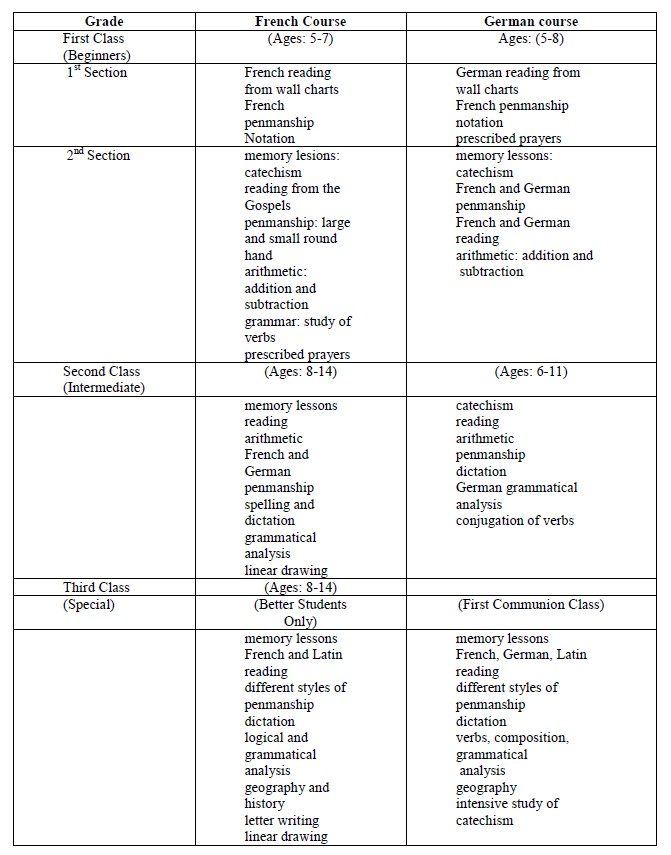
Several significant things should be noted about this program. First of all, it was a noteworthy experiment in bilingual instruction. Shortly after the Franco-Prussian War had ended, an Inspector from the normal school at Coblentz visited Colmar and, after watching the classes in action, remarked: “It is a mystery to me to see your pupils further advanced in two languages than our pupils, who have but one language to learn.” [49] Secondly, the differentiated courses of study, to meet the needs of pupils with varying ability and interests, were an innovation at the time. Thirdly, the program included several courses—history, geography, and linear drawing, for example—which were not in the traditional curriculum. Finally, in setting up the “special class,” the Marianists anticipated the higher primary instruction advocated by Guizot in 1833.
In the official reorganization effected by Loi Guizot, primary instruction was divided into two parts, elementary and higher. In the elementary section, the traditional basic subjects were retained without change; in the text of the law they were listed as: moral and religious instruction, reading, writing, elements of the French language and of computation, and the legal system of weights and measures. [50] In the projected écoles primaires superieures, the same subjects were continued, but the following courses could be added: elements of geometry and its common applications, especially linear drawing and surveying; information on the physical sciences and natural history; singing; and the elements of history and geography. [51]
The higher primary schools, as proposed by Guizot, proved to be unpopular and soon disappeared. There was no mention of them in the important law of March 15, 1850. The subjects that they offered, however, were added as optional courses to the regular elementary program, and thus the curriculum was expanded.
The Manual of 1857 retained the distinction between the elementary and the higher schools. The curriculum prescribed for the elementary schools included: religious and moral instruction, French language, writing, arithmetic, elements of history and geography, linear drawing, and vocal music. In the higher schools, literature, physical science, natural history, algebra, geometry, and agriculture were added. [52]
Subjects of Instruction
Religious and moral instruction was the basic and integrating element of the entire program. Its relationship to the other subjects was explained in the manual by a quotation borrowed from Cardinal Donnet:
To look on primary instruction as merely a means to learn spelling, arithmetic, or drawing is to debase such instruction. … Of what good is it to read, if one does not understand what he reads or if, unable to distinguish truth from falsehood, he merely substitutes error for ignorance? Of what use is it to know how to write, if one does not have correct ideas or noble sentiments to express? Of what use is it to know how to calculate, if right reason and a true conscience do not govern the calculations and prevent them from becoming the instruments of selfishness and greed? The purpose of primary education is not so much to impart certain skills as to develop man’s faculties, so that, as a rational being, he will know how to safeguard his moral and intellectual nature in a material and sensual environment and to appreciate those things which lead to truth and virtue. [53]
Language was regarded as both the key to knowledge and its effective instrument. It therefore merited the teacher’s special attention. The course included the study of vocabulary, spelling, conjugation, and syntax, together with exercises in reading, conversation, oral recitation, grammatical and logical analyses, and composition. [54]
Penmanship was obligatory in all primary schools of the Society and was one of the first subjects taken up by beginning pupils. Five styles of writing were taught—gothic, slanting, round, running, and cursive. [55] According to the Spirit of Our Foundation, “penmanship and even pen-sketching were held in great honor during the first years of our Society, and in the archives many beautiful specimens of this art are still preserved.” Apparently, it was Brother Gaussens who inaugurated the tradition. “Brother Gaussens was an expert penman. Such men as Brothers Coustou, Hausseguy, and Serment were trained by him, and they in turn passed on their proficiency to others in the Society.” [56]
Arithmetic was held to be an integral part of primary instruction because of its usefulness in domestic and commercial life and its value in training the pupil to do abstract thinking. It could, however, “blunt the sensibility of the heart” by its exclusive emphasis on dry formulas and cold reasoning; therefore, the manual counseled that it be taught prudently and with proper objectives in view. The course included the fundamental operations of mathematics, the decimal system, the legal system of weights and measures, and the elements of practical geometry needed for carpentry and surveying. [57]
History was not included by the government in the program of primary schools until 1833. Even then it was merely an optional subject and did not become obligatory until 1867. [58] The Society listed it in the course of studies as early as 1831. [59] The high regard in which it was held by the Marianists was revealed in the Manual of 1857:
There are two types of knowledge eminently superior to all others; knowledge of God and knowledge of man. The first is assuredly the more sublime; nevertheless, the second is definitely superior to all sciences concerned with physical phenomena and matter, because it is spiritual in character and has for object a fund of sure principles and facts. Moreover, it shares with religion the honor of being revealed; for the book which contains the ideas which God has revealed about himself contains also the most beautiful pages of history. History is the remembrance of the past, the lesson of the future, the light of the present, the preserver of events, the faithful witness of truth, the source of wholesome and prudent counsel. Are any other reasons needed to demonstrate the usefulness of this branch of knowledge? [60]
History, as the Marianists conceived it, was much more than a catalogue of dates, names, kingdoms, and wars. Essentially it was the account of Divine Providence ruling the world, using men of all types as instruments to accomplish its designs, directing all events toward a single end, revealing the instability of all things human, rewarding virtue and punishing vice.
All the pupils were required to study sacred history because it was the foundation of religion instruction and the necessary guide for reading profane history. Ancient history, ecclesiastical history, and the history of France were optional subjects, which might be studied by those who manifested an interest in them. [61]
Geography was closely allied to history because without it history was unintelligible. It was another of those subjects much discussed in educational plans and reforms, but not incorporated in the curriculum until after 1833, and then on a rather insecure basis. “With us,” the Manual of 1857 pointed out, “the teaching of geography is more than the memorizing of a list of unpronounceable names which the pupils find difficult to learn and soon forget, but the clothing of dry and sterile facts in attractive dress and the use of means to make the study profitable to heart and mind.” Integration with religion was logical and easily achieved:
Geography, in giving a material description of the earth, ought to speak to the heart and the mind, revealing with the language of faith the grandeur of God’s work, the wonders of his creation, the marvels of his inexhaustible inventiveness, the invariable regularity of the laws governing the universe, the perfect harmony existing among the various kingdoms of nature. [62]
Drawing was considered useful as a preparation for the mechanical trades. But it also served other broad educational purposes: it sharpened the pupil’s vision by teaching him to estimate distances, dimensions, and shapes of objects; it developed manual skill and dexterity; it inculcated habits of concentration, neatness, love of order, and thus contributed to moral training. Freehand drawing was taught in the lower grades, while the upper classes specialized in graphic design, particularly the drafting of sketches and plans. [63]
Music was a favorite subject of the Marianists. “I have a great liking for music,” Father Chaminade wrote to Lalanne, “and I desire that vocal and instrumental music be taught to those pupils who have the required talent.” [64] Interest was particularly keen in the Alsatian schools of the Society, and some of the brothers who taught in them were skillful musicians. [65] Particular attention was given to church music, for, in the words of the manual, “liturgical chant, well rendered, elevates the soul to God and inspires virtue.”
In some of the schools of the period, musical instruction was offered only to wealthier pupils and a special fee was charged for it. The Marianists, however, were interested in teaching music “as a means of purifying the taste of the laboring class, giving them at one and the same time diversion in the midst of their work and edification during religious services.” To indicate the purposes of such instruction, the manual quoted the following words of Cardinal Donnet:
What a service the teacher renders to the school and to the family, if he teaches simple but noble melodies, which, in the painful and trying circumstances of life, become the expression of sentiments proper to a Christian and a self-respecting man! What a happy influence such a teacher exercises on the morality of the common people and on the serenity of the domestic hearth. [66]
Literature, the first course listed for the higher primary schools, involved the study of a few selected works in prose and poetry. The pupils would not normally pursue the subject beyond the primary level, and hence the objective of the course was to cultivate a taste for good reading as a wholesome leisure-time activity. Literature, the manual pointed out, ornamented the memory, enriched the mind, developed the imagination, purified the taste, formed the heart, and inspired noble sentiments. Through good reading, the mind took on in some way the characteristics which he habitually lives. [67]
Science was another subject calculated to raise the mind and heart to God. It was in order to reveal himself and his perfections to man that God created the universe with such magnificence. Across the vast expanse of the heavens as well as on the surface of the tiniest grain of sand, he had engraved in visible characters the proofs of his existence, his power, his wisdom, and his goodness. The sciences enabled man to read in the book of nature the name and the attributes of its Author.
The law of March 15, 1850, did not envision the teaching of scientific theory, but of the “notions of the physical sciences and of natural history applicable to the ordinary purposes of life.” The Marianists adhered to this restriction. The aim of the course was to make the pupils acquainted with the human body, “the masterpiece of material creation”; with the more important animals; with the most common and useful plants and their classification; with the principal metals and the use made of them; and finally, with the arrangement, distance, and movements of the stars and planets. [68]
Algebra and geometry were studied because of their practical utility in such arts and trades as architecture, carpentry, and mechanics. However, their value in training the mind by providing exercise in analysis, in generalization, in judgment, and in method was not overlooked. The pupils were to be cautioned that mathematical demonstration was not the only, or even the principal, means of arriving at truth, but that there were other kinds of truth and other sources of certitude. [69]
Agriculture was held to be basic to the material prosperity of the State and to contribute to the stability of family life. Teachers in rural areas especially were urged to instill a love of the country in their pupils and to dissuade them from leaving the land to find easier and perhaps more remunerative jobs in the city. The course included the elements of agriculture and horticulture. Whenever possible, the theory of the classroom was supplemented by practice in fields or gardens. [70]
Textbooks
The great interest of the Marianists in the primary curriculum and in curricular materials was demonstrated by the large number of textbooks that they produced for use in the Society’s schools. Father Chaminade was particularly pleased with this initiative and took every occasion to encourage it. In a circular letter addressed to all the members in 1843 he wrote:
It is with pleasure that we make use of the opportunity to express our entire satisfaction to the authors of the textbooks already published, and we beg all our brothers to follow in their footsteps. All zealous and courageous members are exhorted to make some contribution in the fields in which they are competent. We shall choose the textbook in each branch which includes the latest improvements and which gives hope of producing the best results. [71]
The books to which the Founder referred as being already published included: Lessons in Reading for Beginners, compiled in the first years of the Society’s Existence; Method of Teaching Reading, published at Colmar about 1840; A Course of Penmanship, by Brother Coustou (1840); a Manual of Arithmetic, by Brothers Boby (1841); a First Reader, by Brother Gaussens (c.1840); and Problems in Arithmetic, by Brother Enderlin (1843). After 1850, new textbooks and revisions of old ones multiplied rapidly. More than one hundred of these texts have been preserved in the archives of the Society, and both by their quantity and quality bear eloquent witness to the initiative and professional competence of the pioneer Marianists. [72]
III: Secondary Curriculum
Classical Studies and the Enlightenment
The Marianists entered the field of secondary education at a time when the course of studies was the subject of considerable controversy. For many years the curriculum had been classical in character, with strong emphasis on the ancient languages; lesser insistence on the mother tongue, mathematics, and history; and a very mild interest in science. The attack on the traditional system began during the eighteenth century, under the inspiration and leadership of the philosophes. They saw in the secondary schools, conducted principally by the Jesuits and the Oratorians, a strong bulwark of the “old order” that they despised and vowed to overturn. With characteristic boldness, they set to work to discredit the schools by means of the clever journalistic propaganda for which they were noted.
Actually, they were not entirely opposed to the classical tradition. In the rational and natural religion of the ancients, devoid of revelation and theology, they found a model for their own religious approach. The radical extremes of Renaissance humanism also appealed to them; “the criticism of Valla, the satire of Erasmus, the worldly-wise skepticism of Montaigne,” were revived and imitated. But they felt strongly that their own “enlightened” century was far superior both to the age of antiquity and to the Renaissance, and that therefore a limited study of the classics was all that was desirable. [73] Marique summed up their viewpoint when he wrote:
The attitude of the Enlightenment toward classical studies was a sort of compromise. There was felt a certain kinship of spirit between the new age and the radicalism of some of the sixteenth century humanists. Both groups were warring against medieval ideas and traditions; both welcomed the teaching of the wise men of Greece and Rome. [74]
However, classical studies could hold at best a subordinate place in the educational system proposed by the philosophes. The whole trend of the Enlightenment movement was frankly utilitarian. Everything was oriented toward the present life; the ideals to be striven for were natural perfection and worldly success. For achieving the end they had in view, the study of the classics might well be a waste of time. What the student needed, to meet the exigencies of everyday life, was “not a mastery of the niceties of expression, but a good stock of useful knowledge in the service of a keen, alert mind.” [75]
On the question of what should be substituted for the humanities, the leaders of the Enlightenment were rather vague:
The basic principle of the Enlightenment expressed no content; it implied only the formal directions, that the reasoning powers are to be developed and that useful knowledge is to be acquired. These precepts did, indeed, suggest the modification of the educational content of the past, but not the creation of a new content; and, in fact, the Enlightenment did little more than adopt the encyclopedic tendency (adjusted to its own critical attitude) of the Renaissance. [76]
Eventually, as the problem of content worked itself out, three groups of subjects emerged as rivals for the position of preeminence held by the classical studies: the historico-political sciences, polite literature, and the natural sciences. [77] In the ensuing contest for supremacy, the last group gained the greatest support. According to Marique, two principal factors accounted for this victory. In the first place, the eighteenth and nineteenth centuries witnessed phenomenal developments in science. These developments, it is true, are generally associated in the popular mind with countries other than France, but in this connection, Bruun has pointed out a significant fact:
Napoleon stands almost alone among the rulers of his day in his appreciation of the scope and utility of the current scientific investigations. The report submitted to him in 1808 by Delambre and Cuvier On the Progress of the Mathematical and Physical Sciences Since 1789 demonstrates how conclusively France might then claim to be the true home of the scientific spirit. [78]
Secondly, as science increased in importance, the philosophes and their followers planned to enlist it in the service of their cause, especially since they came to believe that science and the Enlightenment were at war with a common enemy—revealed religion. To achieve its mission of enlightenment, however, it needed to be popularized; and this could best be done by giving it the predominant place in the curriculum of the schools. [79]
While the Enlightenment theories gained ground during the pre-Revolutionary period, their translation into educational practice was an exceedingly slow process. The expulsion of the Jesuits in 1762 and the resulting disintegration of the secondary school system offered an unusual opportunity to replace the traditional program, but lack of resources and the unsettled condition of France prevented any such action. The plans of La Chalotais and Rolland prior to 1789, and those of Talleyrand and Condorcet during the Revolution, were all conceived in the new spirit of de-emphasizing the classics and stressing science and other “useful” subjects, but none was ever carried out.
The most ambitious attempt made during the Revolution to create a new system of secondary schools was that of Lakanal. The “central schools: which he proposed were actually in operation for a time. They offered an encyclopedic course, including practically every subject suggested by previous reformers, but stressing mathematics and science. The experiment was a dismal failure. The teachers, especially those for science, were learned men, but they could not adapt themselves to the age and ability of the pupils. The courses were veritable conferences which failed either because of the subjects that were treated or because of the poor preparation of the students, most of whom had received a meager primary training. Given a wide selection of courses, the pupils soon drifted toward those that were easiest. The failure of the central schools did much to discredit the Enlightenment theories and created a reaction in favor of the traditional program. [80]
The law of 1802 substituted lycées for the écoles centrales, and defined secondary schools as those in which French, Latin, and the first principles of geography, history, and mathematics were taught. The first lycées were patterned after the schools of the Oratorians rather than those of the Jesuits. The plans of Fourcroy, Roederer, and Fontanes assigned to mathematics a rank equal to that of the classical languages. There were thus two parallel curricula, one literary, the other mathematical. The latter was often referred to as the scientific program, but it contained little instruction in science as such. In an address delivered in 1821, Lalanne declared:
Although the study of the natural sciences has taken a marked development since the last century, it has not yet entered into the program of studies for young students. The classical languages, literature, and mathematics monopolize it almost entirely, while history and geography take but a secondary place; none of the natural sciences, except physics, is counted of any importance. [81]
The Marianist Position
The conservative reaction following the Revolution was of short duration, and agitation was soon renewed for the “modernization” of the secondary curriculum. In the bitter struggle between the defenders of the old and the champions of the new, the pioneer Marianists were able to take a neutral stand. They had no ties with the past and therefore no narrowing preconceptions. Their attitude toward the educational issues of the day was as broad and independent as their social outlook. In 1842, recalling memories of the Society’s origin, Lalanne wrote of his fellow Marianists:
They were all born, or at least raised, after the Revolution; of plebeian parentage, they were in no way tinged with aristocratic prejudice and had no connection with the old order of things, either through their own antecedents or through the tradition of their families. Filled with horror at the excesses of the Revolution, they lived without repugnance under the new regime, which seemed to put an end to such anarchy; they asked nothing more of the civil powers than the liberty to do good. …
They were not rigorists, exclusive in their preferences, enamored of old customs, or infatuated with unessential things. They were free from all party influence and walked in all simplicity before God. [82]
In general, the Marianists adopted a “middle of the road” policy with regard to the secondary curriculum. They recognized that there were defects in the traditional program and that changed conditions called for a new approach, but they also realized that there were no ready-made answers to the problems involved in the required adjustment. Lalanne favored flexibility rather than uniformity, planned experimentation rather than abstract formulas. He complained about the “restless minds” that in the past had been busy with all kinds of theoretical schemes, “foolishly imagining some fantastical, perfect system, whose fulfillment perhaps does not lie within the range of human possibility.” [83] In all schools that came under his direction, he boldly modified the course of studies whenever he felt that circumstances demanded it.
In 1819, as prefect of studies at the Society’s first school in Bordeaux, he retained the regular classical course, but he added a “special” or “French” course, designed for those students who did not need Latin. [84] The school’s prospectus announced the following curriculum: “Latin, French, history, geography, elemental mathematics, bookkeeping, penmanship, and, in general, whatever enters into a good education.” History and geography were almost novelties, although the Oratorian schools before the Revolution had given them considerable attention. A government statute of 1814 accorded them a half hour in the afternoon, but outside the regular school time. In 1818, however, they were assigned a definite place in the official program. [85]
At St. Remy, Lalanne experimented with a new plan, by which he proposed to make literature and science the basis of secondary education, while retaining Latin as the “indispensable regulator of good taste.” The program was divided into three parts—mathematics, science, and literature—each part being considered of equal importance and all of them being developed simultaneously. [86]
The plan was original and quite novel for the period. Latin remained obligatory, but science received greater attention than was customary at the time. French held the place of honor among the literary studies and was supplemented by two other modern languages, Italian and German. Greek, mathematics, history, geography, vocal music, and drawing rounded out the program. Physical training was also greatly stressed. Lalanne revived athletics, encouraged games and walks, built a swimming pool, and organized a school for horseback riding. [87]
At Bordeaux and Layrac, between 1833 and 1845, Lalanne gave even broader scope to his advanced ideas. The staff of twenty-five professors that he assembled included teachers of natural history, physics, chemistry, entomology, mathematics, Spanish, English, commerce, drawing, piano, violin, clarinet, voice, dancing, horseback riding, fencing, and gymnastics. He organized the courses into five sections and would have started a sixth—philosophy—had the government permitted him. The preparatory course initiated the pupils in basic subjects needed for advanced work; Latin, Greek, French, Spanish, and English comprised the language course; the “special course” emphasized professional preparation, especially for commerce; in the mathematics section, the students concentrated on practical arithmetic and on theoretical and practical geometry; the scientific course included physics, zoology, botany, and the elements of cosmography and astronomy. [88]
While Lalanne was conducting these experiments, the curriculum of the government-controlled lycées, despite recurrent criticisms, remained practically unchanged. In 1852, however, a major reorganization was effected. After an elementary or preparatory period of two years, all pupils were to take a common course of three years, in which the classical studies predominated. Then there was a bifurcation in the program, the pupils being permitted to choose either a literary course leading to a baccalaureate in letters and preparing for the faculties of letters and law, or a scientific course, leading to a baccalaureate in science, and preparing either for the faculties of science and medicine or for the special professional schools. The distinction between the two curricula was explained by Farrington as follows:
As far as the general subjects of instruction are concerned, there was apparently not much difference between these courses, but a careful study of the two programs shows very clearly that this bifurcation meant almost an absolute choice between the two great areas of human knowledge, for the scientific branches in the letters section were treated most superficially, and the same was true, though perhaps to a less marked degree, of the literary subjects in the science section. [89]
Shortly after the new program was announced, a member of the Committee on Freedom of Education requested Lalanne to give his evaluation of the reform. Lalanne responded by publishing, in 1853, the pamphlet Observations sur le programme officiél des etudes pour les lycées. After making a detailed analysis of the entire program, he drew the following three conclusions, all of which were critical of the new approach: first, it would ruin the classical studies, because, as everyday experience proved, children allowed an absolute freedom of choice would avoid the ancient languages and elect instead the more practical and popular subjects; secondly, the sciences would also suffer, because pupils would begin them too early and without adequate literary training; thirdly, because of its emphasis on specialization, the program would never achieve the real aim of education, the formation of a complete man. [90] As Lalanne predicted, the plan proved unworkable, and the government abandoned it in 1863.
The Claims of Science
Lalanne’s solution to what proved to be one of the most vital and perplexing problems in modern education—the relative value and the place of classical and scientific studies in the secondary curriculum—was decisive in shaping the policy and the traditions of the Society. Fortunately, he was uniquely fitted to deal with the problem:
Gifted with talents that attracted him equally to literature and science, he had acquired a brilliant classical culture, as is testified by the numerous pieces in prose and verse which he wrote even in his declining years, and which are replete with the fire of true literary genius; but in addition to this, he had already launched at an early age into the study of applied sciences by accepting the post of interne at the Hospital of Bordeaux, while at the same time cooperating in the foundation of the Linnaean Society of that city. [91]
When a choice had to be made between the classics and science, Lalanne’s preference was for the classics. Letters, when properly taught, he maintained, developed the intellectual faculties to a degree of power that could be measured only by the distance separating civilization from barbarism. It was only through the study of literature that the mind, cultivated and enriched, could preserve the treasures of knowledge which centuries of labor had accumulated, and bequeath them to future generations. Without literature, science itself was mute or unintelligible, and so, too, were all other branches of knowledge.
To exclude the classics from the program of education was therefore unthinkable:
To repudiate the literature of the ancients is to renounce the richest and the best heritage ever transmitted to mankind; it is to break a chain that binds together all enlightened nations. Our language, laws, literature have from their inception received such a great help from the writings of the ancients that we might well affirm that they owe their very existence to them. Catholicism has appropriated one of its languages, in which to render homage to God and to pray to him in public; and thus this ancient art is identified with what we hold greatest and dearest—religion and country. [92]
Hence, individuals might, for one reason or another, ignore or reject the ancient classics; but an entire nation could never do so. By such apostasy it would reveal its own debasement and decadence. [93]
On the other hand, Lalanne maintained that the claims of science could not be lightly brushed aside. Those who sought to evade the issue by talking disparagingly of novelty, change, and utility were unrealistic. There was question not so much of fighting new ideas as of facing new facts. It was an undeniable fact, for example, that science was growing daily in importance, and no one could check its onward march. Another fact to be recognized was that parents were insisting more and more that education prepare their children for profitable careers, and to obtain the positions most in demand a knowledge of Latin and Greek was no longer adequate. In the face of these hard facts, the new responsibilities placed on education could not be so ignored. [94]
Lalanne’s defense of the sciences, however, was not based solely on their utility. He believed that they contributed powerfully to intellectual formation. They developed a keen sense of observation and demanded sustained attention; they promoted habits of orderliness through emphasis on close analysis and careful classification; they exercised the memory, since names, facts, and formulas had to be retained; they caused the imagination to grow and expand by furnishing it with the rich materials provided by nature; finally, they supplemented mathematics in the training of the judgment. [95]
Lalanne, therefore, was unwilling to take the position, rather common in his day, that either the sciences or the classics should be discarded. He was convinced that the ancient languages could not, under any circumstances, be repudiated without grave harm to education; on the other hand, he was equally convinced that the exclusive study of the classics was no longer adequate, and that other subjects, and science in particular, had to be included in the curriculum. The real issue to be faced was how all of these areas of knowledge could be incorporated in the secondary school program without sacrificing the thoroughness indispensable to a sound education. The problem, Lalanne admitted, was a difficult one. The days were not likely to grow longer, nor would pupils be suddenly transformed and endowed with more retentive memories, quicker comprehensions, or more generous doses of application and good will.
Specialization, including the type that the government was about to adopt in the bifurcation plan, was not the answer. One could not parcel out knowledge like land, giving each student the right to choose the piece he liked. Neither did the answer lie in increased effort by the pupils to master additional content. “When the mind has to cover a multitude of branches, it applies itself energetically to none; only superficial ideas are gleaned which lead nowhere; even the ability to study is lost, for the student does not learn to think.” [96]
Lalanne’s solution was “to teach the classics simultaneously with all the rest that should be learned, from the beginning of the child’s school career down to its close.” He defended the practicality of this plan in a public address, delivered at Paris in 1852, which won the enthusiastic praise of Count Mole and other distinguished contemporaries. [97] After refuting two possible objections—that the classical languages would cease to be representative if combined with other subjects, and that the multiplicity of subjects would only create superficiality and confusion in the pupil’s mind—Lalanne proceeded to demonstrate that the proposed plan would not only produce a cultured, a well-formed, a complete man, but would also give the best possible preparation for specialization.
No man is perfect, Lalanne argued, unless his ability, his mental and physical powers, have been stirred into life, exercised, and developed. If these latent powers are exercised by only one kind of culture or training, a distorted development is sure to result. What is needed is the harmonious development of all the talents which a child possesses. If all the powers of the mind receive equal treatment by a diversity of occupations, they will strengthen themselves simultaneously, they will correct and compensate each other. In the alternative case, one might produce a specialist, but never a completely educated man.
But, on the other hand, the completely educated man was likely to make the best specialist:
Be kind enough to notice the difference between a specialist, who has not received any other instruction than what pertains to his subject, and a man whose particular talent has drawn him into a specific branch or profession from the ranks of those who have received a common, extended, and varied instruction. The former will be a serviceable man and, in certain cases, really superior to the other, but his field of action is restricted; in all other cases, you will find him either very mediocre, approaching sterility, or downright incapable. . . .The other, who has acquired a distinction in other subjects, will be capable of filling any position that a man of his condition is called upon to take; he will show his aptitude in almost every one of the good offices exacted by the ties of friendship, family, or country, by his energy and ability; in all phases of life, yes, in almost every instance, he will put the knowledge gained by his varied education to good use; he will be the Wise Man of Scripture who draws new things and old from his treasure. [98]
Such were Lalanne’s views on the question of liberal education versus specialization, of culture versus utility, and it is remarkable how closely his ideas resembled those of Cardinal Newman, who during the same year (1852), was delivering his lectures in Dublin on the Idea of a University.
In all problems relating to curriculum, Lalanne believed that three factors were involved: the sublime and beautiful, the utilitarian, and the possible. When these three were in conflict, only chaos could result. The sublime and beautiful furnished the ultimate ideals to be attained; the utilitarian pointed to the immediate goals to be achieved. It was the task of the real educator to reconcile the two, by accomplishing what was possible without sacrificing either the beautiful or the useful. [99]
6. Methods
To the early Marianists the work of education was primarily an apostolate, but it also involved an occupation, a career, a profession. Putting it in a somewhat different way, one might say that in the work of education the apostolate was the end which the Society of Mary had in view, and the teaching profession was the means that it employed. [1] Thus every member was induced, by his interest in the apostolate, to perfect himself in the art of teaching, “to attain the highest possible skill in the branches which he had to teach.” This emphasis on professional competence will be discussed in part I of the present chapter.
As practical educators, the pioneer Marianists were particularly interested in methodology. In time, they developed certain devices or techniques, some of which were original, while others were adaptations of practices more or less traditional in French Catholic schools. Under the headings of instruction, discipline, and guidance—the three principal means used by the Society to impart education—parts II, III, and IV of this chapter will describe some of the methods used by the Marianists which may be regarded as characteristic of their institutions.
I: Professional Competence
There were critics in the early nineteenth century, as there are today, who suggested that Catholic schools were too preoccupied with the salvation of souls to pay much attention to the professional aspects of education. Father Chaminade, however, believed that the two interests, far from being incompatible, actually reinforced each other. A teacher who was professionally incompetent was not likely to be an effective apostle. On the other hand, the concept of education as an apostolate provided the teacher with the highest type of motivation to excel in his profession; for, obviously, his effectiveness as an instrument in the apostolate was dependent to no small degree on the influence he wielded and the prestige he enjoyed.
To emphasize this relationship, Father Chaminade inserted the following article in the Constitutions:
The importance which the Society attaches to Christian education does not cause it to neglect instruction; on the contrary, since we cannot give education without instruction, the Society bestows the greatest care upon the management of its schools and the perfection of its methods, knowing this to be the true means of extending the blessings of a Christian education to a very great number of children. [2]
Teacher Training
The Founder’s solicitude for the professional development of his religious was shown on innumerable occasions and in many different ways. To begin with, he was most careful in the selection and training of teachers:
Never would Father Chaminade agree to accept only men of good will, form them into a body endowed with rudimentary knowledge considered sufficient for present needs, and then condemn their minds to remain in a state of intellectual starvation, just to have a guarantee of their good spirit. [3]
The quality of the teachers took precedence over the quantity of establishments. He constantly resisted the pressure exerted on him to multiply the number of schools, because he was fearful that the Society, in “spreading itself too thin,” might weaken its ability to do good. In 1822 he wrote to Father Mertian:
I desire that the schools of Colmar measure up to the standards set by our own and become models for all the others in the diocese. A novitiate cannot serve as a (complete) normal school. If the young religious are employed immediately after leaving the novitiate, they will soon become bewildered; they should first practice under the supervision of the older brothers in schools that are well organized and in full operation. If we intend to do things by halves, it will not be worthwhile taking so much trouble. We will never succeed in attracting all the children of a locality with imperfect schools, and thus we would have little influence on the morals of the people. The Society would then fail to achieve its purpose in one of its principal works. What harmful consequences would result! I am determined to form really good establishments before becoming concerned about their number. [4]
In the early history of the Society, separate novitiates were organized for the three categories of members. Those reserved for candidates to the teaching category were not only houses of religious formation but also “internal normal schools,” where professional preparation was provided. With reference to the period of training, which lasted two years, the Constitutions declared:
The novices who are preparing to become teaching brothers can and must give to studies all the time at their disposal, after the usual exercises of the novitiate and a few other exercises of piety . . . have been prescribed by the master of novices. There are in the novitiates capable teachers who give to the novices all the lessons that they might need. [5]
Those candidates who did not complete the program of studies in two years were admitted to the profession of temporary vows, but they remained in the novitiate to continue their education until called to active duty by the superiors. [6] This arrangement foreshadowed the later development of a separate institution, the scholasticate, which was organized for the first time in 1858.
The Society was well aware that such limited professional formation was inadequate. Hence a comprehensive program of in-service training was carried on in the communities. This program included pedagogical conferences, supervision of teaching, and organized private study. The following account revealed some of the practices that prevailed in the community of Colmar, which were probably typical also of other houses:
Every Saturday the director examined the teachers’ lesson books containing the outline of their weekly teaching plan. These were regularly placed on his desk, and as regularly returned, each containing a slip of paper bearing the director’s comment and signature. And here let it be noted that this procedure was not Brother Klein’s original idea, but was merely a custom of long standing which he faithfully adhered to. It was also due to his encouraging influence that personal studies were strenuously pursued. The brothers worked at these in groups to add the incentive of teamwork in preparation for the examinations, and even utilized their recreational walks for rehearsing their studies. [7]
The royal ordinance of 1825, which granted legal recognition to the Society, also conferred the simple brevet on all the brothers who received a letter of obedience from the Superior General to teach in any of the Society’s schools. [8] The ordinance of February 28, 1816, however, provided for two other higher “certificates of ability,” and these had to be earned through examinations. [9] In his letters and conferences, Father Chaminade constantly exhorted the brothers to work at their personal studies in order to obtain these advanced certificates. In 1831, Brother Rothéa reported to the Founder:
Our brothers try not only to teach their classes well but also take pains to perfect themselves in secular branches. Everywhere in Alsace, there are classes composed of teachers; each brother is desirous of obtaining from the Academy a certificate of the second degree; in fact, I have never witnessed such a united endeavor among the brothers to acquire knowledge. [10]
Eventually, the Marianists organized their own program of private study and annual examinations to supplement the state requirements. Such a program was outlined by Father Caillet in his circular of February 22, 1861. [11] In announcing it to the brothers, he wrote:
While working daily at our spiritual advancement and our progress in virtue, we must not forget that we are members of a Society dedicated to teaching and that teaching is a means of giving a Christian education. Hence, we must constantly perfect ourselves as teachers . . . We must become good teachers, capable of giving to pupils a solid instruction and of rendering to society all the services that it has a right to expect from us. [12]
Interest in Methodology
Professional competence involved not only the thorough mastery of subject matter but also knowledge of methods to impart it effectively. Basically, the methods adopted by the Society were those in use in the Catholic schools of the period, especially the schools of the Christian Brothers. However, the Marianists were not mere traditionalists in the sense that they accepted without question whatever had been done in the past or was being done in the present, to the exclusion of new developments. Father Chaminade summed up their attitude in his letter to King Charles X: “Our methods differ little from those of the Brothers of St. Yon. Equally opposed to imprudent innovations and to aimless routine, we attempt to profit by modern ideas without abandoning the principles that have been consecrated by experience.” [13]
The same policy was laid down and explained in the Constitutions:
The principles of education, properly understood, do not vary; but the procedures whereby these principles are applied and the methods of teaching must necessarily follow the progress of human society and be adapted to its needs and to its wishes. To admit invariability in the form and matter of instruction would limit to a very short time the service, and even the existence, of an Institute devoted to education. Therefore, the Superior General, at stated intervals, and according to need, assembles the directors of primary establishments and other experienced teachers, to review the methods, to better them if necessary, and to introduce improvements demanded by experience and by the advice of competent teachers.
However, changes and innovations are made with a prudent reserve. These are only admissible in cases where the methods in actual use have become inadequate, and where the advantages of the new procedures have been almost universally recognized. [14]
In a commentary on the first of these articles, Father Francis Kieffer, seventh Superior General of the Society, made the following pertinent observations:
In drawing up this article, our venerated Founder showed a truly astonishing strength of vision. He wished that the administration of our Society, with regard to what concerns education, be a wisely progressive administration. He was certainly not one who would stubbornly hold to worn-out methods which are not suitable to the demands of the epoch. Of course, we should not succumb to every novelty or seek a change for the sake of change. That would be instability and inconstancy. By continually thinking of tomorrow we would be likely to forget today. But, all the same, it is good to make a difference between what might be called the statics and the dynamics of a work or a Society. The statics are the immutable elements which cannot be touched without exposing them to disorder and ruin. The dynamics are the elements of progress, that is, the spirit of invention and of progress in a Society as well as in its members. [15]
The great interest of the early Marianists in methodology was shown by the number of manuals produced for the guidance of teachers. Already in 1822, when the Society had but two primary schools, the Founder commissioned Brother Laugeay to outline a method of teaching for the Society. During the vacation of 1824, Father Chaminade assembled all the primary teachers at Bordeaux to discuss the preliminary draft. As a result of these conferences, there was issued, for private circulation among the brothers, a treatise titled Method of Primary Teaching for Use in the Society of Mary. Father Chaminade said of it: “It contains the first fruits of the experience of Brother Laugeay and his confreres; the success of our schools is the outcome of all these detailed prescriptions.” [16]
In 1831 appeared the so-called New Method, the work of Father Lalanne and Brothers Monier, Gaussens, and Memain. Again the Founder held long conferences with the teachers before releasing the treatise, which bore the official title General Regulations Governing the Schools of the Society of Mary. The “new method” was thoroughly tested before being definitely adopted. In December 1831 the Founder wrote to Brother Rothéa:
I have just definitely settled on our method of primary instruction. Brother Memain left for Agen today, where he will put it into use. I will not approve it until it has been tried out on a large scale, and that can be done quite well at Agen, where there are more than 400 pupils, not counting those in the special class. If the method meets with success, as I have every reason to believe it will, Brother Memain will proceed to Villeneuve, where he will put it to a similar test, and then to Moissac and Lauzerte. [17]
Several years later, the Method of Salins was drawn up by Brothers Troffer and Boby, but it was shortly after replaced by The Mixed Method of Teaching for Use in the Primary Schools of the Society of Mary. Brother Gaussens was probably the author of the latter work.
All of these early methodologies were intended for private use in the communities and the houses of formation and were usually in handwritten form. The first printed and published edition appeared in 1851. It was a pamphlet of ninety pages, entitled Method of Teaching Primary Schools in the Society of Mary, and was the result of numerous conferences, attended by the principal directors of the Society, under the chairmanship of Father John Baptiste Fontaine. [18]
Finally, in 1856-57, as a climax of all of these previous efforts, the Manual of Christian Pedagogy for Use by the Teaching Brothers of the Society of Mary was published by Father Fontaine. It was much more than a methodology or a set of regulations, but was a complete treatise on Marianist pedagogy. It consisted of two volumes. Volume I, comprising 174 pages, contained six chapters treating of education in general, physical, intellectual, and moral education, the characteristics of a good teacher, and the principles of teaching. Much of the material for this part was taken from the circulars of Father Caillet. Volume II, comprising 126 pages, dealt with curriculum, grading, methods of teaching, classroom management, school equipment, and the operation of primary boarding schools. [19]
The principal purpose of these manuals was to assure uniformity in all the Marianist schools. “A teaching society,” the Founder wrote in his circular letter of August 24, 1842, “will attain only partial success in proportion as the education given in its schools is conducted according to a method adopted by all its members; unity of method spells future success for all our establishments.” [20]
It is only by establishing in our schools this uniformity, so desirable in a Society composed of many members separated by distance yet bound together by invisible ties, that we will be able to keep contact with that common center, from which proceed the energizing principles of action and life. [21]
Unquestionably, also, the editing and the frequent revision of the manuals, together with the numerous meetings and conferences involved in the process, kept the Marianists educationally alert. They were induced to carry on a continuous evaluation of their methods, to compare their own procedures with those of contemporaries, to keep abreast of the latest developments. All of this contributed greatly to establish in the Society a tradition of professional competence that has never been lost and that has inspired succeeding generations of Marianists to raise the schools of the Society to the highest possible standard of excellence.
II: Methods of Instruction
Prevailing Modes of Instruction
In many of the French primary schools, during the early part of the nineteenth century, organized instruction was unknown. [22] The teachers simply “kept school” or attempted to “teach as they were taught.” If any formal procedure was followed at all, it was the so-called individual method, whereby pupils received direct instruction from the teacher, either one by one or in groups of two or three, while the other members of the class were left to shift for themselves. Describing educational conditions in Western Europe around this time, Marique wrote:
In spite of the fact that nearly three quarters of a century has elapsed since St. Jean Baptiste de La Salle had introduced the simultaneous or grading method of teaching in the schools of the Brothers of the Christian Schools, elementary instruction in the second half of the eighteenth century was still chiefly individualistic. The schoolmasters were occupied not so much in actual teaching as in dictating words, sentences, rules, sums, assigning tasks, cutting quills, examining the work of some pupil, or listening to his recitation. The pupils came individually to the teacher, to submit their written work to his perusal, or to read or to recite something they had committed to memory. Appeal to the interest of the child, his imagination, reasoning powers, in other words, a real technique of instruction was something unknown. [23]
After the Revolution, as interest in primary education grew, the better schools adopted either the simultaneous or the mutual method. In 1834, according to Buisson’s Dictionnaire de Pedagogie, 18,814 French schools used the individual; 24,310 the simultaneous; and 1,985 the mutual method. [24]
The simultaneous method, introduced into the primary schools by de la Salle and the Christian Brothers, enabled the teacher to instruct all the pupils at one and the same time. Even when individual pupils were called on to read or recite, the rest of the class was required to follow the lesson attentively. If necessary, the pupils were grouped into sections, in which case, some of the brighter students served as assistants to the teacher.
To be fully effective, the simultaneous method called for several classes in each school, taught by different teachers. For many villages and communes in France, such an arrangement was a luxury which they could not afford. In these localities, the mutual method, popularized by Lancaster and Bell, had a special attraction. The method enabled a single teacher to first train a corps of student monitors, and they, in turn, instructed their fellow pupils. The system was generally operated in military fashion, with “company organization, drill, regimental control, precision, and a prompt observance of the word of command.” [25] This military character caught the fancy of the French.
The relative merits and defects of the Lancastrian system were heatedly debated in England and elsewhere during the first decades of the nineteenth century. In France, however, the educational issues were obscured by the fact that the method became entangled with the bitter political conflicts of the period. Describing the initial enthusiasm with which the mutual method was welcomed in France, Compayre wrote:
Under the Restoration, its success was so great that it became the fashion and even a craze. Patronized by the most eminent men of the day . . . mutual instruction became the flag of the liberal party in the matter of instruction. Political passions became involved in it. The new system came into competition with the instruction of the Brethren of the Christian Schools, and was fought and denounced as immoral by all the partisans of routine.… Men held for or against simultaneous instruction, its rival, as if it were an article of the Charter. [26]
Catholic educators in France strongly opposed the Lancastrian movement, not because they were “partisans of routine,” as Compayre suggested, or because they feared its political implications, but because in many instances it led to the exclusion of religious instruction from the schools. Obviously, the monitorial system did not readily lend itself to the teaching of religion, certainly not in the sense understood by the Catholic Church, and a simple solution was to drop religion from the curriculum altogether. To this expedient the “liberals” had no objection, but Catholics voiced a vigorous protest. In some localities they did not hesitate to brand institutions employing mutual instruction as “schools of the devil.”
The monitorial method was also seriously defective from an educational standpoint. It reduced to a minimum the contact between teacher and pupil; it placed too much authority and responsibility in the hands of immature monitors; and its procedures were entirely too mechanical. To put the matter briefly, it overemphasized instruction at the expense of education.
On the other hand, the mutual method undoubtedly had certain advantages, which the Marianists readily recognized and which they pointed out in the Manual of 1824. The method was applicable to an indefinite number of pupils; it promoted sustained attention, accelerated the pupils’ advancement, and eliminated dependence on books; it assured uninterrupted progress, because pupils were grouped according to ability to learn; it conserved the health of teachers by lightening their burden; and it was capable of preserving almost perfect order. [27]
The "Mixed Method"
Without openly espousing the Lancastrian method, [28] the Marianists freely borrowed from it the features that they found useful. The result was a new “mixed” or mutual-simultaneous method. One important advantage of this fusion was explained by Father Lalanne:
A proposition was made to combine the simultaneous with the mutual method, the latter being warmly advocated and spread by the liberal party; by so doing, hopes were entertained to keep or bring back into the Catholic schools those children who were drawn from them by the bait of an imaginary advantage. [29]
In reality, the method adopted by the Marianists combined the three prevailing modes of instruction. Father Chaminade explained this clearly in one of his letters:
The method of instruction used by the Society of Mary is basically simultaneous, but it might well be called mixed, as Father Lalanne has named it; for, it borrows something from all three modes of instruction—the individual, the simultaneous, and the mutual. [30]
The Manual of 1857 described the elements of the Society’s method in further detail:
The individual method ignores the group and concentrates on the pupil; the simultaneous method takes no account of the individual, but considers only the group; the mutual method rules out all direct communication between the teacher and the pupil. No one of these three methods, to the exclusion of the others, suffices for the good management of a school. Hence, while retaining as much as possible the advantages of all three methods and avoiding their disadvantages, the Society forms a fourth method, called “mixed.” [31]
In operation, the mixed method worked as follows: the teacher did all of the instructing, maintaining personal contact with each pupil; the school was divided into several classes, taught by as many teachers as the number of pupils required; if classes were exceptionally large, as beginners’ classes sometimes were, they were divided into sections, with a student monitor in charge of each; but the monitor was himself a member of the section, received the same care as the others, and performed only certain minor tasks, under the immediate supervision of the teacher. [32]
Influence of Pestalozzi
Apparently, the Lancastrian method represented the only important foreign influence on French education during the early nineteenth century. The theories and experiments of Pestalozzi were either little known or generally ignored. According to Bruun, “the most significant, and in the truest sense, the most revolutionary practice during this period, best exemplified by the labors of Pestalozzi in Switzerland, affected France little and England not at all.” [33]
Some ideas in the Manual of 1857, however, were strongly reminiscent of Pestalozzi’s approach, and many perhaps may be traceable to his influence. After stating that in order to apprehend, one must pay attention to what he sees, hears, and touches, or reflect on what he already knows in order to arrive at that which he does not know, the manual outlined four procedures requisite for sound instruction:
- The procedure of “Intuition,” which consists in making materially sensible the ideas which one wishes to present to the intelligence of children. Thus the teacher speaks to them first of all about the objects that surround them and those which can be placed before their eyes; he has them consider the form, the color, the size; he has them give the name, the properties, the uses; he has them draw the object.…
- The procedure of “Exposition” or “Mental Intuition,” which consists in presenting an object to the mind by means of words.…
- The procedure of “Interrogation,” which leads the pupils from the known to the unknown by means of well-chosen questions within the range of their ability.…
- The procedure of “Invention,” which consists in giving to the older pupils a general idea of theme to develop. [34]
The Jacotot Method
The only French methodologist of note during this same period was Joseph Jacotot. His book, Enseignement universel, created a considerable stir with its intriguing paradoxes, but his influence was much greater in Germany and England than in France. He theorized that all men were equal in intelligence, that every man was able to instruct others and even teach what he himself did not know; that all knowledge was so related, that to know one thing well was to have a starting point for knowing everything else. His methods emphasized thorough study of one or two books, repetition, memory, and correlation of knowledge. [35]
The Marianists studied his approach but were not impressed. In 1829, on a visit to Paris, Father Chaminade made inquiries about the Institution Balle, a school where the Jacotot methods were used; he also purchased a copy of Enseignement universel. “After you have read the book,” he wrote to Father Lalanne, “you will lose all desire to see the school.” [36]
Interest and Motivation
The preoccupation of the Marianists with formal methodology did not blind them to the fact that even the most brilliantly conceived method depended for its effectiveness on the teacher. “The good teacher makes the good method,” the Manual of 1857 declared. [37] Above all, the teacher had to be alert and active. “A few minutes’ inaction,” one of the brothers remarked to a visitor at Agen, “would be enough to risk the continuance of good order.” [38] Hence, the Manual of 1831 described the teacher’s role in the classroom as follows:
The teacher is the soul of his class. Beside the never-failing vigilance which he exerts during penmanship, reading, or arithmetic, either over the monitors or the pupils, he goes frequently from one of his aides to another, to direct, review, correct, or to take up the thread of explanation in his own hands, so that the lesson may not languish and the method be strictly followed. He must be present to all. Each pupil must feel the presence of the teacher as if he were near him always, and to attain this, he must be, so to say, everywhere, by the force of his activity and zeal. [39]
The teacher’s activity, however, was not the ultimate measure of success in education. Unless the pupils were stimulated to purposeful self-activity, the most energetic efforts of the teacher would be wasted. One of his principal duties, therefore, and certainly not the easiest of his tasks, was to provide such effective motivation that the pupils would want to learn, and hence would apply themselves to serious study. From all indications, the early Marianists were skilled in this difficult art. Among the many devices which they used to promote interest in learning were the following: practical projects, educational tours, emulations, academic societies, and literary entertainments.
Illustrative of one type of project carried out in Marianist schools was the plan used at Bordeaux in connection with the commercial course to give students a practical knowledge of business. Fictitious companies were set up, with each student at the head of a separate concern or subsidiary branch. The companies made imaginary purchases of raw materials, sold finished products, kept a record of the rise and fall of prices, and, in general, went through all the commercial transactions studied in classroom theory. [40]
Another project, which attracted widespread attention, was the huge relief map of France that Father Lalanne and his students laid out on the property of St. Remy. On a 4.5 acre plot of land, they represented the topography of France by building mountains, hills, and plains and indicated the course of rivers and streams by means of sanded tracks. Cities and villages were marked by blocks of cut stone, and the boundaries of départements were set off by plans indigenous to each.41 Thus Lalanne ingeniously combined the study of geography and natural history. A similar map was constructed at the Collége of St. Hippolyte. [42]
Educational tours and excursions also added zest and interest to school life. Some of these planned trips extended over three or four days. Points of interest visited by the students of Layrac, for example, included the Cathedral of Auch, the palace of Henry IV at Nerac, the botanical gardens of St. Amans, the ancient manor house of the poet Jasmin, the cork oak forests of Xaintrailles, and the grottos of Scaliger.
On a somewhat smaller scale were the hikes and camping trips, organized especially in boarding schools, during which the pupils often studied various aspects of science under the guidance of their teachers and gathered specimens for the classes in natural history. A unique feature in some schools, and much appreciated, was the promenade d’honneur, offered as a reward each month to those pupils who had distinguished themselves by their exemplary conduct and good scholastic work. [43]
The Society laid great stress on emulation as a means of creating and sustaining interest in schoolwork. Regarded as valuable for intellectual as well as moral formation, it was used both as a method of instruction and a method of discipline, and is so treated in this study. It must be remembered, however, that the Marianists themselves never made such a clear-cut distinction, because they were unwilling to divorce talent and virtue. To reward intellectual ability, when not accompanied by serious application and exemplary conduct, was abhorrent to them. [44]
Regarded as a method of instruction, emulation was defined as a sentiment which induces a pupil to imitate, and even to surpass, the achievements of his fellow students. It was a kind of friendly rivalry between pupils, encouraging them to compete with each other and to vie for certain honors and awards.
Emulation was recognized as a legitimate method of motivation in education from ancient times. It was advocated by Quintilian in his Institutes of Oratory, by St. Jerome in his Letter to Laeta, and by St. John Chrysostom in his Address on Vainglory. Apparently, it was sparingly used during the Middle Ages but was restored to prominence during the Renaissance. The Jesuits employed it extensively in their schools, and the Christian Brothers regarded it as “the soul of progress.”
The leaders of the Enlightenment, on the other hand, roundly condemned it. “Let there be no comparison with others,” Rousseau wrote in the Emile, “no rivalry, no competition, not even in the running of races.” [45] Emulation, as the philosophes viewed it, was an artificial device that seriously interfered with the child’s free development. Actually, they contended, there was no need for it, because nature, left to itself, would inevitably achieve its own perfection.
The practice, however, was too firmly entrenched in the French tradition to be dislodged by such criticism. Talleyrand strongly endorsed it in his educational plans. “It is well known,” he wrote, “that in every age, rewards offered as prizes have been effective among free peoples; how great is their influence in a nation that is alert, enthusiastic, and avid for all kinds of glory!” Under the Empire, the method was looked on with favor and found a place even in the state-controlled lycées. [46]
The Marianists did not endorse emulation without reservation. They were fully aware of its potential dangers. Thus they were careful to prevent it from degenerating into petty rivalry. Emulation, as they conceived and practiced it, involved competition, but not conflict; it presupposed the mutual esteem of competitors and frowned on envy and jealousy; it encouraged pupils to strive for awards and honors, but not to humiliate and crush their fellow competitors.
Another objection often raised against emulation was that it stimulated only the brighter students, leaving most of the pupils to sulk in sullen resignation. The German educator, August Niemeyer, after a visit to France, criticized this feature of emulation, as he observed it in the lycées. “Too few pupils,” he remarked, “are able to hope for the first place; the others remain without incentive and, furthermore, are neglected by the teachers. The elite make extraordinary efforts, and with them the teachers obtain good results.” [47]
The Marianists sought to avoid this danger in several ways. First of all, they emphasized application as well as achievement. The conscientious pupil could merit by his seriousness, attentiveness, and good behavior what he could not win by his native talent. Secondly, whenever possible, the organized competitions were between pupils of similar ability. Thus the Marianists borrowed the device, so successfully used by the Jesuits, of dividing the class into rival camps and allowing the contestants to “do battle” in pairs. In this way, every pupil, no matter how poorly gifted, could entertain the hope of “vanquishing” at one time or another, a rival who was near his own intellectual level. Finally, the Marianists were generous with awards, so that a large proportion of the pupils could expect some form of recognition. Their attitude in this regard was well expressed by Father Lalanne in an address at the distribution of prizes:
One word regarding the premiums; in their distribution we have been as liberal as possible, especially to the younger children. . . . . We are well aware that when anything is rendered common, its value is underrated, and that there is less honor in proportion as there is less distinction. Children, however, are not looking for glory; they are not able to bear it, it elates them too much, perplexes their minds, and spoils their hearts. What they need is encouragement because they are weak and timid. What is not an award for merit is considered an expression of friendship, and in this way, the most trifling present affords them pleasure; it expands and elevates the heart and gives it courage, for a heart endowed with these qualities is easily led. All do not share equally because all have not put forth the same endeavor or shown the same facility in doing the work. For each individual, big and little, circumstances and good luck play an important part in this contest. It falls to our lot to temper the enthusiasm of the more fortunate ones, by not praising them too much, and to raise the confidence of the less fortunate, if it is no fault of theirs. [48]
The system of emulation used by the Marianists differed in detail from school to school and was quite complicated at times. Basically, however, the same general pattern prevailed. The pupils were given “good notes” and “bad notes” for application, promptness, conduct and the like, according to a predetermined scale. At the end of each week, the notes were totaled by the teacher, the pupils were ranked according to the results, and “testimonials of satisfaction” were issued to the upper two-thirds or three-fourths of the class. The “good notes” were also changed into small certificates (bons), which were “negotiable” in the sense that they could be used to obtain certain exemptions or to acquire testimonials previously missed.
A pupil who received a “testimonial of satisfaction” each week had his named inscribed on the roll of honor and was given an “honor card,” somewhat larger and more elaborate than the testimonials. The roll of honor was usually artistically drawn and publicly displayed in a prominent place in the school. While many of the devices used for emulation were borrowed from other groups, it would seem that the roll of honor and the granting of prizes to those whose names were inscribed thereon were original ideas with the Marianists. [49]
In the lower classes, the pupil who earned the largest number of “good notes” during the week was given a small silver cross, which he wore during the following week and then surrendered to the new winner. At the end of each month, prizes of various kinds were distributed. One interesting award was announced by the Manual of 1831: “All those who have obtained 200 “good notes” during the month are invited to accompany the brothers on their walk.” [50]
A “grand distribution of premiums” took place at the close of the scholastic year. The program, attended by parents, the local clergy, and other interested persons, was usually elaborate. Often the bishop or some other dignitary presided. Father Chaminade heartily endorsed these programs, as the following entry in the council minutes of the Daughters of Mary revealed:
The Good Father wishes the pupils to invite their parents to the closing exercises, so that they may have the pleasure of witnessing the success of their children, and he is persuaded at the same time that great advantages will accrue from this action.… The program is to be modeled according to the one usually followed at the public reunions of the Sodality. [51]
The awards distributed on such occasions were many and varied. In some schools the highest prize was the “premium for diligence,” given to the pupil who had distinguished himself by sustained application and good conduct throughout the year. In other places, the honor award was the “prize for excellence,” presented to the pupil who had been on the honor roll every month, or who had won the silver cross the most times, or who was voted by pupils and teachers as the outstanding student in the class. There were also awards for those who had done well in the examinations, for those who excelled in music and drawing, and for those who had earned a certain number of testimonials during the year. [52]
Other means used to promote and maintain emulation were judicious and timely expressions of approbation by the teacher for work well done; periodic visits to the classroom by the principal; monthly reports to parents; weekly competition in school subjects, especially in composition work; the “solemn” reading of grades; and public examinations. The last two deserve further explanation.
The formal reading of grades each week in the presence of the entire student body and teaching staff offered an excellent opportunity for public recognition or censure, as well as for repeated presentation of the school’s standards and ideals. The principal, briefed in advance by the teachers, not only read each pupil’s grades but also made appropriate comments. The practice also served to sustain the enthusiasm of the pupils who had done well and to induce those who had failed to forget their past mistakes and to start anew. [53]
Public examination of pupils in the presence of their parents, of church and state dignitaries, and of other visitors was a common practice in the nineteenth century. Generally, the examinations took place twice a year, at Eastertime and at the close of the school term. The Marianists borrowed the custom from the Society of Jesus, and hence the following description of the Jesuit “concertations” by Father Burnichon revealed the nature of these programs:
The Custom Book of Saint-Acheul gives particular information concerning the examinations, which proves that more importance was attached to and more earnestness shown in them than at the present time. The best qualified pupils had the honor of being examined in public; the sessions were continued during three days; the public was invited to attend and even requested to take an active part in the examinations; the students in philosophy had the privilege of interrogating their younger companions with all due propriety, and these examiners were more feared than the regular teachers. [54]
Most of the practices of emulation described above were designed to motivate all of the pupils, regardless of their attainments. The Marianists believe that children who were especially gifted, the elite of the school, should receive additional opportunities to develop their talents. For this purpose, they organized in their schools the “Academies of Emulation.”
In an article on the Society of Mary which he wrote for Migne’s Dictionnaire des Ordres Religieuse, Father Lalanne referred to the roll of honor and the academy of emulation in Marianist schools as “two means of emulation, whose counterparts could nowhere be found, and which since then have been adopted under various forms by nearly all institutions outside the University.” [55] The statement, on the surface at least, was somewhat misleading. The Jesuits had certainly established such academies in their collèges prior to the Revolution. The Ratio Studiorum discussed them at some length, outlining their purpose and organization. [56] The Oratorians also fostered such societies in their schools and used the program sponsored by them as a substitute for formal dramatics. [57] Lalanne, therefore, must have been referring specifically to his own day. Then, the Oratorian schools were no longer functioning and apparently the Fathers of the Faith, who for a time carried on the Jesuit tradition in France, and the Jesuits themselves did not immediately restore the academies in their schools. At least no mention was made of them in the Plan of Studies for Saint-Acheul, the famous Jesuit collège at Amiens. For this reason, and also because of the modifications which he introduced, Lalanne was partly justified in regarding the “Academies of Emulation” as innovations. [58]
These societies, as they existed in Marianist schools, were to some extent miniature imitations of the famous French Academy. Lalanne made an important distinction, however. While the French Academy had for its object to recognize tried and perfected talent, the purpose of the school academics was “to cause the dormant qualities of the student to bud forth and develop under the best possible conditions.” [59]
Membership in the academies was restricted to pupils who “distinguished themselves by a conduct above the ordinary and by a constant assiduity in their studies,” so that the honors and privileges which they enjoyed might be fully deserved and that they might be at all times “conspicuous examples of emulation for others.” Applicants were admitted to full membership only after passing through several preliminary stages, modeled after those used in the Sodality. Thus there were postulants, aspirants, and probationers. Pupils who persevered through these successive periods of trial to become full-fledged “academicians” were “the elite of the elite” and the recognized leaders in the school. [60]
The academy offered several important advantages to the members. In the first place, an incentive was given for creative expression. The pupils produced literary works or wrote papers on history, science, and other subjects, and these were examined and discussed at the private sessions of the academy, presided over by one of the teachers. Secondly, the pupils had opportunities to speak in the private meetings as well as at public gatherings sponsored by the academy. Finally, there were social benefits, resulting from contacts within the academy and from the responsibilities and opportunities for leadership which the members shared. [61]
At the annual commencement exercises and the public distribution of premiums, as well as on other appropriate occasions during the year, the Marianist schools presented elaborate “literary entertainments,” which served both an educational and a social purpose. The “Academies of Emulation” usually had a prominent part in the preparation of these programs. In the smaller schools, at least, these entertainments were a substitute for dramatic productions.
The presentation of theatrical plays by educational institutions had been under attack in France for many years. The Jesuits particularly were severely criticized for being “too fond of dramatic performances and spectacular pageants.” But, as Mother O’Leary has pointed out, “this love of the spectacular is one of the chief temptations of the French, a defect of their qualities.” [62]
The Marianists, apparently, were divided on the issue. The Manual of 1851 forbade “theatrical representations,” and Father Fontaine was highly critical of “school entertainments.” [63] Lalanne, however, was strong in their defense. Dramatic declamation, he maintained, was the most effective means to give the child and the adolescent a good diction and to help them overcome the timidity that usually prevented them from expressing their inmost thoughts and feelings. He felt, too, that dramatic performances enabled the pupil to give expression to those “sentiments and examples from life which elevate, ennoble and sanctify the soul, and constitute the real aim of moral education.”
Nevertheless, Father Lalanne was careful to lay down certain restrictions with regard to such productions:
The conditions for accomplishing good in this matter is that it must aim to educate; a dramatic entertainment given by collège students should not be an amusement only, just to celebrate an event, but from its initial conception it should be a classic labor; true it is that this means of education is less serious perhaps than another, yet nevertheless, it is real and effectual, since it completes the educational formation and tends to elevate the mind. [64]
Lalanne conceded that the most serious objection to dramatic performances was that they were harmful to discipline and disturbed the entire school. “Long before they take place,” he wrote “teachers are occupied with nothing else. Class is neglected and tasks are not performed; exceptions must be made in the timetable…in favor of actors, singers, decorators, and directors!” [65] While recognizing these inconveniences, he believed that they could be controlled, especially in large establishments. For smaller institutions, he advocated the use of “literary entertainments”:
Father Lalanne devised a plan by which all the advantages attached to dramatic art could be realized without its disadvantages. This mode of procedure may be considered traditional in the Society. . . . According to the plan, secular or religious selections in verse and prose are chosen from standard authors for the principal numbers of the program, or even the individual compositions of pupils; the whole is enlivened by the charm of vocal or instrumental music. [66]
Judging by the programs that have been preserved, the entertainments were usually more elaborate and more varied than the above description would suggest. In addition to simple recitations and musical numbers, there were dialogues in Latin and French; memory selections from Latin, Greek, French, English, German, and Italian authors; scientific essays; solution of trick problems in mathematics; and experiments in physics and chemistry. [67]
III: Methods of Discipline
Marianist Attitude
Discipline, according to the Marianists, was of the very essence of good education. Moral training, self-control, and formation of character were all dependent on its proper use. Two kinds of discipline were distinguished—internal and external. [68] The former was by far the more important, but the latter could not be ignored. No teacher, in fact, could do entirely without it. Sometimes, as Lalanne pointed out, it was the only practical kind to use, for example, “when the ability of the teacher or the inherent qualities of the pupils must be taken into account, and then necessity becomes a law.” [69] Hence the emphasis which the Marianists placed on methods of external discipline in the practical work of education.
The Manual of 1857 defined external discipline as “the government, the good regulation of a class”; as “the sum total of all the means a teacher uses to obtain and preserve material and moral order in the classroom.” [70] Such discipline was necessary, first of all, for scholastic progress. In the continuous din of a noisy class serious study or sustained application was impossible; very little could be learned, less understood, and almost nothing retained. In a well-regulated classroom, on the other hand, where silence reigned supreme, the pupils could listen, think, and work, and progress was assured.
In the second place, discipline was necessary for good morals, in any large group there were likely to be some children with undesirable tendencies, whose bad example could easily affect the others. If such pupils were left to themselves, if they were free to come and go as they pleased, to talk, laugh, and amuse themselves or to pass their time in idleness, the possibilities of wrongdoing would be multiplied. Where good discipline was established, however, there would be much more reserve, and the entire atmosphere would be conducive to wholesome behavior.
Finally, discipline was necessary for the welfare of the pupils. Good order and happiness, the Marianists held, were closely related. The child had an inherent love for the good. If he yielded to lower tendencies or to thoughtlessness, he might find momentary pleasure in disorder or misconduct, but he soon felt remorse. It was the teacher’s task to support and assist the child in his striving after good. This could be done not so much by preaching or by appealing to a sense of duty, because love of virtue came only with maturity. Performance of duty had to be exacted from the child through discipline, and thus his will would gradually be trained to habits of right conduct. [71]
In their attitude toward discipline, the Marianists revealed the same balance that characterized their entire program of education. They shunned the somber, Jansenistic approach that still found adherents in France, as well as the extreme optimism of Rousseau’s naturalism. They held, with the Catholic Church, that man was no longer in his primitive, innocent state; that he had undergone a moral revolution, in consequence of which evil was now mingled with good. They accepted the word of Scripture that “the imagination and thought of man’s heart are prone to evil from his youth”; but they also believed, as Lalanne expressed it, that there was in the heart of a pure and pious child, in one endowed with faith and fear, an inexpressible yearning for the good. [72] Their method, therefore, emphasized persuasion rather than constraint, encouragement of good rather than constant preoccupation with evil.
Lalanne’s own attitudes were greatly influenced by his early training at the Institution Liautard, where the Oratorian methods of education were in honor. The Oratorian spirit of discipline, so well expressed in the motto “douce sans mollesse, ferme sans durete,” described perfectly the Marianist approach. The Manual of 1857 employed practically the same words when it prescribed for the schools of the Society a discipline characterized by “gentle firmness.”
Firmness, the manual explained, was a disposition of soul which led the teacher to pursue earnestly and constantly what was good and to remove courageously all the obstacles in the way of improvement. It was not so much an exterior action upon the conduct of the pupils as an energy of will, a patient, unrelenting influence exercised by the teacher, so that the pupils came, almost unconsciously, to will what he willed.
To be fully effective, such firmness had to be tempered by kindness. Most teachers, Lalanne believed, were inclined toward severity; it was a natural tendency in those who loved order and duty, who aspired toward the good and the true, and who were pained at the discovery of faults and defects. The wise teacher, however, would moderate that tendency; he would be careful to avoid the extremes of weakness and severity and exercise a discipline prudently blended with love and fear. [73]
Father Chaminade also prescribed a mild form of discipline for Marianist schools. The first quality which he required of the brothers in their relations with the pupils was “devotedness, born of charity, and transformed by it into kindness.” We must win the world and especially the young,” he wrote to Father Caillet, “by kindness, amiability, and patience.” [74] In the Constitutions, he directed that every religious placed in charge of a school or a class should represent to himself Jesus and Mary confiding the children to him and saying: “It is not the will of your Father in heaven that one of these little ones should perish.” He was therefore to penetrate himself on their behalf with the sentiments of Jesus and the tenderness of Mary; in his prayers, communions, and good works he was to make up for the deficiencies caused by their weakness and ignorance. [75]
There was nothing sentimental in this approach; it called for a rigid self-control, a constant equanimity in the face of trying ordeals that inevitably accompany the work of education. The hard test of such devotedness came when the teacher had to deal with the faults and shortcomings, the indifference, and even the recalcitrance of pupils. Hence, another quality on which the Founder placed great emphasis was patience:
God is patient; he calls many times without being wearied by refusals; he waits for the hour of repentance and, in the meantime, reserves the same goodness for those who offend him as for those who serve him. The brother in charge of children must act similarly; he must not expect them to reach perfection at one bound; he must not lose sight of the fact that he is to sow and not to reap. In exacting from the pupils study, order, silence, and the observance of all the rules, in opposing vice with genuine indignation, he preserves in his heart an unalterable calm and a prudent inclination to leniency. [76]
Commenting on the article cited above, Father Simler, fourth Superior General of the Society, wrote:
When the traditions of the Society and the Constitutions prescribe meekness, they do not mean to remind us of a general virtue, but to impose on us a special obligation, a veritable duty of state; they command us to practice meekness with such a predilection that this virtue becomes one of our distinguishing characteristics. The grand army of evangelical laborers is composed of numerous legions, distinguished from one another by the offensive and defensive weapons which they use; Mary directly enrolls troops whose tactics and strategy are inspired by charity, by a zeal full of meekness and benevolence. [77]
To sustain discipline, the Marianists used the ordinary means common to all Catholic educational institutions: inculcation of a sense of duty, especially through religious and moral instruction; emphasis on respect for authority; adherence to a predetermined timetable and to definite school regulations; insistence on silence, serious application, and orderly movements. Supporting these means and assuring their efficacy were the methods of surveillance, punishment, and emulation.
Surveillance
In certain circles, at least, during the early nineteenth century, surveillance was frowned upon as an unwarranted interference with the child’s liberty. The criticism stemmed mostly from Rousseau’s theory of man’s innate goodness and society’s corrupting influence. In forcing the child to conform to conventions and obey rules and regulations, adults were said to thwart his free development. The utopian socialist philosophers carried this theory to its logical conclusion. “The child,” wrote Victor Consederant in 1844, “shall no longer be disobedient, because he shall no longer be commanded.” Cabet argued that the school code should be drawn up by the children themselves. Fourier, in his treatise on Natural Education, maintained that all the child’s instincts, even the worst, were sacred and should be utilized by the teacher. As Compayre pointed out, the education proposed by the Fourierites was neither a discipline nor a rule of life, but merely a system of complacent adherence to the instincts which the child inherited from nature. There was no question of directing or training, but rather of emancipating and exciting. [78]
The opponents of surveillance also contended that it saddened childhood by frequent recourse to punishments to enforce conformity; that it caused distaste for study; that it killed, or at least deadened, the creative instinct in children; that it degraded education by using the motivation of fear. [79]
The Marianists rejected the fundamental premises on which these arguments were based. The child, left to himself, would not inevitably arrive at his own perfection, for he had too many inordinate tendencies that had to be controlled. Liberty did not mean the freedom to yield to every childish impulse, but freedom to do what was right. Surveillance was not an imposition but a needed protection. The pupil, well instructed and properly disposed, would see in the watchful eye of the teacher, not a menace to his freedom but the expression of authority, a safeguard against sloth and misconduct, and a strong support for his will and his good resolutions.” True surveillance involved a measure of wholesome fear, but as Lalanne pointed out, “what can be expected of a man who fears nothing?… There is little difference between fearing nothing and having no respect, no probity, no religion, no honor.” For what was the foundation of religion, Lalanne inquired, if not the fear of God? What was the support of integrity, if not the fear of law? What was honor, if not the fear of infamy? And what was respect, if not fear mingled with love? [80]
To obtain the desired results, surveillance, according to the Manual of 1857, had to be active, mild, and prudent. The supervisor could not be everywhere and see everything, but he was supposed to be constantly alert. Lalanne was particularly insistent on this point:
Father Lalanne exacted a constant vigilance over the pupils from all his prefects and had the habit of testing it in a striking way. Thus, in the midst of a recreation, when a group of children were playing together, he would suddenly ask one of the prefects: ‘Where is so-and-so?’ The teacher had to be endowed with unerring vision to point out without hesitations or delay the pupil asked for. [81]
Active surveillance, however, involved more than knowing where the pupils were and what they were doing. The supervisor was expected “to educate, to cultivate good habits and to correct bad ones.” This was especially true during recreations. The playground, according to the manual, “ought to be a school of good manners, of polite and correct language, of decent and decorous behavior and gentlemanly bearing.” The prefect, however, was to use discretion so as not to interfere with the games and the merriment of the pupils.
Surveillance also was to be mild because the teacher was supposed to be a guardian. His kindness was to be so unmistakably manifest that the pupils would feel no uneasy restraint in his company, but would be encouraged by his presence and not even think of doing wrong. To win such confidence, the teacher had to avoid open suspicion and threatening language; he had to make allowance for the weakness of children and not insist rigorously on punishment for every fault.
No other function, the manual declared, required as much prudence as did surveillance. Rigid, unyielding adherence to rules was not ideal supervision. The teacher had to know what was to be done and not done, but he also had to adjust to circumstances, to choose the best means at the proper time. “To run a good school,” Lalanne observed, “it is not sufficient to set up good rules; the head of the school must have enough good judgment to make the necessary exceptions.” [82]
Punishment
In the days of the early Marianists, the use of severe punishment, under various forms, was a generally accepted means of establishing or maintaining discipline. With reference to conditions at the close of the eighteenth century, Marique wrote:
Speaking of the schools which he had actually known, Diesterwig says, “stern severity and cruel punishments were the order of the day, and by them the children were kept in order. Parents governed children too young to attend by threats of the schoolmaster and the school, and when they went it was with fear and trembling. The rod, the cane, the rawhide were necessary apparatus in each school. The punishments of the teacher exceeded those of a prison.” [83]
The Conduct of the Schools permitted corporal punishments in the institutions of the Christian Brothers; provision was made for the use of both the ferule and the rod. Modifications in these regulations were introduced in 1811, and such punishments were entirely forbidden in 1870. [84]
In the Society of Mary, the Manual of 1824 declared that “corporal punishment is much in vogue and generally produces prompt results,” and so authorized the use of the ferule and “a strap of stout leather.” The mild temperament of the Founder, however, reacted against such punishment. The Manual of 1831 permitted it only in exceptional cases and placed it under the control of the director. The Manual of 1851 forbade all forms of corporal punishment in the schools of the Society. [85]
The usual penalties imposed in Marianist schools for infractions of discipline were the following: the subtraction of “good notes” or giving “bad notes”; reprimands by the teacher or principal; extra assignments; and detention during recreation periods or after school hours. The most drastic punishment, of course, was expulsion, and the Marianists used it when the good of the institution was involved. Thus, when Father Lalanne took charge of Stanislas Collège in 1854, he found it necessary to dismiss a number of troublesome pupils. [86] But, in general, the policy was to retain problem students unless they were hopelessly incorrigible. The attitude of the Founder in this regard was expressed in a letter to Father Chevaux in 1834:
From the information I have received concerning the expulsion of the two guilty students, it seems to me that they were dealt with too severely. However grave the circumstances of the case, would it not have been better to make the pupils realize the seriousness of their misconduct and thus win them to virtue and religion? A true zeal uses every opportunity to save souls. If the case had been taken before the faculty council, as it should have been, doubtless one of the members would have taken upon himself this particular act of zeal. [87]
In the Constitutions of 1839, the Founder laid down a broad guiding principle for such cases: “The religious is careful not to reject as bad what is not absolutely good; we do not all receive the same measure of grace and the same vocation. It suffices for every one to be as God wills him to be.” [88]
In general, the Marianists regarded punishment as positive and constructive. The Manual of 1857 prescribed that punishments be given rarely, that they be proportioned to the offense committed, and be administered with fairness, kindness, and encouragement. If they disheartened or embittered the pupil, more harm than good was done. It was important, therefore, that the pupil understand the reason for the penalty and that the correction was for his own good. On one occasion, Father Chaminade, presiding over a conference of the brothers, was asked if it was right to force a pupil to undergo a punishment that he resisted. The Founder’s reply was long remembered and often quoted: “That is like asking me if a doctor should prescribe a medicine which he knows will only increase the patient’s fever.” [89]
Father Lalanne summed up all these precautions and indicated the spirit in which punishments should be given and received:
Even with regard to punishment—for it can no more be excluded from a system of education than medicine from a regimen of life—it is accepted as a satisfaction to justice when confidence has smoothed the way. It is received without regret, it is accomplished without resentment, when it has been deserved and made proportional to the offense committed. What the philosopher Socrates scarcely dared to expect from his disciples who were grown men, I have seen little children do; their eyes suffused with tears, and hearts big with sorrow, they presented themselves to ask for a severe penance because of the indignation they felt against themselves and to recover peace of soul. [90]
Emulation
Punishment, in any event, was only the last resort when other means of maintaining discipline had failed. “A good teacher,” Father Chaminade once remarked, “rarely punishes, seeking to stimulate effort by the desire of doing good, rather than by fear of evil.” Relying, therefore, more on persuasion than constraint, the Marianists preferred to reward rather than to punish. Hence, they broadened their program of emulation to include conduct as well as scholastic achievement.
Emulation as a method of discipline was defined as “a natural sentiment which induces us to equal and even to excel others.… It is one of the natural means which Providence has given to man to aid him in the practice of good by rendering it more easy and attractive.” [91] A more complete description was furnished by Father Simler:
Emulation . . . is wholly Christian; it is the practical application of this evangelical maxim: “Be ye perfect, as also your heavenly Father is perfect.” In this sense, emulation is a Christian virtue; it is the lawful, regular, and unlimited desire of one’s own excellence, the hunger and thirst after justice and truth, the worship of duty and honor; it is that interior stimulating voice incessantly calling out to us: “Lift up your hearts!” It is a moral force, manifesting itself by sentiments and acts of generosity, devotedness, courage, and mortification; it is a noble instinct which does not allow us to remain inactive or immovable, but urges us ever onward. [92]
Those who criticized emulation as a method of instruction were equally opposed to its use for moral training. The objection most frequently raised was that it upset the normal scale of values. If the child were told: “Do your duty and you will be rewarded,” the anticipated recompense might well become the end, and duty merely the means. But such a transposition need not necessarily take place if emulation was properly used and the child was led to see in the reward merely an encouragement along the road to his final goal.
The Marianists readily agreed that, theoretically, it would be better to dispense with intermediate rewards. Virtue was true virtue only when it was disinterested. “Imagine the mistake of a teacher,” Lalanne once remarked, “who, to lay the foundation of virtue, put honor first as a reward for the sacrifice made! There is scarcely a more dangerous weapon to wield, scarcely a food or a medicine which does not so readily turn into poison as this noble and valued virtue of emulation, if it is not held within bounds and moderated by others.” [93]
From the practical standpoint, however, the child’s weakness had to be taken into account. The ultimate rewards of virtue or the satisfaction of doing one’s duty were too remote and too abstract for the immature child to grasp. Religion, moreover, would provide the correctives of faith and the fear of God for any dangers inherent in the practice of emulation. It was significant, Lalanne pointed out, that the principal critics of emulation were unbelievers; it was because they were ignorant of the corrective influence of religion that they condemned this legitimate means of education. [94]
The manner in which the Marianists integrated the recognition of good conduct with the approval of scholastic achievement already has been discussed. [95] This was undoubtedly their chief contribution to the theory and practice of emulation. They adopted as their own the attitude of St. John Chrysostom: “Let knowledge perish rather than be bought at the expense of virtue!” Hence they were careful never to prefer the brilliant but undisciplined pupil to one who was average but conscientious in the performance of his duty.
In Marianist schools, the roll of honor and the “academy of emulation” placed a premium on good conduct and gentlemanly behavior, as well as on scholarship. Thus the common standard of emulation was radically changed. All too often, especially in the lycées, the practice was to reward success rather than effort, so that even the wicked could count on receiving honors if they happened to be endowed with intellectual gifts. But, as Lalanne explained, the children trained under the patronage of the Blessed Virgin were preserved from this unworthy system because good conduct was especially rewarded, and thus the most coveted honors were placed within the reach of all. [96]
IV: Methods of Guidance
According to the Marianists, the three principal means of imparting education were instruction, discipline, and environment. The third means, described by Lalanne as “education by assimilation,” involved a certain intangible influence on the child, emanating from his surroundings, especially from the personal example and direction of the teacher. [97] No modern term would seem to connote all that the Marianists had in mind, except perhaps the word guidance taken in its broadest signification.
To train the child, especially in the moral sense, two methods could be used—constraint or persuasion. As Lalanne put it, the teacher could either prevent the child from doing all the evil he wished to do or inspire him to do all the good of which he was capable. The Society preferred the latter method. There were two ways of persuading the child—by direct exhortation or through the indirect influence of an environment created for his benefit. The Society favored the second way.
Happiness in Education
The Marianists believed, first of all, that the environment of the school should be pleasant and wholesome. Not only were the physical surroundings to be conducive to happiness, [98] but the teacher himself was to maintain a certain cheerfulness in the classroom. “No angry wrinkle should mar the brow,” Father Chaminade wrote; “a joyous and affable demeanor attracts youth, but a cold and solemn one repels it.” [99]
Lalanne defied anyone to inspire love of virtue in children who were rendered unhappy by the very circumstances in which they were supposed to become virtuous. Yet, in many schools, he contended, too much gloom and severity were associated with study, and the word “boredom” might well be written across the front of the school. It was true that some improvement had been made since ancient times, when even St. Augustine had complained of “the tortures inflicted on children in the acquisition of knowledge.” In some quarters, in fact, the trend was toward excessive indulgence. But there were still too few teachers who were genuinely interested in the happiness of children.
The time of childhood, Lalanne maintained, was meant for happiness. In the designs of God, it was a privileged age. Without regrets for the past or solicitude for the future, the child could enjoy the present. Unfortunately, adults intervened with their passions and blunders, the soul of the child was troubled, and the plans of God were thwarted. Under the pretext of assuring the child’s future happiness—a future that he might never see—teachers filled the period of childhood with as much sorrow and bitterness as the other periods of life. And in thus sacrificing the child’s happiness for the sake of knowledge, they often sacrificed his virtue also. [100]
While some of these ideas remind one of Rousseau, they were more probably those of Fénelon, who more than a half-century before the Émile was written, called for “amiable discipline” and “agreeable studies” in the education of children. Like Fénelon, Lalanne argued that the nature of the child should be served and assisted, but never forced; that what the child needed most was joy, enthusiasm, and constant activity; that the child’s natural curiosity and his love of games and stories should be utilized in the work of education. [101]
While catering to the interests of children and seeking their happiness, Lalanne, unlike Rousseau, had no intention of setting aside obedience and discipline, effort and application. But he believed that these things could also be made pleasurable, once the teacher had gained the child’s confidence. A child who understood that the teacher was his friend would not only lend himself, he would abandon himself and willingly submit to work, to discipline, to all the duties, pleasant and unpleasant, involved in education. [102] It was the teacher’s task, therefore, to create in the school an environment conducive to such an attitude.
Family Spirit
The ideal environment for education, Lalanne maintained, was the family. There the child was not only instructed and disciplined by devoted parents in whom he had the fullest confidence, but he also saw at close range, and was disposed to imitate, their good example. It followed that the school ought to reproduce as closely as possible the same environment. “To educate children fully,” Lalanne contended, “one must live with them.” Only then would instruction become intimate and example proximate, for “teaching is understood and felt only through community life.” [103]
These ideas were both an expression and a further development of one of the most prominent characteristics of the Society. Because filial piety to Mary, the distinctive trait of the Marianists, emphasized the relationship of mother and son, Father Chaminade liked to refer to the Society as the “Family of Mary.” This conception colored all the intimate relationships within the Society. The Superior General received the title of the “Good Father”; the members addressed each other as “brother,” a name “which expressed but imperfectly the union and charity existing between them.” [104] Community life was patterned after that of the Holy Family. The Society exacted from its members an unwavering loyalty and a self-sacrificing devotedness to its works. The sentiments involved in all these relationships came to be expressed in a single phrase —“family spirit.”
Because this spirit was so real and so intense in the Society, it inevitably became a part of the environment or the atmosphere of its schools. The union and harmony existing between the brothers could not be hidden. Their enthusiasm for the Society and its ideals was contagious. Unconsciously, the pupils absorbed the same attitude and shared the same loyalties. In these circumstances, the family concept was logically expanded to include all those who came within the sphere of Marianist influence.
What this meant in terms of education was well described by Father Simler:
The Society of Mary loves to repeat over and over that every school, every collège, deserving of the name of an educational house, is a family, not a fictitious family, a collection of children of whom the parents rid themselves by necessity or choice, but a true family, like the domestic circle whose extension it is, and, in very many cases, the necessary complement. Whenever the school, the collège, is a true family, the family spirit reigns there; on the one hand, there is paternal authority, affection, and devotedness; on the other, filial respect, submission, and love. Whenever the family spirit is wanting, schools and collèges resemble very much some sort of barracks or prison, as, unhappily, they are sometimes designated; the pupils, instead of being treated like children of a family, are simply formed into regiments, numbered, divided off into sections, and taught by instructors. [105]
The family spirit was basic to the entire guidance program of the Marianists. Because of it, the pupils experienced that feeling of “belongingness” so necessary for their happiness and sense of security. The child was never a name on the rolls or the mere occupant of a desk. He belonged to the family and enjoyed all the rights and privileges of such membership. The democratic tendency had always been strong in the Society from its very origin. The intermingling of all the diverse elements within the Society on an equal footing gave to the Marianists a breadth of social outlook that transferred to their educational work. Rich or poor, bright or dull, the child was accepted for what he was. It sufficed, as Father Chaminade so well expressed it, that “every one be as God willed him to be.”
Family spirit also provided a ready solution for the problem of individual differences. In large schools especially, the backward or poorly gifted child could easily be overlooked. But, as Lalanne explained, “his father does not forget him, nor is he ever out of his mother’s eye. No matter how great the multitude of children, the parent will always find and recognize his own child.” The teacher, animated by family spirit, would have the same unerring instinct, the same interest in each and every child, because, in the work of education, he would assume not only the father’s duties and obligations, but also his sentiments:
The functions he assumes are, therefore, in a manner, a communication of the most beautiful of paternal prerogatives: the education, formation, and development of the bodily organs as well as of the moral life of the soul. Hence the teacher will love to consider himself as the father rather than the master of his pupils; in his intercourse with them, the tender solicitude of the parent will ever moderate the authority of the master. [106]
The thoroughness with which the Marianists undertook to study and direct each and every pupil was shown by the guidance records which they kept. The Manual of 1831 referred to “Reference Registers” used in the schools. They were books kept by the class teacher and by the principal, in which the personal qualities of each pupil were listed, under the headings of health, character, intelligence, and religion. After an initial appraisal was made, additional remarks were added to the record each month. [107]
Finally, it was the family spirit that governed the relationship between the Marianist teacher and his pupils. Where such a spirit did not exist, discipline, not guidance, was the preoccupation of the teacher, and servile fear was often the reaction of the pupils. Lalanne, in one of his addresses, offered a penetrating analysis of such a school:
Each one is for himself; each one has his own appointment; no one has the appointment to be a friend or parent to the children; even to be constituted so by law would be sufficient to militate against him. Discipline dominates everything, and the more exacting it is, the better and more orderly is the establishment considered by the general public. Right here let me say that this sort of discipline spells fear of the master, and fear spells hate. Two distinct parties or two opposing camps are found there; in one are the pupils, who mistrust the teacher; in the other are the teachers, who suspect the pupils; in one there is the spirit of insubordination, in the other the spirit of domination; and between the two there is mutual aversion, which is always a constant quantity. The inevitable consequence is that the pupils leave the teachers severely alone, and vice versa. The work for the day being finished, the teachers hasten home or associate with their friends; the pupils fall back on themselves and associate with their kind.
And here is the evil; for, whenever the pupils are reduced to the necessity of depending upon themselves and have their cliques, it is the dissolute, the refractory, the most progressive in the art of wrong-doing who carry all before them, and instill their ideas, their language, their ways into the entire body. Among themselves they develop a certain esprit de corps, a peculiar school spirit; they create an infectious atmosphere which contaminates everyone who comes within its influence. This harmful environment seems to penetrate the very walls of the institution. [108]
The Marianist schools escaped these dangers by their emphasis on family spirit. The teachers “lived with” their pupils, shared their interests, and even joined at times in their games and walks. The brothers sought, above all, to gain the confidence of their pupils, because they were convinced that without it, true education was impossible. The most sacred maxims presented to the intelligence or impressed on the memory, Lalanne maintained, would never touch the heart unless they were uttered by a friendly and familiar voice. [109] On another occasion he declared:
Let us not be astonished at the fact that nothing penetrates the heart when it is closed by suspicion and human fear. You waste your breath in exhorting, instructing, or reasoning; the child remains enclosed in his spitefulness and grins outwardly, like the man who, sheltered in a cozy room, mocks the storm without. But from the moment that Confidence knocks at the door of his heart, everything else enters with it, and not only is the door ajar, but all the avenues leading up to it are open and free. Your words are listened to, treasured, and cherished, and all the faculties are quick to submit to your influence. It is the good soil, so vaunted in the Gospels, in which every grain germinates and produces a hundredfold. [110]
Similar passages were contained in the circulars of Father Caillet and in the manuals of pedagogy, indicating the great importance which the Society attached to friendly teacher-pupil relations. That all this was not empty theory, but that the early Marianists did, in fact, win the confidence and affection of their pupils could readily be demonstrated from numerous incidents recorded in their biographies. The following account, for example, of the reception accorded to the brothers on their return after the annual retreat was typical of what happened in many localities in which they taught; the event occurred at Agen after the Marianists had been there but a year, and it was reported by Brother Laugeay in a letter to the Founder:
Our return journey was without mishap.… It is utterly impossible for me to describe the joy of the children at our arrival. Some of them had espied us from afar, and that was enough. The news soon spread in the city, and in the shortest time they appeared in groups of ten, fifteen, twenty, all dressed in their best. Each one congratulated us in his own simple way, and some even had tears of joy in their eyes. Their token of sincere attachment touched me most of all. For several minutes I felt myself their father on seeing the happy smiles of the little ones as they crowded around me. If these innocent children inspire us with love, how much must not the good Lord love them! [111]
Parents of the children and local authorities, noting these and similar demonstrations of the cordial relations existing between the brothers and their pupils, were greatly impressed. In 1833, the archbishop of Strasbourg, writing to the Holy See, paid the following tribute to the Marianists:
Those cities which are provided with an establishment of the Society are unanimous in their praise of the manner in which these good brothers have trained the minds and hearts of their children; they possess the art of attracting them, of inciting them to diligence in their studies and of holding them to their duty without any form of punishment or compulsion. It would be very desirable to draw greater attention to this Society in order to attract young men to enter it, and the increased personnel would provide the means of supplying other localities that are anxious to obtain similar establishments. [112]
Next to devotion to the Blessed Virgin, it is doubtful if any other characteristic of the Society of Mary has attracted greater attention or more favorable comment than the family spirit prevailing in its institutions. On the part of the Society, the spirit has been evidenced by a willingness and an eagerness to welcome into an expanded Marianist Family all those who come under its influence, whether they be pupils, parents, friends, or co-laborers in the educational apostolate. On the part of those responding to the invitation, the spirit has been manifested by sincere and loyal attachment to the Society, an active interest in its works, a pride in its achievements, and a great admiration for its ideals and traditions.
Conclusion
This study investigated the educational work of the Society of Mary between the years 1818 and 1868 and attempted to evaluate it in the light of conditions prevailing during the nineteenth century. The findings would seem to justify the conclusion that the Marianists made a notable contribution to education, especially to French education, in the critical period following the Great Revolution.
The school system of France at that time, despite recurrent clamors for reform and innumerable plans and proposals for improvement, was in a deplorable state. What little was left of secondary education after the expulsion of the Jesuits in 1762 was swept away by the Revolution. Elementary education, which had never been in too flourishing of a condition, was completely ruined by the banishment of the Christian Brothers in 1791. The reorganization projected by Napoleon was destined to bring some order out of this chaos; at the time of the Society’s origin, the proposed reforms had not yet taken root and were little more than hopeful experiments. The school system in France had to be reconstructed from top to bottom, and those involved in the program were faced with a task of considerable proportions, involving grave risk and responsibilities.
The early Marianists, therefore, found themselves in a strategic but delicate position. On the one hand, they had to resist the pressures that were all around them to break completely with the past and try to salvage whatever was sound and worthwhile in the French educational tradition, without incurring the charge of ultraconservatism. On the other hand, the progressive, and even radical, theories and practices that were being hailed so enthusiastically as the harbingers of a new order of things could not be ignored, but had to be evaluated carefully and used with prudent discrimination.
The Society of Mary was uniquely adapted to meet just such a challenge. Its Founder was both a serious student of history and a keen observer of contemporary events. In his character there was a rare blend of conservatism and progressivism, a deep reverence for tradition coupled with a willingness to accept innovations that appeared to be justified by changing conditions. He bequeathed to his Society the same balanced attitude, and in this spirit the Marianists met the educational problems that confronted them.
Together with other religious congregations, the early Marianists helped to bridge the gap between the chaos of the Revolution and the official reorganization of education that was not completely effected until late in the nineteenth century. They preserved the wholesome traditions that are still part of the French system, while keeping France abreast of modern educational developments. At the same time, they offered stubborn resistance to the growing tendency to secularize the schools; if eventually the fight proved to be a losing one, it was, nevertheless, a valuable service both to France and to the Church.
In meeting the educational needs of their own day, the pioneer Marianists created a rich fund of ideals and attitudes, principles and practices, which they bequeathed to their successors. The more important of these traditions may be enumerated as follows:
- The Society was founded to combat two great modern heresies: naturalism or secularism, which grew out of the so-called Enlightenment Movement and denied the supernatural action of God in the world; and indifferentism, which affected especially the common people, rendering them defenseless in the face of the concerted attacks on religion.
- Father Chaminade was convinced that these heresies, like those of the past, would be vanquished by the Blessed Virgin Mary. He therefore placed the Society under her patronage. By the vow of stability the members consecrated themselves permanently and irrevocably to her service and promised to propagate devotion to her, especially in the form of filial piety.
- The Marianist apostolate was summed up in the word re-Christianization. Imbued with a deep spirit of faith, the members of the Society were to prove to the modern world, by personal example and by teaching, that the principles of Christianity were not obsolete, but that they were as practicable and as vital to the solution of human problems as in the days of the primitive Church.
- The aim of the Marianist apostolate was the “multiplication of Christians.” Those who came directly under Marianist influence were to be formed into convinced and active Christians who, in turn, would become apostles in their own milieu and thus continue the process of multiplication.
- Without rejecting other works of zeal, the early Marianists, in response to the needs of the times, adopted education as their principal activity. They conceived of education in the broadest possible sense, as embracing all the means whereby religion could be inculcated in the mind and heart of man in order to train him in the fervent and faithful practice of a true Christian life.
- Education, therefore, was not limited to formal schooling. By means of “complementary institutions” such as sodalities, extension courses, alumni associations, and the like, the Society proposed to extend its influence over man during his entire life, “taking charge of him from his most tender age and leaving him only to deliver him into the hands of God.”
- The Founder did not favor specialization in any one type of education. He wanted the Society to be versatile and flexible enough to establish schools of every kind and on all educational levels, depending on the needs of the time.
- Some preference, however, was given to primary education, because it enabled the Society to reach the youngest children and to preserve them from the contagion of evil; because it brought the Society into contact with the common people, the social class that was “the most numerous and the most neglected;” and because the need for primary schools was particularly urgent in the first half of the nineteenth century.
- The early Marianists, by organizing a special, non-Latin curriculum in secondary schools and by establishing higher primary schools emphasizing arts and trades, pioneered in intermediate education at a time when professional or vocational education was little known in France.
- Although restricted by the state monopoly of higher education, the Society, under the leadership of Father John Baptiste Lalanne, made important contributions to secondary education, especially in the areas of curriculum and methods.
- Because normal schools enabled the Society to expand its influence, especially in the primary field, the Founder took a great personal interest in such schools and led the Society in its pioneering efforts to improve teacher training in France.
- By distinguishing sharply between education and instruction, the Marianists rejected the exclusive intellectualism and the utilitarianism of the Enlightenment. Without discounting the importance of instruction, they emphasized moral formation, in which cultivation of the feelings, direct training of the will, and the indirect influence of environment played a significant part.
- The Society also reacted against the “lay morality” advocated in nineteenth century France by insisting on religion as the soul of education and by making it the integrating element in the curriculum. Religious instruction was regarded as the first, the most necessary, the most practical, and the most useful of all the branches of teaching. The intellectual content of religion was stressed as a means of strengthening faith and enlarging its scope, but “education of the heart” and training in religious practice were not neglected.
- The secondary and incidental role assigned to secular instruction did not lead the Society to minimize its importance. The early Marianists were interested in giving a complete education. Their programs of instruction were more extensive and more varied than in most other schools of the period, and in many instances they anticipated official changes in curriculum.
- Because education was their special form of apostolate, the Marianists were induced by supernatural as well as natural motives to perfect themselves in the art of teaching. Professional competence, stimulated and promoted by programs of in-service training, by pedagogical conferences, and by the publication of numerous manuals and textbooks, was highly regarded.
- The Society believed in rigid adherence to the well-established principles of education but flexibility with regard to practices. Procedures and methods were subjected to continuous evaluation, but changes and innovations were made with prudent reserve.
- Instructional methods emphasized the important role of the teacher in encouraging the self-activity of the pupil through proper motivation. Projects, educational tours, literary programs, and emulation were some of the devices used to arouse and sustain interest in scholastic work.
- Respect for pupils as other Christs and other sons of Mary inspired the Marianists with kindness, devotedness, and patience. Discipline in the schools of the Society was mild, characterized by “gentle firmness.” Emphasis was on persuasion rather than coercion.
- Persuasion was attempted not so much by direct exhortation as by the indirect influence of a favorable environment. Every effort was made to create an atmosphere in the school conducive to the “insinuation of virtues and religion.” The most important factor in this environment was the example of the teacher himself, who was to teach a Christian lesson “by every word, every gesture, and every look.”
- The ideal environment for education, according to the Marianists, was the family, and hence they endeavored to reproduce in their schools a sense of “belongingness” and a feeling of mutual trust and confidence between teacher and pupil. This relationship, summed up in the term “family spirit,” became characteristic of Marianist schools everywhere.
The above enumeration, while not exhaustive, reveals the wealth of educational traditions bequeathed by the early members of the Society to later generations of Marianists. It was not the purpose of this study to prove that these traditions have endured. The fact, however, that most of them are clearly evident in Marianist schools today is a tribute to the pioneers and to the fundamental soundness of their educational philosophy. It is also proof that the Society has properly valued and carefully treasured its inheritance and that it is carrying out its unique mission in the Church with the same means and in the same spirit as the Founder and those who came directly under his guidance and inspiration.
Endnotes
Notes: Introduction
- Otto Willmann, The Science of Education (F. M. Kirsch, translator; Beatty, PA:
Archabbey Press, 1921), vol. 1, pp. 321ff. - Cited in Henri Lebon, The Marianist Way (P. A. Resch, translator; Kirkwood, MO:
Maryhurst Press, 1950), vol. 1, p. 330. - Joseph Hiss, Circulars, (Dayton, OH: Mount St. John Press), p. 665.
Notes: Chapter 1
- Pope Benedict XV in a letter to the Superior General of the Society of Mary. Cf. Centenary Souvenir of the Society of Mary, 1817-1917 (Dayton, Ohio: Mount St. John, 1917).
- Henry Rousseau, William Joseph Chaminade, Founder of the Society of Mary (J. E. Garvin, translator; Dayton, Ohio: Mount St. John, 1914), p. xiii.
- J. Simler, Guillaume-Joseph Chaminade, Foundateur de la Société de Marie et de l’Institut des Filles de Marie (Paris: Librairie Victor Lecoffre, 1901), p. 5. This work, by the fourth Superior General of the Society, is the authoritative biography of the Founder. The standard biography in English is J.E. Garvin’s translation of Henry Rousseau’s Le reveil religieux au lender-main du Concordat: G. J. Chaminade, Foundateur des Marianistes, 1761-1850 (Paris: Perrin, 1913). A more recent and more popular life written in English is by Katherine Burton and titled Chaminade, Apostle of Mary (Milwaukee: The Bruce Publishing Company, 1949). Several other French biographies are cited in the course of this study and are listed in the bibliography.
- Rousseau, op. cit., p. 13.
- For the influence of the “French School” on Father Chaminade, cf. Louis Gadiou, La Société de Marie (Marianistes) (Paris: Librairie Letouzey et Ane, 1930), pp. 90ff.: Francis J. Friedel, “The Marianist Doctrine of Father Chaminade,” The Apostle of Mary (Jan. 1931), pp. 2-7.
- Simler, op. cit., p. 24.
- Rousseau, op. cit., p. 18.
- Simler, op. cit., p. 28.
- Cf. Katherine Burton, Chaminade, Apostle of Mary (Milwaukee: Bruce Publishing Company, 1946), pp. 30ff.
- George Joseph Caillet, Circular of February 13, 1850. In Extraits du recueil des circulaires du R. P. Chaminade et du R. P. Caillet (Lons-le-Saunier: Imprimerie et Lithographie de Gauthier Freres, 1863), p. 137.
- Rousseau, op. cit., p. 75.
- Georges Goyau, Chaminade, Foundateur des Marianistes: son action religieuse et scolaire (Paris: Louis de Soye, Imprimeur, 1913). p. 7.
- John Baptist Lalanne, “Société ou Institut de Marie,” Dictionnaire des Ordres Religieux (J.P. Migne, editeur; Paris: Ateliers Catholique, 1859), vol. 4, col. 744.
- Goyau, op. cit., p. 10. For a complete account of Father Chaminade’s work with sodalities, cf. Leonard W. Thome, “The Efficacy of the Sodality of Bordeaux under the Direction of William Joseph Chaminade,” (unpublished master’s thesis, The Catholic University of America, Washington, D.C., 1942).
- Spirit of Our Foundation According to the Writings of Father Chaminade and of Our First Members in the Society (Dayton, Ohio: St. Mary’s Convent Press, 1911-1920, vol. 3, pp. 235-36. See also Louis Cousin, Un insigne Apôtre de Marie, Guillaume-Joseph Chaminade (Paris: Ligrairie Bloud et Gay 1927), p. 61ff.
- Approximately 300 were in the Sodality for Young Ladies, 300 in the Sodality for Young Men, and the remainder in the Sodalities for Married Men and Married Women. (Simler, op. cit., p. 208).
- Rousseau, op. cit., p. 149.
- Spirit of Our Foundation, vol. 3, pp. 137ff. Cf. Simler op. cit., pp. 270ff.
- Cf. Simler, op. cit., pp. 135-53; Rousseau, op. cit., pp. 87-103.
- Simler, op. cit., pp. 335-67; Rousseau, op. cit., pp. 224-88.
- Rousseau, op. cit., pp. 147f.
- Simler, op. cit., pp. 217ff.
- Emil Neubert, “Synthesis of Our Characteristic Traits” (mimeographed copy, Provincial Archives, Dayton, Ohio), p. 7.
- Rousseau, op. cit., p. 436.
- Simler, op. cit., p. 432.
- Ibid., p. 412.
- Rousseau, op. cit., p. xxviii.
- Simler, op. cit., p. 429. The cause of Father Chaminade’s canonization was introduced in Rome in 1908 and has reached the point where the heroicity of his virtues is under consideration. [Chaminade was beatified in Rome on September 3, 2000.]
- Spirit of Our Foundation, vol. 3, p. 297.
- Ibid., p. 279.
- Cf. Gabriel C. Rus, “A Nineteenth Century Secular Institute,” Marianist Educator, (Feb. 1953), pp. 36-39.
- John Baptist Lalanne, Historical Notice of the Society of Mary. Cited in Spirit of Our Foundation, vol. 3, p. 297.
- From Lalanne’s own report of the interview, quoted in Rousseau, op. cit., p. 280.
- Cf. “Les relations du Bon Pere Chaminade avec diverses sociétés religieuses,” Apôtre de Marie, (Jan. 1939), pp. 8-17; Spirit of Our Foundation, vol. 1, pp. 36f.
- Simler, op, cit., pp. 111ff.
- Cf. Lettres de M. Chaminade (Nivelles: Imprimerie Haux, 1930) vol. 1, p. 149.
- Spirit of Our Foundation, vol. 3, p. 235.
- Cf. Lettres de Chaminade, vol. 2, p. 152; Spirit of Our Foundation, vol. 1, p. 36.
- Spirit of Our Foundation, vol. 1, p. 176.
- Lettres de M. Chaminade, vol. 1, p. 321.
- Ibid., vol. 2, p. 11.
- Ibid., vol. 4, p. 374.
- Spirit of Our Foundation, vol, 1, p. 91, note (1).
- Cf. Ernest Cassirer, The Philosophy of the Enlightenment. F. Koeln and J. Pettegrove, translators; Princeton: Princeton University Press, 1951), pp. 3-4.
- Cited in Charles Frankel, The Age of Reason: The Idea of Progress in the French Enlightenment (New York: King’s Crown Press, 1951), p. 8.
- Pierre J. Marique, History of Christian Education (New York: Fordham University Press, 1932), vol. 3, p.30.
- Cassirer, op. cit., p. 163.
- Frankel, op. cit., p. 11.
- Loc. Cit.
- Carl L. Becker, The Heavenly City of the Eighteenth Century Philosophers (New Haven: Yale University Press, 1932), p. 34.
- Geoffrey Bruun, Europe and the French Imperium, (New York: Harper and Brothers, 1938), p. 3.
- Kingsley Martin, French Liberal Thought in the Eighteenth Century (Boston: Little, Brown, and Company, 1929), p. 92.
- Cf. Bruun, op, cit., p.3.
- Ibid., p, 210.
- Ibid., p. 30
- Catholic Encyclopedia, “Lamenais” (New York: The Encyclopedia Press, 1913), vol. 8, p. 763.
- Cited in Bruun, op.cit., p. 230.
- Cited in Simler, op. cit., p. 322.
- Spirit of Our Foundation, vol. 1, p. 50.
- Ibid., p. 612.
- Cf. Henry Lebon, The Marianist Way (P.A. Resch, translator; Kirkwood, Mo.: Maryhurst Press, 1950), vol. 1, p. 32.
- Simler, op. cit., p. 399.
- William Joseph Chaminade, Circulars (Kirkwood, MO: Maryhurst Press, 1945), p. 137.
- Ibid., pp. 136f.
- Joseph Simler, Instruction on the Characteristic Features of the Society of Mary (Dayton, OH: St. Mary’s Convent Press, 1895), p. 62.
- Cf. Paul Verrier, Sketches on the Original Meaning and the Changes in our Vow of Stability (Dayton, OH: Marianist Publications, 1949), pp. 6-7.
- Neubert, op. cit., p. 5.
- Chaminade, op. cit., p. 140.
- Constitutions of the Society of Mary (1937 edition; Dayton, OH: Mount St. John Press), § 55. The vow of stability taken by the Marianists does not imply fixity of residence as in some religious Orders.
- Constitutions of the Society of Mary (1937 edition), § 293. For an extended commentary on filial piety as the Society’s distinctive feature, and also on the Society’s special interpretation of the vow of stability, cf. Emil Neubert, Notre Don de Dieu (mimeographed copy; Fribourg, 1929, and Joseph Schellhorn, Petit Traite de Mariologie a l’usage de la Société de Marie (Turnhout, Belgique: Etablissements H. Proost & Cie, 1933).
- Constitutions of the Society of Mary (1839 edition; Dayton, OH: Marianist Publications), § 1.
- Spirit of Our Foundation, vol. 1, p. 81.
- Cf. P. Broutin, “La Modernite de G. J. Chaminade,” Apôtre de Marie (June 1938), pp. 209-19; (July, 1938), pp. 244-57. The article appeared originally in the Jesuit publication, Nouvelle Revue Theologique (Apr. 1938).
- Chaminade, op. cit., p. 145.
- Cf. Constitutions of the Society of Mary (1937 edition), §§ 293-305.
- Spirit of Our Foundation, vol, 2, p. 17.
- Lettres de M. Chaminade, vol. 4, p. 371.
- Simler, Guillaume-Joseph Chaminade, p. 373.
- Ibid., p. 391.
- Constitutions of the Society of Mary (1839 edition), § 174.
- Cf. Lettres de M. Chaminade, vol. 2, p. 267.
- Rousseau, op. cit., p. 289f.
- Ibid., p. 290f.
- Historical Sketch of the Society of Mary (Dayton, OH: St. Mary’s Convent Press, 1911), p. 34.
Notes: Chapter 2
- Cited in Spirit of Our Foundation According to the Writings of Father Chaminade and of Our First Members in the Society (Dayton, Ohio: St. Mary’s Convent Press, 1911-20), vol. 3, p. 3.
- Ibid., p. 61.
- Ibid., p. 66.
- Loc. Cit. Taken by itself, this criticism of Father Caillet, who was to succeed Father Chaminade and become the second Superior General of the Society, is somewhat disconcerting. It is important, therefore, to note how completely the Founder won him over and how forcefully he himself expressed the principle of universality in one of his official circulars: “Our vocation has a different character and a different spirit; it is to save souls by instructing and educating them from their tenderest years; it is to make ourselves all to all in order to gain all for Christ. For this reason we are priests, we are teachers, we are prefects, we are farmers, we are workers of all kinds; for this reason we try to penetrate into the most forsaken regions and to appear in the largest cities. Provided that we pasture the lambs of the Divine Shepherd, we refuse nothing, we recoil from nothing, save sin, in the choice and employment of human means designed to aid us in the attainment of our noble double aim.” (Circular of Nov. 23, 1861. In Extraits du receuil des circulaires du R. P. Chaminade et du R. P. Caillet (Lons-le-Saunier: Imprimerie et Lithographie de Gauthier Freres, 1863), p. 406.
- Spirit of Our Foundation, vol. 3, p. 61.
- Ibid., p. 67.
- Constitutions of the Society of Mary (1937 edition; Dayton, Ohio: Mount St. John Press), Appendix, p. 144.
- William Joseph Chaminade, Circulars (Kirkwood, Mo.: Maryhurst Press, 1945), p. 145.
- Ibid., p. 146.
- Spirit of Our Foundation, vol. 3, p. 72.
- Spirit of Our Foundation, vol. 3, p. 138.
- Cf. Henry Rousseau, William Joseph Chaminade, Founder of the Society of Mary (J. E. Garvin, translator; Dayton, Ohio: Mount St. John, 1914), p. 128.
- Spirit of Our Foundation, vol. 3, p. 153.
- Ibid., p. 177.
- Ibid., p. 194.
- J. Simler, Guillaume-Joseph Chaminade, Fondateur de la Societe de Marie et de l’Institut des Filles de Marie (Paris: Librairie Victor Lecoffre, 1901), p. 204.
- Spirit of Our Foundation, vol. 3, pp. 133f; 245ff.
- Ibid., pp. 154, p. 137.
- Supra, p. 9.
- Ibid., pp. 276f.
- Constitutions of the Society of Mary (1937 edition), § 281.
- Cf. William Ferree, “Principles Governing the Role of the Sodality in Our Secondary Schools,” The Apostle of Mary (Sept.-Oct., 1938), pp. 150-58; (Nov. 1938), pp. 186-89; (Jan. 1939), pp. 13-18.
- Lettres de M. Chaminade (Novelles, Belgium: Imprimerie Havaux, 1930), vol. 2, pp. 21ff.
- Ibid., p. 10.
- Constitutions of the Society of Mary (1839 edition; Dayton, Ohio: Marianist Publications), § 263.
- Spirit of Our Foundation, vol. 3, p. 32.
- Elwood P. Cubberley, Public Education in the United States (Boston: Houghton Mifflin Company, 1934), p. 85.
- Pierre J. Marique, History of Christian Education (New York: Fordham University Press, 1932), vol. 3. p. 14.
- Cited in T. Corcoran, “The Education of Peoples Since the Renaissance,” European Civilization, Its Origin and Development (E. Eyre, editor; New York: Oxford University Press, 1937), vol. 6, p. 973.
- Loc. cit.
- Loc. cit.
- Loc. cit.
- Cf. H.C. Barnard, The French Tradition in Education (Cambridge; University Press, 1922), pp. 145ff.
- John William Adamson, Pioneers of Modern Education (Cambridge: University Press, 1921). p. 1.
- Barnard, op. cit. p. 191.
- Ibid., p. 228.
- Ibid., p. 231.
- Ibid., p. 245.
- Otto Willmann, The Science of Education (F. M. Kirsch, translator; Beatty, Pa.: Archabbey Press, 1921), vol. 1, p. 305.
- Corcoran, op. cit., p. 974.
- Catholic Encyclopedia, “France” (New York: The Encyclopedia Press, 1913), vol. 6, p. 182.
- Geoffrey Bruun, Europe and the French Imperium, 1799-1814 (New York: Harper and Brothers, 1938), p. 146.
- Gabriel Compayre, The History of Pedagogy (W. H. Payne, translator; Boston: D. C. Heath and Company, 1905), p. 519.
- Ibid., p. 511.
- Willmann, op. cit., vol. 1, p. 305.
- Bruun, op. cit., p. 146.
- Marique, op. cit., vol. 3, p. 47.
- Willmann, op. cit., vol. 1, p. 287.
- Bruun, op. cit., p. 155.
- Cited in Michael Darbon, Guillaume-Joseph Chaminade (Paris: Editions Spes, 1945), p. 156.
- J. Burnichon, La Compagnie de Jesus en France (Paris, 1914-19), vol. 1, p. 243. Cited in Spirit of Our Foundation, vol. 3, p. 303, note (1).
- Lettres de M. Chaminade, vol. 4, pp. 374f.
- Constitutions of the Society of Mary (1839 edition), §§ 339-40.
- Spirit of Our Foundation, vol. 3, p. 9. The Brother David referred to by Lalanne as David Monier, who at the age of sixty and after a remarkable career as a lawyer and a soldier of fortune, applied for admission to the Society in 1818 and was professed in 1821. As secretary to the Founder and as a trusted adviser, he had the opportunity to express his views more freely than the other early members. It is interesting to note that prior to his acquaintance with Father Chaminade, he had been a zealous promoter of the Enlightenment and an ardent devotee of Rousseau. Cf. Menology of the Society of Mary (Kirkwood, Mo.: Maryhurst Normal Press, 1933), vol. 1, pp. 29-32.
Notes: Chapter 3
- Spirit of Our Foundation According to the Writings of Father Chaminade and of Our First Members in the Society (Dayton, OH: St. Mary’s Convent Press, 1911-20), vol. 3, pp. 14-15. The name Ignorantins was commonly applied to the Brothers of the Christian Schools as teachers of the ignorant.
- That is, education between the primary and secondary levels. For a more complete explanation of the term, cf. infra, pp. 65ff.
- Spirit of Our Foundation, vol. 3, p.12.
- Ibid., p. 18.
- Ibid., p. 18, note (1).
- Lettres de M. Chaminade, vol. 1. p. 580.
- The various drafts of the statutes are published in Lettres de M. Chaminade, vol. 2, p. 21 and passim.
- J. Simler, Guillaume-Joseph Chaminade, Fondateur de la Societe de Marie et de l’Institut des Filles de Marie (Paris: Librairie Victor Lecoffre, 1901), p. 549.
- Lettres de M. Chaminade, vol. 2, pp. 103f.
- The text of the approved statutes and of the royal ordinance may be found in Lettres de M. Chaminade, vol. 2, pp. 161ff.
- Cf. “Le Centenaire de l’approbation legale de la Societe de Marie et de la premiere institution Sainte-Marie,” Apôtre de Marie, (Nov. 1925), 239.
- Lettres de M. Chaminade, vol. 2, p.165.
- Henry Rousseau, William Joseph Chaminade, Founder of the Society of Mary (J. E. Garvin, translator; Dayton, OH: Mount St. John, 1914), p. 350.
- Spirit of Our Foundation, vol. 3, p. 68.
- Constitutions of the Society of Mary (1839 edition; Dayton, OH: Marianist Publications), § 254.
- Ibid., §§ 348-49, § 362.
- Constitutions de la Société de Marie (Saint-Cloud: Imprimerie Madam Veuve Belin, 1869), § 6.
- Cf. Edwin M. Leimkuhler, “Education and the Society of Mary,” Apostle of Mary (Nov. 1932), pp. 238-43.
- Constitutions de la Société de Marie (1869 edition), § 251.
- Ibid., § 254.
- Ibid., §§ 338-39.
- Cited in Henri Lebon, The Marianist Way (P.A. Resch, translator; Kirkwood, MO: Maryhurst Press, 1950-51), vol. 2. p. 108.
- Cited in Rousseau, op. cit., p. 342.
- Lettres de M. Chaminade, vol. 4, p. 73.
- Ibid., vol. 2, p. 82
- Ibid., vol. 1, p. 348.
- Ibid., vol. 2, p. 10.
- Spirit of Our Foundation, vol. 3, p. 362.
- Constitutions of the Society of Mary, (1839 edition), § 253.
- Spirit of Our Foundation, vol. 3, p. 19.
- Statute 2. Cf. Lettres de M. Chaminade, vol. 2, p. 21.
- Ibid., vol. 4, p. 474.
- Ibid., vol. 5, p. 356.
- Spirit of Our Foundation, vol. 3. p. 18.
- Lettres de M. Chaminade, vol. 4. p. 73.
- Spirit of Our Foundation, vol. 3. p. 364.
- Cited in Simler, op. cit., p. 491.
- The more important letters are published in the Spirit of Our Foundation, vol. 3, pp. 435ff.
- Cf. Menology of the Society of Mary (Kirkwood, MO: Maryhurst Press), vol. 1, pp. 35-37; and Lettres de M. Chaminade, vol. 1, p. 262.
- Spirit of Our Foundation, vol. 3, p. 317, note (1).
- Infra, p. 62.
- Menology, vol. 7, pp. 33-35; and Lettres de M. Chaminade, vol. 1, pp. 263-64.
- Spirit of Our Foundation, vol. 3, p. 446.
- The articles are reproduced in the Spirit of Our Foundation, vol. 3, pp. 460-72.
- Ibid., p. 460-61.
- Ibid., p. 454.
- Lettres de M. Chaminade, vol. 1, p. 294.
- Cited in Simler, op. cit., p. 545.
- Spirit of Our Foundation, vol. 3, p. 16. For a good account of one of the more important of these schools, see “Le Centenaire de l’École des Freres de Marie de Moissac,” Apôtre de Marie (Nov. 1926), pp. 204-10; Dec. 1926), pp. 250-58.
- A detailed description of the property is given in Lettres de M. Chaminade, vol. 1, pp. 381-82.
- Rousseau, op. cit., pp. 239f.
- Lettres de M. Chaminade, vol. 1, p. 511.
- Spirit of Our Foundation, vol. 3, p. 16.
- Henri Lebon, “L’entrée de la Société de Marie en Alsace,” Apôtre de Marie (Nov. 1924), p. 232.
- Spirit of Our Foundation, vol. 3, p. 474.
- Apôtre de Marie (Nov. 1924), p. 263. In the Lettres de M. Chaminade, vol. 1, pp. 625-26, can be found a set of notes drawn up by Brother Rothéa, listing the material requirements
for the school at Colmar. The document is of interest because it gives in detail the furnishings and equipment used in a large primary school at the beginning of the nineteenth century. - Apôtre de Marie (November, 1924), p. 237.
- Lettres de M. Chaminade, vol. 4, p. 221.
- Ibid., vol. 4, p. 347, note (1).
- Cf. Biographical Sketches (Kirkwood, MO: Maryhurst Press), vol. 2, pp.73-83.
- Ibid., pp. 83ff.
- Cf. Peter A. Resch, Shadows Cast Before. The Early Chapters of the History of the Society of Mary in the Saint Louis Country (Kirkwood, MO: Maryhurst Press, 1948), pp. 35ff.
- Lettres de M. Chaminade, vol. 5, p. 172.
- Father Chaminade resigned as Superior General in 1845 and was succeeded by Father George Caillet. (Cf. Rousseau, op. cit., pp. 453-60).
- Cf. John E. Garvin, The Centenary of the Society of Mary (Dayton: Mount St. John, 1917), pp. 173ff and passim.
- Cited in Joseph William Schmitz, The Society of Mary in Texas (San Antonio: The Naylor Company, 1951), p. 24.
- Ibid., pp. 24ff.
- Tableau du personnel et des establissements de la Société de Marie en 1869 (Sainte-Cloud: Imprimerie de Mme. Ve. Belin), pp. 53-57.
- Ibid., p. 59.
- J. Guibert. Cited in F. de La Fontainerie, The Conduct of the Schools of Jean-Baptiste de la Salle (New York: McGraw-Hill Book Company, 1935), p. 23.
- Cf. M. O’Leary, Education with a Tradition (New York: Longmans, Green & Company, 1936), p. 28.
- Pierre J. Marique, History of Christian Education (vol. 3; New York: Fordham University Press, 1932), p. 47.
- Spirit of Our Foundation, vol. 3, p. 311.
- Cf. Pierre Humbertclaude, Un educateur Chretien de la Jeunesse au XIX siecle, l’Abbe Lalanne (Paris: Librairie Bloud et Gay, 1932), p. 36, Note (4).
- Ibid., p. 34.
- Spirit of Our Foundation, vol. 3, p. 12.
- Lettres de M. Chaminade, vol. 3, p.28, note (1).
- Gabriel Compayre, The History of Pedagogy (W. H. Payne, translator; Boston: D.C. Heath and Company, 1905), p. 520.
- Spirit of Our Foundation, vol. 3, p. 28, note (1).
- Lettres de M. Chaminade, vol. 2, p. 10, Cf. also Spirit of our Foundation, vol. 3, pp. 33-34.
- Cf. Spirit of Our Foundation, vol. 3, pp. 26-27; Simler, op. cit., p. 534.
- The Ordinance of February 29, 1816, had distinguished three grades of primary instruction. Those schools which included the third or highest grace were called écoles du degree supérieur.
- Cf. text of the statutes in Lettres de M. Chaminade, vol. 2, pp. 24-25.
- Spirit of Our Foundation, vol. 3, p. 27.
- Lettres de M. Chaminade, vol. 1, p. 433.
- Spirit of Our Foundation, vol. 3, p. 29.
- Ibid., p. 28, note (2).
- Supra, p. 67.
- Lettres de M. Chaminade, vol. 3, p. 221.
- Cf. Menology, vol. 1, pp. 85-87.
- Cited in Rousseau, op. cit., p. 344.
- Loc. cit.
- Lettres de M. Chaminade, vol. 2, p. 237.
- Ibid., p. 238.
- Ibid., vol. 5, p. 393.
- Spirit of Our Foundation, vol. 4 (Dayton, OH: Marianist Publications, 1950), p. 65.
- Ibid., vol. 3, p. 32.
- Tableau du personnel et des etablissements de la Société de Marie (Rome, 1954), p. 73.
- Spirit of Our Foundation, vol. 3, p. 7.
- Lettres de M. Chaminade, vol. 3, p. 100.
- Constitutions of the Society of Mary (1839 edition), § 361.
- J. Simler, Historical Notice of the Society of Mary of Paris (Dayton, Ohio: St. Mary’s Convent Press, 1891), p. 79.
- Constitutions of the Society of Mary (1839 edition), § 362.
- Supra, pp. 9f.
- Cited in L. Gadiou, La Société de Marie (Paris: Librairie Letouzey et Ane, 1930), p. 117.
- Cf. Humbertclaude, op. cit., pp. 162ff.
- Ibid., p. 293. The authoritative work on Lalanne’s career is that of Pierre Humbertclaude, previously cited. L. Lombardo’s L’Opera Pedagogica di J. P. A. Lalanne, Marianista, a doctoral dissertation completed at the University of Rome in 1925, is also thoroughly done, but is not readily available. An excellent study in English has been made by Sister Antoinette Marie Houlne, “Abbe Lalanne as a Christian Educator,” (unpublished master’s thesis, The Catholic University of America, Washington, D.C., 1938).
- Extraits du recueil des circulaires du R. P. Chaminade et du R. P. Caillet (Lons-le Saunier: Imprimerie et Lithographie de Gaunthier Freres, 1863), p. 409.
- Cf. Lettres de M. Chaminade, vol. 2, p. 85.
- Cf. Supra, p. 66.
- Humbertclaude, op. cit., p. 44.
- “Le Centenaire de l’approbation legale de la Société de Marie et de la premiere Institution Sainte-Marie,” Apôtre de Marie, (Nov. 1925), p. 246.
- Humbertclaude, op. cit., p. 62.
- Cited in Simler, Guillaume-Joseph Chaminade, p. 583.
- Cited in Rousseau, op. cit., p. 359.
- Cf. Lettres de M. Chaminade, vol. 2, pp. 358-59.
- Ibid., p. 585.
- Spirit of Our Foundation, vol. 3, pp. 509-510; Humbertclaude, op. cit., pp. 106ff.
- Lettres de M. Chaminade, vol. 2, pp. 437.
- Lalanne remained at Layrac until 1845, when the poor financial condition of the school forced him to withdraw. Thereafter, until his return to the Society, he served as chaplain of the Boarding School of Laville in Paris (1845-48), professor in the Saint-Lucien Preparatory Seminary at Beauvais (1849-50), and prefect of studies at the Collège Sainte-Marie aux Ternes, Paris (1850-52). (Cf. Spirit of Our Foundation, vol. 3, pp. 484-85).
- Cf. “Le Centenaire du Collège de Sainte Hippolyte,” Apôtre de Marie (Apr. 1926), pp. 429-40; (May 1926), pp. 15-24.
- Cf. Lettres de M. Chaminade, vol. 4, p. 277, note (1); also “Le Centenaire de l’Institution Sainte-Marie de Besancon,” Apôtre de Marie (June 1939), pp. 213-21.
- Cf. “L’Institution Sainte-Marie cites Sainte-Marie de Monceau, a Paris,” Apôtre de Marie (May 1935), pp. 445-55; (June, 1935), pp. 495-504.
- Supra, p.75.
- Cf. Spirit of Our Foundation, vol. 3, pp. 572-73.
- Cited in Humbertclaude, op. cit., p. 192.
- Spirit of Our Foundation, vol. 3, p. 574.
- Further information regarding Stanislas Collège may be found in the following works Le Collège Stanislas. Notice Historique (1804-1870) (Paris: Imprimerie de L’Oeuvre de Saint-Paul, 1881); Humbertclaude, op. cit., pp. 185-253; “Cinquante ans de l’histoire du Collège Stanislas,” Apôtre de Marie (Nov. 1905), pp. 172-74; (Dec. 1905), pp. 213-26.
- Tableau du personnel en 1869, op. cit., p. 59.
- Supra, p. 61
- Supra, pp. 37ff.
- Cited in Simler, Guillaume-Joseph Chaminade, pp. 518-19.
- Cited in Rousseau, op. cit., p. 337.
- Henri Lebon, “Les debuts des écoles normales,” Apôtre de Marie (Aug.-Sept. 1924), p. 141.
- Ibid., pp. 142-43.
- Lettres de M. Chaminade, vol. 1. p. 572.
- Ibid., vol. 2, p.8.
- Ibid., vol. 1, p. 556; Simler, Guillaume-Joseph Chaminade, p. 526.
- For such a survey, cf. Frederic Ernest Farrington, The Public Primary School System of France (New York: Teachers College, Columbia University, 1906), pp. 140ff.
- Ibid., p. 147.
- Cf. Lettres de M. Chaminade, vol. 2, p. 441; Spirit of Our Foundation, vol. 3, p. 42, note (1).
- Ellwood P. Cubberley, Public Education in the United States (Boston: Houghton Mifflin Company, 1934), pp. 375ff.
- Georges Goyau, Chaminade, Foundateur des Marianistes; son action religieuse et scholaire (Paris: Louis de Soye, Imprimeur, 1913), p. 24.
- Lettres de M. Chaminade, vol. 2, p. 300.
- Ibid., p. 281.
- Ibid., vol. 2, p. 69.
- “First Prospectus of St. Remy,” Spirit of Our Foundation, vol. 3, pp. 74-76.
- Lettres de M. Chaminade, vol. 2, pp. 403-404.
- Ibid., p. 423.
- Ibid., p. 424ff.
- Simler, Guillaume-Joseph Chaminade, p. 531.
- Cf. Humbertclaude, op. cit., p. 90.
- Spirit of Our Foundation, vol. 3, pp. 78-79.
- The text of the prospectus is in Lettres de M. Chaminade, vol. 2, pp. 349-50.
- “A Survey of the Normal Schools of the Society of Mary,” Spirit of Our Foundation vol. 3, pp. 80-84.
- “Prospectus des Écoles Modeles Preparatoires dirigees par la Société de Marie,” Lettres de M. Chaminade, vol. 2, p. 457.
- Cf. “Foundation de Courtefontaine,” Le Messager e la Société de Marie (April, 1900), pp. 381-85; (May 1900), pp. 406-408.
- Rousseau, op. cit., pp. 362f.
- Ibid., pp. 363ff.
- Farrington, op. cit., pp. 149ff.
- Ibid., pp. 150ff.
- Constitutions of the Society of Mary (1839 edition), § 254.
- Lettres de M. Chaminade, vol. 5, p. 357.
- Cf. “La Société de Marie en Valais,” Apôtre de Marie (May 1906), pp. 9-17; (June 1906), pp. 62-68.
Notes: Chapter 4
- Constitutions of the Society of Mary (1839 edition; Dayton, Ohio: Marianist Publications), § 251.
- Cf. supra, p. 36.
- Cf. Lettres de M. Chamnade (Nivelles, Belgium: Imprimerie Havaux, 1930), vol. 2, p.10.
- Spirit of Our Foundation According to the Writings of Father Chaminade and of Our First Members in the Society (Dayton, Ohio: St. Mary’s Convent Press, 1911-1920), vol. 3, p. 106.
- Ibid., p. 352.
- Ibid., p. 354. The title referred to is that of Missionary Apostolic, granted by the Holy See to Father Chaminade and to his successors in the office of Superior General.
- E. Neubert, Synthesis of Our Characteristic Traits (mimeographed copy, Provincial Archives, Dayton, Ohio), pp. 20-21.
- Spirit of Our Foundation, vol. 3, p. 353.
- Lettres de M. Chaminade, vol. 5, p. 79.
- Ibid., vol. 1, p. 553.
- Ibid., p. 348.
- Constitutions of the Society of Mary (1839 edition), § 256.
- Ibid., § 257.
- Lettres de M. Chaminade, vol. 3, p. 378.
- Spirit of Our Foundation, vol. 3, p. 568.
- Ibid., pp. 568f.
- M. L’Abbe Lalanne, De l’education publique, morale et religieuse (Paris: C. Dillet, 1870), pp. 254f.
- Ibid., p. 259.
- Ibid., pp. 98ff.
- Spirit of Our Foundation, vol. 3, p. 516.
- Pierre Humbertclaude, Un educateur Chretien de la jeunesse su XIX siècle, l’Abbe Lalanne (Paris: Librairie Bloud et Gay, 1932), p. 180.
- Ibid., p. 135; cf. also Lalanne, op. cit., p. 39.
- Manual of Christian Pedagogy for the Use of the Brothers of Mary (Dayton, OH: St. Mary’s Convent Press, 1899), p. 7. The Society published six different “methodologies” or pedagogical manuals, under various titles, between 1824 and 1857. For the sake of brevity and clarity, they are referred to in this study as the Manual of 1824, the Manual of 1831, etc. Complete titles and descriptions of the manual are given in chapter 4. The text of most of the early manuals were not available to the writer, but numerous extracts appear in Spirit of Our Foundation, vol. 3. Whenever the early manuals are cited, therefore, reference is made to Spirit of Our Foundation. The Manual of 1857 was published in two parts. The Manual of Christian Pedagogy for the Use of the Brothers of Mary, cited above, is a free English translation of Part I. Part II has not been translated; whenever it is cited, therefore, reference is made to Manuel de Pedagogie Chretienne.
- Ibid., pp. 16-17.
- Spirit of Our Foundation, vol. 3, p. 366.
- Manual of Christian Pedagogy, p. 22.
- Spirit of Our Foundation, vol., 3, pp. 501-502.
- Ibid., vol. 2, p. 248.
- Ibid., p. 245.
- Lettres de M. Chaminade, vol. 2, p. 591.
- Extraits du recueil des circulaires de R. P. Chaminade et de R. P. Caillet (Lons-le-Saunier: Imprimerie et Lithographie de Gauthier Freres, 1863), p. 164.
- Loc. cit.
- Spirit of Our Foundation, vol. 3, p. 367.
- Manual of Christian Pedagogy, pp. 25-26.
- Constitutions of the Society of Mary (1839 edition), § 266.
- Manual of Christian Pedagogy, pp. 26-28.
- Lalanne, op. cit., p. 43.
- Manual of Christian Pedagogy, pp. 29-31.
- Ibid., pp. 33-34.
- Ibid., pp. 34-37.
- Spirit of Our Foundation, vol. 3, pp. 367-369.
- Ibid., p. 371.
- Lalanne, op. cit., p. 37.
- Otto Willmann, The Science of Education (F. M. Kirsch, translator; Beatty, PA: Archabbey Press, 1921), vol. 1, p. 316.
- Lalanne, op. cit., p. 39.
- Carl L. Becker, The Heavenly City of the Eighteenth Century Philosophers (New Haven: Yale University Press, 1932), p. 49.
- Manual of Christian Pedagogy, p. 20.
- Lalanne, op. cit., pp. 130-144.
- Manual of Christian Pedagogy, p. 25.
- Ibid., p. 40.
- Extraits du recueil des circulaires, p. 203.
- Spirit of Our Foundation, vol. 3, pp. 371ff.
- Ibid., p. 580.
- Manual of Christian Pedagogy, p. 87.
- Spirit of Our Foundation, vol. 3, p. 579.
- Cf. Humbertclaude, op. cit., p. 144.
- Ibid., p. 143.
- Ibid., p. 128.
- Lalanne, op. cit., p. 49.
- Lettres de M. Chaminade, vol. 2, p. 438.
- Spirit of Our Foundation, vol. 3, p. 337.
- Constitutions of the Society of Mary (1839 edition), § 258.
- Cf. supra, pp. 15, 19.
- Spirit of Our Foundation, vol. 3, p. 356.
- Manual of Christian Pedagogy, pp. 80-82.
Notes: Chapter 5
- Supra, pp. 66f., 84f.
- Lettres de M. Chaminade (Nivelles, Belgium: Imprimerie Havaux, 1930), vol. 1, p. 164.
- Joseph Hiss, Circulars (Dayton, Ohio: Mount St. John Press), p. 680.
- Constitutions of the Society of Mary (1937 edition; Dayton, Ohio: Mount St. John Press, 1937), § 274.
- Cf. Clarence Edward Elwell, The Influence of the Enlightenment on the Catholic Theory of Religious Education in France, 1750-1850 (Cambridge: Harvard University Press, 1944), pp. 7ff.
- T. Corcoran, “The Education of Peoples Since the Renaissance,” European Civilization, Its Origin and Development (E. Eyre, editor; New York: Oxford University Press, 1937), vol. 6, pp. 1011-1012.
- Spirit of Our Foundation According to the Writings of Father Chaminade and of Our First Members in the Society (Dayton, Ohio: St. Mary’s Convent Press, 1911-1920, vol. 3, p. 381.
- Lettres de M. Chaminade, vol. 2, p. 420.
- Ibid., p. 4112.
- Spirit of Our Foundation, vol. 1, pp. 293-94.
- Elwell, op. cit., p. 170.
- Spirit of Our Foundation, vol. 3, p. 392.
- Elwell, op. cit., p. 272.
- Cf. Manuel de Pedagogie Chretienne a l’usage des Freres Instituteurs de la Societe de Marie (Seconde Partie; Bordeaux: Imprimerie de Th. Lafargue, 1857), pp. 10ff.
- Ibid., pp. 12-13.
- Elwell, op, cit., p. 95.
- Henry Rousseau, William Joseph Chaminade, Founder of the Society of Mary (J. E. Garvin, translator; Dayton, Ohio: Mount St. John, 1914), pp. 443-44.
- Lalanne, op. cit., p. 123.
- Spirit of Our Foundation, vol. 3, p. 345.
- Manual of Christian Pedagogy, p. 57.
- Constitutions of the Society of Mary (1839 edition; Dayton, Ohio: Marianist Publications), § 19.
- “Reglement des Religieux de Marie," Lettres de M. Chaminade, vol. 1, p. 226.
- Extraits du recueil des circulaires du R. P. Chaminade et du R. P. Caillet (lons-le-Saunier; Imprimerie et Lithographie de Cauthier Freres, 1863), p. 181; Manual of Christian Pedagogy, p. 58.
- Cf. Spirit of Our Foundation, vol. 3, pp. 393ff.
- Constitutions of the Society of Mary (1839 edition), § 263.
- Spirit of Our Foundation, vol. 3, p. 103.
- Loc. cit.
- Elwell, op. cit., p. 102.
- Spirit of Our Foundation, vol. 3, p. 382.
- Ibid., p. 388ff.
- Ibid., p. 387f.
- Ibid., pp. 381-91, passim.
- Constitutions of the Society of Mary (1937 edition), § 274.
- Spirit of Our Foundation, vol. 3, p. 350.
- Henry Lebon, The Marianist Way (P. A. Resch, translator; Kirkwood, MO: Maryhurst Press, 1950) vol. 2, pp. 174-75.
- Spirit of Our Foundation, vol. 3, p. 351, note (1).
- Constitutions of the Society of Mary (1839 edition), § 260.
- F. de la Fontainerie, The Conduct of the Schools of Jean-Baptiste de la Salle (New York: McGraw-Hill Book Company, 1935), p. 39.
- Pierre J. Marique, History of Christian Education (Volumen 3; New York: Fordham University Press), p. 12. Music, Marique points out, was rarely taught outside of Teutonic countries.
- Frederic Ernest Farrington, The Public Primary Schools System of France (New York: Teachers College, Columbia University, 1906), p. 18.
- Catholic Encyclopedia, “France” (New York: The Encyclopedia Press, 1913), vol. 6, p. 182.
- Ibid., “Institute of the Brothers of the Christian Schools,” vol. 8, p. 59.
- Spirit of Our Foundation, vol. 3, p. 304.
- J. W. Adamson, Pioneers of Modern Education (Cambridge: University Press, 1921), p. 234.
- Cf. Lettres de M. Chaminade, vol. 2, p. 554.
- Spirit of Our Foundation, vol. 3, p. 364, note (1).
- Ibid., pp. 474-79.
- Lettres de M. Chaminade, vol. 2, pp. 553ff.
- Spirit of Our Foundation, vol. 3, p. 326, note (1).
- Gabriel Compayre, The History of Pedagogy (W. H. Payne, translator; Boston: D. C. Heath and Company, 1905), p. 524.
- Ibid., p. 520.
- Manuel de Pedagogie Chretienne, p. 8.
- Ibid., p. 9.
- Ibid., pp. 13-21.
- Ibid., p. 22.
- Spirit of Our Foundation, vol. 3, p. 318, note.
- Manuel de Pedagogie Chretienne, pp. 22-23.
- Compayre, op. cit., p. 525.
- Spirit of Our Foundation, vol. 3, p. 337.
- Manuel de Pedagogie Chretienne, p. 23.
- Ibid., pp. 23-25.
- Ibid., pp. 25-27.
- Ibid., pp. 27-28.
- Lettres de M. Chaminade, vol. 3, p. 168.
- One of these musicians was Brother August Klein, teacher and director of postulants at Ebersmuenster from 1837 to 1856. “During these years he further improved his talent for music, and composed a collection of French and German popular songs, intended for use particularly in our bilingual schools of Alsace. These spirited and delightful melodies at once grew in favor and were soon followed by a series of musical compositions, including devotional hymns in French and liturgical motets in Latin. The latter were used for a number of years at Nazareth, the mother house of the first American Province, and from there they found their way into a number of our parish schools.” Menology of the Society of Mary (Kirkwood, MO: Maryhurst Normal Presss, 1933), vol. 1. p 15.
- Manuel de Pegagogie Chretienne, PP. 29-30. It is interesting to note that the teaching of music was not introduced into American primary schools until 1836. Cf. Ellwood P. Cubberley, Public Education in the United States (Boston: Houghton Mifflin Company 1934), p. 355.
- Manuel de Pedagogie Chretienne, pp. 31-33.
- Ibid., pp. 33-36.
- Ibid., pp. 36-38.
- Ibid., pp. 38-40.
- Spirit of Our Foundation, vol. 3, p. 328, note (1).
- Loc. cit.
- Otto Willmann, The Science of Education (F. M. Kirsch, translator; Beatty, PA: Archabbey Press, 1921), vol. 1, p. 289.
- Marique, op. cit., p. 48.
- Ibid., p. 49.
- Willman, op. cit., p. 288.
- Ibid., p. 297.
- Geoffrey Bruun, Europe and the French Imperium, 1799-1814 (New York: Harper and Brothers, 1938), p. 223.
- Cf. Marique, op. cit., p. 51.
- Pierre Humbertclaude, Un educateur Chretian de la jeunesse au XIX siecle, l’Abbe Lalanne (Paris: Librairie Bloud et Gay, 1932), p. 26.
- Spirit of Our Foundation, vol. 3, p. 521.
- Cited in J. Simler, Guillaume-Joseph Chaminade, Fondateur de la Societe de Marie et de l’Institut des Filles de Marie (Paris: Librairie Victor Lecoffre, 1901), p. 379.
- Spirit of Our Foundation, vol. 3, p. 526.
- Cf. supra, pp. 66f.
- Cf. Humbertclaude, op. cit., p. 33.
- Cf. Spirit of Our Foundation, vol. 3, p. 534.
- Humbertclaude, op. cit., p. 97ff; Rousseau, op. cit., p. 359; Lettres de M. Chaminade, vol. 3, p. 148, note (1).
- Cf. Humbertclaude, op. cit., pp. 118ff.
- Frederic Ernest Farrington, French Secondary Schools (New York: Longmans, Green, and Co., 1910), p. 74.
- Cf. Humbertclaud, op. cit., pp. 172ff.
- Spirit of Our Foundation, vol. 3, p. 313. The Linnaen Society, named after the famous Swedish naturalist, was founded in 1811 by Lalanne and a group of young men interested in natural history, including the noted French naturalist, Laterrade. Lalanne’s interest in the sciences was also shown by his publication of several textbooks including: Introduction to the Study of Entomology; August and Belloui, or Familiar Discourses on Entomology, including a Dictionary of the Best Known Kinds of Butterflies; and Entomological Manual for the Classification of the Lepidoptera.
- Ibid., p. 548.
- Loc. cit.
- Ibid., pp. 549f.
- Ibid., pp. 520ff.
- Ibid., p. 552.
- The complete text of the address is reproduced in the Spirit of Our Foundation, vol. 3, pp. 545-65.
- Ibid., p. 56.
- Ibid., pp. 547ff.
Notes: Chapter 6
- Cf. supra, pp. 101f.
- Constitutions of the Society of Mary (1839 edition: Dayton, OH; Marianist Publications), § 266.
- Spirit of Our Foundation According to the Writings of Father Chaminade and of Our First Members in the Society (Dayton, OH: St. Mary’s Convent Press, 1911-1920), vol. 3, p. 332.
- Lettres de M. Chaminade (Nivelles, Belgium: Imprimerie Havaux, 1930), vol. 1, p. 346.
- Constitutions of the Society of Mary (1839 edition), § 300.
- Ibid., § 304.
- Menology of the Society of Mary (Kirkwood, MO: Maryhurst Normal Press, 1933), vol. 1, p. 16.
- Cf. Lettres de M. Chaminade, vol. 2, p. 163.
- Cf. Spirit of Our Foundation, vol. 3, p. 332.
- Loc. cit.
- Extraits du recueil des circulaires de R. P. Chaminade et du R. P. Caillet (Lons-le-Saunier: Imprimerie et Lithographie de Gauthier Frères, 1863), pp. 386f.
- Ibid., p. 385.
- Lettres de M. Chaminade, vol. 2, p. 10.
- Constitutions of the Society of Mary (1839 edition), §§ 267-68.
- Francis Joseph Kieffer, Circulars (Dayton, OH: Mount St. John Press), p. 228.
- Lettres de M. Chaminade, vol. 2, p. 29.
- Ibid., vol. 2, p. 553.
- Cf. Extraits du recueil des circulaires, pp. 198ff.
- Cf. Spirit of Our Foundation, vol. 3, pp. 328ff.
- Ibid., p. 330.
- Manual de Pedagogie Chretienne a l’usage des Freres Instituteurs de la Societe de Marie (Seconde partie; Bordeaux: Imprimerie de Th. Lafargue, 1857), p. 7.
- Cf. supra, pp. 37ff., 83.
- Pierre J. Maruique, History of Christian Education, vol. 3 (New York: Fordham University Press, 1932), p. 18.
- Cited in Spirit of Our Foundation, vol. 3, p. 318, note (1).
- Frank Pierrepont Graves, Great Educators of Three Centuries (New York: The Macmillan Company, 1912), p. 241.
- Gabriel Compayre, The History of Pedagogy (W.H. Payne, translator; Boston: D.C. Heath and Company, 1905), p. 515.
- “Ancienne Methode d’enseignement a l’usage des écoles primaries de l’Institut de Marie.” (Unpublished hectographed copy, Provincial Archives, Dayton, OH), p. 5.
- When in 1829, the Prospectus of the Normal School at St. Remy announced that the candidates would be trained in the mutual method, Father Chaminade objected and insisted that the article be changed. At the same time, he suggested the arguments that might be used, should the rector of the academy insist on the original version. Cf. Lettres de M. Chaminade, vol. 2, pp. 347ff.
- Spirit of Our Foundation, vol. 3, p. 320, note (2).
- Lettres de M. Chaminade, vol. 2, p. 351.
- Manuel de Pedagogie Chretienne, p. 46.
- Spirit of Our Foundation, vol. 3, p. 320.
- Geoffrey Bruun, Europe and the French Imperium, 1799-1814 (New York: Harper and Brothers, 1938), p. 147.
- Manuel de Pedagogie Chretienne, pp. 49f.
- Cf. Compayre, op. cit., pp. 526f; Patrick J. McCormick and Francis P. Cassidy, A History of Education (Washington: The Catholic Education Press, 1950), pp. 554ff.
- Lettres de M. Chaminade, vol. 2, p. 386.
- Manuel de Pedagogie Chretienne, p. 51.
- Spirit of Our Foundation, vol. 3, p. 466.
- Ibid., p. 321
- Cf. Pierre Humbertclaude, Un educateur Chretien de la jeunesse au XIX siecle, l’Abbe Lalanne (Paris: Librairie Bloud et Gay, 1932), p. 37.
- Cf. Spirit of Our Foundation, vol. 3, p. 500; Lettres de M. Chaminade, vol. 3, p. 124, note (1).
- “Centenaire de Collège de Saint-Hippolyte,” Apôtre de Marie (May, 1926), 23.
- Cf. Humbertclaude, op. cit., pp. 105f, 130ff.
- For the discussion of emulation as a method of discipline, cf. infra, pp. 169f.
- Jean Jacques Rousseau, Émile (Barbara Foxley, translator; New York: E. P. Dutton & Co., 1948), p. 146.
- Cf. Humbertclaude, op. cit., p. 49.
- Ibid., p. 51.
- Spirit of Our Foundation, vol. 3, p. 488.
- Ibid., p. 308, note (1).
- Ibid., p. 414, note (1).
- Ibid., p. 419.
- Cf. Ibid., pp. 309, 419ff. 468ff.
- Cf. Humbertclaude, op. cit., p. 53.
- J. Burnichon, La Compagnie de Jesus en France, histoire d’un siecle (Paris, 1914-1919), vol. 1, p. 257. Cited in Spirit of Our Foundation, vol. 3, p. 533.
- John Baptist Lalanne, “Societe ou Institut de Marie,” Dictionnaire des Ordres Religieux (J. P. Migne, editeur; Paris: Ateliers Catholique, 1859), vol. 4, col. 747.
- Cf. Allan P. Farrell, The Jesuit Code of Liberal Education (Milwaukee: Bruce Publishing Co., 1936), pp. 310ff.
- Cf. H.C. Barnard, The French Tradition in Education (Cambridge: University Press, 1922), p. 171.
- Cf. Spirit of Our Foundation, vol. 3, p. 308, note (1); Humbertclaude, op. cit., pp. 54ff.
- Spirit of Our Foundation, vol. 3, p. 598.
- Ibid., p. 310; Humbertclaude, op. cit., pp. 55f.
- Cf. Spirit of Our Foundation, vol. 3, pp. 598ff; Humbertclaude, op. cit., pp. 218ff.
- M. O’Leary, Education with a Tradition (London: University of London Press, 1936), p. 17.
- Spirit of Our Foundation, vol. 3, p. 420, note (1). Father Fontaine, however, wrote dramatic compositions and directed their performance. Cf. Menology, vol. 2, p. 70.
- Spirit of Our Foundation, vol. 3, p. 503. Cf. M. L’Abbe Lalanne, De l’education pulique, morale et religieuse (Paris: C. Dillet, 1870), pp. 235-39.
- Spirit of Our Foundation, vol. 3, p. 504.
- Loc. cit.
- Sample programs are reproduced in the Spirit of Our Foundation, vol. 3, pp. 505ff.
- Cf. supra, pp. 114f.
- Spirit of Our Foundation, vol. 3, p. 579.
- Manuel de Pedagogie Chretienne, p. 51.
- Manual of Christian Pedagogy for the Use of the Brothers of Mary (Dayton, OH: St. Mary’s Convent Press, 1899), pp. 88ff.
- Spirit of Our Foundation, vol. 3, p. 583.
- Lalanne, op. cit., p. 164.
- Lettres de M. Chaminade, vol. 2, p. 60.
- Constitutions of the Society of Mary (1839 edition), § 259.
- Ibid., § 261.
- Joseph Simler, Instruction on the Characteristic Features of the Society of Mary. (Dayton, OH: St. Mary’s Convent Press, 1895), p. 87.
- Cf. Compayre, op. cit., pp. 528ff.
- Cf. Humbertclaude, op. cit., p. 207.
- Lalanne, op. cit., p. 154.
- Le Collège Stanislas, Notice Historique (Paris: Imprimerie de Saint-Paul, 1881), p. 297.
- Humbertclaude, op. cit., p. 213; Manual of Christian Pedagogy, pp. 82ff.
- Marique, op. cit., p. 18.
- Cf. Compayre, op. cit., p. 271.
- Spirit of Our Foundation, vol. 3, pp. 409f.
- Cf. Ibid., p. 395, note (1).
- Lettres de M. Chaminade, vol. 3, p. 386.
- Constitutions of the Society of Mary (1839 edition), § 262.
- J. Simler, Guillaume-Joseph Chaminade, Fondateur de la Societe de Marie et de l’Institut des Filles de Marie (Paris: Librairie Victor Lecoffre, 1901), p. 482, note (1).
- Spirit of Our Foundation, vol. 3, p. 499.
- Manual of Christian Pedagogy, p. 62.
- Joseph Simler, Historical Notice of the Society of Mary (Dayton, OH: St. Mary’s Convent Press, 1891), p. 53.
- Spirit of Our Foundation, vol. 3, p. 581.
- Cf. Humbertclaude, op. cit., p. 50.
- Supra, pp. 159ff.
- Spirit of Our Foundation, vol. 3, p. 308.
- Cf. supra, p. 166.
- Cf. supra, p. 108.
- Spirit of Our Foundation, vol. 3, p. 277, note (1)
- Cf. Lalanne, op. cit., pp. 134ff; Humbertclaude, op. cit., pp. 122ff.
- Cf. Humbertclaude, op. cit., p. 125.
- Ibid., p. 124.
- Spirit of Our Foundation, vol. 3, pp. 490ff.
- Constitutions of the Society of Mary (1839 edition), § 131.
- Simler, Historical Notice of the Society of Mary, p. 52.
- Manual of Christian Pedagogy, p. 14.
- Cf. Spirit of Our Foundation, vol. 3, p. 380, note (1).
- Ibid., p. 492.
- Ibid., p. 586
- Ibid., p. 498.
- Ibid., p. 458.
- Ibid., p. 361.