
Editor's Note: Anthony's article stems from his involvement in Marianist Studies Program 2.0, a year-long assisted inquiry into the topic of the Five Silences: Marianist Mindfulness for the Twenty-First Century, which was conducted by NACMS in 2017-18.
Click here for a downloadable PDF version of this article.
On September 3, 2000, William Joseph Chaminade, Founder of the Marianist Family, was beatified by St. John Paul II. At this beatification, the charism associated with the Marianist Family—the lay branch, the Daughters of Mary, the Society of Mary, and the Alliance Mariale—was given to the entire Church community. The charism was elevated from a charism of a movement to a worldwide charism.
The pope in his beatification homily cited Chaminade’s “innovative” ways of attracting those especially far from the Church. The pope cited the troubled times of France as it endured the upheaval of the French Revolution and its aftermath, as well as Chaminade’s devotion to Mary, his insistence on the primacy of Baptism, and his insistence on the mission of the Church. It is worth quoting the two paragraphs that treat Chaminade’s charism in their entirety from the pope’s beatification homily.
The beatification during the Jubilee Year of William Joseph Chaminade, Founder of the Marianists, reminds the faithful that it is their task to find ever new ways of bearing witness to the faith, especially in order to reach those who are far from the Church and who do not have the usual means of knowing Christ. William Joseph Chaminade invites each Christian to be rooted in his [her] Baptism, which conforms him [her] to the Lord Jesus and communicates the Holy Spirit….
Father Chaminade’s love for Christ, in keeping with the French School of Spirituality, spurred him to pursue his tireless work by founding spiritual families in a troubled period of France’s religious history. His filial attachment to Mary maintained his inner peace on all occasions, helping him to do Christ’s will. His concern for human, moral, and religious education calls the entire Church to renew her attention to young people, who need both teachers and witnesses in order to turn to the Lord and take their part in the Church’s mission. [1]
On March 13, 2013, Pope Francis was selected to succeed Pope Benedict XVI. His election to the papacy ushered in a new way of being pope, much more pastoral in its tone. Perhaps because of his pastoral role as Archbishop Cardinal of Argentina this new pope seemed intent on fostering a Church that was intent on walking with the poor and the marginalized of the earth. His emphasis is as much on conversion and living the Gospel message as it is on knowing the doctrine of the Church.
In November 2013, Pope Francis published the apostolic exhortation, Evangelli gaudium, The Joy of the Gospel. In this document he talks about the call to conversion, his desire for the baptized to see themselves as “missionary disciples,” and his call to “accompany” those experiencing conversion and the most vulnerable of the world.
This presentation will examine and contrast the creative innovations of both Blessed William Joseph Chaminade and Pope Francis as the pontiff makes the case in The Joy of the Gospel for a new spirit of evangelization. Chaminade’s vision of himself as “missionary apostolic” and his call for his foundations to be in a state of “permanent mission” will be compared to Pope Francis’ call for the baptized to be “missionary disciples,” as well as his call for the Church to be in a state of permanent mission. Finally, the Five Silences, which form the preparatory virtues of Chaminade’s System of Virtues, will be examined as a practical and innovative way to answer Pope Francis’ call to “accompany” those on their conversion journey as well as the most vulnerable in our world. Additionally, given Pope Francis’ emphasis on his social analysis of poverty and injustice, the Five Silences will be reinterpreted and expanded to include a systemic and global application to Marianist spirituality.
Role of the Five Silences in Marianist Spirituality Today
The question of the origin and development of the Five Silences as they are found in the System of Virtues is a complicated one. What seems clear is that Chaminade meant there to be a clear and systematic formation of Marianists and that there were attempts to give articulation to some system of formation that later became known as the System of Virtues. [2] In a table conversation with the Superior General of the Society of Mary, Father Manuel José Cortés, SM, during a meeting of the World Family Council of Marianists in Rome, November 2007, I asked him about the System of Virtues. He mused that Blessed Chaminade was interested in patterning his method of formation to lead a person to fullness of the fruits of the Spirit: love, joy, peace, patience, kindness, goodness, faithfulness, gentleness, and self-control (Gal 5:22). What is interesting in this comment is that the three consummation virtues of humility, modesty, and self-abnegation seem to mirror and complement the fruits of the Spirit found in Gal 5:22.
While this musing might be hard to prove conclusively through historical records, it certainly seems in keeping with Chaminade’s emphasis to root one’s formation in prayer, faith of the heart, devotion to Mary, her mission, and a conviction that Mary and the Church were called to be “spirit filled” as Marianists sought to be in permanent mission. What else is clear is that Chaminade sought to sustain his original insight and impulses by pondering a process of formation that could sustain the call to permanent mission. Thus, the Five Silences, as part of the preparatory virtues, could be seen as foundational in the formation of Marianists and perhaps could lay the foundation for a discipline that could be built in a step-by-step fashion.
The Five Silences comprise part of the first set of virtues and make up the first five of eight preparatory virtues in the System of Virtues. Of all the virtues in this method, the Five Silences seem to be most accessible to the Marianist seeking to further formation in Marianist spirituality. Perhaps this is because of the words used to describe the Five Silences. We speak of silence of words, mind, signs, imagination, and passions. At the same time these words are most accessible to anyone living in the world today in that there is nothing antiquated about the usage of any of these words. Yet we should not forget the other three virtues that comprise the preparatory virtues: The virtues of recollection, preparatory obedience, and support for mortification. One might be cautious in separating the Five Silences from the last three virtues in that this could deprive the individual from understanding the overall intent of the virtues of preparation.
This issue becomes a bit more intriguing when considering the thought of Father William Ferree, SM. He raised the issue of the preparation virtues as, in a sense, complete in themselves, for he quotes Father Chaminade as saying that the preparation virtues alone have “elsewhere made great saints.” [3] This implies, according to Ferree, that other Catholic institutes have used the virtues of preparation to achieve a level of holiness that the Church describes as “saintly.” Ferree then muses later in his presentation of the role of the virtues of purification and consummation in relationship to the virtues of preparation.
While this distinction might not be important for the points made in this paper, it is important to note that Chaminade intended the virtues of preparation to remain as a whole and that the whole of these virtues could lead an individual to deep holiness. This is a point that will be returned to at the end of this paper. It also might explain the particular power that the Five Silences have when presented to those in formation. If the preparatory virtues are sufficient to create saints, then it perhaps speaks to the efficacy of the Five Silences to bring a person to greater maturity and holiness.
Similarities Between Temperament/Themes of Chaminade and The Joy of the Gospel
At this point we turn to the similarities between the spirituality and temperament of Chaminade’s charism and the spirituality and temperament found in The Joy of the Gospel. Also explored will be the similarities and differences between the themes of Chaminade and those of The Joy of the Gospel. There are two similarities worth noting:
- The emphasis on joy and hope considering the political/cultural upheavals occurring in the lives of both Blessed Chaminade and Pope Francis;
- A special view of the role of Mary in faith and spirituality.
First Similarity: Amid Tumultuous Times, Emphasis on Joy.
It is clear from the outset of The Joy of the Gospel that Pope Francis intends to communicate a joyful attitude about the mission of the Church. The very first words of the apostolic exhortation begins with the temperament of joy. In paragraph 84 he states that “The joy of the Gospel is such that it cannot be taken away from us by anyone or anything (cf. Jn 16:22).” He follows up on this theme by critiquing a certain pessimism that he feels has invaded the world and even the Church: “One of the more serious temptations which stifles boldness and zeal is a defeatism which turns us into querulous and disillusioned pessimists, ‘sourpusses.’ Nobody can go off to battle unless he is fully convinced of victory beforehand.” [4] Here, we find similarities to Chaminade’s call to “new wars,” with the pope calling for an attitude of zeal, enthusiasm, confidence, and joy in the struggle to evangelize.
What is perhaps more difficult to appreciate, from our perspective in the twenty-first century, is how Chaminade managed to embody and cultivate what by today’s standards we would classify as mindfulness in the midst of turmoil, chaos, and trauma. We can fail to grasp the psychological toll that the violence and extreme transition of the French Revolution took on the people who experienced it. We know, for instance, that children who experience the threat of violence at school or at home can experience lasting and deep traumatic scars to their mental health, and that these experiences play a part in the development of later illness such as anxiety, depression, and other physical health problems. Consider what one expert in the field of trauma wrote in describing the lasting effects of life changing traumatic events.
Trauma, whether it is the result of something done to you or something you yourself have done, almost always makes it difficult to engage in intimate relationships. After you have experienced something so unspeakable, how do you learn to trust yourself or anyone else again? Or, conversely, how can you surrender to an intimate relationship after you have been brutally violated? [5]
Father David Fleming, SM, writes that Chaminade “witnessed the destruction of parishes, convents, schools, and seminaries; the dismantling of traditional Catholic life; the execution or exile of many priestly and religious colleagues.” [6] He concludes: “Such experiences would more than suffice to make an ordinary priest reactionary. Yet during this revolutionary period, Chaminade seems to have steered a middling course...holding firmly to fundamental Catholic beliefs.” [7]
There also are similarities in the personal journeys of Blessed Chaminade and Jorge Mario Bergoglio, who later became Pope Francis. Chaminade encountered a reactionary revolutionary regime that was hostile toward the “establishment” and sought to control and sometimes persecute Church officials if they would not conform to the ideals of the Revolution. In 1797 Chaminade was arrested and sent into exile in Spain. His three years of exile provided him a period of deep reflection and perhaps even healing. It is during that time that he most probably developed his initial impulse to rebuild the Church of France under the aegis of Mary’s missionary activity. [8]
Jorge Mario Bergoglio’s journey has some similarities to Chaminade’s path. At just 33, in 1973, he was made Provincial of all the Jesuits in Argentina. This was done during the oppressive time of the Peronist regime. Bergoglio himself admits that his rigid style of dealing with dissent—for he had fellow Jesuits that wanted to resist the oppression of the regime, with the official Church’s support for keeping order—created problems in his order. Looking back, he admitted, in his first interview as pope: “I had to deal with difficult situations, and I made my decisions abruptly and by myself. My authoritarian and quick manner of making decisions led me to have serious problems and to be accused of being ultra conservative.” [9]
After his long stint as provincial, in 1990 he was sent into “exile” by his superiors in the Jesuit order. By that time, he had alienated many of his fellow Jesuits who themselves were turned off by his rigidity. He was sent to Cordoba to reflect and pray. He was allowed to hear confessions but not publicly say Mass. Apparently, in his two years in this state of personal exile he interacted with the poor and reflected more on his own leadership style. Because when he returned to Buenos Aires in 1992 as auxiliary bishop it is apparent that he had wrestled with his own ego and authoritarian impulses. He returned with more emphasis on humility, working with the poor, and allowing the joy of the mission for the Gospel to be evident in the Church’s outreach. [10]
We have seen that both Chaminade and Bergoglio lived in times of great political turmoil and oppression, both were sent into exile, although Bergoglio’s was perhaps a deeper and spiritual personal crisis. Both had time to reflect on what is truly important about their calling. Both had the experience of exile and perhaps the crumbling of their own imaginative dreams. Perhaps both were stripped of pretension and truly had to rely more fundamentally on God’s sustaining grace. It is evident that each man returned to his home country with an energy and zeal for work, for organizing people, and for rebuilding the Church in a way where joy was apparent and where God’s justice became a fundamental piece in the Church’s mission.
Second Similarity: The Role of Mary in Spirituality/Faith.
Our Marianist story tells us that Mary’s role in our spirituality is essential. But how is this different from any other charism in the Church? Dave Fleming, SM, points out that Chaminade viewed Mary’s role as the spiritual mother of all the faithful, that she was in permanent mission to bring Christ to all people, and that we are called to live the deeper mysteries of Christ’s life, passion, death, and resurrection by uniting our efforts with her mission. Instead of an “end times” apocalyptic vision of Mary’s role that was popular in Chaminade’s day, we see a vision of Mary as more “wisdom oriented” and rooted in understanding the unfolding mystery of God’s action in the world. [11]
This emphasis on the role of Mary was, in our times, echoed in the very profound decision at the Second Vatican Council to unite the role of Mary with the Church’s own self-understanding. Thus, the fifth chapter of Lumen gentium, The Dogmatic Constitution of the Church, was centered on Mary as Mother of the faithful and symbol of the Church. This notion of Mary as symbol of the Church and symbol of holiness was later developed in the Catholic Catechism of the Church. In paragraph 773 we read the following:
“[The Church’s] structure is totally ordered to the holiness of Christ’s members. And holiness is measured according to the ‘great mystery’ in which the Bride responds with the gift of love to the gift of the Bridegroom.” Mary goes before us all in the holiness that is the Church’s mystery as “the bride without spot or wrinkle.” This is why the “Marian” dimension of the Church precedes the “Petrine.” [12]
Pope Francis emphasizes the connection between the Marian dimension of the Church and the call to holiness. He seems to be affirming Chaminade’s original insight about Mary as he reflects on the Marianist dimension of the Church preceding the Petrine dimension. “Indeed, a woman, Mary, is more important than the bishops. . . . it must be remembered that (the Church) is totally ordered to the holiness of Christ’s members.” [13] For both Blessed Chaminade and Pope Francis Mary’s role is key in calling a person to deep holiness.
The Five Silences Are About the Call to Holiness
Lumen gentium, the Dogmatic Constitution of the Church, sets out for Roman Catholics the path of how the Church is called to exist in the world today. A pivotal chapter of this document is “The Call to Holiness.” In this chapter the bishops of the Church call every member of the Church to holiness by virtue of their Baptism. We are all called to deep union with God. But this union with God is only authentic if it is united to the call to justice and to address the situations of injustice in our world. Thus, to be in mission for the world is to embrace the universal call to holiness.
Blessed Chaminade firmly believed that holiness and union with God was the goal of the Christian life. For him, there was a unity between what he termed “mental prayer” and the ongoing practice of the presence of God. Indeed, Chaminade seems to suggest that the role of the Five Silences is oriented most importantly toward placing the person totally and fully into God’s presence by quieting the senses, thus allowing the person to be present to an already present mystery.
The practice of absolute silence is an excellent means to a habitually active presence of God. By absolute silence we understand here that complete silence enabling us to hear God within us.... Silence is complete only when to the silence of words and signs we join that of the imagination, of the mind, and of the passions.” [14]
At the same time Chaminade saw a unity between prayer, where one is silent so they can be in God’s presence, and the practice of this presence during daily activities. “In order to acquire the habit of the presence of God, we must often recall his presence outside of mental prayer.” [15] He further unites the Silences with our call to act: “Speaking and acting by duty is not considered a breach of silence as long as the duty lasts.” [16]
Chaminade saw the practice of the presence of God, or holiness, intimately connected to inviting Mary into one’s prayer and daily activity. “If this is my belief—and I am happy to say that I think it is—then I conclude that it is impossible to make mental prayer without Mary.” [17] Chaminade didn’t emphasize prayer over action but sought to integrate the two: “In the development of these methods, one notes an ever-present and very strong connection between the life of prayer and behavior at any given moment. One finds in particular allusions to the silences and to the System of Virtues.” [18]
Thus, for Chaminade, the practice of the presence of God involved, for the Marianist, an almost mystical connection with Christ, the Trinity, and the Mother of God. Chaminade certainly calls us to enter more deeply into the mystery of how Christ acts in our world. We are called to be in a state of permanent mission.
Call to Holiness and Marianist Vision of Mission and the Call to Be in Permanent Mission
It is clear that Chaminade not only saw himself as the missionary apostolic of the new Marianist Family but he also called his followers to be in a state of ongoing mission. He connected this sense of mission with the person of Mary and her central role at the foot of the cross and at Cana.
Now, we, the last of all, we who believe we have been called by Mary herself to help her with all our strength in her struggle against the great heresy of our times, have taken as our motto, as we affirm in our constitutions (edition of 1839), the words addressed by the Blessed Virgin to the servants at Cana. “Do whatever he tells you.” We are convinced that despite our weakness our special mission is to perform for our neighbor all the works of zeal and mercy. [19]
Perhaps because of the special pastoral situation in France at the time of the French Revolution and the need for adaptive techniques, Chaminade secured the title of missionary apostolic for his role in the rebuilding of the Church in France. [20] Because of this tile he was able to organize effectively lay men and women who had been without catechesis and pastoral care because of the disruption caused by the Revolution. Additionally, he organized these men and women into sodalities, or what today we would describe as Marianist Lay Communities, with the guiding principle being Mary’s mission to show Christ to all.
Additionally, Chaminade, in his approach to re-Christianizing France, connected life in community with a person’s baptism. At one retreat he gave to women sodalists he cited that at the end of the retreat the young sodalists “fervently renewed their baptismal vows.” [21] Even in the preparation of novices later in the establishment of the Society of Mary, he notes that the novices first renewed their baptismal promises after a period of preparation and as part of the long term preparation to receive vows. [22]
Throughout his life and ministry Chaminade kept the connection between the communities he founded and the ongoing mission that he took from the well-know command of Mary to the servants: “Do whatever he tells you.” He summed up his approach in a letter to Adèle de Batz de Trenquelléon:
I am going to tell you my secret in its entirety. Could a father still withhold anything from one of his daughters who surrenders herself without reserve to his direction? Fourteen years ago, I returned to France as Missionary Apostolic throughout our unhappy land, subject however to the approval of various Ordinaries. There seemed to me no better way of exercising these functions than by establishing a Sodality like the one now in existence. Each sodalist, man or woman, of whatever age or condition in life, is required to become an active member of the mission. [23]
In what might be seen as a prophetic insight Chaminade sought for the sodalities and what will become the Institute to be in a state of “permanent mission.” Because of the upheaval caused by the French Revolution he claimed “something more” was demanded of discipleship. Under Mary’s guidance the Marianist must labor at newness and restoration. “This is the spirit which the new Sodalities inculcate. Each director is a permanent missionary, and each Sodality a perpetual mission.” [24]
One might summarize that Blessed William Joseph Chaminade’s vision for the Church in France after the French Revolution became a prophetic call to the Church in later years in that his emphasis on community, Baptism, and mission were ratified in the documents of the Second Vatican Council and by subsequent teachings that followed this council. This is certainly the case in the writings of Pope Francis.
Pope Francis’ Emphasis on Discipleship, Mission, and Accompaniment
We find a similar theme voiced in The Joy of the Gospel. Pope Francis calls for a Church of disciples, in a state of ongoing mission, one that is joyful, and a Church that is committed to the poor and the vulnerable. It might be helpful to summarize some of the salient points of this apostolic exhortation so that the comparison to Chaminade’s thinking becomes more apparent.
- Our joy comes from the Pentecost event. Here, we remember that Mary was gathered with the disciples at the Cenacle. (Joy) “was felt by the first converts who marveled to hear the apostles preaching ‘in the native language of each’ (Acts 2:6) on the day of Pentecost. This joy is a sign that the Gospel has been proclaimed and is bearing fruit.” (section 21)
- Our joy and zeal is meant to be shared. The first step to sharing is to understand ourselves as “missionary disciples.” “The Church which ‘goes forth’ is a community of missionary disciples who take the first step, who are involved and supportive, who bear fruit and rejoice.” (section 24)
- We are called, as Chaminade emphasized, to be in a permanent state of mission: “Throughout the world, let us be ‘permanently in a state of mission.’” (section 25)
- Like Chaminade, Pope Francis calls for an energy that comes from the mission: “I dream of a ‘missionary option,’ that is, a missionary impulse capable of transforming everything.” (section 27)
- In language similar to Chaminade, Pope Francis describes the Church itself as a community of disciples on mission: “The Church is herself a missionary disciple; she needs to grow in her interpretation of the revealed word and in her understanding of truth.” (section 40)
- Pope Francis introduces a special section on the method of accompaniment of others: “In a culture paradoxically suffering from anonymity and at the same time obsessed with the details of other people’s lives, shamelessly given over to morbid curiosity, the Church must look more closely and sympathetically at others whenever necessary. In our world, ordained ministers and other pastoral workers can make present the fragrance of Christ’s closeness and his personal gaze. The Church will have to initiate everyone—priests, religious, and laity—into this ‘art of accompaniment’ which teaches us to remove our sandals before the sacred ground of the other (cf. Ex 3:5). The pace of this accompaniment must be steady and reassuring, reflecting our closeness and our compassionate gaze which also heals, liberates, and encourages growth in the Christian life.” (section 169)
- Missionary discipleship and accompaniment brings us to a commitment to social transformation of the world. “An authentic faith—which is never comfortable or completely personal—always involves a deep desire to change the world, to transmit values, to leave this earth somehow better than we found it. We love this magnificent planet on which God has put us, and we love the human family which dwells here, with all its tragedies and struggles, its hopes and aspirations, its strengths and weaknesses.” (section 183).
- Missionary discipleship calls us to become poor, to be close to the poor and to learn from the poor. “This is why I want a Church which is poor and for the poor. They have much to teach us. Not only do they share in the sensus fidei, but in their difficulties they know the suffering Christ. We need to let ourselves be evangelized by them.” (section 198)
- Missionary discipleship calls us to be close to the vulnerable: the unborn, the migrant, the earth beset by ecological crisis, women in poverty, those caught by the tragedy of human trafficking, the isolated elderly, those caught in economic bondage and slavery. Pope Francis cites instances of vulnerability that expand our notion of poverty. Each of the examples he cites has to do with living creatures and people who are caught in the destructive cycle of dominance/submission. He implies that through transformation of the social structures Christians can end the cycle of dominance/submission and thus help those in poverty break out of this cycle. (sections 210-215)
It is clear that Pope Francis issues a clear call and challenge regarding holiness. To be holy means to be engaged personally and socially and to be in a constant state of mission. The nature of this mission is the transformation of the world and accompaniment of those most vulnerable. To be holy means to examines one’s privilege and wealth and walk with those who are vulnerable and poor. Pope Francis calls the Christian in today’s world to do a deep examination of conscience and to be open to a conversion of faith and action.
Pope Francis wants the Church to be in a state of permanent mission by accompanying others and by transforming the social order. Does the Marianist charism have anything to offer Pope Francis’ call to discipleship and mission? Most definitely. The following reflections will pursue this contribution by looking at Pope Francis’ call to accompaniment and his call to transform the social order by being close to the most vulnerable.
Marianist Contribution and Marianist Way of Accompaniment
Pope Francis places a very high value on the “accompaniment which teaches everyone to remove our sandals before the sacred ground of the other.” The pope also speaks of the Church initiating its members into “the art of accompaniment.” [25] He speaks of accompaniment as a principal way of moving people closer to God and discipleship. He calls for men and women who are familiar with the “process which calls for prudence, understanding, patience, and docility to the Spirit.” He goes on to say that “we need to practice the art of listening, which is more than simply hearing. Listening, in communication, is an openness of heart which makes possible that closeness without which genuine spiritual encounter cannot occur. Listening helps us to find the right gesture and word which shows that we are more than simply bystander. Only through such respectful and compassionate listening can we enter on the paths of true growth and awaken a yearning for the Christian ideal: the desire to respond fully to God’s love...the organic unity of the virtues always and necessarily exists in habitu. Hence, the need for a ‘pedagogy which will introduce people step by step to the full appropriation of the mystery.’ [26]
The pope’s emphasis on accompaniment and growth in virtues bears a striking resemblance to the System of Virtues’ emphasis on bringing a person to holiness. The pope’s call to have people progress into the appropriation of the paschal mystery reminds us of the virtues of consummation, while his call to listen deeply to the other in words and signs reminds us of the virtues of preparation, principally the first five (silence of words, signs, mind, imagination and passion). Clearly Blessed Chaminade, in the pope’s words, conceived a “system” or “pedagogy” which brought a person more fully into the paschal mystery, thus deepening the person’s conversion and holiness.
A remarkable aspect of The Joy of the Gospel is that Pope Francis uses the word “listen” thirty-four times throughout the document. He places an emphasis on listening as the foundation of spiritual formation and accompaniment, stressing that when we listen we are able to find the right words and gestures that show we truly care for the other. He also emphasizes that a listening attitude is a doorway to entering into an ever deepening mystery of God’s presence in our lives.
Listening, too, forms the basis of the encounter which leads people to embrace more fully the mission of the Church: “the first step is personal dialogue, when the other person speaks and shares his or her joys, hopes and concerns for loved ones, or so many heartfelt needs. . . . In this way they will have an experience of being listened to and understood.” [27]
Aspects to the Art of Marianist Accompaniment
The word “accompaniment” seems to be part of the atmosphere in which Marianists live, work, and interact with their world. As part of the International Organization of Marianist Lay Communities from 2001 to 2009, I can personally attest to the presence and power of this word. Accompaniment seems to have been a word shared by Marianists on four continents, spanning 32 countries worldwide. It was a “go to word” to describe the way we interacted with each other. We sought to accompany others in the way we organized our lay communities, and we sought accompaniment by members of the Daughters of Mary and the Society of Mary as spiritual advisors, or what we called “assessors.”
I want to tease out certain aspects of Marianist accompaniment that I think correspond quite nicely to Pope Francis’ description of accompaniment. There are at least two themes to the art of Marianist accompaniment that speak to the call to accompany others found in The Joy of the Gospel. The first theme comes from our own Marianist way or method; the second theme comes from The Joy of the Gospel.
Theme One: Letting Go and Self-Emptying: The Incarnational Principle
The first principle in the art of accompaniment resides in the gracious gift of the Incarnation. Father Marty Solma, SM, reflected on this mystery when he quoted the great Kenotic prayer found in Philippians (Phil 2:5-11):
The beautiful hymn from St. Paul’s letter to the Philippians that we pray each Saturday evening mirrors the “fiat” of Mary: Though he was in the form of God, Jesus did not deem equality with God something to be grasped at. Rather, he emptied himself, taking on the form of a slave. And, being as we are, he was humbler yet, even to accepting death, death on the cross. Because of this, God highly exalted him and gave to him the name above every other name. So that, at the name of Jesus, every knee must bend, in the heavens and on the earth and under the earth, and every tongue proclaim to the glory of God the Father: Jesus Christ is Lord.
He emptied himself: “kenosis.” This great kenotic act finds concrete expression in Jesus’ ministry to the poor, the outcast, the marginalized, and sinners. He was born in poverty, he had nowhere to lay his head, he touched the lepers and allowed the sinful woman to kiss and caress his feet. He was poor and empty, and the love of his Father became the meat that he lived on.
Mary was poor and empty, too. She called herself “God’s servant, God’s slave” and opened herself in freedom to what was asked of her. [28]
Jesus did not cling to the divine but emptied himself. To accompany another in the Marianist spirit involves a similar effort of not clinging to status, privilege, or even the way we think of others and the world. To empty oneself so as to accompany the other means to truly practice the Five Silences.
- We empty ourselves of our own words to listen to the word of the other. What are the words of the other saying to us about his/her quest for meaning or even the basic needs of life?
- We empty ourselves of our own signs (and what our bodies are communicating) so as to focus on the signs of the other. What vulnerabilities, pains, or inquiries do the signs of the other tell us about what she/he seeks or needs?
- We empty ourselves of the “frames of mind” that get in the way of encountering the other (i.e., our own privilege if need be and our fixed beliefs about how the world should be). We do this so we can understand and relate to the “frame of mind” of the other and appreciate how the other seeks to allow the mystery of God to, in Leonard Cohen’s lyrics, penetrate the cracks of his/her foundations. [29]
- We empty ourselves of perhaps an overactive imagination that can crowd out the impulses of a loving God so as to listen to the imaginations and vision of the other, and to listen to what that person seeks, especially if he/she is facing extreme vulnerability and poverty of body and mind.
- We empty ourselves of our own impulsive passions that can blind us to more peaceful possibilities so that we can focus on the passion of the other, the passion for justice, a better world, for developing his/her humanity, and even the stirrings of anger, bitterness, and resentment that the other longs to let go of but sometimes is helpless to do so.
There is more to tease out concerning how the principle of the Incarnation informs the Five Silences as a principal methodology of accompaniment. It is clear that the Marianist method contained in the System of Virtues has much to offer the wider Church of Pope Francis’ vision of teaching the “art of accompaniment” of others.
Theme Two: Walking With, Walking Behind, and Going Forward
Pope Francis has an interesting take on how a bishop should accompany the members of his diocese. He states that sometimes the bishop will go before the people, calling them forth to a different way of being missionary disciples. Other times the bishop will simply walk with and be with the people, sharing in their everyday celebrations and struggles; and still other times the bishop will need to “walk after” the people, helping those who lag behind and struggle. [30] While this form of accompaniment is best modeled by the bishop, it exists for everyone to be involved in this way of accompaniment: “the principal aim of these participatory processes should not be ecclesiastical organization but rather the missionary aspiration of reaching everyone.” [31]
The pattern of “walking with,” “walking behind,” and “going forward” speaks to a method of accompaniment or mentoring that seems particularly Marianist. In reality, this pattern speaks to a deeper mystery of conversion and transformation that shows up particularly in the Marian scriptures and in the resurrection accounts. Take for instance the finding in the temple. At the beginning of the story all walk together toward Jerusalem, the twelve-year-old Jesus walks with his family; they walk together. Suddenly, he disappears and is unaccounted for; in reality he has walked forward. In their confusion and anxiety, Mary and Joseph in a sense “fall behind,” retrace their steps, and go backward because of their anxiety. They find Jesus dialoging with the rabbis in the temple. They are confused, not realizing that their son “went forward.” Jesus called Mary and Joseph forward into a deeper reality and mystery.
The most important Marian scriptures in the Marianist canon are the wedding at Cana and Mary at the foot of the cross. The fascinating aspect of Mary at Cana is that there is a dramatic role reversal in this pattern. Mary walks with Jesus and the disciples to Cana and to the wedding and the celebration. In this story Jesus appears content, but Mary is “walking behind,” alert to difficulties at the wedding. She understands the shame and embarrassment of the wedding party for not providing enough wine for their guests. She “goes behind” the scene and discerns the difficulty. The drama of the story unfolds when Mary, not Jesus, “goes forward.” She calls Jesus forth in a new way by her statement, “They have no wine.” She continues to go forward into a new reality by trusting that whatever Jesus does will be sufficient for the present moment. “Do whatever he tells you.” Her action of “walking with,” “going behind,” and “going forward” allows the early disciples to walk more closely to the mystery of God’s unfolding. This pattern, embodied in Mary’s action at Cana, speaks to what our Church today describes as the Marian character of the Church in its quest for conversion and deeper holiness.
Mary at the foot of the cross is the next great Marian scripture that we Marianists cherish. Again, the pattern of “walking with,” “walking behind,” and “going forward” appears but with a link to the Resurrection and Pentecost. The scriptures tell us that the women accompanied Jesus in his passion. In the Gospel of John we read that Mary and John accompanied Jesus to his death. They “walked with” Jesus in his sorrow and suffering. They “walked behind” in witnessing what must have seemed like confusion, the death of a dream, and a very personal final losing of her son, with perhaps no hope of finding him once he was dead. Where is the “going forward”? It is only through the lens of faith that we can see that Jesus passed over and went forward, as is seen in the resurrection accounts after his death. But Mary also “went forward” as can be seen in Acts 2—the upper room where the disciples and Mary were gathered in prayer as Pentecost burst upon them. Again, her “going forward” with the early Church is a reminder of the Marian aspect of the Church, with its call to deeper conversion and holiness.
The pattern of “walking with,” “walking behind,” and “going forward” can be seen all throughout the Gospels. Take any passage where Jesus interacts with people, and it can be teased out. Often, Jesus “walks behind” people when they are suffering, in need of healing, and are outcasts and deprived of privilege. He calls them forward into healing, while calling the powerful forward through challenge and sometimes anger.
This pattern reminds us of the action of God, who walks with us, behind us, and before us. It is at once both an incarnational and resurrectional pattern, but it speaks to the deep mystery of God’s action in our lives. Bernard Lee, SM, in The Becoming of the Church, speaks about a God “at the corner, two blocks ahead. The Beckoner. He whistles, and then with a sweeping gesture and a gleam in his eyes beckons me.” [32] We simply have a God who journeys with us in pilgrimage, with and behind us, and who calls us forward into a new reality.
Five Silences and the Pattern of Walking With, Behind, and Before
If Marianists take seriously the call to be missionary disciples and to accompany the poor and vulnerable it will call us to be serious about our call to accompany others. We usually think of accompaniment as mostly “walking with.” Pope Francis challenges us to “walk with” others who are suffering and who may have been discarded by a capitalist society as being too poor or a drag on efficiency. Or perhaps we are called to “walk behind” and help those who are involved in great suffering. At the same time, we are called to have a vision of the dignity of others, a vision that calls us forward. Certainly the tradition of Marianist education and formation speaks to a vision that calls people forward into a world that respects the dignity of all.
How do the Five Silences help us accompany others in a way that allows us to “walk with, behind, and forward” when accompanying the vulnerable?
Silence of Words
- Walking with: listening to and affirming the narrative of the other, the words they use, how they find meaning in their relationships, how their narrative is both coherent or broken.
- Walking behind: listening to brokenness, grief, giving an open heart in suffering. Avoiding a tendency to create dependency or transfer onto the other one’s issues.
- Walking forward: giving hope and encouragement, encouraging a new story, one that helps integrate and respects the dignity of the person. Avoiding a tendency to patronize and rescue.
Silence of Signs
- Walking with: Being comfortable with signs of distress, pain, and sorrow. Not trying to fix the other’s pain, being present to it. Being aware of how one’s signs toward the other encourages or discourages.
- Walking behind: Listening to the needs of the other in times of stress and distress, helping a person reorganize and regroup without creating dependence. Being aware of one’s own signs that indicate fatigue, being overwhelmed, depressed.
- Walking forward: Watching for signs of hope in the other, calling forth hope. Being aware of one’s own signaling to the other that they aren’t going fast enough.
Silence of Mind
- Walking with: Allowing the other to express his/her own mindset without judgment, how the world works, what the other expects from others, from God. Being nonjudgmental and offering loving acceptance. Understanding one’s own privilege and being careful not to act out of that privilege in a way that undermines the dignity of the other.
- Walking behind: Emptying one’s mind of expectations for the other. Listening to and understanding the negative frameworks in the other’s mind, patterns of negative thinking or fatalistic beliefs. Walking more slowly when the other is discouraged or disorganized.
- Walking forward: Helping the other begin to reconstruct his/her narrative and belief system. Allowing another to see a different set of beliefs that are more integrative.
Silence of Imagination
- Walking with: Listening to the musings, imaginings, and dreams of the other no matter how different than one’s own dreams and imaginings.
- Walking behind: Quieting down and silencing one’s own tendency to dream up solutions for the other as one listens to perhaps the fragmented hopes and even despair of the vulnerable.
- Walking forward: Encouraging the other’s dreams and working with the other to provide the means or pathway to accomplish the dreams.
Silence of Passions
- Walking with: Listening to and understanding the feelings of the other. Being comfortable with anger, developing a sense of empathy to place oneself in the other’s skin.
- Walking behind: Taking time to listen when the other is discouraged or involved with the anger at the injustice in which he/she is placed by a system that encourages the cycle of dominance/submission.
- Walking forward: Directing one’s own passion into action for social change so that the cycle of dominance/submission can be transformed. Allowing the feelings of the other to lead to our own deeper conversion into Mary’s call for justice and transformation.
Essential Call to Marianists to Accompany the Poor and Vulnerable
A central principle of Marianist spirituality is that of embracing the concept of mission, even being in permanent or ongoing mission. Pope Francis’ The Joy of the Gospel speaks to the practicalities of the call to mission. This document calls for the Church to be poor, to accompany the poor and the vulnerable, and to work for change in the social order. For a committed Marianist in the Global North, how seriously does she or he take the pope’s message of working for social change? Do the Five Silences lead one to social change? Or, perhaps are they misappropriated to support one’s own denial and resistance to the pope’s writings?
It is clear that Chaminade called his followers to be in a state of permanent mission. In a significant letter to the preachers of retreats, Chaminade summarized his vision of calling Marianists not only into mission but also into a mission meant to touch all classes: men and women, the young, and especially the poor. For Chaminade the mission was meant for all, and it was meant to address the needs of all, especially the poor:
Now, we, the last of all, we who believe we have been called by Mary herself to help her with all our strength in her struggle against the great heresy of our times, have taken as our motto, as we affirm in our Constitutions (edition of 1839), the words addressed by the Blessed Virgin to the servants at Cana. “Do whatever he tells you.” We are convinced that despite our weakness our special mission is to perform for our neighbor all the works of zeal and mercy. . . . Thus, the vow of teaching . . . is . . . far more comprehensive in the Society and the Institute than anywhere else. Its object is to carry out the words of Mary, “Do whatever he tells you,” and therefore extends to all classes, to both men and women, and to all ages, but to the young and the poor especially, so that it truly sets us apart from all other Societies which make the same vow. [33]
In this light it is fair to ask whether mindfulness training, in itself, leads to a person necessarily taking responsibility to transform the social order into a more just and compassionate reality. As a therapist specializing in mental health disorders I often use mindfulness exercises to help a client deal with the effects of trauma, depression, and anxiety. These techniques in and of themselves can be very effective in assisting a person to calm the runaway negative and destructive thoughts, passions, words, and actions that often beset the client. Use of the Five Silences also can be quite helpful to a client (or anyone else) in seeking refuge from a world that bombards the senses and threatens to disorient and fragment a person’s equilibrium.
While use of the Five Silences to assist in mindfulness should be applauded, it seems that Pope Francis calls us to something more and perhaps to encounter the mystery of good and evil that afflicts contemporary living. For those of us living in the Global North, with our own set of privileges that go with this, it might mean looking at our own blind spots and failure to act. The question to ask is this: “Do the Five Silences facilitate a personal transformation that lead to an understanding that a deep Marianist spirituality calls one to work for the transformation of the social order?”
This question, related to personal integration and holiness and the rejection of social disorder and sin, is an essential question to raise for a Christian today. Since 1891 with the first social encyclical, Rerum novarum, on the dignity of human work and the rights and duties of those in charge of human capital, the Church consistently has raised the issue of the proper development of culture and the transformation of structures that promote the subjugation and oppression of people.
There is a paradox to this mystery of light and darkness, holiness existing side-by-side with sin. Theologian Reinhold Niebuhr grappled with this very concept. His observation was that it was easier for the individual to focus on his or her own development in holiness and to even make great strides in this endeavor. When it came to institutions, where power aggregated, it was much more difficult to confront and change the oppressive beliefs and actions that were embedded in the fabric of the institution.
[I]ndividual(s). . .may be moral in the sense that they are able to consider interests other than their own. . . . But all these achievements are more difficult, if not impossible, for human societies and social groups . . . there is less reason to guide and to check impulse, less capacity for self-transcendence, less ability to comprehend the needs of others and therefore more unrestrained egoism than the individuals, who compose the group, reveal in their personal relationships. [34]
The insight of Niebuhr helps explain why an individual might feel personally free of prejudice toward another race or ethnic group, or the poor, yet participate in institutions or processes that actually do discriminate against these same groups. Today we know these processes by the term “implicit bias,” which suggests many people can think of themselves liberated from prejudice but then act out of “implicit” or unconscious beliefs about another set of people.
It also makes working for social change a much more complicated process than just focusing on interior and personal change. The danger, of course, is that we can reduce our Marianist spirituality to just working on interior transformation because working for social change can appear to be much messier and much more complex. To take the “Joy of the Gospel” seriously, we Marianists need to confront our own resistance to working for social change.
Role of the Five Silences, Marianist Mindfulness, and the Call to Work for Social Change
It should be clear that the call to holiness includes both personal and social transformation. This point has been reemphasized in Pope Francis’ exhortation on holiness. In it he cites the need for both personal and social transformation. He warns against just focusing on the personal:
98. If I encounter a person sleeping outdoors on a cold night, I can view him or her as an annoyance, an idler, an obstacle in my path, a troubling sight, a problem for politicians to sort out, or even a piece of refuse cluttering a public space. Or, I can respond with faith and charity and see in this person a human being with a dignity identical to my own, a creature infinitely loved by the Father, an image of God, a brother or sister redeemed by Jesus Christ. This is what it is to be a Christian! Can holiness somehow be understood apart from this lively recognition of the dignity of each human being?
99. For Christians, this involves a constant and healthy unease. Even if helping one person alone could justify all our efforts, it would not be enough. The bishops of Canada made this clear when they noted, for example, that the biblical understanding of the jubilee years was about more than simply performing certain good works. It also meant seeking social change: “For later generations also to be released, clearly the goal had to be the restoration of just social and economic systems, so there could no longer be exclusion.” [35]
How can the Five Silences facilitate the “constant and healthy unease” concerning the call to holiness that Pope Francis calls for? How can the Silences facilitate both an interior transformation and move the Marianist to contemplation and action to transform not only the self but also the social order? A way to think about this question is to consider the preparation virtues in their entirety. When used together, they can bring a person to a deep state of holiness that includes working for social transformation.
Preparation Virtues in Their Entirety
This brings us back almost full circle to Father William Ferree and his presentation at the 1936 conference on the System of Virtues. In his presentation he stated that the preparation virtues in themselves were sufficient to bring a person to deep holiness. There is a natural flow to the Five Silences in that they seem to embody and integrate the contributions of both psychology and spirituality. Certainly practicing the Five Silences on a regular basis can bring a person to greater stability of self and a certain discipline of character. The practice of the silences has great potential to bring a person to a deeper mindfulness or presence not only to the self but also to others.
Yet Chaminade also included the last three virtues in his overall presentation of the preparation virtues. The last three virtues are the virtues of recollection, preparatory obedience, and support for mortification. How do we interpret these virtues in light of Pope Francis’ call to live in a state of “constant and healthy unease” given the great social imbalances and injustices in our time?
Perhaps the Five Silences, when taken as a method of deepening holiness, leads a person to become more aware of the beauty of life and also the incongruity of life. This incongruity, when faced, creates a crisis of sorts. A Marianist in formation, when quieting the senses, comes face to face with how things fit together as a whole and how the whole is ripped apart by systemic evil in the world. Formation into the Five Silences leads us to Pope Francis’ statement that we are called to hold in our hands “constant and healthy unease” to which Marianist mindfulness brings us.
If we tease out the process of formation that the Five Silences facilitates, there are some clear consequences for us to ponder. Some suggestions follow.
- The Five Silences allow a person to understand oneself in a reciprocal relationship with the other. The First Other is of course God. Through the practices of the silence of words, signs, mind, imagination, and passions the Marianist in formation begins to move beyond his or her own ego needs to live in relationship and to live more fully in community. Practice of the Five Silences does bring about a deeper mindfulness, a mindfulness of the needs of one’s self and the needs of the other. The practice of the Five Silences puts us into what Martin Buber described as an “I-Thou” relationship, not only with God, but with the earth, the poor, and the vulnerable.
- The practice of the Five Silences brings a person eventually to a state of “cognitive dissonance,” meaning that a person in formation eventually has to struggle with the reality that not all needs can be met and that the injustice, dominance, oppression, and imbalance in our world often are the cause of people being deprived of the means to meet their needs, whether the need is physical or psychological. In other words, the practice of the Silences eventually leads to the Marianist in formation encountering the mystery of evil in her or his world. There is some inherent contradiction built into the concept of “Marianist mindfulness” in that the Five silences lead the Marianist in formation to see the world as it truly is, redeemed by Christ but still in the grip of sin and injustice.
- The practice of the Five Silences leads a Marianist in formation to a deeper conversion point and a deeper decision: Do I recoil from the pain of this tension and seek my own comfort and refuge, or do I seek to continue to hold this tension in a state of constant and healthy unease? Do I ask God’s Spirit to allow me to find like-minded people who also live this tension in a state of “constant and healthy unease”? Thus, Marianist mindfulness in a sense impels the Marianist in formation to community so as to live with the realities of injustice in today’s world and to work for appropriate solutions to those injustices.
- Perhaps most important, the Five Silences become more complete when the last three of the virtues of preparation are entered into. They allow the Marianist in formation to progress in a method of awareness, discernment, and action that is characteristic of the Catholic Action method of observe, judge, and act. This method of observe, judge, and act has influenced the social teachings of the Church for more than 100 years. [36]
- The virtue of recollection allows for the Marianist in formation to reflect upon the insights and observations she or he has gained from working the Five Silences. Because the Five Silences will lead the Marianist in formation to a state of “cognitive dissonance,” a state of necessary “constant and healthy unease,” there is a need to reflect and recollect with other Marianists in community as to the systemic injustices in the world and how one should act. Once the Silences are worked in prayer and action, the Marianist in formation has a new awareness, for he or she begins to see more clearly the reality of our times. The virtue of recollection is the gateway between “observe/awareness” and “judge/discernment.” It allows the Marianist in formation to reflect on one’s experiences and observations in community, with others in the community. It impels the Marianist in formation to act with others, not alone.
- The virtue of preparatory obedience is similar to the “judge/discernment” phase of Catholic Action. When the Marianist in formation lives with the “constant and healthy unease” of systemic injustice there is a necessary call to listen to the conclusions gleaned by the virtue of recollection. Where is the prayerful reflection leading the person or the community? The root of the word obedience is from the Latin “obediere,” which means to listen deeply. Thus, preparatory obedience calls the Marianist in formation to listen deeply, in community, to the experiences and observations that the practice of the Five Silences has engendered. To truly listen is to be obedient. Here are a few questions to ask related to obedient listening and action.
- Will I be obedient to the conclusions I am drawing about systemic evil and even my role in helping sustain it?
- Is this lived tension I feel leading me to a greater commitment to participate in life-giving actions that will help end systemic social evil?
- Do I retreat into my own refuge, seeking the solace of things and processes that give me temporary relief from the pain I see?
- The virtue of support of mortification sounds somewhat outdated in the twenty-first century yet it speaks to the “act” phase of Catholic Action. We usually do not talk of “self-mortification”; if we do, it takes on a negative connotation. When it comes to the needs of others (the vulnerable and those affected most by systemic injustice) mortification speaks to the decision to change one’s action and lifestyle so that one can be more aligned with those most affected by injustice. Mortification becomes a means to an end, not an end in itself. I choose to vote in a certain way, or tithe more, or become involved in direct service to the poor or involved in political change. By making these decisions, my own lifestyle perhaps becomes more simplified, or I willingly might choose to do without so as to be in solidarity with the most vulnerable.
Summary
The Five Silences, as part of the preparatory virtues, have much to contribute to Pope Francis’ vision of a Church in a state of permanent mission as it accompanies the vulnerable and poor of our world. Taken together the Five Silences certainly can support an almost independent method of “Marianist mindfulness.” Certainly, centering and becoming aware of oneself and achieving a deeper state of recollection is an important contribution in a world beset by many challenges and distractions.
It seems the fullness of the Silences resides more in the balance achieved between centering oneself in prayer and also centering oneself in action in the world. Further, to achieve Pope Francis’ vision of a Church in a state of permanent mission and ongoing conversion, a Church called to be in service to the poor and vulnerable, the entire virtues of preparation need to be considered. It is clear that Chaminade did not stop at “mindfulness” but wanted there to be a special balance and interaction between “prayerful mindfulness” and “mindful action.” Thus, there is need for the final three virtues so that our “prayerful mindfulness” leads to and informs our “mindful actions.”
Potential of the System of Virtues
Going forward, is there a potential for a revival of the System of Virtues in their entirety? A title like “Knowing Jesus and Mary, Knowing and Serving the World” could be a way to introduce Marianists in formation to the process of “mental or mindful prayer” that is integrated with “mindful action.” At its most basic, the System Virtues is a method of bringing the Marianist in formation into a deeper relationship with Jesus and with his and Mary’s mission. The preparation virtues have the potential to bring the relationship with Jesus and formation into the doctrinal life of the Church, with its social mission, into a much clearer focus. Many formation processes place a great emphasis on doctrinal formation and not so much into the personal formation in relationship with Jesus through prayer and reflective action. Perhaps the genius of Chaminade’s system is that he meant to integrate doctrine with the personal/mystical relationship with Jesus that many seek in today’s world.
A possible suggestion is to adapt the System of Virtues to the liturgical cycle of the Church, more specifically to the general outline and flow of the Catechumenal process, which speaks to initial conversion and ongoing formation of the baptized Christian. Chaminade lived in a time where there was great emphasis placed on personal piety and formation. He was impacted by the French School of Spirituality, which would eventually influence the liturgical movement of the twentieth century. It is interesting to note that many of the leaders of this liturgical movement were French speaking theologians. One cannot overstate the contribution of French theologians to the liturgical reforms of the Second Vatican Council.
Two significant liturgical reforms of the Second Vatican Council were the full restoration of the liturgical year and lectionary and the Catechumenate. The restoration of the liturgical year and lectionary allowed all Christians to have access to eucharistic piety and participation, as well as full access to the cycle of readings. The restoration of the Catechumenate placed an emphasis on adult conversion and ongoing formation integrated with the liturgical calendar.
Chaminade, in his system of mental prayer and formation, and in his System of Virtues, placed an emphasis on one’s personal relationship with God and integration into the creedal mysteries. It is interesting that in his method of mental prayer one was to begin with a meditation on the Creed as one cultivated the “presence of God” in and around oneself. Thus, personal formation and relationship with God was rooted firmly in the community of the Church.
With the Catechumenal or RCIA (Rite of Christian Initiation of Adults) process, it begins with listening and inquiry, as the inquirer is invited into a deeper relationship with oneself and with God. Inquiry ends with a “first conversion” and entry into the Catechumenate. At that point a reflection on the Creed occurs, as most Catechumenate processes follow the Catholic Catechism of the Church, which itself follows the Creed as its basic schema. As the Catechumenate progresses, the next period is the Period of Purification, the time of Lent where a more intense spiritual preparation for Baptism occurs. This culminates in baptism and the entry into the final period, that of the Period of Mystagoy, which is a time of ongoing “education into the mysteries.”
A criticism of how RCIA is implemented, at least in the United States, is that it has become too programmatic and more of a nine-month education class for initiates. The emphasis is often more on doctrinal transmission than on the spiritual formation of the person, with less emphasis often on deepening the person’s conversion into the social mission of the Church. There is even less emphasis on the ongoing call to be formed more deeply into the mystery of God’s action in our world, which is essentially the Period of Mystagogy.
If the System of Virtues was reformulated to correspond more with the flow of the liturgical year it might allow more Marianists in formation to deepen their ongoing conversion and formation into not only things Marianist but also into a deeper bond with the world and the Church. The flow of the System of Virtues generally could correspond to the flow of the Catechumenal process and liturgical cycle. Much of the language of the System of Virtues fits nicely within this flow, as illustrated by the table below.
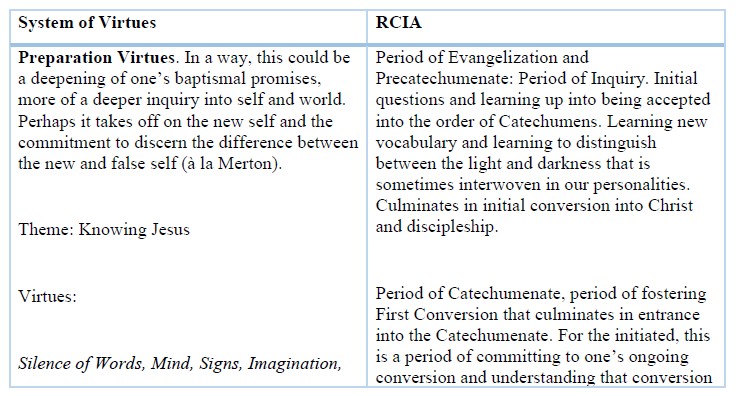
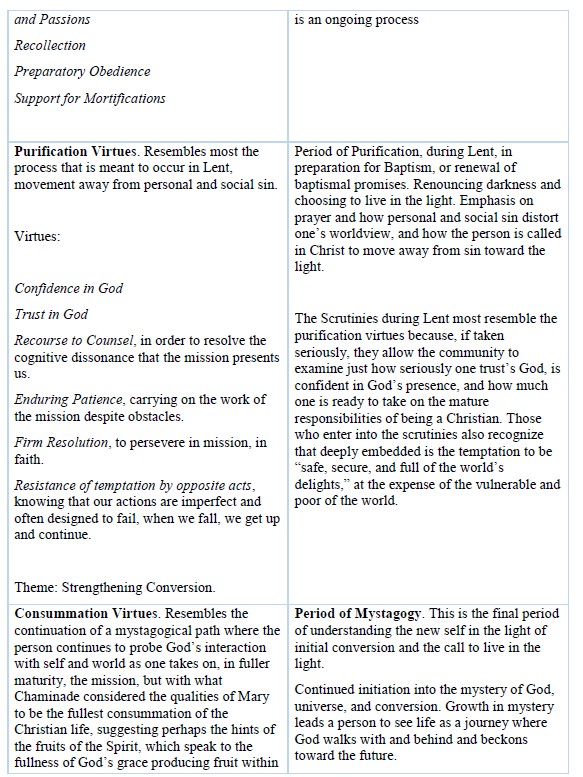
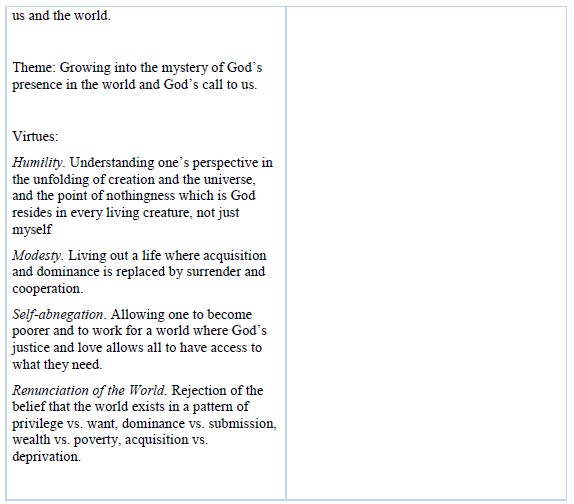
It seems to me that the entire System of Virtues is meant to build on and amplify one’s baptismal commitment. The System of Virtues, or Pathway of Virtues, is a basic road map toward maturity and integration. It points toward building the earth and world as the Spirit informs us to do.
Addendum to The Five Silences, Missionary Discipleship
And the Marianist Art of Accompaniment
At the end of my paper I suggested connecting the System of Virtues to the Church’s liturgical year. I suggested the preparation virtues tie in to the Rite of Christian Initiation of Adults, principally the Period of Inquiry and First Conversion leading into the Catechumenate. The purification virtues correspond to the Period of Preparation in the RCIA, which is really the season of Lent. The consummation virtues correspond to the Period of Mystagogy—the final period in the RCIA that talks about the “education in the mysteries.”
On further reflection, each of the Virtues could be developed in a “Lectio Divina” method, which is a method going back to the early Church where a person reflected on the continuous unfolding of scriptures as presented in the Lectionary. Lectio Divina is a more or less continuous reading of the scriptures that was roughly incorporated into the Jewish cycle of readings and then into the Lectionary as the Canon of Scriptures came into focus in the second century BCE.
The question of making the System of Virtues more a part of Marianist formation has been raised over and over. A simple and practical way of making the Virtues more a part of the Marianist in formation is to make it part of the Church’s Liturgical prayer.
The early Church had a saying that is still used today: “Lex Orandi, Lex Credendi,” which roughly translates to “the law of prayer leads to the law of belief.” Another way of saying this is, “the way of prayer leads to the way of belief.” Prayer is a principal means to shape belief and behavior. The Church prayed for centuries that Mary was the mother of God, then it eventually was defined that way. This also occurred with the Immaculate Conception. The way we pray shapes how we believe and act.
Thus, if the Marianist Family wants the System of Virtues to be more assessable to the Marianist in formation, why not adapt the individual virtues in a Lectio Divina format to the daily readings of the Church. There could be a method that emphasizes the preparatory virtues roughly during Ordinary Time, but following the flow of the RCIA; the purification virtues would correspond to Lent; and the consummation virtues would align with the season of Easter, which involves the period of Mystagogical Catechesis.
While it is dangerous to ask whether Blessed Chaminade would have embraced the Church’s liturgical year, and perhaps adapted his method of formation around the cycle of readings, one has to ask: why wouldn’t he? Chaminade anticipated many of the movements that found themselves solidified in the Second Vatican Council. The French School of Spirituality, to which he belonged, most probably influenced the French liturgical reformers of the twentieth century. One could argue that next to the other three constitutions of Vatican II, the very first Constitution on the Sacred Liturgy paved the way to the spirit and foundation of Christianity in the latter half of the twentieth century and the beginning of the twenty-first century.
I will leave it to the Marianist scholars who know Chaminade intimately through his writings to reject the notion of tying the System of Virtues to the liturgical cycle of the Church. It seems like it might be a worthy proposal to consider. If you believe that the way you pray is the way you believe and act, then perhaps Marianists in the future will pray, believe, and act out of the Virtues as part of their baptismal commitment. It is worth a thought.
What follows is a sample of how the preparation virtues could be adapted to the liturgical cycle. This proposal will either live or die on the affirmation or neglect of those who read it. In other words, if it is meant to be, it will be developed and perhaps be utilized; if not, it will be assigned to the pile of other curious proposals and efforts to make the System of Virtues more relevant.
Lectio Divina Based on the Marianist Preparatory Virtues
1. I Encounter the scripture: I read a suggested scripture.
2. I move further into silence. I ask the Spirit to move me into stillness and silence. I ask the Spirit to guide me in stillness and prayer.
I scan my…
- Body and the messages and signs it is giving me…
- Mind and senses, asking the Spirit to quiet my planning, thinking, etc.
- Passions and feelings, noting any passions and feelings that are the last to quiet
- Inner words and dialog, asking the Spirit to pause my inner tapes and schemas
- Active imaginations about my future or imaginative regrets about my past, and even valid concerns for people I know or issues that occupy my attention.
I note to myself if there is anything that my senses are asking me to discuss later in times of direction and counsel. Sometimes my senses are like a crying child who asks for contact and loving attention. Are there any that are asking for mine in this moment?
I note to myself if there is anything in particular that the Spirit is calling me to deal with or let go: fear, regret, frustration, anger, anxiety, depression, anything that is preventing me from living fully as a child of God, a child of Mary. These cries from my inner being sometimes block the voice of God and prevent me from fully being in God’s presence. I pay attention to any of these things I want to deal with further and note them for possible consultation with others.
3. I continue to center in quietness through paying attention to my breathing. I select a state I want to let go of from what I have noted above, and I choose a quality of Mary I want to further embody: humility, peace, joy, gentleness, love, zeal, or a state that is suggested by the reading I have just read.
Breathing in, I breathe in… (name the quality you seek to embody as you inhale)
Breathing out I breathe out… (name the state you want to let go: anger, frustration, etc., as you exhale). Repeat this exercise for a minute. If distracted you can come back to it.
4. I prayerfully reread the scripture passage, focusing on the themes of the mystery presented as they pertain to my life.
5. After suitable reflection on the scripture and mystery I ask myself…
- Are there any themes, directions, concerns that God is calling me to pay more attention to in the days ahead? (Preparatory obedience)
- What issues, themes, directions, worries, or feelings do I need further counsel about? Am I called to bring them to the attention of a spiritual director or my community for further guidance and clarification? (Recollection)
- How have I changed as a result of my saying “yes” to God’s call? Am I called to further change in the way I live and respond to the needs of others? How have I changed and what is the quality of the change? Can I name this change and bring it to my spiritual director or community? (Recollection, support for mortifications)
Sources and Notes:
- Homily of John Paul II, Sunday, Sept. 2000, paragraph 5. See http://w2.vatican.va/content/john-paul-ii/en/homilies/2000/documents/hf_jp-ii_hom_20000903_beatification.html.
- Teresa Trimboli, NACMS librarian, email message to the author, Feb 28, 2018.
- William Ferree, SM, “Conference on Father Chaminade’s System of Virtues,” given at Villa St. Jean (c 1936), available at NACMS, 1.
- Pope Francis, The Joy of the Gospel: Evangelii gaudium (Vatican City: Liberia Editrice Vanticana, 2013), § 85.
- Bessel van der Kolk, The Body Keeps the Score: Brain, Mind, and Body in the Healing of Trauma (New York: Penguin, 2015), ch. 1, par. 23, § 342, Kindle.
- David J Fleming, SM, A New Fulcrum (Dayton, OH: NACMS, 2014), 3.
- Fleming, A New Fulcrum, 3-4.
- Fleming, A New Fulcrum, 4.
- Paul Vallely, “Where Pope Francis Learned Humility.” The Atlantic, no. 8, (2015), par. 8. https://www.theatlantic.com/international/archive/2015/08/pope-francis-cordoba-exile-humble/402032.
- Vallely, “Where Pope Francis Learned Humility,” par. 12.
- Fleming, A New Fulcrum, 10-14.
- Catholic Catechism of the Church, 2nd ed. (Vatican City: Libreria EditriceVaticana, 2000) § 773, p. 204.
- Pope Francis, The Joy of the Gospel, § 104.
- William Joseph Chaminade, Writings on Mental Prayer (Dayton, OH: Marianist Resources Commission, 1979), § 381.
- Mental Prayer, 567.
- Mental Prayer, 381.
- Mental Prayer, 578.
- Dominique Saunier, FMI, “Prayer for Father Chaminade.” Trans. Timothy Phillips, SM (Dec. 2014, Nairobi, Kenya).
- Chaminade, Letters, no. 1163 to Preachers of Retreats, Aug. 24, 1839; vol. 5, p. 59.
- Fleming, A New Fulcrum, 16-25.
- Chaminade, Letters, no. 74 to Adèle de Batz de Trenquelléon, Sept. 30, 1816; vol. 1, pt. 1, p. 177.
- Chaminade, Letters, no. 728 to Fr. Chevaux, Mar. 4, 1834; vol. 3, pt. 2, p. 252.
- Chaminade, Letters, no. 52 to Adèle de Batz de Trenquelléon, Oct. 8, 1814; vol. 1, pt. 1, p. 132.
- Fleming, A New Fulcrum, 26.
- Pope Francis, Joy of the Gospel, § 169.
- Pope Francis, Joy of the Gospel, § 171.
- Pope Francis, Joy of the Gospel, § 128.
- Marty Solma, SM, Marianist Theme: Mary, p. 3, https://nacms.org/resources/marianist-theme-mary.
- From the song “Anthem.” “There is a crack in everything, that’s how the light gets in.”
- Pope Francis, Joy of the Gospel, § 31.
- Pope Francis, Joy of the Gospel, § 31.
- Bernard Lee, SM, The Becoming of the Church (New York: Paulist Press, 1974), 155.
- Chamindade, Letters, no. 1163, p. 59.
- Richard Crouter, Reinhold Niebuhr: On Politics, Religion, and Christian Faith (New York: Oxford University Press, 2010), ch. 3, par. 14, Kindle.
- Gaudete et exsultate, On the Call to Holiness in Today’s World, p. 98.
- It is beyond the scope of this paper to go into a full history of the See, Judge, Act movement. It is important to trace its roots to Cardinal Joseph Cardijn of Belgium, who as a priest founded the Yount Trade Unionists in 1919, which later became the Young Christian Workers in 1924. His influence on Catholic Social teaching helped Pope John XIII to enshrine this methodology into the encyclical Mater et Magistra, par. 236. It also is important to muse as to whether Cardinal Cardijin was influenced by the French School of Spirituality, and whether Chaminade’s insight of integrating prayer and action became an unconscious-but-important influence, as this School developed into the twentieth century. See http://catholicsensibility.wordpress.com.