
Click here for a downloadable PDF version of this article.
Do we really know Blessed Father Chaminade? We often know about people through particular incidents or quotes of their favorite sayings. We think of George Washington and remember the cherry tree or the crossing of the Delaware. Often, for this reason, people are stereotyped. We expect them to play the role. If they change at all, we are surprised. One may be very organized, efficient, using every moment of his or her time to the utmost advantage, but he or she still may be completely out of it because there is no love. In other words, we may know something about a person, but we really do not know the person.
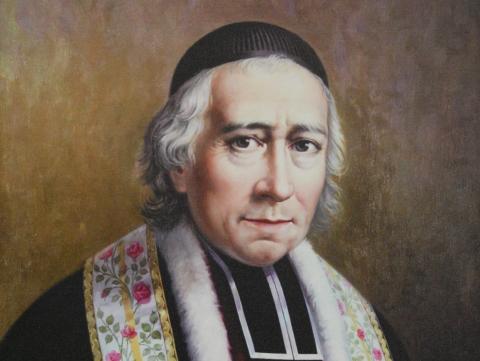
Perhaps this is what has happened with regard to Blessed Father Chaminade, Founder of the Marianist Family. We may know certain incidents of his life, recall key quotations, but we still need to discover who he is as a person. To do this we must stand reverently before him, listen to him in his context, and allow him to reveal himself. It is a task that never ends, for we never fully can grasp a human being. We can only be in awe before the other. Only in this way will we discover the character of the Founder.
Chaminade, Person of Principle and Courage
The experience of the French Revolution and his exile to Saragossa, Spain, profoundly affected Blessed Father Chaminade. How can one live a life of constant risk, experience the very evident daily protection of the Blessed Virgin Mary, and be given an insight into the Divine Plan and one’s role in it without this having a profound effect on one’s life?
Blessed Chaminade easily could have left France and still have been considered a holy and faithful priest. What made him stay? What were his inner motivations? We must stand reverently before him and listen in our hearts for the answers to these questions.
By character and temperament Blessed Chaminade was a very deliberate and prudent person. He only took risks after much prayer and discernment. Naturally speaking, his actions at this time seem so unlike him. But if we allow him to reveal his heart to us we see his deep faith and trust in the Lord Jesus. His love for Jesus makes him desirous of building God’s Kingdom, even at the risk of suffering and death.
It may sound rather adventurous to risk your neck, day in and day out, (i.e., literally, because of the guillotine), but it is only because he did so that Blessed Chaminade appreciated the continuous protection of the Virgin Mary. When, later, he constantly calls us to confidence in Mary, it is the plea of one who knows because he himself has experienced her help. To truly appreciate Blessed Chaminade, we cannot separate his teaching on Mary in his later life from his daily experience of her during the Revolution.
At Saragossa especially, in the silence and poverty of exile, many pieces fell into place in his thinking. He rarely spoke much about this publicly, though there were some innuendoes and indirect references. But there is no doubt that what happened there profoundly affected his whole life, giving him direction and purpose.
When we consider the troubles he encountered from some of his own followers during his declining years, we see that they were caused primarily because he believed that the plan revealed to him by Mary was being threatened. He insisted on his right as Founder to correct abuses, i.e., to see to it that the plan of God was faithfully carried out. He went so far as to call what the leaders were developing “a bastard society,” not the one he was inspired by God to found.
If we look into Blessed Chaminade’s heart, we find that he is truly a person of principle and courage.
Chaminade, Person Totally Centered on Jesus, Son of Mary
It is a fundamental truth of faith that God is always present in our lives, loving us, guiding us, and revealing himself to us. Usually, when we look back in retrospect, we recognize that God always has been with us. At the actual time in our lives of confusion, difficulties, and opposition, we think the Lord has forgotten us. But on reflection, even the obstacles we have to overcome do not seem as formidable as they once did. We grow continuously in trust, the more we open ourselves to God’s revealing love.
Blessed William Joseph Chaminade was no exception to this rule. To stand before him is to see how a loving God continually intervened and drew him ever closer to the Divine Will by loving bonds. This never happens automatically. God always leaves us free. Chaminade’s response to God’s loving invitation demonstrates that Jesus was central to his existence. To grasp Chaminade’s real character we must acknowledge that becoming like Jesus is a thread running through his entire life.
From the facts that we do know about Blessed Chaminade (there is so much in every life that is known to God alone), we can draw, very sketchily, his spiritual lifeline, i.e., the high points or moments of grace in which the Lord encountered the Founder. Jesus and Christian values consistently are primary to Chaminade.
We have indication of what a spiritually active boy he was at the age of twelve, following an accident he suffered at a stone quarry, his subsequent prayer for healing, and the fulfillment of a promise to make a pilgrimage to the Shrine of Our Lady of Verdelais upon his recovery.
The Collège of Mussidan was a school for those preparing for the priesthood, a minor seminary of sorts. The Congregation of St. Charles was a Pious Union of the priest-teachers on the staff and of postulants from the collège. Postulants were not admitted into this congregation before they were sixteen years of age, though there was an eighteen month to two year probation before this.
Chaminade accepted the Rule of the Congregation of St. Charles as his personal Rule of Life. This Rule had a large influence on his life. In reading the Rule of the Congregation of St. Charles, there is no doubt that union with Jesus Christ is at the very heart of it. In the very first article one reads the purpose of the Congregation—to give the greatest glory to Christ. This Rule was influenced by the Jesuit Constitutions and spirit.
Then comes a very interesting development. Jesus becomes the focal point of the member’s whole life. At every age of his sacerdotal life he is called to be united with a particular mystery in Our Lord’s life. The hope is that one day the member will be united with Jesus in glory forever. The member of the Congregation is to be conformed with Jesus by union with his mysteries. We certainly can see in these early roots Chaminade’s love for the feasts of the liturgical year and his insistence on being united with the mysteries of Jesus. Blessed Father Chaminade tried to live according to this Rule of Life throughout his life. His goal is clearly to become like Jesus as completely as possible.
Under the direction of his Jesuit brother, Jean, William was considered capable of making and living out private vows of poverty, chastity, and obedience. He was only 14. God acts in every life, if we are but aware. We cannot simply dismiss the young as immature in the ways of God.
Evidently for Blessed Chaminade there is a heightened sense of God in his life. Prayer is important to him. Consider his maturity in discerning his vocation, examining various religious orders, even living with them, to determine whether this is the way God wishes him to follow. He definitely senses God is calling him to divine service. He rejects those orders in which he cannot find the spirit of silence, recollection and prayer, or a spirit of poverty.
When we think of his life during the Revolution, his years of effort building the Sodality of Bordeaux, his struggles to base the religious congregations on solid rock and not sand, his continual labors especially during the times of rapid expansion, there is one thing constant through all this. Jesus is the center of his life.
In 1840 just before the trials he would have to undergo in his last years, he responded to the best wishes of his two religious Societies.
As members of a single family you ought to love one another as brothers and sisters, having only one heart and one soul. In union there is strength. This truth, so well understood by our forebears can be realized only in a truly Christian community, because it is in Jesus Christ alone that our strength and our life consist. Yes, my dear children, it is in Jesus Christ and his holy Mother that union produces strength.[1]
In his last years, overwhelmed by opposition, receiving slurs on his “consecration” as a Marianist because he refused to give his money and property to the “Society,” Blessed Chaminade made the claim that he made his vows a long time ago, that for him they were forever, and that he always had taken them seriously. Blessed Chaminade claimed that he could not give his money and property to a “false Society of Mary,” such as the new leaders were establishing.[2] For our Blessed Founder this was his way of being faithful to his commitment to Jesus Christ.
Chaminade’s First Goal: To Become Like Jesus, Son of Mary
Even Blessed Chaminade’s devotion to Mary is christocentric. Mary is important because she is the mother of Jesus. She cooperates with Jesus in the salvation of humanity. She has a specific role to play in the Divine Plan: to give birth also to the members of Jesus and to raise them according to his likeness. She fully cooperates with the Holy Spirit in forming them into Jesus.
Blessed Father Chaminade considered Mary as the surest, the most perfect way of becoming like Jesus. He wrote, “What greater means do we have of becoming like Jesus than to have for our mother the very mother of Jesus.” We will not understand Blessed Chaminade’s mind and heart if we exclude this lifelong desire to become more and more like Jesus, Son of Mary.
Chaminade’s Second Goal: Evangelization, To Multiply Christians
If we continue to stand before Blessed Chaminade and reverently allow him to reveal his heart to us, we cannot help but notice his determination in cooperating with Mary in the salvation of all humanity.
The Founder appreciated the consequences and the ravages of the Revolution, the religious ignorance and indifference of the masses, the divided Church because of the Civil Constitution of the Clergy, and the new philosophy of liberty, equality, and fraternity. Blessed Chaminade tried to answer the following question:
- What does it mean to be Church today in France?
- What must we do to make Jesus present and alive in our country, which has been deprived of the Good News for so long?
At Saragossa, Blessed Chaminade experienced the reality of the Church of Jerusalem. Bishops, priests, religious, laypeople all together, helping one another in exile. It was a cross-section of the universal Church, the early Christian community. See how they loved one another. They tried to help each other because the Spanish government would not let them work. While the exiles eked out a living through charity and making figurines and paintings during the day, at night they held discussions together (serious questions about their concerns: their country, their cities, their parishes, their families).
From exile, Blessed Father Chaminade wrote to Marie Thérèse de Lamourous to help sustain her in her struggle during the Revolution. But in the writing he manifests his heart in exile. “What is a faithful soul to do in the chaos of events which seem to swallow it up? Sustain itself calmly by that faith, which while making us adore the eternal plan of God, assures us that to those who love God all things work together for good. Yes, my dear daughter, the good Lord will not abandon you.”[3]
If they were to rebuild the Church in France, Blessed Chaminade knew something had to be done regarding the religious education of the young. He saw his mission as one of cooperating with Mary in making Jesus present in the world once again.
Education in faith became the operational virtue needed to be effective collaborators with the Mother of God. For him, Mary was the sign of something new, creative, dynamic, faith-filled. He knew he had to look at the challenges ahead in an entirely different way from the past. This is one reason why he turned toward starting schools, especially normal schools. He would train the teachers in the faith who would then influence an entire generation.
Chaminade’s Third Goal: Discerning All that Will Help Fulfill the Goals
We have a similar challenge today. How shall we reach the masses, as even Catholic schools close? Entering the heart of Blessed Chaminade we must ponder this question as we pray to the Mother of Jesus. In the heart of Blessed Chaminade we strive to “think outside the box, plan ahead, and read the signs of the times.” But we keep our eyes fixed on his goals, which we have made our own. We embrace all that will help us fulfill them and avoid all that will prevent us from achieving them. This is our third goal.
These are reflections that come to mind as I stand before our Blessed Founder. Others who stand in reverence before him will be inspired to see other aspects of his character. We can never assume we totally have grasped the person. Only God can do that. Our task is to allow God to do just that.
- Chaminade, Letters, no. 1187, Circular to the Two Orders, Jan. 11, 1840; vol. 5, p. 105.
- For a full development of his struggle read in Chaminade, Letters vols. 6-7. In vol. 7, letters 1519 and following.
- Chaminade, Letters, no. 10 to Mlle de Lamourous, Sept. 15, 1797; vol. 1, pt. 1, p. 49.