
Click here for a downloadable PDF version of this article.
Perhaps it was the way the woman addressed him:
"My littlest one, Juanito." [1]
Perhaps it was the way the woman identified herself:
“I am the entirely and ever Virgin
Saint Mary,
Mother of the True Divinity,
God Himself.”
Perhaps it was the inclusiveness of her caring:
“I am your compassionate Mother,
Yours, for you yourself,
For everybody here in the land,
For each and all together,
For all others too,
For all folks of every land.”
Perhaps it was the reason she wanted the church built:
“For here I shall listen to their groanings,
to their saddenings;
Here shall I make well and heal up
their each and every kind
of disappointment,
of exhausting pangs,
of bitter, aching pain.”
Most likely it was all of these and more that brought my weary heart to rest in the mystery of the Dark Woman of Guadalupe long before I had the privilege of journeying through Mexico City traffic to the peace of praying beneath the tilma of Juan Diego that hangs in her shrine.
It was another meeting, like so many meetings I attend, that brought me to Mexico City. It included a trip to the Shrine of Our Lady of Guadalupe. I expected tourists, religious souvenir hawkers, noise, cameras, and religious kitsch. I found, instead, people at prayer, silence, singing, and a depth of reverence that spoke to all who entered there that this was holy space.
I was deeply moved by the silence. This was a place of prayer. Pilgrims had walked for days and now crawled on their knees along the marble floor to signify the humility of poor, ordinary folk before the compassionate face of God represented in the image of the humblest and the most exalted of God’s creatures, Mary.
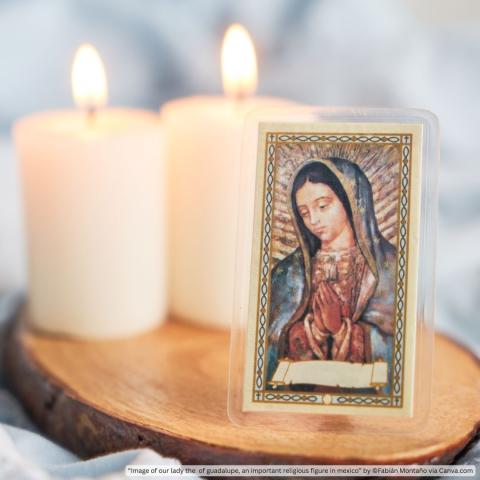
The great cathedral is dominated by the image on the cloak. It is an extraordinarily captivating picture of a young, dark skinned woman, serene and peaceful. Juan Diego would have recognized her immediately as “one of his own.” She stands tranquil and quiet, hands folded in prayer, gazing to the earth and to the one who kneels before her. Although bedecked with a beautiful blue mantle of stars, there is something familiar about her, a feeling of recognition. There was for me in that huge cathedral, among thousands of people, a distinct feeling of being home. For the first time as an adult I experienced the simple faith of the people, my people. I felt the singleness of heart that had been the life support of my parents and of their immigrant parents. The simple faith nurtured by another apparition of the dark Madonna of Czestochowa.
The image of the Virgin of Guadalupe belongs to the people. Seated on one side of me, as I prayed, was a woman, very stylishly dressed in the latest, very expensive fashion and on the other side, an extremely poor man dressed in peasant clothes with three small children. Each head was bowed in prayer. I felt deeply that we were, each of us and all of us together, of her people, part of God’s people. And this was a unity that bonded us more than any language or socioeconomic condition could divide. It was a flickering, intuitive moment of what must be the intention of the Great Paschal Vigil of Holy Saturday night.
The people come to the Shrine of Guadalupe bringing flowers, thousands and thousands of flowers. Some are shaped into floats of all description, bearing her image and the name of the parish from which they came. And some are just bouquets of flowers tied with ribbons and left to honor her. And they come singing: men, women, and children, singing their hearts out in honor of this Woman they so revere. What do the poor have that is beautiful beyond their own love and faith except flowers and song?
The Dark Woman of Guadalupe is mother of the poor, not bringing riches to veil their poverty but standing as a poor woman among them, soothing their pain. She is image of the God who became flesh among the poor, endowing their poverty with the promise of final liberation.
At one point in my visit to Guadalupe I climbed the hill behind the great cathedral to the little chapel of Juan Diego where the original apparition took place. And there with my Anglo, middle-class, theologically-educated heart I bowed my head and was blessed with holy water, dripped from a red rose from the hillside garden. And it was in that blessing that I realized that the miracle of Guadalupe really had little to do with roses in December or miraculous pictures on cloaks. The miracle of Guadalupe is something about a God who loves each of us, and the least of us, and makes of us God’s rag-tag people. And lest we be frightened by the immensity and incomprehensibility of that love, God sends flowers and a humble, dark-skinned woman, whom we readily recognize as one of our own, to deliver the message, again.
Copyright © 2014, North American Center for Marianist Studies
Note 1: All quotations are from the English translation of the original Nahuatl manuscript of the apparition, translated by the monks of Our Lady of Guadalupe Abbey in Oregon in 1983.