
Editor's Note: Marg's article stems from her involvement in Marianist Studies Program 2.0, a year-long assisted inquiry into the topic of the Five Silences: Marianist Mindfulness for the Twenty-First Century, which was conducted by NACMS in 2017-18. It was updated on September 9, 2020.
Click here for a downloadable PDF version of this article.
Introduction
I pray that out of his glorious riches he may strengthen you with power through his Spirit in your inner being, so that Christ may dwell in your hearts through faith. And I pray that you, being rooted and established in love, may have power, together with all the Lord’s holy people, to grasp how wide and long and high and deep is the love of Christ, and to know this love that surpasses knowledge—that you may be filled to the measure of all the fullness of God. (Eph 3:16-19)
Amid a world filled with noise and distraction, where can one find the time just to be; to listen to the silence of one’s heart? These verses from Saint Paul’s Letter to the Ephesians describe the desire he had for believers to develop habits of the heart: faith. So that within their very essence they would know the love of God for themselves and for others. In today’s diverse and changing church landscape, the need for ministers to be silent and to listen with depth has never been more critical. These qualities are the foundation for ministry because a minister works toward engaging people with a depth of listening, verbally and nonverbally, in a way that can bring forth a caring, compassionate, and grace-filled response. These qualities do not come naturally but come with discipline and commitment. To develop this capacity we must be grounded, aware, and skilled at listening on many different levels (to God, ourselves, and those we serve).
Through the works of Blessed William Joseph Chaminade, Founder of the Society of Mary (Marianists) and the writings on mindfulness and contemplative practice, this paper will present and explore a systematic method that will allow those in ministry to develop the discipline of silence and contemplative listening. Each section will contain both theoretical and practical elements of the process and work to help ministers, in formal and informal ministerial roles, integrate this model into their life and ministry. The paper will explain what intentional silence is and where it came from, and then it will explore how Chaminade developed it. From there it will move into a more in-depth look at the principles of Chaminade’s method and present a visual model to help put the different elements together. Near the end of the paper, there will be an exploration of the model and how this relates to both mindfulness and contemplative practice.
Intentional Silence
Over the centuries the tradition of intentional silence, at times, has been more actively practiced then at other times. Thomas Keating, founder of the contemplative practice movement, had a frustrating experience in the 1970s with Christian youth who chose to go to the Buddhist center for meditation to learn about spiritual practices instead of going to learn about this down the road at the monastery. This experience led Keating to ask, “is it not possible to put the essence of the Christian contemplative path into a…method accessible to modern people living in the world?” [1] Keating became frustrated that young Christians began to leave their traditions to follow non-Christian traditions because they did not know that the contemplative practices, followed by Christians for centuries, had a similar spiritual path. These spiritual practices were not accessible to people outside the walls of the monastery.
Almost a hundred years earlier, after the French Revolution, Chaminade also was concerned for his people as he worked to bring people back to the Church. Chaminade was a practical thinker who listened and observed the world and the people around him. As he interpreted the signs of the times he developed a unique method for living in the world and being present to others. This Marianist method involves several virtues (capacities) that a human person can attain. These capacities form a System of Virtues: preparation, purification, and consummation. This paper will focus on the first set of virtues, the Five Silences, in the preparation phase. [2]
“The Five Silences are only a first step on the spiritual journey mapped out in Chaminade’s system.” [3] These virtues were to challenge all religious brothers, sisters, and laity “to take on the mind and heart of Jesus by assuming Christ’s attitudes and dispositions.” [4] This System of Virtues grounded people, as they moved from the false self to the authentic self, to live healthier relationships with God and others. [5] This was foundational in the development of Chaminade’s vision as it served as a guidepost to direct people to grow and mature in their faith, and it helped them to align their attitudes toward bringing Christ’s mission into the world. [6] These principles included several of the following. Firstly, it includes a quality of presence that involves the body, mind, and spirit and an integrated flow of energy that moves and transforms from one to another. Secondly, by recognizing the importance of the interior condition, one places significant time and attention to silence. Silence not only becomes nonnegotiable but also becomes something that is desired. Thirdly, silence and presence are a gradual and progressive process that can only be attained through discipline and practice. Finally, the gift of grace given by the Holy Spirit allows for a collaboration to occur between one’s interior life and God. [7] These principles form the basis for the method and the model that will be presented in the next section. [8]
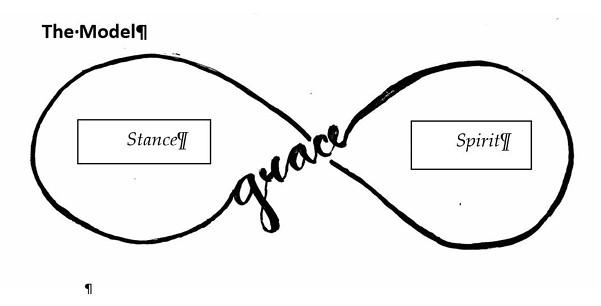
At first, working through the Five Silences might feel like a step-by-step process. However, for a Marianist steeped in this tradition, the process is more circular in design. This circular process created challenges in coming up with a design that would demonstrate the process. Chaminade’s deepest desire for his people was to experience God’s endless love (represented by the infinity symbol). The infinity symbol has no beginning and no end and is divided into two halves. On the one side is “stance,” which involves the formation, understanding, and practice of the Five Silences. On the other side is “spirit,” which involves a pondering disposition and attitude that is open, curious, and committed. In the center you will notice grace. As God is so actively present in each of the areas, grace must continually flow in and through each of the areas with great ease as it is given by God to help one transform into a new self. [9] It does not matter where one begins in the process but that one moves through each of the areas with grace and freedom. In the sections that follow, each of the areas will be explored in further detail.
Stance
“I am like a brook that makes no effort to overcome obstacles in its way. All the obstacles can do is hold me up for a while, as a brook is held up; but during that time, it grows broader and deeper, and after a while it overflows the obstruction and flows along again. That is how I am going to work.” [10] (Blessed Chaminade)
This quote describes the patience and perseverance Chaminade had as he worked toward bringing Christ’s message to the world. This patience and perseverance did not come naturally to Chaminade; as he developed an intentional discipline and attitude, it began to become second nature. In order to pass this method onto others he developed a method called the System of Virtues that could help someone develop a specific set of capacities that would guide them on their spiritual journey. Within this system was a method that prescribed a particular set of disciplines, called silences, that set out in great detail what was involved. The Five Silences are the following: words, signs (nonverbal communication), mind, imagination, and passions. The first two silences work on noticing, being attentive and intentional about what we put out into the world (outer silence). The next three concentrate on the richness within (inner silence).
Outer Silence
Silence of Words
“Listening creates a holy silence. When you listen generously to people, they can hear truth in themselves, often for the first time. And in the silence of listening, you can know yourself in everyone. Eventually, you may be able to hear, in everyone and beyond everyone, the unseen singing softly to itself and to you.” [11]
This quote by well-known physician Rachel Naomi Remen articulates well how silence and listening complement each other—setting the stage for listening to oneself and the other. Words are a form of communication that can have a positive or negative impact on people and their relationships with others. Too often people use words in frivolous ways that create distraction. Richard Rohr in Everything Belongs points out “we suffer from a glut of words.” [12] So, how can one become more aware of the words they use? Consider, for a moment, the impact words have on the lives of others. Words can bring forth life and positivity in people or create fear. They can help to build people up or tear them down.
Intentionality regarding our choice of words is key. The silence of words is not being completely silent but about becoming aware of the messages one sends through the choosing of our words. This virtue invites individuals to reflect on the words they use, when they use them, and how they use them—for disrespect or for goodness and love. A mantra suitable for this virtue would be to “speak the truth in love.” [13]
Ministers can practice the silence of words by becoming more mindful of what they are trying to communicate through their words. Do the words they use have more to do with love for the person they are working with or more to do with themselves and their egos? They can pay closer attention to the words they use and reflect on what this communicates. They can listen more and talk less.
Silence of Signs
“You are the light of the world. A city built on a hill cannot be hid. No one after lighting a lamp puts it under the bushel basket, but on the lampstand, and it gives light to all in the house. In the same way, let your light shine before others, so that they may see your good works and give glory to your Father in heaven.” (Mt 5:14-16)
These verses from Matthew invite us to be a light for the world as a sign of hope. The silence of signs explores the area of nonverbal communication. Chaminade encourages people to become aware of their “body language, to the enacting of their intentions.” [14] The common phrase “actions speak louder than words” reinforces this idea. This virtue challenges individuals to be authentic with one’s communication in order to ensure that double messages, one with signs and the other with words, are not being given. [15]
Presence communicates a lot. The way a minister attends to a person in need or invites a person into a conversation can make all the difference. The way one communicates with his or her eyes, face, and even body sends a message. Becoming aware of these messages and being mindful of what they communicate are important first steps to becoming more present. As one’s nonverbal communication mirrors Christ-like behavior in one’s gestures and looks, a minister can begin to engage with people in new ways and bring out the Christ-like behaviors in others. Questions to help a minister practice this silence can be the following:
- What are some ways you can help those you serve live in joy?
- How can you encourage others without the use of words?
Through mindful attentiveness to the outer silences, one can begin to shift attention to the work of inner silence, where as Chaminade states, “the essential is the interior.”
Inner Silence
Silence of the Mind
Do not be conformed to this world, but be transformed by the renewing of your minds, so that you may discern what is the will of God—what is good and acceptable and perfect. (Rom 12:2)
The above quote from the Letter of Paul to the Romans is a reminder of how important it is to renew one’s mind. This was most clearly articulated when I heard Jean Vanier, theologian and founder of the L’Arche community, speak in early 2002 about his experience of 9/11. He spoke adamantly about his refusal to watch the news of the twin towers falling so that these memories and images would not remain in his mind. Vanier was intentional in what he watched during that time, as he was aware of how this might impact him. Joseph Lackner, a Marianist priest, describes it this way, “just as we become what we do, so we also become what we think and what we remember.” [16] The silence of the mind is a way of intentionally becoming aware of what one puts into their mind and, in so doing, becoming aware of their thoughts, ideas and memories.
This virtue involves idea checking and filling one’s mind with life-giving images and excluding those that take away from life. [17] It is helpful if ministers can take time each day to examine and reflect upon their thoughts and memories; those that bring life and those that need healing. As they examine their thoughts they can then ponder to what their hearts are calling.
Silence of Imagination
Imagination is what can spark new ideas and shape new realities. With an imagination inspired by faith, new possibilities emerge. The silence of the imagination is a form of reality checking. This virtue helps one to examine the images that take over one’s mind. “Imagination also enables us to pass beyond ourselves, over into the other.” [18] A person can create a new story within their imagination, one that allows them to go beyond themselves and into the world of the other. This practice of moving beyond one’s self can help one learn to detach, which is a primary goal in many spiritual practices. [19] Jesus spoke about this when he said we must lose ourselves in order to find ourselves (Mk 8:30, Jn 12:25).
“Father Chaminade directs us to consider our musings, fantasies, and dreams so we may enhance those that enrich our lives as members of Christ’s body and silence or reorient those that deflect us from our mission.” [20] A minister can examine imaginations, fantasies, and expectations that enhance life and those that take away from it, which need to be silenced. She or he can imagine new ways of being and interacting with those served and can imagine how Jesus might respond when faced with difficult situations. One who practices this silence is invited to cultivate an imagination of the higher self: one that helps to bring peace and distinguishes between truth and untruth. [21]
Silence of the Passions
The silence of the passions involves becoming more aware of the role that emotion and feeling play in one’s life. This virtue encourages individuals to identify their emotion and what is underneath it. [22] Like Saint Thomas Aquinas, Chaminade encourages people to integrate emotion into who they are and how they engage with others and with God. [23] It allows for a self-differentiated, nonjudgmental stance in order to influence behavior.
To practice this virtue is to become aware of one’s feelings: to name, claim, and feel them in order to release them. Feeling awareness can move one into intentional action and give direction when lost. A minister can reflect upon the passions, desires, and feelings that are most present in her or his life. (How do these passions, desires, and feelings enhance or detract from one’s life and one’s interactions with others?)
Spirit
There is a disposition required of individuals practicing silence. It involves a pondering spirit that is committed to being open, curious, and full of delight. Openness involves having an open mind in order to self-reflect on one’s thoughts, words, and actions that create a reality outside of oneself. This is an openness to not only examine but also change that which does not bring life to oneself or to those around them. This is an openness to die to oneself in order to transform. Curiosity is what can assist in helping people to remain open to possibilities and opportunities in order to go deeper within themselves and within their relationships. The curious spirit is one that is always searching for more. Delighting in what begins to open up, interiorly and exteriorly, is one of the greatest gifts of the spirit. Delighting has an element of joy within it and can help one begin to experience God’s endless love and compassion. Paired with stance, spirit is an essential element in this process, as it works to keep the Silences from getting tired and stale; spirit keeps the stance alive and active.
Integration
The integration of the Five Silences must be done with intentionality and commitment. It was Chaminade’s intention to start with the Five Silences as a launching point from which a novice or beginner could begin a spiritual journey. Hakenewerth looks at the System of Virtues through a much wider lens, “the System of Virtues is not so much a set of habits to acquire and master by our own efforts (that could be very burdensome and discouraging), but rather a process which gradually opens us more and more to the life of God in us.” [24] This is a work of a lifetime as one explores and uncovers new things about oneself and the other. There is something new to learn at every level within the System of Virtues.
These areas—preparation, purification and consummation—within the System of Virtues closely relate to the levels of awareness of which Keating and the contemplative prayer movement speak. The diagram appears on the following page. [25]
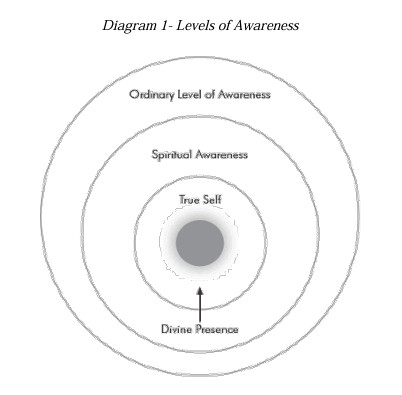
These levels of awareness help one to deepen and integrate the practice even though the practice itself might remain similar. Chaminade’s System also relates well to the ideas and concepts within the mindfulness tradition, both within the Buddhist tradition as well as the more secularized material of Jon Kabat-Zinn. This method of grounding people encourages people to slow down in their everyday practices. The work of the silences does a similar task as it helps to ground us in the everyday ordinary moments. Chaminade’s method appears to combine elements of both mindfulness and contemplative prayer. The gift of each of these systems is that they are authentic in their development as each system was developed and practiced by each of its creators. Therefore, this is not only a skill that can be practiced but also a set of principles by which to live.
Conclusion
If a man doesn’t know and doesn’t know that he doesn’t know, forget him; he’s lost. If a man knows but doesn’t know that he knows, wake him up; he’s sleeping. If a man doesn’t know and knows that he doesn’t know, teach him; he is a good student. If a man knows and he knows that he knows, follow him; he’s a leader. (Chinese Proverb)
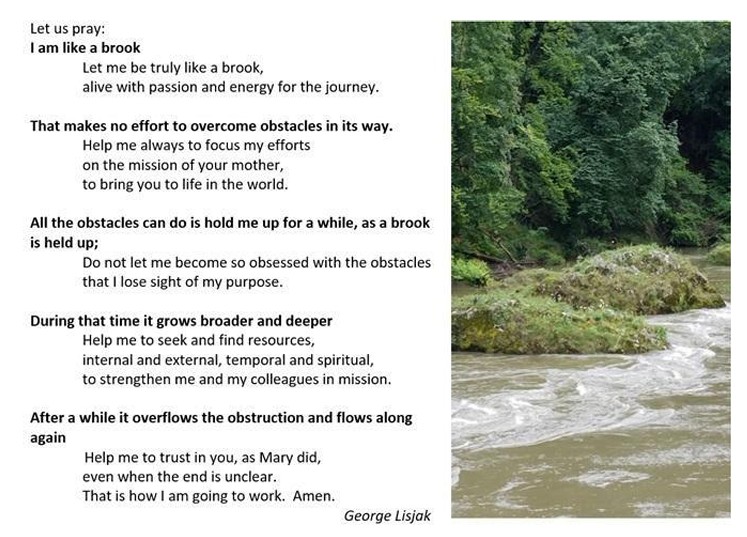
This proverb speaks of the intention beyond the Five Silences; to awaken, to understand and to know. Marianist mindfulness must be shared with the entire Christian Church because it is rich with tradition and practical application. The System of Virtues is an excellent tool for ministers to work at transforming their interior life, and in turn, the interior life of the people they serve. To conclude, here is a prayer of intention and encouragement [26] for all of those who desire to begin this journey.
Sources & Notes:
- Centering Prayer and Inner Awakening, 57.
- Quentin Hakenewerth, SM, “The Value of the Give Silences in Marianist Education” (presentation, Retreat for SM in Peru, 2014).
- Joseph H. Lackner, SM, Virtues for Mission (Dayton, OH: North American Center for Marianist Studies, 2003), 24.
- Melba D. Fisher, “System of Virtues,” Marianist Soundings, vol. 3, no. 2 (Spring 1999), 14-20.
- Fisher, Soundings, 14-20.
- Quentin Hakenewerth, SM, A Manual of Marianist Spirituality (Dayton, OH: NACMS, 2000), 18.
- Hakenewerth, A Manual of Marianist Spirituality, 18-23.
- The model is designed by Aimee Paradis.
- Joseph H. Lackner SM, Virtues for Mission (Dayton, OH: NACMS, 2003), 39.
- Quote attributed to Blessed William Joseph Chaminade, in an article by Jean Baptiste Lalanne, SM, "The Society of Mary" in Dictionnaire des orders religieux, 1854.
- Rachel Naomi Remen, My Grandfather's Blessings: Stories of Strength, Refuge, and Belonging (New York: Riverhead Books, 2000), 24.
- Richard, Rohr, Everything Belongs: The Gift of Contemplative Prayer (New York: Crossroad Publishing, 2003), 39.
- Quentin Hakenewerth, SM, “The Value of the Give Silences in Marianist Education.”
- Lackner, Virtues for Mission, 14.
- Hakenewerth, “The Value of the Give Silences.”
- Lackner, Virtues for Mission, 15.
- Hakenewerth, “The Value of the Give Silences.”
- Lackner, Virtues for Mission, 18.
- Lackner, Virtues for Mission, 18.
- Lackner, Virtues for Mission, 19.
- Hakenewerth, “The Value of the Give Silences.”
- Hakenewerth, “The Value of the Give Silences.”
- Lackner, Virtues for Mission, 21. 6
- Quentin Hakenewerth, SM, In His Likeness: A Manual of Direction for the Spiritual Life (St. Louis: Maryhurst Press, 1977), 4.
- Thomas Keating, Intimacy with God (New York: Crossroad Publishing, 1994), 67.
- George Lisjak, “I Am Like a Brook,” adapted from Blessed Chaminade, presented during a Feb. 2018 MSP 2.0 webinar.
Bibliography:
- Chaminade, Blessed William Joseph. In an article by Jean Baptiste Lalanne, SM, "The Society of Mary" in Dictionnaire des orders religieux, 1854.
- Bourgeault, Cynthia. Centering Prayer and Inner Awakening. Lanham, MD: Crowley Publications, 2004.
- Fisher, Melba D. “System of Virtues.” Marianist Soundings, vol. 3, no. 2 (Spring 1999).
- Hakenewerth, Quentin, SM. “The Value of the Give Silences in Marianist Education.” Paper presented at the retreat for SM in Peru, 2014.
- Hakenewerth, Quentin, SM. A Manual of Marianist Spirituality. Dayton, OH: NACMS, 2000.
- Keating, Thomas, Intimacy with God. New York: Crossroad Publishing, 1994.
- Lackner, Joseph H., SM, Virtues for Mission. Dayton, OH: NACMS, 2003.
- NACMS, prayer written by George Lisjak, In-class Webinar, Feb. 2018.
- Rohr, Richard. Everything Belongs: The Gift of Contemplative Prayer. NY: Crossroad Publishing, 2003.
- St. Teresa of Avila. The Interior Castle. Translated by St. Teresa of Jesus. London: Thomas Baker, 1921.
- St. John of The Cross, Dark Night of The Soul. Translated and Edited by Mirabai Starr. New York: Riverland Books, 2002.