
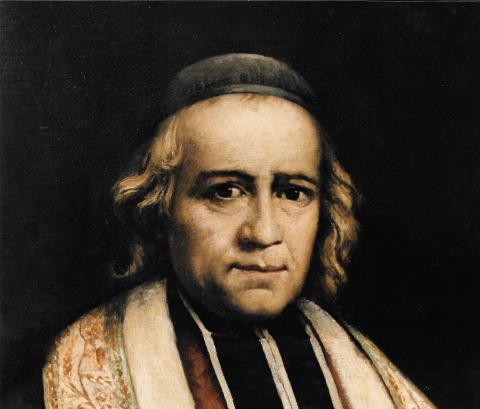
Click here for a downloadable PDF version of the article.
The genesis of this collection of reflections from Father Chaminade came out of an interest by the novices of the Region of Eastern Africa (Nairobi) for a daily reflection from Father Chaminade. It was inspired by a proposal of the Province of France. However, a local initiative was needed to fulfill that desire for such a set of reflections, and this is what happened, beginning in Lent of 2019.
The selection and compilation were made by Brother Timothy Phillips, SM, and Brother Kelvin Maona, SM, (km) when he was a novice. The selections were chosen with the idea of relating each to the readings of the day, often directly, sometimes by theme. The reflections were originally used at the celebration of the Eucharist each day, either at the beginning as an introduction or after communion, and thus reflected the readings of the day.
Because the daily readings for Lent do not change from year to year, it is hoped that these reflections can be used in any subsequent year during Lent. The two feasts celebrated in Lent are included at the end of the text.
The original texts for Sundays related to Year C. Alternate texts have been provided for the Sundays of Year A and Year B. The first and second Sundays of Lent use different Gospel texts that tell the same story; the reflection relates to the story. Occasionally there is an alternate daily reflection.
The sources of the texts used are cited at the end of each reflection. Chaminade Legacy is the English translation, published by NACMS, of the collected writings of Father Chaminade, Ecrits et Paroles. The reference system is Volume, Document, and [page within the document]. The translation of the Letters of Father Chaminade is that published by MRC/NACMS. One or two reflections combine more than one text.
We hope that this can be a helpful means of entering into the Lenten season and getting to know Father Chaminade.
Timothy Phillips, SM & Kelvin Maona, SM
January 22, 2020
African Center for Marianist Studies—Nairobi
Ash Wednesday
I am the Lord your God, be holy for I am holy” (Lv 11:44).
“Be holy,” as special sons of Mary, our most holy Mother of whom you are to be the cooperators so that, like her, you can engender Jesus in the hearts of the faithful and bring to birth children destined for holiness. “My little children, whom I bring to birth anew until. . . .” (Gal 4:19).
(Chaminade, Notes for Conferences and Sermons, Legacy, Vol. 2, Doc. 210 [204] point 3)
Thursday After Ash Wednesday
My honored brother, do whatever you consider worthwhile so that good customs and religion may be assisted and made to flower as purely, if possible, as in the early days of the Church. May the works of faith and the fruits of charity abound!
(Chaminade, Letters, no. 230, to Father Bardenet, Mar. 4, 1823)
Friday After Ash Wednesday
You will admire the special privilege granted to all the Superiors General, my successors. The title and quality of Missionary Apostolic, with which I myself have the high honor of bearing, will recall for them for all time the participation in the apostolate of Jesus Christ. We are all missionaries.
(Chaminade, Letters, no. 1193, Circular to the Priests of the Society of Mary, Mar. 8, 1840)
Saturday After Ash Wednesday
“. . . in the disclosure of your sentiments, I prefer to believe of them what your letter of February 16 says, just as what Brother Clouzet believed: so little time is needed for grace to convert a heart which still has uprightness! Brother Clouzet is himself a proof of the fact, for he is an entirely new man since the last retreat. . . . In the spiritual and supernatural order no evil is incurable. Our Lord Jesus Christ, in giving us his precious Blood, has left us a remedy which is universal and always effective.”
(Chaminade, Letters, no. 1034 to Father Lalanne, Mar. 9, 1838)
First Sunday of Lent Year A, Year B, Year C
Like a roaring lion, the demon ceaselessly roams around me to seduce me and to devour me. By means of persistent suggestions, he attacks me both day and night. And presenting evil to me under the appearances of good, he seeks to draw me under his sway.
The response: The name of Mary will serve as a shield against the arrows of Satan. Do you realize that she is as terrifying to hell as an army in battle array? Upon seeing her, the demon trembles and flees. He has not forgotten that she is the woman of whom it was said at the beginning of time that she is to crush his head by diminishing his power. And every day, to his fury, he sees her taking away souls whom he had hoped to possess forever. If he wishes to attack you, implore with confidence the help and the support of her whom the Lord has given you as mother; you will not have invoked her in vain. When the Jewish people went forth in battle, they carried the Ark with them and held it raised in the sight of their enemies in order to achieve the victory. Mary is the Ark of the New Covenant, for Jesus Christ, your Savior, enclosed himself in her womb. Carry her in your heart through a tender and sincere love, and the demons, your enemies, will flee before you.
(Chaminade, Our Knowledge of Mary, Chapter 10, Legacy, Vol. 7, Doc. 37 [68-70])
First Sunday of Lent Year C
We must lead our hearts according to the interior lights of faith. The righteous one lives by faith (Rom 1:17). . . . With the heart, we believe unto righteousness (Rom 10:10). . . . The righteous not only believe the truths which religion proposes to them; they observe them and love them. By a true affection of the heart, they make them serve as the foundation and steps toward practicing righteousness. This is how their righteousness is fed by their faith. The righteous one lives by faith (Rom 1:17).
(Chaminade, Notes for Conferences and Sermons, Legacy, Vol. 3, Doc. 148 [207])
Lent Monday Week 1
Be holy for I am holy (Lv 11:44; 1 Pet 1:16). You are all fair; there is not a spot in you (Song 4:9). How beautiful you are, my love, how beautiful you are (Song 4:1). Twice beautiful, because of the purity of body and soul which God requires of those who dedicate themselves to him. Purity of body which should be understood in a general way of purity of the senses. . . . Purity of soul which should be understood as freedom from all vices—pride, avarice, vanity, and so on. The reason for this is the great holiness of God to whom we are vowed. . . .
(Chaminade, Notes for Conferences and Sermons, Legacy, Vol. 2, Doc. 209 [198])
Lent Monday Week 1
If these filles (reforming women living at the Miséricorde) were only considered as poor . . . even if they were enemies. You agree that charity is a virtue precious to Christians, which alms and so forth. “But” you may say, “the establishment of the Miséricorde is not my work. . . . I feel no affection for it, nor zeal for this work.” . . . Your feelings are very different from those of the spouse of Canticles. She counted among the most precious graces she had received from her spouse that he set charity in order in me [Cant/Song 2:4]. Now the first effect of this order is a general and universal will to give alms, a will that extends to all the poor of Jesus Christ, without exclusion of a single one. Saint Chrysostom says this virtue must gather within our hearts all those in the world who are in need and in misery, just as they are all gathered into the heart of God. . . . Example. For God is my witness, how much I long for you all in the heart of Christ (Phil 1:8). . . . We must be able to say, when speaking to the poor . . . Our heart is expanded. You are not under constraint in us (2 Cor 6:11-12). Such universality is of the nature of charity, and therefore of almsgiving. It is in no way by natural affection or repugnance, etc. And at least as poor, they would have rights to your liberality. . . . Amen, I say to you, as long as you did it to one of these least of my brothers, you did it to me (Mt 25:40). . . . I will go even further. Even if they were your enemies. If your enemy is hungry, give him to eat; if he is thirsty, give him water to drink (Prov 25:21). If this precept had to be carried out under a law of fear, with all the more reason under a law of love. . . .
(Chaminade, Talk to the Friends of the Miséricorde, Legacy, Vol. 4, Doc. 56 [227])
Lent Tuesday Week 1: The Purpose of Prayer
The purpose of prayer is presented in the Lord’s Prayer. . . . To pray is to desire. The seven petitions which compose the entire payer are only the expression of the different desires of the Christian heart. In the first two, it is the desire for the last end, which bestows true happiness on us. In the next two, it is the desire for the means of arriving there. In the last three, it is the desire to be delivered from the obstacles which might prevent us from arriving there. Hallowed be thy name (Mt 6:9). . . . May it be glorified in me and in all my fellow-beings. . . . May we all render glory to God by our holy lives, and so on. To honor God and to have God honored. This is the end for which we were created.
(Chaminade, Notes for Conferences and Sermons, Legacy, Vol. 4, Doc. 140 [71])
Lent Wednesday Week 1
God calls sinners. Even the threats God utters when calling us are more suited to arousing our confidence than to rebuking our weakness. That is what is clearly indicated in the story of the conversion of the Ninevites. . . . Another forty days, and Nineveh shall be destroyed (Jon 3:4). Who can tell whether God will turn and forgive? (Jon 3:9). Would God have given a period of forty days to those who had nothing to hope from God? The decree is only a threat, and the threat an offer of pardon. God himself assures us of that: If I shall say to the wicked, “you shall surely die,” and they do penance for their sins . . . they shall surely live and shall not die (Ez 33:14-15). (km)
(Chaminade, Notes for Conferences and Sermons, Legacy, Vol. 4, Doc. 84 [153]; Doc. 1 [3])
Lent Thursday Week 1: Notes on Prayer
Amen, Amen, I say to you, “If you ask the Father anything in my name, he will give it to you. Until now, you have not asked anything in my name. Ask and you shall receive, that your joy may be full” (Jn 16:23-24). A magnificent promise, which only a God could make, for God alone can fulfill it. Prayer has a kind of power over the all-powerful word of God. God uses his power only over creatures; prayer acts upon God himself: the Lord obeying the voice of a man (Jos 10:14). Two essential and fundamental truths: we can be saved only by grace, and we cannot obtain grace without prayer. Without me you can do nothing (Jn 15:5). We ought to pray always, and not become weary (Lk 18:1). . . . Prayer is at once both the practice and the support of all the virtues; it exercises and enlivens them all.
(Chaminade, Notes for Conferences and Sermons, Legacy, Vol. 2, Doc. 84 [107])
Lent Friday Week 1
To Mother de Trenquelléon, 1818: For the past several months, I have been busy with the work in which you have a part. I have news to give you about it orally. Let us take courage. Impiety is making great efforts, but God will be our protector and our help. Our divine Mother will cover us and cherish us in the bosom of her tenderness. The essential thing is that all of you put to the best advantage the gifts of God and that all of you advance in virtue, each one in proportion to the strength she receives from grace.
(Chaminade, Letters, no. 97 to Adèle de Trenquelléon, Mar. 11, 1818)
Lent Saturday Week 1
I should want, in the first place, that a Director of Novices penetrate himself well with the spirit of the Society of Mary, that he feel intensely its nature and its end. The very name of the Society of Mary may reanimate all his sentiments. And in fact, what is the Society of Mary? It is a uniting of the Children of Mary, of those most committed in her interests, who, without any human respect, come together to sustain these interests, first in themselves, and then in all those with whom they have any relationship. If you have sometimes entered into the heart of our tender Mother, you have found there no other interests than those of the Sacred Heart of Jesus Christ, her adorable Son, her firstborn, our elder Brother.
(Chaminade, Letters, no. 728 to Fr. Chevaux, Mar. 11, 1834)
Second Sunday of Lent Year A, Year B, Year C
As Christians, we are to become conformed to and incorporated into Jesus Christ so as to live no longer except by the life of Christ. Look and make it according to the pattern which was shown you on the mountain (Ex 25:40) . . . . For as many of you as have been baptized in Christ have put on Christ (Gal 3:27). . . . Your bodies are the members of Christ (1 Cor 6:15) . . . that the life also of Jesus may be made manifest in our mortal flesh (2 Cor 4:10-11). I live, now not I, but Christ truly lives in me (Gal 2:20). Clarity. . . .The Lord on Tabor; his Blessed Mother in the Apocalypse, clothed with the sun, standing on the moon . . . martyrs have astounded their executioners by the splendor emanating from their bodies; have been painted with rays of glory because of that . . . Moses . . . chariot of fire of Elijah . . . made like unto the body of his glory [Phil 3:21] . . . as stars for all eternity [Dan 12:3]. Like the sun before me, and like the moon perfect forever [Ps 89:38]. . . . What a proof of immortality! What more incorruptible than light?
(Chaminade, Notes for Conferences and Sermons, Legacy, Vol. 4, Doc. 63 [39]; Vol. 3, Doc. 194 [198])
Lent Monday Week 2
Charity does not suspect evil (1 Cor 13:5). Judge not, and you shall not be judged (Lk 6:37). Do not judge according to appearances (Jn 7:24). . . . Rash judgment, one which is unfair to our neighbor and which is not based on any sufficient legitimate reason. There seem to be three degrees of rash judgment: doubt, suspicion, and judgment. They are contrary to justice and charity. (km)
(Chaminade, Notes for Conferences and Sermons, Legacy, Vol. 3, Doc. 99 [11])
Lent Tuesday Week 2: The Grandeurs of Mary
The Deep Humility of Mary: The Principle of Her Elevation into Heaven
Mary is supremely humble in her views, supremely humble in her sentiments, and supremely humble in the use she makes of this highest position to which she has been raised. Supremely humble in her views. She has no other view than to please her God, to be known by her God, and to be approved by her God. Therefore, her life is hidden and buried in obscurity. She says nothing that might attract the praise of others for her. The Gospel does not tell us that she spoke more than four times; even then, in few words, in the first movement of virtue, and to proclaim her lowliness while exalting the greatness of God. The evangelists themselves speak of her to us only in passing, as much as the life of Jesus Christ requires it of them. It seems that Jesus Christ himself, who wished to give us a model of the most perfect humility in the person of Mary, was pleased to hide from us the great virtues of his Mother. Yet her obscurity teaches us infinitely better than the most striking actions would have done. By this silence we learn not to boast of our actions—to seek, rather, to hide them from the eyes of others if possible and to always prefer the humble retirement of Mary and her simplicity to brilliant actions which could draw upon us the praises of others. . . . Oh, Mary! You whom the most profound humility has led to the most brilliant glory, obtain for us to imitate, as far as is in us, your holiness, supremely humble in its views, in its sentiments, and in the use you make of your highest position so that we may participate in the glory which surrounds you in heaven.
(Chaminade, Legacy, Vol. 6, Doc. 84 [55, 57])
Lent Wednesday Week 2: Love of the Cross
Everything was being prepared for the mystery of the Cross, so hidden in all the centuries which had preceded its manifestation. So incredible even when Jesus Christ predicted it clearly but always present to his spirit and announced by him from the beginning of the gospel. To his first disciples he said, “Whoever does not take up the cross and follow me is not worthy of me” (Mt 10:38). “If any wants to become my follower, let him deny himself and take up his cross and follow me” (Mt 16:24). (km)
(Chaminade, Notes for Conferences and Sermons, Legacy, Vol. 4, Doc. 127 [75])
Lent Thursday Week 2
Lent Thursday Week 2: Strictness of the Precept on Alms
1. Duty of charity. Just as love of our neighbor is proof that we love God, love of the poor is proof that we love Jesus Christ. . . . If human beings in general are the image of God, the poor in particular are the representatives of Jesus Christ. He is hidden in their person; he has substituted for them, is the surrogate of their duties. . . . How can those who do not love their brother [or sister] whom they see, love God, whom they do not see? And this is the commandment we have from God: that those who love God should also love their brother [or sister] (1 Jn 4:20-21). . . . I was hungry. . . . I was a stranger . . . naked . . . sick . . . As long as you did not do it to these least ones, neither did you do it to me (Mt 25:42-45). . . . If any have the substance of this world and see a brother [or sister] in need but close their heart, how does the charity of God dwell in them? (1 Jn 3:17).
(Chaminade, Notes for Conferences and Sermons, Legacy, Vol. 4, Doc. 122 [35])
Lent Friday Week 2: The Road to Hell
Take no delight in the paths of the wicked, or allow the way of evil men to please you. Flee from it; do not pass through it; detour and avoid it. . . .The way of the wicked is dark; they do not know where they might fall (Prov 4:14-15, 19). There are two roads. The path of the just (Prov 4:18). The way of sinners [Ecclus 21:11/Sir 21:10]. The way of sinners is made plain with stones, and in its end is hell, and darkness and pains (Ecclus 21:11/Sir 21:10). A scattering of roses in the imagination of the wicked, but. . . .
First Step. Slight amusement or complacency at the temptation. Example of Eve speaking with the serpent. . . . We dream of the pleasure we will have in the enjoyment of an object. . . .
Second Step. Consenting to evil, mortal sin. What an abyss!
Third Step. Impenitence not yet final, [repentance] always postponed . . . . Do not let the sun go down on your anger (Eph 4:26).
Fourth Step. From one sin to another sin, to habitual sin. . . . One sin which is not effaced by penance will quickly, of its own accord, lead to another sin (Saint Gregory the Great).
Fifth Step. Complacency in sin, joy at having committed it. Afterward they shall take delight in their condition (Ps 48/49:14). Example of Joseph’s brothers. Behold, the dreamer is approaching. Come, let us kill him. . . . And sitting down to eat their bread (Gen 37:19-20, 25). They are glad when they have done evil and rejoice in most wicked things (Prov 2:14).
(Chaminade, Notes for Conferences and Sermons, Legacy, Vol. 3, Doc. 210 [269])
Lent Friday Week 2 (Alternate): Love of the Cross
Everything was being prepared for the mystery of the Cross, so hidden in all the centuries which had preceded its manifestation. So incredible even when Jesus Christ predicted it in clear terms. . . . Here O Jesus, is the development by the prophets and the fulfillment of your desires. All the people cry out, “Crucify him, crucify him!” (Lk 23:21). Let him be crucified (Mt 27:23) (the answer of the people to Pilate, who had imprudently proposed to free Jesus instead of Barabbas). A harsh flogging and a blasphemous crowning with thorns were unable to satisfy the desires of envy or the fury of the people. . . . Alas, all the just asked for it; all the sins of mortals demanded it. . . . Finally, the sentence is pronounced. . . . And taking him, they cast him forth out of the vineyard and killed him (Mt 21:29). And Jesus also, that he might sanctify the people by his own blood suffered outside the gate. . . . Let us go forth, therefore, to him outside the camp, bearing his reproach (Heb 13:12-13).
(Chaminade, Notes for Conferences and Sermons, Legacy, Vol. 4, Doc. 127 [75-76])
Lent Saturday Week 2: On the Prodigal Son
Folly of His Departure
The prodigal son leaves the paternal home.
First Part. What reasons could this youth have had for leaving his father? None! (1) He could not have complained about his father’s character, (2) or of the treatment he was receiving in the home of his father, (3) or of the life that was lived in his father’s house. What, then, could bring him to leave?
Favors at His Welcome
1. His father welcomes him with kindness. And when he was yet a great way off, his father saw him and was moved with compassion and, running to him, fell upon his neck and kissed him [Lk 15:20]. (1) His father sees him from afar and recognizes him . . . he is the first there, that he may see him . . . his heart, rather than his eyes, recognized him in such a miserable condition. . . . (2) At the sight of him, his father is moved with compassion. . . . Yet with what presumption, disdain, and ingratitude he had left them. . . . How had he lived? Only the excess of his misery made him think of his father. . . . (3) His father runs to meet him. . . . Should he not have waited, hiding his compassion. . . . Yes, [but only] if Our Lord had proposed such a model to earthly fathers. . . . (4) His father throws himself around his neck, holds him close, embraces him tenderly. . . .
(Chaminade, Notes for Conferences and Sermons, Legacy, Vol. 4, Doc. 85 [166-167])
Lent Sunday Week 3 Year A: Retreat of 1821
“If you knew the gift of God” [Jn 4:10]. (1) Faith is the light of the mind. (2) The riches of faith are preferable to all the treasures of earth.
Just as God provided the Israelites with a column of fire to guide them through the desert, so God gives us faith to guide us and to enlighten us in the desert of this life. If we understood clearly the gift of faith which God has given us, we would make every effort to increase it within us more and more. Like the Israelites, we should march only by the light of this torch which is to guide us, even to the Promised Land. The anointing which the Christian receives at Baptism when accepting the faith makes the Christian king, priest, and prophet.
We are king because by faith we must rule over our minds, our hearts, and our bodies; these are the three subjects we are to govern. Our minds by subjecting them to the lights of faith; our hearts, by guiding all our affections by the light of faith; our bodies, by conducting them according to the maxims which faith points out to us.
We are priest, and in this quality we are to offer to God continual sacrifices of praise, thanksgiving, expiation, and abnegation.
We are prophet, through the knowledge faith gives us regarding the future. The Lord your God has chosen you that you may be the people who are his own and special among all the peoples of the earth.
Holiness of the religious vocation.
Happiness of the religious vocation.
Fidelity to the religious vocation.
(Chaminade, Growth in the Religious Life, Legacy, Vol. 6, Doc. 18 [16])
Lent Sunday Week 3 Year A (Alternate): Sermon on the Resurrection of Jesus Christ
In what way is Jesus Christ the life of our souls? . . . The soul is the life of the body; God is the life of the soul (Saint Augustine). I am come that they may have life and may have it more abundantly (Jn 10:10). You have the words of eternal life (Jn 6:69). The words I have spoken to you are spirit and life (Jn 6:64). But how is this life communicated to us? “As the Father has life in himself, so he has granted to the Son also to have life in himself” (Jn 5:26). Because Jesus Christ is life in essence, it is up to him to promise it; it is up to him to give life. Rise, you who are asleep, arise from the dead, and Christ shall enlighten you (Eph 5:14). The sacred humanity he deigned to assume in the fullness of time touched life so intimately and took on its power so completely that there sprang forth an inexhaustible draft of living water. “They who drink of this water . . . will have eternal life” (see Jn 4:13-14). Bread of life; food for life; Easter. Are we living this life? Have we resurrected? As Christ is risen from among the dead . . . so we also may walk in newness of life (Rom 6:4). New life.
(Chaminade, Notes for Conferences and Sermons, Legacy, Vol. 3, Doc. 29 [112])
Lent Sunday Week 3 Year C: Parable of the Fig Tree
Reasons for doing penance, or for profiting from [a retreat]
1. The good things God has given us. A certain man had a fig tree planted in his vineyard.
2. Our ingratitude toward God. And he came seeking fruit on it, and found none.
3. The Lord’s patience in our regard. He said to the dresser of the vineyard, “Behold, for three years now I have come seeking fruit on this figtree, and I find none.”
4. God’s justice. Cut it down, therefore. Why does it encumber the ground?
5. God’s mercy. But he answered, saying to him, “Lord, let it alone this year also, until I dig around it and put manure on it; perhaps it will bear fruit.”
6. God runs out of patience. If not, then afterward you can cut it down.
We cast a glance (1) on ourselves to see: (a.) the benefits we have received from God and (b.) our ingratitude. (2) On our God to see God’s patience, God’s justice, etc. . . .
God’s patience and mercy . . . not to root up such a beautiful tree which God had planted. . . . Not to lose the work of God’s hands. . . . Why does God wish to uproot the tree? Because it is fruitless. . . . Why does God wait? Perhaps it will bear fruit. . . . We must ask, “Lord, let it alone,” at least . . . “until I dig around it,” etc.
(Chaminade, Notes for Conferences and Sermons, Legacy, Vol. 4, Doc. 62 [34-36])
Lent Monday Week 3: Wash me yet more from my iniquity.
It is above all through the Sacrament of Confession that Jesus Christ applies to sincerely contrite sinners the precious merits of the adorable blood which he shed for the expiation of the sins of humankind. Who washed us from our sins in his own blood (Rev 1:5). How much more shall the blood of Christ . . . cleanse our conscience (Heb 9:14). Let us judge the excellence of the remedy we have in this sacrament by the one who is its author.
Excellence. The great doctor descends from heaven (Saint Augustine).
Nature. From his blood he makes a medicine for the sick (Saint Bernard). Even the greatest of sins. There is no great sin which the Sacrament of Confession cannot erase (Saint Augustine).
Swiftness. True conversion takes place without suffering (Saint Leo). Wash your heart from wickedness, O Jerusalem, so that you may be saved (Jer 4:14). By the will of God, [he] has become our wisdom and justice and sanctification and redemption (1 Cor 1:30). Let us beg Jesus Christ to be wisdom in our examination; justice in our accusation, so truth [may be] on our lips; sanctification at absolution; redemption for penance, etc. Go to Confession often. Go and wash seven times . . . and your flesh will be restored, like the flesh of a little child [2 Kgs 5:10, 14]. And cleanse me from my sin (Ps 51:4). Let us take the means for effacing the baneful consequences of sin.
(Chaminade, Notes for Conferences and Sermons, Paraphrase of Psalm 50/51, Miserere, Legacy, Vol. 3, Doc. 86 [179-180])
Lent Tuesday Week 3
Let us judge ourselves if we do not wish to be judged. Let us open our eyes to our faults; or rather, let us beg God to enlighten us. Let us do penance with sincerity and rigor. Let us not judge our neighbor. Let us offer pardon from the bottom of our hearts.
(Chaminade, Notes for Conferences and Sermons, Legacy, Vol. 1, Doc. 82 [65])
Lent Wednesday Week 3
The three great vows which constitute the essence of religious life are professed in the Society of Mary and the Institute of the Daughters of Mary. . . . By applying the great Apostle’s dictum, The letter kills, but the spirit gives life, to these constitutive obligations of the religious state, it will be easy for you to show . . . the effects of the letter and those of the spirit. Slaves of the letter, who stop with the externals of their vow and are careful not to plumb its deep spiritual meaning, begin by distinguishing material obligations, so to speak from the perfection of duty. . . . With the letter as their guide, they tell us they have measured the full extent of their duty. They have acquainted themselves with just what is permitted without fear of transgressing the vow—gravely at least—and they have figured out its precise limits in such a way that they apply their principles to everything in their use. In their admirable calculations, they find the secret of being rich in the midst of a life essentially poor. . . .
(Chaminade, Letters, no. 1163, Letter to the Retreat Masters, Aug. 24, 1839)
Lent Thursday Week 3: The Spirit of Jesus and the Spirit of the World
For to expose ourselves to temptation is to tempt God, and such a sin cannot be more suitably punished than by being abandoned by God. . . I say it is to tempt God in three ways: (1) with reference to God’s all-powerfulness, by asking God for a miracle without necessity. Others tempting him, asking him for a sign from heaven (Lk 11:16). (2) With reference to God’s mercy, by stretching beyond the limits into which it has pleased God to restrain it. . . . (3) By hypocrisy, in wanting to use dissimulation with God. . . . A person is at peace only when he is a slave of the demon. When a strong man, fully armed, guards his castle, his property is safe. . . . When the unclean spirit has gone out of a person” . . . it thinks of returning to it. “Then it goes and brings seven other spirits” to lead the person into sin and again take possession of this soul. . . . Let us then turn our attention to the thoughts of the Son of God. He goes and takes with him seven other spirits more wicked than himself [Lk 11:26]. Is not the demon of impurity ordinarily followed by the demon (1) of vengeance; (2) of disorder; (3) of impiety; (4) of injustice; (5) of lying; (6) of prodigality; and (7) of effrontery and license? (km)
(Chaminade, Notes for Conferences and Sermons, Legacy, Vol. 4, Doc. 121 [32], Doc. 6 [17], Doc. 38 [159])
Lent Friday Week 3
The expression with your whole heart and with your whole soul and with your whole mind and with your whole strength (Mk 12:30). . . . The perfection of the love of God comes not from the side of the extent and strength of sentiment, but from the side of its motive. . . . Oh, what extent!
1. What does it mean, to love God “with your whole heart”? It means to prefer God to all creatures. It means to love only God. It is to act and to suffer only for God.
2. What does it mean, to love God “with your whole soul”? It means to love God our whole life long. It means to be ready to lose our lives for God’s service and rather than disobey God. It means to sacrifice all our passions to God.
3. What does it mean, to love God “with your whole mind”? It means to walk in God’s presence and to think often of God. It means to employ all our zeal and all our industry to make God loved. . . . It means to seek whatever is pleasing to God in order to do it, and whatever might displease God in order to avoid it. It means to submit our insights to those of God.
4. What does it mean, to love God “with your whole strength”? It means to observe all God’s laws and to conform to all God’s desires, which are the rule of our behavior. It means to employ all that we have, all that we possess, in God’s service without holding anything back. It means to give ourselves to God and to God’s service with all the vehemence and all the fervor of which we are capable.
(Chaminade, Notes for Conferences and Sermons, Legacy, Vol. 4, Doc. 125 [59])
Lent Saturday Week 3
Let us continue to use allegory in order to arrive at the truth. If we compare virtues to a building, faith is its foundation. Now, who would want to lay a foundation without digging? A foundation presupposes an excavation which is made before the rocks are laid. Dig, therefore, by humility in order to build faith. Let us dig the dirt of pride from our hearts; let us provide a hole, and the Holy Spirit will fill it with the gift of faith. Let us dig even further. Let us apply ourselves to becoming all the more humble in proportion as we would like to have more faith and to do great things. There is, however, this difference between the allegory and the reality. In the first, we must have finished digging before putting in the first stone; in our hearts, faith fills the void even as we are producing it. . . . Although humility precedes faith, the most efficacious means of acquiring humility is to perform all our actions in the light of faith. Let us want to believe that faith teaches us what we are in nature, destiny, and virtue. Let us want to believe what faith teaches us about God, his grace, mercy, lordship, and grandeur. Humility will follow. The mutual assistance these two virtues give to one another will take us a long way.
(Chaminade, Notes for Conferences and Sermons, Legacy, Vol. 1, Doc. 82 [41])
Lent Sunday Week 4 Year A: A Man Born Blind
“[The true light] which enlightens everyone was coming into the world” [Jn 1:9]. No created mind was able to think, to reason, to discern truth from error and good from evil, except by the light communicated by this eternal, unchangeable light present to all minds. This is what he is as God. He is also the light for all as Son of God made man, sent by his Father to enlighten us and to draw us out of the darkness into which sin had cast us. Jesus Christ is the light of mortals (1) because he enlightens our minds; he helps us to know what should be done and what should be avoided. (2) He is light through faith. “Believe in the light, so you may become children of the light” (Jn 12:36). (3) By his word. (4) By his example. (5) By the life of so many Christians.
(Chaminade, Jesus Christ, Eternal and Substantial Light, Notes for Conferences and Sermons, Legacy, Vol. 2, Doc. 66 [33])
Lent Sunday Week 4 Year C: Parable of the Prodigal Son
“So he got up and came to his father” (Lk 15:20). His return to his father, a figure of the return of the religious soul to God. For this son belonged to a very rich father and had received a rich inheritance. Who is the father, and what is the inheritance of the religious?
We must return seriously to the abuse of grace and the loss of time. The prodigal son considers the extreme need into which he has fallen by leaving the house of his father and by the dissipation of his goods.
First motive for his return: his bitter regret for having offended such a good father; the remembrance of his tenderness and his goodness.
Second motive for his return: the confidence he has in his father’s goodness.
Third motive for his return: a religious should say, “Ah, I myself have reduced myself to this miserable condition; by my negligence and my half-heartedness; I have deprived myself of the graces of the Holy Spirit.”
“I have sinned against heaven which commanded me to obey you; I have sinned against you by my ingratitude.” See how he speaks with feelings of penance! He does not ask to be reinstated to his previous favors. He gives himself over to the hardest work, and the most humiliating; he desires to be counted among the lowest of the hired help. He returns to his father, poor, exhausted, covered in rags. A father always knows his son. He should have closed the doors. No, he even goes out to meet him. He clasps him, embraces him. This does not prevent the son from doing what he had planned to do—he weeps, he moans, he humbles himself. The more he humbles himself, the more the father shows tenderness, the more he hugs him, the more he pardons him, the more he caresses him. “Come,” says the father.
(Chaminade, Retreat of 1824, 17th Conference, Legacy, Vol. 6, Doc. 27 [65-66, 69-70])
Lent Monday Week 4: Faith in Jesus Christ
To know God and God’s Son Jesus Christ is life eternal; that is, to have the knowledge which our faith gives us of God and of his Son Jesus Christ is to be on the way to eternal life. Our faith in Jesus Christ consists in knowing truly in our hearts that he is the Son of God. Let us love to repeat endlessly these words of eternal life which Saint Peter spoke, “You are the Christ, the Son of the living God” (Mt 16:16).
(Chaminade, Directives for the Society of Mary In the Ways of Salvation, Legacy, Vol. 6, Doc. 76 [8])
Lent Tuesday Week 4
In the porches lay a great multitude of the sick, the blind, the lame, the withered, waiting for the moving of the water. . . . And there was a certain man there who had been 38 years under his infirmity waiting for the moving of the water (Jn 5:3, 5).
First Point. Similarity and difference. The union of all the sick around the healing pool presents us with the image of our gathering for the retreat; in both situations, all await the movement of the water, with hope for their cure.
Second Point. Our Lord Jesus Christ will ask each person individually, as of the sick, “Do you wish to be cured?” There is a difference—only one could be cured in the pool, but all of us can be cured in this retreat. Do not consider your malady as incurable. Whatever difficulties there may be in curing it, do not draw from it dangerous resolutions of discouragement and despair. In beginning a retreat, be deeply persuaded from the first that (1) God desires your salvation and your cure. (2) Make all your efforts to show that you wish it, with confidence in the divine mercy, with the resolve of your goodwill. Consider this miracle in the Gospel as a happy foretaste of what will happen to you during the retreat.
(Chaminade, Retreat of 1824, 1st Conference, Legacy, Vol. 6, Doc. 26 [1])
Lent Wednesday Week 4
I am sorry for you, that you know and love so little this God who is goodness itself and his adorable Son, crucified for us. As an effect of his goodness, God calls you to himself; God wishes to unite you to himself and make you share in his own happiness. God’s holiness and justice do not allow him to do so because of the condition of impurity and uncleanness in which you are. On God’s part, is it not an infinitely touching gesture of mercy for him to undertake to purify you and render you less unworthy to be united to him in such an intimate way? Whatever interior or exterior suffering you may have to undergo, should you not recognize God’s love for you and his paternal goodness? Who better than God can balance the remedy of his justice with the harm sin has caused to your soul? I would dare to say, then, that here this is a type of interplay of love—the soul experiences such great pains only because God continues to inspire in it an ever-greater love for him; that by increasing the suffering of the penitent soul, love strengthens and sustains it. The soul goes so far as to complain of its suffering, and yet it loves this suffering because it loves God. . . .
(Chaminade, “The Practice of Mental Prayer. The Purgative Way,” Legacy, Vol. 7, Doc. 11 [31])
Lent Thursday Week 4
Our actions should be made (1) in the state of grace; (2) with attention; and (3) with purity of intention. . . . I seek not my own will but the will of him who sent me (Jn 5:30). . . . We should perform all our activities with reference to our Lord—that is, through imitation, dependence and union. With Christ, through Christ, and in Christ. [But in our actions, Christ asks] How can you believe, you who receive glory from one another; but you don’t see the glory which is from God alone (Jn 5:44). Faith requires a humble and submissive spirit, bringing into captivity every understanding into obedience to Christ (2 Cor 10:5). Pride of the spirit is a hindrance and an obstacle to the reception of faith. (km)
(Chaminade, Notes for Conferences and Sermons, Legacy, Vol. 4, Doc. 143 [85]; 23[91])
Lent Friday Week 4
I would have still more desired to speak to you of the august Protectress and Mother of the Society, the divine Mary. Your love for her, your entire confidence, the habitual desire you have of forming part of her special family, of the Society that is so glorious in bearing her name, of this Society, so feeble and so imperfect in the universality of its members and above all, in its first Superior, but which believes itself so strong and so powerful in the possession of the Name of Mary, as to attack what is strongest and most powerful in this century. . . .
(Chaminade, Letters, no. 388 to Fr. Noailles, Feb. 15, 1826)
Lent Saturday Week 4
The depths of the infernal abyss vomit forth dense clouds of black and pestilential smoke (Rev 9:2) that threaten to envelope the whole earth in a dark night, void of good, full of all evil, and impenetrable we might say to the life-giving rays of the Sun of Justice. Consequently, the divine light of faith is growing dim and being extinguished in the very midst of the Christian world; virtue is becoming more and more rare, is disappearing, while vice is breaking loose with frightful fury. It seems that we are about to see what has been foretold, a general defection and an apostasy really all but universal. This description of our times, unfortunately so exact, is however far from discouraging us. Mary’s power is not diminished. We firmly believe that she will overcome this heresy as she has overcome all others, because she is today, as she was formerly, the incomparable Woman, the promised Woman who was to crush the serpent’s head: and Jesus Christ in never addressing her except by this sublime name, teaches us that she is the hope, the joy, and the life of the Church and the terror of hell.
(Chaminade, Letters, no.1163, Letter to the Retreat Masters, Aug. 24, 1839)
Lent Sunday Week 5 Year A: Raising of Lazarus
His sepulcher shall be glorious (Is 11:10).
The glory of important people of the world ends in the tomb. Contrarily, the glory of Christ begins in the tomb. This is the reason for the joy with which both the church and its true children burst forth on [Easter] this day. The just, always resembling Jesus Christ, will also be glorious in their burial (see Is 11:10).
Jesus Christ is risen; the just must rise. Jesus Christ is risen glorious and triumphant; the just will also share in the glory and triumph of the resurrection of Jesus Christ. The resurrection of Jesus Christ is the perceptible and assured proof of the resurrection of the just. . . .
Why, instead of presenting immediately the glory of the resurrection of the just, do I first present to you proof that he will arise? The resurrection of the dead is surely the most criticized statement of the Christian faith (Saint Augustine). The faith of Christians is the resurrection of the dead (Tertullian). Moreover, is not this resurrection a first triumph? Therefore, death does not have an absolute effect; it is an interruption of life, a sleep, rather than a death.
If Christ is preached as risen from the dead, how is it that some among you say that there is no resurrection? (1 Cor 15:12). One is the consequence of the other. It will be this risen God who will repair the ruins of death and restore our bodies to their original form and original state. He will reform the body of our lowliness (Phil 3:21). This will not be only through the efficacy of his intercession or the strength of his merits, but through the absolute dominion which the Man-God has over all nature. According to the power whereby also he is able to make all things subject to himself (Phil 3:21). Thus Job ties the notion of his resurrection to the notion of the resurrection of Jesus Christ. I know that my redeemer lives and that in the last day I shall rise from the earth (Job 19:25).
Jesus Christ is our Head . . . and if he wishes, as Head, for his members to act as he does, to suffer as he does, to live and to die as he does, why would they not arise like him? The first fruits of those who sleep (1 Cor 15:20). The firstborn from the dead (Col 1:18). If there is no resurrection of the dead, then neither is Christ risen (1 Cor 15:18). Jesus Christ owes it to himself to resurrect the just, just as he owed it to himself to resurrect himself. All power has been given to him. . . . He owes it to the just to resurrect them; to his promises; He owes it to mutual love.
(Chaminade, Notes for Conferences and Sermons, Legacy, Vol. 3, Doc. 37 [141-142])
Lent Sunday Week 5 Year C: Essential Condition for Obtaining Mercy
This essential and indispensable condition which the mercy of God requires for saving sinners is no longer to find in their hearts a love for sin, but to find there an irreconcilable hatred for that monster. What assures this mercy for the sinner? The express word of God, the teachings and actions of Jesus Christ. Now, all of this helps us to see the necessity of the condition of which we are speaking. That you should be converted from your ways and live (Ez 18:23). The prodigal son returns to his father, full of regret for his fault [Lk 15:18]. . . . The parable of the lost sheep does not suppose sentiments of repentance, of which the sheep is not capable; but it does not resist [Lk 15:4-5]. . . . To the sinful woman many sins are forgiven because she loved much (Lk 7:47). . . . To the adulteress woman, “Go your way . . . and do not sin again” (Jn 8:11).
(Chaminade, Notes for Conferences and Sermons, Legacy, Vol. 4, Doc. 85 [165])
Lent Monday Week 5: Fruits of the Birth of Jesus Christ: Growth of Faith, Hope, and Charity
1. Faith - It is truth itself which appears. So that we might more surely progress toward the truth, the truth itself, which is the Son of God, came and became the foundation of faith (Saint Augustine). To be taught by the very and only Son of God. The way, the truth, and the life [Jn 14:6]. All your children shall be taught by the Lord (Is 54:13). Jesus Christ is all truth. Knowledge of Jesus Christ is knowledge of all truth. “He will guide you into all the truth” [Jn 16:13], etc. And this is why Jesus Christ is called the light of the world [Jn 8:12]. On that day my people shall know my name; behold, I who have spoken am here (Is 52:6).
(Chaminade, Notes for Conferences and Sermons, Legacy, Vol. 3, Doc. 8 [30])
Lent Tuesday Week 5
As a virtue, penance, whether joined to the sacrament which bears its name or separated from it, includes two things: the first, to leave sin behind by a true change of life, and the second, to expiate sin by voluntary penances in keeping with these words of the Gospel, “preaching the baptism of penance for the remission of sins” (Mk 1:4; Lk 3:3). The first, to prepare for the life to come by a more holy and more regulated life. The second, to make satisfaction for the past. The one reconciles us with the divine Majesty by changing the heart, and eventually the life, of the sinner. The other anticipates the vengeance God would take someday. It draws upon us the friendship of God and gives us the right, in a sense, to our eternal predestination. But for that, it is necessary that it be sincere and candid. It must be rigorous and prompt, so that if a defective element is found in it, this may be promptly corrected. It must be undertaken through a motive of love of God, a true regret at having offended God, and a sincere desire to satisfy God’s justice to the extent that we can. . . . If we do not resist a habit, it becomes a necessity (Saint Augustine). You shall die in your sins [Jn 8:24].
(Chaminade, Notes for Conferences and Sermons, Legacy, Vol. 4, Doc. 49, [191c-f])
Lent Wednesday Week 5: Sin
‘’You will be my true disciples, if you keep my word. Then you will know the truth, and the truth will set you free’’ says Jesus. He called himself the truth. It is not permitted to choose a doubtful path which is easily proved by (1) reason . . . rules of prudence. (2) By authority. . . . In all your works let the true word go before you, and steady counsel before every action (Sir 37:16). Deep within the heart of each one of us there lies a fierce battle going on between good and evil, right and wrong, grace and sin. We want to do good and yet it is evil that we commit. We want to avoid wrongdoing and yet fall victim to it. We are indeed slaves—slaves to sin. There is no greater slavery than the slavery to sin!
Whoever commits sin is the slave (Jn 8:34). The three authors of sin: the demon, the world, the flesh.
(1) The demon. Serious sin in our soul, the image of the demon: in our intellect, lies and darkness; in our will, malice and perversity.
(2) The world adds to the deformity of the image of Satan the deceiving appearances which disguise it.
(3) The flesh places within us all the tenderness of brutes, subjects the higher part of the soul to the lower part. . . . The Apostle calls sensuality or concupiscence sin because this is the ordinary instrument which the demon and the world use to lead us into sin. (km)
(Chaminade, Notes for Conferences and Sermons, Legacy, Vol. 4, Doc. 31 [119], Doc. 72 [75])
Lent Thursday Week 5
. . . God, in the counsel of his wisdom, prepared another covenant, infinitely more perfect, independent of human inconstancy, which hell might attack but could not destroy; it would subsist eternally. This covenant would be preceded by another one, temporary, figurative, limited to a single people of the world, and destined merely to conserve in the world the hope and expectation of the eternal one. This covenant was often renewed after Abraham with the posterity of this holy patriarch because it was often broken by repeated unfaithfulness. The new covenant is no longer made with mortals, but with human nature united hypostatically to the divine nature in Jesus Christ in the mystery of the Incarnation. All the mysteries of the Incarnate Word are like its provisions. Jesus Christ joined them all together in the ark of the covenant, the divine Eucharist.
(Chaminade, Notes for Conferences and Sermons, Legacy, Vol. 3, Doc. 49 [222])
Lent Friday Week 5
Wonders performed for the establishment of the Christian religion. Jesus said, “If I am not doing the works of my father, then do not believe me. But if I do them, even though you do not believe me, believe the works” [Jn 10:37]. At least they are a striking and incontestable proof of my mission. “For it is not I alone who judge, but I and the Father who sent me . . . and the Father who sent me testifies on my behalf” [Jn 8:16-18] through the works which can only come from him. . . . The shadow of a single man, but filled with faith in the complete power of God, cures the paralytics, the cripples, and all types of maladies. Jesus Christ himself performed an infinite number of miracles for the establishment of his religion. And so the truth of the Christian religion has been proved by the wonders witnessed during its establishment.
(Chaminade, Instructions on the Apostles’ Creed, Legacy, Vol. 6, Doc. 5 [10])
Lent Saturday Week 5: Jesus on the Cross
Eight characteristics form a good captain, three intrinsic and five extrinsic. The first, to possess courage and valor. The second, to be wise and prudent. The third, to have great love for his own. . . . The third is well prefigured by the strong Eleazar, of whom it is said, “He gave himself up to deliver his people and to win for himself an everlasting name” (1 Mach 6:44). The first extrinsic condition is to unify his soldiers, to form an army. And Jesus Christ? And I, if I be lifted up from the earth, will draw all things to myself (Jn 12:32). Jesus would die for the nation, and not only for the nation, but to gather together into one the children of God that were dispersed (Jn 11:51-52). He was the cornerstone . . . as soon as he was crucified; from the rising of the sun even to its going down, my name is great among the Gentiles (Mal 1:11). . . . He set up a standard for the nations, and shall assemble the fugitives of Israel and shall gather together the dispersed of Judah (Is 11:12). I have given you to be the light of the Gentiles, that you might be my salvation even to the furthest part of the world (Is 49:6). He has officers subordinate to him. Their sound has gone forth to all the earth, and their words even to the ends of the world (Ps 18/19:5) [Rom 10:18].
(Chaminade, Notes for Conferences and Sermons, Legacy, Vol. 3, Doc. 28, [108])
Lent Passion Palm Sunday C
Christ, rising again from the dead, dies now no more; death shall no more have dominion over him. In dying to sin, he died once; as to his life, he lives for God (Rom 6:9-10). If I had had the advantage, my brothers, of preaching to you on the death of Jesus Christ, I would have helped you see how clearly it was the image of our death to sin. You would have been better able to grasp the connection between this mystery and the mystical death to sin, which is the foundation of the spiritual life of Christians. I would have said, “He died to sin. . . . So you must consider yourselves dead to sin” [Rom 6:10-11]. You were buried with Christ in baptism (Col 2:12). Jesus Christ did not merely take on human nature; he took on the form of a slave, the form of our flesh of sin. In the likeness of sinful flesh (Rom 8:3).
(Chaminade, Notes for Conferences and Sermons, Legacy, Vol. 3, Doc. 29 [111])
Lent Monday Holy Week: Avarice
Avarice is an unregulated love for temporal goods or attachment of the heart to temporal goods. It manifests itself:
- in an immoderate joy in possessing them, or in an excessive disappointment in losing them or being deprived of them;
- in ways of acquiring or conserving them that are unjust or opposed to the law of God;
- in being over-zealous to acquire them, or in the greed with which they are kept;
- in the usage we make of them beyond the limits of necessity, in order to appease our pride or sensuality or our curiosity;
- in refusing to share the surplus with the poor.
. . . . Let us be content with having food and wherewith to be covered. For those who will become rich fall into temptation and into the snare of the devil and into many unprofitable and harmful desires, which drown people into destruction and perdition. The desire for money is the root of evils; having been covetous, have wandered from the faith and have entangled themselves in many sorrows (1 Tim 6:8-10). . . . Do not labor to become rich, but set limits to your prudence (Prov 23:4). . . . Always set the example of detachment in the person of Jesus Christ, of the first Christians of Jerusalem, and of the Apostles. (km)
(Chaminade, Notes for Conferences and Sermons, Legacy, Vol. 4, Doc. 22 [87])
Lent Tuesday Holy Week: On Love of Neighbor/Friendship
I will no longer call you servants……….But friends (Jn 15:15). Friendship should have its base in reason, but in a reason enlightened by faith. Among the pagans there have been few true friendships; and even among Christians, how many unholy friendships because they have not been purified by religion. (1) We enter into all the affairs of a friend and think we are required to do so by some obligation. (2) We enter into all the passions of a friend, even the most uncontrolled and violent. (3) We enter into all the mistakes of a friend, even the most contrary to religion and the most badly founded. A new commandment I give you, that you love one another as I have loved you (Jn 13:34). . . . In order to be drawn together we must draw close to our root, with Charity and humility draw close to our unity, God, the author of every being; only the same interest, the same origin, creation, the same maker, the Lord. Why then does each of us despise our brothers . . . have we not all one Father? (Mal 2:10). (km)
(Chaminade, Notes for Conferences and Sermons, Legacy, Vol. 4, Doc. 9 [25]; 129 [84])
Lent Wednesday Holy Week: Betrayal by Judas.
Have we expiated so many faulty affections, not to say impure and sinful, with corrupt friends? See why the Lord permits the abandonment which your friends show toward you, and which on your side he commands you also to do. Alas! Do not complain if they go so far as to betray you. . . . It is not without a special command of Providence that Jesus Christ makes of betrayal the first part of the chalice which he begins to drink.
(Chaminade, Notes for Conferences and Sermons, Legacy, Vol. 4, Doc. 145 [10])
Lent Holy Thursday
“And this is my blood” [Mt 26:28] . . . words by which Jesus Christ consecrates, etc. And which at the same time acquire the appearance under which Jesus Christ gives himself to them in holy Communion, as an immolated victim, as the blood of the new covenant. In the old Law there was no solemn covenant without shedding and sprinkling of blood, but the sprinkling was all external. Here, however, it is entirely internal and spiritual, and the blood of Jesus Christ is truly spread over our souls. Could we not say that in Communion there is a kind of infusion into our souls of the body and blood of Jesus Christ; or in following the force and energy of the gospel text, that there is a kind of infusion into our souls of the new covenant through the blood of Jesus Christ? For it is both covenant and ratification of the covenant. This chalice is the new testament in my blood (1 Cor 11:25).
(Chaminade, Notes for Conferences and Sermons, Legacy, Vol. 4, Doc. 97 [32])
Lent Good Friday: Jesus Christ Carrying His Cross
1. The wood of the cross, long, thick, and very heavy, they placed upon his shoulder (Saint Bonaventure). Our sins were loaded upon the cross. He bore our sins in his body upon the cross (1 Pet 2:24). The anger of God which struck him. For the wickedness of my people have I struck him (Is 53:8).
2. Jesus Christ carries it after having experienced all sorts of ill treatment, totally exhausted, his entire body bruised.
3. Jesus Christ carried his cross with his hands bound, as the Blessed Virgin revealed to Saint Bridget; the executioners dragged him forward cruelly with a rope; others at his sides pushed him with blows of their fists. With hands tied and carrying the cross with its largest dimension on his shoulder, he was led to the place of his passion. Those who led him dragged him behind themselves, and those surrounding him struck him with their fists and acted toward him, the most docile Lamb, as though he were a ferocious beast (Saint Bridget).
Jesus Christ could not carry the cross elevated; its extremity dragged on the ground and caused him extraordinary shocks, aggravating his wounds and aggravating his thorns. Saint Bridget says he fell five times.
4. . . . when the Savior was carrying his cross, some were mocking him while others threw mud onto his head and face (Saint Vincent Ferrer, De passione). The Blessed Virgin revealed to Saint Anselm that even the children followed him, casting mud and stones upon him (Anselm). Saint Bernard says they pelted him with refuse from the streets (Serm. de lament. Virg. . .).
5. Jesus Christ carried his cross . . . surrounded by armed men; in their midst were leaders of the priests, scribes, and Pharisees. They were rejoicing at having him within their grip, like angry lions, hurling a thousand blasphemies upon him and wishing him a thousand curses. See, this is how the king of glory was despised by all. The small and the great, the noble and the commoners, together overwhelmed him with outrage and insult (Tauler).
6. Meeting the Blessed Virgin. Half dead with sorrow, she was unable to utter a single word to him (Saint Bonaventure). She followed him. Yet when the time came for Jesus, carrying the cross, to arrive at the place called Calvary, she too took up the cross in order to be crucified with him (William of Newburgh).
(Chaminade, Notes for Conferences and Sermons, Legacy, Vol. 3, Doc. 27 [99-101])
Lent Holy Saturday: Sermon for the Feast of the Resurrection
The sepulcher of Jesus Christ is a mother. Our Master entered it dead; there, he was given birth to a totally divine life. After having sought there the death of sin, I will find there the life of grace. God is our life. . . . We are buried together with him by baptism into death, so that as Christ is risen from among the dead by the glory of the Father, so we also may walk in newness of life (Rom 6:4). We are buried with Jesus Christ by Baptism, through which we participate in his death. . . . Death, sepulcher, and mystical resurrection effected by the grace of Baptism and expressed through holy ceremonies. The grace of Baptism unites us to Jesus Christ dead and risen, to Jesus Christ as he is now. Death to sin and the life of grace are inseparable in the baptized. Jesus Christ does not give himself only halfway. . . .
(Chaminade, Notes for Conferences and Sermons, Legacy, Vol. 3, Docs. 31, 32 [119/123])
EASTER SUNDAY
Christ, rising again from the dead, dies now no more; death shall no more have dominion over him. In dying to sin, he died once; as to his life, he lives for God (Rom 6:9-10). . . . Today Jesus Christ takes on again a new life, and that life is no longer according to the flesh but completely according to God. As to his living, he lives for God [Rom 6:10]. Let us move on to a new life which should be completely celestial. . . . Jesus Christ rises to an immortal life. Christ, rising again from the dead, etc. [Rom 6:9]. Let us live a life of grace eternally, so the death of sin no longer rules in our souls.
(Chaminade, Notes for Conferences and Sermons, Legacy, Vol. 3, Doc. 29 [111])
FEASTS IN LENT
March 19: Feast of St. Joseph
Love has vastly different qualities, depending on its subject. The love of a servant is less than that of a friend; that of a friend, less than that of children. But the love of father and husband is even higher. Now, what is the love of the saints for the Son of God? Love of servants, love of friends, love of children and of adopted brothers at most. But Saint Joseph received the heart of a father toward Jesus Christ, and of a husband toward his mother. Saint Rupert says, “The Holy Spirit, who guided Mary and Joseph, committed the Blessed Virgin to the faithfulness of Joseph. Then, forming the sacred humanity of the Son of God from Mary’s flesh, the Spirit put into Joseph’s heart the love of a father toward the child who was to be born.” It had to be this way because Joseph was to exercise toward him all the duties of a father, to raise him as a father does, to take care of his younger years as a father does. Therefore, he also had to have for him the love of a father.
(Chaminade, Notes for Conferences and Sermons, Legacy, Vol. 4, Do. 150 [50-51])
March 19: Feast of St. Joseph
Yes, my dear children, our destiny is in the hands of Joseph. What a powerful motive for hope and what a happy presage! Joseph the foster father of Jesus and the Head of the Holy Family, Joseph has been kind enough to accept us as his children and to permit us to call him Father! Let us then pray to Saint Joseph with all fervor and confidence. Great power has been given him in heaven and on the earth. He can obtain for us from the august Mary all that is lacking to us, all that we need, even in the temporal order, and he wishes for us all kinds of good. Let us then, my dear children, have for him an entirely filial devotion and may his name be blessed without ceasing in our hearts and on our lips with those of Jesus and Mary.
(Chaminade, Letters, no. 1253, Circular Letter to the Marianist Communities, March 21, 1841)
March 25: Solemnity of the Annunciation
Mary is united to the eternal Father in order to be the mother of all the faithful. How? Through love. “According to the flesh, she is the mother of our Head, Jesus Christ; according to the spirit, she is the mother of his members, for she cooperated through her love in the birth of the children of God to be born in the Church.” A double fruitfulness, one of nature, the other of love. “My children, I must go through the pain of giving birth to you all over again until Christ is formed in you” (Gal 4:19) All the qualities of motherhood are summed up in love. “Love is a mother, love brings nourishment.”
(Chaminade, Notes for Conferences and Sermons, Legacy, Vol. 2, Doc. 168 [53])