

The NACMS library features the largest number of Marianist-oriented books, periodicals, and unbound material in the English-speaking world, which can be a lot to keep organized. NACMS Librarian, Bro. Andrew Kosmowski’s article for Catholic Library World highlights the NACMS Library’s Marianist classification system as a prime example of a classification system within a Catholic charismatic family. He reflects on NACMS Librarian Teresa Trimboli’s work creating the original Marianist Library classification system and provides his assessment of the system’s strengths and challenges. Bro. Andrew hopes this article encourages librarians from different orders to create similar schemas for their congregations.
With permission of Catholic Library Association, this is "Marianist Library Classification: A Case Study" by Bro. Andrew J. Kosmowski, SM, as found in Volume 94, issue number 2 (December 2023) of Catholic Library World.
Click here for a downloadable PDF version of this article.
Abstract
In 2005, Teresa Trimboli, librarian at the North American Center for Marianist Studies (NACMS), published an article in Marianist Soundings [1] describing her efforts at creating a classification system for the center’s library. NACMS, which serves researchers and members of the Marianist Family [2] throughout North America and the world, uses Marianist Library Classification (MLC), which she developed. [3] Other centers for Marianist studies and Saint Mary’s University in San Antonio, Texas, utilize this system for their collections which focus on the Marianist Family.
This is a reflection on the use of this system and an analysis of its strengths and weaknesses. This discussion is also meant to serve librarians or archivists, whether serving a religious order or not, who may want to bring all materials germane to a certain order or charismatic family into a single organized place in their collection.
History of Various Christian Classification Schemata
Many special classification systems are created simply because neither the Dewey/Universal Decimal schemata nor the Library of Congress (LC) schema sufficiently meets local needs. Historically, Christian denominations have found this to be the case. Karl and Anna Jacobsen noted that the Library of Congress system was inadequate for Lutheran collections because numerous groups had come and gone. They collaborated to create a schedule to complement the LC system that filled in some gaps for their materials. This schedule also accounts for changes in names, mergers, divisions, and other problems that could perplex a cataloger of Lutheran materials. [4]
Methodists in the 1950s created a BY class for use in their institutions when librarians at Garrett Biblical Institute (and its predecessor), led by Lucy W. Markley, attempted unsuccessfully to include the Methodist Episcopal Church within the existing LC system. Furthermore, Markley noted goals to correct key problems with the LC system. By creating this system, Markley sought to develop British Methodism better in its schedules and to place these materials first in the geographic sequence, as Great Britain is the home of Methodism. Likewise, she wanted to unify holdings on and prepare a new schedule for American Methodism. [5]
Librarians at Brigham Young University (BYU) and other places throughout Utah deemed the depth of the Dewey Decimal System (DDC) insufficient for proper cataloging of materials of the Church of Jesus Christ of Latter-Day Saints. In the 1940s, Naomi and Edith Rich and Ralph and Ruth Thompson prepared an initial schema for use at the University of Utah to catalog these materials, but it stayed in-house. In the same decade, Robert Divett, unaware of the efforts at the University of Utah, developed a system as a class project at George Peabody College of Vanderbilt University. In 1958, Naomi Rich, now at BYU, and Chad Flake created Mormon Classification Schedules, utilizing the foundational work from the 1940s. [6] After a conversion to LC, the BYU librarians continued revising Mormon Classification Schedules as LC was not fully adequate. The librarians at BYU cautioned that “there is no correspondence between numbers in the Mormon Classification Schedules and numbers in the LCCS BX8600-8699 range or the DDC numbers for the Mormon Church.” [7]
Librarians at Seventh-Day Adventist institutions, frustrated by a range of five numbers within LC for general materials, the separation of biographies on Ellen White and others from the remainder of Seventh-Day Adventist materials, and other reasons, created Classification Scheme for Adventists and Ellen White. This system works but is difficult to insert into existing LC schedules. [8]
Catholic librarians have been particularly vexed with classifying Catholic materials in the LC and Dewey Decimal systems. As a result of the challenges catalogers of Catholic materials have, no fewer than three separate schemata have been created to assist in classification. Jeanette Murphy Lynn in 1937 proposed a classification schema that utilized LC as its backbone, and this went into two successor editions as more Catholic materials were cataloged. [9] Walsh developed a system for DDC which maintained much of that standard’s sequence but at the same time added sections for Catholic theology, biblical studies, and religious orders, among others. [10] Bauer created a new DDC system for Catholic libraries in the wake of the Second Vatican Council. [11] (The Catholic Library Association published at least one edition of each of these schemata.)
Various religious orders within the Catholic Church likewise have attempted to create classification systems to organize local house libraries because of inadequacies in both LC and DDC. Timon Cook, OFM, prepared schedules for the Franciscans based on Library of Congress that used BY as the first letters and then specific numbers for various subjects, complementing Lynn. [12] Joseph F. Cantillon, SJ, proposed a brief system for Jesuit communities in 1945 as a variation on the Dewey Decimal System, complementing Walsh. [13] Oliver Kapsner, OSB, created a Benedictine expansion of An Alternative Classification for Catholic Books, complementing Lynn’s and Walsh’s prior work. [14] William Ferree, SM, created a decimal-based system for the Marianists. A greater discussion on Ferree’s work follows.
Origins of NACMS and MLC
The purpose of the North American Center for Marianist Studies (NACMS) dates back to the 21st General Chapter of the Society of Mary in 1946, though seeds may be seen prior to this General Chapter. The 21st General Chapter envisioned a Second Novitiate experience composed of a “curriculum… covering…a careful study of our characteristic Marianist documents” to assist many Brothers, including those sent for higher studies and for future directors. [15] Similarly, the 24th General Chapter, held in 1961, recognized a greater need for the study of Marianist spirituality. This chapter also acknowledged the necessity to translate basic Marianist documents from French into other languages. [16] Eight years later, in 1969, the Marianist provinces of North America sent delegates to a meeting in Saint Louis to “re-invigorate reading and study of the resources of our Marianist heritage,” thus creating the Marianist Resource Commission (MRC). [17] In 1983, NACMS was founded and gradually assumed all the responsibilities of MRC. [18] NACMS also became a depository for Marianist items when houses of the Society of Mary and the Daughters of Mary Immaculate close.
Many different Marianists have attempted to create a classification schema for materials germane to the Marianist Family to meet the challenges issued by various General Chapters. Father William Ferree, SM, created one in 1943. [19] He revised and republished his classification system in 1949 [20] and 1960/1965. [21] Ferree used a decimal system, but instead of hundreds as DDC uses, Ferree’s schema uses thousands (1000-1999) to separate Marianist items from non-Marianist items. He noted that “Marianist material…would crowd up in a very few categories…and it would be necessary to develop to an extraordinary extent the subdivisions of these few categories so as to differentiate adequately between various items.” [22]
Brother Lawrence Scrivani, SM, then archivist of the Society of Mary’s Province of the Pacific, found Ferree’s system unusable, and he mentioned that two other Marianists likewise found Ferree’s system difficult. [23] As a result he created his own system that he used in the archives in his care. [24] Unlike the ten broad categories in Ferree, [25] Scrivani created six. He used three guiding principles in creating this. First, separate archival materials from library materials. Second, divide Marianist items into a small number of broad categories. Third, emphasize features of greatest import to the Marianist Family. [26]
While archivists were unable to use the Ferree system, the question remained as to whether the system was truly practical for libraries. Trimboli found Ferree’s schedules unworkable because a “great deal of material ends up in a few numbers.” (There is an irony here as Trimboli’s use of Ferree’s system led to the same problem for her that Ferree mentioned as the reason he created his system.) After she told him this, he encouraged her to revise it. [27]
As she attempted to revise Ferree’s system, Trimboli examined Scrivani’s system but quickly found it neither had sufficient divisions and subdivisions nor did it address adequately the Marianist Lay Communities and the Alliance Mariale. Likewise, Trimboli attempted to situate Marianist materials within the LC schedules but found that the materials provided in LC were too general and did not align with Marianist history. Furthermore, she found certain aspects of Marianist spirituality did not have a place within the B-BX schedules. [28] DDC was rejected because of the regular retro-conversion of numbers needed when DDC underwent revision. [29] As a result of finding these already established schemata lacking, she decided to develop a new classification system.
In creating MLC, Trimboli used eight criteria:
- Comprehensive and inclusive;
- Flexible to permit revisions as needed;
- Recognizable groupings for both patron and librarian;
- Inclusive of all branches of the Marianist Family;
- Easy for librarians to use in their collections;
- Easy use for people who may not be catalogers;
- Easily noticeable alignment with AACR2 (the cataloging standard in 2000);
- Unitive of all aspects of Marianist life, history, and spirituality. [30]
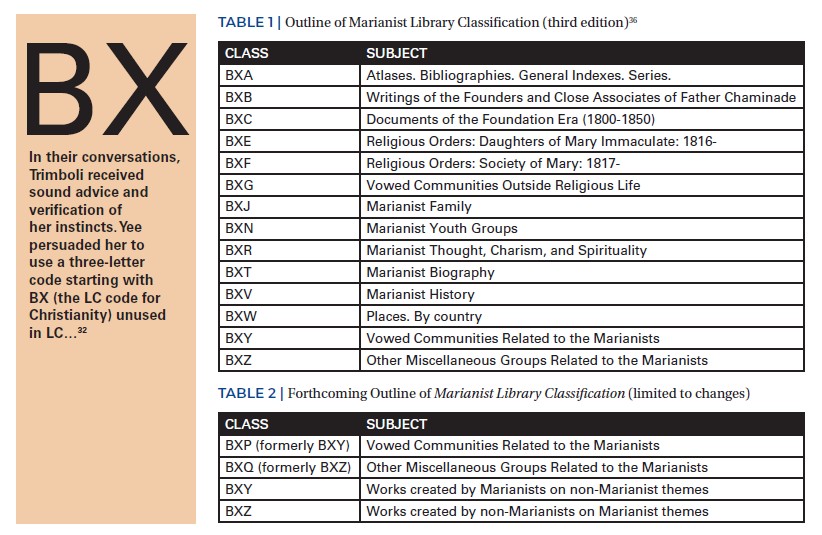
After these criteria were determined, Trimboli called the LC. Providentially, Thompson A. Yee, the acting chief of the Cataloging and Policy Support Office, answered the phone. Yee, an alumnus of a Marianist high school, [31] was encouraging as he understood immediately the goals that Trimboli had in mind. In their conversations, Trimboli received sound advice and verification of her instincts. Yee persuaded her to use a three letter code starting with BX (the LC code for Christianity) instead of W; and to leave ample spaces between class numbers to allow for future growth and revision. [32]
Trimboli decided, for many reasons, to create a system based on the LC system and to follow its cataloging practices and procedures. [33] These included the ease of revising the schedules, the simplicity of creating new call numbers, and a common structure that many academic and research libraries already use. [34] Similarly to LC, MLC uses a letter code on the first line of the call number followed by a specific number in the schedules for subjects, and Cutters to follow for author, title, further granularity, etc. Thus, the library at NACMS has used two classification schemata for nearly twenty years: LC for the general collection and MLC for the Marianist collection.
Use and Discussion
NACMS is not the only institution that uses MLC. St. Mary’s University has used this system to catalog and classify its extensive Marianist collection. [35] Likewise, when the International Center for Marianist Formation was housed in Dayton, librarians at the University of Dayton, another Marianist university, cataloged its collection using this system. Currently the Marianist seminary community in Rome, the East African Center for Marianist Studies in Kenya, and other places use this system. As a result of these uses, MLC has undergone two significant revisions, leading to a third edition, which I have used since I started cataloging at NACMS in 2019.
While cataloging the backlog, I found some places in which this structure is easy to use, and others where it is confusing. My moments of confusion have been guided by the principle, “Reduce the catalogers’ workload.” I ask questions such as, “Is this part of the schedule useful?” and “How can I make this easier for catalogers to use?” As I deviated from the instructions in the 3rd edition, I kept notes. These notes led to changes at the broadest level of classification of the third edition, which is presented in Table 1, above.
In working with the system, and aware that space is a resource, I revised this list. In the upcoming revision, BXY becomes BXP, and BXZ becomes BXQ. This allows for all groups to be nearer to each other. Furthermore, this revision allows for the addition of two significant classes: “Works created by Marianists on non-Marianist themes” (BXY) and “Works created by non-Marianists on Marianist themes” (BXZ). Creating these last two classes allows works germane to the Marianist Family to be separated from the general theological collection. These revisions were made after contacting other librarians who used MLC to ensure that their BXY and BXZ classes were devoid of materials. Table 2, above, summarizes these changes.
In the NACMS library, the creation of call numbers in BXY or BXZ maintains the LC call number. An example, using The Catholic Martyrs of the Twentieth Century by Robert Royal, will help. Royal starts the sixth chapter of his book with a summary of Blessed Jakob Gapp’s arrest and martyrdom. [37] While Jakob Gapp was a Marianist priest, the book’s focus is not on Marianists in particular, and therefore this item is entered into the BXZ schedule. The LC call number for The Catholic Martyrs of the Twentieth Century is BX 4655.2 .R69 2000. At NACMS, its call number is BXZ BX 4655.2 .R69 2000, which is the LC call number preceded by BXZ.
Classification utilizes all levels of a system, not just the class. One strength of MLC is its attention to parallelism. As we know from writing, parallelism is important for communication. In MLC, parallelism allows the cataloger to classify items more easily. BXE (Religious Orders: Daughters of Mary Immaculate: 1816-) and BXF (Religious Orders: Society of Mary: 1817-) use the same structure, with the only difference being items germane to Marianist priesthood found in BXF. [38] The Rule of Life for the women’s order is BXE 2, [39] and it is BXF 2 for the men’s order. [40] In the forthcoming 4th edition, more attention will be paid to parallelism.
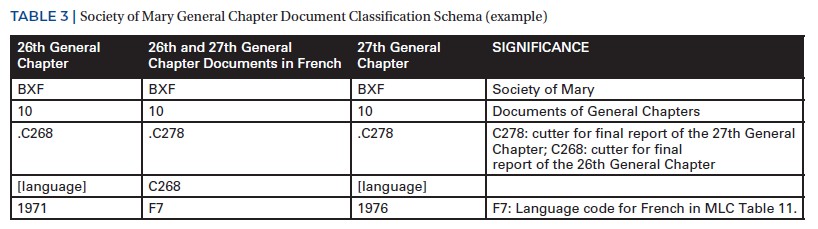
One challenge in the “Canonical, juridical, and other official documents” portion of the system was how to classify recent General Chapter documents of the Society of Mary published in French. In most of the countries where the Society of Mary is located, the Brothers published one General Chapter document at the conclusion of each chapter in their language. France chose to publish two General Chapter documents in one item, making the classification of these items difficult. To solve this dilemma, a system which would allow the documents in French to respect the consecutive nature of the General Chapter documents in other languages was needed. Table 3, above, shows the solution, and explanations of the call number follow that table.
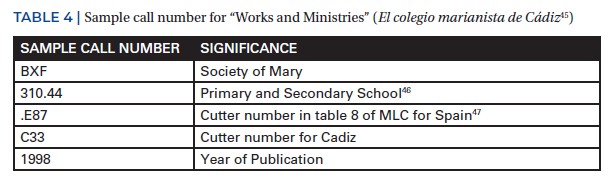
The ”Works and ministries” section has been at times challenging to use. Trimboli created this section while having a smaller number of books about the various Marianist works than what NACMS has since acquired. The section is straightforward until Cutter numbers for the institutions needed creation. At first, the Cutters for these items came from the Cutters other catalogers provided when they created LC call numbers. This option stopped working when materials about the same school ended up separated from each other by books from schools in other nations and continents. To bring materials of the same school together, I inserted the Cutter for Marianist units as found in Table 8 [44] of MLC followed by a Cutter for the city. Table 4, above, is an example.
The most important Cutter is that of the Marianist unit from Table 8 of MLC. This table is organized by continent and then by country. Employing this Cutter allows for books about schools in a certain Marianist unit or in a certain nation to be together. A Cutter for the city then allows for another level of granularity. If a city has multiple Marianist schools (e.g., Madrid or Saint Louis), a Cutter can be created especially for that school, or the city Cutter can provide distinction among the schools. NACMS uses the unit codes for schools within the United States but country codes for those outside as it serves principally a North American audience; librarians or archivists at other Marianist institutions which use MLC may decide otherwise. Other Marianist works, such as parishes and retreat centers, likewise follow this pattern established for schools.
Another befuddling part of the schedules is BXW (Places). The recommended directions for this section are “Follow BXW with country: 1st Cutter for name of place, 2nd Cutter for author (if any) or title, add date.” [48] Scope notes were not provided. This category will only hold guidebooks and maps; histories will not be placed here. Classifying in a manner like “Works and ministries” yielded similarly unsatisfying results.
After thoughtful consideration, I decided to use the DDC as a base. NACMS acquired a copy of the 22nd edition of Dewey Decimal Classification and Relative Index [49] (DDC22) to serve as its standard. To create call numbers for guidebooks and maps, the process will be to consult “Table 2. Geographic Areas, Historical Periods, Persons” of DDC22 for the number that will immediately follow BXW. The germane range of this table is page 239 through page 615. This system was devised to allow for easier shelving within BXW, each continent having a dedicated hundred to itself (e.g., Europe is 400, Asia is 500, Africa is 600, North America is 700, South America is 800, and Australia and Oceania is 900), and it lets this section mirror the bulk of MLC in that it has a three-letter code followed by a number. In the upcoming 4th edition, a table will be included to provide greater guidance. The LC system was not used as a guide for this section as LC is used in the general collection for histories of various places that are important to Marianist studies.
Conclusion
It is important to note that even library and information school students have found that, “[a]nyone unfamiliar with the Marianists could use the schedule without getting confused.” [50] As a new cataloger, I found MLC easy to use overall, despite the issues described above. Challenges using MLC came to light through greater experience and because of my familiarity with Marianist history and spirituality. These revisions and adaptations are my attempts to provide greater organization to acquisitions that NACMS did not have when Trimboli was developing MLC.
An examination of the various classification schedules suggests that quite unknowingly Trimboli matched the intentions of Mormon Classification Schedules as it underwent later revisions. Mormon Classification Schedules states that “[m]any works may be included in the Mormon Classification Schedules which would be classed with sociology, literature, etc. in other schedules.” [51] Trimboli sought to provide a common location for materials that would otherwise have been spread out in different sections of the LC system, such as BX 3784 for Society of Mary, [52] BX 4405.25 for Daughters of Mary Immaculate, [53] BX 4705 for biographies, [54] and L for pedagogy and educational institutions at various levels, among others. (At the time of the publication of this article, no Marianist has been canonized. Thus, BX 4705 is appropriate in LC.)
Trimboli’s goal was the creation of a standalone classification system to gather all Marianist-related items into one area within the library. She did not desire to have Marianist materials housed as a part of BX, but instead created a system that could follow BX on the shelves as a discrete section. In this manner, it shares a feature in common with Methodist Book Classification with its us of BY, a class level not used by LC.. Furthermore, she did not desire to create a scheme modeled on Dewey Decimal, thereby making MLC stand out from the many Catholic classification systems based on it.
Any classification system will show its incompleteness through use. As demonstrated above, MLC is no different. Trimboli understood that the original schema was lacking in completeness and in breadth. [55] These areas of incompleteness come about because the original schema was developed using “literary warrant,” [56] that is, the existing collection of books at NACMS in 2000. Through use, I am finding areas in which further guidance is needed, and these will be added into the fourth edition, such as how to create call numbers for schools and places germane to Marianists. A draft of the fourth edition will be sent to librarians and archivists of the various centers for Marianist studies, the Marianist seminary, and the Marianist universities for their thoughts.
Religious order librarians and archivists should consider MLC a successful model for their organizations if they see a need to create a classification schema to better organize their materials. They should not let potential incompleteness prevent them from creating their own classification systems for their orders. By creating their own schema, librarians can unify all aspects of their charismatic families [57] into one area of the library, thereby better promoting those charisms to their users.
Br. Andrew J. Kosmowski, SM, is lead librarian at the North American Center for Marianist Studies at Mount Saint John, Beavercreek, Ohio. During the past three summers, he has studied Marianist history and spirituality under the tutelage of significant Marianist scholars to better support the Marianist Family in the United States and his work at NACMS as a Marianist Specialist. He is also working with Marianists from different countries on how to better serve their units as Marianist Specialists.
Endnotes:
- Teresa Trimboli, “From Ferree to Eternity: An Organizational Odyssey,” Marianist Soundings 9, no. 2 (Spring 2005) 13-25.
- The Marianist Family has four main branches: The Marianist Lay Communities, the Daughters of Mary Immaculate (originally Daughters of Mary; also known as Marianist Sisters), the Society of Mary (founded in 1817 and also known as the Marianist Brothers and Priests), and the Alliance Mariale.
- Teresa Trimboli and Shirley Martyn, Marianist Library Classification,
3rd ed. (2009), accessed June 14, 2023, https://nacms.org/library/marianist-library-classification. - Karl T. Jacobsen, Library of Congress Classification Schedules for the Lutheran Church, Modified and Expanded, Together with an Alphabetical List of Lutheran Synodical Organizations (St. Paul, Minnesota: Board of Christian Education, Evangelical Lutheran Church, 1953), 1.
- Lucy W. Markley, A Methodist Book Classification (Evanston, Illinois: Garrett Biblical Institute, 1955), ii-iii, accessed June 14, 2023, https://babel.hathitrust.org/cgi/pt?id=mdp.39015030340874&view=1up&seq=11.
- Utah Library Association, Classification Schedule and Subject Headings for Mormon Literature, 2nd ed. (Provo, Utah: Utah Library Association, 1962), v, accessed August 31, 2023, https://babel.hathitrust.org/cgi/pt?id=umn.31951000887735z&seq=13.
- Harold B. Lee Library, Mormon Classification Schedules (Provo, Utah: Harold B. Lee Library, Brigham Young University, 2019), v, accessed June 14, 2023, https://cataloging.lib.byu.edu/wp-content/uploads/2013/04/Mormon-Classif....
- Felipe E. Tan and Terry Dwain Robertson, “An Evaluation of the Classification Scheme for Adventists and Ellen White,” Theological Librarianship 11, no. 1 (April 2018): 30-31.
- Jeanette Murphy Lynn, An Alternative Classification for Catholic Books, rev. 2nd ed. ed. Gilbert C. Peterson, supplement by Thomas G. Pater (Washington, D.C.: The Catholic University of America Press), 17-30.
- Richard J. Walsh, A Modification and Expansion of the Dewey Decimal Classification in the 200 Class, (1941; repr., Haverford, PA: Catholic Library Association, 1963), iii-iv.
- Mary Celia Bauer, Dewey Decimal Classification 200 Schedules
Expanded for Use (Haverford, PA: Catholic Library Association, 1988), i. - Timon Cook. Franciscana Classification (Southfield, Michigan: Duns
Scotus College, 1962). - Joseph F. Cantillon, “A Note for House Librarians,” Jesuit Educational Quarterly 8, no. 1 (June 1, 1945): 42, accessed on June 14, 2023, https://jesuitonlinelibrary.bc.edu/?a=d&d=jeq19450601-01&e=-------en-20--1--txt-txIN-------.
- Oliver L. Kapsner, Benedictine Subject Headings and Classification Schedule, 2nd ed. Enlarged (Collegeville, Minnesota: St. John’s University Library, 1964), iii—iv.
- Sylvester J. Juergens, “Acts of the XXI General Chapter, 1946,” Circulars of Very Reverend Sylvester Joseph Juergens, Eighth Superior General of the Society of Mary 1946-1956 (Kirkwood, Missouri; Maryhurst Press), 36-37.
- Paul Joseph Hoffer, “Acts of the General Chapter of 1961,” Circulars of Very Reverend Paul Joseph Hoffer (Kirkwood, Missouri; Maryhurst Press), 491.
- Norbert C. Burns, Marianist Resources Commission 1, no. 1 (January 1970), 1.
- Christopher J. Kauffman, Education and Transformation: Marianist Ministries in America since 1849 (New York, Crossroad Publishing Company, 1999), 295.
- Marianist Bibliography and Library Classification ([Dayton, Ohio],
Mount Saint John, 1943). - William J. Ferree, Marianist Archives and Library Classification
([Dayton, Ohio], Mount Saint John, 1949). - W. Ferree, Marianist Classification 1960 for Archives and
Documentary Librairies [sic] (Rome, 1960; Fribourg, 1965). - Ferree, 1960/1965, iij.
- Lawrence Scrivani, Annual Report for 1978-79 (Honolulu, Pacific Marianist Archives, 1979), 1.
- Pacific Marianist Archives, Classification Scheme for Marianist Document Libraries, Preliminary ed. (Honolulu, Province of the Pacific, 1979).
- Ferree, 1960/1965, 51.
- Pacific Marianist Archives, 1-3.
- Trimboli, 15-16.
- Trimboli, 19-20.
- Trimboli, 16.
- Trimboli, 20-21.
- Trimboli, 20.
- Trimboli, 21-23. Of interest to catalogers is that W was used by D. Glenn Hilts to contain materials on Adventists and Ellen White. Trimboli considered using W as well and was dissuaded by Yee who pointed out that the National Library of Medicine used W as a class letter. See Tan & Robertson 29 for more information about W as a class.
- “Marianist Library Classification,” North American Center for Marianist Studies, accessed on September 1, 2023, https://nacms.org/library/marianist-library-classification.
- Trimboli, 22.
- Shirley Martyn was a librarian at St. Mary’s University and assisted Teresa Trimboli in creating the third edition of Marianist Library Classification.
- Trimboli and Martyn, iii.
- Robert Royal, The Catholic Martyrs of the Twentieth Century: A Comprehensive World History (New York: Crossroad Publishing Company, 2000), 131-132.
- Trimboli and Martyn, 7-17.
- Trimboli and Martyn, 7.
- Trimboli and Martyn, 11.
- Trimboli and Martyn, 11.
- Trimboli and Martyn, 40-41.
- Trimboli and Martyn, 51.
- Trimboli and Martyn, 47-48.
- Manuel Barbadillo, El colegio marianista de Cádiz: Fundación (1888-1892) y primeros años (1892-1898) (Madrid, Servicio de Publicaciones Marianistas, 1998).
- Trimboli and Martyn, 16.
- Trimboli and Martyn, 47.
- Trimboli and Martyn, 37.
- Melvil Dewey, Dewey Decimal Classification and Relative Index, ed. Joan S. Mitchell, Julianne Beall, Giles Martin, Winton E. Matthews, and Gregory R. New (Dublin, OH: OCLC Online Computer Library Center, Inc., 2003).
- Letter from Diana Matson to Joni Cassidy, December 8, 2004. As cited in Trimboli, 25.
- Harold B. Lee Library, v.
- Cataloging Policy and Support Office, BR-BX: Christianity. Bible. Library of Congress (Washington, DC: Library of Congress Cataloging Distribution Service, 2008), 399.
- Cataloging Policy and Support Office, 407.
- Cataloging Policy and Support Office, 425.
- Trimboli 25.
- Trimboli, 19.
- The Union of Superiors General (Unione Superiori Generali) defines a “charismatic family” as a group of institutes composed of members in varied states of life that share a common spirituality as initially promoted by a particular founder or foundress. These institutes include both religious orders and lay movements. “Charismatic families: Who we are,” Unione Superiori Generali, November 6, 2020, accessed November 27, 2023, https://www.usgroma.org/l/charismatic-families-who-we-are/.