
Click here for a downloadable PDF version of the article.
After many turbulent years amidst the French Revolution that included the government’s suppression of faith and the exile of priests who would not profess their loyalty to the government, Father Chaminade was exiled from France and went to Saragossa, Spain. There he encountered the Shrine of Our Lady of the Pillar, which commemorates Mary’s apparition to St. James that occurred while Mary was still alive. In his book, Chaminade’s Message Today, Fr. Eduardo Benlloch, SM, states that “from the time he returned to France in 1800 at the age of 39, we see William Joseph Chaminade changed. He is not the same person who went into exile. He is decisive and knows where he is going. He has a personal missionary project and becomes extraordinarily creative. His life is not the same as it was before going into exile. Something clearly happened at Saragossa.”[1]
This story of Father Chaminade at Saragossa challenges each member and community within the Marianist Family to ask ourselves the following questions:
- Where do I/we experience moments of “Saragossa transformation”?
- Like Chaminade, how do we become “more decisive” to “know where we are going”?
- How do we become “extraordinarily creative” and develop a sense of “mission” like Chaminade did at the foot of Our Lady of the Pillar?
We typically articulate our mission within the Marianist Family in some form of the following phrase: “to bring Jesus into our world as Mary brought Jesus into our world.” However, what does that mean for the Marianist Family now? How specifically do we “bring Jesus into our world”? Surely, we do not bring Jesus into our world in the same way a teenage Mary of Nazareth gave birth to the infant Jesus at the first Christmas. However, we usually imply that we “give birth” to Jesus somehow in a spiritual manner, perhaps by saying “yes” to the Father’s will in our lives. We utilize this metaphor even though we know that Jesus, as such, no longer exists. The human Jesus has died and is no more. He has been transformed, we believe, into the Risen Jesus Christ.
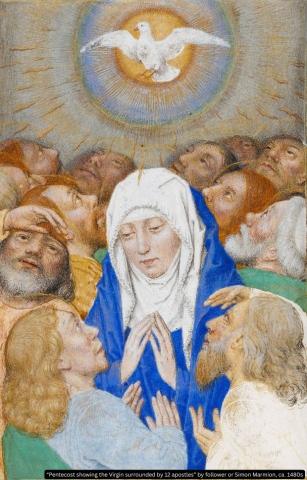
The mission within the Marianist Family is to bring Jesus, i.e., the Spirit of the Risen Christ, into our world; and our model is the “mature presence” of Mary within the struggling and nascent Christian community at Pentecost. At Pentecost, this elderly widow was approximately fifty years old. She was also the mother of an only son who was recently executed in a violent, shameful, and public manner. This elderly, wise woman must have been an instrumental figure in the life of the nascent Christian community.
Mary, at whatever age, attracts the Spirit into her life in an intimate, most exceptional, and fruitful manner. Mary, unlike at the Annunciation, however, is no longer youthful with her future in front of her. At the critical moment of Pentecost, Mary is present not only as the first disciple of her son but also as a mentor. She is a wounded, wise, and much older woman amid this first generation of her son’s disciples who are struggling to carry on Jesus’ legacy by living out their vocation of bringing the message of the Risen Christ into their first-century world. Their situation is in several ways not unlike our own in the twenty-first century. This Pentecostal model enables us to develop a “creative” and “powerful sense of mission,” like Chaminade did at Saragossa. As a Marianist community, we can return to the Pentecostal moment and pray with Mary for the coming once again of the Spirit of the Risen Christ into our world.
Mary not only brings to the Pentecostal community her initial “Yes” (Annunciation) as an innocent teen; her youthful spirit of “proclaiming the greatness of the Lord” and “rejoicing in God, my Savior” (Visitation/Magnificat); and her “Do-whatever-he-tells-you” spirit at the beginning of her son’s public life (Wedding Feast of Cana); but now, as a mature woman (at Pentecost), she brings an even deeper surrender and openness to God’s designs in her life. Her wonderfully faithful heart had suffered so much pain and loss: the death of her husband and the unjust, violent, and shameful public execution of her son. As a result, her presence was a glue keeping this fragile and youthful community together, making it possible to move forward with a spirit of hope in Jesus’ promises. Now, as members of the Marianist Family, we strive to embody the “mature” and “attractive” Marian presence and openness to the promised Spirit of the Risen Christ in every moment of our lives. This elderly, wounded, and wise Woman of Pentecost is our model and inspiration for attracting the promised Spirit of the Risen Christ into our world, both individually and communally.
Our Marianist Founders established the Marianist Family during the first half of the nineteenth century when the Catholic Church was heavily influenced by the Council of Trent and was still a post-Reformation Church with an emphasis on conformity to doctrinal formulas and external observances. Since those blessed beginnings of the Marianist Family, the Spirit has continued to bless us not only with the Second Vatican Council in the twentieth century but now with Pope Francis’ Synod on Synodality (October 2023-October 2024). This synod, with its universal representation of men and women, laity and clerics, within the Catholic Church, replicates in the twenty-first century the original gathering of the Christian community with Mary at Pentecost. The Spirit continues to “pour forth” among us, sometimes in a subtle manner and sometimes in a not-so-subtle way. As a result, we are in the midst of an “Age of the Spirit.” We are encouraged to encounter one another with an openness to the Spirit that leads to greater participation in all levels of our Church. Here are some questions for reflection.
- Have we, as a Marianist Family, kept up in our spirituality with those historical movements of the Spirit?
- Do we focus adequately on the Spirit of the Risen Christ at work in our world?
- Do we focus adequately on Mary’s role at Pentecost, as she attracts this same Spirit into our world today?
- Do we appreciate adequately how Mary’s very presence attracts, in a truly wonderful and fruitful manner, the outpouring of the Spirit in an intimate way, especially within communities?
I argue that we have not paid adequate, explicit attention to the Spirit—the Spirit of the Risen Christ—because we have not paid adequate attention to the importance of Mary’s presence at Pentecost. She is our model for approaching prayer, especially in community settings.
We often rightly refer to Mary and her Fiat at the Annunciation and her Magnificat at the Visitation, as well as her command of “Do whatever he tells you” during the Wedding Feast of Cana. We have a traditional Three O’clock Prayer with Mary at the foot of the cross. However, we refer to Mary’s presence at Pentecost very little and have no prayer, of which I am aware, where we pray with her asking for the outpouring of the Spirit of the Risen Christ within our Marianist Family communities. For me, this lack of a Pentecost prayer is a glaring omission within our Marianist spirituality and needs to be corrected!
Mary’s presence at Pentecost marks for us her most mature spiritual development as a disciple of her son. At Pentecost, Mary is now truly a wounded and wise woman and must have been attuned and attractive to the Spirit in a most extraordinary manner. Her presence at Pentecost, no doubt, was instrumental in attracting the Spirit of the Risen Christ so powerfully to this youthful and fragile community. The original Pentecostal experience serves as a model, I believe, for how best to continue to “give birth” to Jesus: that is, the Spirit of the Risen Christ, in our twenty-first century. The continuing “birth of Jesus” typically happens in a community of believers with Mary present as a mentor, as a model for attracting the Spirit of the Risen Christ. It is imperative in our prayer to recall and give priority to this Pentecostal model and her presence with us as we pray explicitly and always, “Come, Holy Spirit, come.” To me, as a member of the Marianist Family in the twenty-first century, the recalling of Mary’s presence at Pentecost and her presence with us today—in a similar manner as we pray, “Come Holy Spirit, come”—ought to be our primary prayer stance, especially when we gather as a community within the Marianist Family.
The Marianist Family and Synodality
According to Boris Giambanco, president of the International Marianist Lay Communities, “a charismatic family within the Church is one that brings its own unique way of making Christ present in our world.”[2] I argued in this paper that Mary’s presence and role at Pentecost must be highlighted today by the Marianist Family because she is the essence of how we uniquely make Christ present in our world, especially in a post-Vatican II and synodal Church looking to the Spirit for our vitality and renewal. Giambanco also states that a primary objective (in the Marianist Family) is to “nurture joint prayer spaces.”[3] Mary at Pentecost is our unique and primary model for nurturing “joint prayer spaces.” As members of the Marianist Family, we believe Mary is the first disciple of Christ and a model for all members of our synodal Church.
It is particularly appropriate that in the final document of the recent Synod on Synodality, after describing the history and purpose of synods in the Church, the document points to Mary as the model of a synodal Church.
We see the features of a synodal and merciful Church shining in full light in the Virgin Mary, Mother of Christ, of the Church, and of humanity. She is the form of the Church who listens, prays, meditates, dialogues, accompanies, discerns, decides, and acts. From her we learn the art of listening, attentiveness to God’s will, obedience to God’s Word, and a readiness to hear the needs of those who are poor and to set out along the path. We also learn the love that reaches out to aid those in need and the song of praise that exults in the Spirit.[4]
[For the “Attitudes that enable genuine listening and dialogue in the Synodal Process,” see section 2.3 of the Vademecum, which is attached to this work as Appendix C.(5)]
Mary is our model for how to be and act in our synodal Church, a Church that is relational and prioritizes listening, listening from the heart. It is striking that the final document ends by entrusting the results of the synod to the Virgin Mary and references her presence in the Upper Room at Pentecost. In other words, the synod ends by praying with Mary that its work bears fruit. “May she, the Mother of the Church, who in the Upper Room helped the newly formed community of disciples to open themselves to the novelty of Pentecost, teach us to be a People of disciples and missionaries walking together, to be a synodal Church.”[6]
In other words, just as at the beginning, may the mature presence of Mary now mentor us as we develop a more synodal Church. I would also add a more Marian Church.
Pastoral Implications
When I am present in a Marianist community at prayer, it is imperative to call to mind Mary’s presence with us as she was present with the original Christian community at Pentecost. Mary’s presence at Pentecost represents, as far as we know, her most mature relationship on earth with the Holy Spirit. The Spirit of God led this young girl on a journey with her son that eventually led to this gathering of his most faithful followers, who looked and hoped desperately for the promised return of his eternal Spirit—a Spirit most of them had experienced only in a fleeting manner. Now, all the first disciples longed for the promised outpouring of his Spirit on an ongoing basis after his rather sudden and violent passing, followed by his resurrection and departure.
The “mature Marian presence at Pentecost” is important for us to recall as we approach prayer because our situation is akin to the original Christian community. Like them, we come to prayer in faith after his “passing,” resurrection appearances, departure from this world, and, most importantly, after his promise to send his Spirit and not leave us “orphans.” It is important to begin communal prayer by recalling not only his promises to send us his Spirit but also by recalling Mary’s presence with us, just as she was present with that Pentecostal community long ago. We continue in that blessed tradition by gathering in the name of her son.
Engaging in communal prayer within the Marianist Family, it is appropriate not only to recall Mary’s presence within the original Christian community at Pentecost but also her presence with us in the present moment. Like the original community with Mary, we also seek to experience anew with her the promised Spirit of the Risen Christ today. “I will not leave you orphans; I will come to you” (Jn 14:18). Praying for the outpouring of the Spirit of the Risen Christ among us is the beginning of carrying out our mission of “bringing Jesus into our world.” In fact, it is difficult to imagine accomplishing this mission without praying regularly with Mary for the continued coming of the Spirit of the Risen Christ among us. Of course, that invocation is only the first step. We must then actualize the presence of that Spirit concretely in our actions, in our relationships, and in building up the Kingdom of God.
In summary, our first step as a Marianist Family is the same as the original Christian community. We carry out our mission within the Marianist Family of “giving birth to Jesus in our world” by praying with Mary for the outpouring of the Spirit of the Risen Christ in our midst. The Spirit of the Risen Christ builds the Kingdom of God among us. Our second step is a process of continually expressing this same Spirit in transforming our presence and activities in our daily lives.
We pray with a “mature and wise” Mary now because she is our model; she is the one who best attracts the Spirit. At Pentecost and when she prays with us now in our Marianist communities, she brings her most mature self, her most spiritually developed presence. Mary brings with her all the earlier experiences and challenges of her unique spiritual journey and prays with us. We allow her most spiritually developed presence to lead us, at this time and in our place, as members of her family. Praying with Mary for the outpouring of the Spirit, rather than to Mary, is consistent with the Second Vatican Council’s document on the Church (Lumen gentium), which in Chapter 8 describes Mary’s role as a member within the Church, rather than creating a separate document on Mary and implying that her role is somehow separate from the Church, the People of God.
Conclusion
In summary, particularly in the context of communal prayer within the Marianist Family, our primary model is the original Christian community that prayed with Mary at Pentecost for the outpouring of the Spirit of the Risen Christ. The transition to praying with Mary instead of praying to Mary may involve adaptation for some people. Such a transition, however, will be fruitful because it allows us to appreciate more deeply and relate more directly to the fully developed and spiritually mature Mary. Hopefully, such a development will encourage several new creative prayers with this mature Mary for the outpouring of the Spirit of the Risen Christ and new artistic expressions. A cultural bias may prefer depicting Mary as a younger woman instead of a mature woman, but an elderly presentation of Mary embodies a more mature and spiritually seasoned individual. (The Appendices that follow contain two sample prayers.) It is also hoped that Marianist artists create more images of a mature Mary praying with the Pentecostal community and praying with our Marianist communities.
Appendix A: Sample Opening Marian Pentecostal Prayer
Mary, we invite you to pray with us now as you prayed with the original Christian community at Pentecost. We pray with you for a special coming once again of that promised Spirit of the Risen Christ:
As we begin, we recall your youthful and bold “Yes” at the Annunciation;
We call to mind that wonderful “My Soul magnifies the Lord” when you visited Elizabeth;
As well as your “Do whatever he tells you” at that special Wedding at Cana.
And most especially, we call to mind with amazement your incredible faithfulness and courage as a mother while standing during those final moments at the Foot of the Cross; your loving reception of the lifeless body of your deceased Son.
All of which you brought with you to that Pentecostal gathering of your Son’s followers.
Now, we invite you, a mature, wounded, and wise woman to join us at this gathering and to pray with us as you prayed with his young disciples at that first Pentecost:
Come, Holy Spirit, come!
Come, Spirit of the Risen Christ, Come to us once more.
Come, within our bosoms shine.
You, of comforters the best;
You, the soul’s most welcome guest;
Sweet refreshment here below;
Shine within these hearts of yours;
And our inmost being fill!
Melt the frozen, warm the chill;
Guide the steps that go astray.
On your faithful, who adore
And confess you, evermore
In your sevenfold gifts descend;
Give us virtue’s sure reward;
Give us joy that never ends.
Amen.
(Adapted from Sequence of Pentecost)
Appendix B: Simpler Sample Marian Pentecostal Prayer
Hail Mary, Full of Grace!
We acknowledge your presence with us, and we invite you to pray with us as you prayed with the original Christian community at Pentecost:
Come, Holy Spirit, Come Spirit of the Risen Christ.
On your faithful who adore you,
With your sevenfold gifts descend,
Give us compassion for one another,
Give us joy that never ends.
Amen.
Appendix C: 2.3 Attitudes for Participating in the Synodal Process
On various occasions, Pope Francis has shared his vision for what the practice of synodality looks like concretely. The following are particular attitudes that enable genuine listening and dialogue as we participate in the Synodal Process.
- Being synodal requires time for sharing: We are invited to speak with authentic courage and honesty (parrhesia) in order to integrate freedom, truth, and charity. Everyone can grow in understanding through dialogue.
- Humility in listening must correspond to courage in speaking: Everyone has the right to be heard, just as everyone has the right to speak. Synodal dialogue depends on courage both in speaking and in listening. It is not about engaging in a debate to convince others. Rather, it is welcoming what others say as a way by which the Holy Spirit can speak for the good of all (1 Corinthians 12:7).
- Dialogue leads us to newness: We must be willing to change our opinions based on what we have heard from others.
- Openness to conversion and change: We can often be resistant to what the Holy Spirit is trying to inspire us to undertake. We are called to abandon attitudes of complacency and comfort that lead us to make decisions purely on the basis of how things have been done in the past.
- Synods are an ecclesial exercise in discernment: Discernment is based on the conviction that God is at work in the world and we are called to listen to what the Spirit suggests to us.
- We are signs of a Church that listens and journeys: By listening, the Church follows the example of God himself, who listens to the cry of his people. The Synodal Process provides us with the opportunity to open ourselves to listen in an authentic way, without resorting to ready-made answers or pre-formulated judgments.
- Leave behind prejudices and stereotypes: We can be weighed down by our weaknesses and sinfulness. The first step towards listening is freeing our minds and hearts from prejudices and stereotypes that lead us on the wrong path, towards ignorance and division.
- Overcome the scourge of clericalism: The Church is the Body of Christ filled with different charisms in which each member has a unique role to play. We are all interdependent on one another, and we all share an equal dignity amidst the holy People of God. In the image of Christ, true power is service. Synodality calls upon pastors to listen attentively to the flock entrusted to their care, just as it calls the laity to freely and honestly express their views. Everyone listens to one other out of love, in a spirit of communion and our common mission. Thus, the power of the Holy Spirit is manifested in manifold ways in and through the entire People of God.
- Cure the virus of self-sufficiency: We are all in the same boat. Together we form the Body of Christ. Setting aside the mirage of self-sufficiency, we are able to learn from each other, journey together, and be at the service of one another. We can build bridges beyond the walls that sometimes threaten to separate us – age, gender, wealth, ability, education, etc.
- Overcoming ideologies: We must avoid the risk of giving greater importance to ideas than to the reality of the life of faith that people live in a concrete way.
- Give rise to hope: Doing what is right and true does not seek to attract attention or make headlines, but rather aims at being faithful to God and serving His People. We are called to be beacons of hope, not prophets of doom.
- Synods are a time to dream and “spend time with the future”: We are encouraged to create a local process that inspires people, with no one excluded to create a vision of the future filled with the joy of the Gospel. The following dispositions will help participants (cf. Christus Vivit):
- An innovative outlook: To develop new approaches, with creativity and a certain audacity.
- Being inclusive: A participatory and co-responsible Church, capable of appreciating its own rich variety, embraces all those we often forget or ignore.
- An open mind: Let us avoid ideological labels and make use of all methodologies that have borne fruit.
- Listening to each and every one: By learning from one another, we can better reflect the wonderful multi-faceted reality that Christ’s Church is meant to be.
- An understanding of “journeying together”: To walk the path that God calls the Church to undertake for the third millennium.
- Understanding the concept of a co-responsible Church: To value and involve the unique role and vocation of each member of the Body of Christ, for the renewal and building up of the whole Church.
- Reaching out through ecumenical and interreligious dialogue: To dream together and journey with one another throughout the entire human family.[7]
- The material appeared in the October 2024 issue of NACMS Newsletter. The quotation from Eduardo Benlloch, SM, is taken from Chaminade’s Message Today (Dayton, OH: NACMS, 2001), 18.
- Boris Giambanco, Circ. 2, “The Marianist Charismatic Family,” Mar. 25, 2025, 1.
- Giambanco, Circ. 2, 1.
- For a Synodal Church: Communion, Participation, Mission. Final Document, § 29. XVI Ordinary General Assembly of the Synod of Bishops, Oct. 26, 2024.
- For a Synodal Church: Communion, Participation, and Mission (Vatican: Secretary General of the Synod of Bishops, Sept. 2021), § 2.3. Official Handbook for Listening and Discernment in Local Churches: First Phase [Oct. 2021-Apr. 2022] in Diocese and Bishops’ Conferences Leading Up to the Assembly in Synod in Oct. 2023.
- For a Synodal Church: Communion, Participation, Mission. Final Document, § 155.
- For a Synodal Church: Communion, Participation, and Mission, § 2.3. Official Handbook for Listening and Discernment in Local Churches.