
Click here for a free downloadable PDF version of this article.
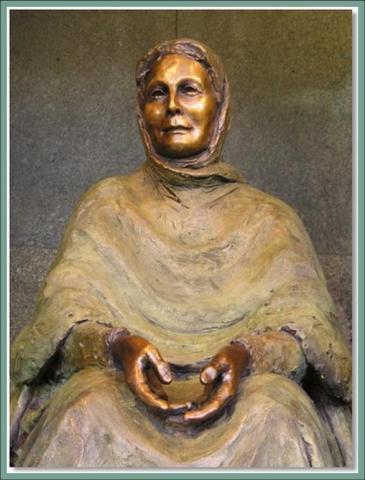
When was the last time that you saw Mary portrayed as elderly and within a community, as we see her alongside others in her last appearance in Scripture, praying in the Upper Room as an older woman with the original Christian community? We almost always see her portrayed in art or in sculpture as youthful, either by herself, often on a pedestal, or as a young mother with her child Jesus.
“Marian devotion has always been a significant part of the Church’s spirituality. In a sense the maternal role of Mary has served as a balance to the traditional male designation of God (Father, Son, and Holy Spirit), and millions of Catholics over the centuries have found it easier to pray to a mother than a father.”[1]
I know that it has been true in my own life. I was closer emotionally to my own mother than my father. My father expressed his love by being a great provider. Typical of fathers in the 1940s and 50s, he expressed his love for our family by providing, especially for the children. In my case, he provided for me by building a desk in my room for schoolwork, a backboard on top of the garage to play basketball, and a headboard for my bed for sleeping. However, there was very little emotional intimacy. Mother was responsible for emotional intimacy in the family. Consequently, I have found it easier for most of my life to relate to God through Mary as a mother and mediatrix.
However, Vatican II took a different approach to Mary’s role in our lives. The assembled bishops thoroughly studied the question of Mary’s relationship to the Church, and the bishops voted to incorporate Mary into the document on the Church rather than give her a separate document. Their theological intent was to affirm that Mary is one of us, rather than a figure who transcends the Church or as a mediatrix to God, though popular devotion and countless Marian shrines around the world reinforce the latter notion.[2]
Of course, if one finds it helpful to pray to Mary as a mediatrix, this is understandable and has certainly been an aide in the spiritual growth of many, including myself. However, I have come to believe in the utmost value of praying with Mary as a mentor, seeking her assistance and “expertise,” if you will, in praying for the coming of the Holy Spirit. She is the one who was undoubtedly the best at attracting the Spirit into her life. She is the one who can best aid me in letting go of my own ego designs and surrendering my will in loving trust to the will of a gracious and loving God: “May it be done unto me according to Your word” (Lk 1:38). She is the one who can best help me focus on God’s gifts and love for me: “My soul proclaims the greatness of the Lord, my spirit rejoices in God my savior” (Lk 1:46). She is the one who can best support me in developing an honest prayer life: “But Mary said to the angel, ‘How can this be, since I have no relations with a man'" (Lk 1:34). She is the one who can best assist me in inviting the Spirit of God into my life. I have come to believe that praying with her, much as the original Christian community prayed with Mary for the coming of the Holy Spirit, most closely aligns with the Vatican II teaching that Mary is one of us and a member of our Church.
A major factor in beginning to pray with Mary has been my evolving sense of God as not only a “paternal figure” but now also as a “maternal figure” in my life. That development has made all the difference. My God is now not only my Father but also my Mother. Since God is now also a “maternal figure,” I no longer need Mary as a maternal mediatrix. I can relate directly in an emotionally intimate manner to a “maternal” God who is above all merciful and compassionate. Mary can now pray next to me as a supportive mentor figure.
It is entirely appropriate that I now relate to a gracious and “maternal” Creator. As Richard Rohr says, “The soul needs a Mother Savior and a God Nurturer. God is, in essence, like a good mother…. “Only (God) who is our true Mother and Source of all life may rightfully be called by this name …. (God) is the one responsible for the birth of all babies that are born to their physical mothers.[3] He goes on, “The kind, loving mother, aware of the needs of her child, protects the child with great tenderness. This is the nature of motherhood…. Whenever a human mother nurtures her child with all that is beautiful and good, it is God the Mother who is acting through her.”[4]
Of course, we know that God transcends gender and is neither male nor female. However, as I have developed a more stereotypically “feminine” and maternal image of God, I have found myself needing less to pray to Mary as a mediatrix and praying more with her as an invaluable female mentor, an “older sister,” an “elder” who can offer unique assistance in my attempts to grow in a wholehearted desire for the coming of the Spirit in my life, much as the early Christian community must have prayed with her at that critical moment for the coming of the Spirit at Pentecost.
Why is this so important? We in the Marianist Family say, in one form or another, that our mission is to give birth to Christ in our world. I have come to believe that we give birth to Christ best by continuing to “facilitate” the intimate connection of Mary with the Holy Spirit in our lives and in the lives of our communities. Whenever Mary’s intimate connection with the Holy Spirit is reaffirmed by us spiritually, Christ becomes manifest once again, and the Kingdom of God also comes to be in our midst. In fact, I would go so far as to say that asking Mary to facilitate the coming of the Spirit among us personally and communally is one of the best ways to “give birth” once again to Christ and ensure the coming of the kingdom of God in our midst.
Let me conclude with the following important questions for us to consider. Where is Mary in our prayer life? Is Mary someone we pray to or someone we pray with? Both are valid, but praying with Mary for the coming of the Holy Spirit may make a significant difference in our spiritual growth. Praying with Mary can free us from a prayer life focused primarily on our own personal ego needs and align our prayer more with Mary’s stance. For example, we know that Mary’s prayer was one that focused on trusting her Creator. “May it be done to me according to your word” (Lk 1:38). Mary’s prayer was also full of joy, and it glorified her awesome Creator; see her Magnificat (Lk 1:46–47).
Of course, as we have also indicated, our image of God will undoubtedly play a role in how we view Mary’s role in our spiritual life. So, we conclude by repeating that all important question for each of us: where is Mary? Where would we like her to be?
Notes:
- Pat Marrin, “Mary and the Church: Pencil Preaching, Monday, June 6, 2022,” National Catholic Reporter Online, accessed Sept. 30, 2026, https://www.ncronline.org/news/spirituality/pencil-preaching/mary-and-church.
- Marrin, “Mary and the Church.”
- Richard Rohr, “Julian of Norwich: A Universal Mystical Motherhood of God,” Center for Action and Contemplation, meditation of May 10, 2026, accessed Sept. 30, 2026, https://cac.org/daily-meditations/motherhood-of-god/.
- Rohr, "Julian of Norwich."