
Click here for a downloadable PDF version of this primer.
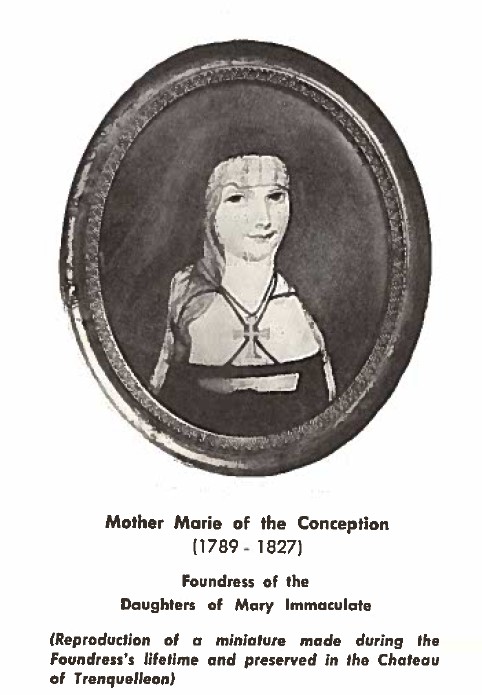
Mary's Eager Optimist: Mother Marie of the Conception (Adèle de Batz de Trenquelléon), Foundress of the Daughters of Mary Immaculate (Marianist Sisters)
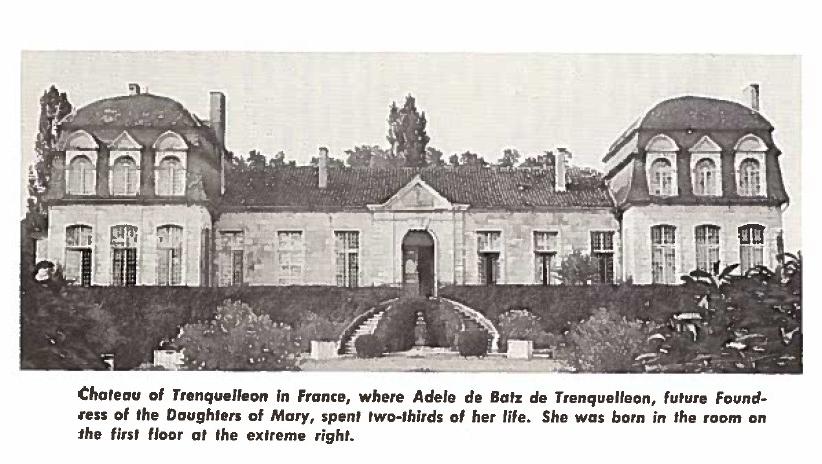
On June 10, 1789, a joyous bustle with undertones of relief and satisfaction reigned over the Chateau of Trenquelléon, whose two charming slate-covered pavilions still rise above the tiny Baise River between Nérac and Port Sainte Marie in France. The baroness de Trenquelléon had just given birth to her first-born, a girl who was destined to bring the name of her family to all continents of the globe. In a matter of hours, arrangements for the baptism were made with the pastor of Feugarolles and before the day was over, a carriage drove happily down the short mile that separated the chateau from the parish church.
The baby was given the name of Adelaide Marie Charlotte Jeanne Josephine Catherine, as was befitting a descendant of a long line of French nobility. Her father the Baron was not present at the baptism. A former page to King Louis XV, he was now First Lieutenant in the French Guards attached to Louis XVI's service at Versailles. He had just had a novena of Masses said for his wife. Neither was the Godfather there, the Marquis of Naucaze, the blind uncle of Adèle's mother, who was in Paris negotiating with the Marquis of Lafayette over the sale of property in Auvergne. The Godmother, Adèle's paternal grandmother, the sister of the Bishop of Montpellier, carried the baby to the font.
The baptism over, the group returned to the château. Letters had to be hurriedly sent to the Baron and other missing relatives, especially to the Countess of Peyronnencq, Adèle's other grandmother, who was to be an influence in her entire childhood and youth. And the news also went around many a salon of the nobility faithful to the King.
Three months after Adèle's birth, her father returned to his château, joyous over seeing his child but worried over the events radiating out from Paris. The Bastille had just fallen and France had begun the frightening trial of the French Revolution. His expense book has a suggestive entry: "For having had the coat-of-arms effaced from the top of my wife's berlin, 6 pounds."
The Baron remained at home for a year before leaving the sheltered security of Trenquelléon for an unknown future. At Paris, events had greatly declined. After six weeks, he left the capital for Germany where he took part in the War of the Princes who tried in vain to reestablish the monarchy in France with the aid of the Emperor's allies. The unexpected defeat of the combined armies allowed Adèle's father but little choice - he went into exile to England.
Confiscation, Spoliation
At Trenquelléon, the fate of the young mother was not an easy one either.
In January, 1793, posters had appeared three times announcing "with the greatest publicity" the confiscation of the Baron de Batz de Trenquelléon's property. Day after day, his wife awaited the visit of the procurator who would make an inventory of his pos• sessions. Three months passed. Finally at seven o'clock in the evening of April 23, he arrived "with a picket of twenty-five men of the National Guard from Nérac, the lieutenant, the brigadier and three gendarmes." All exits to the château were quickly barred, while the family and servants were huddled into one room "under good and sure guard." The sixteen-page inventory was completed and signed at the château only two days later. With anguished mind, Adèle's mother saw the procurator discover the hiding places where her most precious objects had carefully been stored. Thus, he found the fifteen pounds of silverware that she had placed in the chapel "on the upper cornice of the altar."
The first evening, when Adèle's bed-time had come, her mother asked to be allowed to take her to her room. The request was granted, but on the condition that she be escorted by a guard. This was the moment for little Adèle to give vent to the feelings that had been accumulating in her three-year-old mind in the face of all the boisterous noise and spoliation about her. Her comment was never forgotten because of the maturity and touch of humor it revealed: "Soon we'll be like old man Job!"
Exile
The Revolution wore on. The hectic, drastic Reign of Terror finally came to an end. In 1797, on a visit to her mother at Figeac, the Baroness learned to her surprise that her name was on the list of emigrated persons. Legally, she simply was not in France. A hasty decision had to be made; namely, to cross the border into exile. But what should she do with Adèle and her little son Charles? She put it up to her daughter, now eight years old. The answer was spontaneous: "With you, mama, with you!"
And when the carriage left for Spain, Adèle could not withhold her indignation at this enforced separation.
"Ah, the criminals!" she cried out from the carriage window. "They are assassinating us!"
Spain, so different from the delicate French culture little Adèle was accustomed to! Then Portugal, where the Baron de Batz de Trenquelléon rejoined his family in 1798! And another stay in Spain close to the French border for a year, where Adèle made her First Communion. Finally, events cleared the way for a return to the family château in 1801. Adèle was now twelve years old.
Initiation into Sanctity
Life at Trenquelléon was impoverished in comparison with a decade before. Thanks to the Baron's brother Francois, a retired captain of the French navy, who lived at the château during the family's exile, the property was not lost, as other possessions of the nobility were. Adèle settled down to an adolescent girl's life. Due to her mother's culture and deep Catholic life, she advanced rapidly in the finest training the age offered.
A new influence now entered her life, one that was profoundly to affect her entire existence. Her brother's tutor, Jean Ducourneau, a future priest and a born pedagogue, won her confidence. With rare discernment, he taught her the first steps of the life of perfection followed according to a rule of life. The thought of the eternal destinies, moderation of her vivacious temperament, humble preference of another's will to her own, kindness and meekness, attachment to the sacraments as the "canals" of grace, were themes to which the girl became accustomed. She learned how to meditate -"on the love of God, on the desire to be His completely, on His greatness, on His goodness, on His mercy for sinners, on the charity of Jesus Christ... Never will the subject be on hell or the judgment or on eternity or similar things." Her readings were to be chosen from such as "show God good and merciful." Adèle was already being formed along the middle path between excesses of any kind.
Carmel appealed to her and she set out to prepare for this vocation in the framework given her by Jean Ducourneau. She is now ready to embrace her mission in life - it will not however be in a Carmelite convent.
Begin a life mission at fifteen? Yes. Saints progress more rapidly than the rest of humanity. If a person is a saint, he is apt to mature while still young.
Ardent Personality
But what is this Adèle de Batz de Trenquelléon, who almost attains maturity at fifteen, like? Physically, she is charming, with big observant eyes, with smiling lips that are ever ready to break out in words of gaiety and enthusiasm. Hers is a rich, sparkling nature, of endless vitality that trickles along as an unquenchable youth. She is a great optimist who soon finds her reasons of confidence in her Faith. This natural vivacity will be Adèle's great personal problem during her whole life. Her guide well understood the need of dominating it. "It will be the source of many faults," he told her, "unless you moderate it from youth on."
Moreover, Adèle did not know how not to be interested in others. Other people became a part of her life. She could not be happy without them. Luckily, she learned early in life to fuse all her affections into one great love of God. Jean Ducourneau was specific in telling her "not to take from God one part of this heart that He wants to possess entirely."
All these tendencies toward action needed an outlet. Suddenly it opened before Adèle. She found her vocation.
Leadership for Mary
In August, 1804, Jean Ducourneau, Adèle and a friend of hers at Agen formed an "association" that soon enrolled other girls. It was a very simple organization without any special name. In default of enough priests and of any continuation of Catholic life as it had been under the monarchy, Adèle's group offered a chance for spiritual aid and companionship to girls in a countryside that had become quite isolated since the Revolution.
The sole object of the members was "to obtain a good death" under Mary's protection. The members united their prayers and good works with this in mind. Few devotions were asked of the members - the "spiritual rendezvous on Calvary" at three o'clock of the afternoon was a favorite practice.
"Love of God is the only bond in the society," read the statutes. Cohesion among the dispersed members was to be guaranteed by the authority of the one in charge. This role fell to the youngest of the trio of founders Adèle, less by prearrangement than by the ascendancy of her virtues and of her character of leader. Thus it was that, somewhat despite herself, Adèle became the center and soul of a new movement, to which she gave the best of her ardent personality.
The association's growth, slow at first, increased by leaps and bounds after two years. By 1807, there were already sixty members, many of them from beyond the region around Trenquelléon, Nérac and Agen. The movement spread in all directions, even to the Atlantic. In some places priests became zealous aids in upholding the work and in soliciting new members.
Precursor for Modern Apostles
But how was Adèle to reach the members in order to keep the movement alive and united? To this problem, Adèle gave an answer of the Twentieth Century.
We are however in the year 1805. Adèle is only fifteen. How is she going to act? She never hesitates - the problem of her whole life is to hold herself back. That must not be forgotten if a person wants to understand Adèle de Batz de Trenquelléon. For her, it is a simple matter -if the members are dispersed far and wide, she must write to them. The very first letter we possess in her hand, dated February 5, 1805, is a circular letter addressed to a member of Agen but with the request that her letters "should be communicated to the other associates." The entire correspondence that follows is a series of short, lucid treatises of spirituality, filled with zest, cordiality and affection.
We still have more than three hundred of Adèle's letters, written between 1805 and 1816 (the year of her departure from her family château). Almost all are addressed to one member. The facility with which Adèle wrote and the abundance of matter treated make us suspect an epistolary activity altogether unexpected in such a young person and it makes us regret the loss of the letters sent to other members.
The forte of Adèle in this beginner's apostolate is not an original spiritual doctrine, but rather the supernatural avidity of a soul stirred by grace, desirous of giving all to God and of sharing with others her own experiences and the fruit gathered from her own reading. An ardent warmth embalms her lines and establishes an inevitable intimacy between her and her correspondents. Without talking much of herself, she puts herself wholeheartedly into all that she writes. This is far from being a sign of pride or self-love. It means simply that Adèle de Batz de Trenquelléon already possesses a personality that is so candid, so rich and spontaneous, so challenging to others that she feels the need of acting with all her being.
Countryside's Fairy Shepherdess
Adèle is not, however, content with communicating her ideal by means of these letters that are so full of verve. She is constantly moving about from place to place in view of encouraging the different groups and isolated members of the association. At times the girls come to Trenquelléon in order there to pass several days under Adèle's guidance.
Furthermore, faithful to the impulse she gives to the members for seeking apostolic "conquests," Adèle herself becomes a teacher. Gathering the children of the neighborhood at the chateau, she teaches them catechism and the rudiments of schooling. To these classes, she adds an astonishingly active apostolate among many families of the farms and villages near Trenquelléon. The sick, the poor, the children, from the newly born to the adolescents, have unlimited rights upon her person, her time and her budget. Long after her departure from home, her family will still be taking care of "Adèle's poor."
Now, where in France, between 1804 and 1816, can anyone find a similar rural Catholic Action program? Where find a person going from place to place and employing the unprecedented method of circular letters for rechristianizing an abandoned countryside? These initiatives make of Adèle de Batz de Trenquelléon an apostle of surprising modernity. They would even be in the vanguard of Catholic Action practices in the Twentieth Century!
Co-Founder with Father Chaminade
In 1808, when Adèle was nineteen, a new factor, a decisive one, came to influence her vocation. She entered into correspondence with a great missionary of Mary, Father William Joseph Chaminade, and in 1810 they met the first time at Villeneuve-sur-Lot. Adèle now had all of the members of her association become Sodalists, grouped into "fractions" and affiliated to his Sodality in Bordeaux.
And so closely did she follow the path that this master of the spiritual life traced for her that he discovered in her the young lady needed for founding the first branch of the religious society he had been planning for years. All she had learned so far became still more solidly anchored in her soul, and took on a new richness in consecration to Mary. Upon that basis rose the Marianist "militia." Father Chaminade had long wanted "a man who does not die" for keeping alive the work of the Marian Sodality he had founded, that is to say, a religious congregation composed of two branches, one for men, one for women. Now after close to twenty years, he found the helper dreamed of for beginning the feminine branch.
Adèle herself had early felt that her association had a providential destiny for surpassing the immediate present. "I have confidence that God will bless our union," she wrote when fifteen, in her very first extant letter. "It is sure that the Lord has cast His blessing upon our little flock," she wrote in 1807. And seven years later: "The Lord has cast His eyes of mercy on our little society and He has great designs on it."
As to herself, while the ascendancy of Father Chaminade was growing over her, a mysterious, absorbing conviction grew within her. There was no doubt in her mind that God had chosen her for His spouse. Her letters are full of it. She felt herself marked for convent life, whence she could continue her apostolate. Of course, a new foundation would be necessary to achieve this. Bit by bit, it was precisely toward that foundation that both Father Chaminade and Adèle advanced. By 1814, if not earlier, there was no doubt in their minds that they would begin a new religious institute. Adèle even thought of the chapel in the chateau of Trenquelléon as its first sanctuary. Approved by the bishop, it had served already for the reception of the sacraments by the members of her association. And when her father thought of founding a house in the parish for the sick and the care of girls, she thought that "then God's will would be clearly marked." It was however at Agen that Providence destined the new foundation.
Marianist Pioneering
Adèle is now ready, although events do not quite follow the pace of her ardent desire to leave for the convent. Having already made the vows privately, she signs the name she will have as a religious: Sister Marie of the Conception. She already calls her generous fellow-members Daughters of Mary.
Finally, in the spring of 1816, all is ready. Adèle makes her adieux in Condom, in distant Figeac, a bit everywhere. She sells her costliest dresses, takes definite dispositions for her poor, and confides her apostolic work and especially her school to her aide, an orphaned cousin and future Daughter of Mary, who had been living with her for years.
On May 24, the feast of the Ascension, the day before her departure from Trenquelléon, three of her future companions arrive at the château. The next day, in order to avoid the final painful scenes and without forewarning anyone, Adèle and her friends rise before daybreak and slip silently, courageously from the château. A final glance at the charming setting that had sheltered her birth and youth, and Adèle has broken her ties with family and world.
The Marianist pioneers went on foot past the shadowy church where she. was baptized and then to Port Sainte Marie. After these four miles, a carriage took them to Agen.
Six Sisters formed the first Marianist community there in a former convent for repentant women. In July, Father Chaminade came to prepare them for their first profession. On Christmas, they began to wear their costume - a black robe that the nuns had themselves woven, with a white flannel cincture as a souvenir of their Marian Consecration as Sodalists.
Adèle, the born leader who attained maturity almost in adolescence, the enthusiastic shepherdess of numerous brothers and sisters in an abandoned countryside, was now Mother Marie of the Conception, Superior-General of the Institute of the Daughters of Mary Immaculate who will have numberless daughters spread through the decades and in distant climes!
Sodality Beehive
"Your Community," wrote Father Chaminade to Adèle before the foundation at Agen, "will be composed entirely of missionary religious." Zeal for the salvation of souls was what he thought should be the most distinctive trait of the new institute. The big end in view was "the multiplication of Christians." The Sodality had been chosen long in advance of the actual foundation as the means and the atmosphere in which to work. AU other activities were to grow out of it. The Institute of the Daughters of Mary was itself but a sort of beautiful flower and perfect development of the Sodality out of which it expanded. In fact, all of Father Chaminade's works had the Sodality as their point of departure.
Thus the first Marianist Sisters worked in and with the Sodality of Agen, affiliated to the one at Bordeaux. It had just increased its membership by sixty new names.
"The meetings are very numerous," wrote Mother Marie of the Conception. "The mothers and the older unmarried girls form a class that we call the Ladies of the Retreat [just as at Bordeaux]. The young ladies form a second one and the servant girls a third. All belong to the same Sodality but we have them meet separately, because the instruction should be a bit different." A so-called "fraction of the fig tree" was a preparatory group for girls from ten to fifteen, who met under a tree in the garden.
"We try our young ladies very much before receiving them," went on the Foundress. "We see them often. . . . They draw us apart in order to tell us a word, to ask an advice - and that in girls of fifteen, eighteen, twenty years old."
A most impressive group of activities grew out of this combination of the Daughters of Mary and the Sodality. "We want to make little missionaries out of our Sodalists," wrote Mother Marie of the Conception. "Let each one in her own state be a missionary in her family by her friends, her neighbors... Every two weeks, we assemble the most fervent ones and distribute to them their works of zeal. ...
"Some out in the country gather the children in order to instruct them. Others go to teach catechism to the women prisoners.... Others go to instruct the poor in their homes, others read to the sick.... Some are charged with bringing their friends to frequenting the sacraments."
Other activities besides the Sodality preoccupied the nuns. They conducted a free school that became a nursery for the Sodality. A sewing class was added. One Sister conducted a meeting of the women of the lower classes. Every Monday, another gathered "the poor women beggars who are so ignorant" to prepare them in their own dialect for their First Communion (one at the age of sixty) and Confirmation.
The nuns started also the fruitful work of retreats, first for Sodalists and anybody wishing to come. Private retreats were soon added for any time of the year, in rooms reserved for this purpose. A religious was charged with making the meditations and directing the reading for the retreatants.
Mother Marie did not however renounce her old epistolary contacts - the status quo never satisfied Adèle de Batz de Trenquelléon. She aided in the formation of Sodalities similar to hers in various towns; for example, at Port Sainte Marie, at Tarbes, at Pau, at Bagnères, at Auch (under the direction of her cousin, Abbe de Batz).
Expansion
Time was passing. In 1820, the Marianists of the Society of Mary, founded in Bordeaux after the Daughters of Mary, came to Agen upon the insistence of the bishop. They took over the Sisters' house that had proven unsatisfactory to the nuns' health, while the Daughters of Mary transferred their community to the former Augustinian convent. It was there that the Foundress was to finish her life prematurely.
Requests for similar foundations now came from other cities. In 1820, a colony of six Daughters of Mary went to Tonneins, a strongly Protestant town twenty-five miles from Agen. In 1824, the two Founders accompanied a new community of eight to Condom, where the Marianist Sisters still have a place of pilgrimage dedicated to Notre Dame de Piétat. The route south to Condom passed by the Chateau of Trenquelléon. It was the first (and last) stop at her birthplace that Adèle made since her departure eight years before. In the same year, Mother Marie of the Conception presided over the transfer of the novitiate to Bordeaux, not far from the chapel of the Madeleine where Father Chaminade's Sodality had its headquarters. In 1826, she returned there with the Sisters destined to make a new foundation, this time in distant Arbois in Eastern France, where the Society of Mary had already taken root.
Everywhere that the Daughters of Mary went, they followed the same methods, with the Sodality becoming a beehive of activity. From each new convent, there came also new problems for the young Superior-General whose health weakened under the strain, and under the pressure of her own inborn vitality that left nothing to Adèle herself.
Path of Suffering
"Oh, how I desire seeing you reach a great perfection!" had written Father Chaminade to the young Foundress at the time of the installation in Agen.
If kindness, prudence, apostolic zeal, Marian enthusiasm, the pure love of a spouse for her God are indications of perfection, then Mother Marie of the Conception rose high on the ladder of sanctity. This ensemble of virtues in Adèle, which she possessed already in her rural home life, never ceased to claim her entire being. All who knew her - her relatives and friends, her protegees, her daughters in religion, the member of the clergy who saw her in action - all believed they were in contact with a soul filled with the fire of divine Love.
But this fire was enclosed in a mere human body. And this body did not have the same resources as the personality of Adèle de Batz de Trenquelléon.
Sickness had already led Adèle close to the grave when she was twenty. Although her health apparently regained its former vigor, it seems howelver to have been deeply shaken. "Very soon, here and there," writes Mother Marie Madeleine de Pazzi who has passed years of study on her life, "a person notices a breaking down of her handwriting, indicating the slow, intermittent, but sure work of the illness that will carry her away." In fact, shortly after the foundation in 1816, Father Chaminade expresses disquietude over her health. The years 1819, 1820, 1824 and 1826, in turn and each time more menacingly, witnessed attacks of extreme feebleness and a complexity of ailments that progressively reduced her activity.
Obliged to remain in bed for a long period in 1826, she kept busy with writing a treatise on mental prayer and a Little Catechism on Silence. She also wrote the history of the foundation of the Daughters of Mary, a work that would be a precious source of information to us if it had not disappeared.
Hosanna to the Son of David!
The Foundress's health had declined so much that the end of 1827 found her lost. It could no longer be doubted. On December 22, she herself asked for Viaticum. This was the occasion of one of her sayings that are rich in simplicity and psychological acumen. Addressing her assistant, she gave her this advice, often quoted: "Be sweet to the Sisters and support the faults that you cannot correct."
On January 8, when the clergy was called to her bedside, the sick Foundress knew that the end was near. "I am afraid!" said she, human to the end. When she heard the little bell announcing the arrival of the priest bringing her Viaticum, she cried out: "Here is my good Jesus!" Her calm serenity never left her again during the two days she still lived.
After kissing the crucifix at a moment of intense suffering, she dozed away and then awoke saying: "What a beautiful day this is today! What a beautiful day! What graces I am receiving! Help me thank the good God."
During the long night, violent pains wrested sighs from her. She checked herself immediately: "What a weakling I am! Another in my place would suffer in silence."
And suddenly she exclaimed: "Oh, how beautiful she is! How tall she is! She is as tall as I!
"Who?" asked the Sister attending her. "Is it the Blessed Virgin whom you are seeing, Good Mother?"
"Her image," she replied simply.
January 9 was her last day. Toward seven o'clock in the evening, she asked for the picture of the Sacred Heart. Seizing it eagerly, she quickly took it to her lips. But this lively enthusiasm was the tendency in Adèle that Jean Ducourneau had long ago told her to restrain. She will have to watch it until her Jast day! Slowly bringing the crucifix to her lips again, she kissed it with utmost composure, as a supreme death-bed victory over her ardent nature.
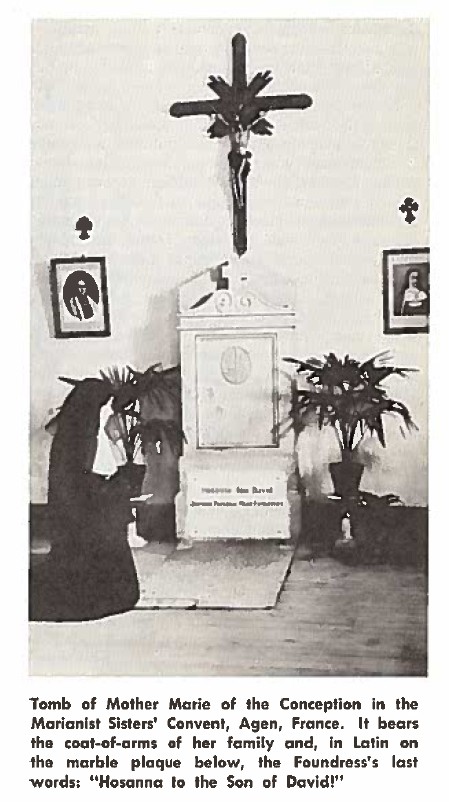
Night advanced, suddenly, the dying flame of life rose in a final outcry of faith. Mother Marie exclaimed: "Hosanna to the Son of David!" This triumphant protestation of loyalty to her Master and Spouse seems to have been one of her favorite prayers - we find it in one of her letters written when she was nineteen. It was her last word. Now it is seen engraved on her tomb as a summary of her entire spirituality and personality.
A slight movement of her lips and all was over.
"The holy awaiting for the divine Spouse of our soul!" When still an adolescent, Adèle had once thus described the moment of death. The Divine Spouse did not fail to be waiting at the gates of glory for the eager and loyal spouse who was Adèle de Batz de Trenquelléon.