
Click here for a downloadable PDF version of this article.
In Buenos Aires, in 1991, a miracle happened. The Church, after analyzing it exhaustively, has endorsed it.
The way in which this extraordinary intervention of God in our history has been lived has something to do with all miracles. But those of us who were close to it, have been forced to think about that "provocation" by God. You can say that we have accepted it and we have taken a peek at "the mysterious nature of the Kingdom of God". The miracle worked on Elena Graciela Otero has been a true "cause of mystery" in our lives. We have seen in all this the hand of William Joseph Chaminade.
Human Attitudes Towards the Miracle
The same attitudes we find in the gospel and in essays dealing with the miracle are also found among us. But in contrast to the reservations coming from science, history, or even from theology itself. appears something indisputable for those who follow Jesus: the miracle in the gospel is like "a vital hinge of his public life". Is it not today still something which supports our faith? The "facts" go before human logic. God is above all. In Buenos Aires, assuming that "God is always right", we have made a big effort to discover God's reasons for curing Elena through the Blessed William Joseph, our founder.
First there was an exhaustive investigation of the facts. Once we were convinced that God had intervened, we proposed to do the same as Jesus: "Praise the Glory of God and strengthen the faith of the believers." (John 2.11). Furthermore, we have experienced the joy of seeing how a serious disease which threatened the life of a very dear person was eradicated and that the person fully recovered.
Theology of the Miracle
Elena's curing confronted us urgently with that unique event, God's revelation in Jesus. It is not an isolated fact, having no contact with our life in faith. "It has opened a breach in human intelligence" towards the first author of this miracle: God and his Spirit in Christ.
From practice we have also understood better why this "miracle" (miraculum, meaning in Latin wondering/impressing by itself) is also called by other names in the Bible: "sign" (6emeion, in Greek), because it is a signal indicating the presence of God; and "strength" (dynamis) because it is the manifestation of the eternal power of God, wisely given to the service of love.
We have also seen that there is nothing incoherent in God or in his Kingdom or in his influence over History: this miracle ascribed to the intercession of the Blessed William Joseph, is also within "the universal context of the History of the Promise," it answers to the Word of Jesus "ask and you will be given" /Lc 11.9), and it agrees with a God who is "sympathetic and merciful" (Psalm 85), and he is also the almighty one (Lc 1.37), the one who creates, cures, gives freedom, forgives, revives, saves, transforms, renews, multiplies ... just by answering his children's prayers (Madame Teufel 15.32)
Throughout our lives we have "seen" the invisible hand of God, the breath of his Spirit, and they have driven events from the very beginning to the end with sort strength and hidden wisdom.
Miracles Today
Are there miracles today? Yes, there are many. But in order to "see it", one must go beyond experimental science and its sensitive data, beyond practicality, beyond simple reason (which means to do without it). One must near oneself to divine logic.
Miracles, signs from God, strengthen faith but they don't give it. They point to the Kingdom, but aren't the Kingdom themselves. They show and make God credible, but they don't prove it. Faith is a personal gift from God to the man who is humble and hungry for justice. Maybe some people reject miracles because they act as a destabilizing element in a comfortable lives people lead. A miracle only happens on the "divine horizon of man". Miracles, both scientifically and philosophically, produce confusion and uncertainty; We "see" the facts, but we "don't see· the miracle. That is, we don't perceive God. To the believer (not exactly gullible) a miracle confirms faith and fosters joy and praise. A miracle is, in short, flan extension of Jesus' message in the form of an action that reveals the nature of the Kingdom of God.·
Our friends in Buenos Aires, especially those of us who have experienced first hand the miracle of God through the intercession of William Joseph in curing Elena, have all strongly "felt" the presence of Jesus among us.
Miracles, signs from God, strengthen faith but they don't give it. They point to the Kingdom, but aren't the Kingdom themselves. They show and make God credible, but they don't prove it.
"God Has Visited His Nation" (Luke 1.28)
The Marianist Family has been living with variable intensity, all of the above events. It has been a generous initiative from God to off er us a sign of his presence and challenge us to enter more deeply into his Kingdom.
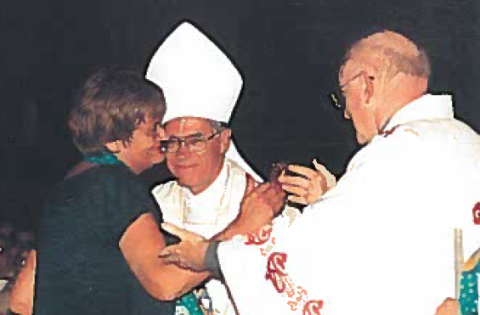
It has been the members of the "Myriam Peregrina" Marianist lay community who have been most greatly affected by the miracle. Elena Graciela Otero was a member there. The year was 1991. A throat tumor, increasing in size and of a malignant nature, afflicted her to such an extent that she had difficulty breathing. The community began praying to God for a cure for Elena through the intercession of the Founder of the Marianist Family, William Joseph Chaminade.
Fourteen men and women of the "Myriam Peregrina" prayed and accompanied Elena. She, herself, having overcome the first impact or the disease, prayed and long with most or the community invoked the intercession of Fr. Chaminade. In addition, many other Marianist lay and clergy members, as well as other people, joined the effort of prayer and action. In March or 1991, she was totally cured.
Testimonies
Dr. Casalá expresses his reaction this way: "Everyone is moved by proof of higher power who loves us and who watches out for our needs." Inés Precerutti says: "We know this happened. Fr. Chaminade was with Elena to help and cure her. Our community was honored by this special privilege, that show of kindness towards us from God through Father Chaminade".
Elena herself, in turn, sums it up this way: It was as easy and simple as attacking the sickness with the most effective "drug" possible: faith and its tool. prayer ... l was always convinced that all I needed to do was ask because He listens ... he is a true saint because in may case it was a miracle ... throughout my life, during this process of faith, I have undergone many difficult tests ... but I never felt completely alone. I felt and feel the presence of God, our Mother and Fr. Chaminade. It is difficult to describe this feeling of protection ... "
"Why did God pick this country? Why this community (Myriam Peregrina)? What is He trying to say? Perhaps we have something to do with this sign from God." (Thoughts by Della Casalá).
The beatification is the end of an ecclesiastic and Marianist stage, but the final reference is the glory of God, father, son and the holy spirit, the honor of Mary and the strengthening of faith of Jesus' disciples.
Thanks!
When Jesus worked miracles that cured others, He usually said, "Your faith has saved you. Now go in peace" (Luke 5.28). That is how the members of the "Myriam Peregrina" community, especially Elena, feel about it, and they have passed it on to those of us dear to them: Jesus, in answer to our faith, gives us peace. One could claim that, through God and William Joseph, the members of this lay community are the protagonists of an event that brings joy to the Marianist world and the Church. What is more, they have deeply felt the presence of Mary, a woman of faith and mother of mercy.
Just as many in the Gospel, we too say: "Today we have seen marvels" (Luke 5.26) and "let us proclaim throughout the city what Jesus has done" (Luke 8.39), moved, at the same time, by the faith of someone who sought Him through the help of a man of God" such as William Joseph Chaminade.
On more than one occasion we have considered the possibility of the story having a different ending: In the existence of a faith in which one can ask for and receive, it could have been that we had asked for His help and did not receive and, had that been the case, would have had to accept it and hold in our hearts the memory of grace. At this point, we are glad to "have been witnesses to the wonders of God" and to have cried out these wonders with song for the glory and happiness of all.
In 2000, a Holy Year as well as the Year of Chaminade, we had the immense pleasure of seeing our Founder, William Joseph, beatified by the Church in the presence of Pope John Paul II. The beatification is the end of an ecclesiastic and Marianist stage, but the final reference is the glory of God, fat her, son and the holy spirit, the honor of Mary and the strengthening of faith of Jesus' disciples.