
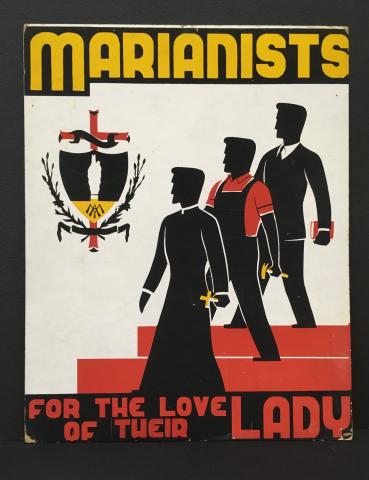
[Editor's Note: Published in 1977 by the Marianist Resource Commission (the precursor to the North American Center for Marianist Studies) Volume 8, No. 4, Documents 42, 43 December 1977.]
Click here for a downloadable PDF version of this article.
There is a certain mixture in all things and their usefulness is contained therein.
~ Clement of Rome, c. 96
In any domain - whether it be the cells of a body, the members of a society or the elements of a spiritual synthesis - union differentiates.
~ Teilhard de Chardin, c. 1946
What have Christians learned about "the one and the many" in the centuries between Clement and Teilhard in the quest to be Church? Clement, in one of the earliest and most significant controversies in the Christian community, censured the Corinthian Church for tossing out their clergy, replacing them with new men, and thus threatening the unity of the local Church. The reasoning in his famous letter developed into the cornerstone of the hierarchical conception of the Church. Teilhard, himself the center of controversy, also was concerned about how unity and diversity develops in the journey to the fullness of Christ. The impact of his writings is still unfolding, but he has already helped us to understand the positive possibilities in the human polarity of individual and society. And in between these men the movement called religious life has struggled to offer its relevant universal and particular gifts to the Church.
But what of the future unity of the Society of Mary? Will it depose its clerics or toss out its lay members to make life and law easier? Or has the "usefulness of the mixture" proved that "union differentiates" in a healthy manner such that the future which emerges will reveal what the Society really is and has to offer the Church in regard to lay and clerical life and ministry? Perhaps what one historian of religion said about religions in general is relevant here: Whatever is specific has meaning for all.
The present issue of the MRC BULLETIN contains part of the struggle of Marianists to understand how their "mixed composition" is a historical charism to the People of God and, therefore, has meaning for the twenty-first century mission of the Family of Mary. Ambrogio Albano, S.M. (Province of Italy), Director of the Marianist Center of Research and Development (CEMAR) has provided MRC with a summary of a provisional draft of his study: "The Mixed Composition of the Society of Mary." With the revision of the Constitutions in process as also the revision of the code of Canon Law, the general uneasiness still felt regarding the identity of religious life has often slipped over into particular structures. Brother Albano's paper, then, serves as a focus for dialogue, and five other Marianists join the conversation by offering their own reflected experiences.
Some questions of self-understanding that arose for me out of this issue were:
- Am I a priest or a Brother who is a Marianist; or
- Am I a Marianist who is a Brother or a priest; or
- (for some) Am I a Marianist Brother who is a priest; or
- Perhaps the real issue is more basic and the question should be framed in terms of Marianist, Brother, or priest all as adjectives which limit, qualify, or specify the substantive person; or
- Maybe these aren't helpful questions at all for you and you have other questions or perspectives to share. You are invited to send these for our "Letters to the Editor" space.
The process of our continuing conversation will make a significant difference as to the future that is forged. And relevant to this are these words of one of the respondents in a letter accompanying his comments: "I found the experience of reflecting on this article to be personally enhancing. Nothing of what appears in my brief response is strikingly new. Yet, I found myself engaged in a deeper dialogue concerning this area than I have previously had an opportunity to do - that was rewarding!"
* * *
THE MIXED COMPOSITION OF THE SOCIETY OF MARY by Ambrogio Albano, SM
1. Two Basic Facts Concerning the Mixed Composition of the Society of Mary
1.1) A new mode of ecclesial being and action.
Already before the foundation of the Society of Mary, Father Chaminade had attempted new modes of ecclesial presence and apostolate: he was convinced that a new mode of being present was necessary in the society that had been born out of the events of the French Revolution and of Europe and Christianity in his time.
He considered one of these new modes of being and action, both within the Church and within society at large, to be the combination of priests and lay people in single communities of life and action with equal rights and equal duties accorded to all. The Marian Sodalities of Bordeaux were founded and functioned according to this practice, and at its foundation the Society of Mary accepted this point as "constitutive" of its mode of being, a new form of religious life in the Church.
1.2) Patterning of religious life on the Church.
When it is applied to religious life, the foregoing basic fact is enriched by a second orientation: this new mode of being and organization in a religious
congregation should be modeled on the very structure of the universal Church itself. In practice, this implied overcoming some of the traditional forms of religious life.
Certainly, the Society of Mary was organized in a hierarchical fashion in accord with the ecclesiology of the time: the distinction between priests and lay members, based on differences of long-standing which had been canonically defined, in itself establishes a hierarchy between the two orders of persons, and Father Chaminade always makes direct allusion, clearly defining competencies and dependencies. But the same Society of Mary introduced, as a socio-ecclesial body, something new and different in religious life, adopting an unprecedented mixed composition of priests and lay members, all of them religious on the same level.
The awareness of this innovation was quite clear from the very beginning and the Founder was careful to remind his religious, both priests and lay members, that their new mode of being should on the one hand harken back to the era of the first Christian communities and that, on the other hand, they should realize a "union without confusion," among the different classes of contemporary society.
With out yet introducing a new ecclesiology, but side-stepping the "de jure condito," ( the existing law) of its time, the history of our foundation and of the first Marianist communities practically transcended traditional distinctions and in a certain fashion transcended the very prescription of contemporary Canon Law between the rights and the duties of clerical and lay religious. This history demonstrated that the fusion of the two elements in a single community of life and action, with equal rights for all, took place not only in exceptional cases or with individual persons, but constituted a basic intuition and anticipated an ecclesiology which would become universal only after another century and a half.
2. Historical Verification of the Mixed Composition of the Society of Mary
2.1) The first Marianist communities.
The witness of the first disciples is universally in agreement in indicating that the first Marianist communities were constituted according to the two basic facts mentioned above and they all confirm our mixed composition. The writings of the time universally bear witness to a harmony existing among the various classes within Marianist communities.
The only occasion for discussing this point arose in the large community of Saint Remy at a particular moment in its history when the strong personality of a few of the religious present gave rise to some serious reflection on the functions, competencies, and authority of the priest religious and the lay religious. But neither the mixed composition of the Society itself nor that of the community of Saint Remy was ever called into question. The interventions of the Founder always stressed the principles mentioned above and resolved the situation by making reference either to the specific personalities involved or to the ecclesiology of his time.
2.2) The approval of Bishops.
Official relations with the various Bishops in whose dioceses Marianists worked confirm the witness of the communities and the first disciples. All the documents that have come down to us are along the following lines: Bishops who approve the new congregation for their dioceses, who solicit a new foundation, and who accept the new community are perfectly aware that there is question of a congregation and of local communities in which lay and priestly religious live together and enjoy equality of rights in their community of life and action. But none of the Bishops take exception either to the constitutive principle or to its practical consequences. The fact that the Superior General was a priest probably facilitated the recognition by the Bishops since no problem of hierarchical order was involved. In any case, it remains historically significant that the mixed composition of the Marianist communities did not give rise among any of the Bishops to any problems either of a canonical order or in relation to the status of this new form of religious life. This is especially important if we recall that the Superior of the local community was almost always a lay religious.
2. 3) Hierarchical organization and the "Offices."
In function of the "union with out confusion" of the various classes or states of society which the Founder so warmly recommended, provision was made for a hierarchical organization within the Society of Mary: there would naturally be a leader or head or director who would hold in his hands all the directive power. This superior was, in the canonical sense, at the head of the hierarchy: he was the representative of God, the Pope, and the Bishop, the Superior General at the local level; he was the coordinator and animator of the life and action of the community, of a province, or of the entire Society. Within the local communities, this man could be indifferently a lay religious or a priest according to local circumstances and individual competencies. In the General Chapters, the supreme organism of the Society-the capitulants were originally all the Directors and the most influential religious, with no importance given to the fact that they were priests or lay members; later on a numerically equal representation of priests and lay members was decided upon. The same system prevailed in Provincial Chapters. At the head of the Society, the fact that the superior was a priest never caused any problem; the Founder was a priest and so was his successor during whose term the first general discussions on the mixed character of the Society of Mary began to arise. The fullness of power belonged to the superior, but the latter distributed it in "Offices" foreseen by the Constitutions: The Office of Zeal (a priest), of Instruction (a priest and a lay member), and of Work and Economic Matter (a lay member). Thus there was attained a unity of responsibilities as well as a good functioning of all persons who constituted the Society of Mary.
2.4) The Constitutions.
The "union without confusion," the patterning on the universal Church, and the new mode of living and working together as lay religious and priests did not give rise to any serious theoretical or practical problem either within the Society or outside it from the moment of its foundation (1817) until that of the animadversions of the Holy See (1864).
All the drafts of the Constitutions bear witness to this fact (1818, 1824, 1829, 1834, 1838). The Constitutions presented to the Holy See (1839) were written from this viewpoint and were "praised" as they were conceptualized and lived. The correspondence of the Founder and his first disciples as well as all of their writings, the internal discipline of the Society, and explanations to officials were always tranquil on this point and demonstrate that the Society simply continued to perfect what had always been considered as one of the characteristic constituents of this new religious foundation: the union, with equality of rights and duties, of religious priests and lay religious in a single community of life and action.
2.5) Continuity of teaching.
The union of lay religious and priests in the Society of Mary did not become a controverted point even during the serious difficulties which arose between the Founder and some of his first disciples (1844-1850): these difficulties were so grave as to lead to the isolation and quasi-expulsion of the Founder from the Society founded by him. Even after his death (1850) the Society continued to live according to his intuition and to propose it to the postulants, to teach it in the novitiates, to preach it during retreats, to spread this teaching in writings and to consider it as constitutive for the Society of Mary as well as original for the Church.
Even the revision of the Constitutions to be presented to the Holy See made absolutely no change in what actually existed: in no document do we find the slightest trace of an attempt at editorial diplomacy or any doubt or basis for fear in the minds of the Marianists when they presented their Constitutions for final approval by the Holy See.
3. The Crisis of the Mixed Composition in the Society of Mary
3.1) The first of the 40 "animadversions" of the Vatican.
It was only in the year 1864 - after the Society of Mary had already existed for 47 years - that the problem of the mixed composition arose and began to create passionate divisions in the minds of Marianist religious.
When it was requested to give definitive approval to the Constitutions of the Society of Mary, which had already been "praised" in 1839, the Holy See prepared 40 animadversions on the text presented to it in order to bring this text into conformity with Canon Law then in force, in order to correct certain terms, and to make this text in accord with the traditional practice of religious life. The 40 animadversions called for modifications that were not really constitutive except for the first one. This first objection, unimagined and unexpected, gave rise not only to emotions, reactions, and polemics but even to a true crisis of identity both on the collective and individual level.
The Constitutions of the Society of Mary, from the first text of 1818 until that of 1864, had always taught that the Society of Mary was composed of lay religious and priests all having the same rights, all occupied according to opportune circumstances in the varied works of the Society, making a self-understood exception for very evident tasks of the ministerial priesthood. The Constitutions of that time placed no limit on the ability to appoint any of the religious, whether priests or lay men, as "superior" of a Marianist community.
The first of the 40 animadversions of the Vatican, on the other hand, read
as follows:
Special care must be taken so that in the future the number of priests in the pious institute be increased to the point that at least the superior in every house may be a priest.
3.2) The reaction of the Society of Mary.
The reaction to this proposal was immediate and violent. A series of mutual accusations between the lay and priest members, lively exchanges of correspondence, apologias, memoranda, anonymous pamphlets arose between 1865 and 1876, creating a division of spirits and risking to cause the separation of the two elements which up to that time had been unified and tranquil.
The embarrassment of the priest members was noteworthy: taken by surprise
and cast in the role of protagonist in a "quarrel" which they had not sought, they tried to explain that the request of the Holy See was due to an imperfect knowledge of the Society of Mary and that it was necessary for us to clarify the entire situation. The suspicion of the lay religious was that the religious priests wished to impose themselves surreptitiously with the connivance of Rome. It should be kept in mind that at that date (1864) the lay religious numbered more than 800 while the priest religious were fewer than 50.
The General Chapters became inflammatory and the various attempts.at mediation gave rise to new suspicions. Trips to Rome on the part of various religious were seen equivocally and were sometimes considered manipulatory.
A proposal to divide the Society into two branches "like the Marist priests and Brothers" began to be whispered about and was prepared as a proposition for General Chapters.
The citation of the text in the teachings of the Founder, who had wanted a mixed society of lay and priestly religious was constantly repeated as an apologetic argument against the intention of whoever was thought to be the author or supporter of the first of the Roman animadversions.
3.3) The apostolic visitation of Cardinal Mathieu.
This identity crisis reached a boiling point and the Holy See, in the face of the agitation of spirits, appointed an apostolic visitor in the person of Cardinal Mathieu of Besançon.
The letters, memoranda, and various testimonies sent to the apostolic visitor, while indulging in the strident tones of the polemic to which the problem had given rise, constantly referred to the intention of the Founder to create a mixed religious congregation of lay religious and priests all having the same rights.
3.4) Juridical compromise.
The long-suffering patience and firmness of the apostolic visitor was such, both in his personal contacts and in his work as President of General Chapters, that an agreement was finally reached. Rome modified the first of its animadversions and the Society accepted the following compromise: the functions of Superior General, Provincial, and Director of Communities having more than twelve perpetually professed religious and dedicated to philosophical or higher education would be reserved to priest religious. The General Chapters, Provincial Chapters, and the "Offices" would in turn be constituted.by an equal member of representatives of lay religious and the priest religious.
This solution was accepted in the succeeding drafts of the Constitutions up to those of 1891 which would be definitively approved by the Holy See.
Already towards 1880 calm returned to the Society which considered that the intuition and the intention of the Founder had been sufficiently safe-guarded concerning the mixed composition of the Society of Mary.
4. The New Canon Law and the "Clerical" Option
The revision of Canon Law published toward 1920 placed the Society before a juridical alternative: did it consider itself "clerical" or "lay?" The question was asked explicitly by the Holy See.
The option was taken without the congregation reacting in any notable way, whether on individual or general levels. Since the Superior General and the Provincials were priests, it declared that it wanted to be a "clerical" congregation.
In practice, however, not only did the lay religious continue to constitute about 80% of the total of all Marianists, but the local superior could again be a lay religious even in cases where the perpetually professed numbered more than twelve and in establishments of philosophical or higher education.
5. Post Vatican II: Proposals for a Return to the Origins
Starting with Vatican II (1962-65) and on the basis of new developments in ecclesiology and in religious life, all religious congregations were invited to review the text of their Constitutions in order to recover dynamic elements of their Foundation which may have been left in the shadow or lost in the course of time.
In the Society of Mary, naturally enough, the idea of the union of lay and priestly religious having the same rights in a single community of life and action came into focus again as a constitutive element to be emphasized as a charism of its foundation with the hope of overcoming juridical compromises of the past. The Society of Mary, therefore, began anew to reflect, in a peaceful fashion, on its mixed composition of lay and priestly members. The Society believes that this composition is not only a constitutive element in its own organization but even thinks that it constitutes an ecclesial richness for religious life. It dares in fact to think that this aspect of its foundation should not be reserved only to Marianist life but may constitute a reference point and a source of strength for the future of religious life in general.
These reflections and this consciousness tend naturally to be translated in the Society of Mary into legislative and juridical formulations. Two of these appear to be of most importance:
- (5.1) The much-praised existence of mixed communities of lay religious and religious priests having the same rights leads many to ask of the Holy See that the new code of Canon Law contemplate the possibility of new forms of religious life which are no longer based on an obligatory alternative between "clerical" congregations and "lay" congregations.
- (5.2) A reconsideration of the spirit of our foundation and of our whole Marianist history leads us to ask. the commission for the revision of the Constitutions for 1981 to attempt to recuperate fully the thought of the Founder concerning the form and organization of a Society of Mary containing both lay members and priests.
- (5.3) The present state of the question sees in the history of the mixed composition of the Society of Mary two lines of development which may somehow be contradictory:
- (5.3.1) On the one hand, there is the intuition or charism of the Founder who conceived of a mixed community of lay religious and priestly religious all having the same rights on all levels of external apostolic activity and internal responsibilities, all with equal "active" rights in the organization and in decisions;
- (5.3.2) On the other hand, there exists a hierarchical inequality or an inequality in government between the lay religious and the priest religious, which is institutionalized on the level of the Superior General and the Provincial.
- (5.4) Therefore, it has been asked whether this inequality in government pertains to the charism of the foundation or merely to the data of the religious sociology of the time. The problem has been asked in the following terms: How is it that inequality between lay members and priest members has been institutionalized only on the level of government but has never been requested nor existed on any other level of Marianist religious life?
- (5.5) The history of the past abundantly documents both the development of the charismatic intuition as well as the inequality of government. This inequality can be authoritatively proved by quotations from the first Marianist Constitutions of 1839. Hence the problem is posed in the following terms: Is the superiority of priests over lay members in the government of the Society a result of the ecclesiology or sociology of the 19th century or is it a constitutive element of the Society of Mary?
- (5.6) The future history of the Society of Mary should maintain for every one what has been received from the Founder as a fundamental principle. Hence all the more do we wish.to recover the fundamental principle concerning the hierarchical practice or the government. On this point two reflections may be advanced:
- (5.6.1) Administrative, hierarchical, and governmental solutions taken by the Founder and continued in tradition were based on the "de jure condito" whether of civil government or ecclesiastical government;
- (5.6.2) The evolution of the Church, its present vision of religious life, its reflection on ministries permit a new structuring and a new legislation concerning the government which would be based on a "de jure condendo" ( the evolving law).
* * *
MIXED COMPOSITION: CONTINUING THE DIALOG
by David A. Thompson, SM; George R. Zehnle, SM; Adolf M. Windisch, SM; T. William Bolts, SM; and Thomas N. Trager, SM
David A. Thompson, SM (Cincinnati Province)
In reading the summary of the proposed study on mixed composition in the Society of Mary by Ambrogio Albano, S .M., I was struck by the new possibilities for viewing my own ministry as a Marianist.
The two basic facts referred to in this article, i.e., viewing mixed composition as a new mode of ecclesial being and action, and a patterning of religious life on the Church, may not today be all that unique in the sense of singular, but they truly are strong indicators amongst us Marianists of a particular model of ministry and presence.
This style of ministry which, in my experience of religious living, is gaining stronger support both within and outside the Society, has much more to do with presence than it does with hierarchial organization or administration. Indeed, the question which excites me in terms of this area is: "What does our style of minis try offer each of us Marianists personally, and the society as a whole?"
One of the considerations which comes sharply into focus when I place this question before myself is that there definitely is an opportunity (because of, but not only because of our mixed composition) to develop among ourselves an integrated spirituality, an experience of the Christ-life which is quite enhancing.
There is certainly more to the question of mixed composition than just balances among members or juridical favors. My belief is that this "more" has to do with the quality of our presence to one another and to the church. When approached in this fashion, I believe we touch more deeply the unique giftedness of each of us who are Marianist religious, regardless of the specific category we have chosen in which to express those gifts. This special witness which we can and are more and more being invited to share with the world, comes closer perhaps to that original vision of a "community of saints." Again, this is special not because it belongs to us exclusively, since many others are living and acting.in this manner these days. However, it indeed is with us - and that is significant!
I am aware that we need to touch on the question of organization and structuring which are part of Ambrogio Albano's study. Along with that investigation, we likewise need to be more and more conscious of the vision that we in fact are already presenting. Our present consciousness can give us some valuable insights into ourselves and our ministry in the world.
"What would it be like if we did not have a mixed composition of the type we are experiencing as Marianists"? This is .yet another question which, when I pose it to myself, elicits some strong responses. I believe that without this aspect of our living and working together, we would have a much more difficult time expressing our communal gift of presence, which is rooted deeply in the abilities, skills, and personalities of each of us regardless of roles.
Some outside of our society have spoken of a special "family" spirit amongst us Marianists. Indeed, we have often spoken of this ourselves! Whatever we call it, the fact that we are living and growing together is being supported day by day by our mixed composition. For when you focus on gifts and talents, there issues a healthy calling forth from each person of the very gifts and talents that most reflect "family." Gentleness, sensitivity, dependence on one another, prayerfulness together, zeal for family living and openness; all these are enhanced by the way in which we are together.
Whether priest or Brother, our style of serving is based on the interior qualities of a person. It seems to me that it is these same interior qualities which we share with the Church. If we did not have this characteristic of mixed composition, these developments would not be impossible, but in my experience they would be rather difficult to maintain.
In our attempts to somehow corral or organize the gifts we possess, we should be aware of some of the rather subtle dangers that this may bring about. On the one hand, is the presumption of believing that by structuring our organization to maintain a balance between lay and clerical members that we have somehow preserved the charism. In reality, gifts of the nature that I have been speaking here (which I pray is not too far removed from the description that Paul presents in Romans 12 or 1 Car. 12;13) are not necessarily present to us in category, as if automatically. On the other hand, we cannot simply dismiss the historical reality that groups of religious do not just "naturally" move towards our style of presence, i.e., mixed composition, without some organization supports. Witness for example the development of most religious orders of men today in this country who are clearly "clerical" or "lay."
We have certainly not done all the "homework" we need to do on this score. Neither have we reflected sufficiently on our own personal experience of ministry in this style of mixed composition. We need to address ourselves to the broader vision of the Family of Mary, the role of women - our own Marianist Sisters - in our ministry, the strong cultural differences between the Provinces and particularly between the countries where we are presently living and working.
Nevertheless, if the discussion about "mixed composition" surfaces issues relating to our identity, our model of ministry, and our spirituality, it seems to me to be worthwhile. For what is "mixed" about "mixed composition" is so much deeper than a role. It has to do with the action of the Spirit and the Lady in bringing us together for growing and a quality presence with others. It has to do with gifts!
Perhaps by placing the question of mixed composition in a somewhat broader context of ministry and service rooted in giftedness, we will move ourselves beyond the juridical level to what I believe Ambrogio Albano is pointing to in calling this aspect of our life not only "constitutive," but a "new mode of being" and a "patterning on the life of the Church."
David A. Thompson, S.M.
(Cincinnati Province)
* * *
George R. Zehnle, SM (Meribah Province)
The rights movements have stimulated arguments and protests from the 1960's to our present day. Americans have daily been deluged with demands for Black, Italian, Indian, Female, and Gay Rights. Each faction has brought its plea before us and has forced us to examine our prejudices and injustice. While often promoting the cause of fairness, these pressure groups have also injected a contentious spirit into hitherto passive yet malcontent parties. Thus we are no longer shocked when nuns demand the ministerial priesthood or when laymen ask for more significant roles in Church policy formation. The rights wave has certainly permeated both secular and religious institutions in America.
Like other groups, Marianists desire equality and rights. If we are to profit from this cultural thrust, we must study the drive for rights more closely. For, while we are most certainly "in the world," we cannot allow ourselves to be swept along with pursuit of personal fulfillment. If religious were to take part in the rights movements as secular people do, the ideals of brotherhood might easily be sundered by an unexamined narcissism.
The Call to Common Life
The most basic Evangelical vocation is to brotherhood. To love one's neighbor and to forget oneself form the bedrock of Christianity. Christ's whole life consisted in abandoning his own will to that of his Father in order to redeem man. Following Christ's example, Christians endeavor to die to their own egotism and self-will so that they might serve one another more perfectly. Emptied of their vain and trivial concerns, they truly experience the freedom and joy of Christ's peace.
While all Christians are invited to personal surrender, religious have been called a fortiori to renounce their desires for esteem and prestige so that they can donate themselves wholeheartedly to a community. In pursuing this goal, the religious professes three vows which help him lose himself in order to present himself to his Brother. In this light, the common life constitutes the essence of the religious vocation. If the vows do not permit the Brother to dedicate himself to God through a concrete commitment to the community, they lose their significance.
Not only are the vows oriented toward the common life. All of the structures of the religious life seek to strip the individual of narcissism so that the community can witness to the Church that Jesus Christ has reconciled men to the Father. For this reason, the rules of religious congregations have called for common activities among their Brothers: prayer, meals, apostolate, even recreation. Without such concrete expressions of unity, the vitality of the common life would soon wane.
The spirit of the common life both flows from and causes the structure of the religious community. Any person who honestly endeavors to serve his Brothers cannot also seek esteem, the man who desires to share cannot compete with his Brother, and the man who imitates the kenosis of the Word can hardly strive for prestige and status. In a word, the religious does not seek hierarchical office; he only accepts such a position so that he might better serve his Brothers.
Marianist Common Life
The Marianist tradition of common life roots itself in many of the Founder's sayings and prescriptions. How often have we read in The Spirit of Our Foundation the joy which Father Chaminade took in the phrase: Cor unum et anima una. How often have we noted in all of the revisions of our Constitutions the persistent call to a unity of spirit and action. This intense common life has always been a cherished tradition of the Society of Mary. In fact, the commonality of prayer and work formed the basis of the composition of the Marianists. As part of the communal witness to the faithful, Father Chaminade mandated both priests and lay religious to cooperate in presenting a "spectacle" to men.
The priests were to serve the spiritual needs of the Brothers. In addition, they were expected to perform the ministerial functions required by the communal apostolate (in most cases, schools). The lay religious were much more numerous because the main work of the apostolate was entrusted to them. Only a few priests were needed to provide the special functions of the ordained ministry. Thus a unity of heart and soul existed amid a diversity of function. It was the common life of both priests and Brothers which bound them together, and the overwhelming success of this radical composition of persons was due to the dedication of the religious to the common life.
The Problem
However 1817 is not 1977. Contemporary American Marianists share few cultural ties with 19th century Frenchmen. We have not lived through the horrors of an egalitarian revolution which persecuted the Catholic Church. On the other hand, having struggled through the late 1960's and middle 1970's, we have been scarred by a cultural and spiritual revolution. This upheaval has weakened religious life, and like most orders, the Society of Mary has been rocked by disparateness and eroded by instability. The consequent uncertainty of those men who remained, underscores their tentative moves toward self-understanding as well as the continual self-questioning.
This lack of definition is mirrored quite graphically by the statistics published by the General Administration earlier this year. According to "Communications," Number 104, p.8, the Society of Mary in 1968 consisted of 563 priests and 2,650 lay religious (about 18%of the Society was clerical). Roughly ten years later, 1977, the make-up of the Society had changed considerably; of the 2,228 members, 628 were priests and 1,600 were lay religious (about 28% was clerical). Every intervening year from 1968 to 1977 showed an increase in the number of priests and a decrease in the number of lay religious. These statistics bear analysis because they evidence a radical shift in the composition of the Society.
To be sure, the past decade has seen great defection by Brothers. However, this is not the only explanation of the shift in the ratio of Brothers to priests. While some priests have also left the Society, their number has grown because an interesting number of Brothers have changed category and become priests. Why has this occurred? It takes little perception to realize that the religious Brothers in the Society of Mary have lost their identity. When lay religious no longer know who they are, when they have lost a clear image of themselves, they will soon leave the religious life or the brotherhood. This loss of image is not limited to the lay religious, however. Priests in the Society are also experiencing difficulties in understanding their vocation. Both clerical and lay members of the Society of Mary are in trouble.
I propose that both clerical and lay members of the Society of Mary have identity problems because they have lost the concrete expression of the common life. The first to feel the effects of such a loss are obviously the lay religious. They lack the sacramental and cultural identity of the priest in the Catholic Church. Consequently, when the lay religious abandons common prayer, common dress, and common apostolate, he loses all of the concrete and existential means of experiencing himself as a religious. Such a man will either leave the community or numb himself to the call of community; he might even seek the priesthood as a form of attaining a visible identity in the Church. The priest, on the other hand, has a subtler, but equally serious problem. Although he may not function in the religious community, he still retains a semblance of the religious life when he performs the sacerdotal ministry. Such a man resembles a diocesan priest, but he too has forsaken the Marianist common life. A Marianist priest is a Brother ordained to serve the religious community and its common apostolate; the man who does otherwise has lost the charism of the Founder.
Solutions
It is most ironic that a call for lay religious' absolutely equal participation in the upper echelons of the Society's hierarchy comes at a time when many Brothers wish either to leave the Society or to become priests. One would expect such a demand to come when the lay religious were more numerous and "under represented." Regardless of the irony, the search for such "rights" of office simply does not address itself to the very critical problem confronting both priests and lay religious in our congregation. In fact, the question of whether or not a Brother should be the Provincial or Superior General actually obscures the real crisis and engages us in a polemic which will prevent us from facing the problem of honestly living the common life in the Society of Mary.
As Brothers and priests, we are called to the Marianist common life. Consequently this lifestyle provides us with our true identity: we are Brothers. Do we pray in common, do we work in common, do we recreate, eat, and even argue in common? In a word, do we live in common? We must address these questions and struggle with the answers. When we do, we will realize that it matters little who has the right to be the Provincial or General Superior and who is being deprived of that right. We will probe the right questions and maybe even approach some of the right answers.
George R. Zehnle, S.M.
(Meribah Province)
* * *
Adolf M. Windisch, SM (St. Louis Province)
The two basic fact s stated by Brother Albano concerning "The Mixed Composition of the Society of Mary" are worth looking at in a little more detail:
1. A new mode of ecclesial being and action.
Brother Albano points us in the right direction when he highlights the fact that Father Chaminade had attempted new modes of ecclesial presence and apostolate before the foundation of the Society of Mary and that his Sodalities of Bordeaux were a focal point. It was in the Sodalities that Father Chaminade organized the ''mixed composition" of the entire Catholic Church in a "union with out confusion." Here were ordinary laity, religious men and women, seminarians, and clergy all joined together. It was this "mixed composition" of the entire church as mirrored in his total Family of Mary that preoccupied Chaminade. The "mixed composition" of the Society of Mary can only be understood against this backdrop since, together with the Daughters of Mary, the Society of Mary was to be "the director who would not die" for the entire Family of Mary. We now have access to ample documentation verifying and explaining this essential relationship and the nature of this "mixed composition." Again for a fuller understanding of the "mixed composition" of the Society of Mary one would have to understand the "mixed composition" of the Daughters of Mary. Chaminade's new mode, therefore, cannot be limited merely to a gathering of lay religious and clerical religious.
2. Patterning of religious life on the church.
In his November 6, 1830 letter to Brother Clouzet (557) Chaminade writes, "In what concerns the organization and the government, I have always in mind approaching as much as possible the organization and the government of the Catholic Church. The more we will get away from this plan, the less will there be solidarity and stability in the Society." Chaminade's ecclesiology is strongly patristic and pastoral. Following the development of St. John Chrysostom, Chaminade reminds his listeners in the retreat of 1821, twelfth instruction, "that all Christians together have been made kings, priests, and prophets by their baptism into the one Christ." This is a follow-up of the 1816 retreat, thirteenth exercise, and the Grand Institut, articles 446-447; Catéchisme Abrégé, q32 in which he brings out that "Jesus Christ, as the model of mankind, prayed, taught and worked during his mortal life" and that the Church is to sanctify, teach, and govern, thereby participating in Christ's triple office as priests, prophet, and king. This patristic description of Christ's triple office led Chaminade to structure these functions into a system of administration comprising the three traditional offices and to group all personnel into three corresponding classes or categories. Now this was something new and different in religious life! The triple office system and the triple category system was in evidence both in the Society of Mary and in the Daughters of Mary! The fact of having religious priests and lay religious all with the same rights and on the same level seemed to be taken for granted by Father Chaminade as witnessed by the language of the earliest Constitutions of 1815 and of 1839. In the 1839 Constitutions article 271, Father Chaminade simply states the fact that the persons who composed the Society are priests and laymen but in article 293 he notes that the Marianist order has a triple classification and then in 46 articles (Nos. 338 to 384) he explains the three classes of professed religious. It is of particular interest to note that the Daughters of Mary had a similar triple classification!
3. Hierarchial organization and the "Offices."
Clarifying Albano's historical verification of the hierarchical organization and the offices; in Chaminade's letters of January 18, 1819 to Pope Pius VII (Nos. 110, 111), the Founder mentions first the Daughters of Mary and then the men. He goes on: "The more particular spirit of these groups is to provide a special leader for zeal, another for instruction, and one for work, and obliges the superior of the Society to have all of the members act together along these three lines and without interruption." It is interesting to note that to the Pope, Chaminade mentions first a system of unique offices and then the obligation of the superior to utilize these offices! It is true in his May 18, 1824 letter to Archbishop de Morlhon, Chaminade reverses the order when talking about the Daughters of Mary. "They are under the direction of a Mother Superior, who is aided in her functions by three principle heads, having the titles of Mother of Zeal, Mother of Instruction, and Mother of Work." Nowhere does Chaminade signal out his hierarchical organization as being unique, while he never fails to notify the highest ecclesial authorities about his unique administrative team of three offices! With Chaminade's concept of obedience and authority it made no difference to him whether the Superior was a Sister, Brother, or priest. Historically, Chaminade showed his versatility by various times stressing "clerical" with the Church and "lay" with civil government.
4. The Crisis of the Mixed Composition in the Society of Mary.
Concerning the crisis of 1864 several points should be kept in mind: on the one hand when Rome looked at the Society of Mary as a canonical "clerical" congregation they were puzzled that the lay religious numbered more than 800 while the clerics were fewer than 50; and they were concerned with the "authority" question of Canon Law. Yet the Holy See did realize that it had an imperfect knowledge of the Society of Mary and it wanted the Society itself to clarify their situation. On the other hand, al though reference was constantly made to the "intention of the Founder" this was not of much help because: 1) the life and person of the Founder were under a dark cloud; 2) most of the writings of the Founder were locked up and inaccessible; 3) the Society of Mary was in isolation, separated from the Daughters of Mary and the other Family of Mary groups. It did not see itself as "the director that would not die"; 4) the rationale for the three categories or classes and for the three offices of administration had been lost sight of; finally, 5) Chaminade did not have to face the same problem of the relationship between his religious priests and his lay religious. He had much more difficulty in clarifying the equality of rights and responsibilities of both his "lettered laymen" and his "working religious." There really was little clarification of the Chaminadean charism so that the Society of Mary accepted Rome's frame of reference and the stated juridical compromise was worked out. The problems of superiorship and of equal representation from the lay and clerical religious never seemed to bother Chaminade nor be a dimension of his unique charism.
5. Post Vatican II: Proposals for a Return to the Origins.
There are a number of Vatican II developments that recall Chaminade's approach. The new revision of Canon Law starts from baptism and works its way up, which is the manner in which Chaminade progressed. Documents on the renewal of religious life ground that state of life in baptism ... again Chaminade saw a frequent baptismal renewal as a normal way of life, with the religious life being a further flowering of that sacrament. In the baptismal anointing with chrism the words of the prayer include: "As Christ was anointed Priest, Prophet , and King, so may you live always as members of His body ... " In the decree of the "Apostolate of the Laity" Nos. 31, 34, 35, 36, we read, "every baptized person is made one with Christ ... they are in their own way made sharers in the priestly, prophetic, and kingly functions of Christ." The "Dogmatic Constitution on the Church": Lumen Gentium, Nos. 10 to 13 develop each of these three functions. This is the basic "mixed composition" of the church and the real "mixed composition" of the Society of Mary as envisaged by the Founder. He was following the lead of the early Church Fathers, notably John Chrysostom, Irenaeus, Cyril of Jerusalem. It is providential that this became the choice framework for both Vatican I and II! It is also interesting to note that this general framework of the threefold ministry of Christ was the same as that used to center the discussions of the Third General Assembly of the World Council of Churches at New Delhi in 1961. And of course, the American Bishops in their November 1972 pastoral letter, "TO TEACH AS JESUS DID" use this as their basic frame of reference. As Albano states in 5.2, we ask the commission to "recuperate fully the thought of the Founder concerning the form and organization of a Society of Mary containing both lay members and priests." There is no doubt about it that the entire Christian world and especially the Post Vatican II Church is reemphasizing the role of the laity among the people of God. It is imperative to resituate the Society of Mary within the Family of Mary once again and to highlight Chaminade's insight of developing Christ's triple functions by means of the Society of Mary's administration with three offices and its corresponding "mixed composition" of "religious priests, teaching Brothers, and working Brothers." This charism must be clearly shown on the local, provincial, and international level. This unique charism should enrich the community life and the apostolic life to an astonishing degree. The mixed composition of the three offices and three categories form a unique contribution to our contemporary world and church. The words of the American Bishops in "TO TEACH AS JESUS DID" No. 14 can well be ours: "Other conceptual frameworks can also be employed to present and analyze the Church's educational mission, but this one has several advantages: it corresponds to a long tradition and also meets exceptionally well the educational needs and aspirations of men and women in our times."
Adolf M. Windisch, S.M.
(St. Louis Province)
* * *
T. William Bolts, SM (Pacific Province)
Brother Albano presents an overview of the Marianist mixed composition, that special gift from Father Chaminade of an order whose lay and clerical members enjoy equal rights and duties. He outlines this vision of the Founder and the witness to its reality in the early experience of the Society of Mary. Then he sketches the crisis that occurred between 1864 and 1876 and the subsequent compromises that structured inequality on the level of government. Finally he presents some reasons for reexamining our mixed composition in light of the renewal mandated by Vatican II and of the present discussions on the revisions of the Constitutions.
By implication Albano asserts that the concept of equality speaks to modern society's and to the Post Vatican II Church's self-understanding.
I believe Marianists should review the ideal of mixed composition today. Any group ideal must be reexamined at critical moments. The quality of an ideal continues only to the extent that the group makes it real, given the new insights it gains over time. For example, American society illustrates how difficult it is to make the ideal of equality a reality. Only very gradually over the past 200 years have Americans, reflecting on this ideal and confronting new social and cultural conditions, expanded the concept of equality to include greater opportunity for more of its citizens.
Any ideal is incarnated in specific ways. A periodic review of structures and modes of operation can reveal how an ideal is actually lived. I believe that Chaminade envisioned a healthy tension among the three categories to maintain a balanced concern within the inner life of the community and within the broad apostolate he proposed. Equal rights and duties helped to insure this perspective. By a partial analogy mixed categories in the Society of Mary can be compared to political parties that help maintain a balanced perspective among the competing interests in a society. The absence of multi-parties or the dominance of a single party can produce an imbalance in attending to societal needs.
The above ideas present more philosophical arguments for reexamining our mixed composition with equal rights and duties. I would like to suggest four possible questions that can assist us in examining how we, in fact, perceive and live this ideal of mixed composition. These questions focus less on the ideal of mixed composition, such as its theological considerations, but rather on its reality. Therefore, they will draw from social science concepts, such as from institutional management and social psychology. I believe each of the proposed questions can provide a focus for a discussion on our mixed composition.
1. How open and free is the choice of category in the Society of Mary?
Albano raises the question as to why inequality "has been institutionalized only on the level of government but has never been requested nor existed on any other level of Marianist religious life." However, it seems to me that a key factor in the reality of our lived equality is the choice of category. Each category should be open to relatively equal talent in order to remain strong and vigorous. A study of how individual Marianists chose their category can provide insights into the vitality of each category. This study could include an examination of role models in this choice. For example, who was the initial role model for the candidate? What changes, if any, took place between the initial category inclination and the novitiate choice of category? What factors, in particular, influenced the novitiate choice? For example, how did a clerical novice master and a lay assistant novice master influence the choice? Was either or both a dominant personality? What criteria, conscious or unconscious, existed for priests, teaching Brothers, and working Brothers? What encouragement or pressures were operative? Who and why were some denied the priesthood? The probing reflection on such questions might suggest the later quality in each category and whether equality in fact does exist in each category to pursue balanced community and apostolic concerns.
2. Is there a "desirable" ratio of Brothers and priests to maintain equality?
This question is not suggesting "quotas," but is related to the first question
about mixed composition. I believe that there is an unspoken perception that the Society of Mary should be composed primarily of lay members. We seem to pride ourselves on this fact, usually in contrast to orders who were initially composed primarily of lay members. Albano's paper refers to a 6%, and a later 20%, membership of priests in the 19th century. If we believe generally that a 75-80% lay membership is desirable, we should study future trends (using the United States as a case study) to perceive what the ratio will be. If the ratio is changing in favor of the priesthood, the study should continue into the reasons for the choice of the priesthood. This aspect of the study might surface the major concern about mixed composition today, namely the question of the religious lifestyle itself. Is it easier to identify with the function of the priesthood than with the values of religious life itself today? Other studies of roles seem to suggest this trend. If this condition exists, there appears to be a crisis in the Society of Mary beginning with the lay religious vocation. Thus, this study should include why some lay members are requesting the priesthood after perpetual vows. Looking at our community life, is our prayer becoming dominated by clerically elite liturgies?
The study in this area can alert us to any possible subtle changes in our mixed composition which could lead to the shift in lay/clerical memberships that took place in the Benedictines and Franciscans.
3. Have we maintained an equality in access to positions in the Society of Mary?
Equal rights and duties can be viewed in fact through the access to training and to positions in the Society of Mary. Albano notes that in our early history bishops approved the Society in which "the superior of the local community was almost always a lay religious." I believe that if each one looks at his experience in the Society of Mary, he would not necessarily make a similar statement. For example, in the Province of the Pacific in the early 1950s and to a lesser degree in the early 1970s many members perceived a clerical dominance in province positions. In another American province a provincial superior noted recently that his communities seemed to be selecting priests as directors. Should there be a concern over such a condition? If so, does this concern reflect that in fact there has been unequal access to training (and to category choice) that produces such a condition?
I believe that study of the experience of the Society of Mary in the United States could be a useful case study.to shed light on our mixed composition. Did the American environment, which promoted egalitarian ideas, have a particular influence on the Society of Mary's self-understanding of equal rights and duties? On the surface the experience in the United States seems to have produced very different results from clerically-dominant provinces, such as France and Italy. Such a study could evolve out of a number of questions on the American experience. If desirable, comparative studies with other national experiences could follow. If in fact modern society values equality, the American experience of the Society of Mary might provide a useful case study for the Society's ideal in the world. I do not know that we have ever undertaken any in-depth study of the Society of Mary's experience in the United States, other than chronicling the development of its communities.
4. Do we have a pride in the unique gift of our mixed composition today?
One of the factors that attracted me to the Society of Mary was its mixed composition. Marianists clearly promoted this feature at that time. I do not hear Marianists talk up this feature today as strongly as they did formerly. If this experience is valid for other Marianists, what does that say about our perceptions of mixed composition? Clerically-dominant orders seem to be using the fact of their new training and roles for Brothers as a "selling point."
I realize that these questions do not deal with other aspects, such as the vagaries of any human organization or the elements of mystery in a specifically religious group. In addition, the manner of dealing with these questions requires varied responses, such as forums, research, and so forth. However, I believe that they can lead to a better understanding of our mixed composition and guide some of the present discussions on our Constitutions. In the end I hope they can help us live this ideal, as given us by Father Chaminade, to become increasingly an important sign for today's society and the Church.
T. William Bolts, S.M.
(Pacific Province)
* * *
Thomas N. Trager, SM (New York Province)
It has been my own experience and conviction that one of the more significant charisms or gifts of the Society of Mary is its composition of priests and Brothers. The recent direction of so many congregations and orders in the church toward a mixed and democratic composition give ample evidence that the wisdom of Father Chaminade's insight was far ahead of its time. The S.M. "grew up" in this tradition from the days of its foundation. As Brother Albano reminds us in his paper concerning the historical development of this aspect of Marianist heritage, the clerical and lay integration was our accepted and effective approach. It was Rome's 1864 review of the constitutions and their subsequent animadversions which developed and heightened preoccupations about the suitability of such a composition. The clerical and lay class distinctions which were not at all a part of the primordial structure or tradition of our foundation had become "institutionalized." The very class distinctions that were so much a part of the secular scene permeated the religious life and many of the Church structures and institutions. Consequently, one can see the frame of reference in which Rome was working and understand, though not agree with, its demands to revise our Constitutions in order to assure the political predominance of the clerical
members.
Though Rome's animadversions concerning our composition prompted and fostered divisions on the part of some of the members of the society the possible breakup into two societies, one clerical and one lay, never eventuated. Father Chaminade's spirit, though suffering some dilution, prevailed. Our most recent General Chapter directed its attention to a proposal from the New York Province suggesting that the office of Provincial be open to either clerical or lay members. Such a direction is surely in concert with the spirit of the Society of Mary, its Founder, and its foundation.
An increasing number of Brothers' congregations and orders are studying, discussing, and, in some cases, implementing moves towards the ordination of their members. In most situations, it's a long and laborious process. At times we do not realize the blessings the Society of Mary has in terms of its great tradition of mixed composition. Unfortunately, we may take it for granted. We have grown up in that tradition, and we fail to see its many positive features.
Perhaps some of us have had the opportunity to visit with other religious congregations of Brothers. In certain cases, there is a distinctly different atmosphere concerning the priesthood. Sad to say, a number of the Brothers' congregations that involve themselves in the teaching apostolate have had negative experiences in their relationships with the priests of the parish schools and diocesan school systems. These circumstances have lent, in some cases, to a sort of "anti-clericalism." Happily, the strained relations are easing with the passage of time, the development of more accurate attitudes concerning the vocation of a Brother, and the move towards team cooperation in the educational and ministerial work of the church. Perhaps the Society of Mary also had its difficulties in this same area. However, because of the clerical aspect of the membership of the Marianists, those problems were not as severe as they seem to have been in other congregations or orders of Brothers.
We hope that most Marianists appreciate the great blessing it is to have priests among its members, particularly in terms of our liturgical and sacramental life. How often have religious without priests waited for the house chaplain to arrive, if, in fact, they have a house chaplain. Oftentimes, the shortage of priests will not allow that individual and significant service to the religious community. We Marianists have enjoyed this important asset to religious life since our foundation. And, ordinarily, when our priests involve themselves with other congregations as chaplains or some similar capacity, we often hear that they are extremely reliable and particularly aware of the problems confronting the religious.
Furthermore, our liturgies and sacramental life are surely enhanced by the fact that our chaplains are our own Brothers. The spirit of fraternity and open exchange gives us the opportunity to relay our expectations concerning the liturgy to our priestly Brothers. This fraternal support and accountability, as well as the training and special focus our priestly Brothers may have experienced in the area of the liturgies, makes for an excellent climate in which we can enhance our liturgical and sacramental life. In addition, the background and training of our clerical Brothers can often inspire and motivate the lay Brothers to pursue studies along the areas of theology and liturgy that they might otherwise find relatively unimportant or unappealing.
No doubt, Father Chaminade was way ahead of his time concerning the mixed composition of the society. Unfortunately, the sociological situation of the time and the ecclesiology that existed did not permit his idea to live in its fullness. However, the present-day changes and direction would seem to indicate that Father Chaminade's charism might come into full bloom.
Because the Society of Mary has grown up with the mixed composition, we might have much to offer to the other congregations and orders as they study this question within their own groups. It would be important to remember that we have been "brought up" in this tradition, and we must take that into consideration in our discussions with other congregations. It may be particularly difficult for them to develop, in a relatively short period of time, the ability to have a harmonious mixed composition. For us, it was part of the Founder's conviction and our earliest spirit. For many of them, it is a significant change in their whole attitude. Changes of such magnitude often take considerable time and dynamics to effect.
With its Brothers and priests living in fraternal harmony, the Society of Mary offers a powerful and effective witness to those with whom we work. God grant that this gift will become ever more significant and meaningful in our work to share the Good News.
Thomas N. Trager, S.M.
(New York Province)