
Click here for a downloadable PDF version of this article.
[Editor's Note: Monograph Series — Document No. 56 — Copyright © 2013 by NACMS, Dayton, Ohio. All rights reserved. Original French text issued by Litographia "Leberit Sri." Rome, 2007.
My gratitude goes to Mr. Saunier
who, with much patience,
proofread my text;
and to Sister Marie Joëlle Bec
who was gracious enough
to offer some improvements.
Preface
When I was a novice I heard Mother Marie du Saint Sacrement Descaves (Superior General at that time) speaking to us with emotion about Mother Mechtilde, telling us that one might rightly consider her the second foundress of the Congregation of the Daughters of Mary Immaculate. From that time on, I have been burning with the desire to learn more about her, to really come to know her, as in families we wish to know the lives of grandparents whom we have not known personally but about whom we are happy to gather some remembrances.
That is why I am pleased to present to you this work produced by Sister Marie Luce Baillet. I am most grateful to her for having agreed to search the archives to present to us the life of this Marianist religious thanks to whom, I believe, we today can carry on the mission that the Lord confided to our Founders.
Who is this Mother Mechtilde? She was the seventh Superior General: Mother Marie Mechtilde Pouilh—a woman in whom was marvelously realized the word of Jesus: “Without me you can do nothing” (Jn 15:5); and this other, from Saint Paul: “Power is made perfect in weakness” (2 Cor 12:9).
Mother Mechtilde lived through a particularly difficult time for the Church in France and, especially, for teaching Orders. She was superior of Petit-Val in Sucy en Brie at the time of the law of 1905, which imposed the separation of Church and State and resulted in the confiscation of the goods of religious institutes. She did whatever she could to maintain the establishment and to permit the religious to continue their mission in secrecy. She welcomed new works of the apostolate in Spain, in Denmark, and in Switzerland.
While the General Administration was in exile in Spain she was the vital contact between it and France. She kept Mother Stanislas Pernier, the Superior General, abreast with all she was doing, sought her advice, and accepted all her responsibilities. After the death of Mother Stanislas in Spain, a new council was chosen. Mother Mechtilde was elected First Assistant. While she remained in Paris, the Superior General and the other Assistants found refuge in Belgium. She continued her role of communicator and consoler, giving attention to each one of her sisters. When the First World War broke out, the General Administration was across the closed frontier. It was Mother Mechtilde who made all the needed decisions.
It became ever more difficult for the sisters to continue their teaching mission underground. So she opened family boardinghouses, notably at Antony. In the basement of those houses, when matters were calm enough, the religious life pursued its course even to the wearing of the habit and the profession of vows after she had obtained from the Holy See permission to open a clandestine novitiate. She used every means possible to help the sisters continue their consecrated life and to make known the One who is the intimate friend, the One from whom she unceasingly drew strength and courage to move ahead. She wrote very frequently to support the religious who, having had to abandon their convents, were scattered about in various locations.
In 1918 the Superior General, Mother Thérèse de Saint Joseph Bouquerand, died at Nivelles, Belgium. It was Mother Mechtilde's responsibility, as First Assistant, to convoke a General Chapter. In the circular letter announcing this, she wrote: “Though our little Society has received many blows, it is still standing upright and, despite its sufferings and its deprivations, it is full of confidence in God and in its heavenly Mother; it will begin a new phase of its life.”
The Chapter of 1919 chose her as Superior General, a responsibility she was to carry until the moment of her resignation for reasons of health, May 17, 1936.
Year after year she would write to her daughters, seeking by her circular letters to strengthen their religious life. She thereby left a very rich teaching based on the essentials: faith, charity, prayer, the Marian spirit, the vows, apostolic dynamism, and peace. The purpose of her teaching was to maintain the unity of the congregation despite all its difficulties. That teaching was rooted in Scripture (which she often quoted) and in the writings of our Founders, Mother Adèle and Father Chaminade; those were her preferred references. She constantly referred to the spirit of the beginnings.
I will not say more, but I urge you to read this biography. I am convinced you will read it with joy and with gratitude for all that the Lord and Mary Immaculate have been able to accomplish for our congregation through its humble availability and its openness to all possible mission fields.
In the document of the 2002 Chapter, we read: “All the sisters (are called) to deepen an awareness of their belonging to this Family, to love it, to take greater interest in its history, in its life, in its mission, and in its new endeavors.” And so, I thank you, Marie Luce, for helping us to know one of those who have preceded us and to enter more deeply into the details of a tortuous history, a history which Mother Mechtilde passed through with humility, confidence, and abandonment to the will of God, constantly putting into practice her motto: “For me, to live is Jesus Christ through Mary Immaculate.”
Sister M. Joëlle Bec
Superior General
From the General Archives of the Daughters of Mary Immaculate
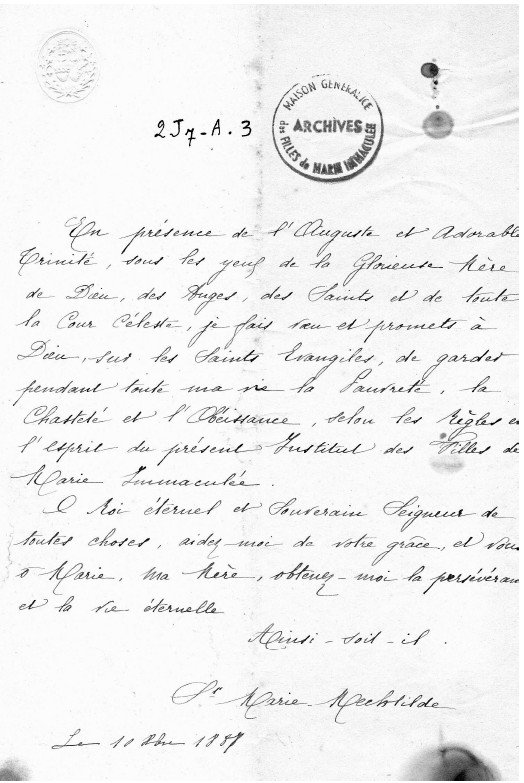
2J7.A.3 - formula of perpetual profession
In the presence of the August and Adorable Trinity, under the eyes of the Glorious Mother of God, of the angels, of the saints, and of all the heavenly choirs,
I vow and promise to God, on these holy Gospels, to observe during my whole life poverty, chastity, and obedience according to the rules and the spirit of the present Institute of the Daughters of Mary Immaculate.
O Eternal King and Sovereign Master of all things, help me by your grace; and may you, Blessed Mary, my Mother, obtain for me perseverance and eternal life.
So may it be.
Sister Marie Mechtilde
Dec.{?} 10, 1887
Introduction
Undertaking to follow the life of Mother Mechtilde means entering into the tortuous path of French history. For the Daughters of Mary it is an occasion for truly returning to the sources of the foundation and of its history: a return to the original inspiration because Mother Mechtilde often quoted from the Founders. It draws us onto the road of a profound self-examination in order to lead us to a deeper challenge to ourselves and a greater openness to the questions of our contemporaries. It leads us to living with greater receptivity the tenderness of Mary with regard to our sisters and brothers. There is question here of the credibility of the Gospel in today's world.
Let us enter joyfully into the discovery, or rediscovery, of the life of Mother Mechtilde. It was an admirable life, yet imitable in the measure in which, at every moment and in the world in which she lived, she tried to seek out the will of God, master of time and of history, in order to accomplish that will. It is also good for us to see how a constant seeking for the will of God and intimacy with him, lived instant by instant, transformed Mother Mechtilde, a fragile and fearful being, into a dynamic and strong woman as she faced all the challenges of her era. (She was at first unwilling to go to Paris, city of perdition, but some years later she established her headquarters there.) God alone knows how rich was that period of secularization in so many different ways.
1. Her Family Life
We know how important is the early childhood
in the life of a human being,
in a familial and educative environment.
Going back to the first glimmer of awareness,
to the first awakening of self-knowledge and intelligence,
in brief, to the first experiences,
we find there a hidden wellspring of a life
we hope to uncover. [1]
Gabrielle-Marie Pouilh is born April 10, 1858, at Graulhet, capital of the Canton of Tarn, along the Dadou, a small stream that empties into the Agout, a tributary of the Tarn. [2] At this time the entire area is a world-renowned center for curing wool and tanning hides. Mazamet is the nearest center of such industry, and the family home is not far from there. Jean Bernard Pouilh, her father, is a tanner. He is thirty-eight years old when he presents his first child to Hippolyte Pinel, assistant to the mayor, Gazaniol.
The Pouilh Family
The family lives in a pleasant house with a beautiful virgin-vine, green in the summer and red in autumn. The vine spreads across the front of the house and climbs to the terrace on the second floor. It is on this terrace in summer, or in winter, in the elegant dining room with its well-polished antique furnishings and under the portraits of grandparents, that Gabrielle passes her first years close to her mother. The latter is a consummate embroiderer. The little girl is happy, gracious, and of kindly temperament.
When she is five, Gabrielle welcomes a little sister, Lucie, as petulant as Gabrielle is calm. Life proceeds tranquilly, though somewhat more serious. Their father, originally from Grenade in Var, has one sister and three brothers. Aunt Gabrielle, the eldest child, has joined the Sisters of Charity and will die at Uzès in 1861. The second, oldest of the boys, lives at Grenade. The next is Gabrielle's father, Jean Bernard. The fourth child, married to a woman from Charente, has left the region. Uncle Pierre, the last and the most beloved of the children, embraces a military career in the marine infantry. Like the rest of the family, Jean Bernard has great affection for his younger brother.
Among the relatives are a Carmelite nun—the cousin of Jean Bernard—and a Poor Clare, the cousin of his wife. These two religious are chosen as godparents for the two children. Gabrielle does not have many opportunities to visit her aunt of the same name because enclosure is very strict, but the family speaks often of her. This touches deeply not only her childish imagination but also her heart.
Gabrielle's delicate health causes her parents some disquietude. She is too thin, too quiet, too well-behaved. She looks at everything with her large, clear eyes filled with dreams. Her sensitivity is extreme. While still very small, she becomes gravely ill, even hopelessly so. She is taken to Father Marie Antoine, at the time a miracle worker from the south of France. She is cured. We may be sure that the frequent repetition of this account in the family circle as a miracle has great influence on the meditative and sensitive child.
There is another, even more dramatic event, when she is eight years old. It provokes such a severe shock that she never fully recovers from it. She is in the dining room, seated on her father's knees and `entertaining herself by shelling nuts. It is cold outside and a large fire blazes in the hearth. Lucie and their mother are in another part of the house. Her father, resting in an armchair, is enjoying a cup of hot milk near the fire. Suddenly he places the cup on the table and brusquely falls toward the hearth. We can imagine Gabrielle's shock as she hurries to call her mother. Dead! Her father, a heart patient though she did not know it, dies suddenly in her presence. She would later recount the terrible impression she experienced some hours later when touching her lips to his cold forehead and his unmoving hands, so pale and so cold.
It is the first time she faces death, alone, experiencing the shock and taking hold of herself as she goes to her mother. This harsh experience at eight years of age will weigh on her the rest of her life. Though she regains her joyful and smiling character, she retains signs of seriousness and of fear, as well as a tragic presentiment of the fragility of human life. From then on, she is a more serious child. She knows she very much resembles her father and deep within her is born the notion that will continue to grow and pursue her: she will die in the same way. Much later, as a self-controlled and meticulous religious engaged in a life at once practical and spiritual (such as is a life of administration), she will admit that she prepares herself for death every night.
This is what she will later write to her sister on October 15, 1927 (she will then be 69 years old), with an express command that this letter not be mailed until after her death:
I have lived with the thought that I might die as did our regretted father, of a sudden death. With a weak heart like his, his death so impressed me that I have always hoped to be like him—to leave this earth without creating any disturbance around me. However, it will be, of course, as God might will.
The image of her mother, Marie Mauriès, would remain vividly in the minds of her final witnesses who had known the family. A photo shows her among her children, eyes cast down and pensive, her mouth tightly closed as though she were restraining a word or an emotion. Her face is pinched, her chin strong and determined: a physiognomy at once sad and forceful. Her dress and cape are those of the lower bourgeoisie, “as they should be.” Her role, even with regard to Gabrielle's vocation, is that of a discrete and tenderly maternal person.
In her widowhood, with the two girls of eight and three-and-a-half years, she is in great difficulty. She has to liquidate the heritage of Jean Bernard and give up the business. The family's financial situation deteriorates. She finds support in Pierre, the youngest of her husband's brothers. He becomes the tutor of the children and Marie's helper. Lucie, at eighty years of age, will write of him: “Our Uncle Pierre had great affection for our father. He often said to me: „Your father is the best of my brothers.‟ And he had been very good and helpful to mother in raising us. He left to me all that he owned.”
Throughout her life, Marie seems to have been overwhelmed by the two great pains of her life: the death of a husband and, later, the departure of Gabrielle for the convent.
Gabrielle and Her Studies
It must certainly be in keeping with her brother-in-law's suggestion that Marie sends her daughter Gabrielle as a boarder to the Sisters of the Cross at Lavaur. She is ten years old; some thought must be given to the future. Children these days must find adequate employment and, for that, they must attain their diplomas. Gabrielle remains at Lavaur for a few years, then she leaves for Castres, to the boarding school of the Ladies Pangon. It is a very reputable institution. The young girls are prepared for their diploma, but they also receive a truly spiritual formation. It is much better than the simple religious overlay sometimes given in some schools with the sentimental devotion of a former romanticism which has them raise their eyes to heaven and create for themselves a religion of sentimentality and comfort.
During her whole life Gabrielle carries the mark of this rigorous formation and seeks to educate women of great strength. Do the Ladies Pangon perhaps exaggerate in submitting these young girls to an involuntary asceticism? Gabrielle must not be complaining, or her mother would certainly withdraw her from the school. Yet, many years later, in 1924, she will confide to another religious: “In the boarding schools we must take care to give our pupils sufficient nourishment; conscience makes that a serious duty for us. I suffered much at Castres from an insufficient diet and; because it was a time of growth, I have suffered from that for the rest of my life.”
Is it at Castres that she acquires the habit of eating little? Her companions often ask how she can survive on so little. During the vacation periods she returns home and Lucie says she is “very good, very kind, and goes to Mass every day.”
The years 1867 to 1878 leave scarcely a trace. In Lucie's remembrances we find some revealing events, such as an accident which probably takes place around the age of 14 or 15, during the summer of 1872. At the Pangon school Gabrielle becomes friends with Hélène Lautard, the daughter of a teacher at Anglès, in the district of Tarn. The two friends love to visit during the vacation, but communications are not easy. Hélène comes up with the idea of asking a certain M. Poulié, who often goes to Anglès to purchase skins, to take Gabrielle along with him in the carriage and to bring her to Anglès. The good man does so, and she makes the trip.
She spends a week with her friend. For her return, the tanner again takes her in the carriage to bring her back to Graulhet. He has another traveler as well. Happy, she heads homeward. The weather is good, and she is wearing a lightweight dress beautifully embroidered with small bouquets. Suddenly, on a downgrade, the carriage crashes into a pile of rocks. What has happened? Runaway horse? Defective brakes? Whatever the cause, the other traveler is killed on the spot, and Gabrielle, thrown upon the rocks, loses consciousness. However, she suffers only a tear in the sleeve of her thin dress and some small bruises to her hands. She attributes this protection to the Virgin Mary, for at the time of the accident she was finishing the recitation of the rosary and was about to begin the litany of the Virgin.
Lucie also tells us something of the young girl who is about 18 to 20 years of age. She is very cheerful, very well behaved, kind and calm, and a bit fussy. She already has that beautiful smile which, throughout her life, will convey an inexpressible mystery of one who seeks God in all those who approach her.
Are we to see an irreparable loss in the fact that all the letters of her mother, of her sister, of her own will be burned? We might suppose that already at this age there burns in her a still-confused desire of a vocation.
Father Ginhac
God permits us to recognize and to follow his blessings, though they are sometimes quite disorienting. Gabrielle benefited from another source of grace. At the Pangon boarding school, the Jesuit Fathers come regularly to teach catechism to the pupils. One of the teachers is Father Ginhac. [3] He quickly exerts an influence over this child and becomes her spiritual guide. Later she will often recall the figure of the priest, so paternal, so mortified, and so deeply a man of faith. His example and his advice seem quite determining in her psychological and spiritual evolution. For us, Daughters of Mary Immaculate, we know how much the presence of this priest has been at the source of spiritual blessings in the life and work of Mother M. Joseph de Casteras,4 third Superior General of the Congregation, as well as in that of Mother Marie Sophie Baud,5 fourth Superior General.
Father Ginhac has just left the rectorate of the Jesuits of Toulouse where he had been since 1860. In 1869 he is transferred to Castres as instructor of the tertianship for the Jesuits who have completed their studies and are preparing themselves for the apostolic ministries. He is to organize a new house, for that of Laon has become too small for all the Jesuit Fathers of the French provinces.
This is how he defines his task in a letter to his sister Eugénie, religious of the Visitation convent of Marvejols:
We call this year, as does our Father Saint Ignatius, Schola affectus, a school of the heart. That is to say, that here we seek to find a taste, and affection, for the things of God; we seek to become children again, simple as in the first novitiate, so as to enter and become set forever in a holy familiarity with our Lord. … The most sure way, the most powerful, the most profound, and the most joyous, is to love. To love Jesus Christ.
Father Ginhac, a little less involved in the organization of his new home, can now devote himself more freely to the spiritual direction of the faithful. At the Pangon school, he is confessor for the teachers and for the pupils; he preaches retreats. Here, the war of 1870 has little impact. The battle rages especially in the north of France. Gabrielle arrives at Castres around 1870-71 and will leave in 1875 after obtaining her diploma. She is one of those for whom Father Ginhac's direction will be determining. This pious adolescent, trusting, contemplative, open to God, hears it said that people cover hundreds of kilometers to come to see him. Without doubt she also hears Father Calot, director general of the Apostolate of Prayer, say of him: “Never has anyone so impressed me or overwhelmed me as he has!”
Gabrielle admires the holiness of the exceptional Jesuit; his influence will be profound and lasting. Profound, for in some ways it changes her personality and the nature of her spiritual life. Lasting, in that she will retain this first formation as a solid center despite the unforeseen and dangerous circumstances in which she will find herself for long years because of the anticlerical laws and the dispersal of her sisters.
Father Ginhac's teaching is hard and strict, including the exact application of the exercises of Saint Ignatius. We may be sure that Gabrielle conforms her life to them. She develops her willpower, pushing to its fullest extent the strength of character she already possesses; she struggles against nature. But Ginhac does not ignore her gentleness and her freshness of spirit. Consummate psychologist and respecter of the spiritual personality of those he guides, he takes into account her gifts. His principle is to be kindly, indulgent, not to impose advice but to observe the working of grace and to support each one in the way chosen for each by the Lord, even with children or adolescents.
Once she becomes a religious she will maintain her correspondence with him wherever she might be. This continues until his death—the exact date is unknown to us.
Back Home
It was 1875 and Gabrielle has just obtained her diploma of graduation. She is seventeen. She leaves the Pangon boarding school, returns to Graulhet, and resumes normal life with her mother and her sister Lucie. There are no letters, no documents, giving us an insight into the intimacy between the mother and the two daughters. We know only that the two sisters are bound by a lively tenderness. Lucie is now thirteen. She is gay, a chatterbox, fidgety. She loves her older sister. The latter does not lack vivacity. During her entire youth she has been struggling against her natural tendency to be hasty. Both are high-strung. Gabrielle has learned to control herself and to present a calm face despite any uneasiness or emotion that might well up in her.
Though there is no documentation to show this, it is still fairly probable that Gabrielle devotes herself to the usual employs of young girls of that period: delicate linens, small tablecloths in view of a traditional trousseau for the future young married woman, and the usual domestic works. Such works leave her spirit free to reflect and to think of her future. It seems she is living the same quiet life of the vacation periods which formerly brought her back home, in the solitude and the silence of the room she then loved. She wants the room all in blue, both walls and curtains. She finds again the ambience that she had created during her infancy and adolescence.
Separated from the world and already formed to a life of prayer and sacrifice by Father Ginhac, she dreams of the enclosure, no doubt for a long time now. When does she speak of it to her mother? We do not know. Nor do we know anything of her interior life at this time. But her actions and the rigidity of her mother in her regard teach us something about the direction her life is taking between her seventeenth and twentieth years. When she does open up to her mother, her decision already has been taken. Her mother does not respond well to the plan. She has been deprived of her husband and also of her daughter during her years of study. Must she now see her leave, and this time definitively? She argues against this decision, discusses, cries, prays, and finally opposes this departure with finality. Lucie who, at this time, is fifteen and loves her sister tenderly will later say, when speaking of this period: “Gabrielle brought us to tears many times!”
The Lord’s Call
Gabrielle is torn between affection for her mother and her sister and the call of the Lord; it is a difficult time for her. Tenderly attached to Lucie and conscious of her duties relative to her mother, she needs heroic courage. She is, certainly, supported in this struggle by correspondence with Father Ginhac, and her mother does not seem to be interfering with it. But the priest leaves Castres in 1877. His superiors have suppressed the two houses of tertianship at Castres and Laon. They gather all the tertiaries of France at Paray-le-Monial, and Father Ginhac becomes the instructor.
In 1878, when Gabrielle is twenty, a pilgrimage to Paray-le-Monial allows her to make several days of retreat under the direction of the priest, there where Christ had appeared to Margaret-Mary. Touched and encouraged by the priest‟s words, Gabrielle makes some resolutions and imposes on herself a sense of direction for her life. She sews together two small sheets of paper which record this privileged moment:
To do all things well for the greater glory of God, the salvation of souls.
Jesus, our Lord as model.
Mary Immaculate for assistance.Profound renunciation: interior and exterior
Interior: complete, absolute in all things, without limit
Exterior: obedience as rule and measureFoundations of the spiritual edifice—Important work to be done, to be perfected as much as possible:
- Purity of intention
- Humility, above all of mind
- Obedience
- Charity
To decide exactly the number of acts to be made each day before every examen. Render perfect relations with God, the neighbor, ourselves. See God in all things; in all things go to God through Jesus our Lord and Mary Immaculate.
(When we have God, nothing is lacking—He alone suffices.)
Special care in the work of four virtues to be perfected—to keep myself intimately united to God through our Lord.
For the direction of the soul: simplicity, humility, and obedience.
Keep in secret graces received.
Generosity without reserve.
Nothing extraordinary in the exterior. Avoid carefully whatever might seem to be so. Love and vigilant seeking of the common life.
Certainly these seem to be the final advice given by a spiritual director to a future novice. After such a preparation Gabrielle accepts no delay to her entrance into a convent. How does she choose which one? Father Ginhac knows many orders whose foundresses, superiors, and religious he directs. It seems to him the Daughters of Mary Immaculate suits her best. “I do not know any order,” he tells her, “which has more of the spirit of Jesus Christ.” Gabrielle's choice seems to be reinforced by the words of her director, for that choice seems to have preceded the pilgrimage to Paray-le-Monial. In fact, for her, it is a semi-cloistered order dedicated to the apostolate; it is both contemplative and missionary. [6]
What discussions must be taking place, what pleadings, what a vehement refusal on the part of her mother? We cannot know, but we can imagine them. The mother's will and the will of the daughter are alike, but one does not understand the other. What can Gabrielle do to respond to a call that is becoming more and more urgent? An exchange of correspondence to resolve these complications takes place among Father Ginhac, Mother Marie Sophie Baud (Superior General of the Daughters of Mary), and Gabrielle, but we have no trace of it.
Departure
It is decided that Gabrielle will leave the house secretly to go to one of the houses of the Congregation. At this time, there are two novitiates: one in Agen, the other in Arbois. It seems that distancing her from her home by sending her to Arbois will make matters easier. She, therefore, goes first to Lyon in order, according to rumor, to avoid possible pursuit. From there, she proceeds, with another postulant, to Arbois. This other postulant is Antoinette Demeure. [7] The short account, which she will later make of this trip, shows clearly a total ignorance of the particular condition of her companion. She writes:
I am pleased to be able to add a note of affective gratitude to the chorus of praise that is today [8] being raised in honor of our most venerated and most lamented Mother Marie Mechtilde. In the whole congregation, I do not think I am mistaken in saying that I am the oldest to have known her, the good God having used her to guide me to Arbois as a postulant in 1878. I have never forgotten her goodness, her kind attentions during that short but painful trip from Lyon to the convent of the Daughters of Mary. I say “painful” for the heart because of separation from family. She was still young, but her spirit of faith inspired her with words of piety that revealed her love of God and of the religious life. I saw little of her during the postulate, but I do remember with what joy she received me when I went to see her after the ceremony of the taking of the habit, November 25, 1879.
Let us return to Gabrielle. Her mother is not willing to accept a fait accompli. Filled with the Roman ideal of the absolute authority of parents, of which there are still some deep vestiges in certain corners of the region, she decides to seek out her daughter who is still (in these times) a minor and to bring her back home. She goes first to the police, then to the procurator of the Republic. He responds:
If your daughter were in a house of ill-repute, we would have found her within two hours; but in a convent, don't count on it! We can search for her. If you were to seek her in the chapel, she will be in the garden; if you were to seek her in the cellars, she will be in the granary. … Leave her, therefore, wherever she is!
So she calls to her aid the tutor of her girls, Uncle Pierre, who is a captain in the marine infantry. On the matter of family authority, he shares totally his sister-in-law's ideas. He comes and takes the necessary steps to find out where his niece is. It probably is not difficult. He takes the train. Gabrielle is at ease again, after the struggle which had drained her energies—and now her uncle appears at the convent, serious, cold, correct, and decisive! She must follow him. During her whole life she will shiver when she has to pass the little hotel near the train station where they had stayed until the morning train.
Gabrielle, of course, is still legally a minor. Because she is at the moment only a few months away from majority status, we are surprised both by the passionate search by the mother and by the help which Uncle Pierre, a thoughtful and reasonable man, lends her. But, of course, it is not a question of the premature departure that sets the mother and daughter in opposition, but the mother's fixed resolution to keep her daughter at home forever. The mother is profiting from the short delay granted by the legislation to make a desperate attempt to retain her. She can but hope that in such a short period of time Gabrielle's mind and plans might change enough for her to renounce religious life. She is making an ill-conceived attempt at intimidation.
This mother, about whom we know so little, remains in the background of the life of her daughters. Of her we have not a single letter; concerning her, we have no revelatory detail. We can see only her reactions on this occasion of her daughter's departure. This exceptional event clarified much: what strength in this silent woman! what tenacious and unrelenting will! How much mother and daughter resemble each other!
A month and nine days after she attains legal majority, Gabrielle leaves home again. This time she enters the novitiate at Agen, May 19, 1879. The farewells are frigid. The mother returns home with Lucie. A frightful silence then begins between Gabrielle and her frustrated mother; for years she will not answer any letter from her daughter. Mother Mechtilde will never again see her mother, but her sister and her uncle will eventually be reconciled with her.
2. The Novitiate
Now Gabrielle no longer needs to seek hiding in some faraway place. She heads for Agen. She sheds no tears on the way. But her “victory over nature” has shaken her deeply. Impressionable and sensitive, she thinks of her mother's pain and frustration, and she suffers. If her will is strong, her normally vibrant sensitivity has exhausted her. She is shaking and seems more timid than victorious when ringing the doorbell at the convent of Agen.
The Daughters of Mary have been at Agen since their foundation in 1816. At first they occupied a spot not lacking in noble title. Centuries ago, the Knights Templar had possessed a fortified castle there. When, in 1312, the Order was dispersed, the Hospitallers of Saint John of Jerusalem (later called the Knights of Malta) took it over. In the eighteenth century the spot was called the Refuge and was occupied by the Religious of the Good Shepherd dedicated to the education of girls in troubled situations. The Revolution evicted them. At the time of their foundation, the Daughters of Mary had leased the property from the city. But the site proved so unhealthful that many religious fell ill. In 1829, the congregation was transferred to a different quarter of Agen, to the former convent of the Augustinians who had also been evicted during the Revolution.
So here is Gabrielle now, a small, thin figure, both intrepid and fearful, entering into a place where many saintly religious have already preceded her. She is already familiar with part of the convent: the parlor, the chapel, the garden. This day she penetrates into the holy of holies, into the community where silence and a great fraternal solitude prevail. How much she has desired this ambience where God can be found, where the creature can hear God without the sound of words!
She is not entirely a stranger there. She has already met Mother Marie Sophie Baud, Superior General, a courageous and gentle woman whose frail health is “only a string suspended between this world and the next, threatening at every moment to snap.” She also knows Mother Marie Stanislas, [9] the mistress of novices. Gabrielle had been barely fifteen years old when they met for the first time. Gabrielle had gone to Agen to see a friend from the boarding school enter the novitiate. It was Mother Stanislas who had greeted her in the parlor. The anonymous writer of a page in the archives says:
From the moment of this interview there was a kind of reciprocal attraction between the two of them. The sight of this older religious, now in full maturity, her so-penetrating eye, her touching and affable smile, her grave demeanor, her manners and words which revealed I know not what of the supernatural and which elevated the soul and drew it closer to God—all this ensemble of virtue and wisdom captivated the young adolescent.
From that day on, Gabrielle had not hesitated to confide to Mother Stanislas certain scruples that she had hidden, as well as her ardent desire to be a religious. Now, she has great esteem for Mother Stanislas and admires her. What joy to be guided by this religious, so interior and so human at the same time, and radiating evangelical simplicity! Gabrielle has already given her complete confidence and reveals her most profound desires. Even before she had made her decision to respond to the Lord's call, the Mother had said, “My child, you are not made for this world.” These words made a deep impression on her.
Mother Stanislas continues in this young soul the work begun in depth by Father Ginhac: cultivation of a spirit of sacrifice, love of physical and moral pain, seeking of suffering. Does she fear some sort of excess in this formation? Is it that loving suffering at this time might break the overly-sensitive heart of this young woman? One day Gabrielle had gone to see Mother Stanislas. She had a book tucked under her arm: La Vie du Père Balthazar Alvarez. Gabrielle told her: “I love this biography very much. This saintly religious loved suffering.” The Mother responded, “I know of something even more beautiful—behold the handmaid.” With no, or very little, explanation, discreetly as was her custom, Mother Stanislas had taught her that more important than love of sufferings for the sake of suffering was the passionate seeking of the will of God as Mary did. That was what would lead to holiness.
Mother Stanislas is called later to have a profound influence on this young sister who placed complete confidence in her. For the moment, Gabrielle, ardent and young, seeks the most painful, the most difficult, the most heroic, following the example of the saint that Father Ginhac was. The lofty and difficult holiness of the latter has spread his influence over the entire house. He is the spiritual director of Mother Marie Sophie Baud herself, who often reminds the local superiors and the mistresses of novices:
The first thing to teach beginners is the great law of abnegation, of detachment from creatures and from oneself. Let us form strong religious. Let them learn to use themselves well, to envisage the great concerns of God and souls without too much consideration of their own selves. [10]
Abnegation! Gabrielle repeats this key word to herself with complete joy and hopefulness that she might give herself without return. From the very moment of her arrival, she has the opportunity to put it into practice. Having put on the black dress of the postulant, she learns something that disorients her somewhat: Mother Stanislas, whom she cherishes and loves much, is relieved that very day of her role as mistress of novices. She is now called to take on new functions.
The religious who replaces her is the formidable Mother Vincent Rambaud. [11] Very good, very strict, she considers it her duty to “purify” the new novices by means of an almost brutal roughness. That is, of course, a rather common opinion at this moment in history, in institutions both of men and of women. Novices must be browbeaten, at least in word. Later, a new postulant who has just left family and the habits of the world will find more understanding and help in making the change.
The following morning Gabrielle follows her companions into the chapel, leaving aside her small concerns in the prayer of preparation for Communion. Her spiritual guide has for some time permitted her the reception of daily Communion. At the proper moment, Gabrielle gets up and, hands joined, moves toward the holy table. But a strong hand is laid on her shoulder: “From now on, you must walk at the pace of the community!” [12] came from the mouth of Mother Vincent. The strong hand leads the postulant back to her place; she kneels there with resignation.
The reforming zeal of Good Mother Vincent finds expression in many other ways to perfect Sister Gabrielle, and she always obeys docilely. She will later recall the truth of this maxim: “Whatever is worth doing is worth doing well, and we must always do the best of which we are capable to please God.” On one occasion, when she is applying herself to mending a torn kerchief, she spends the whole day at it. But the Mother threw the kerchief away and said dryly: “You have certainly wasted your time; it was not worth the effort.” That is true. But the poor, unfortunate, and too-sensitive Gabrielle is very upset and feels the pain for a long time. Small pricks that hurt and can form the character of some, in others, may risk having the opposite result from that intended.
One day, during recreation, Sister Gabrielle says simply that she hates the color green. That evening, while preparing the little oil lamps for all the dormitories (electricity having not yet come upon the scene) she spills on her black postulant dress all the contents of a lamp. To “punish” her, Mother Vincent goes looking in the closets for a dress of the most beautiful parrot green to replace the stained dress until she can clean it. What an unbearable shame to the timid Sister Gabrielle, being forced to wear for several days this dress which provokes the laughter of her companions. We may recall here what Mother M. Joseph de Casteras had said some years earlier about public humiliation: “Never humiliate publicly, but reprimand one on one.”
Such humiliations are common enough, but no doubt the most cruel is the following. One day Mother Vincent shows Gabrielle a living slug and tells her to swallow it. Gabrielle's large eyes clearly manifest a frightful anguish, she admits; heroically obedient, she takes the slug and swallows it. She will later admit that for three days she could feel it moving about, ascending and descending in her throat.
Mother Vincent does not explain her behavior. Is it because in certain regions of France it is believed that swallowing a slug alive will cure maladies of the chest? Might one also think that Mother Vincent has some debts to settle with her own childhood and has not yet seen clearly what is taking place in herself? We can only wonder.
We also know Gabrielle's health is precarious. She does not take proper nourishment and eats practically nothing. Should we see here a consequence of the insufficiency of meals at the Pangon boarding school? May we see in it an imitation of the asceticism of Father Ginhac of whom some wonder how he can live on so little food? Can we imagine what all these reprimands, contradictions, humiliations may be doing to this high-strung temperament? Whatever may be the reality, her health creates real inquietude.
It is clear that, when the time comes for the profession of first vows, the superiors are concerned. They think highly of this postulant, so wholly given to God, never complaining, being always obedient, gentle, obliging, discreet, and pious. Yet she is so frail and so thin. Will she be able, even with her heroic courage, to follow the Rule in all its rigor? The question is presented to Father Ginhac who brought her to the convent. His answer is clear: “If you want good health, send her home; but if you want a saint, keep her and she will render great services to the order.” [13] What a prophet! When the mistress of novices presents Mlle Pouilh for the taking of the habit, “the Mothers of the council give with great pleasure their votes for her admission, and the Reverend Mother is of the same opinion.” [14]
With deep joy Gabrielle dons the black dress and the white cincture of the novices. She sets aside her name and receives that of Sister Marie Mechtilde. With her joy there is nonetheless some sadness. No one of her family is present for the taking of the habit. She does not even have the traditional sponsor. By coincidence, Madame Delzenne, a friend of the convent, is there and accepts this role. Ready for all contradictions and all sacrifices, Sister M. Mechtilde intensifies her control over herself. Gracious, calm, always very gentle in her exterior, she tries not to reveal her inquietudes or her inner turmoil. She is like so many interior souls who, from the beginning of their religious life, try to mount too quickly along the way of perfection. Sure of her good intentions she has to suffer not being understood. But she repeats to herself that she is not mistaken, that her ideas are balanced. Moreover, the struggle which she has had to carry on within her own family reinforces such confidence in herself. So it is that, beneath her apparent calm, storms are raging, leading to a difficult but secret apprenticeship in humility.
She suffers much. Though accustomed to giving of herself, this “nature,” which she seeks to kill, reveals itself and revolts at every moment. Her remembrance of the strong advice of Father Ginhac, and animated with a surprising determination in such a gentle person, she struggles with all her force against moments of spiritual panic that at times threaten to discourage her. She struggles also against her “impetuosity” which leads her to run at times instead of moving calmly toward persons or things. She struggles, too, against an ardent sensitivity which calls up the memory of her mother's beseeching and that of Lucie. She is torn apart by it.
A calm and submissive novice, she moves ahead calmly when she wants to leap; she smiles while being overcome with anguish. Very restrained, quite victorious over her timidity, silent and recollected, she is exemplary. But her nerves are tested to the extreme. She is at every moment on the point of no longer controlling her emotions. Withholding a cry or some tears, she admits one day, “I yearn to scream in the forest.” Fragile, yet decisive, her interior life overwhelms her physical life. God is too sublime and terrifying a host for the strength of a young girl. She knows that. She writes, “But he never abandons a soul that trusts fully in him, and he has for it kindnesses which nothing else can give.”
Divine demands, supernatural kindnesses. … It is grace that sustains this frail creature who offers herself. Grace showers both pain and joy upon her. For she does have joy: an interior and deep joy. An extraordinary smile often lights up her face. It is not a forced smile, but the radiation of a goodness, a confidence, and a mysterious power which engulfs her and which influences others during her whole life.
So it is that Sister M. Mechtilde, guided by Father Ginhac, has entered into the Daughters of Mary. This indicates great wisdom on the part of the priest. If she had entered Carmel, as she had previously thought of doing, Gabrielle would certainly have become an excellent religious. But she would then have sacrificed not only her health and perhaps her life, but all the missionary qualities she was to develop as a Daughter of Mary.
Religious Life in the Nineteenth Century
In order to understand a little better the religious life of this moment and the vigorous formation given, it is good for us to situate ourselves in the context of society in the nineteenth century. Formal education in the family and formation in the novitiate have much in common. Paternal authority in the family and religious authority in the convents accepts no fault.
For this purpose, we depend on two works: those of Yvonne Turin and of Odile Arnold; two works that have two different points of departure. The one seeks to research the emancipation of consecrated women and has as the subtitle “Feminism in Religion.” The other studies especially the relationship of body and soul. Both are admirably complementary. [15]
Though the obvious diversity of the approaches is multiple, we can see to what extent the status of the religious woman agrees with that which, in every way, society dictates for the vast majority of women. All the powers, whether political, ecclesial, or familial, work to control the women they have under their authority. These cannot, either by nature or by right, escape their status of “perpetual minors.” From that comes distrust of self and submission to others.
Women, therefore, have but two options:
- being subject to a perpetual motherhood in dependence and fecundity, thus becoming veritable “procreative machines” or
- being “annulled” in consecrated virginity.
Religious life, then, marked by the customs of this period, is characterized by:
- flight from the world which is distracting, diverting, and which kills the soul. This world is not only void, it is cruel. This flight is accomplished by means of retreat and respect for silence which favored dialog with God.
- disdain of the body and the development of a distorted prudery. After original sin, a human being is perverted. Nature must be reacted against. There is an awareness of an original lack, an innate weakness. As a consequence the greatest spiritual error for a human being, for a created nature, is pride. There is need, therefore, to work at humility, royal virtue for the religious woman of the nineteenth century. The most secure road for attaining this virtue is humiliation and mortification. These virtues require a relationship of dependence with regard to God and a relationship of service with regard to creatures. Accumulation of a maximum of afflictive tests in the registry of sight, taste, sounds, and smells becomes the criterion of holiness. This goes even to “the practice of burying the body and the interior being in oblivion and anonymity.” [16]
Ever since the beginnings of the monastic life, asceticism has been considered a fundamental condition of the religious life. Though we may not like this idea very much in the twenty-first century, it remains a necessity. But in the nineteenth century it is sometimes pushed to the limit of human endurance. It is a clear, realistic, and spiritual wisdom that helps us fix this limit. Mortification is the masterpiece. To carry the cross in following Christ is to be “of one heart” with the word of the Master. [17] But we need to see how that is understood in the nineteenth century. “The soul is sick if the flesh is not mortified.” [18] Nothing against the body, then, is sufficiently harsh because there is no other choice than between this violence and eternal misery. In order to be saved one has to be a martyr: either by the fire of tyrants, or by mortification. This latter becomes a continual exercise of storing up treasures by acts. Even married women are no strangers to this kind of penance. Some impose on themselves rigorous fasts, the wearing of hair shirts, the cinctures of iron with spikes. That is clearly the atmosphere of the times!
The condition of the creature is also a condition of suffering. This is the mystery of suffering which moves to and culminates in a God on the cross. Therefore, poverty, humility, suffering, and the mystery of God crucified are all interrelated. This fact associates mortification to all the deviations which, unhappily, can pervert it. From this comes the importance of the effort to combat nature and to “tame the machine.” [19] This effort becomes a source of progress and freedom for some, but in other cases, in view of repeated failure, it becomes a source of discouragement and embittering of the soul. Now, nothing is more contrary to spirituality than this kind of thinking, for the body is then no longer the temple of the Holy Spirit.
Moreover, the short span of life (causes: the Terror still present, especially at the beginning of the nineteenth century; more recent wars; above all, tuberculosis raging in France) confronts religious women with the fragility of life and often confronts them with death. It is enough to remember that during the eighteen years of the Generalate of Mother Marie Joseph de Casteras, third Superior General (1856-74), one hundred and eleven young sisters died. [20] “It is so good to die young,” some said. [21]
All this obviously takes place within the search for the absolute of faith. The only desire is to please God, to render him a pure devotedness in a spirit of love and great fidelity, but often by sheer determination. On the other hand, we find exceptional personages, women of admirable firmness and overflowing with vitality, joy, generosity, and sensitivity. They are able to find in the conventual space and in their responsibilities a remarkable freedom to master themselves, to blossom into activity, and so to mark their environment and their age.
That is why, despite all the ideas about abnegation of the body and of the “self,” despite the weight of “taming,” despite the solitude and the prohibition of all affection, those sisters manifest a great degree of life, a truly radiating power, a capacity to integrate the weight of contrarieties and theory without being crushed by it. Though sharing in the system, they live through it without succumbing to its negative aspects. It must also be recognized that the convent, during this period as well as preceding ones (we might recall the great abbesses of the Middle Ages) is the only place where a woman could realize fully her profound human and spiritual aspirations, for there she is no longer under the domination of the male.
Today, at this beginning of the twenty-first century, if we are not careful, we risk falling into the opposite trap, laxity. Thanks be to God, times have changed. But the faith imbedded in the body of our ancestors, their desire to adhere completely to the will of God, their seeking after humility by means of asceticism: all those remain. The reconciliation of the body and the soul due to the biblical renewal on the one hand and to the development of the human sciences on the other allows us to enter into a new relation of the one with the other.
God is ONE, and we, created to his image, are one; or, more correctly, we are in the process of unification. God is the initiator of my body. I do not simply have a body, “I am a body.” Whatever the body experiences reflects, therefore, on the soul and vice verse. “I am an animated body,” or “I am an incarnated soul.” The body is my history, my memory, the expression of my personality, the means of entering into relationships with others, the locale of suffering, the reflection of my interiority, “the locale of our transfiguration,” as a religious has expressed it. [22] The body speaks, and I should listen to it. This is not in order to satisfy myself with an exaggerated pleasure, but in order to respond in a more complete and more efficacious way to the Lord of life: “I came so that they might have life and have it more abundantly.” [23] It is so that I might realize what it is that he expects from me for the salvation of others.
The Institute of the Daughters of Mary Immaculate
This congregation was founded in France in 1816. The Revolution had dispersed most of the former orders. Evicted from their convents and prevented from regrouping their religious, these orders either did not survive or were reduced to small communities. All the bishops, though, were asking for religious, men and women, for their works which lacked cohesion and leadership. The Church found itself in great distress. The Revolution not only suppressed the religious orders, but it also subjected the clergy to the Civil Constitution. This caused a division of the clergy into “jurors” and “nonjurors.” The faithful were faced with a separated clergy; this forced them to make a choice. After the Revolution, worship was little by little reestablished, but France was by then terribly dechristianized. The devotedness of the faithful moved in the direction of an urgent apostolate attempting to reestablish the faith.
Adèle de Trenquelléon, [24] our Foundress, from the age of sixteen organized in her area what might today be termed a Catholic Action of Women. She brought together in an association friends and companions dedicated to the evangelization of their milieu while still living with their families. She had carried on a correspondence with Father Chaminade, [25] a priest of Bordeaux, who was driven by the same missionary zeal. Adèle decided to work with him. He initiated her into his understanding of Mary:
Our sodalities are not only associations in honor of the Blessed Virgin; they are a holy militia which advances under the Name of Mary and which definitely wishes to combat the infernal powers under the protection of her who is to crush the head of the serpent.
And later, he wrote to her: “You will be missionary religious.”
Adèle received with enthusiasm this apostolate with and for Mary. From this “little society” organized by her care would be born the Congregation of the Daughters of Mary which would develop this flame of Marian apostolate. More than anyone else, Sister M. Mechtilde profited from this influence.
Filial piety toward Mary, on which Father Chaminade placed great emphasis, implies an imitation of the Virgin in what is most salient in her traits: especially her interiority and her maternal love. Action on others was not to be primarily dogmatic or intellectual and was not to insist, as was usual at that time, on the fear of divine vengeance. It emphasized, rather, the kind and smiling welcome of a mother, especially with regard to troubled souls and “lost sheep.” It healed physical and moral wounds. Charity was to take the form of sincere affection, compassion, devotedness, and tenderness that shared the bread and the kindness of God.
That is what Sister Mechtilde came to understand little by little. With great courage she follows the exercises as best she can, hides her concerns, strains her weakness, and finds a bitter joy in that milieu both austere and smiling. Yet she carries within herself a great pain: that of being completely cut off from her family which never responds to any of her letters and never forgives her for her departure. But she almost certainly sees in this pain a trial which she accepts calmly.
Like the rest of the novices, when she is not compelled to sleep longer, she rises at 5:00 A.M., makes her bed in silence, and then goes to the chapel for community morning prayer and meditation. They all recite the six Our Fathers, Hail Marys, and Glory Bes. That means almost two hours of exercises. At 7:00 A.M. they recite the Little Office of the Blessed Virgin, followed by Mass and a quarter-hour of reading or thanksgiving for those who have permission to receive Communion. Work period or classes go from 9:00 A.M. to half-past eleven. Sister Mechtilde sews or gives piano lessons. This is followed by a quarter-hour of particular examen, then the noonday meal, a dark moment of the day for Sister Mechtilde.
After the meal, there is recreation, usually in the garden, until 2:00 P.M. Then each one returns, in silence, to her work until around 5:00 P.M. From 5:30 until 6:00, when the patter of the dismissed children has disappeared, they return to chapel for the evening meditation. At 7:15, rosary, dinner, and recreation until 9:15. A quarter-hour of examination of conscience precedes night prayer; then follows a presentation of the subject for the next morning's meditation. After night prayer, all is quiet in the novitiate; all fires are to be extinguished by 10:00.
For Father Henri Rousseau [26], who noted the similarity with the rules that Saint Ignatius of Loyola set out for his religious, all that was quite normal:
Nothing very difficult in this distribution of the day. Nothing fantastic in this program, but sleep and recreation balanced with work. Nor was there any rigor in the diet, other than the Friday fast and the abstinence of the three days of the Carnival. Father Chaminade had laid out this regimen. By contrast, the religious discipline is strict and takes its inspiration from Saint Benedict, the legislator of monastic work: silence and separation from the world.
From July 3, 1822, Mother Foundress lived as would Mother Mechtilde. She wrote, “We do not have cubicles; we sleep in a single dormitory.” In a later letter, she returned to these articles which seemed to her especially hard: “We must always work together, in silence and recollection; whenever the exercises and our works allow, we have some rest. Everything with us is in common. We are not permitted so much as to dispose of a piece of paper.” And she already added, with reference to the privation of not having her own room: “One needs religious abnegation to put up with that.”
On July 13, 1888, Pope Leo XIII, when approving definitively the Constitutions of the Daughters of Mary, set the morning meditation at an hour and the ensemble of exercises at four-and-a-half to five hours.
Young Sister Mechtilde submits to the harshest of trials, that of silence. She understands what a break and what purification this is for her. As Father Chaminade had said, and as she would be happy to explain later, this silence is comprised of five silences: of word, of signs, of the mind, of the imagination, and of the passions. That is a rude discipline, common to the strictest orders. It is a discipline that requires her to deepen her interior life, to limit her thought to a holy destitution, and to halt the flurry of images and useless impressions. For the young, this silence favors the obligation, under the action of grace, to nurture within themselves the still indistinct vocation, to free themselves from all the superficiality already acquired in the world, and to find in obedience their true freedom. They then open themselves to a supernatural life and a recollection that prepares them for contact with God.
3. Mistress of Novices
From 1881 to 1887, that is, from the end of her novitiate through her profession of first vows, and to the moment of her perpetual vows, we have no document relating to Sister Mechtilde. In the archives, under the date of December 5, 1881, there is this note on a meeting of the Mothers of the council:
Sister Mechtilde Pouilh will be completing her two years of novitiate on December 8 (1881). Since her entrance into the community, her conduct always has been edifying. She has much piety, a good character, her scholastic diploma, but a very delicate health. She can provide neither a dowry nor room and board, but her qualities compensate for them. With great pleasure the mothers of the council gave their votes for her admission, and the Reverend Mother is of the same opinion.
In September of 1887, another proposal was submitted to the council:
Sister Marie Mechtilde Pouilh, choir sister [27], will have completed six years of temporary vows on December 8, next. Her health does not permit her to make her tertianship, nor to follow the exercises of the retreat; she may pronounce her vows with the others on the day when we close our annual retreat with the act of renewal. Authorization for this will be requested of the Reverend {ecclesiastical} Superior. The councilors are in agreement.
A note added later indicates that this authorization was not given. Yet, a little more than two months after the September meeting, November 18, 1887, we find this resolution in the archives:
The Reverend Mother then proposed the definitive admission to perpetual profession at the convent of Agen, 1) Sr. X., 2) Sister Marie Mechtilde Pouilh who will complete six years of temporary profession on December 8, next. Both these sisters are admitted to perpetual profession.
The Religious
From these minutes we can draw at least two conclusions:
1) First of all, Sister Marie Mechtilde‟s health has improved little since her entrance into the convent, for it is impossible for her to follow even the exercises of the retreat. Her weakness must be grave, though no mention is made of any specific illness. Later, in her confidential letters to Mother Stanislas, she will often complain of excessive fatigue and of a nervous anxiety.
2) On the other hand, from the sober judgments of the council of the Mothers, we may also infer the religious radiation of the soul that this fragile envelope encloses. There is hope, surely, for an improvement in her health. But, even though she may remain unable to do the least work, her life alone, her presence alone, would draw down grace and serve as a living example. There are presences who give God. And who knows what a pure being who has suffered much might radiate around itself.
All the minutes we have just cited are signed by Reverend Mother General, Marie Sophie Baud, who is very ill at this time. She will die next year, March 26, 1888, without having known the decree of definitive approbation of the Constitutions signed in Rome by Pope Leo XIII, on July 3, 1888. She had worked with great determination to obtain that approbation.
It may be said that this deeply-missed mother succumbed under the strain. It was, in fact, after this colossal work which she had imposed upon herself for the revision of the new Constitutions that her health was irremediably broken. [28]
The Constitutions are distributed to all the religious in March of 1889, after the revision of the Directory by the chapter that opens in September to proceed to the election of the new Superior General. This Directory, reviewed, amended, and approved by the bishop of Agen, His Excellency Charles Evariste Joseph Coeur-et-Varin, is joined to the text of the Constitutions. These two documents are given to the religious during the course of a solemn celebration.
Election of a New Superior General
In the course of the Chapter, the First Assistant, Mother Stanislas Pernier [29], is chosen, on September 10, 1888, as fifth Superior General. Her three Assistants are Mother Thérèse de Saint Joseph Bouquerand [30], Mother M. Madeleine de Pazzi Ledoux [31], and Mother M. Marcelline Pasteur. [32]
Hailing from the Jura, Mother Stanislas is a silent, recollected type, gifted with excellent judgment of persons and things. She is very different from the energetic Mother Mechtilde, as calm and sedate as the younger religious is vivacious and passionate. Yet, unquestionable affinities draw them to one another. Thirty years of age separates them, but the contrary would seem to be true, given the tone of their letters to one another. A true tie of mother and daughter unites them: respectful tenderness on the one side; on the other, an active vigilance anticipating all obstacles, joined to admiration of the spontaneous and generous youth of the other. Not only does obedience not prove burdensome for Mother Mechtilde, but she also makes of it a form of veneration. The authority of her Reverend Mother is exercised with such delicacy that she often seems to suggest rather than command. Her letters are filled with formulas like the following: “Do as best you can. … You who are on the spot, judge for yourself and decide. … If you see no difficulty in that, do it.” The most intimate confidence binds them to one another, and each in turn admires and imitates the holiness of the other.
Mother Stanislas is, for the younger mother, a second director of conscience. Father Ginhac continues to offer advice to both of them. But religious life constantly presents problems which need solutions that are nuanced and supple. Moreover, the younger sometimes needs to confide her spiritual conditions to Mother Stanislas, who is more likely to understand them. There does indeed seem to be in Mother Mechtilde a mystical tendency which the priest does not sufficiently appreciate. Is he, perhaps, too unaware of his own rigorous nature for him to take the initiative of directing and expanding that of other, more delicate, natures? It is especially energy and strength that he develops in those who confide themselves to him. Given the extreme sensitivity of Mother Mechtilde, does he see that tendency as a danger? It is difficult for us to know, especially because Mother Mechtilde's letters, always most precise, often cut off abruptly when certain words risk touching on a too personal contemplation.
However, here is a letter that renders the reader pensive. It is a response of Mother Stanislas to Mother Mechtilde: [33]
My dear child,
It is no doubt for your consolation that our Lord has permitted you to think that I have forgotten you, for in truth that is not at all the case. Often I have had a desire to come to you, but always there has been an obstacle. But, knowing you felt truly supported, I was not upset because of that. That, indeed, is the truth.
After having read your letter, I went to choir to say a laudate in thanksgiving for everything. Yes, God is very good to you, my dear child; his gifts are without price and worthy of an eternal thanksgiving. But our divine Master does everything with great wisdom. He has his own plans in view, in these insights and enlightenments, these so intimate communications. It is the accomplishment of his divine wishes that you must desire. I truly ask our Lord that everything may redound to his glory and that he lead everything to that unique end. For the moment, all you have to do is receive, give thanks, and follow humbly and faithfully the impulse of grace.
Yet, take care of your physical strength; be prudent. … Take whatever nourishment and rest you need. And, my dear child, pray much for me who am so much in need of it. I am, as it were, enveloped in difficulties for which the light of the good God is so much the more necessary for me as I see less clearly. There are decisions to be made, means to be taken; but is this the moment? Is it truly the will of God?
My dear child, be my “pray-er.” … Within two weeks I hope to be able to return; meanwhile I assure you, my dear child, of all my affection in our Lord.
This letter seems enigmatic, especially in the second part. Of course, it most certainly is not so for Mother Mechtilde who understands the plans of the Mother General. The mere fact of understanding each other with an unfinished thought, of understanding without being surprised, the divine preparation in a soul, reveals certain affinities and an absolute trust. This trust rests on years of experience and of virtues common to the two religious. Even before her postulancy, as an adolescent, the spiritual influence of Mother Stanislas softened and calmed this young woman who confided in her. Even to her death, she will be able to see into her as though seeing into her own conscience.
Foundation of the Petit-Val at Sucy en Brie
As soon as Mother Stanislas is elected to the Generalate, she devotes herself to directing and bringing to completion the work of her predecessor, Mother Marie Sophie Baud. [34] She completes the revision of the Directory, which is to comment on the text of the Rule and determine the diverse functions of the congregation. She also applies herself to completing the project that she had formulated in conjunction with Mother Marie Sophie, that of establishing a convent near Paris. In that way the congregation would have a center which would be closer both to the houses of the east and those of the south, as well as closer to the Society of Mary so as to help preserve the primitive spirit of the congregation.
After the rejection by Cardinal Richard of a proposed installation at Auteuil, Father Simler, Superior General of the Society of Mary, seeks another location.
On May 31, 1890, the choice is made by the congregation and by the bishop of Versailles: a large domain called “Petit-Val” in the suburbs of Paris, which had belonged to M. Moulton. He had died in 1888, and the property, situated in the diocese of Versailles, was up for sale. [35] It is divided into several lots to facilitate the operation. On July 7, the Daughters of Mary sign the act of purchase for the château situated in an enclosure of about 12 acres on the largest of the available lots. The property has a history of financial disaster, as is clear from the large number of owners who succeeded one another. One after the other had found financial ruin there. When the Daughters of Mary arrive at Sucy, July 16, 1890, the château is practically in ruins. No maintenance had taken place for a long time. Much work is required, and the modifications needed for the establishment of a boarding school are considerable. For instance, the construction of an enclosure wall (a perimeter of almost a kilometer) on a clay soil required digging … and more digging … down to bedrock. Such deep pits also appeared in the finances.
The first community consists of Mother Thérèse de Saint Joseph Bouquerand, Sister Louise Thérèse Aubin [36], Sister Marie Caroline Bordelais [37], and Sister Célistine Demolombe [38]. The courage of the superior and her companions does not waver; they find their strength in the conviction that every work of God is founded on the cross. The foundation of Sucy costs the congregation great concern. The sisters receive all kinds of assistance from Good Father Simler, from the General Aministration of our brothers, and from a certain M. André. From July 20 of this year, the Marianist brothers from Collège Stanislas of Paris come regularly to Petit-Val to help the superior with their advice and with their many competencies. Their help extends to all areas: material, spiritual, cultural. The first class of pupils is able to come on October 7, 1890. From 1893 on, the brothers come from Paris to give courses of preparation for the state diplomas for the young professed.
Mistress of Novices at Agen
In this same year (1890), shortly before the purchase of that property, Mother Mechtilde is given the charge of mistress of novices at Agen. [39] She is now thirty-two years old.
The novitiate seems in need of reform, and a mistress of novices needs to be named. Our Reverend Mother proposes Mother Marie Mechtilde who for a long time already has been involved with the postulants and who has a special aptitude for spiritual matters. She also has many other qualities; she has been named in unanimity.
Transfer of the Novitiate from Agen to Sucy en Brie
During March of 1891, several postulants from the Parisian area present themselves. Mother Stanislas has a profound instinct that the house at Petit-Val will develop and will become their most important institution. She, therefore, takes the decision to transfer the novitiate there from Agen; it soon absorbs that of Arbois as well. [40] In this way there will be more unity in the formation of the young women and more spiritual contact between the young religious destined to become part of the same family.
The measure is important. The fact of placing Mother Mechtilde at the head of this novitiate shows clearly the confidence she inspires in Mother Stanislas and the other councilors. She is still very thin and fragile in body. She is a creature of fire and nerve, dominated by an acquired serenity. That peace is at every moment threatened and is renewed every morning by the hand of God. She has a calm that reflects tenderness and a profound goodness. Her health has barely improved, yet she does not spare her strength. Her will, firm and already heroic, allows her to take on the responsibilities. Moreover, the Mother General remains at Sucy for months at a time to organize the boarding school and to support, if need be, the new mistress of novices.
It is clear that Mother Mechtilde needs what the General Council calls “a special aptitude for spiritual matters,” as well as a special psychology for the direction of a novitiate. There are various young women gathered together there, some postulants, others already in temporary vows. They come from very different backgrounds; their mental condition is different for each one; some are often troubled. Each has received, or thinks she has received, the call. All have been studied, tested, and there is sufficient reason to believe in their vocation. There are among them some who are already firm and resolute in their vocation; there are the hesitant buoyed up by great enthusiasm; there are the timid who need to be encouraged; there are the ardent who need to be channeled and calmed down. But what powers of observation, what tact, what discernment of spirits are needed for the religious in charge of them!
If each one were to be formed, one on one with the mistress, receiving her counsel, her orders, and following them in solitude, that would not pose too great a difficulty. But they are many and different and called to live together. Of course, each one, in confidence, confides her problems, her inquietudes, to the Mother and tries to follow her directives; but they are living in community where each one exercises an influence on the other to affect her or to have her bend. It is understood that all are to observe silence, not to exchange impressions; that each has her clearly delineated work; that each should strive to live only in the presence of God. But even faces that seem most silent reveal, even unknown to themselves, many things, especially around the age of twenty. Human sciences today tell us that body language accounts for 93 percent of our behavior. Sensitivity is a fluid that no vase can contain; it escapes through imperceptible fissures. Disappointments, discouragement, exaltation, susceptibility (not manifested, but subtle) pass from one to the other by some kind of phenomenon of transmission—and the atmosphere is quickly changed.
All this is so tenuous that one might not become aware of these influences, at least not soon enough to remedy them, unless the mistress of novices, by a grace of God, is able to recognize them. Moreover, these young women, so pious, so full of love of God and of good will, have not yet the strength of soul needed; they are so changeable. Those who tend the most to be distrustful of themselves, who best preserve a prudent reserve, often end by being so tender that their nerves give way. Tears break out, petty revolts explode. Many may need family support, and often subconsciously they wish for a maternal tenderness.
Serious problems may also face the mistress. The young women may absolutely need some support to “dilate” disquieted and painful sensitivities: understanding the trouble without sharing it; speaking at the same time with extreme tenderness to calm and with firmness to reawaken courage; discerning in whom or in what the traveling waves have their origin and finding the remedy which best fits this particular instance; consoling so that each one senses the affection, and watching over her. The mistress has to gain their confidence and have herself loved by them. She has to weigh the risk between a too great maternal affection and an unmeasured filial affection. Sentiments have to be directed toward God and spiritualized in such a way that the mistress be not an obstacle but a companion on the road of the Lord.
Mother Mechtilde, therefore, has need of much psychology, counting first of all on the strength of the Spirit, the great formator, and then on knowing how to combine the supernatural with the natural. Finally, she needs great humility in order not to go contrary to the work of the Lord in each of these young persons. These are capacities demanding a profound interior life in order to cooperate with the Lord in his work.
Aware of her bodily weakness and of her inexperience, Mother Mechtilde delivers herself over to prayer and enters the battle. She understands the risks of misjudgments. Too much severity or too much liberality, an error of discernment, showing too much or not enough affection is enough to ruin a vocation. Certainly, taking account of her character, she knows from the beginning certain anxieties; but it is not less certain that, during this time, she receives the helpful guidance of Mother Stanislas who remains longer at Sucy before returning to Agen.
From 1892 on, regular correspondence is initiated between the two of them, continuing up to the death of Mother Stanislas in 1907. [41] The contents are varied: spiritual direction, admission of her weaknesses, material concerns of the house at Sucy, health of the sisters, developments in the boarding department and in the community. In these letters we see a mother working at mastery of herself, “tucking her hands into her sleeves” when she senses her agitation, smiling when she is in fact worried, smiling above all when she is exhausted. She always exhibits her beautiful and affective smile, calm, understanding; she continues to have it, and it will conquer so many hearts. She is becoming less and less self-centered, setting aside her preferences and her repulsions, overcoming her fatigue and her irritation, to become truly a vehicle of grace. She walks the path of holiness, leading the younger ones and having the role of one who governs the rudder threatened by the tempest.
More than ever in the exercise of this service which is the formation of the young, she merits the name of “suavity” bestowed on her by Mlle Delzenne, the daughter of the woman who had been her godmother at her taking of the habit. So vivacious by nature, she walks calmly and with dignity. Her firmness and her love of enthusiasm are covered by an extreme delicacy of words. Moreover, she tends to speak little, to honor silence, and to teach its benefits to the young. When a mere look is sufficient, she spares the rebuke. The novices learn to decipher the smallest expressions of her face, so calm and apparently unchanging, and draw from it blame or approval, compassion or encouragement. Very quickly she acquires an extraordinary influence over her “doves,” as she herself calls the novices. This influence takes deep root in those who make profession: she has given them a taste of true piety, forgetfulness of self, enthusiasm. Yet, despite the kindness of her smile, she teaches them a difficult doctrine. In individual contacts and in the conferences which she gives them twice a week, and of which we have notes taken by the novices, the great themes of renunciation, of love of sacrifice, of obedience, of total poverty are presented without sugar-coating them:
You will be elements of sacrifice; the victim may struggle but must not descend from the altar. Never may you ever do your own will. Never, if we are faithful, will there be a moment when we can say: “I do my own will.” This renunciation begins with our rising and continues throughout the day, without a single moment of respite. You will never do whatever you think most desirable. Never free time, and that until the end of your life.
It is true, she adds:
We do not expect a young novice to rejoice immediately at the sight of the cross which she has to carry, but to accept with love whatever Jesus gives her, and to have the disposition to receive whatever crosses he might wish to give her in the future.
She must see the greatness of God's call: “Listen, O Israel, and do not forget that it is God who has chosen you.” This infinite and eternal God has chosen me; I was in his thought from all eternity.
It is the energetic and constant pursuit, courageous and generous, of perfection that will make you saints. You must also have a passion for souls. God has placed in us this resemblance to himself. Souls are purchased, and at a great price.
She also teaches them that spiritual consolations are rare, that they are not to seek them, that a quarter-hour is sufficient for thanksgiving after Communion even if all the joys of heaven are in it. “We must live a life of pure faith and dry love.”
With her, meditations on faith take a lively and startling course. In whatever happens she shows the novices God expressing his will. She invites them to listen to God within them at every moment of the day and terminates one of these meditations: “What have we said about faith? Ah! not much, almost nothing. In order to know it, it must be lived!”
Nor does she forget that she is addressing beings who are still fragile; she practices a pedagogy that is extremely clever and wise. She uses her personal touch. One religious wrote, “With her hand laid on our head, her deep gaze into our eyes, she spoke the will of God.” Another wrote, “She loved to sign us on the forehead.” Or, dispensing, as it were, the grace of God, she said: “Go to Communion; that will give you the strength to suffer.”
To help these young women of sensitive heart to walk toward God, she devises exercises that are almost childish, almost playful; such exercises bent their will to the will of God. Thus, on October 1, 1891, on the Feast of Our Lady of the Pillar, she begins the Association of Divine Good Pleasure. “The members bind themselves to smile at everything as being the holy will of God, under whatever form it might take.” The association names some candidates chosen from among the novices who would be elected “novices of the association” at Christmas. Each time a small inconvenience arises, they are to say: “Long live the God of Good Pleasure!”
She even composes a very simple song of forty couplets, each of which is an act of submission for a difficulty or misfortune accepted. Did not Pascal affirm that he wanted to “tame the machine”?
One of her former novices said: “When leaving one of her conferences it seems that nothing would cost; we were all transformed, animated with an ardent zeal for the souls who would be confided to us later on.”
And another religious responded: “Her presence alone gave me great joy. This Good Mother was aware of that. When she knew that I was working in a certain place, she would pass by. … She did not speak to me, nor I to her, but her silence, her glance dilated me. Oh! How great was her goodness!”
She also possesses a great art for reassuring others. One religious said:
My remembrance of her will never be effaced from my memory. … She welcomed me with a great maternal goodness. Often, even before I had a chance to open my soul to her, she would have divined in what a state I found myself. I believed that her advice, her encouragement, corresponded to my needs. … It seemed to me that something of her had passed into me. I would have desired above all to be impregnated with her sense of union with God and with her great goodness. … I thought I would have been ready to make all the sacrifices God might ask of me.
And another said, “She gave us God.”
At times Mother Mechtilde is very strict, and her strictness is as startling as her encouragement. This strictness, far from being exercised with a flood of reproaches, consists in a brief word, spoken softly, without a smile and with a somewhat distant attitude. Then she steps back and walks away. As with every other human being, she does on occasion make a mistake. A novice is told to water a large setting of begonias around a statue of the Virgin. It is extremely hot and all the flowers are wilting. The novice, with great determination and with great effort, carries an unbelievable number of buckets of water from a somewhat distant stream. But the sun drinks it up almost as she is pouring it. The flowers do not straighten up. The Mother happens to pass by: “Who was supposed to water these plants?” “Sister X …” “Ah! It is clear that she is not very fervent.”
That is all. But the poor novice is heartbroken. Much later, this religious will be considered a saint by Mother Mechtilde who will appoint her to important positions. We can see the kind of authority she exercised: authority exercised with kindness and honey, but mixed with a bit of harshness. Little by little, with the passing of years, her goodness and an abundance of charity will leave in her, now more certain of her strength, only kindness and persuasiveness.
Here is what Sister Marie Augustin, one of her former novices, will write some years later:
What most impressed me in our beloved mother in the novitiate was the power of this divine sap which was apparent in all her being, not only leaving a lurking impression of the supernatural in those who approached her, but also in communicating to them what they clearly felt to be a strength from on high, a contact with and a flowing out from God, a grace. Meeting her was like passing in front of the monstrance. … The doctrine of “God in us” which she taught us, she lived fully. We saw that for a long time she had allowed God to substitute himself for her nature; she had allowed Christ to pass over into her.
Add to that a certain serenity, an equilibrium in all things; that of the wise and prudent virgin, of Mary Immaculate, whom she so admirably reproduced. We saw a living application of that lovely expression: “For me, to live is Jesus through Mary.” So it was that little souls who desired to go higher had only to take flight after their mother, with the two wings she worked to inculcate in them: the spirit of sacrifice and the spirit of prayer.
It was in the spirit of sacrifice that she placed the high ideal of the religious life of the Daughters of Mary Immaculate: “Noblesse oblige,” she would say. “We must resemble our celestial mother in a constant vigilance to keep ourselves pure of all fault and to be purified as soon as we may have fallen. To be like her, all proportion respected, immaculate.” That could be accomplished, as she so well explained, only with the help of “a courageous pruning of the tendencies of nature.” It was to the word of the Rule that she repeatedly returned: “Oh, my sisters,” she loved to say, “let us go forward by renouncing our self-love, our own mind, our own will; joyfully, simply—without “if” or “but” or any restriction.
“Be not religious by half or by three-quarters; even more, be not phantoms of religious! With a goodly number of such people nothing gets done; with a few saints, much gets done. Be horrified by mediocrity; mediocrity is not for you!” In contradiction (for which the good God should be thanked), she repeated this expression: “Good for heaven! Valid for eternity!” And if someone came to confide in her some weighty humiliation, she would say to the novice, “Oh! thirty-six times more, my daughter!”
And what a mortal struggle against “I, the Queen,” or “I, the Idol”! If these powerful personages with their wicked followers happened to appear in her presence, she would drown them in the happiness of the religious life: “May your life be an endless magnificat; walk like queens on the royal road of the Cross. The good Master will not be outdone in generosity.”
She impregnated us with solid thoughts of faith, drawn from the school of Father Chaminade who did not promise his daughters lives “of rose water,” but a great devotion of submission to the will of God. When we might waste our life on bagatelles: “Let us live of faith!” That was her preferred word: “Come! Be more manly! Forget the trifles! Pure faith and dry love!” And we continued on the road. “A Daughter of Mary cannot be a madame of many affairs,” she would say. “Her essential affair is to become a copy of her mother in heaven!”
She insisted on the necessity of being mortified “no matter how crucifying may be the occasions for not being anything, not being able to do anything, not being able to will anything.” She returned often, and in a very special way, to the Litanies of Nothingness of Saint John of the Cross.
Mistress of all her impressions, she wanted a like work to take place in us in this regard. She said: “Are you troubled by something? What good is it to tell it to all Israel? Each thought, each movement of the heart or of the imagination which hinders our soul must disappear, except for what is of the image of Christ. … Force yourselves, therefore, to reject whatever does not come to you in the name of Christ, and, above all, do not share it uselessly.”
All such austere teaching our beloved Mother would clothe with attractive simplicity.
She preaches especially by example: her demeanor and least word express a peace that is the very peace of Christ. When a novice in difficulty knocks at her door to ask her advice and kneels before her according to custom, often a word is enough, or a smile, to calm the concerns of one seeking God.
4. Superior at Sucy en Brie
In this small new community of Sucy, Mother Mechtilde, while adapting well to her new role as mistress of novices, also watches over some of the work undertaken to transform the buildings. Our brothers work out the plans with the contractors, but many details remain.
Despite the distractions of the works in progress, the letters she writes to Mother Stanislas are full of serenity. No doubt, the change of climate and the happiness of watching the successful initiation of this new foundation have some effect. She gives news about health, which continues good; of the new wells, which are being completed; of the vegetable garden, which augurs well; and the visible promises of the fruit trees.
What she terms her “spiritual bulletin” is doing well, though she barely finds time to pray the rosary in the evening. “I do everything as best I can; I hope for the best, without worrying about the rest.” She continues struggling against her first responses, which sometimes betray her. She is always somewhat on edge and weak, but is not suffering. In general, all is going well and she loves the house.
For her part, Mother Stanislas is satisfied. In the course of her visits, she sees firsthand the results obtained by the novice mistress. On August 17, 1893, she decides to discharge her of the functions of novice mistress and names her superior of the house. In fact, Mother Marie Thérèse de Saint Joseph Bouquerand has to return to Agen as required by her role as the Assistant General. Mother Mechtilde does not welcome this change with any enthusiasm. To leave her novitiate! … She will evidently still have a supervisory role over it, but it will no longer be occupied with the novices all day long; that saddens her. On August 31 she writes to the Mother General:
Finally, I must take leave and say “Amen.” O Lord, my Good Mother, as I sometimes repeat with a crushed heart! When I see the novices, unexpected tears come to my eyes. You know, I am extremely feeble and it is for me a strange enigma that you should have thought to make such a change. I make acts of faith, of respect, and of adoration to the incomprehensible will of God.
After that, Mother Mechtilde makes her apprenticeship as superior, guided from afar by Mother Stanislas. An active exchange of letters takes place between Agen and Sucy. It would be of interest to quote a great number of them, but we shall limit ourselves to the most significant. Mother Mechtilde renders a detailed account of all her activities, of the smallest incidents; she asks advice and the Mother General suggests solutions.
The young superior finds herself faced with a host of problems of which she had never dreamed: material matters, so distant from her usual preoccupations; spiritual problems, for she now has to guide personalities less malleable than novices; also problems of good understandings between the different religious of the community who seek the same end, holiness, but with different characters which the prolonged practice of the Rule has not always improved. This latter problem makes Mother Stanislas uneasy as she wrote May 12, 1893:
You cannot believe, my dear child, what a consolation I have received in learning about the union that reigns among you! I see there the activity of the Spirit of God. It is a great grace, for which we must be very grateful. I know, you do not have much hope … I know well that there are concessions to be made. But how precious is the fruit! Courage, then; and take good care of yourself. I am a bit worried about your health.
Mother Mechtilde is passing through a period of relatively good health. She is enjoying an interior peace which she has been able to find after the rude war against her nature which is always too active and “hurried.” She realizes, of course, that this peace is a grace of repose before other battles, perhaps even more severe ones. It is in this context that Mother Stanislas writes to her on October 27, 1893:
You did well in seeking calm, light, and strength with our Lord. Such moments of respite are absolutely necessary for you. Be not afraid to follow the need for it which you feel. Poor superiors, often busy about many outward things, have more need than do other sisters to recoup themselves, to get their bearings again, or, rather, to place themselves once again under the influence of grace, and also to rest their soul. Their life is a constant giving, completely dedicated to others and to the Lord's work; but this divine master sometimes says to them, as he did to the apostles: “Come aside and rest a while.”
I think a constant effort to remain at peace is the best means for repressing whatever there might be of too much impulsiveness, too much nature, in your activity. Union with our Lord will moderate everything. I hope so. That union will bring fruitfulness to your devotion for the dear souls confided to you.
Remember that grace sometimes works slowly. Do not, therefore, be upset when you notice what is lacking to one or the other. But, armed with prayer, continue to be good, to study, to seek suitable means, to have someone accept advice, etc. … You will see that, with time, you will make progress.
Many times Mother Stanislas returns to the need of an affectionate understanding among the sisters. She knows the evil that the least rivalry or poorly-controlled antipathy can cause in a community. Mother Mechtilde has in her community a worthy and devoted religious of a difficult personality. Her comments are inconsiderate and her actions are fantastic and unpredictable. She does not patiently accept the decisions of the new superior who, nonetheless, takes every possible means to make clear her desires. Most of the time Mother Mechtilde manages to preserve peace. Mother Stanislas writes:
A thorn was taken from my heart when I learned that relationships were becoming better, simple, and soon affectionate. … Our Lord must have been pleased with your resolution with regard to strained relationships, and I hope you will find it easy to continue on course.
But certain outbursts perplex the young superior, and she questions whether she is following the intentions of the Mother General. Mother Stanislas writes:
My dear child, if you try to act under the impulse of the Holy Spirit (and that is very necessary for a superior), you will certainly not be acting contrary to my desires. Ignore, therefore, these thousand fears; act, rather, as a good child of the good God. Seek only his will. After that, calm and abandonment.
The older I get the more I have come to see the necessity of guiding souls by an affectionate gentleness, sometimes without showing signs that there may be anything amiss. They are to be led little by little, with affection, to take the means to reform themselves. That, my dear child, is what needs to be done with N.N. What do you want; that is how she is made. Let us have some compassion. But you will make progress with the good God by showing affection and trust; avoid any display of stubbornness. I am saying to you what I say to myself: “See how much our Lord loves her.” Courage, then; give no great importance to this or that unpleasantness. That is your cross; bear it with submission and love. [42]
Mother Mechtilde rises above these inconveniences. With considerable hesitation she enters into her new role. Other concerns demand her attention. Classes and courses have to be organized, for pupils are beginning to arrive. She takes care of the ill and indicates to Mother Stanislas even the least little malady and the remedy of a “good woman” that she applies. She notes that in the midst of it all she remains at peace, calm. She is not equal to everything, but she remains confident. She lets the Lord supply for her lack. She is confident that he will take care of it, and that trust gives her great peace. Her first preoccupation seems to her to be her lack of faith.
These responsibilities and these multiple attempts to promote good order and the development of the work deepen her love for the congregation. It is like a progressive maternity. God reserves for her some heavy burdens and thus prepares her little by little to face them. She writes to Mother Stanislas:
In your last letter, there is a passage that left me very confused. At first, I did not know what to think. Then, after some reflection, I thought you were using some words of thanks to encourage me. I am so weak, that is true. Yet, I would be most happy if no further mention were made of that. I owe everything to my religious family; I would wish to devote myself to its service without reserve. I shall always be in debt to it. I deeply desire never to leave it—that would never be possible; but I desire with all my heart to accomplish as best I can the duty of filial piety that I have contracted with it.
After God, Jesus, and Mary, the congregation, with the Holy Church, takes first place in my heart. I believe that, every day, the Lord is pleased to make me more aware of the bond of this love. Duty of justice, to respond to it by the love of sacrifice. As you have said it so well, my Good Mother, yes, I hope our Lord will make the sacrifices dearer to me. I want to say that I will esteem them evermore and love them more sincerely in proportion as I live by faith. Since your departure I have worked at this. With the grace of the good Master, I have put human considerations further aside.
So much for my small spiritual bulletin.
Accumulation of Responsibilities: Superior and Mistress of Novices
Around January 24, 1895, the General Council decides to give Mother Mechtilde the dual functions of mistress of novices and superior of the community of Sucy. At that time the community numbers fifty religious, including the novices who arrived in 1891. The bold intelligence of the Mother General thereby puts into the trembling and frail hands of Mother Mechtilde all the authority and all the responsibilities of the house of Sucy at the very moment when difficulties are arising on all sides.
Until now, the boarding department has been filling up slowly. But its good reputation attracts pupils, and the number is increasing. The workload also increases and the teaching personnel are insufficient. A number of professors are needed for piano and for languages. Mother Mechtilde contacts young women in the area, hoping that some might feel called to enter into the order.
The expenditures needed for the ongoing enlarging of the locale have to be faced, and serious economic steps have to be taken. Some sisters are ill; others think themselves ill. All are working too much; all struggle to overcome nature. Nerves are on edge, and sometimes shatter. Work is constantly on the increase. There is a general excess of workloads, an accumulation of functions, fatigue, strained faces smiling or trying to smile; nerves are strained. At times, certain different personalities clash, not brutally (because each is making an effort), but sufficiently for small misunderstandings to arise, for words to become more rare, for voices to become more silent.
For several months Mother Mechtilde is able to carry out the intensive work of her new functions. She writes to Mother Stanislas: “Despite the multiple occupations of the moment I do not feel overwhelmed, so I am quite at peace. Though constantly running from one thing to another I am not tormented by them. I believe this is a grace of the good Master, for I have had, and still have, great need for him to calm this crazy natural spontaneity of mine.” [43]
Things are going well. There is a full crop, and the harvest is beautiful. New pupils arrive and are registered. Laborers and architects are at work. There is more energy evident throughout the house and in the garden. A person has to climb up to one floor, then down, to go from garden to granary. There is an infinity of material concerns. Mother Mechtilde has to make an effort especially difficult for her: drive herself often to these material matters, and then return quickly to the spiritual life. She has to give a conference to the novices or give direction to others, or give a presentation on the Rule; then return to the work of the garden and of the kitchen. In one letter she begins to speak of fatigue: “I am passing through periods of uneasiness, and I know not what sufferings that occur quite often. I am really exhausted, fed up with everything.” [44]
Failing Health
Exactly a month later, August 19, her condition seems to become worse: “If only you knew through what anguish I am passing! It seems to me that you would not keep me here at Sucy.”
A good Marianist priest encourages her to go spend several days in one of their villas in Bellevue. She accepts the invitation: “I am so exhausted; all I can do is follow the current.” Yet, in a postscript she adds: “Having reflected, I cannot bring myself to leave. Afterward I would have much remorse. It is so little in keeping with our customs. May the good God do with me whatever he wishes!” By August 24, the descent is somewhat more steep:
The novitiate is getting along quite well, its direction suffering a bit because of the state of my nerves. Seeing so little strength in these natures, I am inclined to browbeat them. … The weather is stormy and fatiguing. … It is now that I see how little power I have, my excessive weakness. You know, my Good Mother, how I am always inclined to bear my attention on myself! I know not how to forget myself. I am always fearful that this condition of extreme fatigue may lead to exhaustion. May the good Master always give me the grace to do only what is his divine will!
The letter also covers the entire life of the community at Sucy. A retreat is about to be preached at Petit-Val by a Brother of Mary, Father Jacelet. All the religious are preparing themselves for it. Mother Mechtilde, overwhelmed, exhausted, receives renewed encouragement from Mother Stanislas. She would like to see Mother Mechtilde relax for a while and not get involved in too many small items. “She must think big!”
Finally, Mother Mechtilde accepts the offer to go make a retreat at Bellevue. She is in an extreme condition of depression. She writes:
I am truly ill. I have some kind of fever; I really can't wait to leave Petit-Val. You must not at all depend on me, my Good Mother; this is sincere. I can no longer put up with anything, or do anything—and, with that, a condition of annoyance which embitters me and irritates me. I am in an inconceivable abjection.
Finally, she arrives at Bellevue. She takes with her a young Spanish companion, Sister Marie del Pilar. The latter tries in vain to have her take some of the excellent snacks sent to them from the villa Jeanne d‟Arc; it is next door, and some Brothers of Mary—who shower both of them with all sorts of goodies—live there. The two are alone at the villa Saint Charles, but good Brother Besson, a saintly religious of 72 years, comes often to make sure they lack nothing.
On September 14 (1895), Mother Mechtilde writes to Mother Stanislas:
Far from the usual occupations, at rest and in solitude, surrounded by a marvelous nature, I pass my time admiring the plants, the flowers, the fruits, the thousands of bushes. I collect seeds. I find all that interesting. I think rarely of Sucy to which I will return only with fear and trepidation. However, I do not want to let myself go. I want, rather, to profit by the time I still have here to crank up the machine anew and also my poor soul that is already better disposed to accept whatever the Lord might wish.
This is a tiny moment of rest in preparation for other battles. I must indeed expect them. I am always burning with good desires, but I do not do better for all that. In truth, I think I no longer have the energy to vanquish myself; the struggle serves only to embitter my nature. I, therefore, have to be very patient with myself and abandon myself to all that our Lord might will or permit, without complaining.
Please, then, my dearly beloved mother, permit me to keep silent all that my impressionable nature would willingly say to you. I am expiating my numberless sins. The death of my judgment, of my reason, serves not a little to that purpose. I can keep silent by asking you nothing, despite the natural petitions which this exercise of death provokes. May our Lord grant me the grace of seeing you again. I will speak of it to you if you find it a good. I have no intention of hiding anything from you.
This reticent letter disturbs Mother Stanislas. She proposes to the young superior a voyage of distraction. She knows well what a crushing load she has placed on her shoulders by giving her the charge of mistress of novices and of superior in an institution still at the point of developing, but she also knows this sister is the very one needed at the moment at Petit-Val. This house is to become the head of the congregation and needs this frail-but-heroic religious: “If only you knew how I suffer seeing the novitiate in your arms!” she writes. But she does not remove her.
The calm, the solitude, the change of climate, the beauties of nature bring peace little by little to her hypersensitivity. She thinks of the novitiate, her dearest concern. She writes: “I am somewhat concerned about the novices‟ recreations. Their conversations are not always pious; they learn only to speak about themselves. Some of the novices complain of this.”
She is now ready to return to her charge though still very much in pain, hardened by the trial but courageous. She has not undergone in vain the former rude and frightful discipline of Father Ginhac to “kill nature.” Mother Stanislas knows from her own experience to what rigors he condemns privileged souls. She herself has been under his rude hand, but he has taken over when she was less young. Frail Mechtilde, truly a small Jesuit of the “tertianship,” is able to react with a will of iron. She also pays no attention, willingly and deliberately, to the nuances, and the Good Mother recalls the usefulness of them with regard to the novices. “The newly-arrived must be well informed that perfection is hardly of this world, and that the religious life is like a hospital—especially the novitiate—where efforts are made to cure spiritual illnesses. … Do not concentrate your attention too much on the novitiate. You need relaxation, distraction.”
Return to Duties
After this brief respite, life and function take over. Mother Mechtilde assumes again her triple burden: the boarding school, now alive with more students; the community, where she has to help promote, patiently, affection and a good spirit; finally, the novitiate, the weightiest load, for the young novices and postulants continually pester their mistress. Direction of these young ones—sometimes disoriented, troubled, sometimes sulky, crying, too imaginative—becomes, at times, overwhelming.
After the end of 1895 at Sucy, the letters continue; the months pass. Mother Mechtilde is again beset by life and its demands. No more complaints in her letters. There is only a report of tasks accomplished, of advice asked in a filial and calm tone. Yet, there are still some surprises that require a forceful heroism against herself. Nature is never quite totally dead.
In the house at Sucy there is peace, serenity, silence. Interior lives became balanced, stabilized, quieted in a calm. The inquietude and nervous anxiousness of Mother Mechtilde is on the road to being pacified. She writes to Mother Stanislas, toward the end of 1896:
I have let myself go too far in I know not what feelings of distrust in the divine Master and, consequently, to a thousand fears about the future which should not, in fact, concern me. All this flows from my lack of faith, from my lack of humility. I am completely void of them, yet, despite that, I have a great desire to see those virtues grow and develop in me. Oh, yes, my very Good Mother, I have regained courage by seeking to bury myself in God's calm, in penetrating myself more deeply with his goodness. After that, I no longer think of the difficulties. They will come, more or less, according to his good pleasure to which alone do I wish to attach myself. You can see, my Good Mother, that it has pleased him to change my dispositions and to render me a little less negligent.
And a few days later:
I certainly attribute to your prayers and to your heartfelt recommendations to our Lord the profound calm and the closer and more intimate union of my soul to his divine Love which I am experiencing these last few days. It seems to me that it has been a long time since I have felt a union so gentle and so strong. I am not at all preoccupied with anything whatsoever. I live very calmly in this present gift, engulfed by recollection and silence.
Truly, our sisters are edifying. I have seen only some rare exceptions failing against one of our regulations. In general, all seem happy.
A year later, July 27, 1897, in a letter addressed to her, Mother Stanislas asks for precise news on her health, always at risk. She is concerned with the chronic fatigue of the young superior and does not wish her to suffer some attack. But the long and painful period of struggle against herself seems to torment her less than before. The more painful moments, the more tumultuous ones of her interior life, are more a thing of the past. She has asked the Lord again and again for peace, his peace; it has now descended upon her, merciful and enveloping. The battle has been won!
Autumn arrives. In the park the novices are sweeping the dead leaves. Mother Mechtilde is completely penetrated with the calm of the air. Infinitely sensitive to the charm of the seasons and to the flowers opening up or shedding their leaves, she senses the passage of God's goodness. She invites her sisters to praise God for his creation.
Mother Stanislas is reassured. She senses that peace and calm have returned to this delicate soul. She can give her the sad news of the death of Sister Marie Isidore. [45] This Sister leaves behind a remembrance of her devotedness, of her family spirit, of her continual prayer.
The atmosphere of order, peace, and calm happiness is such in 1898 that Mother Stanislas wonders whether this euphoria might provoke a painful feeling of inequality in other more needy convents. It might arouse depression and concern in others. So she recommends:
I strongly desire that the sisters of other houses who go to Sucy be very prudent in their words and in their letters, that they not talk about Sucy as of an “earthly paradise.” This could arouse some feelings of jealousy.
It is true that the establishment is in full prosperity. Pupils crowd the boarding school. All kinds of new courses have to be developed, even vacation classes. Many postulants come knocking at the door. The novitiate increases with young women who have to be studied and closely followed. Such success is not without concern to Mother Stanislas who worries about the excessive burdens on Sister Mechtilde:
I know not how to banish some fear as I see you burdened with the boarding school. … May God be blessed for the hope for life that his goodness gives us in populating the novitiate. But I do worry about you and wonder about this excessive work.
And a little later: “This seems to me an almost impossible task even for one in good health.”
Mother Mechtilde, however, “hangs on.” She is still the thin and small religious who seems very frail. However, through physical and moral sufferings overcome, she has acquired a control of herself that is almost absolute and her nerves obey her. She has reached that degree of renunciation to which God attaches, for his servants, such a serenity that pain, while still being felt, is softened and merges itself into love. Her will is so united with that of the Master that troubles pass her by. Moreover, she loves to repeat often to her novices this word of Saint Teresa: “Let nothing bother you!” Yet the victories she has achieved over herself and the battles she must still wage are more painful and much harder for her than for others because of her frailty.
The kindness natural to her has now been spiritualized. More than ever, she merits the name “suavity” given to her before by her companions in the novitiate. What she calls her “impetuosity,” her “somewhat mad activity,” has been checked and transformed into strength. She possesses an extraordinary calm, not only when she has to make serious decisions, but also, what is perhaps more difficult, in the tiny details of life.
We know of such events as this one: One day she experiences a pain in her neck. Impossible to trace its cause. The bell for dinner is ringing. Calmly she takes her meal—the little food to which she is accustomed. Then she is off on some chore, and then to recreation. It is only then that she asks another religious: “Would you please be kind enough to check what I have on my back?” The other looks: “It's…it's.… Oh! It's a piece of a tail!” “Well, take it off.” There was laughter. A rather small victory, would you say? But for such an impressionable person, it does not lack merit. And her calmness showed itself in much more serious matters in her relations with the novices, the pupils, and their teachers.
Knowing how to remain imperturbable when one is a woman commanding other women, younger and equally edgy, is a strength usefully acquired by one in authority. This amazingly gentle authority she exercises without ever raising her voice, without even having to insist, so much so that others sense that she is transmitting the will of an Other.
In the numberless letters she writes, whether to the Mother General or to religious or to boarding pupils on vocation, she manifests the ambience of Petit-Val. It is an ambience of familial gentleness, of tenderness, covering an authority that does not compromise. It is a family life which softens the rigors of the Rule of the community or of the regulations of the school and also of the inevitable hurts and humiliations. It makes even those hurts and humiliations loved: “Good for heaven!” “Valuable for eternity!” It is a surprising atmosphere of accord, of charity. Sensibilities bend, cede, vibrate in a unison of mother, religious, and pupils.
This thin and tiny superior, so gentle, is surrounded with an extraordinary prestige. There are testimonies from former students. During the times of recreation, the pupils, from time to time, glance toward the entry of the balcony where they know Mother Mechtilde will pass by. “What are you looking for?” the newcomers ask. “She is a saint! She is a saint!” A spiritual current seems to pass through all of them. Their mother passes by quietly, smiling and dignified. The bolder ones accompany her for a few steps, hoping for a glance from her.
An incident enables us to understand these currents of sympathy, this feminine sensitivity, unanimous and disciplined, and all channeled into familial feelings of goodness and charity. One novice is sent home. Lack of suitable temperament? Some small scandal? We do not know. But here is the recital that Mother Mechtilde gives to Mother Stanislas:
I have just witnessed a most saddening spectacle for which I was completely unprepared. After planning the work for the day and after having encouraged my sisters to make some sacrifices to prove our love of the Heart of Jesus, and having said the benedicite, [46] I saw at the far end of the refectory a tall unrecognized figure. For a moment I thought my eyes had gone bad, and I seated myself. Raising my head, I saw, kneeling before me, our poor Sister Emile, weeping, begging forgiveness and pardon of her sisters. Ah! Her confession truly had the air of being humble and her repentance sincere.
The whole community was moved and tears flowed from all sides. Nonetheless, our Lord gave me the grace to maintain my self-composure. I told her that, without any doubt, I was touched by her dispositions, but that I could not readmit her nor make any promise to her, that that was beyond my powers. I promised her our prayers and then invited her to eat at her usual place at table. I thought I should do that in order to cut short a scene which you cannot imagine.
After the meal I was extremely embarrassed! I asked Mother Angéline, my Sister Anne Marie, my Sister Louis Dominique to come to my room to give me their advice. Should she be sent away immediately, or wait for your answer? This latter choice seemed the wiser to avoid any new emotional outbreak.
It is true that this poor child showed that morning a virtue I would never have suspected in her. She accused herself as few others would have done. Such a confession really shook me. These recent days this poor sister has written me two heart-searing letters. I answered with kindness but firmness that she should orient her life in a different direction. What is to be done, my Good Mother? This morning I am overcome with emotion and inclined toward another attempt. The good God has permitted the departure of this poor child to remain a secret. … This lesson will be profitable to our sisters, especially to poor Sister Emilie who begged on her knees the lowest employment in the house. Since the pronouncement of her exclusion she has been crying day and night. If you had been here, my very Good Mother, surely your heart would have melted. [47]
Because she thinks the matter is closed, “In order to avoid rumors we think it prudent to give her her headgear, at least for some time, until we have received your advice on this matter.”
Mother Mechtilde was not mistaken. The Mother General answered, “Take time to reflect; keep her for some days.” The case is closed.
So it is that life goes on for Mother Mechtilde, among her sisters in a true union of heart and of mind. She is happy in this solitude of Sucy, and when her duties oblige her to go out she suffers. She especially dislikes Paris, the great city, noisy, carefree, sometimes dangerous. She learns little by little that safety is found wherever the Lord is found, whether in Paris or at Sucy.
In 1900 she is forty-two years old. She has scarcely changed physically. She still has her beautiful direct gaze and her affectionate and calm smile. She is still thin and frail; now, as at the time of her youth, she eats like a bird. But now nobody wonders how she can live eating so little. Everything about her seems immaterial. She “stands tall” and is available and courageous despite the excessive work. No one could be more disarming and vulnerable. She is all that the Lord needs to realize his works at once difficult and great. Soon she will give battle in the midst of truly trying circumstances.
5. Storm Clouds on the Horizon
What has been going on during these past years in the universal Church? And in French politics? And in the Church in France?
The Universal Church from 1848 to 1914
The pontificate of Pius IX (1846-78) is full of contrasts. On the one side, Pius IX reacts vigorously against the ideas of his time, while on the other, his pastoral and spiritual qualities assure the Church a resurgence of vitality and an unprecedented popularity of the papacy.
To the eyes of Pius IX, the struggle against liberal ideas is only one form of the combat of the Church against the forces of evil. It is in that spirit that he publishes, in 1864, the encyclical Quanta cura, condemning the modernist errors, together with the Syllabus, a list of 80 among those errors. It will be a century before the Church takes a position in favor of religious liberty, in Vatican Council II (1965). The encyclical provokes many backlashes and confirms, for its detractors, the incompatibility of the Church with the modern world. Catholic intransigents agree; others, liberal, are very upset.
In 1869 the pope convokes the First Vatican Council, which proclaims the dogma of papal infallibility before the members depart because of war (1870). Before, in 1854, Pius IX had proclaimed the dogma of the Immaculate Conception. This led the Congregation of the Daughters of Mary to add “Immaculate” to their name. [48] The end of Pius‟ pontificate is darkened by the loss of the Papal States and the opposition encountered during the Council. It is a period full of worries, in particular at the number of governments who were opposed to the Church.
The Activity of Leo XIII
The successor of Pius IX, Leo XIII (1878-1903), does not distance himself fundamentally from the basic principles espoused by his predecessor, but he does make a radically different application. His concern is to renew dialogue with the world that had been somewhat roughly handled by his predecessor's anti-modernist ideas.
On the political level he puts his efforts into controlling the conflicts existing with different governments. In France, despite his advice to Catholics to rally behind the Republic, he fails. This is what he wrote in the encyclical Au milieu des solicitudes, February 16, 1892:
Accepting the new governments is not only permitted, it is required, even imposed by the need for a social bond that made them and that maintains them. … This type of behavior is the most secure and the one which is becoming to the French in their relations with the Republic which is the present government of the Nation.
In addition he works at developing a theology of life in society in modern times and in setting out the modalities of action. He presents new views on a certain number of problems: political power, the notion of liberty, the activity of the laity.
Since 1845 Marxist doctrine [49] has become widespread. The Christian response to the workingman's problem is limited for a good part of the time to charitable action. Analysis of the causes is done only by some few circles, such as the Avenir around de Lammenais in 1830 or the Ere nouvelle of Lacordaire and Ozanam in 1848. In contrast, in Germany an awakening of awareness begins to take place. After 1870, following the Syllabus of Pius IX and the growth of pauperism in France, Albert de Mun and René de la Tour du Pin inaugurate the Cercles Catholiques d’ouvriers in an attempt to initiate a dialogue between the working class and the owners. The various tendencies among Catholics in the different countries of Europe enter into dialogue and a common position is beginning to take shape.
Leo XIII follows this movement attentively, for the idea of an encyclical seems timely. It is thus that Rerum novarum appears in 1891. This is where the pope leaves his most decisive sign and the most durable on the workingman question. (John Paul II will celebrate the centenary in 1991, [50] with the encyclical Centesimus annus.)
This is the first official position of the Church on the social question and on the need to find a solution to it. After the encyclical two currents surface: the traditional current proposes a “corporative system,” a carryover from the ancien régime; and the socio-democratic current with its “Christian democracy.” Between these two ways a third will emerge; it will become the social Catholicism of the first half of the twentieth century. This is the view of a contemporary historian:
The principles presented by Rerum novarum, because they are human and based on natural law and the rights of nations, have guided not only Catholics … they have become in some way the common patrimony of humanity. It is without effort that, on June 17, 1927, the Senator Emmanuel de las Cases could establish a parallel between the principles of Rerum novarum and those which appear in title XIII of the pact of the League of Nations. Leo XIII shows himself as he truly was: one of the truly very great popes of history. He was clearly in advance of the preoccupations of his time, avoiding anathemas and manifesting an astonishing clarity for distinguishing the permanent from the variable. … To the technicians of political economy who had set up a legal system that considered the human person as an indifferent piece of matter, Leo XIII recalls what there is of religious in each human being living on earth and whom a God came to save. To the believers in class struggle, he opposes the union of classes. [51]
On the ecclesial level, the action of Leo XIII is no less important. He gives a great impetus to the development of the religious sciences, favors the development of missions and the development of Catholicism throughout the world. An opening is effected toward the Oriental Churches and the Anglican Church. On the other hand, the end of his pontificate shows a hardening of positions.
The Activity of Pius X
The pontificate of Pius X (1903-1914) gives the appearance of a contradiction between a conservative aspect and a reformative one. He wants to restore Christian society. This purpose is translated into a will opposed to all that appears as doctrines or positions hostile to the Church. But, at the same time, he manifests a determined stimulation of all spiritual energies. His conservative aspect appears with regard to certain young Catholic theologians (Loisy, Lagrange) who take an interest in the methods of historical and literary criticism used by Protestant exegetes or rationalists and applied to the texts of Scripture and to the history of religion. Disturbed, the traditionalists become active. From the beginning of his pontificate Pius X reacts by excommunications and by the encyclical Pascendi (1907).
The anti-modernist struggle is increased when some “integral” Catholics begin a campaign of denunciation. The Sillon, animated by Marc Sangnier from 1899 onward, seeks to reconcile the Church and the Republic, to Christianize democracy, and to win back to the faith the popular masses. In 1905, Pius X, in whose eyes liberalism is the worst of the errors manifested by the separation of Church and State, condemns it in a solemn form in the encyclical Vehementer nos (1906).
From that time on, a more political orientation and more daring theories on the religious aspects of democracy arouse the thunders of the conservative press against Marc Sangnier, in particular the Action française whose supporters are numerous in France and in Rome. In 1910, Pius X condemns the Sillon, though the founder of the Action française is an agnostic and professes a doctrine of positivist inspiration. In 1914, Pius X is led to condemn the works of this latter group, but death surprises him before he can notify the members. Despite all, liberal Catholicism remains alive in the university environment and among youth and young priests.
On the pastoral front during the eleven years of his pontificate, Pius X undertakes reforms in a number of domains: beginning the preparation of a Code of Canon Law [52] seeking to condense the legislation of the Church, which had not yet taken place; adaptation of institutions to present-day needs; reorganization of the Roman Curia and of seminaries; dispositions to improve catechesis and preaching; encouraging frequent Communion; admission of young children to First Communion; liturgical renewal by restoring Gregorian chant and the reform of the breviary; encouraging the laity as organized by the encyclical Il firmo poposito, which became a kind of charter of Catholic Action.
France from 1878 to 1914
During this period France experiences a profound political evolution. Anticlericalism and anti-christianism have been growing since 1790. The first separation of Church and State may be said to have taken place in 1795: “The Republic does not recognize, nor does it underwrite, any cult.” (These two expressions will be taken up again by the legislators in the law of 1905.) For the moment, the law is in effect until 1801. In fact, the situation is painful. The clergy survives in division, in suffering, and in the underground.
When Bonaparte takes over power in 1801, he proclaims that “The Revolution is over.” However, he wishes to benefit from the power of the Church. He, therefore, resumes diplomatic relations with the Vatican and publishes the Concordat. Catholic cult is once again a “public service.” This arrangement is prolonged for a century, but anticlericalism is not appeased by the Concordat. It will continue throughout the nineteenth century with more intense moments.
When the Third Republic in turn suppresses the budget of worship, it explains that, having suppressed a public service, it naturally suppresses the financing of it. The anticlerical policy of the Third Republic is the fruit of the polarization of French society. It begins, in fact, with the defeat at Sedan on September 4, 1870. From 1871 to 1914 we witness the establishment of the Third Republic. After the defeat of the commune (1871), the conservative Republic of Thiers falls. Divided, and abandoned by both the business world and the peasants, the royalists fail in their attempt at a restoration.
The Constitution of 1875 enthrones a parliamentary republic. The economic and social difficulties, and also the republican divisions, help the opportunistic republicans, Gambetta and Ferry, to gain the upper hand. From 1879 on, they move toward a liberal and lay democracy. This is enforced by a diffusion of schools, for they wish to wrest formation of the young from the Church.
On May 4, 1877, Gambetta declares in the Chamber of Deputies: “Our enemy is clericalism.” His speech becomes an absolute foundation for the republican party and begins the laicization of France. The Third Republic holds to a methodical laicization of everything public: cemeteries, tribunals, schools, hospitals, hospices. It suppresses crucifixes and other religious symbols in the courts of justice and in the classrooms of the schools. This group of lay laws at the moment concerns only public schools; private schools, especially in the countryside, are not affected. Somewhat later Gambetta denounces the growth of monastic orders and of the congregations, stating: “They are the true social danger.”
The Jules Ferry law of 1879 initiates the prohibition for religious to teach in public or private establishments. “No one may participate in public or private education, nor direct a center of instruction of whatever level it may be, if he/she belongs to a nonauthorized religious congregation. (That is, not “recognized” teaching body.)” [53]
This law causes a profound shock throughout France. There are fierce debates in the Chamber and in the Senate, and this article is suppressed. But the administration, by strong pressure, has it passed on May 29, 1880.
The first of the decrees proclaims the dissolution of the Society of Jesus within three months. The second obliges the religious congregations to seek authorization. Neither the Jesuits nor the congregations submit. On the contrary, they maintain a strong opposition and are then expelled by force. This is followed with a change in the academic councils so as to exclude any religious ministers who were members.
The secular secondary schools for young women are created in 1880 by the Camille Sée law. In 1881, the Jules Ferry law makes all secular primary schools public. And in March, 1882, it makes all primary teaching obligatory and secular. Schools shall have one free day a week, in addition to Sunday, to allow the parents who so desire it to provide religious instruction for their children.
Expelled religious return little by little and take back their positions. Then the government shifts the struggle to the fiscal field. The laws of 1880 and 1884 set an exceptional double tax in an effort to ruin the religious congregations. The reaction of the institutes is not unanimous: some resist, others submit. We know how division in such cases works to the advantage of the aggressor.
On October 30, 1886, the Bert-Goblt law imposed the secularization of teaching personnel. Beginning in 1894 a new anticlerical wave, even more powerful than that of 1880-89, unfurled over French Catholicism. Its origin is in the Dreyfus affair, [54] for the majority of Catholics found themselves among the anti-dreyfusians. They are anti-Semites, anti-nationalists, anti-republicans. The dreyfusian right immediately denounces a conspiracy seeking to bring down the republic. The minister (1895-1902), Waldeck-Rousseau, begins by dissolving the Assumptionist Congregation, owner of the newspaper La Croix, which it cedes to a Catholic businessman, Féron-Vrau, in 1901. La Croix had taken an anti-dreyfusian position. The minister denounces the millions belonging to congregations and promises to give them to the working classes.
Then, in his law of July 9, 1901 (quite liberal in its general dispositions on associations; it concedes the freedom of association and freedom of religion), he inserts a collection of measures that are discriminatory with regard to the religious congregations (Title III). They will be the only associations if they submit, under pain of dissolution, to a prior authorization by and control of the State. This law sets conditions for their creation, their functioning, the status of their members, their dissolution, and the disposition of their assets. Moreover, the nonauthorized congregations may not engage in teaching.
The minister Combes begins by applying in draconian fashion the dispositions of his predecessor. By the law of July 7, 1904, he forbids teaching by all members of religious congregations, authorized or not. He also obliges teaching congregations to go out of existence within ten years. [55]
Then he goes to the foundation of his position: he breaks diplomatic relations with the Holy See and presents a proposed law pronouncing the separation of Church and State. It is voted on December 9, 1905. However, freedom of conscience and of worship is guaranteed. [56] Attached by conservative and radical oppositions, this radical republic has to face up to numerous difficulties, to social agitation, and to external insecurity. Combes has to resign.
However, with Clémenceau (1906-1909) the radicals remain in power. In 1906 the “crisis of inventories” prevents the public authority, owner of cultural assets, from putting it into practice. The inventories will never be completed. In 1907 a new law offers the departments and the communes the free disposal of assets whose income had not been distributed by an association law of 1901. The church buildings remain available for worship.
Faced with the risk of greater troubles, Clémenceau becomes more tolerant. He presents an enormous program of which he is able to realize only a small part. Aristide Briand replaces him in 1909. These years are characterized by numerous social disturbances. Ministerial instability reappears. Religious issues still provoke incidents, but exterior problems are passing to the fore. War seems imminent, and nationalism regains its vigor especially among the young. From 1910, and especially 1912-13, the moderate republicans again are in charge of the government, supported by Briand, by most of the important press, and by the “volunteers” and the royalists.
Raymond Poincaré symbolizes this regrouping. Opposed to socialism, attached to the army, he finds support from the right despite his distrust of the Church. President of the republic in 1913, he plans to exercise an active role. War seems inevitable. The armaments rivalry upsets public opinion. Russia first enters into war to save the Serbs attacked by Austria. France, having common interests with Russia, cannot stand aside. The First World War is beginning.
The first years of the twentieth century, before the war of 1914, has been called the “Beautiful Era.” In the fields of the sciences and technology, electric lighting produces marvels, and music can be listened to on the gramophone. Railroads are developing. France has entered into the modern age. In 1900 France is ready to welcome the Universal Exposition, which celebrates the exploits of science and technology. The first line of the subway is inaugurated that very year.
In 1903 Marie Curie and her husband receive the Nobel Prize in physics in recognition of their work in radioactivity. In 1911 Marie Curie receives a second Nobel Prize for the discovery of polonium and of uranium. Her daughter, much later, in 1935, will receive the Nobel Prize in chemistry for her work permitting the artificial production of radioactivity. Einstein undertakes his own research and gives the first elements of the theory of relativity. And, in 1909, Blériot manages to cross the English Channel in an airplane.
These first twenty years also see the spread of the intellectual and artistic world: Freud and his studies on dreams; Apollinaire and Proust, producing new literary approaches; advances in radio and the cinema. The latter will have a great diffusion toward the end of the ‟20s with the production of sound films. This is an important art and medium which the totalitarian countries will use for the formation of the mind.
Under the Secular Laws on Schools
It is clear that the politics of France from 1880 to 1914, politics that were secularist and anticlerical, has repercussions for the Church in that country. Through good years and bad, the religious congregations in general have been successful in holding firm despite the difficulties which began in 1876. Those difficulties continue through 1900-1901 and reach a climax with the arrival of Minister Combes in 1902. The religious war begins. Combes wants to destroy Catholicism. Why? Because he has come into power, he says. He begins with the institutes of religious men; then he attacks those of religious women. Six hundred and five such congregations ask for the authorization to teach. Of these, 551 are of women, 64 of men. [57] Two hundred and fifteen refuse to ask, not thinking it proper to submit to the law; they prefer exile. Among these are the Jesuits. “This law of exception wounds deeply our most fundamental rights as free men, citizens, Catholics, and religious. … In attacking our life, it violates in us the imprescriptible rights of the Church. … We cannot ask for such authorization.” [58]
Demonstrations are organized, especially in Paris. The “Catholic Mothers” take to the streets, but nothing is done. Combes has more than 3,000 schools closed, expels more than 20,000 religious, and confiscates their assets. The liquidation of the assets of the non-recognized congregations begins immediately. Men and women secularize themselves in an effort to continuing more or less clandestinely their apostolic works. It is interesting to note the report [59] of a town of 4,000 persons in order to understand the spirit with which the inquests are made:
Gentlemen, in his letter of December 31 last, the Prefect invites the municipality to deliberate on the request for authorization formulated by the Congregation of the Little Brothers of Mary, for the establishment situated at Varennes.
Keeping in mind the fact the congregations in general and the teaching ones in particular are dangerous to the republican spirit and therefore to the republic. … That the reactionary spirit with which they saturate the minds of children will create in the future two Frances, the one enlivened by the spirit of Voltaire and Rousseau, and that animated with the spirit of Escobar and de Loyola. …
Keeping in mind that the education given in these establishments is a necessarily evil; that the men and women who direct them have, contrary to nature, made the vow of chastity; that the fact of wearing the habit gives them the prestige to horde everything; that they have abandoned fathers, mothers, brothers, and sisters; that, in consequence, they cannot teach children how to love and respect their family because they have none and have repudiated them in order to be totally brothers and sisters of Jesus Christ. …
Keeping in mind that France has need of procreation; that the sterility of persons enclosed in the convents is one of the principle causes of the drop in birthrate. …
For all these reasons, we propose that we:
- Give advice against maintaining the Congregation of the Little Brothers of Mary;
- Ask the superior authority to refuse the authorization for the school of Varennes;
- Propose that the government dissolve all religious congregations in virtue of article 13 of the law of July 1, 1901.
Having seen this report, the council approves 15 votes to 4.
It is clear that persons who are lacking in arguments easily fall into the ridiculous in order to arrive at a predetermined end. That may be true at any time, but in this difficult moment it seems to work.
In March of 1903, all the authorizations were rejected. There takes place a new and brutal dispersion of male religious congregations. The religious superiors receive notice that, according to the provisions of the law of July 1, 1901, their congregation is dissolved and their centers are to be closed immediately. A delay of two weeks is given to the most important house. The religious are to be dispersed and are to give up community life under pain of a penal process set up by the law. On October 12 of the same year, 10,049 schools are closed. Among those, 5,039 are reopened by Catholics, 988 for boys and 4,051 for girls. Some are directed by lay persons who have never been members of any of the religious congregations, and 882 by secularized religious. In this way, more than 50 percent of the schools were able to reopen.
The law of July 7, 1904, forbids teaching by members of religious congregations. “With this decree, Combes puts into practice the most radical program of the enemies of the religious congregations. It is the most draconian measure, the greatest violation of rights such as has never before been leveled against the freedom of teaching and against the fundamental principle of the equality of rights.” [60]
Between 1904 and 1911, 1,843 more schools will close, and 272 will reopen more or less legally.
The law of 1905 stipulated the suppression of the budget for worship and the transfer to the State of all the immovable patrimony. Buildings needed for religious services were confided to “associations of believers.” If there is no such association, the buildings are closed. The liquidation is carried out in a most disastrous manner. The prices descend to the tenth or even fifth percent of true value. Priests receive nothing anymore for their livelihood, and the Church creates the “clerical denier” to cover the material needs of the priests. From now on, it is the Christians who keep the Church alive. Later this “tax” will become the “denier of worship”; finally in 1989, it will be named the “denier of the Church.”
The shock experienced by French Catholics, far from being fatal, acts rather as a whip. Certainly the Church experiences great financial difficulties, but the faithful become more responsible for it survival. The economic and social condition of the clergy becomes lower, but motivations for vocations emerge more purified. Under Combes all requests for authorization are rejected. The inquietude is great. The Church must hereafter accomplish its mission in a lay and secularized world.
In the immediate future the vitality of French Catholicism manifests itself in the development of a missionary thrust throughout the world. Two-thirds of the priests, four-fifths of religious (male and female), and much financial assistance to the missions come from French Catholicism. At a moment when a virulent anticlericalism is unchained against the Church, we also see a religious renewal in the intellectual and university spheres. This is the period of Huysmans, Bourget, Brunetière, Blondel, Boutreux, Péguy, Psichari, and Claudel. The trauma experienced by Catholics in France is appeased somewhat when the threat of war becomes real in 1914. This will strengthen ties and give birth to a totally other climate in the postwar era.
Clearly the benefits of this law will not appear until later when the turmoil has passed. But for the Church of that period it is a painful and traumatizing event. Now, a century after the law, there is more talk about secularization. It is no longer a subject of conflict, though one must remain prudent. From a secularism of combat we have passed to a more peaceful secularism. This is a symptom of neutrality, of compatibility with religious freedom and public order, of pluralism in the sense that the State does not recognize religions but also does not ignore them. So it is that the highest level of the State has reached a position of understanding with the different religions in France.
The Church is now poor, but enjoys the freedom which she never knew before. The naming of bishops, for example, is no longer dependent on the government. They keep their freedom of speech so as to intervene whenever the dignity of human beings and evangelical values are at stake. Here are some passages from the letter of John Paul II to Archbishop Ricard:
The principle of secularity recalls the necessity of a just separation of powers (Lk 20:25) to allow all the components of society to work together in the service of all and of the national community. This principle which is part of the social teaching of the Church (3) engages the Christian, as a citizen, to serve his brothers and sisters by an always more active participation in public life (Gaudium et Spes, 1). (4)
Secularity, far from being a field of confrontation, is truly the space for a constructive dialogue in the spirit of the values of liberty, equality, and fraternity to which the people of France are justly very attached. [61]
6. Turmoil and Diaspora
After the Waldeck-Rousseau law on associations, the Marianists (Daughters of Mary and Society of Mary) seek authorization to teach, and they receive it. [62] However, concern remains with regard to teaching congregations. Our congregation has 258 sisters and 28 novices in eight different houses: Agen, Sucy, Arbois, and Lons le Saunier on the continent; and in Corsica, Ile-Rousse, Olmeto, Vico, and Ajaccio. The work at Condom is leased in 1904 to the Committee of Free Schools of Condom, but it remains a property owned by the congregation. All eight are institutions of teaching.
The effects of the Waldeck-Rousseau law seem to have settled down, and the sisters become a bit more at peace; but they are not completely reassured. Prudent persons believe the first wave of persecution has passed, but there will be others; preparations should be made. Each religious order plans its next step in case it has to disband quickly: to Switzerland, to Belgium, to Spain. Convents are organized in all the lands bordering on France. In 1899, Waldeck-Rousseau, then President of the Council, launches oral invectives against the religious clergy. He presents his complaints with an appearance of cold logic:
The religious congregations accumulate assets through legacies and resist the fiscal laws. They engage in polemics and in electoral propaganda; they form the young to being opposed to the successes of the Revolution, teaching a medieval morality with their vows of poverty, obedience, and chastity, all aimed against “the right to possess, to reason, to survive.”
According to him, the congregations have developed too well; they embrace a considerable number of members “thanks to the tolerance of the clerical governments of the Second Empire and of the National Assembly. … We must stop the constituting within the State of a rival power that would usurp all authority.” We must, therefore, expel the most dangerous, “the monks who make liqueurs and the monks involved in business affairs.” In December of 1899 the subprefect of Corbeil calls for the rejection of the requests of all teaching orders for authorization.
A complete change of direction on the part of the government is feared, and Mother Stanislas, as so many others with responsibilities, seeks places of refuge across the border:
As you can see, dear Good Father, we shall try for a foundation in Denmark. The idea is proposed by Mlle Isabelle who is presently at Sucy. She has some acquaintance with religious at Aalorg (a town with a population of some 20,000). She has asked us to write to them. … Do you not see in this a sign of Providence? [63]
That is why the General Council on June 23, 1900, took the following position. “In view of the uncertainty of these times, the changes in French policy, and the menace of oppressive laws against associations, it seems prudent to prepare a place of exile elsewhere. … Spain seems to be the most favorable place.”
Religious friendships enabled Mother Stanislas to decide on two foundations in 1901: one in Denmark, at Aalborg; the other in Spain. The latter seems already to be chosen, and its proximity would much simplify the contact with her sisters. But in Spain material conditions must be found that would allow a convent to survive. Finally one is found in the north at Deva, a large house where a boarding school could be organized to allow young Spanish girls to come to learn French. The house has no garden nor sufficient yard space. It is right on the beach, a factor which causes her some hesitation.
The political horizon of France is darkening, and the sisters must not be taken by surprise. The decision is therefore made to lease that house, July 10, 1901. On November 3 of that year, two small colonies leave, one for Aalborg, the other for Deva where the General Administration will be installed a short time later.
The law of July 1, 1901, has just been promulgated. The congregation hesitates on what should be done, and Mother Stanislas again asks the advice of the Father General.
Time is moving very quickly, and we are not able to move ahead with our plans. That disturbs me quite a bit. We cannot make a final decision without the advice of the bishop. We would like to present him with our statutes and have him sign them. We also need to send them to three other bishops, and that will take time.
That is why, dear Good Father, I ask you to indicate the changes you might consider necessary for us to incorporate them here. I see that there are some useless details. But, since they were approved as such in 1828, I wonder whether it would not be more prudent to leave them more or less as they are. It may be that I am mistaken. As for the article on submission to the bishop, I think it is sufficient and that nothing should be added to it. I intend to say absolutely nothing either about the motherhouse or the houses already authorized. We will try to ask authorization for the six houses that so far do not have it. On this matter, we have more than one question, and we very much need your opinion.
As for myself, I try to find strength and serenity in an abandonment to the will of God. But these concerns continue to dominate me. [64]
Closing of Six Houses
The congregation itself is authorized (since 1828), but six houses are not. The problem, therefore, arises whether the congregation should submit to the new laws or not.
Three solutions are examined:
- Abandon the religious life so as to preserve the works. That is the position of a certain number of lay persons, of priests, and of bishops. This solution is based on the preoccupation to preserve Catholic schools. For the congregation, that is unacceptable for it means violating the rights of God and forgetting that religious support community life. A good number of congregations will choose this option as a means of saving their works.
- Leave France to preserve freedom. This is the choice of many congregations, and in part our own.
- Continue the works in some new way, secretively, without diminishing the religious life. This solution has been accepted by the Holy See and fully adopted by our congregation. This is a solution that Waldeck-Rousseau and Combes fear and resist.
The circular letter of Waldeck-Rousseau dated December 5, 1901, and addressed to the regional prefects, cuts short any discussion. The records of the congregation end by saying the following. “There is only one thing to be done: fulfill the order. We will send the declaration of assets, movable and immovable, the list of personnel, and the required data on the works of Lons le Saunier, Sucy, Ajaccio, Vico, Ile-Rousse, and Olmeto, as of December 18, 1901, through the address of one of these gentlemen from Paris.” [65]
Through the entire year 1902 the correspondence of the superiors reflects the fear of seeing the government refuse the petitions, increase even further its political hostility, and forbid completely teaching in schools directed by religious. Faced with such uncertainty as to the future, efforts are made to unite all human means for facing the situation; but, above all, to confide in Divine Providence.
On June 26, 1902, Mother Stanislas wonders whether something more might be done in case the authorization is denied. The situation is so confused that its seems difficult to make any plans. However, hope must be kept alive while foreseeing the possibilities. Mother Stanislas writes to Good Father Simler:
I have asked our sisters in Ajaccio to make serious inquiry whether there is any possibility of making a foundation in Sardinia. It would be for our sisters in Corsica in the event that our houses there were forced to close. As for us, we hope and follow the road traced by Divine Providence. But, in case of dissolution, I do not see how we could receive all our sisters in the two or three houses founded outside France. Would it not be necessary that some return to their own families? That would be very painful, but what else can we do? Perhaps God will have compassion on France and send us peace? [66]
Being Open to a Faraway Mission
At this time so troubling for the congregations in France, a completely new opening appears: distant or young nations needing religious. Seeing the situation in France, mission countries launch appeals to attract new recruits. That is the case in Poland, Russia, and America.
Here is a letter in which Mother Mechtilde speaks with enthusiasm of an unexpected visit by a Brazilian:
Yesterday afternoon around 4:00 o‟clock we received a visit from M. Sattler [67] and a gentleman of some fifty years of age, M. Carlos de Menezes, from Brazil. He is a wealthy man, at the head of two businesses which produce riches for an entire country: weaving of cotton and refining of sugar. For some years this gentleman has been in contact with M. Harmel and has profited by his advice to form “two model colonies of workers.”
Five or six years ago he brought from France two women religious who have already done a great deal of good. They are being taken from him because the congregation is in the greatest need of subjects. Now this gentleman would like to establish something more stable. To provide for all the needs of all his workers, he is asking for the cooperation of a religious congregation. He is asking only for some six or seven subjects. He will take care of all the rest: material expenditures, voyages, buildings, garden, residence close to the chapel. Nothing would be lacking. He would give each religious the payment asked by the Superior General. The sisters who would be destined for Brazil have only to bring their valises.
Of course, I did not raise his hopes because of the foundations of Deva and Aalborg which we have just made. However, I did promise, my reverend mother, to inform you immediately.
It seems that Brazil lacks religious congregations and that they always receive a very warm welcome. The authorities, both civil and ecclesiastic, are favorable to religious. In addition, M. de Menezes is their delegate … this would be a good beginning of a mission. Moreover, I have been given a quite seductive picture which awakens in me a desire to become acquainted with that land. … May I give him a little hope, for, at some time in the future, it might not be a bad thing to do? [68]
By return mail, the Mother General writes:
Like you, we are all overjoyed with the proposal from Brazil. It has many advantages and that is the kind of work which would please us: above all, to instruct in religion, to care for souls. …
If the Good God should wish to grant us this grace, we would certainly not refuse it after having gotten the necessary information; but, at this moment, it is not possible! We have not a single religious to provide because Spain will require several. If this project in Spain had failed, we would perhaps not be hesitant. But all has been decided, and next Monday Mother Thérèse and Mother Madeleine will leave to finalize it, buy furniture, see to the organization; then, a few days later, the small caravan will head out to this new residence under the protection of Our Lady of the Pillar.
Let me return to Brazil. If one of our houses were to be closed, we might perhaps arrange something, but we cannot count on that. However, I ask you not to say “no” too definitively. We must gain some time: tell him we are making two new foundations this year. This makes the matter more difficult at this time. Perhaps next year it will be easier, etc., etc., that we would be most pleased to dedicate ourselves to this particular work.
Meanwhile, get more information on the situation, the climate. Is it in the north of Brazil? … The south would perhaps be preferable. … Ask questions so as to become better informed. Then find out what the people at Stanislas Collège [69] might think about it. … Finally, and above all, pray to Jesus and Mary to help us know and accomplish their will.
Clearly, enthusiasm on both sides: “it is not possible, but do not say no.” And all the houses will be dreaming for quite some time about a mission to Brazil.
Despite the threatening weather, the religious hope not to be openly persecuted. But everywhere, each house makes its preparation. Mother Mechtilde writes: “I have prepared some secular garb just in case. I believe that, thanks to God, the situation will not deteriorate.” But people aware of the realities are not fooled by the apparent calm. In fact, the battle has already been lost since the vote of 1898 and is confirmed on the parliamentary and intellectual fronts. Waldeck-Rousseau has reached his goal of containing the congregations so as to weaken them and to prevent them, he thinks, from becoming a “state within the State.” He has prepared a proposed law determining future action against them, but he resigns and is replaced by Emile Combes, an infinitely more dangerous power.
Waldeck-Rousseau did not seek to destroy Catholicism, but his successor is clearly determined to combat it with all his strength. In his youth he had wanted to be a priest and had completed a good education in this field, but he was not admitted to the subdiaconate. Now he hates the clergy. A sincere man, no doubt, but he was dead set on his ideas. Of an unheard of intensity of passion, his mind is too narrow and too passionate for him to be a leader of a government. He is inferior to Waldeck-Rousseau. With him, the battle of secularization turns violent.
The elections of 1902 are manipulated by his troops of radicals under the slogan: “Against the priest, everything is permitted.” This becomes the order of the day. Combes takes up again, and he hardens the program of his predecessor: a battle against the congregations and the reform of the schools. He immediately suppresses all nonauthorized schools and rejects any new application. He does not hesitate in the face of the last-ditch struggles of those expelled. On the basis of the laws of 1901 and 1904, the assets of the dissolved congregations are confiscated. Péguy would later say, “I condemn the Group and in the Group the modern intellectual party of having an official metaphysics, a metaphysics of State, and of wishing to impose it on everyone.”
This sentence catches well the spirit of the struggle. Combes wants to extirpate Catholicism from France and begins by declaring the separation of Church and State.
Though it is difficult to see the whole picture, the sisters all are aware of its seriousness, especially as they see the blows striking near them. In July of 1901, faced with the uncertain future, Mother Mechtilde hesitates to set a date for the reopening of classes at Sucy. However, it did take place on October 3. In May of 1902, the Chamber pronounces sentence against Stanislas Collège. It becomes a private collège. A delay is allowed until the end of 1903 out of consideration for the teachers and professors.
Then the official questionnaires begin to fall in abundance. Mother Mechtilde writes:
From Corbeil I have received another pressing question: is our school paying or tuition-free? We answered that it was paying. Such urgency leads to distrust. It is true that, despite our confidence in our divine Master which is, it seems to me, boundless, I cannot keep myself at certain moments from experiencing a moral agony, an anxiety, or a torment. This may, no doubt, come from the condition of my health. But it is very painful and could lead me to act while too upset.
I am concerned also for all the souls who feel, no matter how little, the hatred of this persecution and who suffer in the same way. These daily agonies draw the soul closer to God. Instead of becoming weaker, it becomes more resolute to do the divine will better in and against all odds. The trial will, I hope, have for effect to give us more strength and make us more sincerely determined to seek to work only for the glory of God.
These days we will be seeing the uncle of our novice, Father Pouillard, a Capuchin. All the provinces of the order are meeting this week in Paris. He will share with us a bit of what they plan to do after the expulsion. I will try to learn what I can on the subject of the foreign countries they will choose, in case we have to undergo the same fate—but I do not think so. [70]
That is it: fear, hope, alternating in Mother Mechtilde. Is she aware that the projected law will be carried out first against the male religious institutions of teaching, then to settle accounts with the institutes of women? She helps spiritually the sisters who are secularized and remain at their post. She thinks the work at Sucy can be continued. During the final days of 1902, she writes to Mother Stanislas:
Things are moving here. First, last week the sisters of Sucy (Sisters of Saint Vincent de Paul) received the order to go to their motherhouse at Versailles before January 1. At the beginning of the month the mayor received notice to answer before December 10 on the number and nature of religious establishments in his commune. In addition, the Sisters of the Holy Innocence received a request for the plan of their school from the inspector of Versailles. [71] They sent it on immediately.
Today I received a request from the Primary Inspector to send “by return mail” the number of boarders, as well as the number of externs belonging to the commune and to neighboring communes. This made quite an impression on me, for it is the same request as from the seat of the congregation. I sent an exact response. What is the meaning of this haste? Surely nothing good. Is there something that should be done? I do not know. If there should be some bad news, I will send a telegram.
The good Master wishes us to identify with his holy will; may it be thus.
She sends Mother Stanislas her New Year greetings together with those of the community and adds:
[B]est wishes for the year 1903, which will be a very special year if we may judge by the anxieties which oppress so many religious institutes. How I wish, my beloved Mother, that the Lord spares our dear religious family the menacing blows which are being prepared. Oh! Above all, may he give us the consolation of seeing this storm pass without any of our houses being struck by the lightning, or, at least, that all your daughters may remain faithful to their holy vocation. [72]
She writes a little later:
I think our friends and parents of the children are even more unsettled than we about our situation. I do not go to the parlor without someone urging me to take all possible means to preserve the boarding school. I say nice words with confidence, but that is all. …
Saturday evening, M. Lorber dined with a deputy of the Group party and of the Commission for the Congregations. He told him that between now and Easter the cases of congregations of men who have asked authorization will be completely settled. Then it will be the turn of the nonauthorized congregations of women, and then of us. All the data has been gathered. In five or six months the good God will have the time to derail their plans. …
However, we have made preparations for clothes for four or five teachers so as not to be caught off guard in case of necessity. [73]
So it was that for five months Mother Mechtilde and her sisters passed from fear to hope to pass immediately to resignation. She witnesses the cheerfulness of the children, which reawakens confidence; the esteem and the sympathy of families; and the community which, no doubt, shows truly good will. This time of preparation develops courage among the sisters. Though very impressionable, they are resolved to accomplish the will of God whatever it might be. They think of the first Christians who awaited martyrdom in their prisons and remained strongly faithful, aided by grace.
Closing of Petit-Val
The delay was not long. On April 3 notice was given of the dissolution of the Society of Mary. On June 24, Feast of Saint John the Baptist, Mother Mechtilde is called to the parlor by a ministerial official. She takes Mother Angéline with her. They appear to be calm, but their hearts are pounding. What will they hear? Will it be a sentence of life, or of death? Their doubt did not last long. The commissioner of police, saluting them politely, hands the superior a significant paper. There she reads the fatal decree which notifies her of the order to close the house on August 1 and of the expulsion of the religious.
It is impossible to describe what must have passed through the hearts of the mothers. It seems that all is crashing down upon them and that a chasm is opening up under them. How can it be? This house, which the superior has been guiding for almost ten years, which she saw being born, which grew little by little, is now prospering! This house whose beginnings caused so many troubles, this house which has cost so much pain and solicitude, this house where she has seen such a large number of young girls pass through the boarding school and to whom, without measure, she distributed wise, prudent, and maternal advice! This house where so much good has been done! Must it now be closed, left behind, abandoned?
The blow was no doubt expected. The effect is still mind-blowing. And all that within a month! A month is a very short time in which to dismantle such a large enterprise. That fact registers quickly on Mother Mechtilde and, hoping to get at least another month, she writes to the prefect. Her request is granted, and the final date is pushed back to September 1. It is decided not to spread yet the news of the order received. The children must end the scholastic year peacefully and must be spared any additional concern during the approaching exams. Efforts must be made to continue to appear happy.
The parents learn of it with the approach of the distribution of awards. They immediately ask: will the school remain under the control of the community, but in some other form? And how will it be directed? That is also the very weighty concern of Mother Mechtilde.
But her first concern is to find another path for the religious. The series of departures begins with a small group of novices, prelude of a general dislocation. Little by little, an interval of a few days, the departures increase and become more frequent. Some move southward: Agen receives a goodly number; Condom, a long time abandoned, opens its doors to receive the novices. Some leave for Spain. The house at Arbois, not yet affected, receives several teachers and companion sisters.
In reverse, Mother Mechtilde calls to Petit-Val religious who were at a distance and are unknown at Sucy. In secular garb, they are to reconstitute the domestic personnel of the house, for she does not abandon the hope of saving the boarding school.
Exile of the Community at Lons le Saunier
The community of Lons le Saunier, stricken at the same time with the law of expulsion, finds refuge at Sursée, in Switzerland. The community travels in three sections: June 23, July 10, and July 17, 1903. A lay teacher remains as titular of the school, aided by several secularized sisters.
On July 17 a new caravan takes to the road of exile. It is impossible to describe the sorrowful emotions which marked this morning and this departure. … From six o‟clock in the morning the parents of the pupils gathered with many friends who had come to greet us a final time and to show their sympathy. There is a sepulchral silence on the waiting platform of the train station. Finally, the train leaves, and we say goodbye forever to this cherished town. Some friends accompany us as far as Mouchard, and then we cover the remaining distance that separates France from Switzerland. [74]
At Sucy, Mother Mechtilde also must leave. She especially is more known than all the others. She does not want to go too far from Petit-Val, her work, where so many of her novices learned from her the spirit of the family. She resigns herself to seeking refuge in Paris where she can easily disappear and then reappear as an unknown. She remembers that the pastor of Notre Dame de Lorette had turned to her before the dispersion to get several secularized religious. They were to work with another person to reopen in his parish, Rue des Martyrs, a class abandoned by other religious in virtue of the law.
Sister Saint Léon has a bachelor's degree and is named to direct this work. She is given two companion sisters. A few months later Mother Mechtilde, whom the liquidators will have forgotten, will join them and live with them. At least, so she is hoping.
Mother Mechtilde Finds Refuge in Paris
She now has to find an apartment for a few months. It happens that a former student from Agen, Mlle Delzenne, widowed a few years ago, decides to return to her family. She proposes to Mother Mechtilde to take her apartment situated on Montparnasse Boulevard. The lease expires in three months. Mother Mechtilde, having set aside her religious habit, moves in, wearing secular garb of a somber elegance. Since February, 1901, she has changed her name, taking that of her mother. This name will better mislead observers, and she becomes for a long time Mother Mechtilde. [75] From there she will go out repeatedly to her dispersed daughters. She will visit them at some risk, receive them, comfort them, and support them in the trials of this difficult situation.
She sets to work immediately. First of all, the institution at Petit-Val has to be saved. She spends the vacation period recruiting lay personnel. To them she joins some religious from distant places who dress appropriately, as upright women. The religious of Agen offer her a young woman who for several years has been an assistant teacher in their house. She makes her the directress. Mlle Carcenac inspires confidence. Her experience with young women, her judgment, her firmness, her faith, and her care with which (during the vacations) she makes her acquaintance with the customs of the house—as well as new needs—are reassuring.
She is given, as business manager, a novice of a mature age, secularized, Julie Becq, and extraordinary personality. At first a lay teacher, she had left her post to enter into the Daughters of Mary. She brought with her whatever she had: all her furniture (very beautiful). It will be placed in the rooms of the boarders. Secularized, Julie will leave in the congregation an indelible trace. Knowledgeable in business, extremely resourceful, very intelligent, lively of speech, brilliant, she is extremely pleasing especially to pupils, parents, and friends.
Some former students, some secularized religious unknown in the region, and many lay persons constitute the teaching personnel. Would all this manage to save Petit-Val? This substitution of unknown persons in the place of the teachers chased out by the law, while in general united and harmonious, disorients the pupils who regret above all the superior, their Mother Mechtilde, so beloved and cherished.
From the beginning, there develops a spirit of independence which grows progressively day by day. Order and discipline suffer. Mlle Carcenac, admirable assistant teacher, lacks the qualities of a true directress of a boarding school. Lacking a spirit of initiative, she especially lacks the quick eye able to judge instantly the reactions of each one and to respond quickly. She is very good but lacks true firmness of character. Thinking she can gain at once both the sympathy and confidence of teachers and pupils, she refrains from any observation and lets pass a flood of small failings that damage general discipline, as well as the material and moral interests of the school.
At the same time other difficulties arise. Mother Mechtilde has to leave the apartment on Montparnasse Boulevard, so obligingly put at her disposal. She is about to join Sister Saint Léon, on Rue des Martyrs, at the Cours Saint Louis created by the pastor of Notre Dame de Lorette. But, suddenly retracting his offer, he writes her asking her to seek another lodging because her presence might run the risk of attracting attention and provoking some search of the Cours.
Mother Mechtilde, who has only a week to find new lodgings and move, passes the whole day of Christmas, accompanied by little Sister Virginie disguised as a young girl, searching the neighboring streets. They keep checking the notices for an empty apartment. They finally find one on Rue Vavin, a small one on the second floor. This is where Mother Mechtilde will live for a year and a half and will receive an endless train of visitors. There, one after the other, will come parents of the pupils, sisters in secular clothing, some scattered about in the same area, others who are passing through Paris. The apartment becomes a point of departure or arrival, a miniature “hotel” for the dispersed family.
She is worn out with these constant occurrences, the noise from the streets, and the incessant movements; she is uncomfortable in her unaccustomed dress and hat. Whenever speaking with someone with reserved politeness, smiling and all too kind, she feels that they think: “It is another secularized religious!” She experiences the new sensation of drowning, so painful for those who have known only the silence and fraternal solitude of monasteries and suddenly find themselves, by accident, lost in the harsh solitude of a great city. Heart clenched, but resolute, she faces the catastrophe. She is a tiny item in that wide world she has so dreaded. For the moment, she accepts living there alone, and alone she continues to outsmart the vigilance of the authorities. But, is she really alone? Does not a Presence watch over her lovingly?
Other fears are surfacing. She is suddenly moved by the menaces that are coming to light:
Oh, my Mother! I do not think I should hurry to install myself in the country (at Sucy). We must remain on the defensive. The Ladies of the Rue de Bourgogne, where Mlle de Parieu is, were disturbed last Friday. On that day, in Paris and in all their houses of the province, there were disturbing intrusions—also for the Fathers of Saint Francis de Sales. The wolf does not sleep; we must be vigilant.
Fear of such intrusions leads her to destroy or secrete all the lists of the sisters, all the addresses, all the letters received: business letters, letters of direction, even family letters.
Sale of Petit-Val Before the Spoliation
Other dangers are very present. Religious establishments and properties are in danger of being confiscated. In keeping with an urgent advice from an attorney, the house at Petit-Val must be sold to safeguard it from spoliation. Mother Mechtilde must now take many steps and visit many businessmen to find a sure buyer who would agree to return it once the tempest is over; and then a notary who is willing to register the act. After many meetings, lasting almost six months, the difficulties are overcome. M. Lebouteux, relative of one of the religious, agrees to purchase the house.
The notary of Boissy does not wish to be involved in the sale; recourse is had to a notary of Poitiers who is less fearful. Mother Mechtilde has to go to Poitiers to sign the deed. This is on May 17, 1904. There is, then, some peace on this point. However, the deed will be contested by the government. A proposed law had been deposited with the Chamber, December 18, 1903. It is voted March 28, 1904, and agreed to by the Senate July 7. The deed of sale will be declared null and without effect, June 28, 1912. Petit-Val will then become property of the State.
In a letter of June 5, 1913, the widow of the purchaser sues to regain her asset, but on July 9, 1913, the legal procurer indicates that the tribunal has rejected this attempt. In 1914, a new tentative is made, but it fails as the government plans to install a casino there. A former student is willing to give an important sum to share in the purchase of the property. Nothing happens. In 1917 a letter shows us the decision of the tribunal of Agen stipulating that the Ministry of the Interior agrees to lower the rent on the condition that the occupier makes all the necessary major reparations.
In a letter addressed by Mother Mechtilde to Mother Claire de Saint Joseph Abadie, [76] we learn of the desire of the State, through the Ministry of the Interior, to take over Petit-Val to make of it a residence for deaf-mutes. Two years later, May 20, 1922, at the request of the Director of the State Patrimony, the tribunal of Agen publishes a decree by which the property of Petit-Val will be put up for auction with a beginning price of 345,000 frs. Once again the congregation wants to purchase but does not have the necessary funds. It makes an appeal to the Fathers of Families and to friends. The “Society of Petit-Val du Rocher” is formed for the purpose of buying the property.
The owner of the buildings is, then, this new society. The congregation agrees to pay for a lease at the rate of 4 percent on the monies loaned. This is the decision of the General Council composed of Mother Mechtilde, Mother M. Geneviève du Sacré Coeur, Mother Adèle, and Mother M. François de Sales. Under these conditions the congregation has at its disposal a place where the General Administration can be located and where a formation center can be provided for the young women.
The epic of the house of Petit-Val depicts quite well all the difficulties of the religious congregations of France during the secularization: a series of purchases, sales and resales, caused by the different laws on Catholic teaching of the period, and the concerns of the mothers to invent or find a strategy to save at least the minimum. The motherhouse at Agen, with the General Administration, also undergoes a number of transformations.
Let us return now to the events of the present. At that same time a maximum effort is being made to adapt to the new situation, and Mother Stanislas is using every means to keep alive both the congregation and the teaching ministry. There is fear of new problems as can be seen from this letter addressed to Good Father Simler:
We find ourselves in the greatest uncertainty about the future. Opinions about it are divided, and none seems certain. Shall we survive until Easter? Or until the end of the scholastic year? No one seems to give us any assurance. The prospect of a dissolution is very saddening. Happily, we have placed our confidence in Divine Providence. And we shall have an actual grace. [77]
For Mother Mechtilde the first six months of 1904 bring no improvement in the system of discipline adopted by Mlle Carcenac, the directress of Petit-Val. It is difficult to bring some immediate remedy. Mother Mechtilde remains in the shadows, not showing herself in public much at all. When she goes to Petit-Val, she remains in her room to avoid meeting the pupils; that would unleash a compromising enthusiasm. She shares only in the life of the community and is present only invisibly at the pupils‟ retreat before First Communion. She takes part in the religious exercises, but hidden in a sort of small balcony above the choir of the chapel. Later, she prays alone in the chapel closed to the public.
Discretely, she attends the celebration of the First Communion of 1904 that takes place, not in the house, but in keeping with governmental regulations, in the parish church of the town. There is a torrential rain, and they have to go on foot. The rain adds a certain sadness to the feast, for in previous years all the families gathered together in the school. This time, each seeks its own spot in the small restaurants nearby.
The General Administration Seeks Asylum in Spain
In July of 1904 Mother Stanislas writes to Good Father Simler:
Deva will probably be our refuge for the moment. Lons le Saunier asks for an increase of secularized sisters. Also in Switzerland. So now all our active personnel have found a place. Some sisters in frail health or of doubtful vocation will return home soon. We will do this especially in Corsica, for those who still have families there. … Above all, I desire that all of us grow in devotion and trust in our Immaculate Mother who, I am certain, will not abandon us.
I witness a lot of good will around me; though I also see, with sorrow, that many minds are experiencing a very deep disquietude. This sometimes results in a weakening of faith and even of love for their vocation. Like all of you, dear Good Father, I think that the essential is to begin with a renewal and a reaffirmation of principles so as to be able then to respond to the designs of the Lord for us. The future holds some surprises for us, no doubt, but also graces from which we hope to profit.
It is clear that the weight of her responsibilities and the disquietude for each of her sisters, even when they are carried by faith and abandonment to Providence, is affecting her health. To avoid the worst, she decides to leave for Deva; it is there that the General Administration will relocate.
7. Bond Between France and the General Administration
So we come to the end of the scholastic year 1904. It has been a hard one for Mother Mechtilde, especially because she finds herself torn between the director and the business manager of the house at Sucy; they cannot get along. The parents complain of the decline of the congregation: little work on the part of the pupils, lack of vigilance on the part of the director. She allows anything, lets each do whatever she wishes; in other words, she practices a policy of closed eyes. In addition, the chaplain unfortunately takes sides in the struggle between director and business manger, siding with the director. Thus, without wanting to, he favors disorder and the caprices of the children.
For the moment, Mother Mechtilde, now Provincial Superior, must remain in Paris to establish some kind of meeting station. She must also remain close to Sucy, for the boarding school, formerly so flourishing, is in danger of being ruined. Yet, what can she do? She no longer holds any position in the school and can visit there only secretly. Should she resign? The more timid say, “Lord, protect your own!” But she does not hesitate. Above all else, order must be restored.
Only Mlle Julie Becq can govern there; Mlle Carcenac is unable to control the situation. Mother Mechtilde calls her and kindly, sorrowfully, explains the situation to her with that tenderness, both discrete and incisive, which characterizes her in painful moments. We see it in letters addressed to Mother Stanislas when there is question of sending home a novice who cannot follow the religious life. With God's help she can find a place for Mlle Carcenac with a family where she had been teaching before. Dismissing the chaplain is more difficult. She approaches the bishop.
The vicar-general who manages the affair does so with excellent tact and delicacy; he facilitates the move. Now that she has succeeded, in a kindly manner, in removing Mlle Carcenac, who proved incapable of running the school, who should replace her? She seeks advice from Mother Stanislas:
I have only two possible arrangements. Please tell me which you prefer, or give me whatever advice you think most suitable. I await your goodness at the earliest moment, for time is passing quickly, and this affair must be settled soon.
The first arrangement is the one made at the beginning, with Cécile D. as titular and, at the same time, occupant. The second would be Mlle Julie who would make the request for opening a school and paying the lease. I do not know which of the two would be the better.
I beg you, please let me know your thought. Both of them are good; I believe we can count on them. The second is more mature; she would do everything for us. But with her excessive vivacity, it is important that she be under the supervision of one of us. She is intelligent enough to understand this. All the parents think highly of her and have confidence in her … the teachers are somewhat fearful of her because of the numerous observations she has made to them for their lack of maintaining order.
What is to be done?
The good Master knows our trials. He knows our weakness, and I am firmly convinced he can remedy everything. He may also wish these trials to crush us; we accept everything provided that his will be done. [78]
The question of a director for Petit-Val is decided: Mlle Julie Becq presents the request to open a school and leases the furnishings. [79] Mother Mechtilde takes a deep sigh and relaxes. However, she has consequently tied her own hands and prepared some very painful days for herself. God sometimes permits even the wisest to act blindly.
The Closing of Two Houses: Agen and Arbois
So it is that with September of 1904 Julie Becq takes over the direction of Petit-Val. But the horizon is not much clearer. The proclamation of Combes (July 1904) is in effect, which forbids members of a congregation, authorized or not, to teach. The presentiments of Mother Stanislas (indicated above) were not unfounded. The congregation, as all teaching congregations, is definitively suppressed. On July 9, 1904, Combes sends the Superior General the decree of the closing of classes of Agen and of Arbois. Among other items, the decree states:
The President of the Council, Minister of the Interior and of Worship, herewith applies the law of July 7, 1904, relative to the suppression of teaching by religious congregations, especially in articles 1 and 3, as follows:
Art. 1: Teaching of every class and of every type is forbidden in France to religious congregations. Congregations authorized exclusively as teaching congregations shall be suppressed within a ten-year period.
Every school or class associated with the establishment shall be closed, with exception only of a school service destined uniquely for hospitalized children or for those who have a reason of health or others who would be unable to frequent a public school.
By October 1, 1904, shall be closed all establishments of congregations prescribed as follows, situated in the department of Jura: Establishment of the Daughters of Mary Immaculate of Agen at Arbois.
Art. 3: The prefect of the département of Jura is charged with the execution of the present order, which is to be published in the official journal and shall be posted at the door of the mayoral office in each on the municipalities concerned.
A liquidator [80] is named for each congregation. Searches of certain clandestine convents and pursuits against certain religious orders oblige the secularized sisters to take new precautions. They are in fear of inspections, indiscretions, denunciations.
Mother Mechtilde Springs into Action
Letters from Mother Mechtilde to Mother Stanislas, a refugee in Spain, are quite difficult to decipher, for “the enemy must be deceived.” Her letters are no longer signed Mother Mechtilde, but “Gabrielle,” “Marie,” or even “Gaby.” The text becomes somewhat oracular. There is no longer question of “religious,” but rather “our friends,” designated by their first names or their family names, broken into syllables. There are so many circumlocutions that it is sometimes too difficult to grasp clearly to what the text refers. When one has spent a lifetime writing with honesty and precision, without detours or doubletalk, it is almost impossible to do the contrary and still express the thought clearly enough for the reader. For the two of them, it is a childlike work to recapture the meaning of each sentence so as not to miss any part of the activities and facts.
This coded correspondence is enormous. For one thing, Mother Mechtilde keeps Mother Stanislas more than ever abreast of all that concerns individually the separated religious. And then, a considerable number of letters leave the little apartment on Rue Vavin in all directions to reach the sisters in the diaspora. The directress of Augenteuil is now Mother Louise Thérèse Aubin, disguised as a lay woman.
In a period of social calm, when religious orders have behind them years of tranquil development, it is possible to create in the monasteries and convents a certain atmosphere of discrete and sober joy, of moral, and even material, comfort. The Rule is observed. The order of works and of religious exercises calls each to her place and determines and limits for each one the daily program, obedience, and balance. No one possesses the least thing as personal property, but each is assured of the necessities. Luxury would then be a breaking of the peace.
But can we imagine what life must be like in a period of persecution? Then each must remain hidden, must have a fake social condition, and an individual employment that can actually support a person. Communities are masked as private schools, as workshops, as family homes. Some may have a true trade or valid diplomas. Others have to find some unskilled labor. In addition, some cannot simply be sent elsewhere: the “useless mouths,” the sick, the aged who are absolutely incapable of gaining their own livelihood. After the defections of some mediocre types, those who remain must live a truly heroic life, especially the female religious. It is then so painful to see each one wrestling with her weaknesses, her fears, and her faithfulness to her calling. Among those who remain faithful, not all have the same competency, the same health which resists disappointments, the same income. Then it is that the word “charity” gains its full meaning and develops the spirit of family especially in extreme privations.
The congregation is aware of the need to adopt the Rule in such a way that the secularized religious might live fully her consecration to God in this tormenting situation. The rules adopted for the secularized sisters insist on the fact that secularization must not become a pretext for neglecting the duties proper to a religious. On the contrary, they should serve as a stimulant for a more personal initiative in the formation of solid convictions that guarantee the essential despite the absence of external supports. In the archives we find texts such as the following:
We must preserve the religious life at all costs for it is a priceless treasure. … It is an illusion to think that the religious life must be sacrificed in order to save the works. We have sacred commitments which tie us to God, and no power can suppress them. … Those who fear that they may not be able to remain faithful may ask to be sent to a more regularized situation. … Our enemies wish to destroy the congregation and, in so doing, attack the Church; but they will not be able to do so if we do not wish it so. [81]
This is followed with some advice:
- No timidity, no self-absorption when trying not to expose oneself. Be prudent with Christian prudence. Above all, be careful not to leave any written evidence.
- In ordinary life, live like Christians, and like perfect Christians. Nothing obliges us to take on worldly dress nor to give up our religious practices. So, be pious, be modest.
- Defend the rights of the Fatherland.
- Above all, freedom of conscience. Do not allow the judge to enter into this domain. Contemplate Jesus before his judges. Compromise only yourself, because the congregation has been declared nonexistent.
Mother Mechtilde is concerned about each one. In fact, all her sisters are dispersed. Not every possibility has been foreseen; it needs to be regulated. Each has to be housed, either in a foreign country, as a secular in her own family, or in other convents that do not engage in teaching and are, therefore, still in existence. This handling of misplaced vocations is a great concern, not only for the Marianists, but for all teaching congregations. These women were not prepared for this new lifestyle. Many have to provide for their own livelihood. Some, more or less mature women, do not know how to handle money: “Mother Saint J., exhausted, goes to the beach with a family and borrows from left and right without being aware of the consequences; another buys gewgaws or gadgets.”
In this climate of persecution, convinced vocations are consolidated; the weaker ones fall. This, of course, raises personnel problems. The Superior General of the Society of Mary thought so and points it out at the moment he was going into exile.
Sometimes some enter into religious life for faulty reasons: in order to find a tranquil life without preoccupations; to suffer less and to lack nothing; or even because it is an honorable state in which one receives special attention. Such motives are pure illusion. One might also live one's entire religious life in an illusion, following a common path, avoiding as much as possible the thorns and difficulties. But God, in order to check whether someone has given oneself to him without reserve, whether one serves him for himself and not out of personal self-interest, sends precisely the devastating wind of persecution. At this moment, mediocre vocations fall like dry leaves. After the vigorous and resilient tree of the religious life has been well-shaken, only those remain on the branches who are truly strong, generous, hardened, truly consecrated to God, and able to follow him everywhere and, above all, even to Calvary. [82]
Mother Mechtilde writes to Mother Stanislas:
I have passed some good days in the country (Sucy), and I think I will return there Monday evening and remain there as long as my inseparable Virgi (Sister Virginie) is in solitude (retreat). [83] On the 26th she will be very close to Choisy le Roi with five of her friends (religious) to spend some moments with the best of masters. The following Saturday, they will go to Montmartre. Like Saint Ignatius, they will renew you know what (vows). Then they will go to confide everything to Notre Dame des Victoires and will return to the château well rested and disposed to be very generous. …
I have had some bad days. Oh, yes! While all is joy there where you are now, and for which I thank God, here it is truly “Long live the cross!” But which one? Ah, it is so harshly mysterious as well as painful. Our new lifestyle makes us pass through agonies and through some very strange changes. It is very hard to explain what we feel. Only God knows, and that is enough. In any case, I promise you that we will not attach ourselves to life; we would abandon it easily. I do not know whether it is a matter of illness, but the earth seems to me so filthy, so disgusting, that I experience an insurmountable disgust. M. de Bonneuil (pastor at Bonneuil) told me himself that he has had enough of life, that he is so homesick that he could not bear it these past three weeks. And he said that, without my having communicated to him anything of my own interior condition. …
You are very right, my beloved mother, to encourage me to leave these cares to the Master. I give very little sign of intelligence, of good sense. Ask him, I beg you, to have pity on such a madwoman that I hardly know when I have a bit of reason.
I think much of Anne Marie and all the others. How much I love them! May they pray much for their poor sisters in France. [84]
Exhaustion, anxiety in the presence of situations that seem insurmountable, filial abandonment … such complaints will become fewer and fewer as Mother Mechtilde senses that her actions are supported by the hand of God; but, at this moment, she is undergoing a difficult apprenticeship.
Here she is, thrown into action, an arduous action. She has to rethink all her methods. She was excellent in directing religious women and novices in a convent; will she know how to direct them once cast into ordinary life? The youngest return to the authority of their parents, an upside-down triumph for those who had opposed their departure for the convent. The religious habit had separated them as much as did the convent. Once again they are young girls, dressed again in their former gowns that some had set aside only a year or two before. Unconsciously they return to the former mentality, and their parents take up again, with pleasure, their tone of voice and their former demands. “In no way would I want my daughter to go teach in Argenteuil; that is too far away from us.” Pampering softens, deafens those who had just learned to submit to the hard law of sacrifice.
And, more:
The pastor of Notre Dame de Lorette told me, yesterday, that he had almost asked me for a titular other than Odile, for her caprices are beginning to disturb him … and Suzanne, not being supervised, has a disorderly and dirty appearance. [85]
Andrée, Suzanne, Odile … a whole procession of postulants and novices appears in these letters, generous hearts, but feeble souls who need to be sustained, encouraged, brought to God, but without the powerful help of the Rule. Too-free smiles have to be examined closely, noisy manifestations of joy have to be moderated, certain relationships have to be closely watched. Alas, parents have to be somewhat seduced not to unconsciously undo a work barely begun so as not to compromise too severely the future of the congregation.
This tumultuous life is both solitary and overpopulated. If Mother Mechtilde has any weakening, it is not often. Tormented by physical fatigue and surrounded by a chain of complicated, unusual, and varied duties, she is not upset. Her mind remains clear, and she proceeds with great serenity: “Your will, Lord, and not mine” is her motto.
During this period her long letters scarcely speak of her own health, and then, only briefly: “I am doing well,” or, when answering a question from Mother Stanislas: “If I have said nothing of my health, that is by oversight, for it continues to be good.”
A Trip across France and to Deva
Oh, yes, Mother Mechtilde is doing well despite the fatigue of her daily moves that take her from Paris to Sucy, to Argenteuil, or even further: to Agen, to Arbois, to Deva (Spain). She stops en route, changing to small, slow, local trains heading to small towns or properties of the sisters. She may have to see a certain religious currently placed with an unknown family; she has to replenish Sucy with items collected from other houses. She then returns to the main rail lines, burdened with valises and baskets of vegetables or of the most heterogeneous useful objects which she in turn distributes at other stations according to needs.
Always on the go, always with valise in hand, she does not complain. She is doing well despite not having a regular regimen, sometimes taking her meals only in the afternoon when her train arrives, or snatching a cooked meal from a perambulating vendor along the road. She still eats very little, to the dismay of the sister who accompanies her. Even if she does not seem to be thinner than she has always been, some photos of the moment show her face emaciated, with two lines on each side of her mouth. Her eyes seem enormous, but always smiling. Divine grace at work, and determination to “hold fast.”
She always has been distinguished in appearance, naturally elegant, and without pretense. If we look closely at the material of her clothing, it is clearly of inferior quality, dyed, and secondhand. New clothes for all these secularized women would have cost a considerable amount. Various adaptations are made, using old pieces left by the novices in previous years at the taking of the habit. A pathetic and emotionally moving toilette which causes the sisters themselves to laugh when they see themselves in a mirror. But they scarcely have time even for that!
A trip to Deva enables her to have a meeting with Mother Stanislas. It also allows her a visit with her Carmelite aunt at Tarbes and a visit with her relatives at Toulouse. At Grenade sur Garonne she is with her sister Lucie, guardian of the paternal house, and prays with her at the cemetery at the family tomb. From there she heads for Agen to bring her sisters, being tested by the unsettled conditions, news and encouragement from the exiled General Administration. There she is able to register, November 2, the sale of the house at Ajaccio.
Then back to the routine: visits, errands, correspondence (17 or 18 letters per day), responding to calls from all directions, placing and relocating secularized religious. She writes to Mother Stanislas:
We must take care not to put too many in the same house. They must also be moved from town to town; we must avoid sending them to places where they might be recognized. Otherwise there will be denunciations. We have to keep in mind their abilities, their character, their health, and move them from time to time.
She studies each case carefully, the sister's material situation, and the shock to her spiritual condition: “Now it is Mother du R. who writes to tell me that Corsica frightens them. Poor souls! How I have compassion for them! And, also, what to respond to Marthe.”
She gives Mother Stanislas a precise report of her activity. By the sheer force of circumstances she becomes the only intermediary between Paris and Deva. All the responsibilities fall on her, and the governing of the dispersed houses is now in her hands. She, whom a few years ago the least responsibility would unnerve, now must make on-the-spot decisions about all the interests of the congregation. She must be the center of all support, govern Petit-Val without being recognized, supervise all the material and spiritual interests, and also, despite the conditions, see to the recruitment of new subjects. Where can novices be found in such conditions as now exist? And then, how to form those who do present themselves?
All these problems, all these tasks, now fall on a frail, hypersensitive, and nervous person who tends to overly respond and is extremely impressionable! It is obvious that for her whole life she has worked at dominating herself, and, God helping, she has succeeded. But it is one thing to dominate oneself, quite another to achieve a permanent condition of cool and rational thought, or a glance which enables her to govern a pitching ship that is setting sail into the unknown.
Mother Mechtilde Faces Up to Her Responsibilities
These responsibilities do not crush her. She is in no way thoughtless; insoluble questions do not frighten her. Faced with two solutions, urgent and problematic, she invites the Lord to choose. She tosses a spiritual coin, heads or tails, counting on God to make the call. If he expresses it through a test, she accepts that and works tranquilly to remedy the situation. Ready for action and indifferent to the result because of faith, she achieves a heroic paradox, incomprehensible to a purely human psychology.
Her precarious position, this persecution, seems to liberate in her a need to expand the field of her endeavors. Far from retreating to concentrate on the protection of her sisters or on needed organization, it seems, rather, that she is discovering a broader world, an extended uncultivated field, which she must explore in a holy search for abandoned souls who are suffering and appealing to her. Not only does she still dream of Brazil, but now she turns her gaze to Japan. “In Japan our Brothers of Mary await us. When the colony in Spain is sufficiently large, it might dream of this dear mission. There, too, we will have to be secularized and adopt foreign modes. I hope that by then there will be subjects fervent enough to again make this sacrifice.”
Thus it is that she displays the orientation of the congregation and the charism of the Founders: “you are all missionaries.” But reality quickly draws her back to the daily concerns. The pastor of Argenteuil, unhappy with the teachers at the normal institute, asks for Daughters of Mary to replace them at his parish school. This request comes at just the right moment, for the house at Agen, condemned by the decree of closure, will be able to send some secularized religious. At the same time, the pastor of Bonneuil needs to resurrect his school and looks with envy at the laicized school, a superb palace recently constructed. Fortunately Count Marbot offers him his residence at Bonneuil for the installation of Christian schools, catechism classes, and youth groups. The reverend pastor rejoices, and he also asks for secularized Daughters of Mary. Mother Mechtilde replies to his request: “We will consider this matter.”
On occasion she gives private lessons when she thinks she can have an effect on a young soul. Some foreign ladies are received as boarders at Petit-Val. She extends her influence also to them to bring them closer to God. A Danish woman decides to abjure her faith and to become Catholic. She takes her to the pastor at Bonneuil to prepare her for First Communion during the Christmas season. The woman wants everything to be done in private, so as to protect Mother Mechtilde. There is joy and consolation. The woman also wants her to accompany her and to be her godmother. What was asked was done. In addition, the women of the Private Union of Women Teachers ask her to come to their meetings. She does so, the second Sunday of December.
As for the boarding school at Sucy, the new directress who had seen the weaknesses of the previous directress, remedies the situation. Her request to the Prefect of Corbeil to reopen the school meets no difficulty. From Corsica, Madame Brunet (Sister M. Henriette) comes as assistant to supervise discipline. Then Father Berruyer, a secularized priest of the Society of Mary, comes as chaplain for the house. In October of 1904, everything is in order; opening classes and the new school year begin well.
A Creative Spirit
Because the teaching ministry has become so uncertain, Mother Mechtilde turns her attention to other forms of apostolate. With M. Cousin [86] she goes to the Charonne to visit the Center for Family Unity headed by a former Carmelite nun. In less than four years, this nun has exercised a salutary influence over more than four hundred families. The Ladies of the Cenacle, at least some of them, move toward that direction. Mother Mechtilde asks herself: “Should not we also, after the example of Mother Foundress, try to move likewise in that direction?”
This concern for present-day effectiveness begins to develop in her mind. To the initial concern of protecting her menaced flock, there is now joined a missionary obligation which will be expanded and stabilized little by little. Friends and enemies might both have logically anticipated (the first, to deplore; the second, to rejoice) an ego-centering of the religious life, a return to the catacombs. On the contrary, it truly seems that persecution will widen God‟s field, which, for Mother Mechtilde, is also the field of the congregation. Taking with her a goodly troop of good will, she feels a strength that she has never before known, which she had never before had; she knows she is moved by grace. All kinds of apostolate are being studied around her.
The beginnings of this twentieth century are alive with new works. So many religious to be employed; so many works to be done in the vineyard of the Lord! So many new ideas for the distribution of the secularized; so many new opportunities for plans, for trials, for success!
There is a truly great good to be done in our poor country. Is there not for us an imperative duty to work at its renewal by a very devoted activity? Should not we also, after the example of Mother Foundress, try to move likewise in that direction? How many chosen souls have become catechists, missionaries, in certain parts of Paris. … Yet, I remain no less attached to the divine will, for which I thirst beyond anything else! [87]
Initiative at Antony
In April of 1905 a development takes place that directs Mother Mechtilde toward a particularly fruitful activity.
The Society of Mary, having lost all its educational houses and properties in France, has been able, through a negotiation with the liquidator, to regain possession of their recently-constructed buildings at Antony. But they cannot now occupy it without bringing it once more under government control. Father Prudham, SM, former director of Collège Stanislas, has an idea. Why not entrust the building to Mother Mechtilde? She could put it to use, maintain it, and pay the taxes. It is a good solution for the Brothers of Mary. They would thus be freed of all charges and of any care for the maintenance. Besides, they would be certain of being able to regain full possession when the times will permit it, without having to go through any process or negotiations. For the sisters, it brings a possibility of setting up some work there and of housing some of the secularized sisters still dispersed in the area. But for that, Mother Mechtilde needs the consent of Mother Stanislas.
She joins this matter with some others and decides that it is worth a trip. She goes to Spain where she spends several days. A former novice, wealthy, accompanies Mother Mechtilde to Spain. Mother Stanislas favors the initiative, and the occupation of Antony is agreed. In that large and beautiful building the many rooms—well-lighted, large, and healthful—allow for the creation of a family boardinghouse. Clients will not be lacking, for at Petit-Val some are turned away for lack of space.
Mother Mechtilde dreams: “As a boardinghouse for paying families, it is clear that ten to twelve licensed personnel could be lodged there: two or three for administration, four female servants, four to six „guest boarders,‟” and then, true boarders.
This is the realization of a dream: a small clandestine religious community reconstituted. The former novice offers to sign in her own name the contract that would seal the possession of the house. Mother Mechtilde says to Mother Stanislas, “I would simply be her agent or her steward for the family boardinghouse we would establish in full legality.”
According to the plan, Mother Mechtilde would leave her fairly expensive quarters on Rue Vavin and relocate at Antony. But a difficulty presents itself. Almost all the parents of the young girls at Sucy live in Paris, and it is common for them to meet freely with Mother Mechtilde. Such comings and goings run the risk of drawing too much attention to Antony. So she reserves a small office at 34 Rue Montparnasse in Paris, and every Thursday, between 1:00 and 5:00 P.M., she will receive all those who wish to see her.
Her activity is not limited to studying ideas submitted to her in view of new interests and possibilities. Humbly, she takes on the most prosaic tasks. Furniture must be gotten for Antony because it will become a family house, and the furnishings that were found here and there are far from sufficient. So she sews; she searches the byways of Paris seeking the least expensive furniture; she frequents sales. She says to herself, “If we are still being pursued can we afford to buy high-priced items?”
How much walking! What searching among secondhand dealers! What negotiations to furnish this great villa without overspending the means in her poor purse of a secularized woman! Overcome with fatigue, she visits impossible places; she loses her way, retraces her steps; walks interminable avenues—always with one hand in her pocket grasping her rosary out of sheer habit! She arrives at a shop, her thoughts at once precise, yet full of Ave Marias. She has to believe that the Virgin is with her, for in June she writes to Mother Stanislas that all is finally ready. “With Sister Françoise we have visited our large house where everything has been improved and furnished since last year. It is certain that this house has a future according to all present indications.”
In fact, requests for the summer are many. All the rooms are occupied, and it is anticipated that all the persons who have come for some weeks will settle themselves there permanently.
Denunciations
An unforeseen difficulty arises. Among the assistants who took their places at Petit-Val in October is a young woman, Nathalie L., a former student. Her two younger sisters are still pupils at Petit-Val. On the Feast of All Saints, she had to stay home to undergo a small surgery. The directress waits a month. When the absence of this young woman seems to be permanent, Mlle Julie replaces her. Some time later, Nathalie comes to take over her position. Chagrined at having been replaced, she harbors a deep resentment. Her father also comes. There is a violent scene, and he leaves taking with him his two daughters. Some days later he returns and demands quite a sum of money as compensation for his daughter. In order to have peace, it is paid, and he stops menacing the congregation. No further attention is given to the matter. The school continues to function well; discipline is restored.
Because Mother Mechtilde is the only intermediary between Deva and France, she has to be initiated into the financial affairs. She does this with a Marianist priest who is her advisor. The funds are, of course, relatively small, but that is all the more reason to avoid mistakes. She banks small amounts: 50 francs, 200 francs, 500 francs, for which she keeps an exact accounting. She has to invest these small sums. She shows herself all the more candidly distrustful the less she understands business affairs. A few months later, the failure of a businessman to whom she had entrusted 2,000 francs overwhelms her, not only because of the loss, but more because of the misfortune to the man.
In March of 1905, she has a most disagreeable surprise. A very precise denunciation comes from the prefecture. The commissioner of Corbeil, agent of the prefect, comes to make an inquiry at Petit-Val. The items of the accusation have to do chiefly with the presence at the boarding school of a number of religious, in particular the head of discipline, and with the frequent relations of the directress with Mother Mechtilde, with the latter directing as before but under cover. She comes, it is said, at certain times to spend a day or two there.
It is abundantly clear at once what is behind this information. Mlle Julie maintains her calm and shows that this denunciation is based on the revenge of the L. family, very much disturbed by something. Thanks be to God, the commissioner is not seeking conflict. He says he understands and drafts a report indicating the motive of the ill will as a basis for the denunciation. A great cloud is thus dissipated, at least for the moment.
Mother Mechtilde is quite satisfied. Her work seems to have been saved. Yet, some misbehavior on the part of the secularized religious disturbs her. Sister Marthe loses her head somewhat with 130 children at Argenteuil; she has to be replaced. Alphonsine would toe the mark, but her mother, happy to have her back home, puts up a fight. And Claire? And Louise-Thérèse? And Odile, who is now so taken up with gewgaws!
Mother Mechtilde carries them all, and always, in her heart, for these are her novices whom she must preserve and for whom she must answer before God. Whenever she can, she reminds them of graces received and surrounds them with the spirituality of their order, which they should maintain in order to do the will of God. She has to explain, console, encourage … her maternal kindness is evident. She writes the following to Mother Stanislas. “It is true, my Good Mother, the divine Master gives me many graces in the midst of this vagabond life. I hardly recognize myself. I do try, it seems to me, to take all the desired precautions in order to do the most possible. … Have no fears about us; we are protected by a most tender Master.” [88]
We are now in June of 1905. Everything seems calm and there is a sense of euphoria, of confidence, when a first surprise brings something of a shock into the calm. At Petit-Val preparations are underway for First Communion. Father Sattler preaches the retreat. Ten pupils are completing their preparation. It is the eve of the great day; they are walking around in the park after dinner. Mlle Julie, tired, directs the material preparations to welcome the parents and numerous friends the next day. She is told that four gentlemen are in the parlor to see her. She is shaken by the news. Visits of this kind do not bode well.
Going to the parlor, she finds herself in the presence of the justice of the peace, his town clerk, and two police commissioners. They inform her that, on orders of the liquidator, M. Cazanobes, they will place seals on the house. Place seals the evening of First Communion! Mlle Julie protests vigorously. Because she is by personality agitated and violent, when she protests vigorously she showers the gentlemen with a flood of vehement in an indignant and arrogant tone of voice. The justice of the peace calms her down and persuades her to change her tone of voice. He explains that on his command the gendarmerie and the soldiers could immediately invade the house.
She immediately quiets down and explains to them that on the eve of the First Communion all the parents will be arriving; she will find herself in a very difficult situation if the justice carries out his orders. She asks them to postpone their inspection. They are fairly accommodating and are willing to place the seals only on the door of the directress‟s office and to make a quick inventory of the furnishings. So, the celebration goes ahead as planned without any troubles, presided over by Bishop Potron, bishop in partibus of Jericho.
Poland
With any plans for Brazil and Japan on hold until later, attention turns to Denmark where there is already a community of Daughters of Mary. M. Cousin makes two trips to Poland, and Mother Mechtilde follows his activity from afar. “M. Cousin is still in Warsaw for the matters of which I have spoken to you, both for them and for us. It seems he is satisfied with his trip. We shall know on his return what must be done in favor of dear Poland which desires to see the religious life flower again in its midst.”
At issue is a proposal from a group of wealthy families in Poland, offering to prepare for the Marianists two residences for teaching and hospital work. They promise to cover the losses themselves if the project does not succeed, leaving to them the proceeds if it succeeds. These families want to profit by the freedom finally given by the State to establish religious houses. Cousin thinks that this preliminary work will encourage the arrival of Polish men and women into France, along with numerous vocations.
Seals and New Denunciations
During July there is a new wave of surprises. A much more disquieting bother falls upon both Petit-Val and Antony at the same time. It is a new denunciation, in proper form and with supporting dates of all the elements that are material for condemnation. The commissioner comes and places under the eyes of the directress a sheet on which there is, first, a photo of Mother Mechtilde; below it, a list. The list is so precise that only a frequenter of the house would know the information: her different comings and goings at Sucy, and the number of professed religious living at Petit-Val with the date of their professions. Even Mlle Julie, former religious, is listed there.
The document states that Mother Mechtilde had lived at Rue Vavin and that from there were issued all the orders concerning Sucy. It states that she now lives at Antony from where she continues to direct the boarding school, also trying to reestablish there the religious community. On such and such a day, it further adds, at a specified hour, a cow had been taken to Antony. Many other details prove that there was a close relationship between the former superior of the house and the greater part of the people employed at the boarding school. Such proofs could annihilate the house. It was all very true and logical; no one could deny any of it.
Mlle Julie‟s imperturbable aplomb is extraordinary. She gets up and coldly offers to the commissioner to question the personnel and to verify for himself the truth of the statements. At that point a miracle takes place: he doesn‟t budge. Then she clearly proves to him that this denunciation is a sequel to the first, again provoked by the family of Nathalie L. Providence has the delicacy to blind the commissioner‟s mind. Or, perhaps, he is quietly a bit of an accomplice of the poor sisters. He does not insist; he recalls his report on the ill-will motives already evident in the prior charges. In fact, this second attempt to ruin Sucy came from the same source as the first: from the vengeance of a farmworker who had been fired for serious reasons and who could not pardon that.
Mother Mechtilde and Sucy emerge victorious. During the following years, Sucy will still cause her many worries and tests of her patience. Moreover, not all the tribulations come from the outside. Not everything was moving smoothly in the house: rivalry among the teachers; the elementary classes at war against the upper ones. As a consequence, there were cliques and clubs that encouraged a party spirit. The upper classes begin to take on airs of independence, abandoning the habitual piety and respect. Everything becomes a reason for criticism, disdain, jokes.
Mother Mechtilde is aware of the situation. She also sees that “even the good religious are not ashamed to step beyond the boundaries,” and she suffers, asking them: “What will remain of these vocations? What is happening to modesty, calm, love of the peace of the Lord?” She does everything possible to see them and to speak with them individually and to inspire in them the same love that she experiences. She writes constantly to each, senses their crises, and writes sadly to Mother Stanislas: “They do not seem to have any need of God!”
New Tempests
The fictitious lessee {at Antony} is Georgette Gaillard who had offered to lease in her own name and had accompanied Mother Mechtilde to Spain. A former novice, she is a quite jolly person, well brought up, sure of herself. The lady boarders find her very acceptable. Very observant, Mother Mechtilde remarks that sometimes she seems very childish. But, she thought, “perhaps I am being too severe.” Be that as it may, she accepts her. In certain delicate situations one must try not to be betrayed. There could be little to fear from this young, somewhat childish, novice. She had made a first attempt at Agen, then asked for an extension before taking her vows. Now she is thinking of taking the veil as a professed. But her coquettishness, her lukewarmness, her infantilism, her mentality—all disturb Mother Mechtilde who does not think she should be allowed to bind herself by vows.
After having consulted the council and Mother Stanislas, she refuses to allow the profession. Mlle Gaillard had hoped that her funds would have been a decisive argument. She is now much irritated by this refusal and from then on devotes herself to systematically contradicting whatever Mother Mechtilde does. Overlooking her simple situation as fictitious lessee, she wants to dominate everything. Clever and charming, she draws to her side first the manager, a member of the Society of Mary who does all he can to work among the lady boarders, against Mother Mechtilde. However, he does not succeed in getting from them the signatures he would need in order to bring the matter to the ecclesiastical authority. Mlle Gaillard‟s attitude then becomes coarse and insulting. An intrigue develops with the result that the owners of the building, the Bishop of Tarbes and M. Soulange-Bodin, are turned against Mother Mechtilde. The intrigue even creates a bad impression at the archbishopric of Paris.
One day the two owners, the Bishop of Tarbes and M. Soulange-Bodin, accompanied by three ecclesiastics, come to the door. After having visited the property they call Mother Mechtilde to the parlor. After the usual pleasantries, the prelate wishes peace to the house. She thanks His Excellency for this always precious wish, adding that, thanks be to God, this blessed peace might be given to his companions. This seems to offend the bishop. He seems almost indignant. After a sharp admonition, he leaves the house. Later the truth will out, and all the judgments suggested by his unexplainable attitude will be revealed.
Meanwhile, her heart saddened by the injustice, Mother Mechtilde nevertheless remains at Antony, going to Paris only on Thursdays to spend several hours receiving visitors. She keeps her troubles to herself and prepares herself for more surprises. “We must now always be ready for new developments. How truly do all things tend toward disorganization! It is all truly incomprehensible!”
She is also approached with all kinds of requests. In the religious world there is a great re-arrangement going on:
Lord, what am I to do? I beg you, show me your most lovable will. On many sides (including the Brothers of Mary) there is a desire to see two of our sisters at Ris for truly missionary work: catechism, youth groups, and the taking over of a large building with facilities to house young children. … Many times I have categorically said “no,” for at this moment it is impossible. … It is strange that my soul and my heart are open to all opportunities when it seems that the interests of the Lord are involved. [89]
There is so much good to be done in our country. She is obsessed with the notion of a fruitful apostolate:
I have just been invited to take part in the Congrès de la Fédération Jeanne d’Arc, which will bring together all the feminine works. I burn with a great desire to go. The reason I have this desire is to associate ourselves with these new works. We could thus find a place for all our members and an orientation that would help us develop in our country according to the needs of the times. Unless you advise otherwise, I plan to go there, May 28-30. It will be held at the Institut Catholique in Paris. I assure you I will be prudent. [90]
What Is Being Called “Mixed”?
As provincial superior of France, Mother Mechtilde is concerned with the matter of “mixed”: to have the congregation as “mixed” by depending on a relationship with Auch. What is this all about?
Since 1836 there has been at Auch a “Third Order” associated with the Daughters of Mary. [91] In fact, the central superior, the mistress of novices, and her assistant in charge of this Third Order were named by the Superior General of the Institute of the Daughters of Mary in agreement with the spiritual superior. Later, with the growth of membership, the leaders were chosen from among the members, though their appointments were always ratified by the Mother General of the congregation.
In 1856, during the reign of Napoleon III, the central government of the association, of its own initiative, requested official civil recognition. It was granted by decree of February 16, 1856. Under pressure of the regulation of economic affairs relative to property, and by the need to be enabled to receive donations offered to the Third Order, it separated itself financially from the congregation. This created some concern and some fears for the future. For better or worse, the Third Order tried to live the same kind of life as the common-life sisters. It was inspired by the same Rule and received from the Superior General advice, motivation, and orientation. The Constitutions of 1888 registered this evolution.
The idea of a fusion of the Daughters of Mary Immaculate and the Third Order of Auch had already taken root in the heart of one of the superiors of the central house at Auch, and it was strengthened at the time of the persecution that befell the religious congregations. [92]
Advice was asked of Father Simler, Superior General of the Marianists. Though of the family, he was not directly involved in the relationship existing between the two branches. He drew up a series of observations and suggestions that served as the basis for study of the questions. We may summarize them as follows:
Questions concerning the relations between the Institute of the Daughters of Mary Immaculate and the pious association of the same name:
- Preliminary considerations
- General questions
- Special questions
- Transitional moves
When, in 1900, difficult times began for the religious congregations, and in particular their suppression, the Third Order is able to continue its presence and activities thanks to its hospital branch. Like all the other congregations, it can no longer exercise its educative function, and it suffers the dispersion and secularization of the teaching members. At a general meeting on October 10, 1900, a certain number of questions are raised. But twenty years are to pass before union is achieved. Throughout that entire time the desire for fusion remains alive. The more circumstances seem to stifle it, the stronger becomes the desire.
In April of 1906, the tribunal recognizes the original incorporation of the Third Order of Auch. The attorney Menard, at the Paris bar, is still hoping for a mix. In June of the same year, Mother Mechtilde writes to Mother Elisabeth Guy, provincial of Corsica, that the question of the “mix” is being pursued with the hope that the four houses in Corsica may be saved. They have just received notice that they are to close. She adds the following:
In the defense of a good cause I should dare to be audacious for it is only the audacious who, today, can do something. … There are so many reasons for sadness! Yet, I strive to make of all of them subjects of confidence. My sadness is superficial; my confidence is becoming more and more profound.
In July she is planning a visit to M. Fallières, president of the Republic, to ask for recognition of the mix. In that way she can reach Clémenceau and Briand. She would seek to maintain three houses recognized as mixed: Agen, Arbois, and Ajaccio. Meanwhile she receives a letter from the superior of the central house at Auch that moves in the same direction. [93] On October 24, the affair is placed on appeal. For that, the advisor of Mother Mechtilde will draft a request for the granting of the mix. Once made, heaven and earth will have to be moved for it to reach M. Fallières and Clémenceau and to obtain from their “highnesses” a favorable response. Everything must be attempted. Jesus, through Mary Immaculate, could give it success. Mother Mechtilde is so anxious to obtain this mix that no sacrifice would be too much.
In 1912 Father Lebon, Assistant General of the Brothers, takes to heart moves made by his predecessor. Father Hiss, Superior General at the time, is strongly in favor of the fusion and follows the evolution with great interest. During the period of the war, situations change as do the people. In 1919 the General Chapter decides unanimously to accelerate the steps necessary for a definitive fusion. Mother Mechtilde becomes Superior General in July and addresses the superior of the central house communicating the last changes. She indicates the points to which the project should address itself.
The year 1920 seems to crown the hope and the projects. On the one hand, it marks the opening of the canonical process for recognition of the heroicity of the virtues of Father Chaminade. On the other, the feeling grows that the fusion is all but achieved. Various meetings are held to clarify and finalize the different aspects of the matter. In April, Father Lebon, delegated by the archbishop of Auch, goes there to study closely the different questions. On May 10 of the same year he sends a letter to Mother Louise du Sacré Coeur to share with her the results of this consultation. The next step is to send to the Holy See all the elements that might clarify the matter.
The complete folder, together with the requests of the central superior and of the Superior General of the Daughters of Mary, is sent to the archbishop of Auch, and through him, to the Holy See. The latter is favorable to the fusion and asks for some modifications. A decree of 1921 authorizes the fusion. [94] It confers canonical legality to the Institute of the Daughters of Mary, but that, of course, has no civil effect. Before the State only the Association of the Third Order exists; this places the Daughters of Mary in an irregular situation. The only civilly recognized superior is the head of the central house of Auch. This ambiguity will continue for some years.
In addition, the existence of two categories of sisters in the now unified congregation, though it was especially efficacious during the period of secularization, becomes anachronistic with time.
In 1960 there is an unsuccessful attempt to regularize the situation. In 1988, the congregation of the Third Order becomes the Province of France of the congregation of the Daughters of Mary Immaculate. [95] This means that by becoming a province of the congregation, the Third Order changes its name and its seat. Now it depends on the congregation of the Daughters of Mary Immaculate. Legally it may now absorb all the communities existing in France. This principle will be definitively recognized by the French Ministry of the Interior on March 9, 1989. [96]
Closing of the Houses in Corsica
On June 20, 1906, the Official Journal publishes the decree for the closing of the houses in Corsica. This decision fills Mother Mechtilde's heart with sad bitterness, especially thinking of Mother Stanislas who will feel the backlash of this decree. She does not have the courage to write to her. She contents herself with asking the help of the divine Master in this sorrowful trial, and to draw from it some great grace for her soul. Once again they must proceed to some plan for placing as best they can the newly secularized sisters. Once again there are persons to be sustained; there are fears to be faced. The parents of the young religious will rejoice, beseeching their daughters to return to them. There will be struggles. She must anticipate that some will leave the congregation.
These newly secularized sisters join the group whose difficulties are carried in her own heart. She must write to this one, try to see that one. Her keen psychology measures at each visit the fidelity or the weakness; she trembles for each one, above all, those most menaced. She prays unceasingly. Then, she leaves all to God to accomplish his redoubtable will.
Some letters from Mother Mechtilde are addressed to Mother Marie Elisabeth Guy, provincial of Corsica and second General Assistant. In them she is called Elisabeth de l'Ile [97] so as not to attract the attention of the government. The sisters of Corsica have already left to explore Sardinia and have founded a house in Nuoro in 1904.
Mother Mechtilde resumes the burden of her many tasks. She is becoming more and more aware of the difficulties increasingly encountered by the secularized; they lack experience, formation, and, above all, “backbone” to hold firm in the midst of various situations. “What robust and extensive formation must be given to subjects of the new generation? When I say "extensive" I think of the views, the judgments which we must try to place before them.” More than anyone else she sees how criminal it is to cast into a life for which they were not prepared these pure souls, kindly, without defense, running the risk of being derelicts at sea. Formation in the convents must be reviewed. Every effort must be made to save her sisters, to keep their heads above water.
In order to fight against discouragement, she organizes retreats at Thiais, at Presles, at Petit-Val, at Antony; there they can again find themselves surrounded by family. Her presence arranges many things, sets upright weakened situations, reconciles, and calms. She knows that difficulties do not come from ill will but from the trying, upsetting, circumstances that weaken the nerves. “M. André (a Brother of Mary) has come to see me at Sucy. He is struck with the worn faces of the sisters. The body must be cared for if we wish the soul to have strength in the service of the Lord. Otherwise it may be the occasion of temptations and loss of vocations.”
For that reason she is always careful to send the more exhausted, in rotation, to Franche-Comté or Spain for some complete recuperation. After the more critical period has passed, she has the joy of counting her daughters. Few will be missing and those who remain are ready to face any trial. One of the consequences of persecution is to bring forth certain qualities that slumber beneath the calm of conventional life. Persecution arouses fervor. In the retirement of the cloister there is perhaps a risk of turning too much within and not enough to others. Urged by necessity as much as by the desire to do a work of zeal, they now find themselves in the presence of a vast field of opportunities and personal initiatives.
Ongoing Concern for Petit-Val
As for Petit-Val, concerns continue. Pupils are numerous, but the authority is less and less respected. Mlle Julie, the directress, is showing herself more and more the tyrant. She threatens the pupils very little so as to be popular, but the teachers and other personnel are scoffed at and kept at a distance. Even the religious who have been superiors before, such as Madame Abadie, are humiliated in the presence of the pupils. A moment arrives when even Mother Mechtilde herself is not allowed a word and is not received by the directress who, each time, sends her word that she is occupied. What quarrels arise between the teachers and the families, the pupils being “for” or “against”! The horrible directress tenders her resignation at the end of 1907.
Mlle Julie is the one who had received from the government permission to open the school. Now, when the official signature is to be transferred, she refuses to do so; she even menaces Mother Mechtilde with an official denunciation. Mother Mechtilde even asks herself whether, given all the problems at Sucy, she should not attend the last annual reunion of the former pupils of Petit-Val. She suffers in advance at the very thought of having to face the directress straight on. But not going would be yielding too much to her nature. She thinks of the disorder in the house: overworked and sick personnel and disastrous examinations for graduation. Only the results of the examinations this year (miserable failures) serve to curb her pride. Mother Mechtilde suffers from this rupture. She has not forgotten the time when Mlle Julie had been her novice, full of good intentions, generosity, devotedness, personal effort over her nature, and passing improvements.
Her heart is crushed. It takes all her effort to accept the defeats of this kind, just as she accepts the victories—both adjusted to the incomprehensible will of God. Mlle Julie has now resigned, to be replaced in 1908 by Madame Vigneau (Mother Marie de la Croix), and everyone breathes freely again. Vigneau becomes superior of the community in 1911 and is replaced as directress by Madame Abadie (Mother Claire de Saint Joseph), who will be in charge until 1919.
The Augustinians of Meaux
During these years of persecution, Mother Mechtilde has acquired an openness of mind that is much more extensive than previously. She, the fearful one, afraid to go to Paris alone, now experiences the value and power of human contacts. The more she advances in these strange years, the more she expands her activity, the more she sees far and wide. The gesture to make or the word to speak does not only concern the young whom she can touch by her guidance, but also is open to every person whom the Lord has her encounter. To one whom she is sending to a new position, she says, “Remember always that you are a missionary!”
The confusion and chaos in which the sisters work not only does not destroy the structure of the congregation, it rather consolidates, enriches, and reinforces it. That is how God also works inside this Mother. During this so turbulent period it is by a special grace of God that her confidence remains absolute. When the sisters are dispersed, they are delivered to their personal initiatives. When choices are required that demand urgent solutions, there is grave danger to unity. Minds are overcome by unusual events and the seriousness of problems, especially in view of the short time available for their solution. It is easy, then, to lose sight of the needed unity. There is always the possibility that the authority of the one who is at the head be questioned and the life of the order be put in danger.
But, with Mother Mechtilde, there is no fear of that. Strongly attached to the essential elements of the Directory, she engraves in minds the teachings of the Founders. She understands that one must fight, above all, to maintain unity of views through obedience to the Rule. “It will keep you, if you keep it,” she would tell them. Very much aware of the new necessities of life, she does not give ground on obedience to the Rule; she insists on trusting humility. In many of her letters she makes of humility the sovereign remedy for difficulties of the moral or intellectual order. But this is not the case throughout all congregations!
When chapters gather, a certain ferment sometimes arises…with an end difficult to anticipate. Diversities clash that endanger the very life of certain congregations, or force them to attach themselves to other, stronger ones. That is what happened to the Augustinians of Meaux, who were both teaching and nursing religious. Having had a chapter, they split up. The teachers accepted secularization; the hospital personnel refused to do so. They had to go their separate ways. That is why Mother St. Jean, with some ten others, lives for a time in temporary quarters. Then, one day, attracted by a notice in the papers, they come to Antony without identifying themselves. Impressed by the influence of Mother Mechtilde, they reveal their identity and develop ties of friendship.
Little by little, at the mercy of their disorder, their ineptitude, and their illnesses, they come seeking her advice. Attracted by the strength they discern beneath her kindness, they ask to be received into the Daughters of Mary. At first, Mother Mechtilde is not at all interested in integrating these sisters coming from elsewhere. Her object is to maintain the teaching of the Founders, their aspirations, and their spirit, and to save the lost sheep of the congregation. Besides, these Augustinians belong to an active order; the Daughters of Mary are contemplatives and missionaries. The Augustinians are also adults, and therefore less likely to adapt. Will they bend without reserve to this new spirit? She does not accept their proposal immediately. She prays, seeks to do the will of God, and imposes on the Augustinians a long period of reflection.
Moreover, there are obstacles to their desires. They have, at Chelles, a prosperous school whose foundress and benefactor, Madame Gasnier-Guy, does not wish to hear any talk about a dispersal of her personnel. Finally, Monsignor Lavielle, vicar-general, decides that the school is to remain under diocesan direction. He will be the instigator of the defection of several religious after the affiliation has been decided.
Between 1906 and 1919, the Augustinians come faithfully to Antony to make their retreat with a missionary diocesan priest from Paris. Mother Mechtilde, by her patience and smiling goodness and by her behavior, ends up by conquering the heart of their benefactor, Madame Gasnier-Guy. The vicar-general himself changes his attitudes, and the fusion is decided in the General Chapter of the Daughters of Mary in 1919. The necessary indults are requested of the Holy See.
The Superior General of the Institute of the Daughters of Mary Immaculate, prostrate at the feet of Your Holiness, expresses the favorable vote of the General Chapter which was held at Sucy en Brie July 19, 1919: in view of the request formulated by the superior of the free school of Chelles and of six of her collaborators who, before the decrees of 1903, formed the congregation of the Augustinian Religious of Meaux, from which she separated them to convert into a diocesan congregation, begs His Holiness to confirm the union of these seven members with the Institute of the Daughters of Mary Immaculate, a union approved by his Excellency the Bishop of Meaux.
For this union, Mother Mechtilde required that the acceptance of the Augustinians be individual. Each must be able to decide in complete liberty. The same request is made by the Augustinians themselves. On July 18, 1920, seven sisters become Daughters of Mary, with three remaining separated.
Mother Mechtilde takes many precautions to smooth relationships between the newcomers and those whom she has formed from the beginning of their religious life. She also, as is her custom, devotes her energies to maintaining ties with the three sisters who have become a separate group. They are living as simple laywomen working in the Church. For the integration of the seven Augustinians, a celebration is held to which Madame Gasnier-Guy is invited. The day is passed in a most enthusiastic manner. It is in this way that the boarding school of Chelles was begun in 1920.
A Path of Human and Spiritual Growth
Mother Mechtilde, a firm guardian, saves this little congregation from decline at a moment when this is happening to many others in these difficult times. Not only does she save it; she also enlarges it and strengthens it. She expands her activity, increases her strength, and gives evidence of true combativeness. But what happens to a more faithful interior life? Hardly has she completed her prayers, when distractions and concerns constantly insert themselves. She must hurry to the most needed: buying, discussing, preparing retreats, writing letters of direction, writing … always writing. Where is the essential? She says: “Life passes so quickly, and I have not yet done anything serious for the Master I serve. It is time to begin!”
But, is she not aware that this interior life she is seeking is opening itself in great simplicity and is opening itself ever larger to all those she meets? Persecuted, and persecutors? Her's is an intense interior life turned toward others. Her personal sadness, her own health? None of that has primary importance for her.
In her letters to Mother Stanislas she no longer reveals much of her interior state, only details on all her activities. Complete availability, total forgetfulness of self. She expresses her questions: Should Sr. X go to Argenteuil where I think she would be in her proper place? Or should she be left where she is? Should I take part in a certain work? After having given her opinion, she abandons herself completely to whatever is decided. With regard to novices who show signs of laxness, she intervenes with good measure, corrects with kindness, and with no bitterness. Even in what concerns Petit-Val, a work “dear” to her heart, she accepts not being consulted when there are important decisions to be made. She renounces all personal preferences, obedient to the event: “May the most just, the most high, and the most amiable will of God be done in all things.” That becomes her favorite motto. This expression we formerly used to say at every “obedience.” Today, even if circumstances have changed and expressions updated, we should repeat it with determination and strength of will. Mother Mechtilde repeats it in almost all her letters from now on.
There is a progressive denudation. She no longer thinks of herself, no longer analyses: a sign of true holiness. Her love for others takes all forms: spiritual help, material succor, dread of causing pain, extreme kindness above all for the suffering, love with an understanding smile or a maternal and affective gesture. She extends her great tenderness well beyond her clandestine communities. Has she reached the point of denudation, the total emptying of a heart fully tending toward God that John of the Cross calls “the dark night”?
There is still present a holy friendship which has bound her to Mother Stanislas since her adolescence. She has accustomed herself to see in that mother an expression of the divine will. The reciprocal affection that animates them enables them to support one another. They have lived apart from each other for many years, but, obliged by the difficult matters of this period of French history, they have an almost daily correspondence.
Death of Mother Stanislas in Spain
In a letter of March 25, Mother Mechtilde gives Mother Stanislas an account of her doings. She offers a secularized sister living with her family to the pastor of Grenade sur Garonne (her sister Lucie‟s parish) who is seeking help for his school.
In Mother Mechtilde, secularized religious, small in stature and always smiling, there is a solid head that undertakes matters with avidity, but also knows what is viable and what is most useful. She realizes that everything has to be done with good measure, attending to the smallest details if great hopes are not to be shattered. She never ignores the humblest questions. In the same letter in which she renders account to Mother Stanislas of all proposals for works, she adds without transition: “You should have received the pear crate with two packets of books. You will receive a small package with fifty stalks of asparagus for Amorebieta. This is the time to plant them.” [98]
Because of the difficult personality of the owner of the Deva property, Mother Stanislas with her entourage has to find a new place of residence. After much searching, Amorebieta, a large village near Bilbao, seems appropriate. A house there is under construction. Agreement with the owner is quickly reached, and it is leased even before it is finished. In this way the interior can be arranged the way she wants. A chapel is added. The adjoining field is slowly converted to a vegetable garden. On April 4, 1906, Mother Stanislas, now 81 years old, takes occupancy together with the rest of the General Administration.
At this time, Mother Stanislas is very tired and so bent over that she says to her sisters, “I can no longer see you, nor look up to heaven; all I can do now is see the ground!” She can no longer write. She is weakening more and more, day by day; she passes serenely and lucidly the time remaining for her. She asks to receive the Sacrament of the Sick. Her health seems to improve until February, 1907. On the eleventh she again asks to receive the Sacrament of the Sick. The whole community is present for the ceremony.
On February 13, Ash Wednesday, she asks to see the sisters. At her request, one of them reads to her the article of the Directory on the dispositions at the hour of death. She again offers herself to the Father as a victim with the dying Christ. She would have liked to receive Communion, but she is told it would be better to wait until Friday. “Perhaps there will not be time!” In fact, on Friday, the fifteenth, toward 7:00 o'clock of the morning, while awaiting the promised Communion, she begins her final agony. Her death, around 10:00 o'clock has the gentleness, the discretion, and the nobility of her whole life. She previously had left her final recommendations.
I would like to recommend three things to you:
- A great devotion to the Blessed Virgin. She is our mother; love her, confide yourselves to her in all your difficulties; often have recourse to her with filial confidence.
- An ardent zeal for the glory of God, devoting yourselves to him without counting the cost.
- A great love for one another. Love each other well. Let no one injure her sisters, whether in speech or in behavior. I ask of the Blessed Virgin to repair whatever I have not been able to do in this regard. Finally, may you pardon me everything.
Turning toward Mother Thérèse, [99] she added:
Mother Thérèse, promise me to assemble the community this evening so that all may embrace one another and forgive each other whatever may have caused some pain.
After having pronounced these words in a surprisingly strong voice, this Good Mother, at Mother Thérèse's request, gave her blessing to the community and to all the expulsed and scattered sisters. After that she scarcely spoke; only a few interspersed words: “I am going into eternity; pray for me”—“pray that my judgment be favorable”—“I am as not existing. May the will of God be done.”
The funeral services take place the next day. There are a dozen priests present. The mortal remains are buried in the parish cemetery, under the cloister.
From afar and with anxiety Mother Mechtilde follows the way of the Lord. For several months she has received no letters. Mother Thérèse answers for Mother Stanislas. News of the death pierces her deeply. Her answering letter reveals a writing alarmingly different from her usual one:
How painful is the blow, for you and for all of us. May our so good and so holy Mother obtain for us the graces of submission to the divine will. With you, I say the Fiat, well flooded with warm tears. God and our Lady will certainly pardon us, for it seems to me that now a part of my own soul has been taken from me. I have always been at one with this so loved and unique Mother. I have great confidence that up above, more than ever, she will see that I still need her help. She will watch over her daughters with that tender and maternal solicitude that has always touched me.
Oh, how much we must look above at this hour of trial and not fall back on the immense desolation which overwhelms this poor, sensitive heart. Only with great pain can I support such a blow.
I think of you, too, my good Mothers, and I understand better than ever the loss which we have just suffered. How I wish I could sweeten somehow all the bitterness! Certainly, of full heart I promise you my entire filial devotedness. I have but one desire, as you know: to serve at the best the dearly beloved family today so tested. I shall try to be more inspired with the precious examples left by her for whom we weep.
Some months later, October 6, 1907, in a letter to Mother M. Madeleine de Pazzi Ledoux, she says, of the document she has received, “As to the work we have to do with regard to Mother M. Stanislas, I have received some internal documents; others have been promised, particularly those of Félice Pernier.”
8. First Assistant
Mother Marie Thérèse de Saint Joseph Bouquerand, First Assistant to Mother Stanislas for almost twenty years, has great experience in governance and a clear idea of the needs of the congregation. The capitular assembly of 1908, held at Angers and not at Agen because of the seriousness of the situation, is chaired by her. She is then elected sixth Superior General of the congregation. She is 73 years old. Her health immediately causes some concern, but she experiences remissions that allow her to carry out some regular visits to the different establishments. Mother Mechtilde is given the office of First Assistant on the General Administration.
The new Superior General will reside provisionally at Agen. This decision of the Chapter is motivated by the need to regularize the material affairs which are now in the name of Mother Thérèse as representing the congregation.
Move of the New General Administration to Belgium
This Chapter is especially concerned with helping the secularized sisters to live their vocation in the midst of difficulties:
Remain united in heart forming one body.
Meet in groups when that is possible.
Be energetic.
In the struggle, the heart suffers more than the body.
Mutual assistance to one another. Give all support possible. [100]
In the acts of the General Council of February 22, 1908, and according to an article of La Croix of Paris, there is talk of a possible foundation in Belgium. Such a house would serve as the seat of the General Administration and of the novitiate.
A preliminary exploratory trip is undertaken. Mother Thérèse and Mother Mechtilde leave to study various sites. On April 30 a small colony heads for Belgium: it is headed by the Superior General, and Mother Marie Madeleine de Pazzi, the steward general. Mother Thérèse leaves a small community at Amorebieta; it will have quite an influence there. The superiors settle at Haeltert.
The beginnings in Belgium are not brilliant. A work of a family boardinghouse does not prosper. There are financial difficulties due to poor management by the religious. Mother Mechtilde writes: “Behold, another visit of the Lord which we did not expect! … Clearly the will of the Master is not in favor of this work at Haeltert which it had seemed to offer in so providential a manner. … We have no choice but to accept, ask his lights and his help to better direct the vessel of the dear administration.” [101]
Installation at Nivelles
And so, August 30, 1910, the motherhouse leaves Haeltert and moves to Nivelles, in Brabant, not far from the headquarters of the Society of Mary.
With her usual directness Mother Mechtilde renders account to her new Superior not only of the goings on of “affairs” but also of all that is of interest to the works and to each religious: the sufferings of the secularized isolated in the world, living under the regime of the authorized lay directresses, deprived of the fraternal support of community life, and living in constant fear of searches. Full of initiatives and bubbling over with the desire to extend the reign of Christ and of his blessed Mother and the well-being of her religious family, her soul opens itself to all projects. However, she does sacrifice them in advance if they are not in accord with the will of God. Under her pen there is always some thirst for union with God through union with his will. She presents the situations, proposes solutions, and gives her full devotedness.
We have 161 of her letters to Mother Marie Thérèse. [102] From the very second letter there is a supernatural calm enveloping this correspondence. The last detachment has separated her from her self; it leads her into true solitude, without sighs, without thinking herself a heroine. She is suffering, but of a suffering so accepted that it escapes any need of expression which almost always accompanies pain. With simplicity she writes, “I am working as I have often been counseled to do by our dearly beloved deported: in a peaceful spirit of repose, abandoning the rest to the tender mercy of the Lord.”
At the Château de Fontaine
During the three or four years after the death of Mother Stanislas there were many prosaic, thorny, and confused matters of which to take care. The first was the long affair of Julie; she had resigned from Petit-Val but did not want to cancel the lease. In France Mlle d‟Hérouville rents to Mother Mechtilde her château of Fontaine (near Nonancourt, in Eure) to house some of her activities. Mother Mechtilde is not very enthusiastic, for the château is four kilometers from Fontaine, a villa which is in turn several kilometers from the train station. And she has neither horse nor carriage. Would people come that far? But the Mlle insists, and the Mother accepts the offer. She installs there a small group of three secularized sisters and a family of gardeners.
She must, once again, go hunting for furnishings for the small château. She writes to Mother Thérèse: “Providence will help in everything. I will move myself, poor like holy Job. However, there will be 22 beds to begin with.” [103] She asks the sisters to find curtains and towels to be sent to the depot at Nonancourt. “There, without any hesitation, we can practice the holy Rule. … next week the place will get into action: several children to be prepared for First Communion before they begin their apprenticeships. Others will come for the fresh air. One franc fifty centimes per day.”
There, living costs are not high: milk, 0.25 frs; meat, 0.90 frs. She has some supplies of cakes and jams. These are modest reserves but …
I am discovering that we must do as do those good people who, far from being fortunate, refuse nothing to God and raise a number of offspring for his glory. The park is beautiful. It has cedars and beech that are more than two hundred years old, and there is a superb vegetable garden and an orchard.
She contacts the bishopric at Evreux to see whether there could be a Mass at the chapel, and she asks Bishop Amette to get a chaplain. She will be given a young but tired Sulpician who will be there for a time for his health!
The work at Fontaine is announced to the working classes and to the Ladies of Charity by M. Odelin, first vicar-general of Paris. We shall see with what results. The Master of masters will take possession of the house and install himself there. Mother Mechtilde writes to Mother Thérèse: “I am not yet fifty years old; we must give whatever strength we might have. In a few years, it will be too late. Remain at peace. I will try to commit as few stupidities as possible.”
The work at Fontaine is a nonviable type. No one is coming to this isolated place, not tired young women, not city dwellers in need of help. Mother Mechtilde had foreseen this, but what risk is she running in giving it a try? She risks only fatigue and hardship. Very soon she abandons the effort and returns to Paris where the Julie affair still unsettles her. Not only has Julie not rescinded the lease; she has denounced her to the prefecture as a show of force. That is where the situation is now.
But Mother Mechtilde must suddenly stop all activity. Her heart troubles her, and the doctor forbids all travel; that does not prevent her from going to Bordeaux some days later. Then follows a series of blows. The businessman who has their small account goes into bankruptcy. “Sometimes I wonder what plans God has for this little family.” Her thoughts turn constantly to Petit-Val which is in danger of falling and where she is rejected by the new directress as she had been before by Julie. On June 28, 1909, she writes to Mother Thérèse:
These days someone spoke to me about a Trappist priest to whose prayers they have recourse to have workers for the religious family. He answered: “I will ask for them, but not for you nor for us, but for the religious families who deserve them and who devote themselves to former true workers.” This unusual response aroused all kinds of reflections in me. Truly, is not this good Trappist in the right? See for us. When I think of what is going on in the nest (Petit-Val), can we really want to send recruits there? Instead of being formed, would they not be deformed? My heart is sick over all this.
For all the arrangements of personnel asked of her and which she tries to provide, she reflects that it is truly impossible to find the person without defects who is able to satisfy everyone.
The present moment is full of obscurity, of all kinds of sufferings. We move from one surprise to another, but they are not all rose-colored. There are uncertainties all along the road. One day we think we can do a certain thing; the next day, we must carefully avoid it. There is great need of circumspection with everyone. This is truly the hour of darkness. Yet I have complete confidence that we have an incomparable Master who is helping us not to fail.
Efforts to Save Agen
On January 7, 1910, Mother Mechtilde tells us of an attempt on the part of the Marquise d‟Aubergeon to save the motherhouse (Agen) from confiscation. On the advice of a businessman from Agen, she sets out for Antony to find the proof that the convent on the Rue des Augustins is truly the property of Madame Lebouteux because she paid for it from her own resources.
Early in January 1910 the liquidator of Agen sets up an inhumane project to separate the aged sisters or hospitalized sick at the convent. Efforts are made to show the shamefulness of the measure. At the same time, in Corsica, the same attempt. Finally, a small house and garden are conceded to the invalid Daughters of Mary at 36 Cours Grandval, in their confiscated convent until the death of the final survivor. Together with their superior, Mother François Xavier Leca, they may retain their religious garb and carry on their convent life openly. The superior, who is also the provincial of Corsica after the death of Mother Elisabeth Guy, does not hesitate to move secretly from one establishment to another. She encourages her secularized sisters to follow heroically their apostolate of teachers of the faith in their temporary and very uncomfortable homes.
Mother Mechtilde is assailed with requests for foundations:
- Moscow, where six religious would manage an asylum for forty elderly Frenchmen, and a care center for 30 to 40 children. But an order of the police requires them to remove their religious habit.
- An offer of a house at Fontenay, for a second family boardinghouse.
Mother Mechtilde refuses both offers. She has not enough personnel and, for the moment, it would be well not to overextend herself; health must first be preserved and improved. On the other hand, the work of retreats for young women “tempts her” because of the possibility of recruitment. She finds in this contact with young people, who are often discerning their direction, a providential opportunity to exercise the very sharp psychological gift which surprises and enchants those who find themselves affectionately approached. She often awakens conditions in unsettled souls who run the risk of being lost unless accompanied. In this context, she explores all possible roads.
On August 1, 1910, she opens a model and modern workshop: L’atelier du Coeur de Marie. With the help of a laywoman well skilled in sewing and styling, she inaugurates the work. There are five young girls. They are few, but others will come. Two days later they are seven. There is cutting, singing, and praying in a climate of gentleness and peace. She says they are “polite and happy.” The pastor of Bonneuil, newly arrived, begins a small young people‟s club. He immediately asks Mother Abadie, a secularized religious teaching in his parochial school, to find someone to organize his club. Mother Mechtilde provides two devoted sisters, the mademoiselles Audray, who on Thursday afternoons and on Sundays teach catechism. They instruct and lead the singing for the youngsters who come to breathe the air of the club and leave with a small newspaper created by her: Ma récréation.
A goodly number of well-intentioned people work in these projects. As a result of secularization, these people are neither entirely religious nor entirely lay, and the ambivalence is felt. Such people may fall into a certain indifference, but may also initiate positive developments because of their contact with secularized sisters.
Creation of the “Union of Universal Care”
It is, perhaps, in the “union of universal care” that we find the greatest mixture of good wills. Mother Mechtilde already was thinking of it in 1906. In fact, on December 22 she had added to a letter to Mother Stanislas a plan for a “syndicate” on which she had been reflecting for some time. She intended to submit it to all kinds of criticism. “Today I begin with you, my very Good Mother; Sunday, it shall be Father Riest, SM, our preacher; then, my advisors also will tell me what they think of it. If it might seem feasible, I shall begin immediately to put things in motion.”
It seems that this idea was suggested to her by her anguish in the presence of so many religious cast into the world by secularization. The purpose of this association, of this syndicate, would be “to come together, to provide for the secularized, an earning work in secure families or groups.” With this in mind, Mother Mechtilde gathers an elite of persons who propose to themselves not only to assure, by whatever means, cooperative works (clubs, study circles, housekeeping classes), but also to soften all kinds of miseries so numerous in society. A great number of persons are asked to give whatever they can of their time and to become aware of all the needs around them.
The association answers to various needs: finding jobs for teachers; procuring places in an orphanage for children; finding nurses for the sick, and sick people for the nurses; giving clothing; teaching morals and religion. The purpose of this work would be to “be more and better concerned with the progress of a true social good.”
This is how it is recorded in a small notebook of minutes:
First minutes, February 9, 1908
The times seem ready for associations, syndicates, works of mutual support. On all sides people with humanitarian ideals are coming together to help the poor, to procure charitable help, and also with the intention of finding support and help in the more or less difficult circumstances in which they might find themselves.
That is why, wishing to take advantage of the law of July 1, 1901, which grants a right of association, a group of persons has come together February 9, 1908, at Antony, Rue de Chatenay, no. 1, with the purpose of forming an association with the name of “Union of Universal Care.”
It is certain that there are some deficiencies because of a lack of finances, and good will is not always strong and assiduous. However, the mere sharing of ideas, of activities, of views, and of expressed sentiments have incalculable results. They all contribute to opening up minds, to increasing a sense of worth, to bringing together good will and generous souls. A great spirit of initiative is moving within Mother Mechtilde. She finds ideas in her meditations, develops them, organizes them, and devotes herself to them body and soul.
It is not her role to impress strongly her mark on these works. Often she finds herself left out of them when there are fruitful realizations. She studies, prepares; whatever results there are, she places into the hands of the Superior General. Humbly her own personality disappears. She returns to her role, to her true vocation of awakening souls and working to direct toward God all those who encounter her smiling and kind face.
With the help of the canon Jacquemot, she creates the Argenteuil School of Notre Dame, which quickly brings together numerous pupils. This is in 1912.
The idea of a Clandestine Novitiate
At Antony life is burgeoning. All the rooms are occupied. There is such an influx of lady boarders that Mother Mechtilde sends some of them to Sucy. These women are generally recruited in upscale neighborhoods. There are visits from Bishop Rumeau of Angers, a great friend and advisor of the congregation and director of Mother Mechtilde after the death of Father Ginhac. Some secularized religious occupy some of the rooms, which allows the creation of the nucleus of a community. Other religious are hidden in the kitchen among the secular help who are in the service of the ladies or in the care of the gardens. This presence is used wisely and remains precarious. What does the future hold?
For the time being, Mother Mechtilde knows how to keep the dispersed sisters on alert, but how many years must pass before being able to form groups openly? One question, that of recruitment, torments her constantly. She loved her novitiate so much! She had formed the novices with such enthusiasm to lead them toward God!
It is not impossible to find generous souls. On the contrary, many young women become aware of a vocation through contact with the secularized who have remained fervent. But how can a novitiate be organized in secret? Some isolated novices live in nonteaching communities, but Mother Mechtilde knows well that stimulation and emulation come from the group. How to constitute groups that have the same point of departure, have the same youthful warmth, and will await with the same enthusiasm the great day of taking the habit? Father Subijer is procurator general of the Society of Mary in Rome. She confides to him a request signed by the archbishop of Paris to obtain from the Holy See authorization to open at Antony a clandestine house of formation for the religious life.
Mother Mechtilde is always thinking of the future and wants to keep the fires burning for better days ahead. There will arrive the moment when the sisters will be able to wear the religious habit again, to come together without having to hide. But if it is a little slow in coming, who will be there to open up the convents? Only a few old religious, vanishing one by one. What age will the few clandestine novices be when that day arrives? Recruits must be found: among the former pupils, among the young teachers. Very naturally she becomes their friend and finds occasions to speak intimately with them. They are perhaps fourteen years of age, sometimes twenty-five or more. In the innumerable letters she writes and in the relationships she forces herself to have with the families, she tries to win over the mothers of families and their hearts.
Vocations
Some of her companions will save all the correspondence of this period. It is clear that with a very refined approach and a sure psychology, she imparts all the doctrine of the Founders. Through familiar words sown among the kind maternal phrases, she teaches them: avoid dissipation; try to be recollected; perform small sacrifices; try to do something apostolic in your situation; do not forget to make your little examen every day. She does not multiply advice but she slips her counsels naturally into her responses to the questions of the young girls. She adds to this some well-adapted retreats in which she helps each one to draw out the meaning of a desire or a spiritual experience. In this way, a vocation is clearly brought into the forefront. Sometimes there are difficulties: the father thinks his daughter too young or too frail of health, or he wants her to be more mature before letting her leave home. Mother Mechtilde does not insist. But in her correspondence she treats the young person as a religious and continues her formation.
Of course, human nature has its limits. Despite the sureness of her psychology and the light of grace, she does not always succeed in discerning real motivation. So it may be that some young person on whom she was counting never returns to visit her.
Despite the troubled times, young women do aspire to the religious life. Obviously one must proceed with great discernment. A born psychologist, a mistress of novices at heart, always animated with a concern for vocations, she never refuses anyone at first sight. She studies behavior before admitting any as postulants. She assigns them specific functions, has them follow a retreat; rarely is she mistaken in her judgments. She loves souls who give themselves immediately without bargaining. Naturally she imposes on them a long enough delay, but she recognizes with satisfaction their fidelity, the work of grace.
On the other hand, she doubts hesitant natures prone to unexplainable, multiple, and contradictory changes. Speaking of a novice whose secularization has been delayed but who must now make a decision, Mother Mechtilde writes to Mother Thérèse about her:
As to X. The exceptional authorization which has been accorded to her by Rome will complete two years the 18th next. This poor child is asking for a prolongation of the novitiate because she truly senses she has not made much progress. What extension can be given her?
After this trial period, this is my humble opinion: These two years have been passed in all sorts of fluctuations. There have been some good moments; but, basically, no consistency. She has little understanding of obedience; attaches herself to small things (for example, saying she has failed four or five times against silence), but not accusing herself of having preferred her caprice to the will of God. There is little openness to understanding the practice of obedience.
As to the practice of poverty, the example of A.M. has been harmful to her. She will be a child all her life. She is not very healthy and becomes alarmed in this matter for very little reason. She is very changeable about everything, except for her desire to become a Daughter of Mary.
As to giving my opinion on her profession, my conscience would refuse it.
That is how she analyzes and thinks about souls.
Among them is found the philotée of Father Diecht, SM, Reine Zègre. In 1917 she will become Sister Marie Aimée du Sacré Coeur. Another young one of that period, Fernande Gollion, will later become Sister Marie Stanislas.
The Novitiate Opens Its Doors
After she has inaugurated Antony, Mother Mechtilde discretely calls, one after the other, all the novices who have returned to their families. She reconstructs, to the extent possible, the novitiate of which she continues to dream. In the building there is still available the ground floor and the basements. It is in the latter that she gathers the novices together in secret. After all the ladies have been served, the novices go below. They are so united that every pain is lessened. After all the doors have been closed, all the sisters in lay garb rediscover in the cellars the ambience of their lost communities.
A secret chapel is organized there and it is there, while the ladies above are asleep, that are celebrated the taking of the habit, temporary vows, and perpetual vows. The pastor of Bonneuil comes to preside over the liturgies. Because there is always fear of some denunciation, all noise is avoided. Every word of the priest, as though heard for the first time, touches them deeply. Then the candles are extinguished. Regretfully the religious costume is taken off to be replaced by secular garb. They mount the stairs. Now they feel all the more ready to face all difficulties and all struggles. The cellars are thus occupied by the clandestine novitiate. The first floor remains the most used of all the house. All kinds of things take place there: retreats, organizational meetings, groups of young people once a month. Even a wedding.
In her letter of September 7, 1910, Mother Mechtilde announced to Mother Thérèse that the vicar-general of Paris, superior of the community, has regulated and approved the matter of the nest (the novitiate). The first celebration of the taking of the habit will take place the next day in the chapel and will be followed by three professions. For the sake of prudence, all will take place secretly, without religious garb. “The habit would, certainly, have given great pleasure; but our friends prefer above all to be prudent. The chaplain insists that things be done simply, as would best suit these difficult times.”
The following year, Léonie Bouveret, schoolteacher at Sainte Marie de Lons, will enter the novitiate in Belgium, July 26, and receive the name of Sister Marie Elisabeth. [104]
As to the works, Mother Mechtilde gives herself to all of them. Whether she succeeds or fails brings neither dismay nor enthusiasm, nor discouragement. She offers all to the Master; she desires only his will. She lives by faith. “Long live the faith!” is an expression that often flows from her pen. She lives of faith, of forgetfulness of self, and of an immense charity that glorifies God above all else.
In the most painful moments, in the darkest of nights, it seems that God causes a profound tenderness to descend into the emptiness of a being who is completely devoted to ardent solitude. It is not possible to refuse it, for it takes the form of an obligation.
Visit of the Superior General
In the years preceding the war, the General Administration, though in exile, is able to maintain regular contact, directly or through correspondence, with the secularized sisters in France, as well as with the exiles in foreign lands. The superiors, by staggering their trips, visit the houses and sustain the dynamism of the sisters by their presence. The Mother General, having returned from a voyage in France, on February 19, 1911, shares with the community at Nivelles some interesting statistics on the schools. She speaks, above all, of the spirit of abnegation that animates the secularized sisters. On October 22, she writes to those secularized communities:
Secularization does not in any way keep us from following the spirit of poverty and the customs of the congregation. … Read and meditate, in the fascicle of The Spirit of Our Foundation,105 the very important details which will enlighten you and refresh in your minds directives perhaps forgotten. Here, among others, is a passage of a letter written by Mother Foundress on January 13, 1824: “May holy poverty shine in our dress, in our meals. Let us love to be dressed as poor women and treated as the poor. … Let us fill our subjects with the spirit of poverty, and we shall make religious of them.” [106]
In these present times, the practice of obedience must not differ at all from what it was before.
This same year prepares the transfer of the novitiate from Amorebieta in Spain to Nivelles in Belgium. On September 14, Mother Mechtilde will send the “aspirants” from Antony. Meanwhile, on April 26, she makes her regular visit to Agen. When she mentions the “young friends” of that motherhouse, she is speaking of the secularized sisters who are teaching there. She can get to the school only from outside, for the communicating doors have been walled up since the expulsion of the community. On May 12, she is at Amorebieta. In October, Good Father General proposes M. Duval-Arnould as the attorney to regulate the affairs of Petit-Val. The same month, the Mother General comes to Antony. The condition of her health has changed; she is no longer herself.
In 1913, Mother Cécile Berton, superior at Petit-Val, dies; this adds to Mother Mechtilde the governance from a distance of that house. In a letter of May 21 to Agen, we see that Mother Thérèse‟s health gives cause for serious concern. Because of this condition of her health, and because of the uncertain situation of some establishments in the process of liquidation, the General Chapter of 1913 cannot be held. An indult for a year‟s postponement is granted.
War of 1914-18 and the Opening of the Novitiate
In 1914 war erupted. From before the invasion of Belgium, the Franco-German war will paralyze for five years any effort to convoke a chapter. Mother Mechtilde, completely given over to the will of God, renews her fiat. The Constitutions told her that “in case of absence or illness of the Superior General, the First Assistant replaces her until the next chapter.” [107]
During these years of the war, therefore, Mother Mechtilde finds herself alone of the General Administration to regulate all matters. She is preoccupied not only with the vitality of the congregation, but also with its recruitment. Since the novices were, through prudence, sent first to Spain in 1904, then to Nivelles in 1911, there was no longer in France an organized novitiate to welcome the vocations that the Blessed Virgin wished to send for her mission. We have seen that a number of young women from France and from Navarre are candidates. In 1914 she had been able to realize her dear project: she opens at Antony, under the cover of the family boardinghouse, a regular novitiate. Must she sacrifice the religious habit? Well, then, “take on Jesus Christ.” With ardor she stimulates souls, requiring of her novices that strong faith drawn from the school of Father Chaminade and a limitless charity after the example of Mother Foundress.
She also accompanies closely the young mistress of novices at Amorebieta, Mother Adèle Guy.108 There is a correspondence of some forty letters between them, dated from 1912 to 1916. She gives her advice, insists on obedience and common life, and helps her discern what is best for each of the novices.
Through these letters we learn that the house at Antony is vacated due to the war. The lady boarders have all left, some toward Paris, others to the outlying provinces. Mother Mechtilde tries to send the new candidates to Belgium, through either Holland or England. But in September of 1914, 250,000 German troops are at Bruxelles; restrictions follow and communications with Nivelles become more and more difficult. As for her, she will be sending four crates to Nivelles, but it is difficult to know what is in them because the labels are in code. It seems that they are part of the “obediences” she has to give in order to respond to the needs of the various houses.
In January of 1915, Mother Mechtilde invites the sisters to prepare to celebrate the centenary of the foundation of the congregation by renewing themselves in the primitive spirit. “Let us meditate and practice the holy rules; let us read, and reread the fascicles of the foundation.”
All the churches of France and the allied countries organize from May 8 to 16 a novena of supplications to implore peace and a final victory. It is made every evening and ends with the benediction of the Blessed Sacrament. In June the war intensifies. At that time, Mother Mechtilde is planning a trip to Spain to speak of the modifications and treat of questions which concern the government. On the twenty-fifth of that month, a year before the feasts of the centennial, she asks the sisters to pray the Veni Creator and the Ave Maris Stella.
On June 18, 1915, she at last receives some news from Nivelles, via Mayence and Fribourg. Everyone seems to be doing well despite the restrictions: “To suffer passes, to have suffered well does not pass!” During the third trimester of the year, she sends a circular [109] to the sisters recalling the characteristic virtues of the congregation; family spirit, faith, apostolic ardor, charity. The more this personal work on the virtues is made with Mary, the easier it will be. This will be for all of them the way both of preparing the centenary of the foundation (May 25, 1916) and of manifesting their union with the members of the General Administration, “captives” in Belgium.
Financial difficulties develop in the novitiate of Amorebieta. Mother Mechtilde must do something, though the war is rendering everything more and more expensive. She consults with Mother Adèle on the financial arrangements for these difficult moments. For example, she writes the following to her. “No investments are secure. We must not go to those who give the greater return, but those with the least risk. Borrow, then, from the State at 5 percent interest. Then, on better days, the general steward will do what she judges suitable, for that will be her responsibility.” [110]
Some are beginning to weaken in health. For the young, the best source of strength is a healthful, abundant, and well-prepared nourishment. That is better than medicines. As for Mother Adèle, she should restrict her activities to concentrate on the essential. Her burdens are too great. She must give time to her interior life, live intensely united to Christ, speak to him of her concerns, of others. She should seek only and always his will.
The lack of news from the General Administration weighs on Mother Mechtilde especially at the approach of the centenary celebration: “No news from our dear ones in Nivelle. This silence is becoming more and more painful. Let us attach ourselves to the will of our good Master to accept, to do, whatever he wishes.” [111]
A few rare letters will come through Mayence and Fribourg. She receives from Nivelles a circular letter that she sends on to all the sisters. It deals with the preparations for May 25, 1916, first centennial of the foundation. In this same letter, Mother Geneviève indicates that the community is doing quite well in this difficult moment. “We are not too badly off; we place all into the hands of providence. Here we are, at the time of the passion and compassion; our place is clearly at the foot of the cross together with our sorrowful Mary. Let us pray to her with real filial devotion and confidence.” [112]
Around the end of March, Mother Mechtilde is suffering. We do not have many details. She is tired enough to confide her correspondence to a secretary until the end of May. However, at the beginning of May she makes an effort to encourage the sisters for the celebration of the centenary with a collective letter sent to the novitiate of Amorebieta. For us, Daughters of Mary Immaculate today, it is stimulating to have resonated in our hearts the sentiments that animated Mother Mechtilde at that moment:
Do you wish to make progress in holiness? That is, do you wish to enter into the designs of God and at the same time see our dear small congregation prosper? May all of you have the mark that characterizes it: a supernatural spirit, a great charity, a truly filial piety toward Mary, and an ardent zeal. Let us often make our examens on these points. The more this work is done seriously, the more we shall be penetrated with this spirit. It will lead us to a very great respect for our superiors and officers who hold God's place for us. It will lead us to love our sisters profoundly, and we will render to each of them the religious duties incased in our rules. Let us meditate on the chapters concerning our relations with our superiors and our relations with our sisters. We will draw from those chapters the vital forces needed to fulfill generously the sacred duties, sources of peace and joy. In general our troubles emanate from neglect of these duties, or from carrying them out poorly.
The easiest and most effective way to accomplish them as we should is to reproduce our Immaculate Mother. It is to inspire ourselves with her spirit and to act, to pray, to suffer, to obey as she did and in union with her. When we live under her maternal influence, she will give us the understanding and love of her solid religious virtues. They will make of us vital souls, well tempered, on which we can count. Our Mother will light up in us the true zeal that overflowed from her soul. Instead of thinking only of our petty personal interests, we will embrace the divine ones, those for which we have come into existence.
Oh! my sisters; I beg you, let us seek to remake ourselves on the heavenly model which was that of our first mothers and sisters. There must not be in our houses ordinary religious, full of themselves. Mediocrity is unworthy of us. It must be banished forever; we must have reign among us the fervor of the first years of the foundation. A new era will begin May 25, and I wish the dear house at Amorebieta to be a nursery of truly holy daughters of Mary Immaculate according to the most excellent of models.
A letter of June 4, 1916, to Mother Adèle recounts the festivities that took place in the region of Paris. The celebration of the centenary of the foundation was a joyous day, according to Mother Mechtilde. It began with exposition of the Blessed Sacrament, and with the Te Deum sung during the celebration of the Eucharist. A presentation by Father Schmitt on the Founders and on the characteristic traits of the Superiors General awakened the assembly, for those virtues ought to be ours as well. Finally, the papal blessing and the benediction of the Blessed Sacrament with the singing of the Magnificat closed the day.
And a fioretto from another letter: “The Rule: a habit well made, which fits on all sides but is uncomfortable on none.” [113]
Toward the end of the year, December 17, 1916, she learns, with great sorrow, of the death of Mother Marie Madeleine de Pazzi, Assistant General, for whom she has a tender affection.
In France, it seems the war will continue, and bonds among the French are strengthened. The anticlerical uproar calms down as everyone strives to become useful and to oppose the occupier. Privations increase and it is becoming more and more difficult to send money to the novitiate at Amorebieta. By 1917, following the discovery of a web of espionage in France, it becomes difficult to obtain passports for Spain, or for the young sisters who have completed their novitiate to come from Spain into France or Belgium. Every movement is controlled.
Though customarily Mother Mechtilde's letters deal with the functioning of the novitiate, with the financial difficulties, and with the behavior of each novice or professed, the letters of the year 1917 deal more with the spirit of the congregation.
On March 21 she writes to Mother Adèle:
It is time to forget oneself, a time for prayer, and for penance. Yet you mention that around you no one seems to sense this need. Perhaps, for some of them this unawareness may be due to their age, to various infirmities and fatigues; perhaps, for others, habits or a much too natural lifestyle which does not know how to accept the least contradiction. Does the language of faith now no longer make an impression on them? Without becoming overly concerned in this matter, speak only this language to them from now on. If they no longer understand, at least for some of them, after the war we will see what to do. I will come to visit you when the weather is better, and then I will do whatever seems possible in order to obtain a little more of the practice of the religious life.
In your letters I note that you are depressed. Why? Our venerated Mother Stanislas would say to you, “What does faith say to me?” Do you not know that the hours of desperation are the hours of God? Then, await everything from him!
Seeing the number of novices and young professed at Amorebieta and the difficulty of having them come into France, the mothers think of other works. They often speak of Derroñadas, a sanitarium, but that foundation encounters a considerable number of difficult problems to be resolved. There is question of a possible opening of houses in Soria and at Madrid. In addition, the young women of the novitiate in Nivelles also cannot be evacuated, but must remain expatriates. At Nivelles a club for girls operates, and the sisters teach classes to 45 young girls; that number is growing constantly.
At the time of Pentecost, 1917, Mother Mechtilde wishes for the novitiate a visit of the Holy Spirit, more than ever indispensable, and insists by emphasizing these words: “This light, these graces of strength, become ever more necessary for us. We must do everything possible to merit them abundantly in this hour of testing. Let us pray for one another that this Spirit of Love may find us all such as he wishes us to be: calm, attentive, ready for all sacrifices, and ready for complete dedication. Especially, empty us of ourselves so that he may fill us as he pleases.”
For the month of the Sacred Heart she insists strongly on the need to
put all our know-how, all our love, to having him reign completely in us through the actualization of our motto. Every day arouse your dear world to have him live always more. We must obtain from his love the cessation of the terrible plague that keeps us in anxiety. We must obtain for our sisters in exile all the graces they need. And, then, the intentions of the Church, the regeneration of France, of our families; above all, the development and progress of our dear congregation by a renewal of the spirit which should characterize it. Its recruitment, our works, anticipated foundations, and a thousand other intentions touching the glory of the good Master.
Let us remember, too, that in the apparitions, those to Saint Gertrude, those to Blessed Marguerite Marie, those, some years ago, to the Reverend Visitandine of the Rue Denfert Rochereau, he begs for our love: “See this heart which has so loved and is so little loved … You, at least, please love me!” Is not this invitation repeated every day when he gives himself to us in Holy Communion. … Let us then know how to profit by every opportunity to give ourselves without reserve to all the desires of God whatever they may be.
This same year she learns of the death of Mother M. Marcelline Pasteur, secretary general, and of the deteriorating health of the Good Mother. She died January 21, 1918. At the end of the war, Mother Mechtilde alone remains of the General Administration.
From Fribourg, where the Father General of the Society of Mary now is, she receives news about the death of Mother Thérèse de Saint Joseph. He has received the news from his Assistant, Father Lebon, who is now in Belgium. She immediately sends a letter [114] to all her sisters, showing how much this mother had lived her sixty years of religious life as did our first mothers, in fidelity to the Rule and in the spirit of the foundation. Mother Thérèse de Saint Joseph died peacefully on Sunday, January 13, after having received the Sacrament of the Sick. She was conscious to the very end and blessed each of the sisters of the congregation as well as each of the communities.
Beyond the borders the war is intensifying. Paris has been bombarded, as well as the coasts of the English Channel and the North Sea. Despite this, Mother Mechtilde is contemplating a trip to Angers, then to the southwest, going from there to Amorebieta. But the times are difficult and unpredictable. Numerous nightly warnings end up wearing people out. On her return from Angers, she writes to Mother Adèle:
Here I am today, coming to reassure you in our regard; I distrust the press that exaggerates everything. It is true that the long-range cannon is again making itself heard. Even on the day of my departure for Angers, while I was traversing Paris on my way to getting the train from Orleans, the Big Bertha was heard five times. We heard it again last evening, four times. Even last night the Goths tried, in vain, to penetrate into our capital. Our infantry obliged them to retreat and launched bombs into important suburbs. The alarm lasted barely an hour. However, last week, when I was in the country (Petit-Val), we had an infernal night. We could have thought that all hell was rolling over our heads; the aerial combat was impressive. No bombs fell on Petit-Val, but at Créteil, at Vincennes, at Juvisy; as you see, not far away. These are grave moments and we must be at prayer and supplication to touch the heart of our good Master. [115]
What About the Houses Outside of France?
We have spoken much of Antony and especially of Sucy, the “General Headquarters” (to borrow a military term) of Mother Mechtilde. We also have made allusion to the closing of the houses of Lons le Saunier, Arbois, and Agen, as well as those of Corsica. Mother Mechtilde receives the sisters—somewhat disoriented—disperses them, and replaces them. A proverb says that “in some cases, misfortune is good.” Certainly, at the moment it is hard to see, but at some distance the exile also permitted us to get beyond the frontiers of France and to plant seeds just across the border or even at a greater distance.
In the Acts of the Apostles, persecution engendered dispersion: “On that day, there broke out a severe persecution of the Church in Jerusalem, and all were scattered throughout the countryside of Judea and Samaria, except the apostles. … Now those who had been scattered went about preaching the word (Acts 8:1, 4). This is what the Daughters of Mary are doing, as are so many other congregations. This is the great development of foreign missions. France, alone, would provide two-thirds of the priests and four-fifths of men and women religious to the foreign missions.
We have seen the sisters from Lons le Saunier exiled to Sursee (Switzerland) and to Aalborg (Denmark). These foundations, though, did not endure; they were closed in 1907. On the other hand, the foundations in Spain continued to develop to become today the principal province of the congregation. From Amorebiata the sisters would go to Saint Sebastian in 1920.
The houses of Corsica and Sardinia will develop for a while, especially those of Corsica. Nuoro (Sardinia) closed in 1911.
In 1919, the house of Nivelles will return to France, at Antony, to become the motherhouse and harbor the novitiate until 1920. In that year, the General Administration and the novitiate will go to Yerres, newly founded, though Antony will continue until 1922.
In summary, of the foreign houses opened because of these events, only those in Spain will have a serious future.
9. Spiritual Mistress
Among the young secularized sisters is “the dear, tiny, Reine,” become, as of April 25, 1917, Sister Marie Aimée du Sacré Coeur. [116] It is of interest to follow her path, thanks to a long correspondence between her and Mother Mechtilde. The letters run from 1910 to 1935. That is an entire religious life directed by Mother Mechtilde with its temporal and spiritual journeying; it is the story of a vocation born “secularized” and pursued faithfully during difficult times. We will find in this mother the qualities needed to accompany a person: patience, kindness, and firmness together. They develop intimacy with the Lord and lead one along the road to holiness.
Such a journey is especially dear to me because, as a young religious landing in Condom in 1964 with a vacation group from Petit-Val, I first meet Mother Aimée, at that time provincial of the Southwest and superior of that community. I appreciated the strength, the gentility of that woman who is young at heart. I found in her the enthusiasm, the lively temperament of one's first years of religious life, a certain anti-conformity that pleased me. Her advice enabled me to face an unexpected event: the first day of our arrival, a young girl of thirteen had a crisis of severe peritonitis during the night. That meant doctor and hospital at 2:00 in the morning. Exteriorly, I kept my calm. The other religious was keeping watch with the youngster, so I had on my hands twenty-three other youngsters, aged four to fourteen. Inwardly, though, there was panic.
Reine Zégre
On April 30, 1910, Father Diecht presents to Mother Mechtilde a young girl of sixteen who is about to graduate. Her father is a doctor, and she is one of six children.
The first letter is dated October 15, 1910. It is a short note congratulating the young woman on having successfully passed her exam. It is just a few lines, affectionate and simple. The following letters, until her entrance into the novitiate in June of 1917, are addressed to “my dear, tiny, Reine.” They are concerned with the family life of the young girl, with her parents, and with her brothers and sisters with whom she is quite occupied. Mother Mechtilde praises her for carrying out well her role as older and caring sister. But she is disturbed by Reine‟s frequent illnesses. The girl is somewhat overburdened, being “jack of all trades.” [117] She recommends she take care of herself, and then she, very discreetly, speaks to her of God, without being childish.
The divine Master allows all so as to perfect you and have you be, in the future, of greater service to the family that will be yours. … Let your soul sink into a profound peace. How much do I wish for you this peace of Jesus, this possession of yourself into which I would love to see you entrenched. It must be the result of your belonging to the King of virgins who wishes to rule totally over his tiny Reine. He allows a thousand difficulties. They are needed for the development of your virtue. It is a matter of drawing the better part from everything, and never becoming discouraged because of your lack of success.
There follow very precise suggestions for the education of her brothers and sisters for, at that ungrateful age, “these enfants terribles are very much centered on themselves.” “Do not give way to your natural reactions; control yourself; sanctify yourself.” She foresees for her retreats, good works, friendships—all in an atmosphere of piety and devotedness. She invites her to come to Antony for short periods of time. She works to create between the two of them a tie of true affection. In her letters, she also speaks of the meritorious activity of her sisters in religion, dispersed in small groups around the world. She chooses from their activities whatever might find a sympathetic echo in Reine. “Yesterday, through Switzerland, I have again had news of our exiles. They are doing well. Besides the club for young girls they have young children from the north, from Pas-de-Calais, whom they are teaching. This apostolate they find very satisfying.”
The Novice, the Professed
If the young lady shows a desire for a retreat or for a visit in the convent of another order, far from showing any displeasure she gives lively approval. She renders praise to those religious, knowing that the ties developed will hold firm and will bring the inquisitive lamb back to her. Days and months pass, and Reine enters the novitiate in the summer of 1917; she makes first profession {as Sister Aimée} in 1919.
When, in 1903, the Ursulines had left Condom, Mlle Campardon had reopened Piétat and had directed it until 1914. The locale was then evacuated to become a military hospital until 1919. Now the Daughters of Mary have returned, and Mother Mechtilde immediately sets up a private school for girls with lay teachers under the direction of Mlle Campardon. Everything is lacking to that school, but the sisters are full of joy. Here is what Mother Mechtilde herself writes in 1922:
Hear Jesus saying to you: “It is I; fear not.” Ineffable words! Have confidence, it is I. I, your brother, your friend, your savior, your spouse. Fear not. And why? Because it is I. Father Mateo says that “the love of confidence is the greatest force for holiness.” Would you like to know where the Son of God seems to me to be transfigured? On Tabor? No. Tabor seems to me to represent only for a moment what is proper to him: glory. The transfiguration which ravishes my soul is what renders him like us, leprous like us, covered by our miseries, crushed under our infirmities: in the crib, at Nazareth, at Gethsemane, on the cross, torn by wounds, covered with blood, exhausted by sufferings, devoured by thirst, agonizing, dead.
It is then that he is truly transfigured: to the resemblance of my miseries, victim for my sins. In that state, what love he inspires in me, and what confidence! It is truly there that I see, that I feel, that he has loved me passionately, loved me even to folly! It is there that I understand and I taste this word: “I have come to seek and to save what had been lost.” [118]
Campardon will leave Condom for Auch, where she will become mistress of novices in 1924. Mother Mechtilde will continue to accompany her with her affection and her advice.
The difficulty in finding personnel for Condom, as elsewhere, leads Mlle Campardon to seek help from Mother Mechtilde who sends her young secularized sisters. It is thus that Sister Aimée is sent to Condom in 1921. She is of an enthusiastic temperament, very vivacious, full of great good will, prompt and fiercely dedicated to her work, somewhat lightheaded. Such fiery individuals enchant Mother Mechtilde; she sees in them a gift of the Holy Spirit.
Besides the school, Piétat harbors some women boarders. When this group of young religious arrives, it was not without some disturbance. The first letters of Mother Mechtilde to Sister Aimée reveal trouble, agitation, and an upsetting of the community. There is much nervousness, especially on the part of a certain Françoise, too many words and too many secrets. But with time the tumult of the first months settles down. Efforts must be made to contact pupils, to organize the courses, also to organize the spiritual and material life.
Mother Mechtilde accompanies and supports the young sister:
You are having experiences like none other. I ask that you profit from them to attach yourself more than ever to him and to her who have chosen you. The most Blessed Virgin will overcome all these disturbances of your soul and will put an end to them. Meanwhile, in order to merit that and to atone for your sharing your impressions, I ask you for a week of silence.
Within a few days I will go to you despite the matters which occupy me. I shall do the impossible. Calm one another. Above all, be silent in order not to rekindle the flame. I imagine that good will exists on all sides; but the evil spirit knows how to upset even the best at certain moments. [119]
Silence and interior life at the same time as physical effort to face up to the difficulties of a foundation—the mother thus submits them to a rough schooling. A discipline at once demanding and liberating: that is what allows beings to give the best that is in them. But she follows closely the development of their activities. She expects precise and regular correspondence and, above all, a strong and healthy spirituality.
At the end of this same year, she writes to the young Sister Aimée, insisting on a union with God that must persist despite the overburden of work and all her responsibilities:
Remain with him, not only at Communion, but while you are overseeing your little world, while you are teaching classes, while you are taking recreation, while you are coming and going. Then he will be pleased to transform you; refuse nothing to grace, at least deliberately.
Your spiritual life has its ups and downs, which it is important to suppress. At all costs, they have to be avoided. Do all you can to move forward always, against winds and waves. When all is calm and you are faithful, do you have some merit? There are some more difficult days: everything is weighty, everything is boring, everything is fatiguing, and I do not know what fever of pride, of egoism, dominates you. That is when you must keep awake and pray the Master to remain with you. You know, my dearly beloved child, that I would not wish for anything in the world to see you remain a mediocre religious. [120]
In all her letters, while treating practical matters with precision, Mother Mechtilde shows the greatest concern for the spiritual life. Knowing Sister Aimée's tendency toward flightiness, she unceasingly reminds her that the life of the congregation is also a contemplative life. With energy she judges, returns to, and comments on notes received:
Your first month is not notable in fervor. You have wandered, fluttered, perhaps counted much on nature—and that, to the detriment of grace. You well know that our Lord wants absolutely your sanctification, and that it has cost him dearly. Marvelously nourished with his flesh, with his blood, with his divinity, what can we not do with him? But you are too often preoccupied with bagatelles. You have turned away from him to give yourself over to laziness or chimerical fears. Certain duties not being to your taste, you did them halfheartedly with consequent unhappiness within yourself, with loss of time, of grace, and of merits. This is a resume that greatly disturbs you, and I am aware of that.
I challenge you, therefore, to put the brakes on this nature, to slow it down on every occasion, and not to fail to correct it when it does its own thing. And that, without pity. [121]
A month later, another letter:
I sincerely hope that this year will be good for you, well filled with generous acts. The preparation for the sublime union to which you aspire is something so great that I would want you to neglect nothing deliberately. [122]
For this preparation for perpetual vows, Mother Mechtilde invites her to well-prepared prayer, well made, though this does not mean with consolations. Try to listen to the Lord despite all difficulties and distractions, making acts of faith, of trust, of love. Prayer will not be less good for it. Do we seek the consolations of God in prayer, or the God of consolations? She insists on prayer, for that is where we draw strength and courage to move forward. “Be not too tender on yourself. Be strict with yourself, imposing on yourself all the corrections needed to stimulate you.”
Sister Aimée will pronounce her final vows in a few months. They must be preceded by an energetic control of herself, by a generous gift, lucid and total. How is she to live her contemplation when overburdened with works? She must not go beyond a reasonable limit. “I forbid you to wax the floors or to wash the courtyard; you do not have the strength for that. Why do you so tire yourself scouring kettles? You tire yourself excessively, I am told, and I am displeased with that, knowing that you have need of all your strength.”
The Superior
Obviously the new school year is about to begin and everything must be in readiness. That explains the frantic housecleaning. An equilibrium must be found between excessive work and caring for one's health. It is not always evident. A weakening in health necessitated the removal of the directress of studies. To replace her, Mother Mechtilde sends Sister Anne-Marie, possessor of an upper-class diploma. The little community embarks on a new scholastic year with Mother Aimée as superior. She is twenty-five years old.
The boarding school does not enjoy the prosperity it had at its beginnings. Many storms have shaken it, especially the secularization which closed it. The difficulties of these times do not allow for a perfect organization. There is no question of placing there the most experienced teachers, especially because the children are very young. Mother Mechtilde sends several young sisters who have not yet proved themselves. There will also be several lay teachers; those will not be deterred by poverty and the low salary or the harshness of the ambience.
Mother Mechtilde's letters of those days show an uneasiness about Piétat. It needs more pupils, more experienced teachers. None of the young ones know how to conduct a classroom. At Fleurance, at Astaffort, the schools manage with more pupils and fewer restrictions. The young ones must learn to simplify. She also fears a lessening of piety in a house plagued by so many difficulties. Discouragement lies in wait for them, religious exercises are omitted or reduced, misunderstandings may begin to develop. “When I come this July, I will see more clearly than I do now. … Meanwhile, united with Jesus, you must do all to find the one thing necessary, his will, by being more desirous of entering into his views. … Seek the reign of God and his justice; all the rest will be given you over and above.” [123]
Despite the efforts and the work, tensions continue to mount. Mother Mechtilde acknowledges the good will, but is somewhat concerned about the results:
When you feel really exhausted, ask for a little more sleep for a few days. Go to bed a half-hour sooner and get up a 5:20 A.M. But hold taut the bridle of nature, mixing in all the acts of love that you can. Do this work, not with the head, but with the heart.
Ask our Immaculate Mother for a growth of the interior life. Ask with a more intense desire, a more intense need. Ask that you might draw from meditation and from Holy Communion the fruits of a more intense union with our Lord. He must live in us, this beloved Master. Love to say to him often: “What do you want Lord? My soul is listening.” … You will draw from him all that you need. Never lose from sight that he is good and that you are nothing. With him, all is possible; without him, nothing.
For you: goodness, discretion, reserve, silence; speak when appropriate, act with modesty, without commotion, with kindness and affability. … And also take care of the good health of all. [124]
Good health! Where is it? From 1920 to 1925, every letter speaks of colds, discomforts, stomach disorders, attacks of nerves. Piétat becomes, for Mother Mechtilde, the source of very serious worries: epidemics of grippe, of mumps, beset the small community.
You are passing through a series of contradictions; they must be adored and received in keeping with God's will. The condition of your health does not surprise me, given some imprudence committed. I am, rather, surprised that your condition is not much worse. You lack experience, my dear child, but I nonetheless counted on your compensating for it by a great attachment to what is of the Rule. At my age, I can assure you that I have never seen those who are at the head of houses keeping late hours, or permitting such, except for a truly special matter. Never without heat in the winter; they would never have authorized that.
At Piétat there was great cold: large rooms with terribly high ceilings impossible to heat. She must find a smaller room so as to be able to heat it. Mother Mechtilde also speaks of each case in particular. With Lent soon to arrive, she gives her maternal counsels. She suggests suppressing the fasts, except that of Good Friday; asks a more substantial nourishment for this or that sister, more meat for another. In fact, she finds the menus are sometimes insufficient. If some do not ask, the superior owes it to herself to be attentive, to divine and to anticipate. If necessities occur, let them be given quinine or glycerolphosphate to sustain good health.
Yet, this avalanche of difficulties, epidemics, overwork, setbacks all serve to the good of those who love God. I would wish for you that you make “gold” of all and receive everything as coming from the hand of your spouse, of a spouse who loves you infinitely. With him, should you not share in the cross and the bitter herbs of each day? Oh! How I would wish, said our Venerated Foundress, “that we might all become saints, and that by a true death to ourselves. By entering fully into the road to Calvary, following Jesus, we can be sure of meeting him.” Our most Reverend Mother also said: “Let us never forget that the nature of the religious life is to be a penitential life. Therefore, whoever distances herself from that end is only a phantom of a religious.”
You have, therefore, done well in treating yourself as you have at the beginning of this month. Be a model of the Rule; without it where would you be going?
My dear child, take care to allow yourself to be transfigured by the grace of Jesus. Participate, as best you can, in his sufferings, in his passion, in his humiliations. Make serious efforts to enter into his calm, into his peace, into all his desires. The more you are penetrated by him, the more will he produce in you the marvelous change of yourself into him. Then it will no longer be you, with your exaggerated vivacity and agitations of all sorts, but it will be Jesus, calm, kind, humble. That is what I hope for with all my heart.
Mother Aimée du Sacré Coeur collects such teachings with deep piety. Perhaps she does not always understand the prudent wisdom of Mother Mechtilde, whom she admires. Her youth then leads her to ill-conceived generosities. For instance, one day, while the entire community is just recovering from illness but not quite yet convalesced, she drags herself to go to give a class. Through charity, she accepts an elderly sick lady who could have, without any financial problem, hired a nurse. The whole community, already exhausted, takes on this additional burden to take care of and watch over this person.
In an age when there are no elevators, with rudimentary kitchens, no tools for peeling potatoes, everything is done by hand. Water often has to be drawn from a well. Summer brings some respite to the community, but the following winter aggravates their condition, and they are again sick. Because there is no improvement in health, Mother Mechtilde reviews the situation. On January 24, 1927, she writes: “You are falling down, one after the other. To tell the truth, that is a situation which disturbs us, and we ask ourselves what does God want in all that. Without any doubt, we accept. But there should probably be some study made of the situation, for it is not normal that everyone's health be more or less affected, especially of the young.”
But, take note! Piétat is no longer the only house where the sick multiply. Cologne, Sarrault, Astaffort … overwork, illness, cold, impossibility to give all the classes or to follow the Rule of the community. To all that must be added privations. For the younger members of the congregation, poverty—and the concerns it brings—has an acuity so much more painful than in the tranquility of calmer times. In the dispersed institutes, in the clandestine and strained communities, poverty takes on a tragic character. When the pupils are many and pay their tuition, when postulants bring their dowries, things can be manageable. But how can indigent pupils be refused, or pious but not wealthy postulants? They are accepted, and all draw closer together with that fervor which is a blessing of poverty.
Mother Aimée causes Mother Mechtilde some concern. We can sense in this mother a secret tenderness for the young superior who is active, intelligent, enthusiastic, generous, happy, always ready to give of herself and to give fully. Her spirituality is sincere and lively; she is full of good will and love. But her youthfulness is unable to be moderate and her practical sense is not yet sufficiently trained.
Since 1925, Father Lebon, First Assistant of the Brothers of Mary, charged with the financial situation of Piétat, appears very solicitous. Because these last two years of sickness money has slipped away without anyone being aware of it. Besides, the small tuitions asked of the parents are late in coming. Sister Aimée does not know how to collect the money.
In January, 1927, the financial situation is becoming more serious. Mother Aimée asks Mother Mechtilde whether she can borrow three thousand francs. The latter suspects a kind of panic on the part of the young superior. However, she must be left to act if she is to learn to discipline her initiative. So she limits herself to recommending economy for she foresees the difficulties which she will have to face. She does, though, raise some questions: “What will be the interest on the loan?” Nor does she hesitate to tell her: “This is the first time such a matter has arisen. Take energetic measures to collect the monies due. Nor do I want you to think that I am overly concerned; no, that is not the truth.”
Two weeks later she writes the following. “I agree with the council of the administration. We are disturbed on the matter of your financial situation which can only become worse every day: 23,780 francs of debt! This is more than a not-so-bright situation; it is a very serious situation that must not continue.”
The letter continues with some propositions for resolving the matter. It indicates that one of the councilors will come on the site to examine the situation and to see what it requires. Then she moves on to the matter of health which seems to be improving little by little. She concludes with a renewed expression of affection. To the young, too generous Sister Aimée, a compassionate Mother Mechtilde says, “All this without any bitterness, but only to help you to reflect and to pray that it may please God to come to your aid and to help you to do his holy will.”
The steward general, Mother M. Louis Dominique, goes to Piétat. She puts the financial accounts in order, recommends a reduction in the too-numerous personnel, urges that the accounts be kept up to date. The women boarders, received thanks to Mother Aimée's “heart of gold,” are turned over to works organized to meet their needs. Those sisters who are too sick are moved from the house to reduce the burden on the superior.
Mother Mechtilde's great concern is for the workers who are let go. She sets out to find positions for them. Her letters of the period display goodness, discretion, a supernatural calm not exempt of concern for terrestrial realities. She continues to accompany the young superior. “I do not know what we will decide in the council of the administration. We have never before had to disentangle such a situation. This is indeed a time to call on all our confidence in the divine King who wishes us to experience this humiliation.”
Finally, the situation is cleared up thanks to gifts from a number of people. Now is the time to organize for the future. Mother Aimée finds it very difficult to resist when she sees people in difficulty, but it becomes necessary so as not to fall again into her bad habits. Justice requires that debts be honored. There have to be restrictions, economies.
More humble after this experience, Mother Aimée again takes on the direction of Piétat, but the finances are turned over to a lay person. She tries to make amends, but always with ideas that conform little to realities. Mother Mechtilde admires her generosity and her childlike soul, but reprimands her and then reassures her. She reads in this soul a purity of intention, a generosity without limits, the courage to work herself to death, and to drive her to extremes for the good of others. Gently, delicately, with a kind of respect for this heart who would fill the house with all the needed of the world at the risk of having it collapse under an excess of charity, Mother Mechtilde exhorts her to let God work in her:
Force yourself to develop a more profound supernatural spirit. You will give God in proportion as you are filled with him. Draw deeply, then, from him the life of grace which he places each day at your disposal, in prayer as in Communion. “Without me,” he says, “you can do nothing.” That is clear. Oh! Go to him with the true desire to draw all that is lacking to you. May our Lady also be with you. With all my heart, my dear child, I have affection for you and remain truly yours.
Two years pass. The life in small clandestine groups of religious continues; it is a difficult and poor lifestyle. The Rule is followed to the extent possible. There are no more defections. Those whose vocations were not solid have left; it was truly a small number. Mother Mechtilde carries on with them amicable relations so as to help them in their new positions.
Secularization is not a period favorable to recruitment. Despite the positive help of lay people, the religious personnel needed to assure vibrant houses is lacking. She thinks: we really need fifteen religious where there are only three. And they are overworked. Consequences follow. Poverty aiding, tuberculosis menaces the youngest. Places in the hospital or sanatorium are limited. Nervous tensions also are excessive, for fatigue and anxiety do not favor equilibrium. It is then that Mother Mechtilde intervenes to preach wisdom, calm, kindness, discernment. If an early rising seems not appropriate, one must be content with a half-hour of meditation instead of an hour. In the opinion of her sisters, Mother Mechtilde does not spare herself, never complains, and always has a smile. But in her letters she analyzes the nervous fatigue in a way that reveals her own experience.
I sense you are all still overworked, and I suffer for that. … Such nervous fatigue takes a long time to cure; you can hardly do more to reduce it. In no way should you try to do more; you will end up failing. Try as much as possible to eat more. As you yourself are so very impressionable, I suspect that you fear everything; that is the nature of this kind of fatigue. No longer being yourself, everything will necessarily seem bigger, more boring, more intimidating. Be not surprised by such impressions.
It is difficult to understand the ambience in which the secularized religious are living. These women, poorly dressed, are seen passing along the street or watching over children in a playground. When someone asks them a question, they answer in a subdued tone with a sly smile. Some protest against the spoliation of their goods and their rights, but it is really their life that is at stake.
My very dear child, the Easter vacations are ending now, and you do not seem to me to be very strong. Nerves are about to burst the skin at the moment the very important trimester is about to begin. I depend a lot on the One who can do everything, and I ask of him, for your year: strength, great self-possession, so as to enter well into the views of the good Master who wishes you to be wholly for himself. He has risen; he is with us, we read in the opening antiphon for Easter. What a truly consoling truth! He is with us. Do you believe that? Without any doubt.
Well, then, with him are we not able to surmount ourselves? to suffer? to bring everything to a successful end? with him? Do nothing more without him, and you will tell me with what ease you do all things better! With him, you will do twice, three times the work, prayers, putting up with some, with others; all will become easy. Take to heart this means of doing all with him. Use this wealth which you have; make progress every day in faith, in trust.
I am always deluged with letters. But, if you knew how much I think of you, of your needs, and how painful it is for me not to be able to give you more help. … Let us depend on the Lord whom we serve in and against all else.
Mother Aimée, aware of her inadequacies in practical matters, has submitted. Her heart is no doubt suffering somewhat, but resigned, since the finances of the house are now assured, having been put under the care of a lay person.
Interior Struggle
And now, at the beginning of 1930, a new “obedience” sends her to San Sebastián (Spain). The house at Amorebieta had become too small for the number of pupils, and the sisters moved to San Sebastián ten years ago. There Aimée is neither directress nor steward; she is now a simple religious. She must have written a pain-stricken letter to Mother Mechtilde, for she answers her:
I know all that the sacrifice must have cost you; I anticipated some of the anguish your nature would experience. But I did not doubt at all the infinite goodness of the Lord who, at the proper time and in the proper way, will send the needed grace for you to benefit from all the pinpricks given to you so that you might make progress in patience and, above all, in love of the divine will.
It is great that you find yourself to be the extra wheel of the chariot, even better for you to efface yourself. … These first months in Spain will be counted for you as gold for eternity. After all, let my very dear Aimée du S.C. hope or desire only what Jesus and Mary hope and desire for her. … Attach no importance to the growls of a barking nature. Upward, always upward.
The struggle of poor Mother Aimée must be quite hard, for a few days later Mother Mechtilde responds anew:
I have read your last letter very attentively without being surprised. I expected all these movements of nature in my dear child. The sacrifice has been generously done and the enemy wishes to take his revenge. He will try everything to weaken, disorient, disconcert you.
By the grace of God you have been able to surmount all the struggles taking place within you; you have remained faithful, humble, at the service which the Lord has prepared for you. A modest task, very modest; but which he will all the more appreciate. Love to repeat without tiring: “May the most just, the most high, the most amiable will of God be done in all things!”
I will come back to you as soon as I can. Believe in my very maternal affection in Jesus and Mary Immaculate.
This distancing is a wise measure. It brings some repose to the young religious and puts her in the school of an intelligent, comprehending, calm, and kindly superior. It is a measure which reveals to her, under the glance of God, all the benefits which a retreat after a failure could bring.
In September a new “obedience” sends her to Lons-le-Saunier, as superior. From now on, all her initiatives, all her activities, are supported and approved by Mother Mechtilde. Through some extracts from her letters (for there are many such letters), we can judge the effect, the formative influence, and the psychology exercised by Mother Mechtilde. She is pleased with Aimée‟s personality chiefly because of her youthful nobility, a nobility that is perhaps still too human, but a generous, proud, and direct nobility of character. Helped by God, she strives to guide a person through her mistakes, even her faults, to be transformed by her advice.
Far from destroying or annihilating such vibrant energies, she disciplines them so that her sisters may be transformed willingly and be spiritualized. Then humility, the holy and just regulator, strips them of all illusion. It is thus that the heart achieves the detachment and renunciation which leads to God.
What means does she use to lead others to such transformation?
She casts her sisters into activity but without losing sight of them. She gives them at the same time a sense of their weakness and a sense of God's power which sustains them. She forms them to virtues of courage, of forgetfulness of self, of charity, of humility. Knowing that the best teaching is still example, she herself puts into practice what she writes to her sisters: “You will give to God to the extent that he lives in you.” Her road to holiness is closely tied to the souls who follow her; this is, indeed, a property of love.
This, even more than commanding, is how those are formed who must, themselves, take on the heavy responsibility for others: responsibility for minds which must remain faithful to the Rule of the congregation, without deviation; responsibility for hearts where charity must grow and overflow. The course of Mother Aimée's religious life continues, passing through diverse responsibilities until she becomes Mother of the District of the Southwest. It is she who will again close the house of Condom in 1965. She will die August 16, 1978, at Sucy en Brie.
10. Church and France, 1914-39
In chapter five we left the Church and France at the eve of the First World War. What is going on now?
This war will be a decisive turning point for the history of the world and of the Church. It marks the end of the society of the nineteenth century. France will emerge very weak and unsteady. There will be four years of bloody and disastrous combat in which 65 million warriors of fourteen nations will have confronted each other causing among them 8.5 million deaths, not counting civilian victims. Out of the war will be born new ideals of peace. Catholics and anti-clericals will have fraternized; the climate will have changed. But the war will not really be over. Spirits will remain mobilized; exacerbated nationalisms will rise again until the Second World War, which follows twenty years of “armed peace.”
How can the Church, to which belong thousands of combatants on both sides, emerge from these events without being affected? The popes of the twentieth century will turn their attention more to the present and to the future than to the past. We shall see.
The conservative republicans take over power in France in 1919. This new government forms the “national block” with Raymond Poincaré as president of the council. Because of unpopular decisions taken to protect the national currency, in particular the considerable raising of taxes, he is defeated in the 1924 elections. Edouard Herriot, radical ally of the socialists, replaces him. It is the “victory of the Left.” Taking aim at the propertied classes, he raises taxes on capital. As a result, there is a great exodus of large fortunes. This is also the year of the Paris Olympics. Herriot is forced to resign in 1926, and Raymond Poincaré replaces him, forming a government of national unity. Thanks to some firm measures, Poincaré succeeds in restoring confidence and stabilizing the currency. As a result he is reelected in 1928.
The period which follows that of before the war does not at all resemble it. It is often characterized as “the years of folly.”
During the war years, women replaced their husbands as heads of the family, including in the business world. They have gained an unprecedented independence. The writer Colette, in her works and with her personality, symbolizes this change. A novel, La Garçonne, paints a portrait of the masculine bourgeois world that oppresses the woman. André Breton, in a manifesto in 1924, draws the literary and artistic world into a veritable cultural revolution in which the cult of liberty holds a certain place: surrealism.
In 1930 a conservative government decides on important fiscal matters in favor of the less favored elements of society: free secondary schools and the creation of social insurance groups. It builds the Maginot line, thereafter the frontier between France and Germany. In 1931, France presents its third colonial exhibit at Vincennes. But all these displays are not enough to mask a growing economic crisis and a growing number of unemployed. The recession begins, provoking popular dissatisfaction and the return of the Left for a two-year period. But the new government does not succeed in redressing the economy and has to resign in 1934.
In the preceding year, Adolph Hitler comes to power in Germany, and the fascist menace in France contributes to the creation of a union of the Left. It is the Popular Front which comes into existence in July of 1935 and carries the elections of 1936. A series of social laws is immediately passed: the workweek is limited to forty hours with two weeks of paid vacation. But dissension within the government leads to its fall. In 1938, France is governed by a radical, Edouard Daladier, who, despite his wishes, will lead France into the war of 1939-1945.
During this period, what is happening to the universal Church and to the Church in France?
Benedict XV: 1914-22
Benedict XV may well be considered the first pope of the twentieth century. His brief pontificate, overwhelmed by the effects of the war, does not allow him the time to imprint his mark with reference to the laity. He makes efforts to prevent hostilities while organizing the military chaplains, then helping the prisoners and refugees. He offers his good services to restore peace whenever it is menaced. His most remarkable intervention is that of August 1, 1917, when he tries to prevent the splintering of Austria-Hungary. It is not understood by the French nor by the French episcopate concerned about national solidarity. When the conference on peace is held, in 1919, the pope is kept at a distance. In the same way, the Holy See is kept out of the negotiations to establish an international union of nations elaborated by Woodrow Wilson, president of the United States.
The end of his pontificate is more positive. In 1921, after some difficult years, diplomatic relations between France and the Vatican are reestablished at the initiative of the French government. They open the way to a condition of negotiation and cooperation that will permit, under Pius XI, the drafting of a juridical statute concerning the unnationalized goods of the Church. (Pius X had rejected the notion of Cultural Associations foreseen by the law of 1905.) Diocesan associations presided over by the bishop and recognized by the state will come into being under Pius XI in 1924.
In his first encyclical, Benedict XV gives a warning to the integralists. He encourages the formation of Christian labor unions and social action. The CFTC is founded in 1919. The pope gives his approbation to the formation of a Christian Popular Party in Italy. He manifests a clear desire to separate the missionary cause from colonial practices and to promote a native clergy in his encyclical Maximum illud. Finally, he creates the Roman Congregation for the Oriental Churches.
Pius XI: 1922-39
When Benedict XV dies in 1922, the archbishop of Milan, [Ambrogio Damiano Achille] Ratti, is chosen pope. He takes the name Pius XI. He is a man of culture and of action, an eminent scholar, a diplomat, and a pastor. He is decisive, even authoritarian. At this moment in France the elections bring into power the Group of the Left; this will cause a deterioration in relations with the Vatican. [Édouard] Herriot announces a series of anticlerical measures: a new rupture of relations with the Vatican; a renewed expulsion of religious; an application of the secular laws to Alsace-Lorraine; and a single education system. The reaction of the Catholics is very strong. General [Édouard] de Castelnau creates the FCN (National Catholic Federation) which will play an important political and religious role in France during the “between-the-two-wars” era.
With the arrival of Poincaré in 1926, the anticlerical offensive comes to an end. The progressive compromise realized during the period 1905-26 grants a status to the Church which, despite the changes of government, will never thereafter be called into question. The accords passed between France and the Holy See, signed in 1923-24, govern the application of French legislation on religions.
The Church is no longer considered a force hostile to the government, but as a moral force of public usefulness. It is also experiencing a religious renewal, often mixed with nationalistic sentiments which the war increased. Such sentiments are most clearly expressed in the newspaper l’Action française.
The Catholic renewal in France presents two currents: the traditionalist movement represented by the FNC, and the movement that will give birth to Catholic Action. Pius XI favored the latter, conscious of the specific role of the laity within the Church. All the Catholic Action movements will flower into a Pleiades of militants who will appear again in various forms of the Christian life: workers, independents, farmers, students. In this context he publishes, in 1931, on the occasion of the fortieth anniversary of Rerum novarum, the encyclical Quadragesimo anno. In it he emphasizes the importance of the Christian labor unions which defend the rights of workers and spread Christian principles on social issues. For the first time we find there the expression “social justice.”
Concerning missions, he continues the work of his predecessor and publishes the encyclical Rerum ecclesiae, truly a Charter on the Missions. But he must also face the threat of fascism. At first, the Vatican notes that fascism restores the influence of the Church, so it views it favorably. But in 1924 Hitler, in his key work Mein Kampf, judges Christianity as incompatible with national-socialism, exalts race, proclaims the primacy of the nation over the person, and presents the new order that he intends to impose on Europe. The German bishops denounce this ideology. Pius XI condemns national-socialism publicly in the encyclical Mit brennender sorge of March 4, 1937. At the same time, he denounces another form of totalitarianism, communism, and its atheism in his encyclical Divini redemptoris.
As for ecumenism, in the nineteenth century the papacy viewed it as a pure and simple return to its bosom of all the separated churches. Then, at the time of Leo XIII, a small opening begins to appear in ecumenical relations. There is some movement toward a closer relationship with the Anglican Church, but the effort was short-lived. After the First World War, [Désiré-Joseph] Cardinal Mercier again tried, but without success. Pius XI, after first encouraging such efforts, shows a certain rigidity: one should not speak of a “union of the churches.” However, the ecumenical spirit is beginning to move at the base rather than at the top. Father [Paul] Couturier provides a new breath of air with the “common prayer for the unity of Christians” in 1908. Elsewhere, progressive theologians such as [Yves] Congar and [Henri] de Lubac open the road to a theology of ecumenism. Paradoxically, the Second World War will open new and definitive roads to ecumenism.
In addition, on the level of intellectual life, questions on living in society incite a certain number of Catholic thinkers to raise fundamental questions on the meaning of human effort with respect to spiritual salvation. Jacques Maritain, in 1936, publishes L’humanisme integral. Teilhard de Chardin, forbidden to publish, begins to exercise his influence. Theological thought, enriched by a return to the biblical and patristic sources, places more emphasis on the Church as the Body of Christ than on its visible and hierarchical aspects. This is the time of Karl Adam in Germany, de Lubac and Congar in France, [Charles] Journet in Switzerland. Bases are being laid that will contribute later to supporting the theology of Vatican Council II.
All this reflection accompanies a greater engagement of Christians in society. In France, the renewal in all genres of literature appears, including novels of Catholic inspiration, which achieves its highest point with François Mauriac, Georges Bernanos, Van der Meersch, and Julien Green. Claudel presents meditations and lyrical commentaries on sacred Scripture. There is also a renewal in the theater with Jean Giraudoux, Jean Anouith, and Antonin Artaud.
During the years 1927-39, Catholic publications are on the rise: La croix, Vie catholique (1924), Vie intellectuelle (1928), Esprit (1932), Sept (1934), and Aube (1932).
Pius XI dies on February 10, 1939. Europe is, once again, facing the horrors of war. [Eugenio] Cardinal Pacelli is chosen pope and takes the name Pius XII.
11. Superior General
During the early years of the persecution Mother Mechtilde is the connecting link between France and the two Mothers General who succeed one another: Mother Stanislas, who resides in Spain, and Mother Thérèse, who lives at Nivelles in Belgium. Beginning in 1914 the frontiers are closed. This obliges her to make decisions on all things and in reality to govern the congregation in France and in Spain. At that time she is overburdened with concerns and work.
Mother Thérèse dies in 1918. On January 10, 1919, Mother Mechtilde sends a letter to all the sisters to stimulate their faith. She announces to them the next General Chapter which is to elect a new Superior General. This letter is a reflection on the past years and an anticipation of the future, which seems will be more kind. She says:
After having received so many blows, our little society is still standing and, despite its sufferings and its material losses, it places all its confidence in God and in his heavenly Mother. It is about to enter into a new phase, to expand, and to grow in keeping with the wishes of our divine Master. He gives us a glimpse of this new year so important for the entire world. All the nations are moving along in harmony to elaborate treaties of peace to put to an end to the fury of an enemy who had hoped to rule over the entire world. While these statesmen will have numerous and grave problems to resolve, shall not we also have our own?
Then she asks the sisters to pray for the future General Chapter, for the congregation has never before been in such a difficult situation.
The chapter convenes and elects Mother Mechtilde as Superior General. In this way it gives her the title which she had in fact from the beginning of 1914: we might even say since 1904, the date of the first exile of the General Administration. She is given, to help her in the task, three Assistants: Mother M. Geneviève du Sacre Coeur Lebouteux [125], Mother Louis Dominique Chauvin [126], and Mother Saint François de Sales Bouvenot [127]. To these are added, as secretary general, Mother Lucie Sausse, who died January 6, 1923.
On August 12, 1919, Mother Mechtilde writes to the sisters, who already know the results of the elections, to speak to them of what lies in store for the congregation. The trials have been serious, gaps have been opened, and eighteen sisters have died in less than five years. There is much work awaiting a limited number of sisters. Consequently, there is need to strengthen the faith, to redouble fidelity, to make the Rule bequeathed to us by our Founders the nourishment of our souls. She recalls the words of Jesus:
“My food is to do the will of my heavenly Father.” Mary, our Mother, did nothing more here on earth, yet she accomplished it in the smallest detail. By vocation, we are called to reproduce our Immaculate Mother. Such a task becomes very simple by imitating her, and nothing is higher or more satisfying. Our Good Father Chaminade took pleasure in listing for his children all the good things that come to them with the Rule.
- It is the light which is to guide them in the accomplishment of all their duties. The more they study it, the more will they be penetrated by it.
- It is for everyone a source of peace, of joy, and of strength.
- It is the sure way and the certain proof of holiness. The spirit of our holy laws is the evangelical spirit, the Spirit of Jesus.
Mother Adèle had no different exhortation on this matter. Her direction breathed the kindness and charity of Christ, but she held firmly for the maintaining of regularity. She recommended it repeatedly. She added, “Sometimes we must omit something for the sake of peace, for many things may be sacrifices; but not regularity.”
Let each of us undertake this practice. May our Immaculate Mother give us a taste for it and bring us intensely to do always more and better the divine will by a faithful accomplishment of our holy rules.
This fidelity to the Rule is all the more necessary, for the letter tells us that the sisters will shortly resume their regular way of life. Therefore, more than ever, they are invited to place themselves again under the observance of the Constitutions as in the first years of their religious life. In fact, for some twenty years the sisters have lived dispersed, in hiding. Mother Mechtilde will strive to lead her sisters on the road to holiness. Regularly she will address them with reflections on poverty, chastity, obedience, faith, humility, charity, the spirit of sacrifice, the spirit of piety, the life of mental prayer, abnegation, the missionary spirit, apostolic zeal, fidelity to commitments, the spirit of prayer, the interior spirit, and silence. We shall return to these points in the next chapter.
The sisters‟ health is not at its best. Because of the secularization, each one had to live as best she could, and the war brought privations and difficulties of all kinds. Mother Mechtilde insists much on the necessity of rest (but without self-seeking), of wisdom in the use of penances, of healthful and sufficient food, of the sleep absolutely necessary to maintain health. “We must build a fire that endures according to the will of the Master,” she writes to Mother Claire de Saint Joseph. [128] During the eighteen years of her Generalate, 116 deaths will affect the congregation.
Her new appointment does not prevent her from continuing her same activities or creating or sustaining various works. She moves about a lot, passing rapidly from one town to the next, overseeing everything. It would seem that her new task gives her an even greater freedom. During these last difficult years, she acquires a grasp of rapid solutions, the art of working with young people to overcome their interminable hesitations. She helps them understand that life is short and that each day is precious for God's work.
She had had the audacity to reopen the convent of Condom during the period of secularization, as we have already seen. The house, Notre Dame de Piétat, was founded in 1824 by Father Chaminade and Mother Adèle. But in 1830, the sisters had withdrawn and closed the boarding school because the Ursulines also had a similar school. Two such establishments for that small town seemed to be too much. But the Ursulines also had departed, and this was when the Marianists returned.
If, for the religious personnel, there is great effort on the side of religious life, there is also a problem on the side of the lay teaching personnel. The works are being reopened successfully, but with secularization there is a lack of teaching personnel. Thus it is that in her letter to Mother Claire de Saint Joseph Abadie, Mother Mechtilde points out that seven schools of Seine et Marne have had to close because of lack of teachers.
Opening of a House at La Grange-aux-Bois
In all her letters to Mother Claire she shares her desire that the congregation once again locate in the Paris region. A number of buildings are up for sale and deserve the attention of the council, but often they are not suitable. Finally a choice is made for Yerres, near Paris. Everything will have to be transported from Antony to this new location. Mother Mechtilde thinks that will take a good two months.
La Grange-aux-Bois is at Yerres, very close to Villeneuve St. Georges. It is with regret that we leave the diocese of Paris. But we will still be close, and there is every chance we can return later when we are more numerous. The bishop of Versailles is happy that we will settle in that area. Two moving vans have already left, but how many will be needed to empty out our monster of a house! This morning we had a meeting with the architect, but with the railway workers still on strike there is no rail service and the streetcars are overcrowded. So we have to wait until Saturday. [129]
Taking over the Institution Vallet
In the month of August of this same year the archbishopric of Paris asks the Daughters of Mary to again take on a work, the Institution Vallet located in Bourg la Reine, not far from Paris. There are extensive buildings with parks and gardens. Mother Mechtilde is at a loss momentarily because, in order to respond to this request, she has only one sister who would have to take over, keeping all the personnel of the former directress. However, the acquisition does take place and soon brings forth fruit.
Toward the end of this year of 1920, and, in an effort to make the Family known, Mother Mechtilde entertains the project of having someone write a new life of the Mother Foundress. She thinks about it for some days, gives up the idea, and comes back to it. For 1,000 copies, the publishers are asking such an elevated price that she is frightened by it. How could such a work be paid for? For the moment she puts the idea aside. Then she gets the idea of asking for contributions from all the segments of the Marianist Family. She places the project in motion, suggests raffles, musical performances, charity sales. Little by little the idea catches on. The project succeeds with the publication, in 1921, of the Vie d’Adèle de Trenquelléon, written by Father Henri Rousseau of the Society of Mary and published by Beauchesne.
After an emotional visit to Nivelles, which she has not seen since 1914 and where three members of the previous administration had died, she decides to close the house.
In her new function, Mother Mechtilde does not cease to continue her movement toward the Lord. Here is what Mother Marie Elisabeth Bouveret writes:
When I arrived at La Grange-aux-Bois in the month of September, 1921, our venerated Mother Mechtilde seemed to have attained the degree of virtue called consummation.130 Very peaceful, deeply good, she lives in intimate union with Christ present in her and in a very filial confidence in Mary whom she reproduced so well! With what confidence she loved to repeat: “Let us become him, through Mary!” That was indeed what she herself was living in the exercise of a great faith and an ardent love. I cannot tell you how great was her zeal for souls. … I have always been struck by the manner in which she pronounced this word of the Our Father: “Thy kingdom come!”
Her gentle yet firm authority was exercised with balance. She saw everything from above with her clear intelligence, her broad and focused insights. I lived fourteen years with this venerated mother; I consider that one of the greatest graces of my life.
On January 18, 1922, we learn that the move from Amorebieta to San Sebastián has been made, but not without incident. In fact, one of the moving vans caught fire. A certain number of furnishings and other items were completely destroyed by the blaze.
This year brings more anxiety on the subject of the house at Agen. It had been confiscated by the state and, like Petit-Val, underwent sale, purchase, spoliation, and repurchase. Now the house is in danger of eluding the grasp of the sisters, for it has to be repurchased at a very high price; as usual, funds are lacking. Finally, after much concern, Agen remains in the hands of the Daughters of Mary Immaculate.
General Chapter of 1924
In a letter of April 19, 1924, Mother Mechtilde announces the convocation of the next General Chapter. On August 16, she gives a report. After a week‟s retreat, the assembly hears from the council a report on the past five years. Then, on August 8 and 9, it proceeds to elections to fill vacancies of the assistants who have resigned or are ineligible for reelection.
The following are elected: Mother Adèle Guy; Mother Saint Vincent Lascombes, provincial of the houses of Gers; and Mother Elisabeth Bouveret, mistress of novices at Yerres. Mother Louis Dominique, very skilled in financial matters, is retained in her function in view of the difficult times being traversed by the congregation. Mother Geneviève du Sacré Coeur, for serious reasons of health, presents her resignation. Mother François de Sales Bouvenot is retained in her position.
In the following days the Custom Book is reviewed and slightly modified in view of weakened health. Four commissions work on different subjects, as previously defined: government, works, financial records, and economic questions. Several decisions are taken. The question of vocations is taken up and studied, and there is hope of opening a postulate. As to the work of Christian education, special attention is given to the professional formation of members. Finally, the Chapter ends with a certain number of more practical comments, such as religious instruction in the schools, the relationships between the teaching sisters and the lay teachers, and the rules of enclosure. Father Lebon, Assistant General of the Brothers of Mary and delegate of the Good Father for the Chapter, concludes the assembly with a phrase of Christ. “'Fear not, little flock.‟ Preserve your spirit; it is your strength. Impart a solid professional formation and work at the recruitment of your religious family. Have faith in God, trust in our Mother!”
Mother Mechtilde ends this report by asking her sisters to carry out to the best of their ability the dear motto: “For me life is Jesus through Mary Immaculate.”
On September 19, 1925, she writes to the sisters at Auch on the occasion of the death of their superior, Mother Saint Henry. Then there are the visits to the communities, solving of problems, discernment in the answers to be given—always with tact and goodness.
At year's end, Pope Pius XI, in his encyclical published at the approach of Christmas, institutes the Feast of Christ, the Universal King. [131] As the months pass, it becomes clear that this initiative of the pope was well-received by the bishops and commented on in their pastoral letters; it woke up many sleepy minds. A spirit of renewal swept through France. Throughout 1927, bishops, archbishops, and cardinals encouraged this movement of conversion to Christ the King. They urged Christians to a more real and more generous love for Christ, Redeemer of the whole human race. Here is what the archbishop of Lille, and that of Versailles, have said:
All people without exception, men as well as women and children, the learned as well as the ignorant, the powerful as well as the weak, all are his subjects. What they are, what they have of faith in Christian immortality, what they should and can be in the supernatural order—do they not have all this from Jesus Redeemer?
Jesus Christ is today more than ever necessary, and nothing can replace him. It is through Jesus Christ that France was established; it is separated from Jesus Christ that France was lost. It is by returning to Jesus Christ that our country will regain its greatness and its glory. We are dying of religious starvation. Our fatherland is declining, not because it is Catholic, but because it is not enough so.
Mother Mechtilde has at heart to associate her sisters with this movement and to arouse them to ever greater fervor. [132]
Reelection of Mother Mechtilde
In a letter dated January, 1929, where she announces the convocation of the fifteenth General Chapter, she speaks of education. The remarks she makes are always up to date regardless of the period of time. I remember a Congress of Religious Women in Mission with the title, “Education, mission impossible?” At it, Father Xavier Thévenot began by citing the complaints of education and parents, without naming them. At the end he said, “Do you know from whom come all these sighs?”—from educators of ancient Greece! And so, Mother Mechtilde‟s comments should not surprise us. “Life with all its demands is becoming difficult. Children are not becoming more cooperative. Their parents refuse them nothing; consequently, education is becoming a more and more difficult work. Yet, I tell you there is no reason for us to become discouraged.”
At the approach of the Chapter that will take place at Agen from July 30 to August 3, she indicates to the different communities the prayers to be said to God and to Mary for its success. Besides, when speaking of “Chapters,” she often uses the term “family assembly” or “family congress.” In the context of the meeting she finds an occasion to develop her view of mission: to sanctify self more every day; to become filled with God so as to bring him to others; to not be taken up with the trivialities of life, empty words, worldly habits; to live an always more intimate life with Christ in constant fidelity. “Lovable charity,” she says, “is a powerful means of the apostolate. Let us all work at becoming saints!”
In this Chapter, Mother Mechtilde is confirmed in her office of Superior General. Her Assistants are as follows: Mother Adèle Guy, Mother M. Elisabeth Bouveret, Mother Saint Vincent Lascombes, and Mother M. Geneviève du Sacré Coeur Lebouteux.
The Chapter devotes time to relive, in this house of formation, the life of the first sisters formed under the direction of the two Founders. They realize that twenty-six years of secularization have brought some weaknesses into the more serious aspects of the religious life and a penetration of the spirit of the world into the communities. What might she say of the twenty-first century? I know not. But it is a question to be raised. Despite all, Jesus and Mary continue to love the family and every occasion may become a trampoline for a new departure. Nothing is ever definitive.
This Chapter decides the transfer of the novitiate and of the motherhouse to Sucy, shares its concern for vocations, and asks an intensification of our love for the Virgin Mary, gift of God. Mother Mechtilde recalls what the Founder said. “The true secret of success in our works, whether for our own sanctification or for the support and propagation of the faith, is to interest Mary in it.”
We need a deeper knowledge of her life and of her mysteries in order to discover her maternal tenderness and so to grow in our love for her. “In keeping with the Founder's advice, we must give Mary to souls. What cannot be done by one who loves and who wishes to do it? I need not remind you that the Holy Name of Mary should be found naturally everywhere.”
These words are followed by a series of counsels on the vows, enclosure, the religious exercises, the religious garb, going out of the convent, the holding of house councils, a reference to the quinquennial report which every Superior General must send to the Vatican. A final session of the Chapter is given over to education and religious instruction. The multiplication of Christians is our mission. After the example of Mary who formed Jesus and presented him to the world, Mother Mechtilde recalls to her sisters that we are called to have him born in the persons who come to us for an education. We are to lead them to God by developing a strong, living, and deep faith.
During the year 1930 a terrible flood devastates a dozen French departments and brings death to numerous persons. Agen is not spared. This flood is as momentous as that of 1875 which was caused, for this area, by a little rivulet, the Masse, which empties into the Garonne. Fortunately lives were spared but the motherhouse is a disaster: floors ruined, buckled, undercut, doors ripped away, furniture and windows broken, and walls collapsed.
Mother Mechtilde makes an appeal to the generosity of other houses, in proportion with their own needs, to come to the aid of the community at Agen, assuring them that “once more the ties of fraternal charity are reinforced.”
The year 1932 marks the death of Mother François Xavier Leca, [133] provincial of Corsica. In 1910 she had succeeded Mother Elisabeth Guy in that position.
That same year, in a letter to the superiors of the congregation, [134] Mother Mechtilde reports on her visitations of the year 1932 to the communities of Agen, Auch, Condom, and the houses dependent on them. Visitations also include San Sebastián, the Jura, and Lorraine where there is the new foundation at Walscheid. [135] During that same period, members of the General Administration visit the communities of Corsica.
Overwork, coupled with a lack of extern personnel, leads to a weakening of the religious life itself. It is absolutely essential to return to the spirit of faith, to missionary zeal, to charity after the example of Mary, our mother. It is important to have at heart matters of health, the interests of each of the sisters, and their spiritual advancement. Insofar as they are superiors of houses, they are called to return to these fundamental points. They are to give evidence of solicitude, of delicacy, of attentiveness with regard to each one with a view to advance all together on the road to holiness. As she often does, Mother Mechtilde leaves some questions for their reflection. “Do you love in motherly fashion the sisters of this community which Mary has confided to you? Try to see how Jesus and Mary Immaculate will respond to your maternal duties. Do you read? Do you meditate on your Rule for superiors? Do you have its spirit and its heart?”
At the request of Pius XI, the year 1934 commemorated the jubilee of the Redemption. Mother Mechtilde therefore invites all the sisters to meditate and look more deeply into this precious mystery, which, in fact, is truly one: Passion-Death-Resurrection-Ascension-Pentecost.
We are redeemed by the blood of Christ, this blood which the Catholic Church collects and preserves together with all the fruits of grace, of supernatural life. It reminds us of the last supper, of the institution of the Eucharist, and of the beginning of the priesthood of the apostles. It reminds us of the Passion, the crucifixion and death of our adored Redeemer. Nor let us forget that at the cross was the most Blessed Virgin. Let us share in the sorrows of our mother; we have cost her so much! … And, then, how much joy the resurrection of Christ, our Lord, will bring to us, and how much supernatural life! It will be to the extent that we share in these mysteries. His ascension and the coming of the Holy Spirit will crown all these gifts.
What mysteries to contemplate and what precious fruits to collect! … Let us enter fully into the intentions of our most Holy Father. An entire year is given to us to nourish our souls. What shall we bring? What will we do to profit by it?
We also know that Jesus uses us to complete the work of his Redemption. Let us accept the part he reserves for us. “The one who believes in me shall not die. I shall raise him up on the last day.” Heaven is for those who rise up! [136]
General Chapter of 1934
The end of the jubilee year also brings a new General Chapter, because it takes place every five years. The date is fixed: it will open at Sucy en Brie on July 31 (beginning of the school vacations) and close on August 4. Beginning with this announcement, certain prayers are adopted by the entire congregation in view of the preparations for the meeting. After the difficulties of life brought on by the secularization, it seems difficult, according to Mother Mechtilde‟s reflections, to restore a religious life based on faith, on regularity, on silence. But, again, these are not reproaches, only observations and pressing invitations, repetitive and wholly maternal to take up again, little by little, a more regular lifestyle. She outlines the path by referring to certain scenes of Scripture where Jesus‟ glance calls us beyond ourselves: the cross, the discourses of Peter after Pentecost, the rich young man, the example of Paul. [137]
In a report sent to all the communities, Mother Mechtilde reviews all the questions treated in the Chapter. This time it is Father Coulon, Assistant General of the Society of Mary and delegate of Father Kieffer, the Superior General, who presides at the different sessions of the Chapter. At the beginning a proposal is presented to the assembly to form different commissions to study the questions that face the congregation. The great points to be considered are grouped under four headings: vocations, the Rule, finances, mission. We learn of the creation of a postulate at Alsasua in Navarre, at Cologne du Gers, and an eventual one at Walscheid, in an attempt to expand recruitment. It is announced that the novitiate will be transferred from Yerres to Sucy.
Attached to this report are the Statutes of the Chapter, that is, the diverse orientations taken for the next five years.
The works are prospering and require more and more commitments outside the community. How, then, to reconcile the cloister with the present needs of the works? The conclusion of this study made at the Chapter brings the following decision:
The rules and usages concerning the cloister are subordinated to the times, places, and circumstances. They may be modified when they are an obstacle to our life as “missionaries,” but we must never lose from view the spirit of separation from the world so strongly emphasized by our venerated Founders. Each house shall take the appropriate decisions. [138]
Moving Toward Retirement
Some months after this chapter, Mother Mechtilde experiences a strange fatigue. Those around her see clearly her declining strength; even her psychological resistance seems to flag. Yet she remains always ready to act. The First Assistant, aware of the situation, frees her of certain concerns and replaces her in many cases, especially in difficult and fatiguing missions.
She maintains her active and important correspondence with many religious whom she encourages and supports. These letters become infinitely maternal. The fatigue which she experiences she understands better in others. The more she experiences fatigue and the weaker she gets, the more she fears for her sisters; the greater becomes her concern for their health. She especially recommends to superiors who must separate themselves from any helper: “[B]e sure to separate in great friendship, even if it cost you dearly. Everyone who approaches the house should leave it a little bit better and happier than she was before.”
She knows that good physical health allows for a greater calm and is more conducive to trust and to the acceptance of trials as well as to abandonment into God‟s hands.
She is also well aware of the extremely difficult life most of them have endured for the past several years. With regard to one of her sisters, she analyses what she terms “the martyrdom of nervous depression.”
For Sister X, it is fortunate that she move about freely. Her fatigues, I know, are incredible. One must have passed through them (and she has passed through them) to realize all the desires which pass and repass in a mind which easily moves about the countryside in all directions. Assure her that, if she has a desire to come to Grange-aux-Bois, my empty room, and others, are available to her. She knows how easily a person can isolate herself here; no one, no one, would disturb her. Two weeks, three weeks, would do her much good. Certainly nothing, nothing, is imposed on her. It is only a thought that I offer. Let her make it clear what she would consider the better. We must have much patience and indulgence with such a condition. It is a very special kind of martyrdom, but it always has the trait of humiliating those who go through it because such a person no longer knows what she wants.
To her insight into souls she joins an ever creative concern of understanding and excusing. “We must have the heart of a mother for all our sisters.” Her sensitivity, extremely refined, far from being senile or hardened, is marked by calm, abandonment to God, and confidence in grace. She dominates all situations, in God. “Preserve within you a profound peace. May our mental prayer be better made; let us have at heart, above all else during these weeks, to live our motto: „Let us live Christ through our Immaculate Mother.‟ I remain, most tenderly, yours in Jesus and Mary.”
After years of intense struggle, of excessive work, of privations, the present is much more flourishing: vocations are being multiplied, pupils are becoming more and more numerous, and works are expanding. It should be an occasion of enjoying again the calm of God. That is the necessary condition for the missionary influence to become more intense.
In 1935, her letter to Mother M. Adèle exhibits an increasing weakness:
What must you be thinking of my silence after the so good letter which you sent me November 11, and to which I respond only today? For four weeks I have been in complete repose at Petit-Val. Mother M. Thérèse no doubt has already told you. We have the same illness: fatigue which reduces us to not wanting to do anything. This is a strange illness which no one can define and which renders one unable to do anything. What workers we are! While on every side good workers are needed, we are worthless. However, let us accept such a humiliating role. … Be a model of patience. A good superior does her best. Without doubt this is not always easy or simple, but we must tend in that direction and draw our sisters through example as much as we are able.
It follows, of course, that many administrative decisions and interests are suffering. Completely detached from this world, she is aware only of God and thinks only of his interests. Always very kind, her own will dead, she already lives in a superior sphere. The time for struggling against her scruples or her uncertainties is over. She is living in profound calm. Her face is always smiling, her posture always upright.
Months pass and Mother Mechtilde's memory fades little by little. During this burial of her remembrances, she lives only of God and for God. God grants her the grace of being aware of this weakening of her faculties, of her inability of henceforth being able to acquit herself of her obligations or to carry on her tasks. With a humility full of kindness, she agrees to resign as Superior General. This is what she writes on May 11, 1936:
In view of my age and the state of my health, I confide provisionally and until further notice the general direction of the congregation to the members of my council under the responsibility of the First Assistant, Mother Marie-Adèle.
This decision, my very dear sisters, is entirely conformable to the Sacred Canons and to the letter of our Constitutions. It is motivated only by love and by our devotedness to our beloved congregation. You will see it this way, I am sure, my dear daughters, and will accept it also in a great spirit of faith.
I again recommend myself to your prayers, and I bless you maternally.
In Jesus and Mary, I remain all yours.
Then she retires to Auch, while the council meets at Sucy to handle all the unfinished business. This is what Father Kieffer [139] writes to the first Assistant:
I can tell you I was awaiting your letter with some impatience. I was wondering how this rather delicate situation would be resolved. … This impatience was not accompanied by any disquietude. … There is, in the most reverend Mother, a supernatural spirit so intense and a desire so great to seek in everything the good of the congregation that she will naturally agree to the advice of the members of the council. It is good that she has been able to make the trip to Auch without too much fatigue.
When Mother Mechtilde accepts from the hands of the local superior the letter from Rome announcing the acceptance of her resignation, this is what Mother St. Vincent writes:
I gave her the special delivery; we were in my room. She hastened to open it and, in my presence, she read its contents without the least sign of a negative emotion. “Ah! That is good!” she said to me. “Rome has accepted my resignation. May God be praised! Certainly it is time to elect my replacement!” “But, my reverend Mother, don't you experience some pain, some regret, in all this?” “Oh, no! It is quite the contrary. … It is a long time, you know, ever since I was novice mistress, that I have had the heavy burden of responsibilities, of worries, that my too feeble head can no longer bear. … Besides, it is time for me to prepare to appear before the good God in calm and in recollection, in a more reposed life. I have always wished to do God's will and, of course, I wish it now more than ever.”
We chatted a long time on this subject. I was greatly edified by the humility, the spirit of faith that emanated from the words of our venerated Mother. She had, I assure you, complete lucidity of mind and, though she appeared unmoved, I was profoundly touched. After leaving me, all joyous, she went upstairs to her room where she found Sister Emilie before whom she allowed her joy full expression. Emilie seemed astonished. Oh, yes, my sister; I am most happy and soon you will know the cause of my happiness. Meanwhile, please say the Magnificat with me.
Without any difficulty she left in my hands the letter from Rome; I will give it to you at our next meeting. We are happy to harbor under our roof a saint, despite the small annoyances she causes us from time to time. [140]
The resignation accepted by Rome required a meeting of the General Chapter to elect a new Superior General and a new council. The Chapter of 1937 named Mother M. Adèle Guy to replace her as Superior General. Mother Mechtilde was notified directly by her successor. She received the communication with the holy indifference of those who accept every event as a manifestation of the will of God. At the announcement, she had only these simple words: “Ah, good! Be brave!”
Heading Toward the Lord
During these final years of life, even though the shipwreck of will and mind brought some problems and some supplementary surveillance by the community of Auch, Mother Mechtilde retains all her kindness, her tenderness, her indulgence, and her great charity.
In 1940, from the end of May until the end of the school vacations, numerous sisters are coming to the south. They especially come to the house at Auch to see her. In early August she has some discomfort, but the Feast of the Assumption finds her still in relatively good condition. After Communion, which she ardently desired, the day is passed with visits of the sisters, coming one after another to visit with her. They speak of the approaching ceremonies of profession: “Ah! That will be a great feast day; I will don my choir mantle,” she says. [141]
By the beginning of September, though, her condition worsens and death comes on September 2. Mother Adèle Guy sends a letter to all the sisters, announcing the death:
It is in our dear house of Auch that our regretted Good Mother has the joy of seeing a goodly number of her daughters. How she welcomed them with all her tenderness, with all her maternal goodness! What a grace for all of them to have met with her and to have received from her lips a few words about the good God which formerly did us so much good and which this Good Mother, despite her painful condition these last years, never forgot. Until the very end they were the expression of her intense interior life, of her charity so full of delicacy, of purity, of elevation of the soul, of her love without limit for Jesus and Mary, of her passionate devotedness to the congregation, of her zeal for the formation of the young for whom she manifested right to those last moments what I may call “a weakness” … completely stamped with a supernatural and maternal solicitude.
The months of June and July passed, for our Mother, in the satisfaction of these “unexpected visits” of which her condition did not permit her to realize the cause.
In the midst of all that, did our Mother realize that her end was near? Did she fear death?
We have related that, from her very infancy, stricken by the sudden death of her father, she lived with the idea that she would die in the same way. Every evening of her life, therefore, she prepared herself for death. In this way, trusting in the love of God, she had established a friendship with the idea of death. A letter to her sister Lucie had been prepared long ago to be sent to her as soon as she had closed her eyes. Lucie, less stubborn than their mother, after long years of silence had pardoned her sister her entry into religious life and was reconciled with her. From time to time they visited each other affectionately.
Very often during these final days I had gone to bring to the venerable patient the thought and heart of all her daughters, to give her a hug from them. She would grasp me tightly in her arms and wish, it seemed, to have all her heart pass into mine, for you, my dear sisters. Many times she would add: “I am happy,” or “Are they all given to God? All?” When we would speak to her of Jesus: “he knows full well that I want only him!”
We never surmised in her the least anxiety or incertitude; her gentle serenity never left her. … The candle went out, little by little. Her last words at the point of death were: “We do not love God enough; it is our mission to make him loved. Oh, arouse souls!”
The services were held in the chapel of the convent … I prayed for her, and I prayed to her for each one of you. [142]
As Mother Adèle mentioned in her preceding circular letter, the letter of Mother Mechtilde, written October 15, 1927, to be sent to her sister at her death, was given to her at the funeral. This is what it said:
My very dear sister,
In 1900, from Sucy, I had written to you a letter so that it might be sent to you after my death. I renew it now.
I have lived with the thought that I might die as did our regretted father, suddenly. Weak of heart as he was, his death has made such an impression on me that I have always desired to do as he did, to leave this earth without being a bother to any around me. However, it will be, I well realize, as God might will it. One day or another we are destined to leave this poor land of exile. When this letter reaches you, that hour will have come for me. Be not upset, dear sister, yet a little while and we will be reunited up there never again to separate ourselves.
When leaving this life my only regret is the pain that this departure will cause you. Courage! At that hour may the divine Consoler give you strength and submission to his holy will. Being closer to him, I shall think of you; I shall pray and ask, for you, the marvelous graces of the Lord that he might bless your final years and accord you a holy death.
If, on some occasions, I have caused you any pain, pardon me and pray for me. I have always sought to spare you the slightest annoyance. You have been for me the most loving of sisters, seeking always to give me pleasure. Between our two hearts I do not believe that there ever was the smallest difference. In all circumstances you have been of a generosity that has touched me deeply: I again thank you for that.
If, after my death, you would like to have some graces for your wellbeing, with what eagerness I would make myself a suppliant to obtain them from the One who has all power. I will never stop loving you very much and praying that all our dear ones may be with us in the blessed eternity.
I am happy to go to join them. I truly die in my vocation. I have only thanksgiving to give to the Lord who called me to himself despite my unworthiness. I have not done all the good I should have wanted to do in his service; I have often done the evil I should have avoided. Nonetheless, it seems to me that I shall be very, very happy to die, and I entrust myself completely to God. To the heart of Jesus and to that of my Immaculate Mother, I abandon in peace my soul for all eternity.
Soon you will come to join me. It seems to me that up there the good Master will reward you largely for your great charity.
Enclosed is the picture of mama whom I am going to see. … With great fondness I embrace you, most beloved sister! How good it will be to see each other again soon! It is a grace for me to die a Daughter of Mary Immaculate! Always love tenderly this incomparable Mother!
Lovingly yours,
Gabrielle
Mother Mechtilde was not buried near her sisters in religion. She had twice left her mother and her sister Lucie to respond to the Lord's call; she had inflicted upon them both an inconsolable pain. After their mother's death, her Uncle Pierre, her tutor, and Lucie became reconciled with her. But they made her promise to have herself buried in their own cemetery plot, so that she might be with her family at least after death. Mother Mechtilde, meeting with the administration council at Yerres, had asked of her sisters the authorization to make that promise. Though quite unnerved, they had consented.
She was buried in the family plot at Grenade sur Garonne, in a quiet atmosphere, with some discomfort on both sides. Lucie's strong attachment to her sister made pardoning difficult; and the sisters, for their part, experienced great frustration. Since there are now no longer any bloodline heirs on that side of the family, could it some day happen that the revered Mother might be placed alongside the other Superiors General? All humble, kind, and serene, she, living in God, has already seen the solution.
12. Selections from Her Teachings
A certain number of the teachings of Mother Mechtilde have been preserved. Wishing to restore to the religious life, after twenty years of clandestine living and difficulties, all its fervor and its authenticity, she will devote her two terms as Superior General to presenting in a systematic way the essentials of the religious life: the vows, the specific virtues, the life of prayer, a communitarian life, and the missionary spirit. By virtue of two teachings a year, usually around Christmas and Easter, she addressed her sisters and presented to them reflections and meditations on the essential elements of their life.
It is quite natural and inspired by filial respect to read and meditate on these teachings given in the previous century. Despite some obsolete expressions they remain meaningful for the Daughters of Mary of the twenty-first century who are today spread throughout the world.
Recalling these excerpts, we must remember that the readers receive them with their own subjectivity: their history, their education, their sensitivity of the moment. The result may be quite personal even when they make an effort to be so as little as possible.
The Vows
Toward the end of 1919, having been elected just the previous July, Mother Mechtilde sends to her sisters a circular on poverty:
Observing the vow of poverty means not having anything at our personal disposal, but the virtue is of the heart. It requires interior despoliation, the absence of any attachment. If, by the vow, we are effectively poor, by the virtue we are so affectively. … We must be captivated by a true affection for poverty. … The truly poor woman is kind, humble, never lacks constancy in her spirit of poverty, and even in sickness she is balanced and serene. … Detached from all the goods of this world, the voluntarily poor one cannot but make progress in faith. She lives by hope and her heart is truly free to love.
This would be a good time, my dear friends, to renew ourselves seriously on this point. Do we have any habits contrary to poverty? Do we employ carefully our time and whatever is at our usage? Are we careful not to perform any act of ownership? As a truly poor one of Jesus Christ, do we endure with patience, without complaint or murmuring, the privations inseparable from our condition? [143]
In her teaching on chastity, she compares the wise and the foolish virgins. Then she refers us to the Rule that indicates for us the means not only to live the vow but also to enter more and more fully into the virtue: assiduity in prayer, vigilance, watchfulness over the senses, fleeing from idleness, mortification, openness of conscience, humility. She takes care to remind us: “It is good for the virgin to expect some combat. For all, the Kingdom of Heaven suffers violence. It is then that she will need to turn to prayer; in union with Mary, she will crush anew “the head of the serpent.” [144]
As for obedience, our model, Mary, became the most beautiful of all creatures, for she responded to the gifts received by an always greater conformity to the will of God. That is how she glorified God to the fullness of her ability. We have been chosen to be part of her family. We must, then, imitate her whose entire life was a faithful expression of the word: “I am the handmaid of the Lord.” [145] Jesus himself tells us: “My food is to do the will of the One who sent me.” [146] And she cites the letter of Good Father Chaminade on obedience: “Will whatever God wills, and as he wills it!” [147] That requires a strong faith. So we have the following teaching on this virtue.
Faith
Today I find myself pressed to speak to you of faith. We received this grace in Baptism. But, when entering into the family of Mary Immaculate, it seems to me that it is doubly accrued by a gift of a special tradition. Our venerated Founders were so strongly animated by it that they gave a profoundly religious formation, a vigorous texture which led Mother M. Joseph de Casteras [148] to say: “We are cut according to a pattern. Let us live by faith, my dear children, for Good Father Chaminade lived only by faith.” He himself said: “Subjects are often unequal to their task only because they have little faith. Too much self-sufficiency, too much trust in human talents, too little confidence in the grace which accompanies them. I believe that, whatever blows the congregation of the Daughters of Mary may experience, it will remain standing because God has inspired us to give it a foundation as solid at that of faith.”
In such circumstances Mother Mechtilde recalls the critical moments undergone by the congregation: the terrible flood at Agen in 1875, when a “considerable number” of members were mowed down by death at the very beginning of their religious life; then the illnesses and sufferings; but above all, the decrees which, beginning in 1903, seemed to be made to annihilate the little society.
Mary was watching over her family. Somber houses, numerous defections, painful passion for its members; but faith preserved it from the worst: “All is possible for the one who believes.” [149] Thanks to faith, we know from where comes our life and to where it goes. … Certainly, it is a gift. But the Lord wants it to grow through our activity. To live by faith through recollection and intimacy with Christ. To see in all events (contradictions, sadness, failures, painful conditions of health, forgetfulness, lack of energy, but also joys, consolations) the action of God who does not allow us to be troubled. After the example of Mary, her daughters shall know how to use everything to rejoice the heart of God. Like the saints, we often ask: What would the Lord do in my place? What would Mary think, what would she say? “It is impossible to please God without faith,” Paul told the Hebrews. [150]
Mother Mechtilde ends this letter on faith by recommending to the sisters what the Directory proposes as procedure: the interior, which will cause us to live within ourselves with God who inhabits us; purity of intention, or a clarification of our deepest motivations, so as to please God and no longer humans; finally, union of our will with that of God, in whatever circumstances. “Let this seal of the spirit of faith be deeply imprinted in all the members of the family, so that they may be better suited to working at that multiplication of Christians for which we have been made.” [151]
Humility
In January of 1922, Mother Mechtilde turns to the virtue of humility. It was so outstanding in Jesus during the course of his life, his death, his ineffable gift of the Eucharist; and in Mary, his mother, humble handmaid of the Lord. She refers to the Directory which states: “„humility is the foundation, source, root of all other virtues, guardian and key to all graces. „God resists the proud, but gives his grace to the humble,‟ [152] Scripture says, and the psalms confirm this, saying: God looks with disdain on the proud, removes them from his thoughts, from his heart, while he lavishes his liberalities on the little ones for whom he has every preference.”
Humility rests upon two fundamental ideas: the “all” of God, and the “nothingness” of the human. Mother Mechtilde suggests two approaches: the knowledge of God, and the knowledge of the human being. The abyss of the infinite of divine perfections calling out and revealing the abyss of our human misery. But these two ideas must not simply remain in the mind, for it is easy to understand that God is all and we are nothing. They must pass into the heart. “The more you come to understand yourself,” Father Chaminade told Mother Thérèse Yannasch, [153] “the less will you have confidence in your own powers.” God gives his grace in proportion to the interior conviction of our weakness. Experience shows that it is the most rare of virtues, the most foreign to our nature. We can find it only in Jesus and in Mary.
According to Mother Mechtilde:
The first degree of humility consists in effacing ourselves, in disappearing like Jesus in the Eucharist. The second degree goes even farther. It consists in being very comfortable with being known, esteemed, and appreciated for what we truly are. Often we are clever at concealing our deficiencies and sometimes extolling our virtues which we do not have. It requires solid virtue to accept that others appreciate us at our true value. Thus, little by little, we arrive at the third degree, the most perfect: accepting being treated with no regard.
Our venerated Mother Foundress wanted to see humility in all her daughters and never stopped recommending it. There is no true holiness without practical humility. I challenge you this year to lessen your susceptibility; it is a daughter of pride. Be deeply penetrated by the thought that never has any saint become a great saint without excelling in humility. One never arrives at excelling in it if not tested by humiliations. Until now you have been spared on this point. Now the Lord wants to have you enter into a more rough, but more certain, path. True humility is not discouraged by its weaknesses, but hopes for all from on high. [154]
Unite in Love, the Spirit of Charity
Two circulars on charity are listed below: one speaks of unity in love (it was delayed somewhat because of illness), the second treats of the spirit of charity. [155]
At this time, which follows the celebration of the resurrection of Christ, the dominant wish of the soul of Mother Mechtilde is that:
[W]e might better understand, and that we live more fully, the practice of the new commandment of Jesus resurrected. … He wants so much that it be observed that he asks, at the last supper, in one of the most sublime prayers, that his disciples make real this mutual charity: “Holy Father, preserve in your name those you have given me, that they may be 'one' as we ourselves are 'one.' … I am in them and you in me so that they may be consummated in unity.” [156]
This prayer Jesus made for all of us. It is Christ's supreme hope before shedding his blood. … Its fulfillment will be the infallible sign by which his disciples will be recognized. … It is the bond of perfection. The love which you will have for one another will be the evident proof that you truly belong to him. On the last day, it will be the sign which the divine judge will use to distinguish the elect from the reprobate.
This divine commandment of Jesus is not something vague. Jesus takes the trouble to enter into detail: you will be treated in the way you have treated one another. Your heavenly Father will pardon you only if you pardon. Do you wish not to be judged or condemned? Do not judge or condemn anyone. … Give, and it shall be given to you. [157] Draw then, especially in daily Communion, a love always more profound, more ardent, more generous, for your neighbor…true holiness is the entire gift of yourself…the least deliberate coldness to one of our sisters will constitute an obstacle, more or less serious according to its degree, to our union with our Lord.
Mother Mechtilde continues, citing several Scripture passages [158] and then presents the example given by Jesus and Mary during their lifetime: at Cana, at Naïm, with the family of Lazarus. Yes! “Charity is patient, good; it is not envious nor inconsiderate; it is not puffed up with pride, seeks not its own interests; it does not irritate nor take account of evil; rather, it rejoices in virtue; it excuses all, believes all, hopes all, puts up with all.” [159]
Referring to her earlier circular on charity, she now turns to the question of knowing whether the efforts required by the texts of Scripture are sufficient, or whether they might be “doubled.” Contacts with the world, with family, overwork, diminished spiritual work, egoism, jealousies, rancor, coldness—all can diminish or weaken the spirit of charity so much recommended by our Founders. It is with that in mind that she addresses herself again to her sisters in the days following the feast of the infant in the manger. She asks that he give them, as a Christmas present, a lively desire to become, all of them, full of that charity which he came to bring to the world. For that is truly the fire he came to light in the heart of consecrated persons.
Then she begins a commentary on the articles of the Rule relative to this virtue: “The sisters shall love each other in God, as God loves them” (art. 11). She also quotes a passage from Bossuet which, unfortunately, remains very appropriate:
A strange thing! Man is made to live in society, but he is unable to live there in peace. That is because nothing is more contrary to his nature and nothing is more discordant than the results of his passions. The world which ought to be a true family is now only a vast battlefield where people are pursued, where they quarrel endlessly. That that should take place at a time when Christian ideals are no longer effective is, perhaps, understandable. But that it should take place in the cloister which is the world of piety, that, no, that is not conceivable.
- To love each other in God: that is, without exclusion, without distinction. But, one might say, how can I love this sister? She is such a bizarre person, she is so egotistical, so proud, so impatient! If we love only those who love us, where is our reward?
- To love as God loves us: that is, with a sincere, true, effective love, like Jesus in the Gospel. To do good for the body, that is already much; but to do good to the heart, that is better. That is an eminently more sublime mission.
- To love in God, for God, as God loves us.
Then Mother Mechtilde repeats her favorite motto: “To live, for me, is Jesus through Mary Immaculate!” Respect and love are two sentiments perfectly compatible for her, though some may think that the first inhibits the second.
Next comes mutual support. “Carry one another's burden.” [160] Let us take the word in its first meaning: that is, to sustain, to carry, to assume, and not in the sense often understood: to be resigned, to bear, to be sullen. “Become in charity servants of one another.” [161] “Let each one be attentive not to his own interests, but to those of others.”[162] With these words she brings to a close the circular on the spirit of charity.[163]
The Spirit of Sacrifice
After having treated of the vows and charity, Mother Mechtilde reflects on the spirit of sacrifice.
Let us beware of the old leaven and, at this Pascal time, let us be a new dough for him. Did he not say to us once: If you wish to be perfect, “deny yourself, take up your cross, and follow me.” [164] This appeal respects our freedom: “if you wish.” And we answered it full of ardor. Whatever you do that is human, even the most common act, that act is, and ought to be, sacred. There is nothing, not even your sleep, which is not a portion of the worship which you give to God. Community life is full of many renunciations that come from the temperament, character, mindset, and education of each one. No one escapes it. To the renunciations of common life are added those of our faithfulness to our vows. We accept them all out of love for our heavenly spouse. Such a love can lead us far and very high on the path to holiness.
Our heart is made for love; that is a necessity of our life. That is why we love both the Creator and the creature. We cannot serve two masters. From the time of our profession, we have promised to love only him and creatures in him. It is sometimes difficult to remain at the height of this act, for us to hold to and walk along this path; we must ceaselessly place ourselves face to face with our models, Jesus and Mary.
To have an understanding of the cross means to understand that the crosses which God destines for us are a particular grace and an authentic sign of his love. Do you not sense, my dear daughters, that we are all called to follow very closely Jesus and Mary in this life?
Our venerated Mother Foundress excels in this point: “Long live Jesus! Long live his cross! All is contradiction in this world below. Let us strive to draw profit from it; let us not lose the graces attached to these daily crosses which crucify our nature but which sanctify our soul. … Love the cross; it is the nuptial bed of the heavenly spouse!” [165] It is easy to say to the good God that we love him when nothing distracts us from his service and when our penchants do not have us experience any opposition. What does the one know who has not been tempted? If we have experienced the weakness of having looked back, it is time to redress ourselves. [166]
The Exercises of Piety
The circular on the exercises of piety [167] begins with a short meditation on the passing of time. Years roll by at a vertiginous speed. They have us witness to unexpected and dolorous disappearances; they lead us to think that a year will come which we begin on earth and finish in heaven. The instability of time: “We have not here a lasting city; we seek the city that is above.” [168] In the midst of this incessant movement, of perpetual vicissitudes, one thing remains, attracting and never abandoning anyone: grace. Never tiring of our failings, our slowness, our reticence, the Lord draws us: “Behold, I stay at the door and I knock. If anyone hears my voice and opens the door, I will enter into their home and I shall sup with them and they with me.” [169]
To profit from and render fruitful this year which will bring together a General Chapter, it should be a year of prayer. Prayer for the family, for the Church, and, above all, for France, which will be holding elections for the legislature. “Ask and you shall receive,” Jesus says to us. [170] This year invites us to take to heart our spiritual exercises. Prayer compensates for our poverty: “God is gracious toward those who invoke him; ask whatever you wish and it will be given to you.” [171]
Know how to multiply exercises of adoration, respect, love, confidence, and absolute abandonment. Not to insult the Divine Host. Live in an ever-closer intimacy with him; he will then bestow his Spirit. Cultivate this Spirit with love that he might make us better understand, better appreciate his call and the grandeur of the religious life. Called to multiply Christians, do everything for their salvation. Help them to know God our Father; help them to understand why he calls us his children, why Mary is our mother and Jesus our brother. The weapon, universal and invincible against difficulties and problems along the road, is prayer.
Excessive work runs the risk of having us sacrifice exercises to employments. Apart from very exceptional circumstances, we must, as a matter of habit, take the time to devote ourselves to them. Without the Lord we can do nothing. Let us be distrustful of our great natural activity that blinds us by presenting us with unforeseen impossibilities. Spiritual exercises are a beneficent source of courage, generosity, renewal, restoration in the One who is strength, goodness, wisdom. “All you who suffer, come to me and I will console you.” [172]
Is it normal to cut into the time of meditation with the one who died for us? Let us rather be generous when it is a matter of prayer; let us give good measure. Let us remember that holiness is measured neither by the consolation received nor by the desolation suffered. In both cases, we must simply serve the Lord with the desire to go always higher, willing that his name be sanctified, that his kingdom come, that his will be done on earth as in heaven. To do that, let us remain united to our Immaculate Mother.
Mental Prayer
Keeping to her theme, after having spoken about spiritual exercises, Mother Mechtilde turns to meditation. [173] The sisters are on Easter vacation. She comes to join them in the joy of Christ resurrected, wishing them to live as truly risen women.
The religious life gives us all the means needed for our sanctification. Baptism has made of each Christian a temple of the living God; the grace of religious profession has filled us with his presence. “If anyone loves me and keeps my word, we will come to him, and we will make our dwelling in him.” [174]
At the moment of our decision to leave home, we left all, all that we had most cherished in the world (and Mother Mechtilde was speaking from experience) to no longer love or serve anyone other than Christ Jesus. Now, the Rule gives us all the means we need to make progress along this route. One chapter in particular, marvelous in its clarity, invites us to understand better the excellence, the sublimity, the advantages of mental prayer. In effect, what is it? An elevation of the soul toward God; the necessary homage rendered by the creature to the Creator. It is a heart-to-heart chat with him, a one-on-one conversation with him. It is the cry of a poor, weak, lax soul calling upon life and awaiting everything from him.
This spirit of mental prayer must be cultivated with care. “Just as a branch cannot bear fruit unless united to the vine, so you cannot bear fruit unless you remain united to me.” [175] The life of mental prayer sustains, stimulates, enlivens in us faith, humility, love. It is not necessary to reason much; the act of faith is above reasoning. This faith leads us to adhere to the mysteries which the saints contemplate. It is the first light of our interior life: I believe what God has revealed, because he has revealed it.
God dwells in me. He is the good shepherd who guides me and nourishes me, not only with bread, but with the Word; he is the source of living water (Jn 4:10,13). Let us, then, go each day to be quenched of our thirst by the Spirit of Jesus at this divine spring. Let us actualize our motto: “For me to live is Jesus through Mary Immaculate.” Let us study both the heart and the life of Mary. It is in mental prayer that we will make this study; that we will drink through prayer, through imitation, from this treasure of virtue. To follow the mother is also to follow the son, for she will teach us how to live in a real union with Jesus.
Then she cites a sentence from the Constitutions of that time, those of 1888 (revised in 1919 to conform to the new Code of Canon Law of 1917), and which remains today in our Rule of life: “The more a soul gives itself to mental prayer, the more it approaches its end which is union with God through conformity with Jesus Christ.” [176] This expression shows the importance of this moment in our life, for it is impossible to rise to holiness without giving ourselves to it. Following the challenge of Mother Mechtilde to her sisters to ask themselves the question, let us ask ourselves whether we bring to mental prayer all the desired dispositions: “Do we thirst to speak with God, to look at Jesus, to contemplate him, to meditate and ruminate on his word of light, of life?” For her, these dispositions should be characteristic of all members of the little family which we compose.
Abnegation
The chapter of 1924 has taken place, and Mother Mechtilde gives its orientations in a circular. Now she continues her reflections on the religious life. These are on abnegation. [177]
The new year brings with it many new fears. The horizon is charged with menacing clouds; a wind of revolution blows over France, and the good sense of the people is running the risk of sinking under the flood. Mother Mechtilde is persuaded that the evil is not in this or that form of government but, much more, in the mind and heart of the governed: errors, passions, unbelief, hatred, egoism, with which we are all more or less tainted. That is what needs to be reformed. Yet she maintains an optimism for a better future that will come only through a return to the One in whom all subsists, a return to his teaching and to his laws. An article in the newspaper La Croix has recently appeared in the same sense: “Our country is truly sick, and it can be cured only by a return to God and to an evangelical morality.”
Is she making an allusion to the election of the party of the Left? Certainly, for at this moment the Herriot ministry is announcing a series of anticlerical measures for the year l925. [178] The following year, with the arrival to power of Poincaré and a government of national unity, the anticlerical offensive will come to an end, and it will be the last.
All these unregulated tendencies derive from the idea that sacrifice frightens not only societies but also individuals and religious families. Yet the rule for the prosperity of all these is found in the Gospel: “Seek first the Kingdom of God and his righteousness and all the rest will be given to you in abundance.” [179] To the extent that a soul distances itself from the divine center, it becomes lowly in its thoughts, desires, and aspirations; egoism dominates. That is the real danger.
Among us, in this family blessed by Mary Immaculate, are there souls who would be satisfied to remain there? That cannot be! Let us lend an ear to the exhortation of the apostle: “Despoil yourselves of the works of darkness and put on the works of light, of Christ Jesus.” [180] Is not this simply the doctrine of abnegation?
For us to be regenerated into Christ, we must know how to pass, as he did, through death, through mortification of the carnal man! … Without doubt, there is no need for us to add to his merits. We must collaborate together…by accepting the mortification imposed by duty, circumstances, physical and psychological trials, all kinds of contradictions. It is in small things that love is measured. Through our Immaculate Mother, let us give ourselves, let us pray, let us suffer, let us work with her and as she does. Let us live, following her, and she will have us mount the summit of Calvary where, with Jesus, our all, we shall say: “Lord, into your hands I commend my spirit.” [181]
Let us pray, let us suffer for the success of the missions, for the always greater extension of the Church, for the Sovereign Pontiff. Let us not fail to associate ourselves with the great needs of our France, for the triumph of religious rights with which we are so strongly involved.
Authority
It would appear that, at this time, all seems upside down in our world; we experience a demoralization, a “frightful decadence,” which should incite us sisters to live on an ever higher level. Despite our profession of vows, certainly a foundation against such dangers, some pernicious infiltrations are taking place. It is, therefore, most urgent that we remedy them:
Disengaged from all ties of self-conceit, of self-love, let us seek only the will of the Lord. Let us be in his hands as new clay that he will shape according to his wishes.
It seems proper, my dear daughters, to point out to you one point on which it is urgent to do better: authority is no longer respected. … The words of the Apostle Paul seem to be ignored, perhaps even considered outdated: “Be obedient to those who guide you.” [182] “Children, obey your parents…Servants, obey your masters.” [183]
It is thus that I direct your attention to the principle of all power. It is in God that is found the reason for whatever human power there is. But we do not see the adored Master nor do we hear him. So, on this road which we, both societies and individuals, are to follow, he has given us leaders who are to help us discover, and then accomplish, his will: “He who hears you, hears me.” [184] “As the father has sent me, so I send you.” [185] “He who despises you despises the one who sent you.”186 In my superior I see clearly the human envelope; but under that envelope, as in a sacrament, I see the real presence of my God: God willing, God ordering, God speaking.
Jesus on earth obeyed God alone. He gave obedience to Mary and to Joseph. Later he showed himself the subject of the powers which ruled the nation. At the moment of his passion, he would recall to the great ones of this world from whom came their power. So it was, that from the circumcision to the last Passover, he never ceased accomplishing the law to its last iota.
Then Mother Mechtilde cites a passage of two instructions: one given by Bishop Rumeau, spiritual advisor to the congregation; the other, by Bishop Gay of illustrious memory. She terminates with an extract of a letter of Father Chaminade to our Mother Foundress. [187]
Apostolic Dynamism
We are now in 1926. What will the new year bring? What startling events might we anticipate? What may come, it is always the hour for trust, Mother Mechtilde would say.
Wonderful little apostles of the Lord, daughters of the most holy Virgin, let us work as best we can, each in her own sphere, at the task of evangelization. We can all be apostles by prayer, suffering, example. Let us give ourselves to this apostolate with great faith, with a zeal which not human or natural consideration can crush. Such fidelity is imposed by our vocation. Our venerated Foundress writes to the novices of Bordeaux: “You are the nursery of little missionaries from which you will be plucked by the divine Master and planted in various places to do his work.” [188]
Despite the difficulties caused by the persecution, our souls rest with Jesus, and we have not abandoned our field of action. That is something at least. But not enough at this hour when our enemies are set upon the dechristianization and degradation of our France. (She is alluding to the assaults of secularism and to the Franco-Masonic activities of that period.) In this grave hour, let us call upon all our energy, our intelligence, our devotedness to make Christ known, loved, and served. Let us mobilize all people of good will to hasten the Kingdom of God.
Our Mother Foundress was willing to go to the ends of the world to save a single soul. To her close friend, Mother M. du Sacré Coeur Diché, she indicates the purpose of the congregation: “To be little missionaries, each in her situation. This end excites me and brings me to a true gratitude toward the Lord.” [189] It is not necessary to cross the seas in order to engage in a mission. Each one of us has our field of action in the functions confided to us. We have a responsibility for souls. One of our boarding schools near Paris has prepared eighteen pupils for Baptism, because of parental neglect.
Have times really changed? She also insists on the solid spiritual food the sisters must give to their pupils in the course of religious instruction. The classes should be carefully prepared and given with clarity and simplicity in order to be assimilated…the same also for catechism. She makes reference to Father Chaminade. [190]
She invites the sisters to read, reread, meditate on the Spirit of Our Foundation, relative to the teaching of religion. [191] If she insists on secular subjects to enable the pupils to obtain the diplomas expected by the parents, she considers more important and more essential arousing and cultivating the treasures that the Lord puts into our hands to inspire in the young a fear and a love of God.
Let us fortify our pupils with this knowledge, and we shall make of them strong women such as are needed in our country these days. Let us hunger and thirst to make Jesus Christ known. Mother Adèle says: “Let us be ready to go anywhere to make him known, to accept any work, to sacrifice our health, our preferences, our repugnances, our very life for the salvation of others.”
Yes, the children are difficult; they are too spoiled. The task is difficult and dry. Perhaps our faith is not deep enough, our religious life too superficial, our apostolic flame too pale. We must know how to present the Gospel at the level of the young. How do we do this with catechism? with the history of the church? with sacred history? with esteem for the liturgy? What secrets the manger would reveal to us if, guided by our Immaculate Mother, we became truly humble. It is then that she will animate us with overflowing zeal and make of us true and solid apostles.
In her next circular, [192] Mother Mechtilde continues her teaching, now no longer on the catechism, but on zeal in our works, which are generally prospering. It is charity that directs true zeal. To facilitate interpersonal relationships, it is enough to manifest an affable approach full of simplicity. We must know how to efface ourselves, to forget ourselves, in order to be agreeable to others. Is she nostalgic for the past? One might believe it when she recalls how the sisters formerly had a positive influence on the young confided to them. Vocations came from among them. Over some thirty years, things have changed. But let us not be deceived. The change is in the heart of our sisters today who seem to have less tendency to go out of themselves toward their neighbor.
Do we not experience a thirst to do good? Why have we been created? For what purpose were we called to the religious life? May Jesus reawaken, reenergize our zeal. With him, let us love the souls who come to us. May our love for them be generous. Let us spare neither our time nor our effort when it is a matter of doing some little good. Sometimes we have to bring calm to another. Some are too outgoing, too easily aroused by the wind of passions. With what delicacy, what prudence, what wisdom must we approach them. … Our zeal must be as expansive as that of Jesus Christ, for, for us to live is Christ. On the cross, his arms embrace the universe. Like him, our zeal must be catholic as well as apostolic. May a profound faith always inspire our zeal!
Charity
Long live Christ the King, in this new year! That is how the circular of 1927 begins. [193] That was barely two months since, for the first time, the universal Church had celebrated the Feast of Christ the King. Mother Mechtilde wishes that this kingdom be established deeply in all her sisters. She does not limit herself to some expressions of love. Chosen, separated, and consecrated by the Lord, Daughters of Mary, Jesus expects us to serve his Kingdom. Let us, then, open up our hearts to love, and let us ask ourselves the following: What is the secret motive of my thoughts? of my words? of my behavior? Egoism lies in wait for us! And it shows itself in our communitarian lifestyle.
Each day we ask: “thy will be done.” If, in fact, we wish that, let us make every effort to establish it in our mind, in our heart, in our will. That is the work it imposes on us. … Let us be precise.
1) What will we do to establish his kingdom completely in our mind? … A lack of the interior life will lead a religious to see everything as does the world, to judge everything according to its maxims. Well, this spirit penetrates deeply into our communities. Let us be more attentive to the Holy Spirit.
2) Let his kingdom become stronger in our hearts. He wants them to be generous, absolute. Without the heart, nothing counts; with the heart, all is given. It is the moving force that gives impulsion to all the powers of our being; it is truly love that moves it. Between Jesus and us, an intimate and perfect union. He wants our hearts to be free, righteous, and pure. “For me to live is Jesus.” In the end, it is always self-love that is the worst enemy. Why am I more cold? Why do I see less clearly? Am I assailed by distractions, temptations? less enthusiastic in my work? It is not a question of killing nature, but of making what vitiates it disappear. Now, then: courage, prayer, help from above. In a word, let us attach ourselves to our sovereign King.
3) From now on, let us turn our will over to that of the King. All holiness consists in the doing of God's will. Of what use are striking works or even holy actions if we are not in accord with God? We are wasting our time. … If we are faithful in drawing from the spirit of faith this perfect conformity with the will of God, as our Venerated Founders recommended, what progress might we not make in holiness!
Fidelity to the Rule
The next circular [194] prolongs what Mother Mechtilde said in the previous one on the Feast of Christ the King.
The invitation made to the Catholics of France by all the bishops cannot leave her sisters indifferent. It should be lived with more fidelity and depth among consecrated persons, basing themselves on the rock of faith so often recommended by our Venerated Founders. She returns to the theme of the persecution that has been launched against the religious teaching institutions. It has inevitably lessened the attachment to what is essential in the religious life. Consequently, stress must be placed on the primacy of the Lord and on his will in our lives:
In order to develop in ourselves a love for the Rule, I ask you, my dear daughters, to read often on your own our Constitutions, our Directory, the various regulations. Why would you not meditate on them from time to time? It is our Gospel dictated by the Holy Spirit to our Holy Founders. … Then, I invite you to reread the eighth fascicle of our Venerated Father Chaminade. Our Good Mother Foundress insisted no less than he in her directions: “be firm in observing the Rule,” [195] and again, the Rule, the Rule. Shame on us if we do not preserve for those who come after us the deposit of the Rule in all its exactitude. [196] May our Immaculate Mother help us to appreciate this yoke and make of her daughters living rules for the honor of her little family and the glory of Christ the King.
Spirit of Prayer
The contemplation of the infant in the manger [197] in his abasement, his poverty, his perfect obedience and absolute immolation of all his being leads Mother Mechtilde to invite her sisters to reflect on the spirit of prayer.
Prayer, this arm recommended by our Lord, is both powerful and the source of every good. A true daughter of Mary knows that she must recognize her limits, her weaknesses, her shadow side, and know that grace is indispensable for her. How can it be obtained without prayer? Look at Jesus during his lifetime. He, who lacked no good, nonetheless, prayed often to his Father. He withdraws into the desert or into a secluded place and passes the night in prayer. “Watch and pray,” he says to his disciples. [198]
How often he proclaims: “Ask and it will be given to you. If you do not obtain, it is because you have not asked. [199] Ask and you shall receive, knock and it shall be opened to you.” [200] “If you remain in me and my word remains in you, you will ask for whatever you wish, and it will be given to you.” [201]
We must, then, pray in the spirit of Jesus, in his name, and we shall see our prayers answered. If, on some days, we have to carry the cross or drink the bitter chalice, let us look upon our Lord on the cross in his final prayer. In a quick reflection on ourselves, do we not see that we lack the spirit of prayer? On some days, because of excessive work, we omit some exercises; on another day, a long and unnecessary conversation leads us to some other negligence; or, on another day, we just forget. … What good, what influence, can such a missionary exercise? … You will do much if you pray much, little if you pray little. Where do we stand in this matter?
For the greater number of the members of the family, in August it will be twenty-five years that we have lived under the blow of religious persecution, despoiled of our goods and of our cherished insignia. For the moment our political leaders do not show themselves any more kindly disposed. A communist revolution invades the masses and if, in the midst of this turmoil, we wish to do the will of God, we must live a profound and unshakable faith.
The Lord promised that he would be with us until the end of the world. How could we be discouraged? Let us turn to him, live with him, for him. Let us pray more, counting on his promises. It seems that no other epoch has been as difficult as ours. Yet, there is one bright star on the horizon: Catholic youth. Let us, in our turn, form in our houses of education an elite for the Eucharistic Crusade and for Marian sodalities.
Union, Obedience
The divine Resurrected One has us live out of his own life. [202] Let us see him more as within us. Let us love to say with Saint Augustine: “Lord, you have made us for yourself and our heart is restless until it rests in you.” For that, listening, silence, and prayer are necessary: “I shall listen within myself to what the Lord will say to me.” And, often, he says: “Be perfect as your heavenly Father is perfect.” [203] All creatures are called to form together only one family whose Father is God. When we say “Our Father,” we make a proclamation that we are, and want to be forever, members of this family. This should always be a filial obedience under a paternal governance. Nowhere does this Christian ideal exist with greater truth than in religious societies, and very especially in ours, founded on principles of faith and governed according to principles of faith. A strong spirit of faith should be a distinctive mark.
There have been some weaknesses, but perfection resides in conformity with our Lord, the ideal for those who obey as well as for those who govern: “Only Son though he was, he learned obedience through his sufferings.” [204] Throughout his entire life, he was obedient. Obedience, therefore, is the great law and even, in some sense, the only law of creation. Charity cannot exist without obedience for it wishes, or does not wish, what God himself wishes or does not wish. The life of every religious should be able to be summarized like that of Jesus: “I always do what pleases the Father.” [205]
The chief obstacle to the reign of the will of God is our self-will, a form of pride. May this thought lead us to a serious examination and to a practical renewal on these essential points. Let us strive to reproduce the virtues which are presented to us at Nazareth: humility, simplicity, spirit of faith, of prayer, family spirit.
The following two circulars announce the next General Chapter. [206] The third gives a report on it. [207] We have considered them earlier. [208]
The Marian Spirit
In this circular, [209] Mother Mechtilde refers to an article by Pierre l‟Ermite published in the newspaper La Croix, on the occasion of the twenty-fifth anniversary of the proclamation of the secularist laws (1905-1930). Despite the difficulties, the uncertainties, and the weaknesses of some, the congregation has survived, has even extended its influence; new fields of action have appeared. Thanks to our mother, Mary Immaculate, perseverance has won out.
This is an occasion for Mother Mechtilde to emphasize our knowledge and love of Mary. For us, Daughters of Mary of the twenty-first century, we can make them our own.
Let us take to heart more than ever our correspondence to the grace of our vocation, by reproducing as far as possible the virtues of Mary in our little congregation. [210] We want everything in us—mind, heart, will—to tend toward her for the greater glory of God. … In our meditations let us learn to know better this admirable mother; let us love her ever more by a more filial imitation; let us serve her in a more worthy manner. She can arouse in us that primitive spirit which our Venerated Founders had placed in her name and instilled into the first members of her twofold family. Devotion to Mary is the grace of graces given to this double family. … Our life should be so penetrated with the thought, the presence, of Mary that nothing escapes her maternal influence.
She cites a letter of Father Chaminade to our Mother Foundress:
I need not call to your attention that the Holy Name of Mary should naturally be found everywhere: that, whether you pray alone or in common, whether you exhort, instruct, or hold sodality meetings, whether, etc., nothing should please you or your dear daughters unless the Holy Name of Mary is found in it. [211]
Closely united to Mary by faith and love, we work under her auspices as docile instruments in her hands, whether for our own sanctification or for the sanctification of others. Such union will be for us both a source of light, strength, peace, and gentleness, and the true secret of success.
Recruitment
She returns to her New Year's greetings in which she had invited her sisters to reproduce as much as possible the virtues of Mary. She thinks that would surely help her sisters to draw deeply a profound spirit and love from the mysteries of the life of Christ, a more ardent apostolic dynamism for working at the sanctification of others. With Mary we wish to devote ourselves to the apostolate without counting the cost; to making the Lord better known, loved, and served. With the harvest becoming ever greater, we must pray to multiply apostles and priests so that they might go to work in the vineyard. The Church in France is at this moment mobilizing its energies for the task. All the dioceses are concerned and congresses are multiplying. The war, in fact, has decimated the clergy; several thousand priests have died on the field of battle; hundreds of others have died prematurely, exhausted by overwork. Mother Mechtilde asks her sisters to unite themselves to the daily requests that are arising.
To this priestly recruitment she asks her sisters to associate that of the Christian schools. The enemy is determined to demolish them and to substitute a single school system. She raises a number of questions: What are we doing in France to recruit teachers and educators who are Christians and religious? What is the source of the rarity of subjects for Christian education through French boarding schools that have produced religious missionaries, hospital personnel, Poor Clares, Carmelites, and other institutions? And she exalts at the same time the grandeur, beauty, and necessity of the educative task: to form the mind, the heart, and the character of the child and the youth. Let us know how to appreciate our vocation as religious educators. A vocation is awakened ordinarily by the action or word of another. If we do not speak of our vocation, how will the pupils learn to know it and to esteem it? How can they develop a desire for it?
My dear daughters, how can we reanimate our convictions on our social role and on our apostolic mission which are both of prime importance? Let us also revive our faith in the fruitfulness of our efforts in the work, whatever it may be, that has been confided to us. Pope Benedict XV said to the bishops: “The good of the Church and of the State depends entirely on having good schools. The Christians of the future will be only those women and men to whom you will have given instruction and education.”
Is not the vocation of the woman teacher transformed by being united in the same person with the profession of religious vows? Our venerated Father Chaminade said that the religious life is to Christianity what Christianity is to humanity. It is as imperishable in the Church as the Church is imperishable in the world. Without religious, the Gospel would nowhere have a complete application in human society. We must convince ourselves that our works of education can and should produce vocations.
It is futile to put all the stress on difficulties, on soil said to be too ungrateful; such thoughts become a pretext for discouragement and fears. We must set ourselves to work, to act with confidence, energy, and perseverance. By the grace of God and Mary's help, success will come little by little.
God has put within our works the seeds of vocation; it is up to us to have them germinate and fructify. If you are convinced of this, you will not let yourselves be overly impressed by obstacles. Secularization is one obstacle, because the religious are seen as merely teachers. We must not exaggerate its importance. Is not the greatest hindrance of secularization to be found in the mind of certain religious? How is it that others do foster recruitment among their pupils?
Today, it is true, we are less hesitant about talking to our pupils about our Founders or making them known; less hesitant about turning their attention to the religious apostolate of teaching. Let us pray, then: “The harvest is great but the laborers few. Pray, then, the master of the harvest to send workers.” [212] To prayer, let us join the ongoing struggle against ourselves and fidelity to the Rule. Above all, let us bring the most delicate charity to everything in our mutual relationships. And faith in the greatness of our vocation. Let us arm ourselves with zeal and courage to multiply the number of children of the family.
Mother Mechtilde challenges her sisters to open the souls of the children; to widen the circle of their ideas and their preoccupations; to help them discover some of the social miseries, the needs of the Church, the admirable works which are developing in their time; to draw their attention to works of teaching and education and to show them their importance; and to underline the action exercised in the life of a people as in the life of the Church for the propagation of the faith and of the Gospel.
The Spirit of Prayer
In 1932 Mother Mechtilde returns to the spirit of prayer. [213] She had already treated this subject in an earlier circular. [214] From all times God has made promises without number in answer to prayers, in the Old Testament as well as the New; and he has kept his promises.
In Jerusalem, on the shore of Lake Tiberias, in the towns of Galilee, in the desert—everyone was coming to him, peoples of every condition and from every place. There were publicans, the poor, the infirm, sinners, Jews, and pagans. There were the sick of all kinds: lepers, paralytics, the deaf, the mute, the blind, the sinners. Jesus listened to them all.
The power of prayer is universal. Father Chaminade said: “The Christian is by vocation, by duty, by interest, by gratitude, by taste, a man of prayer.” We must strive to have descend in abundance all the blessings of heaven. All our works are suffering greatly because of lack of workers. We are receiving unceasing requests that pain us deeply because we can give no help. The workers we have suffer from the overwork that is required of them. I come today to urge you to renew yourselves in the spirit of prayer so as to respond to the needs of the moment. It behooves us to do violence to heaven. Let us pray, let us beg, through Mary our Immaculate Mother. Let us seek the protection of St. Joseph and of the saints, the help of our holy mothers and sisters who are already in heaven. Let us plead with unwavering confidence the cause of our recruitment.
Prayer is the rampart of the just, a powerful help for those who move forward, an assured pledge of perseverance for the more holy. It is the root of numerous blessings, for Jesus said: “Without me you can do nothing.” [215] Let us develop the habit of praying as we should, for “you ask and you do not receive because you pray poorly.” [216] We must pray with the attention of our mind. Let us give our prayer the intention of glorifying God and of obtaining what we ask of him. With the apostles, let us beg the Lord to teach us how to pray. Did he not say to pray always?
To facilitate this task of praying, for it is not an easy one, Mother Mechtilde suggests to her sisters to organize in each community a day of fervor for each one, and that until Easter. Such a day would have as its end to refresh the sister in a spirit of prayer, in an offering to God of whatever the Rule asks of her, and to add to that some sacrifices that grace might suggest interiorly.
Peace
The circular of April [217] comments on the death of Mother François Xavier Leca, [218] provincial of Corsica. It gives some elements of the life of this sister, and above all of the virtues she manifested: goodness and charity in particular. Mother Mechtilde profits by the occasion to invite her sisters to be inspired by the example of this sister in living an always greater fidelity to our ideal. She urges them, on the occasion of Easter, to live with Mary and through her with the risen Christ and to review the first encounters of Jesus Risen with Magdalene and the holy women. She also speaks of the first meeting of the risen Christ with his mother. She asks them to meditate on the first words of Jesus: “Go, tell my brothers to go to Galilee where they will find me.” [219] And also: “Peace be with you! It is I, fear not!” All these words are addressed to us today!
Jesus has each one of us hear this precious greeting by having us taste the abundant peace which is the true life of a being because it is the life of God. It is a life which makes the soul strong, energetic, vigorous. In its growth, this greeting has us ascend the mountain of Peace; it brings us closer to God, to this God of whom Saint Bernard speaks when he says it is enough to contemplate it to become infinitely happy. … This peace is necessary for us to see things well and to judge them sanely; to know ourselves well; to carry out the tasks assigned to us; to recognize the will of God. The Spirit of the Lord is not in troubles or uncertainties. Let us, then, establish within ourselves, my dear daughters, the Kingdom of Peace.
As true Daughters of Mary, let us be the sowers of peace. Let us take to heart this role. Is it not that of our Mother, the Queen of Peace? Let us have at heart to listen to this gentle kingdom. Is it not the proof, the assured mark that God is in us? “May the peace of the Lord which surpasses all sentiment guard our hearts and our minds.” [220]
Silence
On January 1, 1933, Mother Mechtilde invites her sisters to reflect on silence. But, before that, she returns to the matter of the rapidity with which time passes. With the passage of years succeeding each other, the weight of graces received seems to weigh more heavily. Being constantly showered with them, she asks herself, do we respond as we should to the designs of God's love? Is it not about time that we do something better and something more? One means of living this “better” and this “more” is to respect silence. It is the first of all the regular observances, indispensable for a good ordering of works and for the sanctification of the members of the congregation.
Silence is the source of all goods and a servant of justice. For nine months Jesus lived silently in the womb of his mother. During his infancy at Nazareth he spoke little; as an adult, his attraction for deserted places is clear. It is the same for Mary and Joseph. Let us ask of the holy family an understanding of this practice.
She cites the fathers of the Church, the ancient fathers of the desert, the founders of orders. For all of them, silence is the way to converse with God. Therefore, the rule of silence ought to be rigorously observed. It has been said that in order to reform a nonobservant monastery it suffices to have it observe silence. It is certain that silence is not only the soul of an exterior regularity; it is even more the soul of the entire religious life. It is the necessary road for attaining the end of every vocation: perfect union with God.
She invites her sisters to read, and read again, the first pages of The Spirit of Our Foundation and to listen to our Mother Foundress saying, and repeating, that the manner of observing silence indicates “the level” of religious life in a community. She recommends its observance such as we know it in the congregation: silence of words, of signs, of the mind, of the imagination, of the passions. For Father Chaminade, silence is the soul of the religious life. It is the key to religion and a chief column of the temple of the Lord. Let us, then, esteem silence and have a profound love for it. [221]
Mother Mechtilde then asks about who meditates from time to time on this chapter on silence?
“If anyone thinks himself religious but does not bridle his tongue, his religion is empty.” [222]
Our Foundress, an interior spirit, knew well the value of recollection. “It seems to me that I love silence of the word. I so treasure silence that, if our Constitutions did not recommend it, I would be tempted to make it a commandment. I see that almost all our faults have their source in failures against it.” [223]
Should we not, continues Mother Mechtilde, do some serious work on this matter? I am sure that there would be an advantage for all of us to make our special work on silence. The life of the Holy Family at Nazareth was a life of silence. May this new year be for each of us a year of progress in the supernatural life and in a true zeal for souls.
Supernatural Spirit
This year of 1933 [224] marks the centenary of the Redemption, and Pope Pius XI addresses a universal message on that subject. Mother Mechtilde takes advantage of it to sensitize the sisters to a renewal in the spirit of the congregation. We should have recourse to Mary Immaculate, Mediator for all of Christendom, asking that she might instill in us a true Christianity. Unfortunately, the spirit of zeal and of charity does not seem to distinguish her sisters as it did their predecessors. The spirit of the age invades the communities in their way of seeing and doing, to the detriment of a supernatural spirit. Likewise, self-love more or less takes the upper hand, and the spirit of obedience is weakened. And where is the spirit of mortification?
We all know that we are laicized only in form, consisting only in a change of dress. Let us reflect on this! Let us face squarely the promises made at our profession! Very simply, I come inviting you to a true recovery of our primitive spirit; it will give us all, and our works, a renewal of fervor. This moment seems to me to be well chosen: let us profit by the immense jubilee graces to bathe ourselves in a more living faith in practice, in our mother the holy Church.
“Pope Pius XI,” said in the newspaper La Croix of last April 11, “nourishes the hope that this Holy Year will see a renewed peace in the world.” Following his inspiration, let us dip into the treasury of graces offered to us. Let us draw especially from the heart of our Immaculate Mother a confidence and a generosity without measure. Do we really know all that we have cost her? How much her heart was transpierced, like that of her divine Son! Our heavenly mother, standing at the foot of the cross and supported by the hard cross of her Son, gives birth to us in inconceivable pain. She is truly the Mother of the Redemption being the Mother of the Redeemer God. Besides, are not the words of Jesus at the end of his life, “Woman, behold your son,” deeply significant? She is Mother of God, mother of grace; it is her mission to form him in us. Let us love to repeat, “For me to live is Jesus Christ.”
Jubilee of the Redemption
The message of Pius XI invites Christians to meditate on and to contemplate the inexpressible redemption accomplished by Jesus Christ. Mother Mechtilde [225] asks her sisters to enter completely into the intentions of the Holy Father so as to better penetrate the love of which we are the object. During this year which is given to them to nourish them on this great mystery, what is to be their response? What can they do to benefit by it? Though we are indebted beyond our means, the Lord expects from each of us the little she is able to give:
Our Lord wants each of us to be his Simon of Cyrene. The spiritual life is a life-of-two, a collaboration at every moment in humility and trust. Let us every day learn more how to become other Christs. Our venerated predecessors lived by faith, hope, and love; they were true missionaries of the most Blessed Virgin. May this jubilee year help us, arouse us, to work effectively for the glory of God, the sanctification of others.
Pius XI invites us to make a novena through the intercession of Mary Mediatrix for the glory of merciful love so as to open souls to grace and love. Does not our vocation consist of an appeal to union with Jesus through Mary, and in a very special way? Jesus uses us to achieve his redemptive work. “The one who believes in me will not die.” [226] Heaven is for those who are raised up. It is good to remember, in the darker moments of life, that Jesus, the well-beloved Son of the Father, shares in our pains. Through Mary, our mother, let us all strive generously to live and to realize to the best of our ability the motto: “For me to live is Christ.” Let us be his faithful imitators this Holy Year.
Renunciation
This end of the jubilee year declared by Pope Pius XI coincides, for the congregation, with the convocation of the sixteenth General Chapter. We have spoken of it before. [227] Our concern here is the teaching given in this regard. It is a matter of asking the Spirit for a renewal of the congregation in its primitive spirit. Mother Mechtilde returns to the years of frightful secularization, to the need for regularity, silence, and the practice of the vows. For her, the cross is the book which presents to us a summary of the Christian life. Lift up your hearts! Let us rise above mediocrity, above lowly passions! We must renounce self, conquer self, rise above self. As always, she recalls how Mary will give us a more profound knowledge of Jesus on the cross together with a true need to show him greater love, more practical and more generous.
Have we not left everything to follow Christ? A cross was given us on the occasion of our profession. Christ living in us wishes us to imitate him; and how much he helps us to do so! Let us open ourselves even more to his action; let us lose no occasion to efface ourselves. Jesus wishes to be imitated in many ways. But it is especially the divine crucified one that we are to take as model.
From the moment he works in us a resemblance to himself by some suffering, we can say that it is the glorified Christ who conforms us to the suffering Christ. It is at the moment when he is nailed to the cross that Jesus begins his great conquest: “When I shall have been raised up, I will draw everything to myself.” Put simply, during his public life he worked a few miracles, but he did not have a great number of disciples. Like the mustard seed of the parable, the primitive Church was very small, for it fit into the cenacle; but after the passion, it expanded rapidly.
It is impossible for us to be united to God, or even to be saved, without passing through the passion. “If anyone wishes to come after me, let him take up his cross and follow me.” The divine crucified is our treasure and our Christian passport; there is no religious soul that does not carry its cross. The crucified places before us his patience, his obedience, his courage, his pardon of offenses, his immense and perfect charity. … Does he not, at the painful moments of suffering, say to us, “Come to me, especially all you who labor, you who bend under the burden of life, and I will relieve you.” [228]
What are our sufferings compared to those of Christ? Let us learn how to carry the cross, saying to ourselves: it is not I who pray or suffer, it is Christ living in me.
The Religious Spirit
Some days before the assembly of the General Chapter (we are at July 15), Mother Mechtilde writes to the superiors, speaking to them of the religious spirit. [229]
She makes an overview of the last years, especially since 1914, when the exile of the General Administration brought difficulties supplementary to those which had already existed because of the clandestine life of religious congregations. The exile impeded all communications or relationships because of the closing of the frontiers during the war with Germany. These were moments of suffering, feelings of isolation, lack of personnel, penury, and difficulties of finding provisions on both sides of the border. Add to that the death of three mothers toward the end of the war and, above all, notable failings in the living of the religious life.
Mother Mechtilde, therefore, insisted on the need to restore the religious life according to the Rule of Life, returning to the vows, enclosure, apostolic fervor, the spirit of faith, and mental prayer as they were seen by the Founders. She cites a passage of a letter of Father Chaminade to Mother Saint Vincent de la Bastide. [230]
She reflects at length on the preparation of the monthly retreat, a task of the superior who is spiritual animator of the community and an element of communion among the sisters. Such communications return to the points which seem the most neglected. They are followed with a spiritual accompaniment seen as a material help to each one for living more fully the motto: “For me to live is Christ through Mary Immaculate.” In this regard she cites a letter of Mother Adèle to Mother M. Louis de Gonzague: [231]
Let us place our trust in God. We can plant and water, but God alone can give the increase. It is in mental prayer that we can find our strength in God. Let us often place before him the needs of our dear children. Let us rely more on the grace of God than on our words. These are but empty sounds if God does not give the understanding. I am afraid that at times we count entirely too much on ourselves. O my God, you alone can touch the heart; please take possession of those of our dear children. Reign in them as Lord and Master; command them as a loving Conqueror.
In concluding this chapter, what most strikes the reader who pursues the teachings of Mother Mechtilde are these four essential points:
- The vigor of her teachings. She seeks no satisfaction for herself; they are all centered on Christ: to have him known, loved, and served through Mary Immaculate. Her deep desire is to give depth and regularity once again to the members of the congregation who, because of more or less unfortunate events, have lost certain habits or certainties of life. This appears as an obsession: to recover a primitive thrust weakened by political events.
- A constant reference to the Scriptures with frequent references especially to the New Testament: the Gospels, St. Paul, St. James; also the Old Testament. The spiritual authors of her time or of the past are rarely present. Her teaching comes from her own long meditation on the Word of God and contemplation of the life of Jesus and of Mary. In this teaching a certain motto recurs often; she seems to hold to it dearly. It is a paraphrase of Paul: “For me to live is Jesus through Mary Immaculate.”
- A constant reference to our Founders, Mother Adèle and Blessed Father Chaminade, to illustrate her different teachings and to recall the spirit of our foundation.
- The concreteness of her teaching makes a person aware of the present condition of the universal Church and of the political situation in France. Her writings seem based, not always but often, on existential realities in order to respond to actual problems, to give a teaching, or to provoke a commitment.
Conclusion
After this prolonged voyage marked by encounters, incomprehensions, misunderstandings, joyous and disconcerting events, sometimes deceptions; after this life so full and, whatever the circumstances, so animated by missionary ardor which makes a person creative, inventive, and able to face whatever comes along—I treasure from Mother Mechtilde her preferred motto: “For me to live is Jesus through Mary.”
Today's world, so different from that of Mother Mechtilde, never fails to present us with “light” or “soft” items: novelties, with respect to the times of our first mothers. One question arises: is faith today to become “light” or “soft”? Faith does not depend on either “light” or “soft,” but on an unchanging attachment to the loving and beloved person of Jesus. Our mothers had this basic faith in their bodies, anchored, fixed, riveted into Christ. He is the centrality of our life, as Pope Benedict XVI insists so often. Both for Mother M. Joseph de Casteras, third Superior General, and for Mother M. Mechtilde, seventh Superior General (considered as the one who saved the congregation at the moment of secularization in France), humiliations, vexations, the most outrageous accusations, could not shake this faith in Christ. Even if our sensitivity (for the human person is always the same kind of being) experiences these as wounds, they are an occasion for uniting oneself and offering oneself to the Lord, to the unshakable Rock.
Between this life of sacrifices, perhaps exaggerated, and our “light” life, must we not pose to ourselves personally and seriously these question: Why am I here? Why am I in the religious life? What is my passion? And, what are my convictions? I remember an Ignatian retreat in which the Jesuit father proposed one evening, at the moment of particular examen, these four questions drawn from sacred Scripture and made them personal: “Adam, where are you?” “Elijah, what are you doing here?” “What are you seeking?” “What are thou seeking?
Sources and Notes:
- 1 E. Leclerc, Le Royaume caché, DDB, Paris, 1987, p. 13.
- Biographical data on Mother Mechtilde is based on a manuscript by Odette Valence (AFMI {Archives of the Daughters of Mary Immaculte, Rome} 2 J7-A.71, 1-9).
- “An incorrigible adolescent, he smothers within the walls of the minor seminary. His evil spirit makes him revolt; he complains of everything, of the food, of his enslavement. At that time he is far from thinking of the priesthood. One day, a retreat which he attends against his will in order not to offend a protector who might provide him with a brilliant career in the world, changes him completely. While he has promised himself to ridicule all the sermons he hears, he is suddenly, during a procession, faced with the presence of a large crucifix which the men are carrying on a plank. He repeatedly looks at the image on the crucifix, and he seems to see rays that come from the Sacred Face leap toward him and penetrate all his being. He trembles and surrenders. Suddenly resolved to belong only to God, he enters the Jesuits; from then on, his ardor and his fervor never faltered. He strove with all his soul toward holiness, not without difficulties due to the nature of his personality. He was ordained in December of 1852 and employed all his energies, which were very great, to combat his nature” (Father P. Ginhac, by Father Calvet; vol. 1, Roulers, Belgium, 1913).
- See M. L. Baillet, “Elargis l’espace de ta tente,” Mère M. Joseph de Casteras, 1798-1874, Ateliers monastiques de Ste Jeanne de France, Thiais, 2005.
- Solange Félicité Baud was born in Byans les Usiers (Doubs) on June 24, 1830. She was educated by the Ursulines. She began her postulate with the Daughters of Mary in 1849, took the habit Apr. 8, 1850, made temporary profession Feb. 17, 1852, and final vows in the Institute in 1855. She was superior of the community at Lons le Saunier. In 1866 she was named Assistant to Mother M. Joseph de Casteras, and, in 1874, succeeded her as fourth Superior General. She died on Mar. 26, 1888. See F. Zonta, L’heritage d’Adèle de Batz de Trenquelléon, SPM, Madrid, 1999, pp. 159-63; see also Index, F. Zonta, After Adéle, NACMS, Dayton, 2002.
- At the time of the foundation of the congregation of the Daughters of Mary, in 1816, only orders with solemn vows were recognized in France. Simple vows did not constitute the religious life. Anyone who wished to be a religious had to express the usual solemn vows in a “religious order” or a “monastery.” Such vows were by nature definitive, and, for women after the Constitution Circa pastoralis of Pius V (1566), they consequently imposed enclosure. Father Chaminade, the Founder, was convinced of the irreplaceable value of the religious life in the Church, knowing full well that solemn profession, the only one possible, was tied to the observance of enclosure. However, enclosure had never forbidden the care of the sick in hospices nor the education of the young.
- Antoinette Demeure, in religion Sister Antoinette, was born Sept. 15, 1853, at Saint Etienne (Loire). She entered the novitiate of the congregation on Nov. 25, 1878, at Arbois (Jura), made her first vows on Dec. 8, 1880, and her definitive profession on Sept. 22, 1886, at Tonneins (Lot et Garonne).
- This letter bears no date. It is from 1940 or 1941, after the death of Mother Mechtilde, when remembrances of the sisters who had lived with her were being gathered.
- Marie Françoise Elisabeth Pernier was born at Saint Claude (Jura), Jan. 1, 1827. She entered the boarding school of the sisters of the Sacred Heart in 1835. She felt herself called. However, against her own desires her confessor guided her to the Sisters of the Sacred Heart. She entered there Nov. 21, 1846, but she did not feel at ease there and her health began to suffer. She left that congregation and entered into the Institute of the Daughters of Mary, Feb. 15, 1847, took the habit June 24 under the name of Marie Stanislas, pronounced her first vows Dec. 31, 1848, and her definitive vows in 1853. She was sent to Condom and became director of the boarding department until 1858. She was then named as superior of the community at Arbois. In 1874, she became Assistant to Mother Marie Sophie Baud. At the death of the latter, in 1888, she became Superior General. She crossed the border into Spain to make a foundation there, and she died there, at Amorebieta, Feb. 15, 1907. See F. Zonta, L’heritage d’Adèle de Batz de Trenquelléon, SPM, Madrid, 1999, pp. 164-70; see also Index, F. Zonta, After Adéle, NACMS, Dayton, 2002.
- See circular letter of May 23, 1875.
- Justine Rambaud, in religion Mother Vincent, was born at Besançon Mar. 24, 1845. She entered the novitiate of the congregation Nov. 22, 1866, at Arbois, made her first profession Oct. 13, 1869, and her final vows Oct. 5, 1872. She died June 6, 1903, at Agen.
- At that time daily Communion was rare, even in the convents. It was generally received only two or three times a week.
- {There is a play on the French words: santé (health), and sainte, (saint).}
- Extract from the minutes of the Council, Nov. 17, 1879.
- Yvonne Turin, Femmes et religieuses au XIXè siècle, le feminisme “en religion," Nouvelle Cité, Paris, 1989; Odile Arnold, Le corps et l’âme, la vie religieuse au XIXe siècle, Seuil, Paris, 1984.
- O. Arnold, Le corps et l’âme, la vie religieuse au XIXe siècle, Seuil, Paris, 1984, p. 59.
- “If anyone wishes to come after me, he must deny himself and take up his cross daily and follow me” Lk 9:23; also Lk 14:27.
- St. Alphonsus de Liguori (1696-1787), (126), 1843, p. 139.
- {The French uses “dressage,” the taming of horses.}
- M. L. Baillet, “Elargis l’espace de ta tente,” Mère M. Joseph de Casteras, 1798-1874, Ateliers monastiques de Ste Jeanne de France, Thiais, 2005, p. 191.
- O. Arnold, Le corps et l’âme, la vie religieuse au XIXe siècle, Seuil, Paris, 1984, p. 288.
- B. Ugeux, professor at the Institut Catholique of Toulouse, a White Father.
- Jn 10:10.
- Adèle de Batz de Trenquelléon (1789-1827), in religion Marie de la Conception, was born in the Château de Trenquelléon in the commune of Feugarolles, near Agen (Lot et Garonne). In 1816 she founded the Institute of Mary (Marianists).
- William Joseph Chaminade (1761-1850) was born in Mussidan {Perigueux} and died in Bordeaux. As a refractory priest of the diocese of Bordeaux, he had to go into exile in Spain. During that exile he was inspired to found an order of two branches: the Daughters of Mary in 1816, and the Society of Mary in 1817. Upon his return from exile in 1800 he had created the Sodalities of men, of women, of young people for the rechristianization of France.
- H. Rousseau, SM, authored a life of Mother Marie de la Conception de Batz de Trenquelléon. Born at Besançon in 1859 and ordained a priest in 1883, he was named Assistant to the Superior General in 1907. He died at Rèves (in Belgium) in 1941. See AGMAR, under “H. Rousseau.”
- As a “choir sister” she received the title of “mother” with her perpetual profession. The Congregation at that time was composed of “choir sisters” and “companion sisters.” This distinction was abolished by the General Chapter of 1949.
- See Rev. Bassand, Arbois, Mar. 28, 1888, 2J4-A7, AGFMI, Rome.
- See footnote 9, above.
- Augustine Bouquerand was born July 18, 1836, at Saligney (Jura). A pupil of the Marianist sisters at Abbaye d‟Acey, she entered the novitiate in 1856, made her first vows in 1858, and her perpetual vows on Oct. 15, 1861. She was a classroom teacher, directress of the boarding school at Arbois, superior of the community of Lons le Saunier for 12 years, and then Assistant to Mother Stanislas Pernier in 1888. She was elected the sixth Superior General in 1907. In 1908, as a result of the political situation in France, she moved the General Administration to Nivelles (Belgium). During the war of 1914 she was practically separated from her sisters, and died in Nivelles on Jan. 21, 1918.
- Joséphine Ledoux was born on Dec. 8, 1830, in Pagney (Jura). She entered the congregation on Dec. 24, 1847, and became Assistant to Mother Stanislas Pernier in 1888. She was elected Assistant to Mother Thérèse Bourquerand in 1907, and she died at Nivelles on Dec. 17, 1916.
- Céline Pasteur was born on May 20, 1847, at Sirod, entered the novitiate on Feb. 17, 1868, at Arbois, made first vows at Agen on Apr. 24, 1870, and perpetual vows on Sept. 7, 1873. After having been Assistant during the Generalate of Mother Stanislas, from 1888 to 1907, and then that of Mother M. Thérèse Bouquerand, she died at Nivelles in 1916, a few months after Mother Ledoux. {Some discrepancy: Ledoux died in December, Pasteur “a few months later” of the same year?}
- From Arbois, June 18, 1889.
- See notebook #12 of annals of the Institute of the Daughters of Mary Immaculate, 1890, pp. 5 ff. This foundation followed the closing of the community of Notre-Dame de Piétat at Condom.
- The first mention of “Petit-Val” appears in 1250 in the registers of the Chapter of Notre Dame. It often changed owners: in 1328 the Chapter of Notre Dame was proprietor; then Charles Bouquet, advisor to the King in 1580; Jean Molé, Lord of Jusanvigny, Président des Enquêtes in 1620; Madame de la Guette, widow of Emmanuel Addée, attorney to the King‟s Council, in 1634. From 1660 to 1691, it belonged to Sir Grandchamps. In 1712, Sir Monceau de la Melonière sold it to the Lord of Toury de Mesly. He in turn sold it to Pierre de Saint Rémy, who in turn sold it in 1746 to the Marquie Louis de Peultre de Marigny. This latter sold it in 1764 to J.J. Lefebvre. The Count of Galmarche bought it in 1773, and in 1780 he sold it to Sir Bénézech, later named Minister of the Interior and removed from office by Barrés. All these were followed by a list of small proprietors who all went into debt and had to sell the property one after the other. It was in 1841 that M. Moulton brought the property of 24 hectares {approx. 60 acres}.
- Philomène Aubin was born Aug. 15, 1855, at Calenzana (Corsica). She entered the novitiate in 1881, pronounced first vows in 1883, in Corsica, and her perpetual vows Oct. 12, 1889, at Agen. She died there Apr. 10, 1929.
- Marie Bordelais was born Feb. 8, 1859, at Romagne. She entered the novitiate in 1878, pronounced first vows in 1881 at Agen and her perpetual vows on Oct. 1, 1893, at Sucy. She died Oct. 2, 1937, at Condom.
- Caroline-Marie Demolombe was born on Nov. 1, 1853, at Arbois. She entered the novitiate at Arbois in 1882, pronounced first vows in 1884, and perpetual vows on Sept. 8, 1895, at Ajaccio. She died on June 9, 1938, at Sucy en Brie.
- See General Council minutes, May 23, 1890.
- See General Council minutes, Mar. 12, 1891.
- There are 292 letters of Mother Mechtilde to Mother Stanislas, with the answers of the latter. See 2J7-D2, AGFMI, Rome.
- Letter of Nov. 3, 1893.
- Letter of May 30, 1895.
- Letter of July 19, 1895
- Sister Marie Isidore Bee.
- Prayer before meals, asking the Lord to bless the food.
- Letter of Oct. 25, 1901.
- Mother Marie Joseph de Casteras, at the time Superior General, obtained from Rome the option to add to the title of the congregation the word “Immaculate.” From that time on, July 14, 1869, the congregation became the Congregation of the Daughters of Mary Immaculate.
- Karl Marx, German philosopher and socialist economist, born at Trèves in 1818, published his Das Capital in 1867 in which he lays out his doctrine.
- The encyclical Rerum novarum is the only one which has been the object of commemorations by his successors in the form of new texts prolonging or putting into effect the thought of the Church on this subject: Pius XI, in 1931; Pius XII, in 1941; John XXIII, in 1961; Paul VI, in 1971; John Paul II, in 1981, and in 1991 for the centenary.
- P. Pierrard, Histoire de l’Eglise par elle-même, under the direction of J. Loew and M. Meslin, Ed. Fayard.
- The code would be published in 1917 by Benedict XIV and was later replaced by that of 1983 following Vatican Council II.
- A nonauthorized congregation is deprived of moral (civil) personality. It is, therefore, not recognized. Of course, there is an equivoque in the words: nonauthorized, nonrecognized. The law of 1901 will take advantage of this equivocation to require that every congregation be authorized not only to enjoy moral personality, but also to exist legitimately.
- Captain in the French army and of Jewish origins, he was accused in 1894 of delivering secret documents to the enemy. A council of war condemned him. In 1896, it was discovered that the handwriting of the documents was not that of Dreyfus but of another officer, Esterhazy. In a second trial Esterhazy is acquitted. In 1898, Zola attacks the General Staff in an open letter published in the newspaper L’Aurore, under the heading: “I accuse.” Zola is captured and condemned, but his article makes known to the public all the details of the affair. Dreyfus is innocent. The process is reviewed, but in 1899 another council of war condemns Dreyfus with attenuating circumstances. Dreyfus will never be completely cleared.
- E. Combes: extract from a speech of Sept. 4, 1904: “Whether it is a matter of buildings devoted to worship or residences allowed by the provisions of present agreements, there is no question of reasonable concession, no sacrifice in keeping with justice, that I would not be disposed to accept, so that the churches and the state might inaugurate a new and enduring era of social concord in guaranteeing to religious groups a real freedom under the incontestable sovereignty of the State.”
- Before 1905 four religious cults were recognized: Catholic, Lutheran, Calvinist, Jewish. They enjoyed the status of a public establishment. The law of 1905 brought an end to this condition by postulating two principles: 1) freedom of conscience, individual freedom (art. 10 of the Declaration of the Rights of Man); 2) freedom of worship, collective freedom. It allows each group to seek the status of a cultural association. That was rejected by Rome, for it would escape from the authority of the bishop, was not canonical, and raised the specter of the heavy hand of power. So the subordination of worship recognized by the State no longer exists.
- According to E. Lecanuet, Les signes avant coureurs de la separation, vol. 3, Paris, 1930. A. Rivet, Traité des Congrégations religieuses, 1789-1943, Paris, 1944, speaks of 456 congregations, 395 of women, 61 of men.
- E. Lecanuet, Les signes avant coureurs de la separation, vol. 3, Paris, 1930, p. 300.
- Report of the mayor and the city council of Varennes (Allier) from its session of Jan. 19, 1902, in Chanteclair, revue d’éducation chrétienne, septembre 1902, p. 25, cited by L. Ubbiali, Las marianistas durante el periodo de secularización en Francia (1898-1920), pp. 44-45.
- Remond Latreille, Laïcisation et separation (1879-1924), vol. 6, in Histoire du catholicisme en France, la période contemporaine, vol. 3, Paris, 1962, p. 503.
- Letter of Feb. 11, 2005, to Ricard, archbishop of Bordeaux and president of the Episcopal Conference of Bishops of France, and to all the bishops, on the occasion of the centenary of the law of July 7, 1905.
- Much of the present chapter is based on L. Ubbiali, Las marianistas durante el periodo de secularización en Francia (1898-1920), SPM, Madrid, 1997. [The English version of this work is Suppression of Religious Orders in France, Doc. 51(Dayton, OH: NACMS, 2004).]
- Letter to Good Father Simler, Superior General of the Society of Mary, Nov. 1, 1900, in L. Ubbiali, Las marianistas durante el periodo de secularización en Francia (1898-1920), SPM, Madrid, 1997, p. 64.
- Letter of Aug. 20, 1901, to Simler, in L. Ubbiali, Las marianistas durante el periodo de secularización en Francia (1898-1920), SPM, Madrid, 1997, p. 67.
- Annales XIII, 1896-1905, p. 146, at AGFMI, Rome.
- Letter of Dec. 25, 1902, in AGFMI, Rome.
- American Brother of Mary. The Society of Mary had taken root in America some years earlier.
- Letter of Aug. 25, 1901, to Mother Stanislas.
- Stanislas Collège was directed by the Society of Mary (Marianists).
- Letter to Mother Stanislas, Mar. 24, 1902.
- Sucy en Brie was at that time a dependency of the Department and of the Diocese of Seine et Oise, the capital of which was Versailles.
- Letter of Dec. 22, 1902.
- Letter of Jan. 19, 1903.
- Letter of Mother Marie Claire de Saint Joseph Abadie, “account of the exodus of the community of Lons le Saunier to Sursée,” p. 13, AGFMI, Rome.
- In the archives of the congregation we find the spelling: Mauriez, and Mauriès. In this work I conform to the extract of the birth certificate of Gabrielle Pouilh: “daughter of Pouilh Jean Bernard … and Mauriès Marie, his wife, under date of June 25, 1874” (AGFMI 2J7-A: personnel).
- July 3, 1920.
- Under date of Feb. 4, 1904, in L. Ubbiali, Las marianistas durante el periodo de secularización en Francia (1898-1920), SPM, Madrid, 1997, p. 82.
- Letter of Aug. 9, 1904.
- Letter of Aug. 11, 1904.
- The liquidator is named by the local tribunal where the motherhouse is located. He is confirmed in his function by the Procurator of the Republic. On July 16, 1904, the tribunal of Agen names M. Jules Cazanobes for our congregation. This liquidator proceeds to an inventory of the goods of the congregation, administers the goods of closed houses, and proceeds to the liquidation. There is always the possibility of initiating a lawsuit against the liquidator; naturally, this is quite useless. Such a suit is brought by the Society of Mary; it is rejected, as was to be expected. Consequently, each house expects and prepares to make strong opposition to his presence, as, for example, at Olmeto (Corsica). During the years between these antiecclesiastical laws and the First World War, the congregation has recourse to various tribunals and submits a number of cases.
- Religious life in the present times, in Règles de conduits pour les sécularisées, AGFMI, Rome.
- Simler conference, Mar. 29, 1903, in Annales-XIII, 1895-1905, AGFMI, Rome.
- What is in parentheses is added by the author to help clarify the text. It is clear that in such troubled times Mother Mechtilde does not have the time to vacation in the countryside.
- Aug. 27, 1904
- Letter of Mother Mechtilde to Mother Stanislas.
- Bro. Cousin, of the Society of Mary.
- Letter to Mother Stanislas, Feb. 26, 1905.
- Letter to Mother Stanislas, Feb. 28, 1905.
- Letter to Mother Stanislas, Mar. 21, 1906.
- Ibid.
- The Founders, Adèle de Trenquelléon and Father Chaminade, after the Revolution, had the ambitious desire to bring the message of the Gospel to all areas, to all ages, and in all conditions. The Marian Sodalities of lay people founded in 1801 were already a response. However, for the Daughters of Mary, because of their enclosure (the only way to be true religious), they were limited in the scope of their missionary efforts. Only the foundation of the Third Order Secular, in 1817, allowed the sodalists, while still remaining in their ordinary conditions, to take private vows, to pursue the same ends as the congregation, and to consecrate themselves to the evangelization of rural areas in keeping with the directives received from the congregation. However zealous and active those members might be, the greater part had responsibilities to their families; their works could not attain the regularity and stability of a religious order. The project of the Founder, therefore, was to bring into being a Third Order Regular, which joined the spirit of the Daughters of Mary with a direct apostolate. This dream was realized only in 1836, eight years after the death of the Foundress. It was established at Auch, for that diocese had always had with the Founder relations of esteem and confidence. It was recognized in 1856 by Napoleon III. More than thirty foundations were made by this Third Order.
- Julie Lacoste was born in Cologue (Gers) of a relatively wealth family. Mother Marie Aimée Lacoste entered at Auch in 1842, took the habit Nov. 12, temporary vows Jan. 29, 1844, and perpetual vows Jan. 27, 1845. She distinguished herself early on by her goodness, the correctness of her judgment, and her humility. In 1848 she was named superior of the central house of Auch and continued in that office until her death in 1897.
- Marie Guilhempey was born Dec. 5, 1848, at Cologue (Gers). She entered at Auch Oct. 3, 1872, took the habit May 29, 1873 under the name of Sister M. Louise du Sacré Coeur. On Sept. 18, 1875, she took her first vows and on Sept. 6, 1877, her definitive vows. In 1901 she becomes novice mistress at Auch and assistant to the central superior. In 1903 she becomes Mother Superior of the central house at Auch.
- Decree of the Congregation for Religious, n. 3416/20 of Apr. 4, 1921.
- Letter of Mother Marie Teresa Castro, Superior General, of July 20, 1988. She gives her agreement to this transformation.
- See AGFMI, Box 88, folder A1.
- Elisabeth Guy was born Oct. 18, 1842, at Fied (Jura). She entered the postulate, then received the habit of the Daughters of Mary Nov. 22, 1865. She made her first profession Sept. 23, 1867, and her perpetual vows Aug. 25, 1870. She was at Agen for the 1871 Chapter, accompanying the superior of Ile de Rousse; she returned as superior of Olmeto. In 1890, at the death of Mother Agathe Couach, she became provincial of Corsica and, in1908, second general Assistant. She died Dec. 19, 1910, at Ajaccio.
- In March of 1906 the General Administration was transferred from Deva to Amorebieta, also in Spain.
- Mother Thérèse Bouquerand (see note 30, above).
- See “practical regulations” of the Chapter, 1908, AGFMI, Rome.
- June 28, 1909.
- AGFMI 2J7D1.
- Letter of Sept. 30, 1907.
- Mlle Bouveret, in religion Mother Marie Elisabeth, was born June 10, 1898, at Andelot in Montagne (Jura). She entered the novitiate at Nivelles on Sept. 29, 1912, pronounced her first vows on Dec. 29, 1914, at Nivelles, made her definitive commitment on Jan. 2, 1920, at Lons le Saunier. She was missioned to Yerres, was novice mistress 1936-1951, then Assistant General. She died Oct. 25, 1967, at Arbois.
- Documents left by Fr. Chaminade, Founder, on the religious life. This work was published in fascicles under the care of Fr. Lebon.
- Adèle, letter no. 497.
- See ch. IV, art. 162.
- Maria Guy, in religion Mother M. Adèle, was born on Oct. 24, 1878, at Cornod (Jura). She entered the novitiate Apr. 9, 1896; made her first profession May 11, 1898; her perpetual profession Feb. 2, 1905, at Amorebieta. She was mistress of novices in Spain, Assistant to Mother Mechtilde during her second mandate, then eighth Superior General of the congregation. She died at Yerres, July 28, 1976.
- Aug. 4, 1915.
- From Antony, Jan. 4, 1916.
- Letter of Jan. 4, 1916.
- Letter of Apr. 11, 1916.
- Letter of Oct. 20, 1916.
- Letter of Feb. 21, 1918.
- Letter of May 30, 1918.
- Reine Zègre, born Oct. 17, 1895, at Clermont sur Oise, superior of several houses of the congregation and then mother of the district.
- {Trans. Or “cook and bottle washer.” The French expression cordon bleu et éducatrice might be rendered more literally as: “chef and teacher.”}
- Letter of Apr. 11, 1922.
- Letter of Feb. 11, 1920.
- Letter of Dec. 1920.
- Letter of Oct. 24, 1921
- Letter of Nov. 12, 1921.
- Letter of Apr. 21, 1923
- Letter of Feb. 29, 1924.
- Lucie Lebouteux was born Feb. 4, 1864, in Paris. She entered the novitiate Feb. 1898, pronounced her first vows Feb. 2, 1900, and her final vows Feb. 2, 1905, at Amorebieta. She did much work in Spain, at Amorebieta, before becoming Assistant General. She died at Huarte Nov. 8, 1957.
- Marie Chauvin was born Dec. 12, 1965, at Arbois. She entered the novitiate there Dec. 23, 1895, made her first profession Feb. 2, 1898, and her final vows May 25, 1903. She was stationed at Sucy, and later became steward general. She died Sept. 28, 1948, at Sucy en Brie.
- Alice Bouvenot was born Nov. 26, 1868, at Le Deschaux (Jura). She entered the novitiate at Arbois Dec. 23, 1895, made her first profession Feb. 2, 1898, at Sucy, and her final vows Sept. 24, 1909. She was sent to Antony. She died Feb. 14, 1942, at Sucy en Brie.
- Ernestine Abadie was born Mar. 28, 1864, at Masseube (Gers). She pronounced her first vows Mar. 25, 1887, and her final vows Sept. 8, 1892. She was superior at Sucy, then at Agen. We have 70 letters of Mother Mechtilde to this superior, dating from 1919 to 1924 (AGFMI 2J7D6). She went to Corsica and died at Ile Rousse Aug. 31, 1951.
- Letter to Mother Claire Mar. 4, 1920.
- Chaminade proposed as means of sanctification the “Method of virtues” consisting of three levels: virtues of preparation, of purification, of consummation.
- On Dec. 11, 1925, in his encyclical Quas primas, the pope instituted the feast in response to a reigning secularism. It was celebrated for the first time on the last Sunday of October, the Sunday before All Saints in 1926. The preceding months provided an occasion for organizing a whole program for an effective explanation of the feast and to make Christ the King the conclusion of the holy year.
- See circular of Apr. 16, 1927. We shall return to this in chapter 12.
- She was born Feb. 1, 1845, at Arbori, near de Vico (Corsica). She entered the congregation at Ajaccio where she took the habit on Oct. 29, 1873. In September of 1874 she was sent to the novitiate at Agen. She made her first profession on Apr. 9, 1876, and her final vows Sept. 8, 1879. A fervent soul, faithful and generous, she died Feb. 12, 1932, of a cerebral congestion. (See Mechtilde letter of Apr. 12, 1932.)
- Letter of Sept. 25, 1932.
- The community, founded in 1931, was closed in 1940 when the sisters were dispersed by the Germans.
- Circular of Dec. 20, 1933.
- Circular of Mar. 24, 1934.
- Circular of Sept. 20, 1934.
- Fr. Kieffer, Marianist religious, was born at Bossendorf (Alsace) Sept. 4, 1864. He was named Superior General of the Society of Mary on Apr. 13, 1934. Letter of May 30, 1936.
- Letter of Mother St. Vincent Lascombes to Mother Adèle Guy, Sept. 21, 1937.
- The sisters received the choir mantle at their perpetual profession and wore it every morning for the celebration of the Eucharist. That custom ceased in 1965.
- Letter of Mother St. Vincent Lascombes to Mother Adèle Guy, Sept. 21, 1937.
- Circular on poverty, Dec. 15, 1919.
- Circular on chastity, Sept. 30, 1920.
- Lk 1:38.
- Jn 4:34.
- See Spirit of Our Foundation, vol. II, § 591.
- Cousin of Mother Foundress and third Superior General of the congregation.
- Mk 9:23.
- Heb 11:6. We know now, thanks to biblical research, that the author of the letter to the Hebrews was not Paul.
- Circular letter on faith, Apr. 15, 1921.
- Prov 3:34, Greek.
- Clémentine Yannasch was born in Hambourg (Saxony) on Feb. 16, 1794. After an infancy in Spain, she moved to Puch, near Tonneins. Very brilliant and immersed in a worldly environment, she met some of Adèle's friends. On one of her trips she met Adèle and shared with her her desire to dedicate herself to the instruction and care of the poor. On May 22, 1816, she joined her at the chȃteau de Trenquelléon, and on the twenty-fifth they left for the foundation at Agen. She took the habit on Dec. 25, 1816, and the name of Thérèse. She made her perpetual vows July 25, 1817. She was named First Assistant, and in 1820 was chosen to found the convent at Tonneins. She died there, Nov. 3, 1823, at the age of twenty-nine.
- Circular letter on humility, Jan. 6, 1922
- Circulars of May 4, 1922, and Jan. 3, 1923.
- Jn 17:11, 21.
- See Lk 6:36-38.
- Mt 5:23-24; 1 Cor 1:10.
- 1 Cor 13:4-7.
- Gal 6:2.
- Gal 5:13.
- 1 Cor 10:24.
- Circular of Jan. 3, 1923.
- Mk 8:34.
- Letter no. 525, Sept. 4, 1824, to Mother M. du Sacré Coeur Diché.
- Circular of Apr. 25, 1923.
- Circular of Jan. 2, 1924.
- Heb 13:14.
- Rev 3:20.
- Mt 7:7.
- Rom 10:12; Jn 15:7.
- Mt 11:28.
- Circular of Apr. 19, 1924.
- Jn 14:23.
- Jn 15:5.
- Rule of Life, I.61.
- Circular of Jan. 3, 1925.
- See chapter ten, above.
- Mt 6:33.
- Rom 13:12.
- Lk 23:46; see Ps 31:6.
- Rom 13:1.
- Col 3:22.
- Lk 10:16.
- Jn 20:21.
- Lk 10:16.
- See Spirit of Our Foundation, vol. II, § 581. “They should obey in a spirit of lively faith that leads them always to behold in their superiors and directors the image of God. … In the things commended they must see an order from God himself. … How pitiable is the soul of a religious the moment it turns from this view of faith, when it sees naught in its superiors and directors but creatures full of defects! What sins it heaps up, what evils beset it, what a terrible future it prepares for itself!” Instead of spreading a good and benevolent spirit, full of indulgence, it spreads weeds which we must all view with suspicion.
- Letter no. 535.3, of Oct. 20, 1824.
- Letter no. 250.4, of Oct. 13, 1814.
- He said: “The catechism should be the preferred study of the teacher and the one which requires the most care as being the most necessary for salvation. The spirit of faith and charity should animate and vivify religious instruction.”
- See vol. III, chap. III, nos. 270-76.
- Circular of Apr. 12, 1926.
- Circular of Jan. 2, 1927.
- Circular of Apr. 16, 1927.
- Letter no. 588.3 to Mother del‟Incarnation de la Chapelle, June 27, 1825.
- Letter no. 481.4 to Sister Dosithée Gatty, Apr. 19, 1823.
- Circular of Dec. 27, 1927.
- Mk 14:38.
- Jas 4:2.
- Mt 7:7.
- Jn 15:7.
- Circular of Apr. 12, 1928.
- Mt 5:48.
- Heb 5:8.
- Jn 8:29.
- Circulars of Jan. and Apr. 1929.
- Circular of Jan. 3, 1930.
- See above, chapter 11.
- Circular of Jan. 1, 1931.
- Constitutions of 1919, art. 1.
- Chaminade letter no. 70, July 20, 1816.
- Mt 9:37.
- Circular of Jan. 5, 1932.
- Circular of Dec. 27, 1927.
- Jn 15:5.
- Jas 4:3.
- Apr. 12, 1932.
- See above, chapter 11.
- Mk 16:5.
- See Phil 4:7.
- Spirit of Our Foundation, vol. 2, §§ 769, 770.
- Jas 1:26.
- Letter to Mother de l‟Incarnation de Lachapelle, no. 638.3, Feb. 27, 1826.
- Circular of Apr. 1933.
- Circular of Dec. 20, 1933.
- Jn 11:26.
- See above, chapter 10.
- See Mt 11:28.
- Circular to superiors, July 15, 1934.
- “Often subjects are incapable of doing what they have to do only because of their little faith, of their too great self-sufficiency, of too much confidence in human talents, too little confidence in the grace which accompanies their work and all their acts of obedience. … I believe that, no matter what disturbances the institute may suffer, it will remain firm because God has inspired us to give it a foundation as solid as that of faith.”
- Letter no. 539.2, Nov. 2, 1824.