
Click here for a downloadable PDF version of this article.
[Editor’s note: Sandra Yocum has served as the University Professor of Faith and Culture and as an associate professor in Religious Studies at the University of Dayton. She delivered the following remarks at the Marianist Founders’ Dinner, held at the University of Dayton on January 28, 2026.]
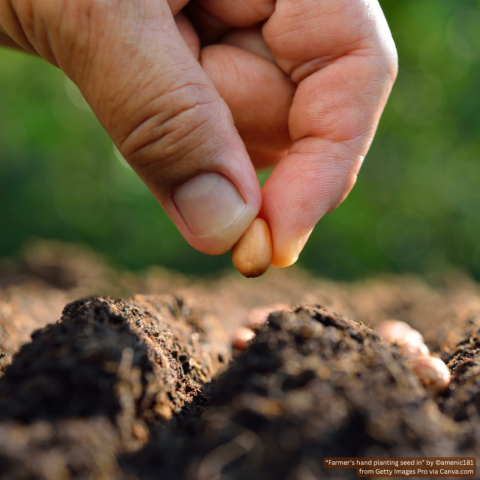
How many of you in this room have planted seeds? Seeds are wondrous things. Take a carrot seed, for instance, teeny, tiny, about the size of a sesame seed. Then amazingly, this tiny brown fleck, when planted and nurtured, becomes a beautifully bright orange carrot with feathery green tops. A carrot seed will never produce lettuce, nor a lettuce seed a carrot; when I look at those seeds, I have no clear indication which is which. When planted, these tiny specks of almost nothing transform into a powerhouse of life-giving sustenance, a gift from our planting but not of our making.
This evening, we celebrate our Marianist Founders, who planted seeds of hope that, to this day, still produce a rich harvest; just consider the worldwide network of the Marianist Family. Just as importantly, the harvest provides us with more seeds for planting. Now we know what to expect in planting a carrot, but what about a hope seed? Unlike a crunchy carrot, hope seems abstract and vague, more akin to wishful thinking than something to chew on. In my own puzzling about what it means to “hope,” Saint Thomas Aquinas’ succinct definition has proven helpful. Hope is “the pursuit of a future good that is difficult but possible to attain.”[1] So a seed of hope, when it germinates, produces an action, pursuit, and purposeful movement toward a particular end, a “future good.” Yet how do I know what I am pursuing is an actual good?
This question seems especially pressing right now. Writing this reflection on hope became exponentially more difficult for me after the events in Minneapolis and elsewhere over the last few weeks. I thought and prayed whether I should even mention the conflicts and the shooting deaths of Mr. Pretti and Ms. Good. Are these events an elephant in this room or only in my head? Here is what I know for certain: Each and every person involved in those conflicts—the immigrants, the ICE watchers, Ms. Good and Mr. Pretti, as well as the agents of ICE (Immigration and Customs Enforcement)—is a human being made in God’s image, and pursuing the good must at the very least honor that reality. Yet, the goodness of our common humanity, which draws us together, seemed to evaporate into the frigid air of those Minneapolis mornings. And my hope, like so many times before, wavers between despair—simply giving up on the pursuit of the good that seems impossible to attain—and presumption, assuming that I need not bother with the pursuit because I can’t change what happened and just leave it to God, who will take care of matters. Yes, despair and presumption are the two vices, according to Aquinas, that undermine the virtue of hope.
But here’s the thing: Hope is not dependent on what I might be feeling. Like every other seed that I plant, seeds of hope are not of my making. They are gifts given to me to plant. As Aquinas makes clear, hope, along with faith and love, is a theological virtue because the virtue’s action, the pursuit, begins and ends in God, the source and end of goodness, of all that exists. Hope then comes as a grace: a gift of God’s love, even in our very desire to pursue a good. For Christians, Jesus Christ, the creative and creating Word of God who became flesh, reveals this love, and our faith in Christ’s redeeming love grounds our hope. Hope truly needs to remain in the good company of faith and love to pursue the good.
Father Chaminade embraced the gift of the Incarnation as central to his life and his mission, not as a past event but as present and active in every age, including his own. And he recognized Mary’s yes as central to God’s coming in the flesh, and he echoed her “yes” in dedicating himself to Mary’s mission of bringing Christ’s mercy and love into his world of social upheaval and violence. He echoed her “yes” even while the specter of the guillotine haunted his priestly ministry and even while he endured the anguish of exile in Saragossa and even in facing rejection from some of the brothers in the Society of Mary near the end of his life.
Father Chaminade was no lone ranger of hope; after all, we celebrate not one but three founders of the Marianist Family. Here I borrow two insights from the twentieth-century American Jesuit William Lynch’s 1965 book, Images of Hope: Imagination as the Healer of Hopelessness, to explain. First, Lynch “equate[s] the life of hope with the life of the imagination,” the “real imagination,” akin to the “scientific method of hypothesizing.”[2] In Saragossa, Chaminade perhaps wished that the Revolution had never happened, but as he looked to the future, he imagined founding sodalities, small groups of men and women, to revivify faith, a plan based upon his knowledge of the situation in France.
Second, and most important for us tonight, Lynch insists that “Hope not only imagines, it imagines with. . . . to discover and enlarge the possibilities of the situation.”[3] Chaminade imagined together with Marie Thérèse and Adèle how to bring Christ into their time and place. Our Marianist Founders planted their seeds of hope in the rich soil of God’s merciful love that no violence, not even death on a cross, can extinguish. And as our Marianist Founders imagined together, the possibilities of their situation enlarged to animate Adèle’s cher projet (dear project) to found the Marianist Sisters (Daughters of Mary Immaculate) in 1816 to further the work of sodalities and to continue care for the poor and marginalized: in other words, the works of mercy. In taking the religious name Marie of the Conception, Adèle announced her continuing Mary’s nurturing of the seed of hope, Jesus the Christ, the source of every Christian’s hope and the font of God’s mercy. This imagining together also freed Marie Thérèse to live and work with women, former sex workers, as they pursued a future good in the community at the Miséricorde (House of Mercy), one quite different from their past. After his return from exile, Father Chaminade not only worked to found sodalities but also accepted the task of reconciling to the Church the priests who had taken the oath of loyalty to the Civil Constitution, an oath Chaminade himself had refused to profess, thereby putting his life in jeopardy. And from the sodalities came those who imagined together the Society of Mary, whose dedication to the Mission of Mary, like all other members of the Marianist Family, continues to this day.
Our three Founders planted seeds of hope that they recognized as gifts not of their own making but rather as the fruitful harvest of Mary’s yes. Despite the great challenges of their time, they pursued future good in the midst of communities bound together in prayer and committed to education and to the care for the poor and the marginalized—not only with works of mercy but also in pursuing justice. So, let me turn back to our present; I wish with all my heart that I could change some events of our recent past, but I cannot. Rather, I am called to harvest some of our Founders’ seeds of hope and to plant and nurture them here in that same rich soil of God’s merciful and creative love so that they germinate as an action, a pursuit of that future good that is enormously difficult but attainable.
Education remains central to the Marianist pursuit of that future good. A passage from Pope Leo XIV’s Apostolic Letter, Drawing New Maps of Hope, beautifully expresses this pursuit of the good. He writes the following:
Educating is an act of hope and a passion that is renewed because it manifests the promise we see in the future of humanity. . . . It is a “profession of promises”: it promises time, confidence, skill; it promises justice and mercy; it promises the courage of the truth and the balm of consolation. Educating is a labour of love that is handed down from generation to generation, mending the torn fabric of relations and restoring the weight of promise to words: “Every [person] is capable of truth, yet the journey is much more bearable when one goes forward with the help of another.” Truth is sought in community.[4]
I would also add that the pursuit of the future good, which is so difficult and so far away, can only be sustained in a community that imagines together the possibilities in both our harvesting and planting seeds of hope.
[1] Summa theologiae. Latin text and English translation, introductions, notes, appendices, and glossary, vol. 33 (New York: McGraw-Hill), 2a2ae, 17,1, p. 5.
[2] William Lynch, SJ, Images of Hope: Imagination as the Healer of Hopelessness (Baltimore: Helicon, 1965), 23.
[3] Lynch, Images of Hope, 23.
[4] Pope Leo XIV, Drawing New Maps of Hope, On the occasion of the Sixtieth Anniversary of the Conciliar Declaration Gravissimum educationis, Oct. 27, 2025, The Holy See, § 3.2.
Click here for a downloadable PDF version of this article.