Editor's Note: First appeared in Vida Marianista, no. 71, Feb. 2012, pp. 2-3.
Click here for a downloadable PDF version of this article.
If there is one person in Spain, who believed and proclaimed the birth of this conscious reality, which today we call the Marianist Family, it has to be Eduardo.
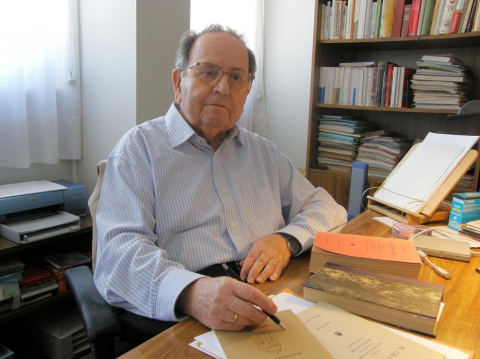
After a serious and swift illness, Eduardo passed away on December 15, 2011. His farewell Eucharist on the following day, at the Church of Colegio Santa Maria del Pilar in Saragossa, turned into a very moving and intimate family experience. We were all there, some of us physically far, and others sharing together the mystery of the death and resurrection of Jesus. Although Eduardo is gone, he continues to be with us. He was prepared to leave, to respond to the last call of the Father. We knew this—those of us who lived with him here at the Saragossa novitiate for so many years, where he worked as a brother, teacher, priest, man of the Church, and family man. But we also know that he “continues to be with us.” According to our Founder, “The man who never dies” goes on living because all he has given us and all we have lived together with him.
Eduardo Was a Born Formator.
He inherited this from his own family, which included some distinguished professors and university researchers in Saragossa and Madrid. He was a formator. From the time he was young, he applied his sharp intelligence to the service of his own personal formation, as well as to the formation of others: as a teacher, researcher, and writer. Eduardo was a literary man, but in his early days he had dabbled in the sciences. He enjoyed philosophy, history, biographies, and classical and modern languages in particular. (He was multilingual, a great translator, and a real fan of dictionaries.) A few months ago, he was very moved and surprised when a former student sent him by email perfectly-typed notes from a philosophy class Eduardo had taught him forty years ago.
Eduardo obviously was a reader, and he liked to delve into Marianist literature and the foundational writings. This is why he would travel every so often to the Marianist Archives in Rome, where one can always find unedited treasures. It was never enough for Eduardo to read what others had written; he always wanted to go back to the sources, to the foundational writings. There, one can always find new discoveries, or at least new insights to understand what we are living today.
He Was a Formator of His Own Family.
Eduardo helped to unite, strengthen the bonds and, above all, educate in the faith the different generations of his family. He was a patriarch, and he liked to act as such. His “priestly patriarchy” involved hard work because he had a great number of relatives. But he left us an example of a family man and of a priest standing in the gap, at the bosom of the Benlloch-Ibarra family. In contrast to today’s style of “loose” relationships and commitments, he presented a traditional, solid, and unbreakable stance because the transmission and formation of faith has to be solid, rooted in the heart. In this area, he was a true son of the Founder. His understanding of “Chaminade’s message” was not in vain.
From the time he was young he applied his sharp intelligence to the service of his own personal formation, as well as to the formation of others: as a teacher, researcher, and writer.
He Was a Formator in the Society of Mary.
Eduardo accomplished this through the various ministries that were entrusted to him: education, government, and especially the initial formation of brothers and priests. By the time he died, he had spent no less than thirty-six years in houses of formation (fourteen in the seminary and twenty-two in the novitiate). His work of formation in three places (Fribourg, Rome, and Saragossa) was a progressive journey in his work as an educator and also as a researcher and writer. This was his way of advancing in the study and education of the charism. Others had already done this. In this regard, Eduardo gathered the testimony of so many Marianists who had been good teachers because of their research, rather than by repeating old lessons. He, like others, taught because he searched for and found original things (etymologically: “those that came from the origins”). In this way, Eduardo teaches us how to carry out true, intellectual, and quality work; he clearly opens a way that many have already tried and followed, since Simler and Klobb. He was very rigorous and meticulous, because he did not want to offer cheap or false information about our spirituality. Cheap material made him nervous. He also offered informational literature, but his information was not cheap, it was authentic.
He Was, Above All, a Formator of the Marianist Family.
Eduardo helped to discover and widen the concept of the Marianist Family. If there is one person in Spain who believed and proclaimed the birth of this conscious reality, which today we call the Marianist Family, it has to be Eduardo. He was obviously not the only one. There were many who shared his vision; but as a researcher, essayist, and writer, he was a key contributor. He effectively and successfully utilized various literary genres. His first book, Chaminade’s Message Today (Spanish 1988, English 2001 by NACMS), a true essay, was undoubtedly his best work (and one of the best written interpretations of the legacy of the Founder and the original history). There, he already announced what was to become the new concept of the Marianist Family. This was part of the history of what Chaminade and Adèle founded, but the Spirit recreated it in the second half of the twentieth century. Then, with the Spanish translation and edition of all her letters (1995 and 2002) and the novelized biography The Gift of Friendship (1999), came his efforts to make the figure of Adèle better known. He later published Origins of the Marianist Family (Spanish 2001, English 2010 by NACMS), an erudite and very comprehensive work about the beginnings of Marianist history, which was based off his notes from presentations to novices. Eduardo did research as a hobby (as many of us did at the beginning), which later became his passion, with rigor and a contagious enthusiasm. He was an avid collaborator in ongoing formation—including in the “Horizons” international program for young brothers and in many short courses of Marianist spirituality, which he gave in Spain and in various countries for the laity and for religious men and women.
To top it all, Eduardo also was an editor. This was something he really enjoyed because he truly believed that the work of publishing was extremely important. Thus, he worked as director of the “Servicio de Publicaciones Marianistas.” Among other works there, he did an extraordinary critical edition (2005-06) of the biography William Joseph Chaminade, written by Father Simler. The best biography of the Founder had been edited in French one hundred years earlier. Eduardo dared to coordinate the edition of this work in Spanish and revised and improve all the notes, and he helped the reader by correcting the material given to the last years of the Founder. Eduardo supported from the beginning the creation of the Spanish periodical Vida Marianista, just as he had previously started the Revista marianista internacional. He had been a consistent, in-depth collaborator of Vida Marianista in “The Spiritual Page” section. Even a month before his death, he still had the joy (already mixed with the discomforts of a cancer he did not suspect) of seeing the publication of the first volume of the Letters of Father Chaminade (2011), whose edition he had coordinated.
This is something of what Eduardo was. But only something, because there is so much more that remains in the intimate memories of those of us who shared life with him: his humor, his culinary prowess (he was a great “chef” of French and Aragonese cuisine), his great love of the cinema, his art of playing the flute and the ocarina, his joy for a well-written work, and his beloved town of Calatayud. We must also comment on his discretion, his devotion to the diocesan Church—as well as to the parish and to the consecrated life—his availability and gentleness toward the Marianist Sisters, and his selfless and constant dedication to the sodalities, of which he was an ongoing mentor. The “Chaminade Year” ended by pointing out one of the great teachers of the charism and of its history. Thank you, Eduardo.
Material from Vida Marianista, no. 71, Feb. 2012, pp. 2-3. English translation by Roser Williams. Copyright © NACMS, 2012. North American Center for Marianist Studies, 4435 E. Patterson Road, Dayton, OH 45430-1083.