

Click here for a downloadable PDF version of this article.
Introduction
Welcome to this guide for conquering racism. I commend you for picking it up. Read through its pages, and you will find a definition of racism and a technique of how you and others you are involved with can do something to change it.
Racism is a dysfunctional social system that has been constructed by human powers in society. Just as a family, a business, a school, or any institution can lose its cohesive way of functioning so too a society can lose its manner of operating so that each member gives and receives in a fair and respectful way.
Racism is a social system in which the power of one race dominates others. The way this power is used can be obvious. It can also be hidden in economic, political, religious, cultural or other manipulations.
As you read through this manual you will be challenged to examine your own loyalties. Perhaps you may need to examine what you have thought were authentic values and causes worth giving your energy and support.
I am a Catholic priest and a member of a religious order called the Marianists. I have been a teacher in Catholic high schools, a parish priest, a director of religious formation for those entering the Marianists, and a chaplain in a retreat house. I certainly believe in the importance of faith and the presence of God’s help. However, this book is not written from a faith perspective. Racism is a public, societal reality that can infect people of any faith. Just as people in a society can share the same sicknesses and the need for medical assistance, those who suffer from the contagion of racism need remedies to cure it.
As the reader of this book will recognize, a major object of concern is the use of systemic power by the white race in America. During a workshop analyzing the nature of racism a participant remarked, “It is a question of power and understanding the power in a system.” In the example of a dysfunctional family later described in this book, a mother was holding onto misguided and dominating power. To bring correction and justice to the family system, the father had to use his power to correct the family’s dysfunction. Being both afraid and oblivious, the father let the mother keep her power and control to the detriment of the family. If he were to upset the dysfunctional power system, the mother and other members of the family would fight back desiring to hold onto their accustomed power. If he were to exert his proper role and use his influence correctly, he could be an instrument that brings the family greater health. This book is an effort to help the reader become such a leader in the dysfunctional system of racism.
Racism as a social system is comparable to a hurricane, a system of tremendous ferocity. Human beings have built this unjust social construct of racism that infects our society. What makes it so powerful is the way that members of society and social groupings of all kinds are co-opted into the dysfunction. Indeed it is a tremendously powerful control system. However, it has been created by human beings and therefore can be dismantled by human beings.
This manual will examine principles that explain the nature and means of changing racism. These are:
- Racism is a stable social system that strongly tends to stay in place—Chapters 1 and 2.
- When any key person or institution in a racist social system can control his/her emotional reactions, accurately observe the functioning of the racist system, avoid counterattacking when provoked and maintain an active relationship with other key members without withdrawing or becoming silent, the entire system will change—Chapter 3.
- Racism is built on triangulating. Triangulating, the basic building block in emotional systems, is the process in which individuals or institutions emotionally pull in support for their emotional comfort in opposition to a third party—Chapter 4.
- The member of the minority in a racist system easily becomes the “identified patient,” the one in whom the system’s pathology surfaces –Chapter 5.
1. Think Out of the Box to Understand Racism—Think System
Teachers and other leaders sometimes tell us to “Think out of the box.” To understand the nature of racism we have to do this. We have to leave a way of thinking that may have become very comfortable to us and use another. The new box is one in which one recognizes the nature of emotional systems. The old box does not like anyone really grasping what emotional systems are. The old box likes to look at facts and also stay very loyal to what has become comfortable. The new box helps those in it to recognize how relationships on many levels can be unfair, dominating, and unjust. In this new box one can understand racism.
The old box so many of us have been taught to use wants to rest in our accustomed way of thinking and acting. Human nature likes familiar places. This is known as homeostasis, an organism like a human body, plant, or social organism staying as it has been raised to be. The new box calls us to look differently, to see the emotional ties that want to dominate our thinking and seeks to change patterns for the better.
Come with me as we journey into this new way of thinking. This book is a journey into this newness. This thinking is based on the writing and investigation of Murray Bowen, a psychiatrist and family systems therapist, who studied dysfunctional families. Bowen’s method is ideally suited to help a group see rationally how it is intertwined in a racist system.
Murray Bowen shows how one deals with serious family dysfunction without abandoning the family. His discoveries and theories have had profound influence not only for the family but also for all social systems. His book, Family Therapy in Clinical Practice, [1] first published in 1978, is an edited collection of his writings from 1957 to 1975.
In 1972, Bowen was invited to deliver a paper on specifying predictable human reaction to crisis situations. This paper catapulted him into the area of dealing with the larger systems of society. Initially, his greatest fear was making sweeping generalizations about society because he thought he did not have sufficient data about societal systems. He discovered, however, a missing link that made it possible to bridge the gap between the family and society. The link came from clinical notes concerning his dealing with delinquent teenage children. Bowen discovered that delinquency problems are multigenerational and involve many of the institutions of society—schools, social agencies, police, and courts—and the entire fabric of society that deals with social problems. In 1973 he wrote a paper about the basic concepts of family systems on which the societal process is based. His goal was “to present the concept of the emotional process in society as accurately as possible.”
Racism is an emotional social system. Just as Bowen discovered that delinquency feeds on the social climate so also does racism. Often in America we hear of claims that racism is operative in certain situations. For example, when Hurricane Katrina hit New Orleans and other parts of the South, the worst
natural disaster in United States history, cries of racism were numerous. Many
poor blacks were not helped in time to prevent deaths and other horrendous
problems. To understand racism one has to grasp the social systems that are
infected by racism. Many blacks did not have cars to get out of the city before
the hurricane. Many blacks have not had recourses and environments for good
education. Many blacks do not have good jobs, supports and contacts that whites
have. To grasp the nature of racism one needs to look out of the box, not at
individual cases of unfair treatment at the time of Hurricane Katrina or other
situations, but at how the power and resources of society are being used. New
Orleans economic, social, educational and other resources favor people who
benefit from the white culture. Systems thinking honestly looks at this reality.
Bowen had first attempted to apply his family systems theories to society
in 1972, in a talk entitled “Cultural Myths and the Realities of Problem Solving.”
Although the talk was only marginally successful, it was, for Bowen, an
important paper in his career. It helped him build a bridge between emotional
process in the family and society. [2]
Bowen demonstrates how systems thinking is different from conventional
thinking. In this manual we will use the key dynamics Bowen discovered
operating in any social system. He describes some of the numerous relationship patterns in society that parallel family relationships.
Bowen’s theory will help the reader understand the emotional system of racism. Bowen’s method will enable the reader to act as the leader who coaches others to an awareness of how they are a part of racism. By knowing what is happening in the system and by becoming emotionally differentiated enough to deal rationally with the racist system, one is able to assume a leadership role in helping others do the same. One can become free of the emotional ties of racism and thus be objective. Bowen said that his theory “provides no magical answers, but it does provide a different way of conceptualizing human problems. It offers a more realistic evaluation of the difficulty in changing the basic patterns in any human dilemma, and it suggests ways to avoid some of the pitfalls of conventional or linear thinking, and to institute progress toward long-term goals.” [3]
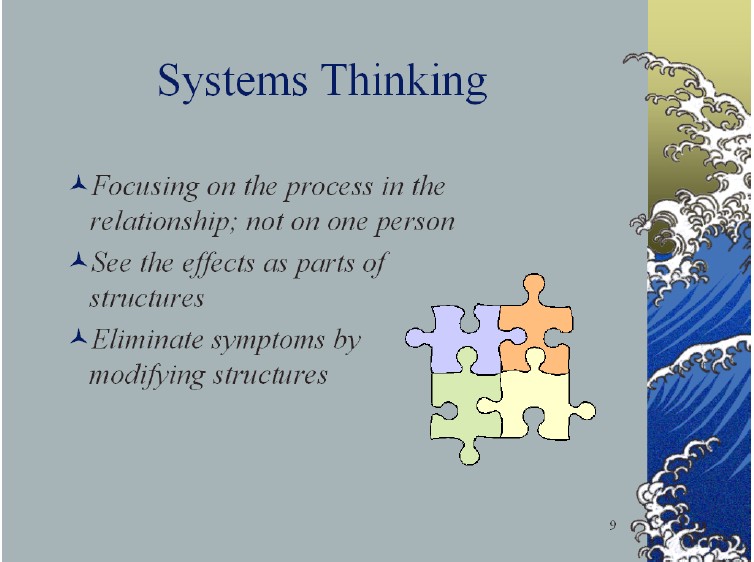
Bowen begins by explaining the difference between linear and systems thinking. Systems thinking is based on the functioning in human relationship systems. In a racist society we look at the patterns and not on individuals’ actions. It carefully avoids asking, “Why individuals act from an emotional point of view,” which automatically brings a person back to conventional thinking. On the other hand, conventional thinking diagnoses a patient and prescribes a remedy. Only the circumstances of the individual patient are considered. This individualistic way of thinking is ingrained not only in medicine but also in many of the professional sciences. Systems thinking examines the effects of the systems on a patient.
Edwin Friedman, writing about religious congregations, said that systems thinking identifies a problem in the nature of the system and not primarily in the nature of its parts. He uses the term homeostasis to explain the nature of a system:
A key to the relocation is the concept of homeostasis: the tendency of any set of relationships to strive perpetually, in self-corrective ways, to preserve the organizing principles of its existence. Theories based on the individual model tend to conceptualize the “illness” of a family in terms of the character traits of individual members, and the ways in which their various personal problems mesh. The family model, on the other hand, conceptualizes a system’s problems in terms of an imbalance that must have occurred in the network of its various relationships, no matter what the nature of the individual personalities. [4]
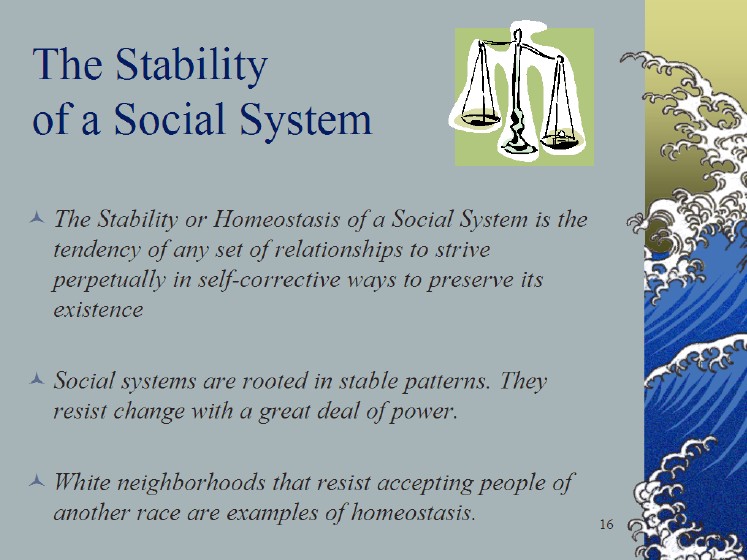
Systems thinking presupposes that, no matter what the condition of an individual, if he or she is part of a system that has a name, the system had to achieve some kind of balance to maintain its identity.
In the case of racism in America every person and every institution is involved in racism, a social system that is endemic to our society.
In any social system there is a strong emotional pull to keep the homeostasis the way it has set itself in place. There is great resistance to change.
However, as we shall see later, if a leader is able to correct himself or herself, the entire system will be led to change.
The next chapter will present an example of what this thinking is all about.
2. Emotional Ties Verses Knowing the Power in a System
I have met some extraordinary people and heard some painful stories since I have been doing this work against racism. An elderly African-American couple came to our retreat center for an anti-racism workshop. They were originally from Jamaica but had lived for many years in a small, mostly Caucasian town in the United States. They were very religious people and very involved in their church. The woman attended the meeting of the churchwomen’s group regularly for years and had evidently become friends with the other women. When one of the women and her husband were celebrating their fiftieth wedding anniversary, my new friend was invited to the church ceremony. She got all dressed up, bought a gift, and went to the Church ceremony. Afterwards the other guests went off to a reception to which my friend was not invited. At our workshop she explained how much this hurt her, yet she had become so used to this kind of treatment that she was able to brush it off. Her husband was much stronger. He complained voraciously of how he had been attending church for years but never had heard a homily against racism, while many other moral problems were the subject of sermons.
Let’s go out of the box and look at the situation described above. If we stay in the box we may feel only the hurt of the elderly black couple. If we go out of the box we can take a look at the power of the emotional system the couple was involved in. In this emotional system, the church evidently has let the racist attitudes continue without any comment. There are the Caucasians who exclude blacks from certain levels of friendship without consciousness of the hurt being caused. There are also the few blacks who have been living in a holy anger for years without apparently doing much to try to change the situation.
I know another person who is very angry when he speaks to me about how African-Americans have control of the city government where he lives. His anger flares up as he tries to describe the graft that the black people are perpetrating. He is not able to look beyond what he sees and to examine how he is part of an emotional system in which he allows himself to be swayed.
An authentic leader is one who can separate himself or herself from emotional ties and not be manipulated by them. It is one thing to have friends or to love your family and another to be swept up unconsciously by ties to unjust and unfair pressures that keep others from their freedom, growth, and happiness. Murray Bowen gives an example of a family that is caught up in an emotionally dysfunctional system.
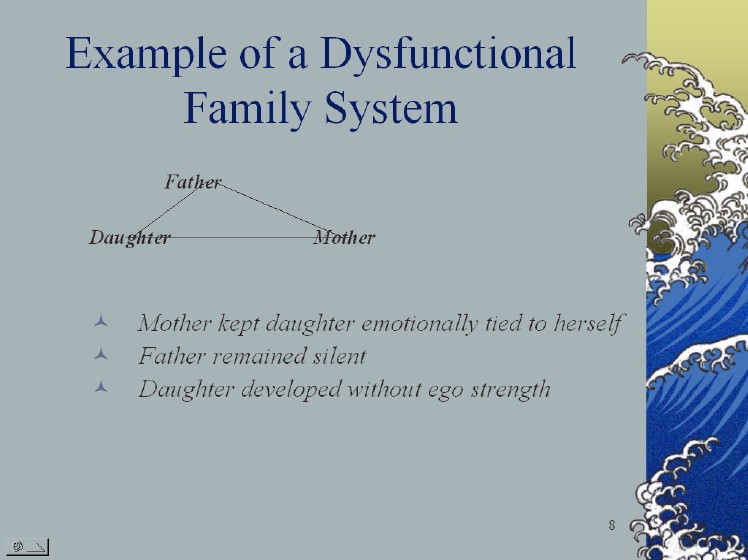
The family he described consisted of a husband, wife, and two children. The daughter was born first, followed by a son eighteen months later. The mother did not have a high degree of self-identity and, in the process of raising her daughter, fused emotionally with her, rather than enabling the daughter to develop her own ego-differentiation. Her son, on the other hand, was left emotionally outside of the control of the mother and developed rather normally. The mother, for example, did not use enough energy when the daughter was very young to encourage her to go out and play with other children. The son, on the one hand, quickly went off to play with friends. The daughter remained with the mother for longer periods. This pattern was repeated over and over in the relationship between the mother and daughter. As a result, the daughter developed a relationship-oriented personality, rather than a goal-directed personality. Later in school, the girl’s favorite teacher through the early class years was one who continued this pattern of over-concern with the child. Although the young girl performed rather well in school, she did not develop strong ego strength on her own. By the time she was in middle school, she began to rebel from the mother. During high school the rebellion became very severe. The girl began to act out. After high school, she left the family and lived a lifestyle that was very different from what the parents wished. She actively used drugs and exhibited other antisocial behavior. Meanwhile, the son developed rather normally, did well in school, went off to college, and became close to a girl he planned to marry. [5]
Bowen says that once a child is “programmed” to a certain level of giving and receiving with the mother, that program remains relatively fixed throughout life. The mother’s relationship with the girl was characterized by worry and over-concern, which tended to take over the child’s life. The child’s ego strength became similar to the mother’s. The two became fused and neither had a proper level of ego-differentiation. In order to learn how to relate well in life, the child needed a relationship with a parent who had a differentiated ego. As the girl became older, she was financially dependent on the parents but broke away from the emotional attachment she had with the mother. The mother, however, remained emotionally attached to this child. This younger woman developed a relationship with a man similar to the one she had with her mother. The young man also was a refugee from a family where he had a similar pattern with his mother. The two of them maintained equilibrium of so called “giving to each other” as long as they did not work and were able to devote themselves totally to one another. They lived in a type of emotional cocoon that could not be threatened by inner or outer forces. Otherwise, they could not cope with ordinary life demands.
This family had become highly dysfunctional just as our society has become so in racial relations. In the family described above the father remained manipulated by the power of his wife. If he had intervened and insisted that his daughter be separated from the unhealthy emotional pressure of his wife, the daughter could have had the opportunity to be raised without the mother’s emotional needs determining her growth.
Racism has patterns similar to the family described above. To think and act out of the box is to be conscious of the emotional ties that are operating in our lives. It may be that we want to be loyal to a political party or patriotic to our country. We may even have a conviction that something is immoral. We must look beyond loyalties and grasp what controlling emotions are operating in the social systems involved. I am not suggesting that these loyalties are not to be kept; I am asking you to recognize what is happening in the system in which you are involved. Ask yourself if you are being given a reward so that the controlling forces can keep their power.
The mother in the example above swayed her husband to be quiet and keep his ego undifferentiated, that is to say, with a low concept of who he was by some emotional tricks, as she appeals to a false loyalty. These tricks and manipulations are often hidden. Just as the black couple described above was caught in an emotional system, so the family described was caught in such a system.
The history of racism shows the same emotional dysfunctions. George C.L. Cummings explains that class, racial, sexual exploitation, and imperialism are the four primary forms of oppression that have arisen from Western civilization. In explaining the economic dimension of this oppression, he views the Industrial Revolution as building a capitalist civilization that reinforced the four major types of oppression. The black slave trade permitted during the American Revolution provided the cotton for the first large export market that, in turn, provided for the capitalist mode of economy in Great Britain, which became the first mass production industry as witnessed in its Lancashire mills.
This first major industry displays the central presence of the four types of oppression. Forms of class exploitation occurred in both the cotton plantations in the Americas and in the mills in Britain. Imperialist oppression took place in Britain’s control of territory, resources, and people in the Americas; racism provided the chief ideological justification for the use of Africans as slaves in the Americas; and sexism was employed to defend the abuse of women on both the plantations in the Americas and within the mills of Britain. [6]
The discrimination and marginalization of blacks and other minorities in the United States are partially a result of the capitalist economy and the support of it in various degrees by the institutions of Western society. Bourgeois revolutions’ grand ideals of liberty and equality were co-opted by the forces of undemocratic capitalism. Today, the results of the control of capitalist elites are more powerful than the nation state. The four types of exploitation are still much in evidence.
In our American history, black slavery served as a platform on which white class, ethnic, and gender struggles were diffused. Because America accepted black slavery and discrimination, the fundamental nature of human dignity for others could also be avoided.
The slave trade, exploitation of labor and child labor, and the imperialist expansion of nations was the emotional system on which the industrial revolution was built.
This global system, the family mentioned above, and the black couple I described above are all involved in dysfunctional social systems. To extricate ourselves from similar situations we need to examine how we operate in the system. In the next chapter I will speak of the first principle for changing a dysfunctional system.
3. Becoming a Person Free from the Co-opting Influences of Racism—Becoming Differentiated
Deacon Bill Johnson is an African-American gentleman I have come to know and work with very closely in anti-racism work. Bill is a retired postmaster, husband, and father of two married sons. He grew up in segregated South Carolina where he was forced to use separate public facilities for coloreds and suffered the other well-known humiliations that people of color suffered. He has become a deacon in the Catholic Church and a strong leader fighting the types of racism we have today. His two sons graduated from a South Carolina military school that was formerly segregated. He develops programs to educate and lead the people of South Jersey, where he lives, to overcome racism. Bill is a very good example of a leader who relates well with people and at the same time opposes the insidious dimensions of racism.
The first principle for changing the emotional system of racism is to be a leader like Bill Johnson, someone who is emotionally non-agitated by the system and remains differentiated from the system. Bill has led people away from racism, including his family, members of the white community where he is deacon, and those in his workplace.
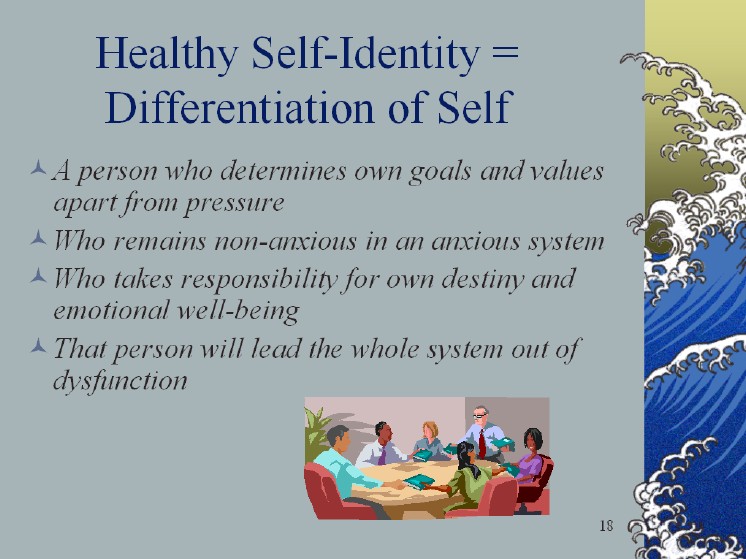
This “differentiation of self” is the cornerstone for changing any dysfunctional system. All people can be placed on a continuum of differentiation from the highest to lowest level of human functioning. At the highest level are those who can “differentiate” between emotional and intellectual functioning. People at the lowest level have intellect and emotion so fused that emotion controls their lives. People on the higher level have a “solid self” with a differentiation fixed by forces inside the self, while those on the lower levels have a “pseudo-self” or functional self that is determined by relationship forces. Functional levels can be assigned for individuals or for members of a family determined by the head of the family or for a society determined by prevailing environmental forces.
Bowen, speaking about lenient parents, maintained that there is a general trend toward leniency in society today. Such parents are usually intelligent, over-devoted people who make a project of doing the best for their children. In a sense, these parents try to give the child total love. The child, in turn, expects this total love. The process continues until the family becomes exhausted because it cannot meet the child’s demands. The child eventually moves from the influence of the parents and society and becomes the parent. The child then seeks from society the type of love that is impossible for society to give. To break this pattern, the obvious answer for the parent is to understand that lenient discipline is actually the parent’s need to emotionally attach himself or herself to the child. The child needs a discipline that helps him or her become goal oriented and not emotionally fused with the parent.
Bowen speaks about the emotional level of self-differentiation needed in society. Self-differentiation is the way an individual functions whereby he or she operates from ego strength and not from an emotional fusion with another. In 1973 Bowen said that, for the previous twenty-five years, society was slipping into a functionally lower level of differentiation or an emotional regression.7 When he compared the amount of functioning happening from the determined self with functioning happening from feeling orientation in society, the overall mode of operation in the past decade had been one that was over-lenient and from a type of “no-self” parent. By this he meant that after the mid-1960s there was more evidence of a lower level of societal functioning. There was little evidence of strong, long-term principle planning; rather, there was a type of “rights” thinking and less “responsibility” thinking. He further states that the overall pattern through the 1960s was like a family with a problem child, which gave into emotional demands and hoped the problem would go away. He maintained that society was in a state of being “an undifferentiated family ego mass.” People were operating more emotionally dependent on each other rather than as autonomous individuals. Bowen addresses what happens in large urban centers where the patterns of strong ego-differentiation are few and, yet, the closeness and the emotional ties are strong. These people tend to be functioning not from a reasoned and calm appreciation of the strength of the individual, but from a functional fusion of emotional ties.
Bowen maintains that society after World War II operated from a somewhat high level of emotional differentiation. However, twenty-five years later, the level of differentiation had dropped. He said that human beings have used physical distance as a way of escaping emotional pressures. With the advances in communication and travel and the increased population growth after World War II, the world became closer, and there has not been a sufficient emotional adjustment to this new reality. How to be differentiated with the new pressure this closeness brings has not yet been set to healthy patterns.
Bowen developed a scale of ego-differentiation. At the more differentiated level, a person can both know with his or her intellect and be aware of, or feel, the situation emotionally. At this high level of ego differentiation, a person is a leader in a social system. As one gets lower on the scale, one is able to know some facts, but most of the person’s intellect is under the operational control of the emotional system. There is less differentiation between the intellect and the feelings as one sinks lower on the scale. Bowen maintains that the majority of the population probably is in the center range of emotional differentiation. People at this level do not have a critical grasp of the difference between intellectual and emotional functioning. They would not clearly understand the difference between truth and fact, fact and feeling, or rights and responsibility. At the lower levels of differentiation are those whose intellects are submerged in the emotional system. Bowen discovered that there is wide evidence that most of the population is below fifty (out of a possible one hundred) on the scale of ego-differentiation. The population is distributed with most people in the twenty to forty-five scale range, with a small percentage above fifty, and the highest levels in the decreasingly smaller group up in the sixty-five to seventy range. [8]
Take a look at yourself. Are you emotionally detached from the racist power influencing you? The way most Americans treat people of other races today is by being polite. This has become the acceptable manner. However, there are many entrenched ways that racial patterns influence us. For example, suburbs are beginning to become integrated, but the emotional fear in white people is very deep. During a workshop I led, an African-American Catholic sister explained that when a suburban school goes beyond 50 percent students of color, the white families begin to withdraw their children. Leaders at such a school need a strong sense of differentiation to stay above the emotional fear operating in the school community. If the leaders maintain calm and help the clientele to sort out the pressures they are dealing with, the leaders will guide the community to maintain a good educational institution not dominated by racial fears.
Edwin H. Friedman, when introducing the chapter on leadership, states this well:
The overall health and functioning of any organization depends primarily on one or two people at the top, and this is true whether the relationship system is a personal family, a sports team, an orchestra, a congregation, a religious hierarchy, or an entire nation. But the reason for that connection is not some mechanistic, trickle-down, domino effect. It is, rather, that leadership in families, like leadership in any flock, swarm, or herd, is essentially an organic, perhaps even biological, phenomenon. And an organism tends to function best when its “head” is well differentiated. The key to successful spiritual leadership, therefore, with success understood not only as moving people toward a goal, but also in terms of the survival of the family (and its leader), has more to do with the leader’s capacity for self-definition than with the ability to motivate others. [9]
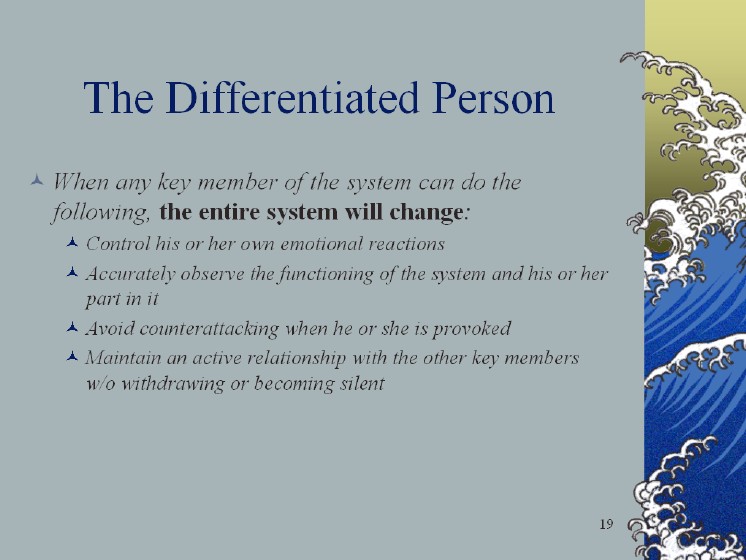
The way out of any dysfunctional system is the ability of a person to be different from the dysfunction. If a member of the system can remain firm, non-agitated, and self-directed in the midst of what is happening, he or she will be able to move the rest of the system. A leader of course has much influence. The leader or any member wishing to bring about a change has to remain active in the system.
Father Clarence Williams, who gives racial sobriety workshops, helps participants develop their ability to be differentiated by a simple method, which he calls the I BEAM Method. When confronted with a racially unjust situation, the person clarifies his or her feelings and writes down the reason for the feelings and finally how he or she wishes to act. Here is an example.
When I read about the ethnic cleansing in a foreign country, I feel very angry because my government and other forces can put pressure to make it stop. Therefore, I will become active in Amnesty International and work for change.
Those who really want to make changes can join support groups that enable them to become better differentiated.
Companies, churches, schools, and other institutions can change the racist system by becoming more and better differentiated. I can speak of the experience I had at the retreat house where I work. Four years ago we sponsored a workshop for our staff, which was all white, and for a number of people of color in the area. We studied the nature of racism. The director of the retreat house gave a presentation on our mission and goals. Then we asked the group what we could do to welcome people of diverse races and cultures to our house and take part in our programs. They suggested changing the pictures in the house and making the house known in the area as a place where all cultures and races are welcome. For four years we have been developing retreats for African-Americans and Hispanics. We changed the atmosphere of the house so that other cultures—beside the white community—feel welcome. We invited people in the community (Anglo, African-American, and Hispanic) to come to an annual potluck supper. We have speakers and programs to discuss how to work against racism. We call the evening a “Diversity Gathering.”
The result has been that the African-American community has come to feel at home at the house. Hispanics are also beginning to feel the same. The local newspaper has printed a number of articles about the effort of our center to work against racism. The openness of racial and cultural position at the center has become accepted and appreciated by the community.
Differentiated racial leadership is especially needed today with the new type of racial discrimination we are experiencing. Joe Holland and Peter Henriot, in their book [10] presenting a method to analyze society, describe the stages of racism in America. They scientifically identify the shifting forms of racism in the United States. The first form, paternalism, came during the plantation economy. A new form of racism came with emancipation: discrimination with its two-tiered or dual-labor market in an industrial economy, with blacks usually at the bottom. Now, a third form of racism is developing: marginalization. “With a shrinking industrial economy, ‘structural unemployment’ is heavily concentrated among non-whites. An urban ‘permanent underclass’ is developing—a class of people who are isolated from the economic mainstream and ignored.” [11]
Because of the third stage we are now experiencing, Holland and Henriot forecast a grim future for healthy race relations in our country. The two deep structures of this stage are capital and technology. Capital, the control of money, is becoming transnational and, as such, does not have the restraint on it that national governments once had.. Nations are at the mercy of international conglomerates that can shift their financing at will to cheaper labor markets, leaving regions literally helpless. Technological advances in machinery, computers, and energy are taking over human labor, leaving structural unemployment or permanent marginalization. “We are witnessing the creation of a permanent underclass in the so called ‘developed’ world, a class that will never enter the mainstream of productive life in contemporary society.” [12]
The differentiated leadership called for in this new stage can help transform the systems so that capital and technology serve basic human needs and fundamental rights are accountable to the community at every level.
Differentiated individuals and communities are models for bringing about this change. In every institution in the country, small groups of poor, middle class, and wealthy people need to become creative actors. Those closest to the problems have their creative imaginations stimulated and set the pace for change that gives leadership to all they contact. This may be a slow process, but it is organically transformative.
The fourth chapter will deal with the dynamic of triangulation that is operative in the racial hurricane.
4. Triangulation and How It Plays Out in Racism
White supremacy is a phrase that causes much consternation. It is a concept that needs a context to be understood. Triangulation will give the context and help in the understanding of what white supremacy means.
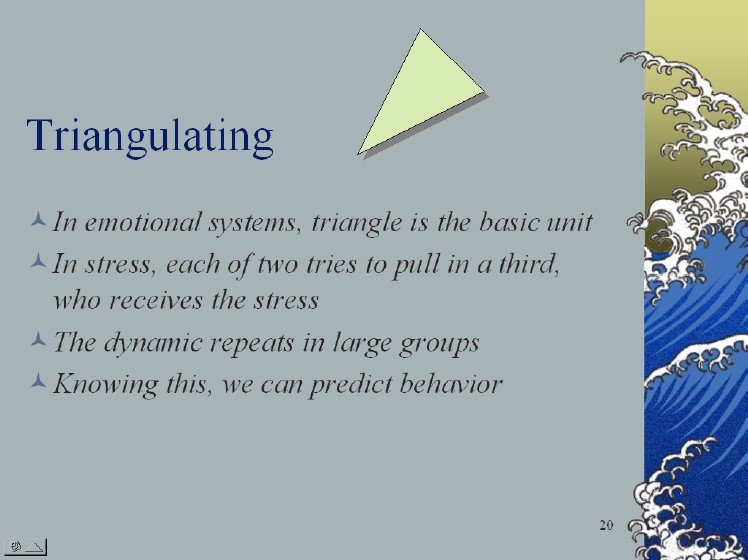
The triangle is the smallest stable emotional unit and can be called the molecule of emotional systems. In the example of the family described in Chapter 2, the dysfunctional mother had an uncomfortable relationship with her daughter and pulled in the father for support in her control of the daughter. This triangle of a relationship is an example of triangulation.
Edwin Friedman says that “The basic law of emotional triangles is that when any two parts of a system become uncomfortable with one another, they will ‘triangle in’ or focus upon a third person, or issue, as a way of stabilizing their own relationship with one another. A person may be said to be ‘triangulated’ if he or she gets caught in the middle as a focus of such an unresolved issue.” [13] This is exactly what happened to the father. He was drawn into the triangle in the unresolved issue of the mother dominating her daughter.
Triangulation is the dynamic of a two-person relationship (as is the case of the mother and daughter) that is unstable, and it automatically becomes a three-person system under stress (in this case, the father who is pulled in).
Because the most uncomfortable one in the triangle attempts to establish a more comfortable closeness-distance, the emotional system is in constant movement. There may be constant bickering. There just will not be peace. The uncomfortable person or the person under stress finds his or her own “comfort level” disturbed. We can recognize that the relationship between the daughter and her father was disturbed. They were not honest with each other.
The term “triangle” gives a definition to the emotional forces flowing back and forth among three poles. This movement repeats itself over and over again so that one who understands the dynamics of triangles can predict the next move before it happens. It was rather easy for any therapist to predict what was going to happen to this family. The mother pulling in the father had an injurious effect on the growth of the daughter.
If one is differentiated he or she can manage to stay above being controlled by someone trying to dominate and create a triangulation. Healthy relationship is based on mutual sharing back and forth of healthy energy and growth in building families and communities. Unhealthy relationship is disturbed as in the triangulation of the family described where one is able to control the powers of another.
Friedman explains that “when individuals try to change the relationship of two others (two people, or a person and his or her symptom or belief), they ‘triangle’ themselves into that relationship (and often stabilize the very situation they are trying to change).” [14]
Parents soon learn not to get triangulated into squabbles between their children. The kids have to sort out conflict by themselves. I knew a family where the kids had to sit on the stairway until they solved their problems. Wise leaders know that they can’t solve problems between two conflicting forces without getting pulled into a triangular relationship. They must stay above the fray. If a leader can remain unagitated emotionally and in relationship without interfering, the two conflicting forces will probably solve the problem.
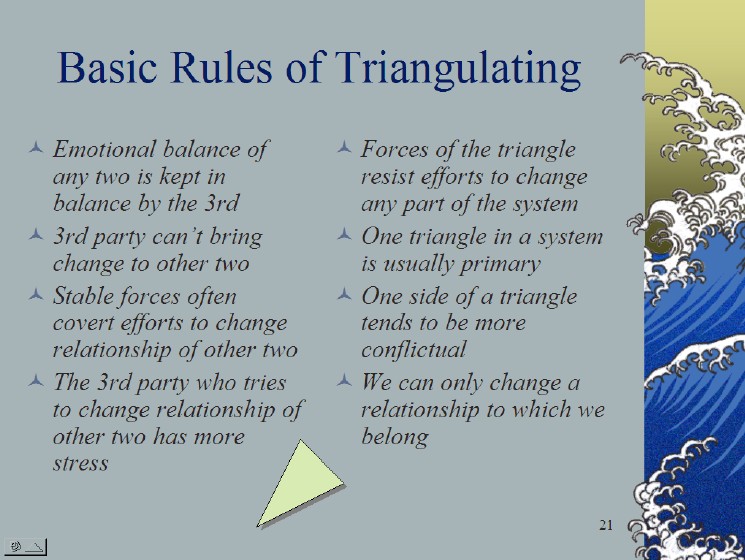
Knowledge of triangles helps predict behavior so that a therapist can insert cues that may result in predictable shifts in emotional behavior.
The triangle is the microscopic organization of emotional systems. “In very large groups, or the total of society, the same automatic emotional forces operate with large numbers of people siding with each emotional issue.” [15]
White supremacy is triangulation on a massive scale. American society has allowed itself to be one in which people of color are emotionally, economically, politically, and in many other ways, targeted. The powers of white society have come together to put the person of color in a secondary place.
In Beloved, Toni Morrison, winner of the Nobel Prize for Literature, vividly describes the effect of three centuries of racist thinking in the following manner:
The day Stamp Paid saw the two Blacks through the window and then hurried down the steps, he believed the undecipherable language clamoring around the house was the mumbling of the black and angry dead. Very few had died in bed, like Baby Suggs, and none that he knew of, including Baby, had lived a livable life. Even the educated colored: the long-school people, the doctors, the teachers, the paper writers and businessmen had a hard row to hoe. In addition to having to use their heads to get ahead, they had the weight of the whole race sitting there. You needed two heads for that. White people believed that whatever the manners, under every dark skin was a jungle. Swift, unnavigable waters, swinging screaming baboons, sleeping snakes, red gums ready for their sweet white blood. In a way, he thought they were right. The more colored people spent their strength trying to convince them how gentle they were, how clever and loving, how human, the more they used themselves up to persuade whites of something Negroes believed could not be questioned, the deeper and more tangled the jungle grew inside. But it wasn’t the jungle Blacks brought with them to this place from the other (livable) place. It was the jungle white folks planted in them. And it grew. It spread. In, through and after life, it spread, until it invaded the whites who had made it. Touched them every one. Changed and altered them. Made them bloody, silly, worse then even they wanted to be, so scared were they of the jungle they had made. The screaming baboon lived under their own white skin; the red gums were their own. [16]
Morrison shows us an example of what has happened in the way people of color were taught to think of themselves and the way white people were taught to think of them.
Michael A. Cowan, a professor at Loyola University in New Orleans, in “Moving in ‘White’ Circles” explains that for thirteen generations—from the sale of the first slave in Jamestown, Virginia, in 1619 until today—white people and black people have cultivated Morrison’s jungle. By defining themselves as white, people lose touch with the deeper cultural heritage they have from their origins.
In exchange for my birthright, I receive the cultural, economic, and political privilege of being “white” American; that is: someone with special access to the economic resources and social benefits of this country. Having accepted such a deal without even knowing it may mitigate my personal guilt for racism, but even unknowing agreements have real effects. One such effect is losing track of the plural cultural heritages, which get dimmed down by “whiteness.” [17]
To be “white” is to have one’s basic assumptions about oneself and others formed by centuries of colonialism, slavery, and racism. In America, it is to have a privileged position. To be “black” is also to have one’s assumptions formed by the same history, but in the negative way.
Cornel West, when analyzing the genealogy of white supremacy, said, “The idea of white supremacy is a major bowel unleashed by the structure of modern discourse, a significant secretion generated from the creative fusion of scientific investigation, Cartesian philosophy, and classical aesthetic and cultural norms.” [18]
West explains that blackness was intentionally excluded from the classical ideal because the structure of discourse was dominated by the will of white men to control. As is seen in this quote, his writing is insightful and sharply descriptive of the causes and realities of racism.
To grasp the meaning of racism we need to understand what a dysfunctional system is. It is one based on this triangulation where people of one race come together in two sides of a triangle to make themselves feel comfortable by making the third, a person of another race, an inferior person. This is called white supremacy.
An ancillary dynamic of this concept is that of the identified patient that will be treated in the next chapter.
5. Recognizing the Identified Patient as Distinct from the Real Cause of Racism
I have listened to many people of color tell stories of how others have been suspicious of them. An African-American, who chaired the board examining candidates for the bar exam in Maryland shared with me how he was frequently looked at with suspicion when shopping. A Mexican-American woman with a Ph.D., who was leading a conference I attended, shared how she was asked to pay her hotel bill ahead of time, before her Caucasian companion. At the end of a workshop I led, a group of African-American women shared the deep hurt of being barred from lunch counters when they were young women. I know that there are deep hurts in the hearts of people of color because of these types of experiences.
On the other side I, myself, have feelings of suspicion when I am in a neighborhood of mostly people of color. I remember walking at dusk in Chester, Pennsylvania, where I had taught school for nine years. I noticed a big black man following me, and I became fearful. Finally, the man approached and asked if I was Father Cassidy. It turns out, I had him as a student when he was a junior in high school.
Let’s take a look at the social system that creates these fears and suspicions. If we go back to chapters 1 and 2 we recall that racism is a constructed social system. It very strongly tends to stay in place. It is dysfunctional in that it is built not on sharing of gifts and talents and appreciation but on fear and manipulation. To correct the system we need to back away from it and see what is happening. We do this similar to the way a meteorologist examines a hurricane. Just as an expert weatherperson can measure wind speed, water temperature and the other forces that contribute to the strength of the storm, we can examine what is happening in the racist system. Leaders in families, churches, schools, communities, and businesses—in fact anyone who is part of America—can be similar to such a weatherperson by examining racism.
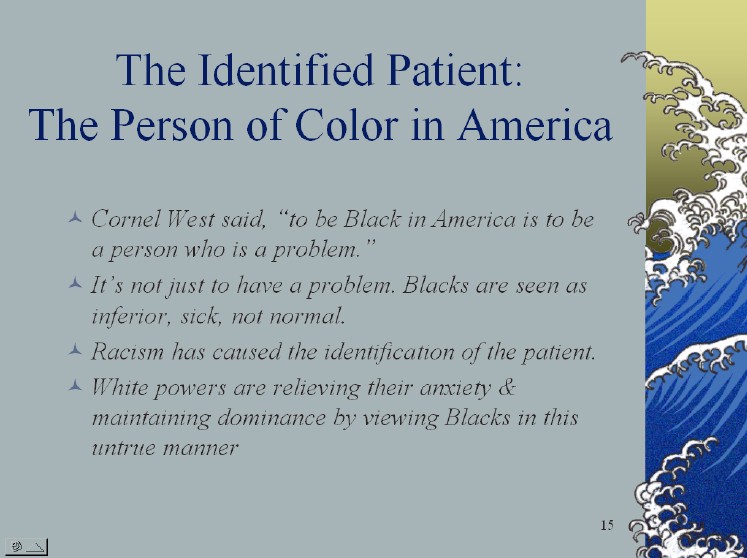
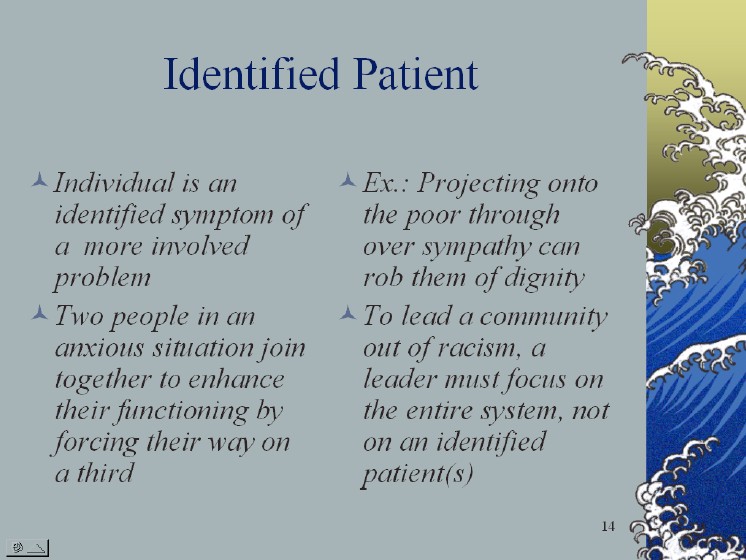
A dynamic of racism is that the person of color becomes the “identified patient.” The racist system is both sick and dysfunctional, and those caught in this system often cannot name the true cause for their racist feelings. Feelings can lead to incorrect judgments. What happens in the racist system is that the person of color becomes the one who is the “identified patient,” the one misdiagnosed as the problem, the brunt of misdirected feelings. However, the member of the system who suffers with an obvious symptom is not actually “the sick one,” but the one in whom the societal pathology surfaces. This is what is happening when the person of color is looked upon with suspicion or when the Caucasian operates out of fear of a black person.
Society avoids the causes of the pathology by examining only the individual. If one uses systems thinking, the individual is, rather, an identified symptom of a more involved problem.
We are speaking here of a triangular emotional process through which two people or systems gather their forces against a third. The third becomes a patient who receives from the other two a type of self-sacrificing righteous attention. The anxiety of the two produces an anxiety reaction in the patient, which makes the problem more severe. In the racist system in which we are living, it is a false solution to project onto African-Americans in our cities the notion of being patients for which we need to care.
The person of color becomes the “identified patient” and is not treated as a true human being. Also the person of color loses his or her perspective and develops false projections of white people. Racism creates a two way street where both white and black because they are not seeing clearly operate from misjudgments.
The basic dynamic causing the “identified patient” is two or more people in an anxious situation getting together to enhance their own functioning by forcing their way on a third. By keeping the focus on one of its members, the group denies the very issues that contributed to making one of its members symptomatic. The individual may have many problems but in systems thinking one must keep one’s eye on the power of the system.
Because we have a decreasing functioning level of ego-differentiation, as was treated in chapter 3 above, society allows persons of color to be mistakenly stigmatized. Society projects false stereotypes on groups of people, emotional over generalized images on categories on human beings. Problem projection in society grows. “Society is creating more ‘patients’ of people with functional dysfunctions whose dysfunctions are products of the projection process.” [19]
Bowen cites the example of criminals. At first, society tries the Band-Aid approach to antisocial behavior. Society hopes the problem will go away. Rehabilitation programs are sought for repeat offenders.
During the past twenty years, an over-lenient society has passed laws and made rules that further foster the development and preservation of criminals. The total trend is seen as the product of a lower level of self in society. If, and when, society pulls up to a higher level of functioning, such issues will be automatically modified to fit the new level of differentiation. [20]
The same projection process happens when we scapegoat vulnerable minority groups. Bowen explains how the black person was the main object of the projection process for more than a century. As this is modified with blacks, other groups, such as welfare recipients and the poor, become the same recipients of this projection process. “Just as the least adequate child in a family can become more impaired when he becomes an object of pity and over-sympathetic help from the family so can the lowest segment of society be chronically impaired by the very attention designed to help it.” [21]
Bowen maintains that no matter how good the principles in these programs are, because they have built in a projection process, they are doomed for failure.
He tackled the question of whether family patterns tend to influence society or vice versa. The evidence, he maintains, supports the thesis that the emotional orientation is set by society. Public officials are forced into continuing the functioning level, which is generally operating.
Racism is the emotional system that allows false projections to dominate. If society allows itself to exist in this false and often entrenched consciousness, good judgments will not be made for building up a humane and enjoyable community. Look at the way we still allow the separation of white and black communities in America. The fear of back people dominates still in so many communities. Whites have fled good communities and leadership is not present to prevent the fear and projection to take control.
One study I read of the city of Cleveland showed how the whites fled from the East side of the city to the suburbs. There was an enormous cost to build a highway to help them get to work back to the city. The neighborhoods they left became a burden for the government to find a tax base to keep schools, libraries and other facilities operating. Then there was the cost of the new communities they built up. The emotional system of racism was a great part of this dysfunction. Society let itself be dominated by this hurricane.
Rather than stigmatizing a person of color as a problem, people need to get to know each other’s value.
Cornel West describes the way the person of color in America has been falsely identified. He says that to be black in America is to be a person who is a problem. It is not just to have a problem. In America today, the black person is an identified patient, a person who is a problem, someone who is basically seen as inferior, “sick,” not normal.
Referring to W.E.B. DuBois’ words, West states:
This seminal passage spells out the basic components of black invisibility and namelessness: black people as a problem people, rather than people with problems; black people as abstractions and objects, rather than individuals and persons; black and white worlds divided by a thick wall (or a “veil”) that requires role-playing and mask-wearing, rather than genuine human interaction. [22]
When I was in Mexico for two weeks I noticed that the main actors and commentators on television were Caucasian. The racism that considers people of color to be somehow inferior seems to be operating in that country, also. As I travel in the United States, I see numerous Mexicans working on gardens and in hotels. The same system is operative in both countries, albeit, on different levels.
Gary, Indiana, is one of the most segregated cities in America. Because of this, the bishop of the Catholic diocese there, Bishop Dale Melcik, invited Father Clarence Williams to give a workshop on racism and how to become racially sober to the priests and other leaders of the diocese. Also an educational program on this same subject was initiated in all the schools and religious education programs. All who took this program were taught what happens in the racial social system and were given tools to take positions against it. As a result, the Catholic population (as well as many other people in the area) is beginning to recognize a new non-racial way of relating.
Bishop Melcik, thinking outside the box, had a better idea when he took the lead to show people what is going on in the racist system. This is leadership, teaching people what is really happening and training them not to act out of fear.
In the religious order to which I belong, we have had a number of workshops about racism and multiculturalism. We have discovered that an organic process is needed to change an implanted system like racism. Change can’t be forced. Rules may be needed; however, much more powerful is the coming together to share stories and learn what is really happening in a racist system. Then people begin to change. The differentiated leader is one who can provide opportunities for this type of exchange in his or her family, business, church or civic community. It is not only interesting and wholesome; it is creative, rich, and life giving in so many ways.
Just as a child in a family needs to be nurtured and educated and not stigmatized in an inferior way, leaders in society also must not allow minorities to be relegated to positions of being identified patients, but rather treated as productive agents worthy of rights and responsibilities.
6. Opposition is Part of the Game
Let’s look at the opposition that both an individual and a community experience when seeking to change the racist system. I have heard many times from Caucasian people that they don’t like it when black people get together to form their own organizations. Many whites saw Black Power as a threat some years ago. Now we see a proliferation of black caucuses in politics and a growth of associations of blacks for business, publication, and other purposes.
James Cone, a black theologian, presents a strong argument for Black Power. He says “Black Power is an attitude, an inward affirmation of the essential worth of blackness. It means that the black man will not be poisoned by the stereotypes that others have of him, and he will affirm from the depth of his soul, ‘Get used to me, I am not getting used to anyone.’ [23] And ‘if the white man challenges my humanity, I will impose my whole weight as a man on his life and show him that I’m not that ‘sho good eatin’ that he persists in imagining.’ [24] This is Black Power: the power of the black man to say Yes! to his own black being, and to make the other accept him or be prepared for a struggle.” [25] Cone is stating strongly the need for people of color to be who they are.
On the other hand, subtle forces are at play by Caucasians who have the benefit of an atmosphere of superiority, as was mentioned in chapter 4, as well as an infrastructure of financial and other power resources. Blacks must fight to change the status quo. Whites can often passively resist. Recall that the racist system is a social system that is as powerful as a hurricane, and it tends to stay in place. Anyone trying to change the system is going to have opposition. The task of the healer is not to get emotionally drawn into a conflict but let all parties grow into their human integrity. In order to do something about the racist system, both whites and blacks need to maintain a calm and reasoned relationship with those who are in the system. If that is done, they can become leaders in helping the whole system correct itself.
Edwin Friedman said that the non-anxious presence of the leader is the primary way to lead a social group out of emotional conflict situations.
The basic concept of leadership through self-differentiation is this: If a leader will take primary responsibility for his or her own position as “head” and work to define his or her own goals and self, while staying in touch with the rest of the organization, there is a more than reasonable chance that the body will follow. There may be initial resistance but, if the leader can stay in touch with the resisters, the body will usually go along. [26]
He explains further that the leader must maintain nonreactive, clearly conceived, and defined positions while staying in touch. The leader seeks to define himself or herself and not the followers. Thus triangulating is avoided. The group’s need for a leader will move them to follow. The leader has to deal with sabotage, as the more defined members of the group will seek to take their own nonreactive positions. Friedman says it is crucial for the leader to distinguish process from content and to maintain an ability to be playful.
When any member of an emotional system can control his own emotional reactiveness and accurately observe the functioning of the system and his part in it, and he can avoid counter attacking when he is provoked, and when he can maintain an active relationship with each of the other key members without withdrawing or becoming silent, the entire system will change in a series of predictable steps. [27]
When a member in a social system like racism starts to lead correctly, he or she will be threatened by accusations like the following: 1) “You are wrong!” or 2) “Change back and we will accept you again” or 3) “If you don’t, these are the consequences.” [28]
Our country has a long and tortured history of opposition to those who wanted to change slavery and racism. Here I want to show that the opposition is part of the dysfunctional system. Anyone trying to make a change will be beaten down in all kinds of ways. However, the path of final victory is by maintaining one’s self-identity. Martin Luther King, Jr., tells the story of feeling deep depression after receiving an ugly call from someone condemning him while he was on a civil rights march in the South. He finally realized how he had to stand firm in his purpose in the face of such opposition.
Resistance is a natural part of growth. Whites in the racist system are likely to go into a denial that they are doing anything to force blacks into an uncomfortable situation. Blacks are inclined to deny they have any power and think of themselves as inferior.
If society treats people in such a way that their egos are not properly developed, they become patients resisting change. Methods of caring for people of other races, or for the poor, that do not permit the proper development of goal-oriented ego differentiation perpetuate controlling social systems. Methods and lifestyles that leave whites in a cocoon and don’t change their perspective prevent them from becoming strong leaders. Raising children in atmospheres where they have models of strong differentiated egos is the best way to combat racism. I have come to know a number of people who have little concern for the color of skin and who are able to deal with people of another race not because of skin color but because of ability, friendship, and basically good human relationship.
Look how we have forced blacks to take jobs they are not prepared for or forced children to change schools by busing. I know of a white woman who was a supervisor of a black woman for years. The black woman was in a position for which she was not trained, and the supervisor suffered trying to help her. Games were played on the part of both parties for years. Some progress and harmony were achieved when the real problems and abilities—time on the job and work tasks—were finally talked out honestly and adjusted.
A significant range of racial patterns is very predictable. Knowing what is happening in social systems we can predict what will happen in the future.
To be able to predict patterns in families and social systems it is important to know the parents’ levels of differentiation. The second important factor concerns the emotional functioning of the families of origins of each spouse. Lastly, one needs to know the overall functioning patterns within each spouse. Although it is difficult to get accurate estimates, if one has relatively good information in these three areas, one is able to predict rather well what will happen in a family or any social system to which the child is raised. Bowen says that “the denied emotional attachment to the past replicates itself with one’s spouse and one’s children . . . . The more one denies an attachment to the past, the less choice one has in determining the pattern with his own wife and children.” [29] What he is saying here is that emotional patterns will continue in families if they continue to be unconscious and denied. The fact is that the more one denies an attachment to the past, the less one is free to overcome it. Patterns, therefore, replicate themselves with the children. Bowen says that these patterns can be predicted before the marriage takes place. The degree of undifferentiation in the spouses will predict how much emotional fusion will take place in marriage.
Understanding the opposition or resistance that has developed in persons, white or black, by low ego formation is a key to understanding what is happening in a racist system. Anyone trying to overcome racism needs to understand how emotionally fused they are to their own race and how much denial they have that prevents them from understanding the pattern of emotional fusion in a society of which they are a part.
Anyone seeking to bring about a change in an entrenched racial system is going to face persistently the opposition of those who have become emotionally raised in an attachment to racial patterns. If the people you are working with have a relatively strong ability to separate their emotional attachments from their good judgments there will be a level playing field to change the system. If on the other hand you are dealing with people who are not strongly differentiated you will face strong opposition. Understanding and relating to society in a calm and intelligent manner will enable a leader to function differently from the racist system swirling about them.
7. Deeper Causes Operating in the Racist System
Cornel West is a scholar who gives a clear analysis of the deep causes of racism in America. He recognizes that black skin cannot be used as a political tool. He shows that black leaders, to be effective, must not be controlled by emotional ties to a constituency if they are to lead people of color to authentic development.
In his 1994 book Race Matters he says that the basic causes of American racism are 1) the eclipse of U.S. economic predominance in the world, 2) the structural transformation of the American economy, and 3) the moral breakdown of communities throughout the country, especially among the black working poor and very poor. [30]
World economics have shifted power into the hands of global companies. Formerly economic power that was controlled by laws in the United States and other countries is now operating with free reign.
The postwar American liberalism, by which economic growth accompanied state intervention for the disadvantaged, ended in the 1960s. The watershed war on poverty lifted half of America’s poor from poverty. It was a brief moment when we bravely confronted our most explosive issues: racism and misdistribution of wealth.
The efforts of progressives have been to reduce poverty by social and affirmative action programs. Unfortunately, these programs have helped middle-class Americans disproportionately due to compromises with the political power of big business.
The second operative cause presented by West is structural economic transformation. The structure of the American economy has been characterized by a contraction of the manufacturing sector and an expansion of the service sector resulting in the narrowing of job opportunities for semi-skilled and unskilled workers. Another structural change—the most crucial insofar as it negatively affects the black American—has been the mechanization of southern agriculture. Fifty years ago, 50 percent of black teenagers had agricultural jobs and more than 90 percent of these lived in the South. The recent de-industrialization of northeastern and midwestern cities, along with the entrance of new immigrants, has made it difficult for unskilled blacks to find jobs.
The third major phenomenon extending racism among American blacks, according to West, is the breakdown of the moral fabric in the country, especially in black working poor and very poor communities. When this happens, there is a collapse of meaning in life and a breakdown in supportive networks in family and spiritual communities.
High crime rates, increasing numbers of unwed mothers, and poor academic performances are related to the pervasiveness of sexual and military images used in media and advertising. Since the end of the economic boom at the close of the 1960s, American youth have been bombarded by strategies that project sexual activity as instant and violence as the locus of masculine identity. We must recognize that the circumstances into which people are born and live affect how they behave.
West says that the welfare state has not been the cause of the current crisis. The welfare state was a compromise between conservative forces arguing for unregulated markets and liberals seeking broad subsistence rights. Because it is a compromise, it has many flaws. The only feasible alternative to the welfare state is to create more jobs. Attacking the welfare system will not create jobs.
There is a need for a revitalization and moral regeneration of the black community through intermediate institutions, such as the churches, mosques or schools. Presently, these institutions are fighting an uphill battle against the media. Yet these institutions are beacons of hope. Their role is both transformative and oppositional to class subordination by capitalist forces.
(In his 2004 book Democracy Matters West shows that there are three fundamental dynamics that are working against democracy in America: Free market fundamentalism, aggressive militarism and escalating authoritarianism. [31] West shows that these dynamics are ingrained ways of operating that sweep into their destructive paths all who get in their way. They are also emotional systems and like hurricanes have tremendous power. The first dynamic, West maintains, gives economic power to a few to operate like religious fundamentalists. The second, aggressive militarism is an emotional system, which is led by extreme military powers and the third, escalating authoritarianism, is the use of power without the consent of the people in a democracy. These systems are like racism living in the emotional sway that they generate.)
Another author, Winthrop Jordan describes the fundamental causes of racism in America in his book White Over Black. [32] He demonstrates that while the economic and political powers were creating the slave system, the meaning given to blackness and whiteness played an extraordinarily powerful part in support of the racist system.
White and black connoted purity and filthiness, virginity and sin, virtue and baseness, beauty and ugliness, beneficence and evil, God and the devil. The English discovery of black Africans came at a time when the accepted standard of ideal beauty was a fair complexion of rose and white. Negroes not only failed to fit this ideal but also seemed the very picture of perverse negation.
Moreover, Jordan examines the use of scripture and theology to reinforce the economic domination and the cultural prejudice against people of dark skin. He explains that, in the sixteenth century, the curse of Ham (Genesis 9:20-27) was used to legitimize the black slave trade.
Jordan is able to extrapolate from the social system of economic power the meaning given to whiteness and blackness and the false interpretation of scripture and theology that were the roots of racism in America.
Racism promotes a systemic mindset and institutionalization of the belief that a race is inferior. West shows that skin color has no meaning outside of a system of race conscious people and practices. Blackness is a political and ethical construct. Any valid understanding of black racism in America cannot begin with claims to racial authenticity; there is no call to black authenticity, which is not a political tool. West shows that Judge Clarence Thomas, in his hearings before the Senate Committee as a nominee for the Supreme Court, appealed to this racial authenticity by citing “his birth in Jim Crow, Georgia, his childhood as the grandson of a black sharecropper, his undeniably black phenotype degraded by racist ideals of beauty, and his gallant black struggle for achievement in racist America.” [33]
This is an example of the political appeal. This false construct weakens the black community from speaking the truth. “The very fact that no black leader could utter publicly that a black appointee for the Supreme Court was unqualified shows how captive they are to white racist stereotypes.” [34] The 1994-95 trial of O.J. Simpson demonstrated how strong this political call of race is in America. A major result of racism on the black community is the mindset that blackness in and of itself is a moral cause for value.
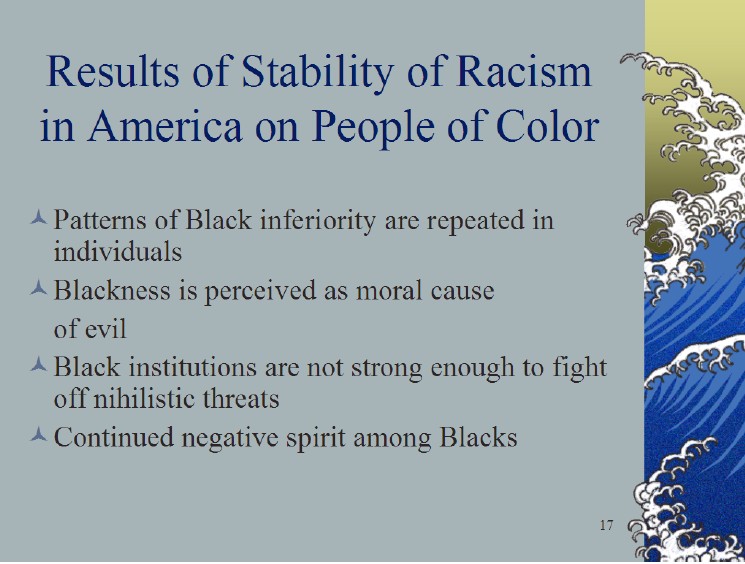
At the heart of the situation of Blacks in America today, West explains, is the nihilistic threat that increasingly pervades black communities. He says that in the racist system live too many people of color who aren’t living the values of life. They are living in despair, a sense that nothing can help them. The reactions of so many people of color during the Katrina Hurricane disaster of 2005 clearly demonstrate this state of hopelessness. West says: Neither the appeal to blackness as a political ploy, the liberal call for better government and citizenry programs, nor the conservative plea for self-help programs or business expansion deals with the major “eclipse of hope, the unprecedented collapse of meaning, the incredible disregard for human (especially black) life and property in much of Black America.” [35]
What he is saying is that racism brings with it this inhuman sense of hopelessness and neither conservative nor liberal programs giving economic help alone will cure the malady of racism’s emotional system.
What this refers to is psychological depression and a personal sense of worthlessness and social despair. “Nihilism is to be understood here not so much as a philosophic doctrine that there are no rational grounds for legitimate standards or authority; it is, far more, the lived experience of coping with a life of horrifying meaninglessness, hopelessness, and (most important) lovelessness.” [36]
When blacks first came to the New World, they created religious and civic institutions that fostered familial and community support, values of service, sacrifice, love, care, discipline, and excellence. Now, however, these traditions are not sufficiently operative to fend off the nihilistic threat. West says that the two significant causes for this are the saturation of market forces and market moralities, as well as the present crisis in black leadership. West sees this resulting in many black people being set adrift without resources in confronting the workings of the United States capitalist society.
The market forces seek to make profits by convincing the public to consume. Pleasure—which involves comfort, convenience, and sexual stimulation and which has little to do with past and future moral and other cultural values—has become the goal of the market and of the people. The seductive market edges out non-market values handed down by preceding generations.
A deep-seated anger, rage, and pessimism result from this nihilism. Presently, these feelings are directed primarily towards black citizens, especially black women. More recently, it can be detected surfacing in the larger American society.
An aspect of this nihilism is the black self-hatred in the inability of many black Americans to love their own black bodies—“especially their black noses, hips, lips, and hair.” [37] Yet, behind the closed doors of white and black America is the intriguing role of sexuality in American racism. Hatred of the black body, by the black, is only a part of this.
West contends that although black sexuality is a taboo subject in America, a frank discussion of it is a requisite for healthy race relations. While the white supremacist ideology is based on the degradation of black bodies, black sexuality is kept taboo because it is a form of black power over whites. “In fact, the dominant sexual myths of black women and men portray whites as being ‘out-of-control’—seduced, tempted, overcome, overpowered by black bodies.” [38] On the one hand, whites claim to control their supremacy over blacks; while, on the other hand, they are controlled by black sexuality and, therefore, by blacks.
For most black males, this scenario plays out so that, in their youth, power is acquired by stylizing their bodies in such a way to reflect their uniqueness and power over others. It develops a machismo that is a fake form of self-identification. The black female, because white beauty plays a stronger role in sexual desirability, has psychic bouts with self-confidence, fear of her black skin and characteristics, and the burden of raising black children.
What is needed in this convoluted drama, where healthy self-identity is thwarted by hidden sexual myths, is a candid dialogue about black sexuality. In the past, struggling black churches and institutions made “a Faustian pact with white America: avoid any substantive engagement with black sexuality and your survival on the margins of American society is, at least, possible.” [39] Now the healthy culture forces need to provide a climate where the myths are debunked, so sexuality, rather than exploiting the person, is integrated into healthy human living.
This is an example of conversion that West proposes as the remedy to nihilism. New models of collective black leadership must confront nihilism, which is a disease of the soul, like alcoholism and drug addiction. The confrontation needs to advance through the politics of conversion, by loving and caring, and by a transracial coalition that overcomes the white supremacist market forces and creates an atmosphere of affirmation for black humanity. West, in his epilogue, states: “My aim in this book is to revitalize our public conversation about race in light of our paralyzing pessimism and stratifying cynicism as a people. As a radical democrat I believe it is late—but maybe not too late—to confront and overcome the poverty and paranoia, the despair and distrust that haunt us.” [40]
This chapter has sought to present an analysis of the causes—past and present—of racism in America. It has focused on the thoughts of one author, Cornel West, who bases his analysis on the principles presented in chapter one. The description of racism developed by West provides the reader a direction with which to conduct his or her own analysis. Any group willing to do so will come to it with its own preconceived notion and emotionally charged position. This chapter is offered as an example of how social analysis can be a resource to understand more fully the systemic nature of racism.
8. Leading a Group to Be Anti-Racist
I was a member of a council in which a leader told members that they were racist. This statement was out of context and turned her listeners off completely. Another time at an anti-racism workshop a black co-presenter, to draw attention to the evil of racism, asked, “Why do you white people hate us so?” He got attention and also the anger and the confusion that followed.
How does one go about helping a group to become anti-racist? I first want to show what happens in a dysfunctional group where leadership has been manipulated. In chapter 5 we spoke about the emotional level of self-differentiation in society. I shared of how Murray Bowen spoke of society in the 1960s as having developed a pattern like that of a dysfunctional family with a spoiled child. Society was giving into emotional demands, somewhat hoping that the problem would go away. The society was in “an undifferentiated ego mass.” Racism is such that we have this undifferentiated mass common in society. This is the insidious way that racism has affected American society and so many other countries in the world. It is such that any institution in America, whether it be a family, school, church, synagogue, mosque, or business is affected by being in this atmosphere. It is in the air we breathe. It is like alcoholism that can affect anyone despite his or her education or economic level in society. The power of a racial social system is similar
A useless way to bring corrective action is to accuse a group of being racist. This is similar to getting angry with a group of people who are infected by a sickness. A means is needed to help the ego differentiation of a group rise to a level where people take responsibility for their behavior.
The purpose of the leader of a company, school, church, or any organization is to provide goals and structure and the means to achieve them. Parents and teachers provide this for their children and students. A country expects political leaders to provide organization to government in order that the peace and security of the people are secured. In the presence of the emotional pulls of racism that are affecting America, leadership’s role is to model and provide goals and means to break away from the racist manipulations. In our country after the Civil War the northern political leaders under President Grant tried to provide such leadership to prevent the South from becoming a segregated society, but the task proved impossible. It was not until the civil rights era and the leadership of Martin Luther King, Jr., that we were able to move past much of the emotional control that racism had on us. Since that time we can see the progress that has been made in civil law, media, business, and social practice to accept people of all races. Deliberate steps of leadership— whether they are on the part of prophets like King, legislators, or business leaders—have brought this progress about.
The goal is to help members of society recognize how they can be active in not letting themselves be manipulated by the emotional pull of racism. When the leader sets the pattern by providing the standard and means for the members, the organization will follow. I discovered when giving anti-racist workshops that I had to set up the standards for the workshop. If I gave into a local authority that wanted to limit or determine the attendance or be an obstacle in what was presented and discussed, the workshop could not succeed. The attendees needed freedom to share their feelings without the emotional threat of a boss who was holding onto racist controls and manipulating constituents to follow his or her emotional patterns.
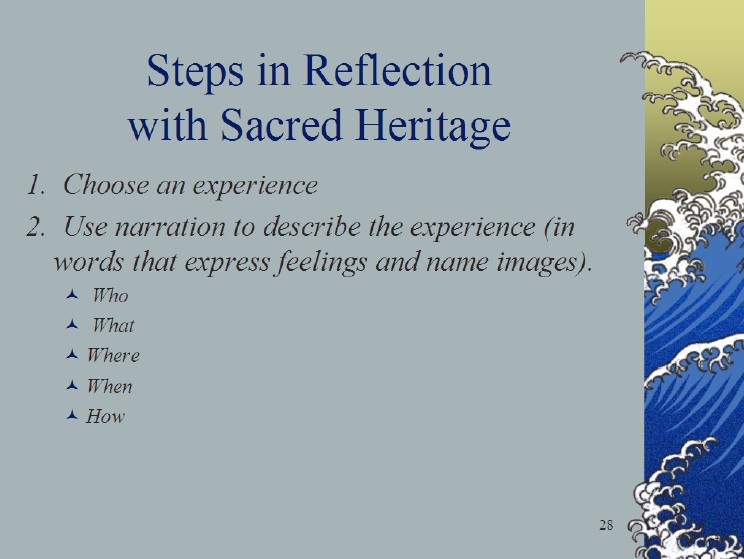
At one workshop we discussed how to integrate schools. I planned the workshop so that there were an equal number of blacks and whites present. We began by telling stories of our racial background. There is nothing like personal stories to have people understand each other and appreciate each other. A black teacher shared how it had been her experience that predominately white schools often allowed a percentage of blacks; when that number went above fifty percent, the white parents began to pull their children out of the schools. A white leader of a high school told of how he sought to hire more black teachers. The black teacher wanted a system of transportation to be provided for the school from black neighborhoods. As we discussed these issues we all began to appreciate each other’s point of view. We realized that the function of a school is to care for each student. When the attention is on this primary goal, the fears and threats of racism lose power. The function of a leader is to help a group achieve its primary goal. When a group is honestly sharing, the emotional pulls of racism begin to dissipate.
A leader of an institution can use the following method to guide constituents to become anti-racist. There are five steps to this method.
- Provide a place for people of various races to come together and share personal stories of contact with people of other races.
- Seek to find the heart of the matter. Together discover what is happening in the institution.
- Look at the goals and honored traditions that the group considers essential.
- Compare the heart of the matter with this tradition.
- Plan for action that the group will take to work against racism.
Practically, this five-point method is accomplished through the following process:
- When bringing people together, share stories of racial experience. Stories contain feelings that reveal what is honestly happening. Tell the stories by sharing: who, what, where, when, and how. Do not talk about the why. These descriptive narratives will help the group to know each other and what is significant without looking at motives. The group chooses an experience that it wants to discuss which typifies what is happening in the group.
- Look for the heart of the matter. Name the central feeling the group is experiencing. Name an image that captures the central feeling. Describe the insight emerging. State the heart of the matter.
- Now look at what is especially honored in the group that gives a direction to where the group wants to go. Share what this tradition is.
- Compare the heart of the matter that the group has named with this tradition.
- Determine what actions the group wants to continue the tradition.
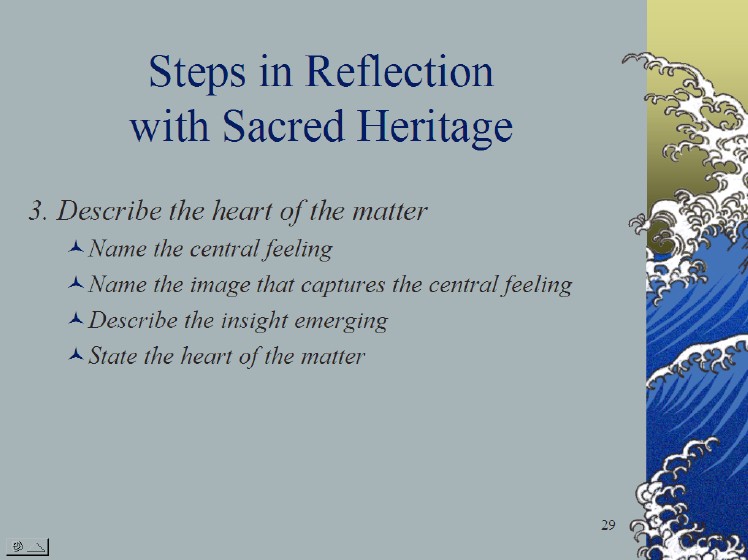
This is an outline of a method that any group can use to take a look at a racist dysfunction and discover how it can move to a solution.
Members in the religious society to which I belong have engaged in this process for five years. We began by gathering together for a weekend at which we first went through step one: we shared stories of our racial experiences. Then we went to step 2 and looked at the heart of the matter—a subtle dysfunctional denial of racism. We realized in step 3 that our honored tradition is the community life we live. For step 4, we shared much about how we failed to match up. In step 5, we adapted an action plan to hold workshops for our brothers and lay associates at which they could come together and do what we did. This process has guided us for four years through many workshops and many other actions. We are presently involved in helping our leadership to plan a corporate strategy to have the members pledge to be anti-racist.
Other groups have gone about this process in various ways. A diocese I am a part of had a workshop for the leadership. Then workshops were held for all the leaders of the diocese. A committee has been set up to continue the education of the members of the diocese. Presently a workshop is being planned for the priests.
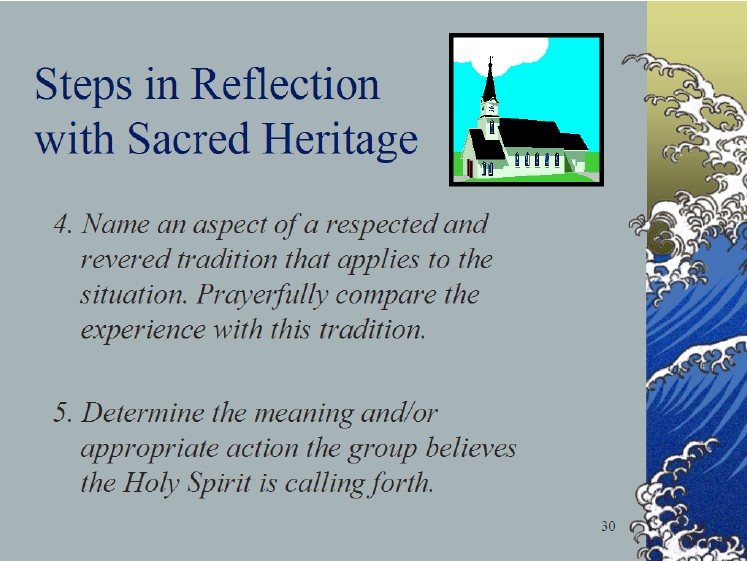
It is the task of leadership to set the pace to overcome racism. The emotional system of racism will have its control unless the policy and energies of the group are used to help in the formation of the members to counteract the emotional control of racism.
To counteract the control it is not a matter of causing more anger but of providing means for the members to come together to share their feelings and to make plans to change based on what are their sacred values.
9. Admitting the Reality of the Denial of Racism
Have you seen the Spiderman movies? Peter Parker, who plays the part of Spiderman, is a timid and highly intelligent young man who has an extraordinary ability to leap amid skyscrapers by sending out webs at the speed of light. He uses this super human ability to care for all kinds of people in need. In the Marvel Comic Book series, as well as the films, he is tortured by a struggle to find his own identity. If he accepts this supernatural ability, will he be able to fall in love? The film is a mini twelve-step program that he goes through to find out how to adjust to his gifts, his identity, and his place in society.
At the retreat center where I am chaplain, a number of retreats are reunions of those who are going through twelve-step programs for addictions. I have met some extraordinary people who are similar to a mature Spiderman. One particular woman told me she had been through many twelve-step programs in her life. Her husband is deceased, but she has recovered from this tragedy and many others by the way she has processed her life. She has been able to lead a number of retreats for widows and widowers. She and her team of widows spend hours together dreaming up creative ways to help others who have lost spouses. The person that my friend has become amazes and moves others. She is able to work with and for others in a way that creatively guides them to dialogue, ritual healing, and fun. Her personality is the secret to her ability to lead and guide others.
Father Clarence Williams has developed an eight-step program to help a person become sober from racism. Twelve-step programs help people overcome addiction. Williams’ eight-step program helps people heal from the social pressure of racism.
This eight-step program is similar to a twelve-step program in that it leads one to be like my widow friend. It helps one be sober, that is free from the dysfunction of racism, much as the twelve-step program of Alcoholics Anonymous frees a person from the control of alcohol. Williams’ steps are taken from Elizabeth Kubler Ross’ analysis of the dying process—denial, anger, bargaining, depression, and acceptance. To this, Father added three more steps: reengagement, forgiveness, and witness. These eight steps bring the sober, non-racist person to a freedom that engages with others in a positive way to help eliminate racism.
I encourage you to read Williams’ book, Racial Sobriety A Journey from Hurts to Healing: Institute for Recovery from Racisms (Detroit: IFRFR, 2002). I want to share some reflections with you on the first five steps. My objective is not to repeat what he says but to point out what I believe are some key areas that need consideration if one is to understand the nature of racism.
Denial is a very deep part of the dysfunction of racism. In the meetings I have had with people trying to stop racism, denial has been a constant theme because people often ignore their feelings of concern for others so an existing racist social system can stay in place. Black people tend to absorb the negative thinking that the social system puts on them. To really do something about racism means to rise above this thinking and to see what real human relationships can be.
I met an older black woman who wanted to live in Haddonfield, New Jersey, but had to live in Camden because the taxes and property values in Haddonfield were too high. She paid $800 in taxes for her Camden house. I told her that my sister and her husband were moving from a house in Garden City, New York, because the taxes were too high, about $14,500 a year. This is an example of the discrepancy in the way Americans live. Is this directly racist? No. But this is part of the whole dysfunction of the way our society is set up in which racism is part.
Races living separately continue the psychosocial effect of denial. We avoid these matters in so much of our lives. We go on living without bringing them to consciousness. We give excuses for not getting engaged. “I’m too busy.” “It is not my responsibility.” “Everyone has to pull themselves up by their own bootstraps.” “I can’t do anything about this system. I am too busy to do anything.” “I am comfortable with my neighborhood. If I said anything to my friends or neighbors they would either ignore me or get angry.” “I would not be accepted if I would become an activist. It is too uncomfortable to bring up these controversial topics.” “My friends and I don’t ever talk about racism. We don’t know how to talk about it.”
All of these statements lead to the conclusion that we live in a denial of racism. This of course doesn't apply to everyone. It is a psychosocial state that oozes out of control that prevents us from dealing with this horrible dysfunction. When we are in denial, we let incorrect opinions and adolescent behavior take over our way of thinking and acting.
To work against racism is to be like my widow friend who has processed her life and is leading others to recognize what is wholesome. Her twelve-step programs have helped her to become someone who has differentiated herself from dysfunctional systems. As a result they cannot control her.
10. Finding Your Anger in the Racist Dysfunction
Finding and realizing your anger, denial, bargaining, and depression can lead to acceptance of racism and then to a determination to build the skills needed to eliminate it. However, it is not easy. I have sought to remove my own denial of racism, but I know that I am not yet separated from this sickness. In this chapter I want to help the reader recognize his or her anger level.
I have listened to the anger in families that come to our Family Retreat House for prayer and healing, and I am convinced that anger can be constructive. I pray with my anger and my other feelings every morning. I usually write down my dominant feelings and then use them to help me face the day with the truth of what I am experiencing.
I see stable families who learn to express openly their feelings and then to process what can be done to work out good solutions to problems. One family spent years working with a son who was addicted to drugs and finally shared with him their true feelings without denial. The young man finally came to recognize his weakness and is living a powerful, sober, and useful life through the guidance of a twelve-step program.
If you scratch the outer shell of a black person in America you will probably find some deep anger. A very well educated and retired black man shared his feelings at a workshop about being treated as a second-class citizen while growing up. He had never brought to consciousness the feelings that prevented him from sharing his childhood experiences.
The white supremacy culture has become a way for white people to hide from their true feelings. Through the years the prophets among us who have raised the cause of the underdog person of color have tried to awaken the consciousness of both white and black people. Martin Luther King, Jr., in his speeches, thought, and actions, expressed pathos for the deeper feelings of Americans. He and others like him have been a means for the nation to name its anger at the suffering of black people, as well as a means for white people to name its deeper repressed anger at the same.
Because they perceive that rights and privileges are being taken from them, the anger of white people is very deep in America. The anger of people of color—caused by being deprived of rights—is also very deep. This is all part of the dysfunction of our society. To deal with racism is to face these angers in us. If churches, companies, schools, and other institutions in society fail to let this anger surface so that it can be dealt with in ways that bring about solutions, the anger grows infectious. It is the same as the dysfunction of anger caused by centuries of the Muslim and Western conflict. Western culture has a deep fear of losing its dominance and its rights. Religion is used to protect this dominance. Rather than deal with the fear, defensiveness has been a cause of wars for centuries. Muslim people, on the other hand, turned to fundamentalism, which is a defense for being treated as second-class citizens and for a loss of rights. These very deep and active angers now operate in society.
Leaders who can stand up and say they are angry because they may lose power and at the same time can deal with these angers by not going to extremes, but by finding solutions, are the ones who guide us away from dysfunctional systems that let anger dominate.
11. Bargaining, Compromising, or Finding the Common Good in Society
I found myself bargaining with the leader of an institution when seeking to lead a staff workshop on racism. The leader was very concerned that I would incite too much emotion on the part of the large black worker population. He asked me to interview ten workers privately beforehand, and from the interviews people would be chosen to attend the workshop. I found myself having to give in to his demands. Eventually, I realized that in order to have an effective workshop, I had to set up the criteria. Bargaining may be needed as part of the process to help people develop an integrated society, but I gave up too much to be effective in that circumstance.
Compromise is needed as a part of politics because we live in a world that is not ideal. However, in our efforts to become a mature society we are on a journey to racial justice. Bargaining is part of the process. However, bargaining is only a process, a method. The outcome is what is important. When we bargain to buy a car we do our best, but it is the outcome that is important.
I don’t think there is an American that is not conscious of the bargaining process that one goes through regarding racism. The person of color is continually thrust into situations where he or she has to decide how to act and what to do. Does he or she compromise with the white supremacy society? It is a constant challenge. A white person with any type of conscience is continually struggling with how to deal with race pressure in order to act with justice. I know of many young people who have gone to developing nations and come back bargaining with what to do from their experiences. A college junior who came back from working with leprosy patients at a hospital in Ecuador struggled with her new consciousness. How does she share her experiences? What does she do with her life in the future? She is surrounded with the benefits of our culture in America and was face-to-face with people of color who are suffering with a terrible disease. What is she to do about it?
The benefit of the bargaining is to come to an understanding of what has to be accomplished. At the heart of our human life is decency and right judgment. Healthy human life results from making decisions that are not selfish. Coming to good decisions is a very demanding process. Racial problems can only be resolved in this way. It means involvement and listening to all sides. It also means becoming a person that is more integrated and willing to change institutions, especially those to which one belongs. We need to go through the bargaining process to change these institutions. A person who is involved in this process will feel suppressed and beaten down at times and at other moments joyful at the successes. It is important that he or she is involved and struggling to overcome any manipulation and constantly looking for the healthy end result.
12. Resisting Depression
Depression is a state in which we feel powerless. We lose energy and drive. Depression is a prison. Insight as to what to do is not present. White people in our society are forced into a prison of continual benefit from simply being white. Black people are forced into a prison of continually being deprived of their status. Depression is the state of not having power and insight of what to do about this dysfunction.
White cultures have lost so much of the roots that enable individuals to celebrate and become strong differentiated persons. People of color in many areas of the country have been robbed of their church and other community support groups. A retired white teacher who has taught for years in the inner city public schools of Philadelphia conveyed that the people in the area where he lives, North Philadelphia, exist in terrible dysfunction. They do not lack enough food to eat, but they are in a chronic state of inability to face the realities of daily life. Their lifestyle has become such that it is stabilized into a common sharing of depression. This teacher adopted a black boy who is so hooked on drugs that his father has to keep the door of his house locked so that his drug addicted son does not steal his possessions. This is serious depression.
On the other hand, I know of white families that are depressed in the opposite path. They live so far away from the problems of inner city and rural America that they have no insight as to what their sharing in the power, benefits, and accumulation of wealth does to the poor. They not only suffer from denial, they suffer from a depression, a social state of not being who they can be. Anyone with wealth can either use it to become someone who can relate and share with others, or live in a depressed state where insight and creativity are not operative.
Ada Maria Isasi-Diaz, a theologian, demonstrates that present United States consciousness is based on the maximization of profits. [41] Our system and our consciousness benefit the few. Two-thirds of the world’s goods are used by the United States. We effectively exclude from our consciousness “those” people who are different. Although there are many in the USA who can resist this consciousness, she says that the desire for maximizing profits dominates. This way of thinking prevents us from bringing to mind the needs and suffering of others.
She shows that we need to reinvent our way of thinking. She says that we have a thinking problem, an epistemological problem. Our system does not think in a way that considers most of the rest of the world. We need to become aware of and take responsibility for our way of thinking. This means that we do not allow a type of depression that prevents us from understanding reality.
I have met a number of people who consciously want to do this—to understand reality and make appropriate changes. However, a number of them have become depressed. There are teachers, wanting to help students who have been deprived, who live in inner-city areas, earn lower wages and sacrifice with their families what many others have. Year after year these teachers are surrounded by a wider culture that is thinking differently. Their depression sometimes becomes so strong that they are not able to operate well and their situation becomes worse.
Depression is a stage that we may have to experience, an inevitable consequence of feeling helpless. It is also a trap that can keep us ensnared by forces that appear to dominate. In racial matters we seek to understand when a depression makes us feel powerless. We seek not to be overcome by these negative forces but rather discern our own power and resources.
13. Living in Acceptance
M. Scott Peck in The Road Less Traveled says that not many people travel the road processing their hidden motivations to become fine-tuned change agents in society. It is the exceptional person in society that recognizes the need for change and takes the initiative to bring them about.
Murray Bowen says that no person can be differentiated completely from emotional pulls. The human condition is such that it is impossible one hundred percent of the time to act without being influenced by passions that pull us from objective judgment. Clarence Williams says that acceptance is a commencement event because it is beginning a way of life where one is no longer dominated by intellectual illusions. Acceptance is being in a new state of self that is ready to begin the journey of processing one’s reactions and seeking to transform the powers of society that keep racism in place.
Acceptance is not living in false consciousness as is sometimes thought by those who seek to live in a type of controlling assimilation. Acceptance is recognizing one’s specific ethnicity. It is being in a state where the negativity is not pushed onto people of color and assumed into their psyche.
For generations those entering American society have sought acceptance by denying their own ethnicity. We have allowed cultural differences to keep us apart, a process that leads to marginalization. Here is an example.
A Latino family who lived in an Anglo Saxon neighborhood did not keep their house the way the neighboring families did. As a result, they were not accepted. The Latino family was looked down upon and isolated from the rest of the neighborhood.
Differences can become the basis for separation and even hatred. People try to make dissimilarities disappear, just as the neighbors wanted the Latino family to disappear. What results is a separation into two conflicting parties. The dominant whites tend to feel that they are not responsible and they have no need to change. They do not think they are accountable to anyone. The people who are dominated begin to assume their own negativity and an assimilated hybrid can develop. They lose a sense of who they really are. Rather than being themselves, this group seeks to become both the dominated and the dominating. False judgments are made instead of differences accepted.
Society has highlighted differences and not fostered relationships. We begin to think that differences are impossible to live with. In West Side Story, Maria struggled to become herself. She was a Puerto Rican girl who didn’t let the dominant culture keep her from recognizing her distinctiveness. This is an example of a way to accept oneself and also live with differences.
In my own struggle to be racially sober I have sought to be morally just to people of color. I have tried to change the institutions in which I live so that people within these institutions accept people of other races.
However, acceptance is an interior disposition. It is accepting myself for who I am and not pressuring others with the patterns I want for them. My personal self is a value. I have my own characteristics, which I trust and think are correct for me. I seek to appreciate my own background and to enjoy it. I seek to admit how I have let my white race keep me from appreciating the gifts I have as a person. For me to be racially sober is not to assimilate other people’s cultures. It is to allow others to be themselves and for me to accept myself. I can then relate to the problems of society and create structures that are just and fair.
Acceptance also means recognizing the systems with which we live and work for what they are. According to a Japanese friend of mine, many Japanese firms are close-knit structures and it is difficult to leave as workers become part of the system. Over working can become endemic because of the emphasis placed on company loyalty. Many wives of workers eventually seek separation and divorce because husbands frequently overwork and are absent from their homes. Acceptance means realizing the good and bad effects of this system.
The hurricane of a system will forcefully seek to draw one into its homeostasis. To be differentiated means to accept the powerful forces in any system as realities and at the same time accept the gifts that one has as an individual not to be controlled by these forces.
Being at a point of graduation means growing from being unconscious of the systemic powers to recognizing the work that has to be done. Graduating in this way is taking the road less traveled but one that will lead to wholeness.
When one is beyond anger, denial, depression and bargaining, one can seek to use power to be a corrective to the system.
14. Being Different in Unjust Social Systems
The history of the human race is full of establishing social systems and changing into new ones either by violent or nonviolent means. Racism is one form of an unjust social system that keeps raising its ugly head. However, there are new systems that constantly try to take control of us. To conquer racism is to discover how to overcome any unjust social system.
For example, today we are in a struggle related to modern media and societal control. The principles spoken about in this book about racism are applicable in sorting out how the media system can take control of us. How often have you been in a discussion with another about politics? The views are often so emotional that it is impossible to get to the truth about an issue. On a grand scale the media and media conglomerates use emotion to control policies. We have operating today a new type of social control like racism by a few who have control of the media.
Racism, like any type of prejudice that becomes part of the social system, has its way of taking control of the system. To be aware of this power control by untruths in any social system and then to become differentiated from it is the purpose of this book.
Karl Jung speaks of the “collective unconscious” (the united mass of humanity from all over the world coming to a realization that is an advancement for all human beings). This worldwide consciousness is an extraordinary gift for the human race. Now in all parts of the world many people see a willingness to recognize the unjust power plays that racism involves. Arising today is a consciousness related to the injustice of power systems that bring power and wealth to certain groups at the expense of others. Most human beings realize the injustice of these systems.
The white supremacy that is part of the American social system is a definite part of our dark side. We now have the ability to make racism history. We have the ability to make correctives in this system.
Systems of wealth have such control through media, finances, and other means that create unjust power systems. This book is not naming any particular business, political party, or financial organization. It is naming the dynamics that are operative in these power plays.
They are as follows:
- Power systems tend to stay in place
- People tend to triangulate with others to keep their power
- The suffering in the system is not the cause of the problem but the designated patient
- The system is corrected by staying involved and being different through a person (or people) in the system.
The process a person goes through while trying to be different is the following:
- Denial
- Anger
- Bargaining
- Depression
- Acceptance
After acceptance, a person needs to go about the work of maintaining a newfound realization and helping society correct the system.
Sources and Notes:
- Murray Bowen, Family Therapy in Clinical Practice (NY: Jason Aronson, 1983).
- Ibid., p. 415.
- Ibid., p. 416.
- Edwin H. Friedman, Generation to Generation: Family Process in Church and Synagogue (New York: The Guilford Press, 1985), p. 23.
- Bowen, pp. 426-32.
- George C.L. Cummings, “Racism in the U.S. from 1492 to 1992,” Reading the Signs of the Times; T. Howland Sanks and John A. Coleman (New York, Paulist Press, 1993), pp. 82-83.
- Ibid., p. 438.
- Ibid., p. 442.
- Friedman, p. 221.
- Joe Holland and Peter Henriot, Social Analysis, Linking Faith and Justice (New York: Maryknoll, 1994).
- Ibid., p. 29.
- Ibid., p. 80.
- Friedman, pp. 35-36.
- Ibid, pp.35-36
- Bowen, p. 425.
- Toni Morrison, Beloved (New York: Knopf, 1987), pp. 198-99.
- Michael A. Cowan, “Moving in ‘White’ Circles,” unpublished manuscript, 1995.
- Cornel West, Prophesy Deliverance (Philadelphia: Westminster Press, 1982), p. 65.
- Bowen, p. 444.
- Ibid., pp. 444-45.
- Ibid., p. 445.
- Cornel West in “Black Strivings.” Cornel West and Henry Louis Gates, Jr., The Future of the Race, (New York: Vantage Books, 1996), pp. 84-85.
- Franz Fanon, Black Skins, White Masks. Trans. C. L. Markmann (New York: Grove Press, 1967), p. 131.
- Ibid.
- James Cone, Black Theology and Black Power, (San Francisco: Harper, 1989), p. 8.
- Friedman, p. 229.
- Ibid., p. 436.
- Ibid., p. 437.
- Bowen, p. 433.
- Cornel West examines these three causes in light of how liberal and conservative blacks have responded. Cf. Cornel West, Race Matters (New York: Vintage Books, Random House, 1994), chapter 4.
- Cornel West, Democracy Matters (New York: Penguin Press, 2004), pp. 3-7.
- Winthrop D. Jordan. White Over Black (Chapel Hill, NC: University of North Carolina Press, 1968).
- Cornel West. Race Matters (New York: Vintage Books, Random House. 1994) p. 37.
- Ibid., p. 36.
- Ibid., p. 19.
- Ibid., pp. 22-23.
- Ibid., p. 122.
- Ibid., p. 125.
- Ibid., p. 124.
- Ibid., p. 158.
- Ada Maria Isasi-Diaz, Mujerista Theology (Maryknoll, New York: Orbis, 1996).