
Click here for a downloadable PDF version of this article.
INTRODUCTION
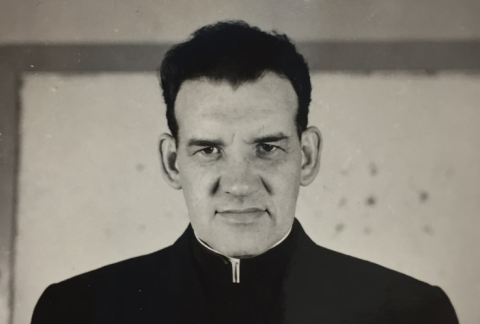
This work is a conference written by Fr. William Ferree, SM, which presents a working program for “apostles.” [1] It points out the two methods of attack at hand today: study of the ideal and total effort. The body of the conference points out that a mission so grand as ours will demonstrably fail; but in the economy of salvation, that failure is the sacramental veil of success.
1. Our mission is universal
Anyone who reads Father Chaminade’s writings attentively will discover that he proposed to himself a mission so vast that almost all his followers—including ourselves—have come to the conclusion that he was indulging in a sort of rhetorical exaggeration. They, and we, have been driven to this conclusion by the fact that a literal interpretation of his words is obviously out of contact with reality as the whole of human history reveals it to us. Unless Father Chaminade left us some extraordinary means of action which men before us did not possess, it was demonstrably absurd to want to be taken literally in a statement such as this: “There is no question of saving the souls of a few public sinners; what we want to do is to attract and convert the world which has gone wrong almost in its entirety.”
Yet the propagation of a really universal mission is so constant in his work that we cannot legitimately take refuge in a figurative explanation of such statements. We must face the fact that he meant what he said.
Was he simply mistaken, then, in his appreciation of the extent of his mission—and of ours; or did he really leave us some extraordinary means of action which renders possible what is otherwise only a naïve delusion: the effective conversion of the whole world?
2. The means to achieve this mission
My own growing conviction is that he left us the means: that the marvelous combination of doctrine and organization and means of action which are revealed by an analysis of his writings and his various foundations really do constitute something distinctly new and almost unbelievably dynamic in the Christian apostolate. Furthermore, Father Chaminade himself seems to have been clearly conscious of this even in the recognized imperfection of his work brought on by the petty struggles of his subordinates and the concessions he had to make to their incomprehension. “I am so convinced,” he wrote in 1824, “that we have found the means of reestablishing Christian usages (in present terminology: “of reconstructing a Christian social order”), of propagating the spirit of religion, and of setting up powerful barriers to the seduction and corrupting torrent of secularism and materialism (“philosophism” as it was called in Father Chaminade’s time) that I will not allow (our Institute) to be changed substantially, or even modified.”
3. “Universal” taken literally
Thus we can see not violent rhetoric, but a cold statement of fact in Father Chaminade’s words: “Our work is grand, it is magnificent . . . it is universal . . .” And indeed, the more we study this work, the more profoundly we can realize how grand and magnificent it is. At almost every step of the study we find new revelations of its tremendous solidity and power. If we have any heart for a high ideal, we must surely consecrate ourselves body and soul to ours; and in the enthusiasm of that consecration we will want to spend for it the last ounce of our energy.,
And this is as it should be, for no other form of consecration is worthy of so high an ideal as this.
Success in Such a Mission
1. It will never succeed
But in that same enthusiasm, we will be tempted to think that so great an ideal, enforced by so marvelous a system, must almost infallibly succeed in its eventual realization; and this is not as it should be, for it exposes us to a disappointment even greater than our enthusiasm. We are here face to face with the most agonizing problem that faces the apostolic heart; it has the formal command of Christ (to which it has consecrated its whole existence) to go and baptize all nations; and at the same time it possesses the formal assurance of Christ that it will not succeed.
2. Did Christ succeed?
Of his own success, Our Lord could say: “If I had not done among them the works which no other man did, they had not had sin; but now they have both seen and hated both me and the Father.” If they saw Christ, and hated him, will they reserve a better fate for us? “Because I have chosen you out of the world, therefore the world hateth you.”
3. Discouragement for “apostles”
Oh, how much apostolic enthusiasm, throughout the ages, has been quenched, how much heroic generosity has been broken, by the discovery of this hard reality! There are a million ways in which that discovery can be made: One may elaborate a powerful conception of the apostolate and find no collaborators generous enough to give it expression. Another may actually build up a powerful instrument of the apostolate, and find no man with vision enough to succeed him in its direction. Another may find and group around himself men of great vision, only to see them taken from him by death before any of their promise can be fulfilled. Still another may find himself excluded by his own disciples from the work he created, and the work itself perverted to other ends. Another may experience none of those difficulties, only to find a prosperous and successful work suddenly wiped out of existence by some natural catastrophe or by the blind destruction of war.
And these are only the causes of ruin that come in a certain sense from within—that touch the apostolic work in its very being. From without there beats upon every apostolic work wave after wave of that vast, mysterious sea of human malice—that sea which Christ himself did not attempt to calm: “If the world hateth you, know that it hated me before you.” It is the world that crucified Christ and that makes martyrs of his apostles; the world that we must wear our hearts out to convert, but whose conversion—let us face the truth—we will not bring about.
Sacrament of Our Mission
1. Our failures are our success
There is no more heartbreaking contradiction in the world than this one between an ideal which demands and receives from us the consecration of our whole beings, body and soul, to its realization; and the almost inevitable discovery that its realization is impossible.
Almost inevitable? Is there then a way to avoid this sad discovery? There is a way: it is to start out with full knowledge of what awaits us.
Why play on words in so serious a matter? The contradiction rests the same, surely, if we discover it after we have failed, or whether we know it before we start!
No, it is not at all the same. If this truth comes to us as a discovery—above all as a tragic discovery—it only means that we were trusting before that to our own natural efforts, no matter what we pretended to believe. But if we start with it as a principle, then our whole lives become a heroic act of faith, and we are liberated so that we can give the last ounce of our energy to the accomplishment of the great mission we have received. Our whole work, in fact, is transferred to a higher plan, where our reason cannot penetrate, and where our very failure is our success.
And by this I do not mean merely the fact that our failures in the Apostolate are successes in this sense, that through them we work out our own personal sanctification. That is true, of course, and for some people may seem a sufficient compensation for the tragic contradiction we have noted; but after all, it is to a certain extent beside the point. The failures to which we must look forward are in the apostolate—in our profound yearning and heroic efforts to turn men to God, and to the realization of their eternal destiny—and we do not remove the tragedy of such failures by simply turning our attention from them and concentrating it on something else: on our own individual salvation.
No, it is in a far profounder sense than that that our very failures in the apostolate are our success, and our success in the very field of the apostolate itself!
2. How Christian life is sacramental
How can this be? The explanation lies in a consideration of the whole economy of our salvation. We are composite beings, at once spiritual and material; and in the ordinary course of events our whole spiritual life, and very attainment of our spiritual destiny, has tenacious roots in the material. This is only another way of saying that the whole Christian life is sacramental, and all its parts are sacramental. The very spiritual concepts by which we come to our knowledge of God, depend in their ultimate genesis on sense impressions, on the material world: “There is nothing in the intellect which was not first in the senses.” And God, when he came to us for our spiritual salvation, came incarnate in a material body like our own: the Sacramentum conjunctum as the theologians have called it. The great means of grace which he left us for our salvation, the Sacraments properly so-called, have seemed so crassly material to many men that these latter have alleged them as obstacles to the Faith. The very mystical union of the faithful with Christ, and among themselves, was given a visible, a material form in the Church. And this sacramental character affects even the commonplace, everyday actions of our material lives, turning them into events of tremendous spiritual significance. One such event, the act of getting married, was directly raised to the dignity of a sacrament in the full force of the word, but in very truth all our actions partake of the sacramental character, as a mere glance at our Lord’s description of the Last Judgment will prove abundantly: the just are admitted to eternal life because they fed the hungry, gave drink to the thirsty, and do other equally material acts; and the wicked are excluded from it because they did not do them.
3. Our ideal is sacramental
Now let us go back to our apostolic ideal and consider it in the light of this sacramental character of everything else in the economy of salvation. When Our Lord gave that stupendous command to his apostles to “go, teach all nations, baptizing them . . . he gave them an assignment which was entirely within the reach of their understanding, just as, at the last supper, when he gave them the Eucharist, he gave them something which was entirely within the reach of their human powers of assimilation. But in this latter case, he gave them something far greater—infinitely greater—than the bread and wine that appeared to their view and that lay within their powers. In accepting the appearance of bread and wine, they received the Divinity itself, that Divinity which to their natural powers was infinitely inaccessible.
What we do not sufficiently remark is that in the former case also, he gave them something far greater—infinitively greater—than the words that sounded in their ears, and that lay within their understanding. In accepting words of that mission, they heard the divine will itself, that will which to their natural understanding was infinitely inscrutable.
Here is a subject that merits our profoundest meditation. Just as the Divinity “who dwelleth in light inaccessible,” whom no man can know or approach, actually comes into our ordinary lives in the Eucharist; so the divine will whose sublime purposes are infinitely beyond all possible human understanding, whose depth, and height, and breadth we can never penetrate or even suspect, actually becomes a part of our daily preoccupations in the words of the mission that we have received!
See now what has become of the heartbreaking tragedy of our inevitable apostolic failures! We do not understand them, any more than we understood them before; but they have been lifted out of their human surroundings—where only there can be question of tragedy—and placed in the steady light of eternity, where even to think of failure is blasphemy. There is the true field of our labors—a field unthinkably sublime that has been opened up to our poor human effort by the “mission” we have received. We will not accomplish literally the mission as we have received it—Our Lord himself has assured us of that; but this failure is like the failure to receive literally mere bread and wine when we approach the sacrament of the altar. Here is the sublime secret of the “sacrament of our mission.” By those few human words which we understand and accept, our whole lives—in the measure in which we are faithful to them—are spent in sublime efforts that are as far beyond the reach of failure as the unalterable will of God!
4. Not a point of consolation
But if we look upon this thought only, or even principally, as a point of consolation, we have missed the whole point. The “sensible sign” of this “sacrament” by which alone we can attain to the sublime mystery which is hidden behind it, is our literal mission, taken literally, just as it presents itself to our human understanding.
Working at Our Mission
1. The apostles took Christ literally
When our Lord, therefore, told his apostles to baptize all nations, he gave them the literal end to which their efforts were to be directed, and as long as their efforts were directed to that end, they were doing his will, without any regard whatever to the success or failure that they enjoyed or suffered. But insofar as their efforts would have fallen short of that literal end, they would have fallen short of accomplishing the will of God, and their lives would have been failures, even if, in the lesser end that they had substitutes for the one they had received, they had succeeded so magnificently that all succeeding generations of men would sound their praises and worship at the shrine of their success. Yet humanly speaking, how right and reasonable it would have been to substitute some lesser end; for the very Master who sent them forth to convert the whole world had assured them that the world, far from being converted, would hate them for their pains: “Because I have chosen you out of the world, therefore the world hateth you.” Yes, indeed, it would have been right and reasonable, humanly speaking, to substitute some attainable end for the hopeless folly of attempting the clearly impossible; yet that way would have lain failure and death in the very reality of their sublime mission, and not just in its human expression.
2. What is our literal mission
My Brothers, these thoughts have tremendous bearing on our own life and work. From our venerated Founder, interpreting to us our part in that vast effort which Christ demanded from his apostles, we have received a mission of our own which is as clearly impossible as theirs. Nay, more; in a certain sense it is more so: The apostles were sent to convert a world that did not yet know Christ; we are sent to convert one that has rejected him.
But we are sent to convert the world. If we took out mission from Father Chaminade’s interpretation of it, we are: “There is no question of saving souls of a few public sinners; what we want to do is to attract and convert the world which has gone wrong almost in its entirety.” We have “become the sons of Mary for the salvation of mankind.”
3. Substituting a lesser end
Yet I think that in our practical appreciation of our mission, and in our practical efforts to realize it, it is demonstrably and sadly true that we have substituted for that vast and humanly impossible mission a lesser and more “reasonable” one.
4. Means for grasping the mission
Just for the moment it is not our fault, for many historical circumstances have combined to deprive us of a clear perception of what we were destined to accomplish; but we cannot any longer plead this excuse of ignorance, for now we have at our disposal the means of studying Father Chaminade’s conception of the mission of the Society—of the Societies, rather—which he founded. It is almost certain, from what our studies up to the present have revealed to us, that this conception is going to stand out in ever vaster and more majestic lines exactly in the measure in which we penetrate into it more profoundly. From the very beginning of the Society—when its plan was as yet by no means fully sketched—this vastness of conception aroused opposition on the part of members who thought it impossible. Today, when we can look back on it with the perspective of over a century, and when we can see the vast ramifications of the conception which were hidden from the sight of those who stood close to its origins, we must now admit that it is more impossible still.
5. Extent of effort measures success
But vast as it is, impossible as it is, it is our mission and the measure of the effort that we must make to accomplish the will of God. Here is the practical part of this study: that our vast mission is the measure of the effort that we must make. If we work at that literal mission of reconstructing a Christian world order, taken literally in all its vastness, then we will accomplish what God wants us to accomplish, though the world laugh at our folly. I believe with you that we will fail in that mission; but only because I believe it is an appearance only, a sacramental veil, which protects our poor understandings from the awful majesty of what it places within our power, the accomplishment of the eternal designs of Providence itself. We do not, we cannot, understand those designs which we will attain; but we can understand the sacramental appearance that places them within the scope of our attainment.
On this understanding our efforts must be based. Our literal mission to reconstruct a Christian world actually measures our responsibility to God for the use that we make of our lives.
Note:
- The sermon The Sacrament of Our Mission which is reprinted in this issue is strictly a request number. It has circulated for some time in copies typed out for themselves by various religious, and in a hectographed edition made by the Department of Religious Studies of the University of Dayton. Inclusions in The Apostle of Mary is the easiest way of supplying the additional requests that have come in. The text is that of a sermon delivered in the Seminary of Fribourg in 1937 [William Ferree, editor]. The Apostle of Mary Documentary Series, Vol. 1, Nos. 7, 8, 9; July-September, 1944.
All text and graphics are property of NACMS Copyright ©2010
North American Center for Marianist Studies (NACMS)
4435 East Patterson Road, Dayton, Ohio 45430-1083 / (937) 429-2521