
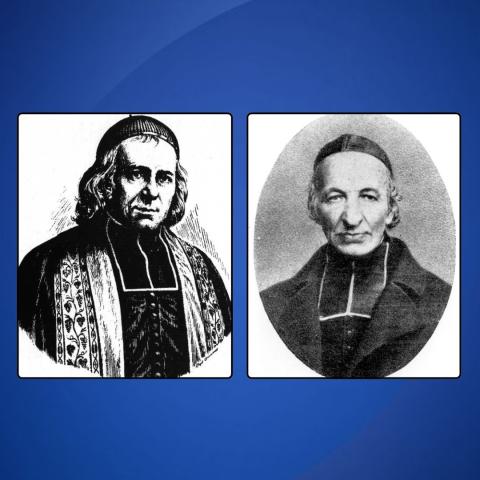
[Note: NACMS has begun posting some documents in electronic format on its web site. Many of these documents are the apostolic fruit of Marianist scholars who have submitted them for consideration. These works have not been edited by the staff of the North American Center for Marianist Studies. Rather, they have been posted as provided in our continuing effort to spread “The Word”—Jesus, son of Mary, for the salvation of the world—and to foster greater understanding of Marianist studies and its interconnection with society.]
Click here for a downloadable PDF version of this article.
SPIRITUAL DIRECTION: CHAMINADE AND CHEVAUX
by Luigi Ruggin, SM
Thesis for a Licentiate in Theology
University of Fribourg, April 1981
Directed by S. Pinckaers
Translated by Joseph Stefanelli, SM
Foreword
Father Hoffer has written a precious synthesis of Chaminadean spirituality. [1] Since John Chevaux is considered, throughout the Marianist tradition, to be a “true” son of Father Chaminade, I could have traced his spiritual physiognomy by following the plan of that book. But that is not the purpose of the present work; it seeks rather to underline the manner in which Father Chaminade accompanied in the spiritual life a religious who entrusted himself to his guidance.
It is clear that it was not possible to separate such an activity from a whole series of concomitant events. For Father Chevaux, Chaminade is also the founder of the Society of Mary and is his superior. On the other hand, Chaminade sees in Chevaux not only a humble religious, docile, malleable, but also the Master of Novices, Director of the community, and counselor of other religious. This spiritual direction is, therefore, a complex relationship and moves within a considerable number of associated problems.
In my research and in the use of documents I have, to the extent possible, limited myself to those which related directly to the object to be demonstrated; that is, to the correspondence between the protagonists of our story during the long period of their spiritual closeness [2] and to some other writings very presumably known and used by both of them. As a strictly chronological development would have been fragmented and somewhat boring, I have most often distributed the material according to themes. I believe this is most useful for understanding a thought and a method of direction that, in fact, never received definitive formulation and which, therefore, could not be subjected to precise analysis.
Besides, the founder of the Marianists is known more as a man of action: action, moreover, inspired by a great docility to the Spirit and an exceptional awareness of the signs of the times, and always joined to a decisive will to retain the essential. What is, for him, fundamental in the spiritual life is this: allowing oneself to be conformed to the image of Jesus Christ in the womb of the maternal tenderness of the Virgin Mary and to work here on earth with the unique vision of eternal salvation. And to do that with a “life hidden in God: one that is industrious, ordinary, obscure, interior, of faith,” [3] “faith of the heart,” as he preferred to name it. [4]
Whether Father Chaminade’s spiritual direction was prudent and efficacious may be discerned from the following testimony: “… Father Chevaux encountered that simple and benevolent language with which he knew how to say everything, to make all acceptable, without ever wounding, without ever discouraging. Who knows how many persons he was able, depending on the need, to lift up, to strengthen, to re-direct, to save from the depths of the abyss, or to launch into the magnificent ways of perfection!” [5]
The chief benefit of a good direction is that it produces peace and tranquility; [6] and these, completely interiorized, will inevitably overflow onto others.
*******************************************************************************************
CHAPTER ONE: Before They Met
I. William Joseph Chaminade
1. Early Years and Adolescence
William Chaminade was born April 8, 1761, in Périgueux, capital of the former Périgord and today of the department of Bordogna. His parents, Blaise and Catherine Béthon, were cloth merchants and members of the middle-classes of the province. Even in Périgueux, a small city of 15,000 inhabitants, the religious situation displayed a vague and tolerant faith, lacking both high and low points, yet not lacking some examples of authentic Christian practice.
Blaise Chaminade in particular was known, among other things, for having keep his business closed in a city in which all the merchants keep open shop even on festive days. [7] Certainly, the entire family was deeply Christian, and the development of priestly vocations within it is the most convincing proof. [8]
We know little of William’s childhood. In his letters there are some memoirs, provided as edification or encouragement for his correspondents. They reveal a child like so many others, but educated with great care by his mother and his older sister, with all the attentions and signs of predilection which are often reserved in a family for the last-born. [9]
From his mother above all he had inherited “ his gentleness, his affability, his moderation, his great prudence, and, above all, his religious education. He was at his mother’s side while she prayed; he went to church with her… It was at her knee that he learned to recite the Creed, his favorite prayer … Finally, it was to his mother that he owed his devotion to Mary, a devotion at once sensitive and strong -- it would be the soul of his holiness, the purpose of his apostolate, and his great means of captivating souls.” [10]
At the age of ten, in 1771, he received the sacrament of Confirmation and it was at that time, in keeping with the customs of that period, that he chose the name of Joseph, in honor of the spouse of the Virgin. He preferred that name even to the baptismal one. In the same year, he entered as a student in the collège of the Congregation of St. Charles at Mussidan. There, together with his brother Louis who had preceded him two years before, he came under the guidance of John Baptist, the eldest of the Chaminade children. [11] “The holy men of Mussidan,” as the people called the Chaminade brothers at the beginning of the Revolution, also became members of the Congregation of St. Charles. They brought it to its greatest development [12] and made of their collège “one of the better schools of piety and knowledge.” [13]
The long stay at Mussidan of almost un-interrupted twenty years was a fruitful one for young Chaminade. Under the guidance of his oldest brother, who was always for him a master listened to and venerated, William pursued a good scientific and philosophical preparation. He also learned from him mental prayer, and attentiveness and availability to the voice of the Lord. Into his hands, he professed the private vows of poverty, chastity, and obedience when he was barely fourteen years of age.
While at Mussidan, William Joseph experienced a visible sign of the protection of the most blessed Virgin: quite seriously injured in one foot and unresponsive to medical treatment, he turned with confidence to Mary and obtained from her an immediate cure.
For his theological studies in preparation for priestly ordination he passed a year in Bordeaux (1781-1782), at the end of which he received the minor Orders. He returned to Mussidan to take up again his usual work. He was, in fact, too young to receive the sub-diaconate or the doctorate; he had to wait until his twenty-fourth year as was required by the canonical legislation of the times. In the autumn of 1784, shortly after the ordination to the sub-diaconate, he was in Paris. He lived with the Sulpitian community of Laon, at that time under the direction of the saintly priest, Peter Nicholas Psalmon, who was martyred for the faith in 1792. [14]
In 1785, having returned to Mussidan with the title of Doctor of Theology received from the Paris Collège de Navarra, William Joseph was ordained priest. He took up again the office of steward, a task which required great shrewdness because of the all-too-modest revenue to be administered. To this he naturally added the various activities of the sacred ministry and, probably, also of teaching.
The Congregation of Saint Charles was still living the fervor of its foundation. To some extent, its limited development contributed to this, as did the contemporaneous presence of positive elements such as the Chaminade brothers. It was an example of a religious life certainly not easily found in the ecclesiastical institutions of the times, but an indication, among others, of decline and rebirth already visible in the years immediately preceding the great Revolution, as recent works seem to demonstrate. [15]
In that same period was being formed a generation of people which would assure the survival of Catholicism during the revolutionary crises, and which would make possible the rebirth of the 19th century. Yet it is clear that the Revolution occurred before the renewal was able to bear its fruits. It changed profoundly the problems which were facing the Church. [16]
Revolution and Exile
The Revolution had begun only a few months before, when W. Joseph Chaminade was deprived of the experienced and sure guide who had supported him to that time. The death of his brother, John Baptist, on January 24, 1790, marked the beginning of ten years of uncertainty, of dangers, and of persecution which the young priest of Périgueux was to pass through with the courage of confessors of the faith.
In February, 1791, having refused to pledge submission to the Civil Constitution of the Clergy, he lost the benefit of subsistence from his family which had been destined for him at the time of his ordination as deacon, in keeping with canonical provisions; even his benefits from the collège of Mussidan were confiscated. Remaining at Mussidan became extremely perilous because he was too well known. He therefore moved to Bordeaux, in the suburbs of the city, judging that the capital of the South West would still be favorable to the exercise of the priestly ministry.
Chaminade was of a peaceful nature. He had been raised to respect all legitimate authority and had never given the caretakers of public order any occasion to be concerned about him. But his priestly zeal and his professional distrust of the police ended up in provoking some “confrontations,” more or less desirable, depending on one’s point of view. [17]
Chaminade’s biographers have stressed, with numerous incidents, his courage as an intrepid priest, always one step from the guillotine, escaping every time thanks to his presence of mind, the cleverness of some friend, and, undoubtedly, through a particular protection of Province and a miraculous intervention of the Virgin. [18] Dressed in various disguises, he went wherever there was need of him.
There were only about twenty priests still in Bordeaux, but they were well directed in their extraordinary fragmentation by the vicar-general of Bordeaux, the Reverend Joseph Boyer, successor of the martyred Langoiran. In his “Rules for the exercise of the sacred ministry,” [19] which Boyer had promulgated, he stressed, among other things, the importance of the apostolic role of the laity. There are statements like the following: “Lay people, in every age but especially in times of persecution, have served the Church with the greatest success: the ministers, therefore, shall seek out carefully among the faithful of their flock those who, strong in their faith, instructed and full of zeal, wish to share their solicitude for the salvation of souls.” [20] For Chaminade, too, seeking out and encouraging such collaboration between clergy and laity was a constant characteristic of all his apostolic initiatives.
Did the fall of Robespierre mark the end of the Terror? Had more favorable days finally arrived? Chaminade seemed to believe so; he decided to come out into the open and take up anew the liturgical functions in an oratory within the city. But peace was short-lived, and many priests had to return to the underground. The most impelling preoccupation then for the ecclesiastical authorities was that of encouraging the return to the Church of “constitutional” priests. That seemed the only way to realistically oppose the accommodating policy of the Directory which claimed that the “non-juring” priests should share the church openly with the unfaithful and schismatic priests. [21] The solicitude of the Church for the lapsed priests drew toward her the sympathy of many Christians, clearly overwhelmed by the merciful expression of a mother whose suffering has made her more understanding and blessed with serene kindness. The numerous Manuals composed for the instruction of the “missionaries” charged with restoring the faith in France indicated the model to be followed: Cyprian, the holy bishop of Carthage. They recommended a prudent pastoral behavior and conveyed a deeply human attitude, signs of a profound psychological insight. [22]
Chaminade’s natural temperament inclined rather to rigidity; his judgment was always determined by the law, by norms. But it had, with the trials of life, acquired a more spontaneous kindness and a wisdom to be at once both understanding and firm without violating his conscience. In this way, having been delegated the powers of Penitentiary, between 1795 and 1797 he fostered the conversion and rehabilitation of a considerable number of constitutional priests.
During those same months (the young priest was among the most visible and most esteemed of the city), he acquired the fervent disciples who later would be the most dependable supports of his works. One of them wrote: “I have met the priest I have so long been seeking. He is a saint. He will be my guide and he will be my model.” [23] This evaluation is of interest for it places us face to face with a director of souls who is revealed at peace and in command of himself. He encourages by his very sureness, “he knows how to take immediately the measure of the soul he is guiding. He marks the work done; he points out the weaknesses; he directs one anew toward the object: the highest perfection sought in the ordinary roads, through a complete renunciation in order to entrust oneself completely to God and to the guide chosen by God.” [24]
He is not a clairvoyant. He intervenes only when he has a clear vision; once sure of himself, he does not turn back. Is this a matter of divine revelation? Certainly he gave prudent consideration to all his decisions in prayer. He says so himself in a letter written thirty years later which refers to his constant practice: “Before taking up my pen, I wanted to seek some further information. There was some difficulty because of the approach of the mail carrier. I got down on my knees. I felt all that I said … After having written, and without rereading what I have written, I am in still greater peace and more satisfied.” [25]
At springtime in 1797, after a victory by the moderates, the return to religious peace seemed definitive. The decree of expulsion against the emigrated priests was withdrawn and they wasted no time in re-entering into France. Worship was resumed in public oratories and Chaminade re-opened his in Rue Sainte-Eulalie 14. Without warning, on September 4 of the same year, the Jacobins returned to power: all the laws against the emigrated priests were re-enacted and many of them returned into exile, Chaminade among them. But why, since he had never left French territory? The police of the Revolution never succeeded in putting hand on him during the time of the Terror. So they had put him on the list of emigrants. [26] His efforts to have his name removed had proved fruitless.
So it was that he left for Spain, heading for Saragossa where he arrived October 11, vigil of the feast of Our Lady of the Pillar, the great patroness of Aragon and of Spain. Many other French priests had found temporary refuge there. Chaminade remained there three years, supported by the local clergy and by the work of his hands. He modeled plaster statues representing the Madonna and the saints, and sold them to pilgrims.
But the greater part of his time he spent in study and prayer, and in meetings with his fellow exiles discussing on the nature of the ministry they would take up again once they returned to France. From time to time, he visited the religious communities of Saragossa and its surroundings, as he had done before in other circumstances, in order to learn their rules and their style of life. Above all, he prayed, passing long hours at the feet of the miraculous pillar. It was during one of those visits that he is thought to have seen “in an instant” what was to be his future work. [27]
3. New People for New Times
On his return from exile, toward the end of 1800, he began to put into action that “something really worth while” which he had thought to do for the glory of Jesus. [28] Rich experience and an acutely insightful mind enabled him to judge clearly the new situation, indeed the new epoch, inaugurated by the Revolution. At the same time, he studied the institutions of the past in order to take up again whatever might still be alive and enlivening. But he would leave behind whatever had become archaic, so that it would not be a burden slowing down the process of renewal of society in a Christian direction. Prudence advised against explicit reference to the theology and the organization of the “constitutional Church,” [29] but he took account of it, just as he adopted the changes of the Revolution which he considered as progress even for the thought and the practice of the Church.
As a youth, Father Chaminade had been a member of the Marian sodality inspired and directed by the Jesuits. He was convinced that those institutions, with suitable innovation, would respond fully to the needs of his times. He therefore decided to take his inspiration largely from them and to become their legitimate heir. With time, though, the Marian Sodality of Bordeaux showed, on comparison with the traditional ones, such substantial differences that it would be seen as an original creation. [30] It must be pointed out that the sodality began before the Concordat between Napoleon and the Holy See, and was already located in a sufficiently clear context: that in which we see the exercise of the “apostolic missionaries.” [31] The missionary movement, or at least a goodly part of its members, carried the conviction that in order to Christianize France it was not necessary to simply restore, and at once, the structure of the past. What was needed was a basic change in the structure of pastoral ministry. [32]
Chaminade had returned into France with the title of Missionary Apostolic and it seemed to him that “there was no better way of exercising these functions than by establishing a sodality like the one now existing.” [33]
He therefore approached the young men, priests and laity, and, among the latter, the most diverse categories: students, artisans, the independently employed. He wanted to reach the masses, but the first sodalists were undoubtedly chosen for their qualities since the edifice had to be based on a solid foundation and because events did not point to a greatly reassuring future. He, therefore, undertook a prudence program of recruitment; yet, in little more than a year, in 1802, the sodalists of Bordeaux had already reached a hundred. Their association seemed complete in both life and organization. In Chaminade’s mind, though, these were to be only the first stones in a complex building. The feminine section began March 25, 1801. It witnessed a notable expansion and, though less visible in its style, it undertook works of incalculable fruitfulness.
The external doings were common to both masculine and feminine branches: the same success, the same life-style, the same direction. In developing the structures, the sodality of young men was by far the more creative, but the apostolic and societal undertakings ranked very high in both.
To these two groups others were added. Very soon some adults, deciding to give public testimony to their Christian belief, were admitted into the sodality. Yet, it was obvious that their age and their professional and family commitments would not allow them to participate in the life of the association without serious inconvenience. Would the movement have continued without them?
Father Chaminade had never concealed his preferences: charm and energy belong to the younger generation! But he was also convinced that the young, once they have reached a mature age, would more easily retain the ideals loved in youth by remaining within the ambiance of the sodality. So it was that, in May of 1803, he organized a special section named “Association of the Fathers of Families.” It had as its primary purpose “edification in piety and the support of the young men in civil society.” [34]
Similarly, the women, the mothers of families, received from Father Chaminade the creation of a section of their own, known as the “Ladies of the Retreat” by reason of the practice of a spiritual retreat which brought them together once a month.
There was also a fifth section of only priests, probably inaugurated in 1804, after they had become numerous within the sodality. Originally they had been part of the two masculine sections. Their presence within the association was one of edification and encouragement for the lay members, and a confirmation of the clergy’s appreciation of Chaminade’s work. The Archbishop had at first insisted with the missionary apostolic to take on the direction of a parish; some two hundred parishes of the extensive diocese were without priests. However, he came to appreciate the decisive role the Marian sodality could play in the religious renewal of the city and wanted its director to remain at his post to prevent the impetus of the movement from faltering. Moreover, he did not hesitate to solicit the interest of the Napoleonic government. He wrote: “this valuable sodality needs to be encouraged both by the political and police elements of society, as well as those of religion.” [35] Matters might have gone differently.
As we follow the development of the sodality, we must not overlook the fact that behind the five sections, that is, in their heart, there is always the vigilant and orderly mind of the ardent missionary apostolic. The sodality of Bordeaux aspired to be a supra-parochial association, open to all the young people of the city. Chaminade was in fact convinced that first there must be created fervent communities, and, only after that, the reorganization of the parishes. The young people united in the sodality would effectively have experienced the missionary “moment,” as formerly the Apostles had in the communities of the primitive church. Was not the Church, coming out of the revolution, in a “missionary mode”? Why have any illusion? He was following one of his intuitions.
However, the bishops, after the Concordat, gave their priority to the re-organization of the parishes. In Bordeaux, Archbishop d’Aviau proceeded with a difficult and delicate work of restructuring. The method foreseen by the Concordat of 1802, and the governmental arrangements created a completely new and problematic situation. [36] No less difficult was the task of providing for the recruitment and formation of future priests. In this area, too, the role Chaminade’s young movement proved decisive: when the seminary opened, all its personnel, teachers and students, was drawn from the sodality.
Directly or indirectly, the Marian sodality was at the origin of all the pastoral initiatives, of the revival of religious institutes, of the works of social assistance in the city and sometimes even beyond the limits of the city or the diocese. [37] In addition, Chaminade and his young people began educational works in favor of the lower classes. He himself solicited the return to Bordeaux of the Brothers of the Christian Schools, helping them both materially and spiritually.
It is to two of his followers that we owe the institution of a new teaching group. [38] Another work that was to have a great development, and is still in existence, was that of the Misericorde for the reform of women who had lived a dissolute life. It was begun and directed with great success by Mlle Thérèse de Lamourous, spiritual daughter of Father Chaminade since the years of the Terror. [39]
The sodality of Bordeaux had provided to these (and other institutions too numerous to mention) the greater number, and abundantly so, of their members, precisely at the time that it itself had greater need for their collaboration. A constant growth, until 1805, had resulted in a membership above five hundred, and we can easily imagine the difficulty of confiding such a multitude to leaders who were inexperienced or not zealous enough. The crisis seemed insurmountable. Chaminade, in order not “to lose the fruit of my past efforts,” [40] thought of forming a nucleus of twelve members capable of keep alive the spirit of the sodality. The “Reunion of the Twelve” fortunately remained only a plan. Renewal was not long in coming, thanks, above all, to new elements arising in the “nursery” of the movement.
The class of “postulants” brought together young boys of twelve to sixteen years of age. It was producing the best fruit for the sodality properly so-called and was guaranteeing its natural growth. The leaders of 1806-07 had no reason to envy the workers of the first hours.
To enlarge as much as possible the basis of the good was then Chaminade’s prioritized course. The disciples themselves, after their departure from the sodality to go to the diocesan seminary or the convents, were present just about everywhere, operated as “persons sent on permanent mission.” Rather than weakening the association, they strengthened it, thus becoming a fount of benediction: “we play the game of ‘losers winners,’” [41] the missionary apostolic could say not without some pride.
Just as it was moving forward on the road to a solid and durable stability, the sodality underwent a unforeseen halt. The relations of Napoleon and the Church had never been easy. But, from the moment of the imperial coronation, a movement of resistance, guided by the thinking of the Pope, made clear the desire of the French Catholics to put a limit to the absolutist claims of the Emperor.
In 1809 the tension reached its height. The extraordinary resistance of Spain to the Napoleonic invasion and the economic difficulties encouraged opposition to the regime. Napoleon were concerned about the resurgence of the ultramontane sentiment in favor of the Holy See. The humiliation inflicted on Pius VII in the whole affair of the imperial coronation provoked, in fact, the arrival of a slow but irresistible movement of revenge. To the hostility now in the open Napoleon answered immediately by ordering the annexation, pure and simple, of Rome. [42] That was followed by the deposition and incarceration of the Pontiff. Pius VII thereupon wrote a Bull of excommunication of the Emperor. Some persons, more or less associated with the Marian sodalities of Paris and Bordeaux, assumed the task of smuggling the papal Bull into France, and succeeded despite the careful vigilance of Fouché (Napoleon’s chief of police). Other sodalists assumed the task of copying it and distributing it.
At that point, the police intercepted some items and claimed to have discovered a very serious intrigue, to have broken up a vast conspiracy. In fact the police, in order to acquire credibility with public opinion, exaggerated a case that, in itself, was relatively small. The Emperor, annoyed by the fervor of “this cabal of altar boys” (as he termed the sodalities), finally had the needed pretext for taking action against it. He decided on a complete suppression of all such groups.
Father Chaminade protested of the innocence of his association. Its usefulness had been attested to on many occasions by the civil and religious authorities; its meetings had always been open to the public and anyone could testify that political discussions had always been avoided in them. [43] His protests were in vain. All meetings were forbidden. Officially, the sodality of Bordeaux remained suppressed until the fall of the Empire; in fact, it continued without interruption, but also without any public display. Chaminade had sown well, and he could say of the sodality:
Since its suppression the virtue of its former members is less doubtful. They conduct themselves very well, as a rule. There must not be many among them who have forgotten their consecration to the Blessed Virgin. [44]
Though sincerely concerned with the interests of the Church, Chaminade, burdened with his apostolic work, followed with prudent reserve the political changes. He continued being the ecclesiastical superior of the Miséricorde and, until 1811, also of the Brothers of Christian Schools. He did not limit himself to supervising, but exercised a very active authority, preaching retreats and giving religious instruction and spiritual direction. For his part, the Archbishop had confided to him various charges, associating him with his own concern for the needs of the Church. In return, he received understanding and encouragement to be always an intrepid defender of the interests of religion. [45]
Still, his most absorbing occupation continued to be in favor of the sodalists: “he is at their disposition for the direction of conscience and many go to him.” [46]
4. Originality of a Master of the Spiritual Life
The suppression of the Marian sodality leads us to interrupt the narrative. This allows us to use the occasion to make more precise Chaminade’s role within the youth movement he had promoted.
Beyond a man of action, the missionary apostolic knew well that apostolic action, in order to be truly effective, must strike deep roots and be nourished by faith. For this faith to be enlightened and purified and strengthened there is need of instruction and contemplation. This is how he himself understood his role:
The director, in directing the ensemble, really runs everything. I had the sodalists understand that, in principle, they formed a body, but one which should be full of life; and so there is not one who, since then, does not look upon the director as the soul of that body in regard to the functions he has to accomplish, but all look upon him as a tender father in the midst of a numerous family. [47]
Not to be forgotten are the nefarious effects of the Revolution, especially the widespread religious indifference. Having to deal with young people sorely lacking in religious instruction, Chaminade’s challenge was to provide some remedy to such lack. He promoted a close and orderly union of religious formation and apostolic activity which was, in fact, one of the most characteristic notes of the sodality of Bordeaux. The instruments most commonly used for this purpose were the Dialogs and Discussions on religion and on morality. [48] These are written by the sodalists themselves, but “they have been seen and approved by the director who is responsible for the teaching of the Church, of which he is the representative and the minister.” [49] In addition there were the Instructions given on the occasion of a feast, and the Retreats, in Chaminade’s own writing. Of them he wrote: “they are very rough notes, some extracts or portions of extracts. [50]
These writings, all from the imperial days, moreover “do not seek to investigate doctrinal questions in depth nor to sift out truths from the currents of his time.” [51] He limits himself to giving “spiritual direction to men and women who took seriously their need to live as Christians.” [52]
We have seen how, as a youth, he had tried the Ignatian method of mental prayer, and that he later came to know the Sulpician method. It is possible that his personal experience, or perhaps the reading of an author such as Guillaume François Berthier, [53] added to his system an important element: the spirit of faith. This can grow until it becomes a structure of the personality of the believer, as the revealed truth takes deeper root in his soul.
In any case, it is one thing to live which has been learned during a period of formation and through study, or even with meditation according to accepted Church tradition; and quite another thing, to be a good director of souls, a good master of prayer. How, for example, does one form to meditation young sodalists desirous of growing in the spiritual life? Certainly not by simply applying methods that are taught, but, rather, by adapting them to their spiritual needs. Chaminade tried out various directions. That is why the diverse elements which he drew from a multi-century tradition, while not being merely an amalgam of doctrines, had not yet, at that time, been fashioned into a harmonious systematization.
Such was the first step. Soon after, just at the end of the Napoleonic era, he could say that “the sodalists can be directed to the highest perfection with the practice of the evangelical counsels.” [54] A certain number of young persons were asking to emit the vows of religion and to commit themselves to a precise program of spiritual life. The following text makes clear the religious task of a young man of fourteen years:
Great honesty. Kindness and firmness of character. Frequenting of the sacraments. Zeal for the glory of God. Sincere trust in the protection of the Most Holy Virgin, etc. St. Joseph, pray for us … Holy Angels, pray for us! Read some lines of the Gospel, keeping to the order of the four gospels. Brief examination of conscience, in the evening. At midday, ejaculatory prayer: “The most just and most high and most holy will of God be done, praised, and eternally exalted in all things.” [55]
The same sodalist, in 1812, underlining the importance of mental prayer, noted:
if at some time I am not able to make vocal prayer without omitting meditation, I would omit the former by preference. [56]
An activity suggested even to simple sodalists: “they were encouraged to make a quarter hour of meditative reading (mixed meditation) each morning.” [57] In addition, Father Chaminade preached, every year, a retreat for all the sodalists, and meditation was an obligatory topic. He made specific its method, insisting on preparation and the exercising of the faculties: memory, intellect, and will; and on an examen at the end of the prayer. [58]
5. The Religious Foundations
The fall of Napoleon led to the immediate renewal of the meetings of the sodality at the Madeleine. [59] The young men undertook a feverish activity, especially as to purpose and organization, revising their statutes and rules. They established new criteria governing election procedures, the distribution of responsibilities, the holding of councils, and keeping of registers. There was a truly young impatience for making up for lost time, and a desire for expressing all that, for long years, had matured in the workshops of souls.
Meanwhile, the sodality extended itself beyond the confines of the diocese of Bordeaux. But we must go back a bit in years. In 1808, Father Chaminade was put in touch with Mlle Adele de Trenquelléon [60] who was directing, in the diocese of Agen, an association of friends. He became her esteemed advisor. Chaminade affectionately called this reunion of young women “the cherished third group.” [61] Since this group had not come to the notice of the police it continued to exist even during the dark years of the suppression of sodalities.
The young women were of quality and Father Chaminade wished to make them “missionaries.” He briefed them on all the customs of the sodality of Bordeaux. He sent them, on various occasions, copies of the Manual of the Servant of Mary, a precious book which contained the prayers, indulgences, and norms of the sodality. The affiliation of this group with the sodality probably took place in 1815. From Bordeaux the missionary apostolic directed and encouraged:
Be faithful, my dear child, to your calling. Work at increasing the family of Mary, but take care, while swelling its number, not to neglect nourishing the piety of the older members and helping them to grow in virtue and in fervor. [62]
After 1814 Chaminade could have been able to restore the religious state as it had been before the Revolution. He did not do so at once because he had not yet found a formula which would not de-nature the sodality. His first thought about the “state of religious living in the world” [63] was that it would continue to exist within the sodality itself, not to impede it but to rejuvenate it. The young religious would remain true sodalists. In fact, he wrote: “The religious state, formed within the sodality, is only a more perfect way of fulfilling from within their own consecration to the Most Holy Virgin.” [64] The State existed among the young men, the young women, the Ladies of the Retreat, and the Fathers of Families, and drew recruits as long as the sodality was in exist. [65] Gradually, the choice was made for community life. From the “state” of the young women was born, in 1816 at Agen, the Institute of the Daughters of Mary; and the following year, in Bordeaux, that of the young men, the Society of Mary. Born from the sodality, the religious institutes were to remain within it, at its service, with the same purpose: re-Christianization of society.
For Father Chaminade, solicitude for and constant preoccupation with the numerous family of sodalists had to progressively diminish in favor of the religious families. This was another paternity which was to absorb his energy for more than thirty years. In the midst of all kinds of troubles, both economic and political, he resisted the temptation toward a frenetic activity which the needs of the times and the fervor of the initial foundations unavoidably would have required. Greatly inspired by their “Good Father,” [66] the sons and daughters persistently turned to him for guidance, in keeping with the spirit of the foundation, to the highest perfection. This was the fundamental demand of every consecrated life which Chaminade recalled frequently, and with striking expressions. In 1838, he wrote:
Let us not be half-religious, for such religious end by not being religious at all, even if they were three-fourths religious. Such can hardly hope for heaven, because only the just enter there, and “just” is synonymous with “saint.” [67]
Among the many religious of the Society of Mary who placed themselves under his direction and tried to live by his spirit in order to attain holiness, John Chevaux was distinguished for his great humility and docility.
*******************************************************************************************
CHAPTER ONE: Before They Met
II. John Chevaux
John Chevaux [68] was born at Jouhe, a village of the French Jura, September 4, 1796. He was raised in a modest family where an austere patriarchy dominated. His education was seen to especially by his mother who inspired in him a tender devotion to the Madonna, very much venerated in her parish. [69] When he was ten and a half years old, on March 22, 1807, he received his first Communion. “This date, as was true also for that of his Baptism and, later, those of his religious profession and his priestly ordination, appears in his personal spiritual diary. These days were celebrated every year with a great piety and gratitude, as moments on which he had received the greatest gifts from God.” [70]
Gifted with good intellectual qualities he was sent for classical studies under the guidance of a priest who had taken the oath of the Civil Constitution of the Clergy and who, after his rehabilitation, make great efforts to do good. He had gathered together some forty young men whom he guided individually or in groups, some of whom later became priests. The style of life of these students was extremely simple. Young Chevaux learns how to impose on himself penances and privations. He continued the practice during his entire life, even when sick or advanced in age.
At the end of his study of the humanities, he went to Besançon to follow, as a day student, classes of theology at the major seminary. [71] The extern theology students lived in small groups with families recommended or authorized to give them hospitality. For the most part it was up to them to provide their own sustenance and to organize their common study in some room best suited for the purpose. “In our bedrooms we studied, prepared our lessons, commented on the lectures of the previous day, discussed, carried on veritable theological conferences.” [72]
Chevaux profited greatly from this arrangement. He made progress in his studies and in his esteem for those he met. One of his companions noted: “Chevaux always distinguished himself by his uprightness of judgment, by his great piety, by the seriousness of his bearing and his behavior always motivated by charity and ecclesiastical spirit. This is how he was seen by his superiors and was considered a good student of the seminary.” [73] However, considering himself unworthy of the priesthood, he was unwilling to proceed to Orders and returned to his family.
He placed himself at the service of a venerated priest, a certain Moutrille, elderly and devoured by cancer. The two developed close ties of affection and mutual appreciation. So much so that, when Chevaux, attracted to the religious life, wanted to realize his desire by entering the Society of Mary, the old priest rebelled at the thought of being separated from the wise and foresighted young man whom he considered his only faithful support. Chevaux, not knowing which way to turn, sought and found advice from a priest in Besançon who sent him the following letter. Here we can find the dispositions of the young Chevaux, his fears, and a soul inclined to scruples. The reverend Curnot wrote: [74]
It seems to me to be a great work of charity that you are performing by offering your service to a debilitated priest who asks it with such insistence. It also seems to me that, if after some months after you have entered at Saint Remy [75] you would learn that the reverend Moutrille is poorly taken care of, that he wants you back, and that your absence risks shortening his days, you would ask and obtain permission to go to his aid. But is it a wise thing to anticipate this return? [76]
Another reason, even more important, recommends patience: the people must not be given a pretext for discrediting religion or the religious life. Chevaux feared to compromise his eternal salvation by remaining in the world. Curnot continues:
That the world presents you with certain risks; that the sight of certain persons, that your present situation if you stay, expose you to certain temptations … alas! where would you not have them in this miserable world? I do not think you find yourself in what is properly called a “proximate occasion” of sin. With the help of God, which you can and must hope for, remaining in your present situation with the advice you find here, you can very well not succumb and you will find enough support so that you will have nothing with which to reproach yourself for not having carried out a decision which the circumstances have changed, or have at least postponed the execution. [77]
Now it was necessary “to be patient another year, or until the old Moutrille is no longer of this world.” [78] Chevaux followed this advice. In fact, he had to wait only a few months. In the autumn of 1825 he appeared at Saint Remy and asked to be admitted among the novices of the Society of Mary. To the one who welcomed him, he said he did not know in what way he might be useful, but he would do all he could by working the fields. [79] But the truth was quickly found out. “This young man, slim and modest, had come on foot from his native lands carrying a small sum of money to pay for his novitiate, and on one shoulder the small package of clothing which concealed a completed seminary education. [80]
1. Need for Spiritual Direction
Together with many other spiritual authors, Chaminade is convinced of the need for direction of conscience. The matter seems to him to be self-evident and there is no need to have recourse to many proofs of a psychological nature to justify his reasoning. On this subject, too, he finds the roots and solutions in Scripture. A verse from the prophet Hosea [81] and the episode of the Acts of the Apostles [82] about the disciple Ananias, whom the Lord chooses and sends to Paul to show him his will, offer Chaminade reliable and sufficient elements to convince the hearer of the necessity of spiritual direction. [83]
Because life is full of difficulties, and humans are often beset by indecision, “a judge is needed. Now, no one should be judge is his own case. We must therefore have recourse to a director who indicates the will of God for us. We seek one out, and we find peace because we can be sure that that is the will of God, and whoever does the will of God is in peace.” [84]
2. Choosing a Spiritual Guide
We select these few sentences from a conference of 1826 which Chevaux had copied for himself. The humble religious, undergoing a continual struggle against a feeling of distrust of himself, desired nothing more than to entrust himself to the guidance of an experienced man, calm and patient. He had just recently completed his novitiate under the direction of the excellent Charles Rothéa, a priest to whom the early Marianist generations owed much. Why did not Chevaux chose him as spiritual father? A short description of Rothéa’s spiritual, moral, and religious character may suggest a plausible answer.
He had been pastor at Sainte-Marie-aux-Mines. Feeling oppressed by the pastoral responsibility, he wanted to take refuge in the religious life. So, in 1821, he entered into the Society of Mary. Two years of formation in Bordeaux under the direction of the founder himself rooted deeply in him the spirit of the Society. In 1823, Rothéa was sent to Saint Remy in charge of the religious life of the new community. He was also charged with welcoming and directing the postulants and novices who soon applied for admission.
Following the teaching and example of Chaminade and with the help of a “Method” elaborated in the first years of the Society and successively improved, [85] he was able to transmit to the young men an enthusiasm for the religious life. He met often with the novices in personal interviews, arousing their fervor, their simplicity, their trust. He was himself all cordiality and kindness, and considered that approach as the best foundation for a good direction. [86]
But, though he was at ease in guiding the novices and in animating the religious of the community, he was extremely hesitant in resolving administrative and disciplinary challenges. He was aware of this and suffered because of it. Besides, was it not this very feeling of incompetence that led him to quit the parish in favor of retiring into the religious life?
Because of circumstances and the lack of suitable personnel Chaminade, though he knew Rothéa well, [87] often had to turn to him for responsible positions; this inevitably caused him great suffering. This consequence was more than apparent, and Chevaux greatly appreciated the humility and mortification of his confrere. He was concerned for his extremely fragile psyche, and must have hesitated much about entrusting himself to him, for both of them needed understanding and strength. On the other hand, Chaminade, passing through Saint Remy in the early autumn of 1826, was able to appreciate at first hand the qualities of young Chevaux. He surely had something in mind for him, for he had resolved not to lose sight of him. [88]
If, originally, Chevaux’s choice was based on the impression which Chaminade had made on him of human and religious strength, following circumstances imposed it quite naturally. Master of Novices, superior of the community, ordinary visitor of the works in Alsace, mediator, moreover, when needed among the members of his community, and between the founder himself and some of his sons, Chevaux found no better means for his own behavior than to appeal to the prudent and illuminated counsel of the one he considered to be the living Rule of every religious of Mary. He wrote: “The Good Father wanted nothing more than to inculcate in us the spirit of our holy state, and to explain to us our holy regulations and lead us to love them whether in the ordinances or in practice … We must, therefore, interpret (this spirit) by means of him (Good Father) or by means of our Constitutions which are his other self.” [89]
So it was, quite simply, that, having met each other casually, as often happens, without having sought each other out, Chevaux and Chaminade together wrote the most beautiful pages of the young Society of Mary.
3. Moral and Intellectual Features of Chaminade
Here and there, we have touched on the human and supernatural qualities of Father Chaminade. At sixty-five years of age, they were only accentuated. Nature had not favored him especially. He certainly was not a gifted speaker: “his speech was slow, his style rather involved, his delivery somewhat monotonous, his accent noticeably Périgordian.” [90] Father Lalanne, first member of the Society of Mary and close friend of the founder, recounted his reserve in this way: “Completely withdrawn from the world and almost too enclosed in his modest office, he has as his only occupation the works of zeal and his conversation deals only with God.” [91]
His only attraction on others was a goodness that knew how to express a welcome that was simple and full of solicitude and directed immediately to the spiritual and supernatural concerns of others. But he was also concerned about their temporal affairs and their physical health, as will shortly be seen. [92] He was attentive and kind toward all who approached him. His benevolence and great patience with the sons who caused him the greatest concern and of whom he could legitimately lament, may be something disconcerting: his correspondence offers abundant and convincing proofs.
Another characteristic element of his personality was serenity, almost a synthesize of all his moral virtues. It was a serenity that seems unalterable: “Praise and blame, prosperity and contradiction, all left him unmoved.” [93] In fact, though, he was not unalterable: the secret of his peace was absolute confidence in God, humility, and modesty, which completely inspired his wisdom and great moderation:
In his spiritual life there was no trace of the fanciful. He had an unshakable faith … in his devotion … his affection for Mary and his boundless confidence in Saint Joseph precluded neither urgent prayer nor recourse to every human means available. He counted entirely upon God for the success of his undertakings. But at the same time he bent every effort to become a holier man lest he should be an obstacle to the accomplishment of God’s work, feeling that his effort should correspond to the magnitude of what he wished to accomplish.” [94]
To be complete, we must not neglect his hardiness and firmness, certainly disconcerting in someone so reserved and prudent. But they can be explained thanks to his great trust in Providence and the intimate and profound conviction that he received a divine mission “in order to revive and rekindle everywhere the divine fire of the faith.” [95]
“All aspects of this physiognomy -- goodness, wisdom, moderation, prudence, energy -- are fused and summed up in one absolutely characteristic trait: serenity of soul and of countenance.” [96] The portrait of a saint. This term, “saint,” should not surprise us, for his disciples, those who knew him, did not hesitate to use it to express in a single word his moral portrait. [97]
Father Lalanne further writes: “Chaminade was not only a saint, but also a learned man.” [98] Notwithstanding the enormous activity and the vicissitudes which he experienced, Chaminade never abandoned completely the study begun at Mussidan and perfected in Paris. His preferences are clearly for spiritual authors of the great French School, commentaries on scripture, history of the Church, and works of philosophy and moral theology. [99] A meditative spirit, Chaminade loved study and expanded his knowledge through letters, observation, and personal reflection. An independent spirit, he knew how to free himself from servitude to old ideas when the new times suggested new ways for the greater success of his apostolate. [100]
Finally, he was endowed with an excellent practical mind, an indispensable quality for a man of action as he essentially was: “He possessed a fund of common sense and a sound judgment, constituting in themselves a precious endowment. In addition, he had the faculty of noticing details, of perceiving even the finest shades of difference, and of applying principles to suit needs and circumstances.” [101]
4. Chaminade’s Consciousness of His Spiritual Paternity.
In order to understand sufficiently the sentiment which Chaminade had of his spiritual paternity, we must record at least the loud protestations which he had to raise in the last years of his life to affirm his rights as founder. [102] As such, he always retained his principal and irrevocable responsibility to support and encourage his sons on the way to religious perfection through the practice of virtues and according to the spirit of the institute which he had founded in keeping with the divine inspiration [103] and which the Holy See had approved. [104]
In a circular letter addressed to all his “dear sons” immediately after having signed his resignation from the Generalate, he said: “You will write to me and I shall write to you myself. Frankly, I am withdrawing from affairs only to procure for myself the means of speaking oftener to you and especially to be able to occupy myself with you more usefully.” [105]
All obstacles would be overcome precisely thanks to an elevated sense of paternity. In a circular to the directors he could say: “I have resisted because I am your father, and by the grace given to me I hope to be incapable forever of betraying my children.” [106]
Faced with growing hostility on the part of his Assistants, Chaminade proclaimed once again his inalienable duties:
Your aged Father … at this time when he is about to speak, tells you that he would have many things to say to you. His paternal heart, full of tenderness for you … Your Father, afflicted and at the same time consoled by your love and your submission, is quite ready to take up again his burdens of General and Founder, duties which are entirely paternal … I am speaking to you, my dear Children, as an aged Father of a numerous family who sees death close at hand and who does not wish to die without seeing all of you well united and marching with long strides toward the goals which the Incarnate Word had in mind at the foundation of the Society of Mary. … When I am less busy I shall be able to speak to you more at length about your spiritual and eternal interests without, however, forgetting your temporal needs. I have them greatly at heart. [107]
To Chevaux, whom he had called to Bordeaux to help him in the administration of the Society, he explained the meaning to be given to his resignations of 1841. He excluded, as not pertaining to the specific issue, the appeal of his adversaries to an article of the Constitutions:
If I had not made my resignation according to article 482, [108] I would be a great criminal, especially as founder of the Society; I would be a traitor to the Society, a parricide in the moral and supernatural order, a monster of iniquity… [109]
To all heads in the Society he defined his role as founder and father. [110] To Chevaux, two years later, he recalled the serious danger into which he would have placed so many of his children if, at his resignation from the Generalate, he had abdicated purely and simply his rights and duties as Father. [111]
Two months before his death, he could write to Father Caillet, his successor in the government of the Society of Mary: “I have never renounced my obligations as spiritual Father of the Society … you will not authorize yourself to limit my solicitude as Father and Founder.” [112]
Chevaux, choosing Father Chaminade as his spiritual guide, had not been mistaken. It would have been difficult for him to find another father so solicitous and tender, so determinedly faithful. Undoubtedly, from the vast and diversified harvest from Chaminade’s writings, correspondence emerges as the privileged instrument of the founder of the Marianists for knowing, advising, and uniting all his children in charity and concord.
Unable to occupy himself with each one, he sought many times, though he was not pre-disposed to this kind of work, to draw together in an organic “method” the principles of his direction, but never with complete success. However, his attempts were concretized in the following writings:
- Manual of Direction (1829)
- Advice to a Master of Novices (1834)
- Notes on the Novitiate (1834)
- Letters to a Master of Novices (1835-36)
- General regulation for the Novitiate of Saint-Laurent (1841)
- Writings on the Society of Mary (1828-38)
- Constitutions of 1839
For our purpose, we may point out here, all these writings have a double importance: for their absolute value, and because their natural recipient was precisely Father Chevaux.
5. Knowing the Person in Order to Foster the Action of the Spirit
The meeting of Chevaux with Chaminade -- the one seeking spiritual direction; the other, who could offer it to him -- does not seem like that of two persons who previously had no knowledge of each other. [113] The Holy Spirit had been guiding them both for some time: a common faith, begun and grown thanks to the continual flow of spiritual direction which the Church imparts through its sacraments, the transmission of the Word of God, and the authority of its teaching. The common faith and the Holy Spirit, in this as in other cases, had created a mutual tie before and independently of feelings of familiarity which were, though, not slow in manifesting themselves.
This seems the obvious explanation, on the level of faith, of the immediate confidence of Chevaux with regard to Chaminade. The ever deepening knowledge which the latter would have of the former would enable Chaminade to make his spiritual counsel more incisive. It would become increasingly more suited in helping him become more sensitive to the direction of the Holy Spirit who must remain, in any case, the principal actor along every step of spiritual progress.
The first five years, at least, of this spiritual relationship were years of “study” on the part of Chaminade, and of simple and trusting openness on the part of the young religious at Saint Remy. Immediately after his perpetual profession, October 17, 1827, Chevaux was directed decisively toward the priesthood. In December he received the tonsure and minor orders. The rapidity of the movements surprised Chaminade, who was not aware of the preceding career of the young professed. Nevertheless, he encourages:
I see that Father Rothéa is moving you ahead very quickly [114] and, without doubt, he has good reasons for acting thus … Always try to find a little time, in spite of your numerous occupations, to study theology. [115]
This is the first letter addressed to Chevaux in the collection of Chaminade’s letters, but the direct relations between the two had already begun before that time. We know of Chaminade’s presence at Saint Remy for the yearly retreat of autumn 1827, for he himself directed and preached it. It was at the end of the retreat that Chevaux professed his final vows. We can not only image with what eagerness the young man must have listened to the meditations and conferences of the founder, but from his detailed notes we can also reconstruct the tenor and content of those events. [116]
Father Chaminade placed great importance on the annual retreats of the religious. He himself prepared them with greatest care, or advised others. He saw to it that all be found in the most favorable conditions for drawing certain advantage from them. After having spent an entire year on a given activity, often very physical, the religious needed to dip again into the spirit of their state. Above all, they felt the need to advance in Christian perfection; that was the reason they had pronounced their vows.
This motive obviously determined Chaminade’s preaching. The most treated themes were the great truths of faith: death, heaven, hell, conformity with Christ to be achieved through the perfect practice of the vows of religion; Mary’s maternal role in the life of the Church and of every Christian; but, above all, faith and meditation. The instructions and conferences which have come down to us [117] are not directly from Chaminade. From him, we have only outlines of retreats, quite incomplete, full of erasures; nor do they always correspond with the retreats in fact preached and preserved by the participants in their personal notes.
Chevaux, immediately after having received the sub-diaconate on March 16, 1828, was beset by doubts that his ordination might not have been regular. What had happened? We do not know. Probably a sentiment of unworthiness prompted his imagination to seek some obstacles to advancement on the path to the priesthood; or, perhaps, a scruple that some norm of the canonical regulations had not been observed. Chaminade, having considered the case, found nothing irregular and encouraged him to go ahead. [118] He noticed with regret that the young man was too busy: “In time you will know what I am going through. Have patience, keep calm, be faithful to your prayers.” [119] On October 28 of the same year Chevaux was ordained deacon, and two days later, priest.
Meanwhile, Father Chaminade, always concerned about religious formation and the spiritual life of new members of the Society, was seeking to discern some priests for the delicate task of Master of Novices, and for the spiritual direction of the more numerous communities. [120] He was also planning to visit all the works of the Society “to regulate all that refers to both things and persons.” [121]
A) Trust in the Grace of State
In fact, in 1829, he undertook a long trip that took him twice to Saint Remy: the first time toward the end of July and early August; the second, around the middle of September. During the first stop, he decided to open at Saint Remy a real novitiate; but finding a Master of Novices as he had imaged him was not easy. Finally, all things considered, he chose Father Chevaux. As long as he could, he had lengthy meetings to form him; then, when his visit was coming to an end, he decided to leave him some written materials.
Of course, a “method,” even were it perfect, does not render a young priest able to direct others; but it would, meanwhile, provide the subject matter for a number of instructions. So it was that he composed, or, rather, began, his “Manual of Direction for religious life and virtues in the Society of Mary,” [122] a work which remained unfinished.
Their meeting, after that of 1827, would solidify the spiritual education of Father Chevaux and provide for Father Chaminade a more profound knowledge of his directee. From now on he could count on him. To one who raised the question: “Chevaux has none of the means that he would need to run a real novitiate,” [123] he did not hesitate to respond:
Hasn’t he a sound judgment? Has he not piety and zeal? Is he not very docile? Is he not hard-working? Is he sufficient unto himself? If he lacks experience, if there is a certain simplicity in his way of doing things which may retard the work somewhat, if he does not win the confidence of certain subjects by reason of his simplicity, is there no reason for hoping, for considering the good qualities with which he is gifted, that by the counsels that will be given him, he will be formed and eventually become a very good Master of Novices? [124]
In this matter Chaminade was not deluded; it would only take some patience and encouragement. He wrote:
You tell me you always have the good will to do well, but that you always feel your weakness in doing what is good. Weakness, properly so-called, is very little in accord with good will. Your timidity and certain embarrassment in your ideas prevent you from following with firmness what your reason, enlightened by faith, makes you perceive. From there come troubles of conscience, which put new confusion into you interior. This is doubtless what you call your weakness. It is because I believed you had good will, and that I believed you surmount this interior embarrassment, that I named you Master of Novices in Saint Remy. What is annoying is that you have been put to too great a test from the beginning. By my counsels and exhortations, with your good will, we would have come to a happy end of all the trouble. Nevertheless, take courage. [125]
On this point also, Chevaux showed himself humble and teachable. Having to lead others along paths he did not think he himself had yet covered, he humbled himself, prayed, sought the lights of the Holy Spirit, and consulted with his superior. [126] This was especially so in that he had accepted the new function without having well grasped the plan within which he had to insert the realization of the novitiate of Saint Remy. In fact, Chaminade had put forth his plan only orally, and Chevaux was “merely being kind when he agreed to the plan.” [127]
Father Chevaux is still not able to distinguish between problems that are inherent in a plan from those that arise from not being able to do everything at once, or, in a word, to distinguish between essential defects and the accidental ones due to circumstances of location or shortages of all types, etc. These are defects which are present in any kind of institution, but which are gradually eradicated. [128]
As we can see, Chaminade, defending the correctness of his choice, did not delude himself on the real difficulties and on the limitations of his man. He therefore praised Chevaux’s obedience to his immediate superior. [129] He invited the latter to consider that “the Master of Novices still has very little experience, and knows very little how to extricate himself from difficulties,” [130] and that, finally, there was no need to expect immediate perfection. That was, indeed, the classical mode for ruining whatever little good might realistically be expected.
B) Timidity and Distrust
The timid character and distrust re-emerge again and again:
You tell me that my timidity and some confusion in my ideas keep me from following with determination what reason, enlightened by faith, lets me see. But does not this confusion in my ideas come, in fact, from my inability and my ignorance? [131]
To convince his correspondent to withdraw the trust which he had given, Chevaux entered into details, tracing a portrait heavy with shadows,. This is important for us, insofar as it allows us to understand his interior. It is important, above all, for presenting those elements which Father Chaminade seized upon for an always more satisfactory, and more effective, direction of his spiritual son.
The letter of June 4, 1830, therefore, demands our attention. After having presented, in a rather wandering account (which reveals an acute spirit of observation) each of the novices and of the temporary professed he was following, the Novice Master ends with an evaluation of himself and his role:
Finally, Good Father, I turn to the saddest subject of Saint Remy, to the one with whom I have the greatest difficulty and of whom I have not yet had the courage to begin a complete conversion; to the one who intrudes into the guidance of others, but who does not know how to guide himself; to the one who tells others what to do, but does not do it himself; to the one who sees others making progress in virtue, but does not himself advance at all; to the one who doubts whether he is even on the road of virtue and believes he has reason to doubt it, but who, nevertheless, continues onward because he is told to do so.
Do not believe, my Good Father, that these are exaggerations. I only wish here to depict faithfully the state of my soul. I, therefore, begin by telling you I doubt having made, during my whole life, a single meditation methodically and without long distractions. Usually little decided on a subject for my meditation, I make a good part of it, but I spend the rest either in wasting time (I don’t even know doing what!) or in allowing my mind to wander into more-or-less weird ideas. In the “considerations,” at the moment for the reflections I want to make, I continually represent to myself episodes which distance me from my principal purpose. It follows, thus, that I have done almost nothing of prayer. The evil is that I have not the courage to conquer and discipline my imagination….
Sometimes I am tempted to regret that I have been made to advance in sacred Orders. And, often, I have even thought of making a careful examination of the possibility, notwithstanding that I am a priest, of a more lowly occupation in the Society, even the most vile in the eyes of others. I would also add that I feel called to it and that I wish it might be feasible. However, you must be afraid that this might lead me to neglect my duty and to give way to discouragement; no, my Good Father!
I take pleasure in the thought that what I desire might be realized; still, I will carry, with the grace of God and with courage, the weight of the office in which Providence has placed me. Even if I were commanded something that, humanly speaking, seems impossible, I would likewise undertake it.
I have also taken note of this: unable to imagine anything alone, I am, though, led to imitate which I have seen done, to repeat what I have understood or learned. Consequently, to be employed in any occupation it would be necessary for me to have seen, heard, or learned whatever I would have to do. [132] What I need is a master to direct all my actions, who would tell me all that I should say and do, and that, until I would have been well trained in my work.
As a result of what I am saying, you must feel how confused I am with the direction of a novitiate which I have never seen in full operation, of which I have heard speak only in passing, and where what is needed is a man able to establish it on a solid foundation. You may judge from all this how impatiently I await a good manual of direction which would indicate all that I should be doing. In addition, I would have need, for some time, of someone who could help me in putting it into practice.
I lose much time in imagining what I must say to our good religious and to the novices, what order to follow and how, and often I do not success. Then I am satisfied to moan and to recommend everything to the good God, in keeping with the advice you have given me.
You can see, my Good Father, the ills of your child. Deign to provide some remedy through your prayers and your advice. [133]
The collection of Chaminade’s letters does not contain a response to this one from Chevaux. We may presume that Chaminade did not let himself be influenced by this confession of inability by the Novice Master. “It is a great treasure,” he wrote, “for any Order to have one or two good Masters of Novices. An Order degenerates very quickly and falls into laxity when it can no longer find subjects fitted for this office.” [134]
Chaminade was evidently convinced that he had found in Chevaux this treasure; for the moment, that was enough. This impression is confirmed by the repeated requests of the founder to the superiors of the establishment at Saint Remy to “spare” Chevaux and to give him all the helps needed so that he might, in all tranquility, carry out his precious mission in the midst of his confreres. [135]
C) “Pay Attention to Your Health”
Chaminade’s attentiveness and delicacy often reached the point of an exquisite concern:
I have learned that your health is making progress. I cannot refrain from expressing the pleasure which I experienced in receiving this good news. Moderate your zeal and your work. Never use all the strength you might think you have. I can understand, to some extent, the difficulty there is in moderating oneself when we are called by impelling duties; but we can succeed by setting aside all personal considerations and seeking to carry out only the will of the Lord.
Knowing how weak is your health, I have not required of you an account of the novitiate. I did not even ask how far you were advancing in the beautiful paths of faith and of conformity with Jesus, so as not to oblige you to write. I think that you are constantly doing better, as illness is not necessarily an obstacle to our spiritual advancement; it is an obstacle only when we are called upon to give an account of it. [136]
And, on another occasion:
I have sometimes desired to receive news from you a little more often, but I do not accuse you of laziness. Your functions as Master of Novices are so delicate and the difficulties that present themselves in direction so numerous that I am sometimes amazed that you do not seem to have any. Take care of your health and make use of the little relaxations required to remain normal in every way. … Courage! may the novices find in you the model that they have to imitate, to penetrate thoroughly, the true religious spirit; which is, no other than the Spirit of Jesus Christ. [137]
Chaminade left no means untouched, he allowed no occasion to be lost, for helping his spiritual son. “I am leaving with Father Chevaux a very precious little pamphlet by Father Olier. :
Introduction to Christian Life and Virtues. He must have learned it well and, so to say, made himself a master of it, both for himself and for others.” [138]
The weak health and the surcharge of work to which Chevaux was subjected caused some anxiety for Chaminade:
I pity you, my dear son, for having so many difficult classes to teach. They deal with such abstract matters as to call for really serious preparatory studies [referring to mathematics], and you are obliged at the same time to exercise the functions of the holy ministry. Nevertheless, take care not to overdo your studies or use too much lung power in your explanations. Your health is weak, and your strength must be spared. Try to advance in faith and in the imitation of our Lord Jesus Christ. It is too bad that we can give so little time to these important matters. Let us at least act in such a way that nothing will prevent us from practicing virtue: In that way, “only one thing is necessary.” [139]
D) simplicity and seeking collaboration
Chevaux found means to intensify his epistolary relation with his Father and founder, [140] because a conflict of authority at Saint Remy forced him into a delicate role of mediator:
You must suffer, my dear son, from all these mistakes which are causing such flimsy argumentation and misunderstandings in a matter which, after all, is so serious. I assure you that I have often taken my share of the worries which you must have as a result. You have not wanted any part in the situation, but you have always held to what is primitive and well-ordered, and you have acted wisely. [141]
Another precious means of knowing the soul of Chevaux, though indirect, is, for Chaminade, the periodic reports which Chevaux sends him on the members of the community of Saint Remy, in particular his novices. These minutes on the educative action of the Novice Master (at times quite detailed, like the one reported just above) often reveal aspects of his own character and the sentiments which provoke inevitable difficulties: the simple and modest guide who is aware of needing more than the others to be advised and who is amazed that anyone could still have any confidence in him.
The fear of being unable to work out his salvation in the world which, a few years before, the ex-seminarian of Besançon had anguished over, the sentiment which had led him to take refuge in the religious life, had certainly been salutary for it had determined his will to turn decisively toward God and to seek evangelical renunciation in a mortified life.
But, as Chaminade reminded him, that is not sufficient ; it is only the entranceway into the road. Only faith and charity enable us to walk on it. [142] The conflict of authority among those responsible for Saint Remy troubled Chevaux not a little. He had imagined the convent to be an oasis of peace; instead … Here was the “why” on the necessity of faith. Even the wisest of plans and the best determined and most detailed of Constitutions would not provide the solution to many problems, the founder was saying, especially when the individuals are not truly religious. However, if some profit is drawn from the difficulties, faith is purified and strengthened. [143]
It should not be thought that Chaminade required submission without any reply or an unconditioned abandonment. No, he was certainly not an autocrat or an authoritarian! Instruct, enlighten, counsel, “invest” the heart so as to get from the religious a responsible and spontaneous agreement. The case is not rare in which he renounced his own point of view. [144] He accepted and sought advice from his subjects with no fear of seeing his authority diminished. Rather, he was convinced, as he says in his last letter, that “it is a defect which is all too common in our day, this tendency among men to deny owing anything to their subordinates.” [145]
To the accusation of absolutism made against him by the Archbishop of Bordeaux, he defended himself in these terms:
Was not he [speaking of himself], all his life, yielding wherever he could, yielding without going contrary to the law of God although going contrary to his own interest? In the present case … .Absolutism! Is it not in the line of duty and perfectly normal to refuse to accept the consequences of a trap that was laid? [p. 197]… Quite a few people are suggesting an act of humility; others who have the necessary authority to give advice, want me to continue to struggle. I believe I should, too, and have always believed it without any doubt or vacillation [p. 198]. [146]
He was unyielding, there is no doubt, against any form of compromise. For a right conscience, “absolutism” is an obligation. Would not a humility which admits culpability to something of which it is innocent often be out of place?
From 1832, in addition to being Master of Novices (a position he would hold almost uninterruptedly until 1860), Chevaux would be director of the large community of Saint Remy; and from 1841 to 1845, he would add to those two the charge of Provincial of Alsace. At each appointment, without exception, Chevaux protested his inability to direction his confreres. Chaminade was well aware that he was loading heavy burdens on the shoulders of the humble priest; sometimes he would even say he was ready to revoke the assignment. Yet the grave circumstances which determined his choices are not to be underestimated. He therefore advised him to seek the support of the brothers more experienced in the various sectors of the work and to bear all with patience. [147]
He himself had done all possible to help and to support. He promised him a “Practice of Mental Prayer” which was to serve for the renewal of the community and for the direction of the novices. [148] Peace “in the midst of the storms and anxieties of life” [149] would be possible only if we let ourselves be guided by the Spirit of Jesus Christ under the auspices of Mary. Then we will be strong and “all hell will be capable of nothing against us. I will put enmity between you and the woman, etc., and she shall crush, etc.” [150]
E) the “weaknesses” of Chevaux
Despite all these attentions and encouragements, Chevaux’s character was still weak and at times devoid of elasticity. Chaminade marveled at this: he had deluded himself a bit on this point. However, because nothing is beyond reform, he hoped that he would manage with practice. [151] Meanwhile it was necessary to orient the mind and to minimize the drama. Chaminade spoke to Chevaux of the latter’s worries:
As long as we are upon earth, we shall have them. … Act with great simplicity! Fulfill your duties, try to please God. … One must not be easily alarmed. Be mild and honest with every one, but not feeble, timid, and uncertain. You will see that, with the grace of the Lord, all will turn out well. [152]
We seem to hear an echo of the wise advice of Father Cutnot. [153]
In April of 1836, in a letter never sent but read directly to Chaminade who was then at Saint Remy, Chevaux presented the condition of his soul in this way:
Your departure disquiets me greatly. I have reason to fear that if some measures (to straighten out the mess at Saint Remy) are not taken, things will continue badly as in the past, if not worse. Saint Remy should have a man able of captivating the minds and gaining the hearts of all through charity and virtue; and you know that I am not at all like such a man … I have not changed at all; I seem to be more lost each day. I am becoming always more imperfect, less pious, less recollected, less exact, less zealous … In a word, it seems to me that God is withdrawing from me … because he wants another in my place; or because I have tired him by my dereliction… That second hypothesis is the more realistic. In the position I occupy, I can do harm, unless God in his infinite mercy converts me. [154]
He is, of course, willing to accept everything: “Make me doorkeeper, cook … whatever you wish … take no notice of the honorary titles which I have carried much too unworthily.” [155] But he immediately adds:
For the rest, my Good Father, there is no need to consider the observations this text has imposed on you. I will in any case be submissive to you. I will always regard your will as coming from heaven. If the good God continues to leave me in my desolating tepidity as head of this work, I shall continue to support patiently, with resignation, and in a spirit of penance the bitterness of this situation.” [156]
And at the foot of the page he noted: “I have read this to the Good Father who told me he would have to think it over, and that I should remain tranquil.” [157]
In another letter, of 1839, Chevaux laments that he is still the same; that not even the thought of death succeeds in arousing him from spiritual laziness. Only the hand of God would be able to do it, if only he had a more lively faith. [158] At the same time, his submission, gratitude, and affection toward Chaminade continue to grow. “I can sense more than ever how necessary it is, for the good of the Society, that the good God continue to give you sufficient health to complete the work undertaken … that he bestow on you all heavenly blessings so that, in that way, he may enrich your crown.” [159]
Yet, the feeling of guilt re-appears. He feels himself guilty for all the defections and all the errors of his brothers:
It is enough for me to be in charge of something for it to go wrong ... for that reason, I have often had the temptation to beg of you for myself the duties that you know are less grave with consequences on the good of the Society … This has always been my desire, and experience nourishes it more every day.” [160]
To this he adds a magnificent profession of faith: “I always submit myself to the holy will of God, for I myself do not know what would be better. I adore that will, and I tremble.” [161]
In his answers, Chaminade no longer stops to analyze these dispositions and their causes. By now he knows that his spiritual son’s protestation of insufficiency, though undoubtedly sincere, will be vanquished and subjugated by humble submission to the advice and orders which he may choose to adopt; in obedience Chevaux will always find peace.
These considerations have, I trust, shown Chaminade’s extensive study and attentiveness to know his directee well; he thus reached a relatively high degree of certitude, and quite early on. We have moved beyond analysis; it was for our own utility. For his part, Chaminade, as early as 1833, was able to make a sure diagnosis of Chevaux’s illness and also suggest the therapy.
Today I see better than ever what is lacking in you and so I am going to take all the possible precautions so that you do not succumb. I am not sorry that you happen to have a feeling of your weakness and even of your incapacity, for nothing is more suitable. In fact, no other feeling is closer to the truth. If all men are to have it, even the strongest and the most enlightened, then, with all the more reason, you, who certainly are not the foremost in the world. Do you not see that we are really in a supernatural order, although it seems natural, and that precisely for that very reason, in this supernatural order, we all require that Jesus Christ be our strength and our light?
By all your humiliations and the avowal of your weaknesses, you seem to believe that natural talents would be absolutely necessary to fulfill high functions. This would be true in the civil and administrative order; but in the religious order, where we receive a mission which is divine, all our reasonings lose their fitness and can not honor the great Master whom we serve. The foolish things of the world God has chosen, that he may confound the wise (see 1Cor 1:27). [162]
With faith we can overcome lack of confidence. By means of faith we can achieve confidence in God which is daring. At that point, Chaminade’s certainties show themselves as unfaltering and contagious:
Oh! how we have degenerated! Where is then our faith, our faith in Jesus Christ? I have no intention here, my dear son, of humiliating either you or your collaborators, but to awaken you all from the kind of stupor into which you seem to have fallen, and to recall to you what you all are … You are real missionaries … (called) to introduce everywhere, so to say, the spirit of faith and of religion and to multiply Christians. [163]
The role of the spiritual father, as we have seen, may be important, but to be authentic it must remain modest so as not to cheapen the true Director who is the Spirit of the Lord. Chaminade knows that and says so clearly: “You ask me: What is to be done? Well, my dear son, how is it that you have not placed this same question before the Lord himself in prayer?” [164]
*******************************************************************************************
CHAPTER TWO: The Essential is the Interior
I. Faith and the Spirit of Faith
1. Education in Faith
“In great affairs more than ever, time must be taken for reflection and for prayer. It is very rare that these great affairs arise which do not allow for at least a little leisure time.” [165]
For a religious Society immersed in the world without all the external structures which might preserve it from contagion from the world, the only truly effective means to maintain fervor is the interior spirit: a profoundly inner life, continually feed and renewed. That is the reason for the extreme importance, among other means, of the retreats [166] and of the daily hour of meditation. [167] If a religious is seriously occupied with his interior life, it is a certitude for Chaminade that all the rest becomes secondary.
To the foundress of the Daughters of Mary, after having spoken of the need to undertake certain apostolic works, he said:
I am always coming back to the first principle: May the community grow, may the subjects be well trained, may they mature, may they be sanctified. With saints, we shall do great things; with ordinary or imperfect religious, we shall be doing next to nothing. [168]
To Chevaux, who was extremely preoccupied and almost paralyzed by the responsibility of having to organize such a complex institution as that of Saint Remy, which was a large community, he manifested his satisfaction knowing that he was “trying to lead a really interior life.” [169]
He himself regrets that he does not have a little more time to speak with his religious “of the interior life, of that which we are to have closest at heart,” [170] fundamentally the only plausible preoccupation for anyone who takes seriously the warning of the gospel: “What does it profit a man to gain the whole world if later he losses his soul?” [171] Chaminade seems to be saying: For you, who seem to be one of these men, “I shall add here no special advice regarding your spiritual conduct. In finishing this letter, I shall repeat to you always to work at becoming an interior man, a man of faith and of mental prayer.” [172]
For Chaminade, “being a religious” and “being a man of faith” are two synonymous expressions. For that reason, even during the novitiate, “the first practice to be introduced is that of faith in the omnipresence of God.” [173] Faith, the spirit of faith, practical faith, faith of the heart: these are words which recur frequently in the writings of the Marianist founder. They are various aspects of the same reality, but, little by little, we will discern their differences and identify, along the paths of faith, some very precise stages with very significant names.
Progress in faith is equivalent to spiritual growth. Chaminade, following this conviction, would adopt, as spiritual father of his religious, a constant reference to the need of a continual work of purification and development of faith:
What seems to me constitutive in the thought and religious personality of Father Chaminade is that he is a man of faith. [174] For him faith is in his very essence, a light for the intellect of the believer; it is a communion of the mind of the creature with the plan of God, revealed by him to purify our natural sight in order to see with him. Since faith is global, it involves the entire person. Therefore our heart, also, is called to love God, to be modeled on the heart of God, so that our life and our behavior might be inspired by the life and behavior and grace of Christ. [175]
For this chapter, too, we must point out the importance of the retreat of 1827 which, in Chevaux’s eyes, must very probably have seemed like the synthesis of the Marianist ideal. From the very first day of the exercises, faith is at the center of the founder’s considerations. The reason is evident. Only in faith can we obtain the two kinds of knowledge most necessary for humans: the most perfect knowledge of God, above all; and therefore knowledge of oneself, in the light of the knowledge of God. [176]
Because here on earth we have no other purpose than to “work out” our salvation, and that is achieved through faith: the beginning, the foundation, and the root of all justification, [177] the conclusion imposes itself: in order to be saved we must believe “well.” [178]
Another obligatory source for discovering all the depth and intensity of Chaminade’s teaching on faith is the Method of Mental Prayer on the Creed. Written in 1840, it is completely centered on faith and on living it out: faith is the wellspring of the spiritual life. [179]
These two writings reach their high point, we might say, in the Constitutions of 1839 which contain many articles on faith. It is emphasized here only to show the doctrinal foundation which supports the prudent spiritual direction given by Chaminade. In fact, if it is relative easy to compile a collection of all Chaminade’s writings or passages in which he speaks of faith, [180] it is more problematic to draw from them their appropriateness in the various moments of the spiritual progress of a person considered individually. It is not a matter of simply repeating at every step: “one must live by faith, walk the paths of faith, etc.” What is necessary is that the suggestions of the spiritual father be perceived and received by the spiritual son as a word of life.
We shall, therefore, limit ourselves to those passages of the letters which seem to us answering to this requirement, even if we are not able to detail the background of the Marianist religious life against which the figure of Chevaux presents itself.
Chaminade was asking himself how to override the indecision and inadequacies in doing the good which the will would wish and “what your reason, enlightened by faith, makes you perceive.” [181] In such a case, the will is moved by fear of God’s judgments while faith is an intellectual faith that has not yet reached the heart. The interior is, as it were, divided; from there “come troubles of conscience which put new confusion into your interior.” [182]
Two years later, consulted by Chevaux for the direction of a novice who was living in a situation similar to the one described, Chaminade had an opportunity to clarify his thought further:
In the spiritual education you have to give your novices, you must always reach the heart and form the will as well as enlightening the mind in the principles of the interior life. I do not see how the will may be gained for God otherwise than by faith and charity. [183]
Formation in faith, therefore, is a process of unification within the person of the believer, and, with more reason, of the religious, of intellectual faith and faith of the heart. If someone “has understood the necessity of evangelical renunciation and of the mortified life, that is something. But it is not much if his heart does not incline itself to the renunciation of self and to the mortification of Jesus Christ.” [184]
Formation in faith requires continual exercise. For Chaminade there was no event that could avoid a look of faith: a recovery from illness, for example, shows forth the mercy of the Lord who “gives you more time to unite yourself more and more with him by the bonds of faith and love,” [185] and he adds: “may…all your occupations be related to God by him, with him, and in him.” [186]
In 1839, writing to Chevaux who was upset because he remained cold and indifferent in the spiritual life from which not even the thought of death could shake him, [187] Chaminade returned to the exigency of faith:
Act in such a way, my dear son, that all your actions, little by little and without worry, become works of faith and, although you are cold and almost without feeling, it is of no matter; for it is your labors that are to accompany you before the dread tribunal [of God] and not your feelings. [188]
All the actions of life are to be made in the spirit of faith since, in keeping with the expression of scripture, “the just one lives by faith.”(Heb 10:38). [189] This same spirit of faith will lead to shortening the distance between prayer and profane occupations; satisfaction of bodily necessities, all sufferings and humiliations, considered in the light of faith, acquire divine values. [190] Intercalated in this way into daily life, faith does not express only a degree of excellence in the spiritual life. It is an essential condition of the spiritual life because faith expresses in a direct manner the opposition “to the spirit of the world” which remains always (though its vocabulary may change) the first fundamental decision to be taken by anyone who proposes to embrace the religious state.
Even to the novices the religious choice must be presented in it radicalism. A patient and gradual education is, of course, necessary, but at the end, before the religious profession, the Novice Master must be certain that the obstacles opposed to a clear separation from the world have been removed.
One of the first obstacles which the young novices usually encounter on the path of faith is love for their parents.
This obstacle is all the greater from the fact that it doesn’t seem to be any. It seems favored by the fourth commandment of God and often authorized by persons who appear prudent. It is good to go into clear enough explanations, so that the novices may make this sacrifice with the same generosity as they make all the others. [191]
It is not only a disciplinary exigency. Christians “ receive from him [God] a divine and interior life. They see in him, by faith, his quality of Father, from whom alone they expect their inheritance.” [192]
Even before Chevaux had been charged with the novices and had received the letter of advice of which we have cited only a passage, the community of Saint Remy and its chief superior, Bro. Clouzet, were the object of the attentive supervision of the founder; faith was the “capital point” constantly called to mind.
He proclaimed insistently that his only “policy” was faith: “I do not recall having started any kind of institution without having first examined if it was in the order of Providence, and when I thought it my duty to start it, I tried to put into it all the prudence of which I was capable.” [193] This statement is even more significant for us, because it is found in the letter in which Chevaux is mentioned for the first time.
For the young professed at Saint Remy and for the entire establishment, Chaminade shows the greatest concern. It is not surprising, then, to see his preoccupation and his great suffering in seeing that the spirit of faith had become weak in that community. [194] He therefore insisted: “Renew your faith. May you, with the help of our good Father Rothéa, reanimate it in all your Brothers.” [195]
In the same letter, a bit further up, he had said: “I have not forgotten that you need a good Novice Master.” [196] A few months later, Chevaux became the “good Master” charged with reviving the faith of all his brothers. In the meantime he was able to penetrate himself, little by little, with the spirit of faith which Chaminade, as we must underline, was recommending as the necessary “regulator” of everything. He wrote to Clouzet: “If you constantly follow the dictates of faith, it will, as it were, infallibly lead you to heaven; during your entire stay or pilgrimage here on earth, it will lead you to enjoy a profound peace.” [197] On this point Chaminade never changed: in all his sons, especially the directors, he did not desire any other disposition.
To Chevaux, who wanted to lead a confrere to practice humility through arguments from authority, Chaminade pointed out the only practical way: lead him to believe in God and in Jesus Christ, and in a second step, appeal to this faith; “you can correct him of all his vices and bring about his advancement in all the virtues.” [198]
2. Faith and Progress in Virtue
Faith, therefore, is indispensable even in personal asceticism. The very life of piety becomes an illusion if it does not manifest itself in practical faith. Faith, moreover, is the motive for fidelity: for overcoming temptations, faith is more useful that the very sensitive consolations which the Lord might send which bring the risk of feeding pride. “All you happiness is in your union with our Lord Jesus Christ by faith and love.” [199]
On the same day, both to Mouchet (recipient of the previous letter) and to Chevaux, who was his director, Chaminade advised a technique ever so fruitful in the spiritual life: union with Mary. To refer everything to God in faith “is a universal practice to render to God the glory we owe him, to obtain all the graces we need, and to acquire the sanctity to which we are called.” But, he adds, this practice becomes very easy if we habitually remain close to the Blessed Virgin,” [200] “in her love and trust.” [201]
We will return in a subsequent chapter to Mary’s role in the spiritual life of Chevaux.
Faith raises us above our spiritual miseries, above the repugnancies of nature, and above our self-love. Faith contains within itself God’s omnipresence, for our salvation, while not excluding our cooperation with grace, is essentially the work of God. [202] In one of his letters he writes: “Grace achieves the work of our salvation only little by little. It is up to us to work with grace and nothing more.” [203] Therefore we should not expect sudden changes in the behavior and judgment of the religious. Rather, conquering them with a smile, helping them in a climate of dialogue and trust, and recognizing the will of God for them: such knowledge, if there is even a minimum strength of will, can produce some important transformations, [204] functioning like a strong spring which drives one to correct defects and to overcome fatigue. [205]
Whoever is animated by faith cannot be incorrigible, but can in fact arrive at the highest self-abnegation, in keeping with the example of the annihilation of Christ.
Chaminade expressed this conviction with the force that came from his personal experience. In a letter to Claude Mouchet, [206] there is an important and suggestive passage:
The more you have faith in Jesus Christ, God and Man, …the more you will penetrate yourself with his annihilations, especially in the Most Holy Sacrament where he is God and Man in complete reality … Maintain yourself with respect before the august Sacrament, and consider these divine annihilations in the light of faith; this light of faith will produce in you a profound sentiment of annihilation. Your faith will increase little by little and will make you fulfill, as it were habitually, at least in your heart, the first duty of Christians towards God, that of adoration and annihilation. [207]
Reciprocally, self-denial, united to faith, is a legible sign of spiritual progress. [208]
If faith should become the arms which can habitually be used in the struggle against the old man, it is no less important for the life and growth of virtue. Faith is, before all else, the means at our disposal for attaining to the source of all virtues, which is Jesus Christ himself. Chaminade writes to Clouzet:
Why do you not come to an understanding with Chevaux [209] to enter into the paths of faith? These rapidly lead us to conformity with our Lord Jesus Christ, the source of all virtues and our unfailing source of help. If you or Chevaux think you need more complete teaching, it would be a real satisfaction for me to work concurrently with the two of you towards your advancement in virtue and, in consequence, towards your happiness in this world and in the next. [210]
By means of faith we succeed in seeing a certain harmony among the various truths and mysteries and in establishing ties among them for a greater spiritual advantage. [211] In order to express more clearly Chaminade’s thought on this point it is helpful to return to a letter written toward the middle of November of 1842. It is addressed to Chevaux, but is clearly a development of prior passages.
We unite ourselves to Jesus Christ by the faith which we have in him. We draw from his treasures with this faith, since these treasures are ours. Have we need of humility, or patience, etc.? … let us see in our treasury the humiliations, the love of humiliations, the sufferings and the love of sufferings which Jesus Christ has always had. … Let us make for ourselves a healing balm from his humiliations and from his sufferings. Let us apply this balm to our pride, to our impatience, and we shall be healed … There you have, my dear son, the use we must make of our faith … throughout the course of our life. I am limiting myself, my dear son, to this general application which you yourself are able to particularize for the destruction of all the vices and the acquisition of all the Christian and religious virtues. [212]
3. Faith of the Heart and the Spirit of Faith
To act in a spirit of faith, Chaminade is convinced, means being docile to the Holy Spirit who advises us to prudence, charity, trust in one’s own intellectual powers. This whole road should move toward involving the heart: only “faith of the heart,” or, as we might say today, the trusting commitment of the whole person, can assure real progress in the life of the spirit. [213] The faith of the heart “has nothing in common with the sensed fervor whose effects can sometimes be felt by the soul.” [214] It is, rather, that profound love of the truth which leads one to taste what is believed, which obtains “the happiness there is in remaining with Jesus Christ in one’s interior … The heart believes unto justification (Rm 10:10).” [215]
This path is certainly the most secure even if it does require a greater dosage of patience and prudence. [216] “The peculiar quality of faith of the heart is to give stability to the faculties of our soul, to our mind and to our will. I call this the will of the ‘new man.’” [217]
Even if the field of the “faith of the heart” and that of the “spirit of faith” seem to overlap, we can make a distinction and see in the second a progression relative to the first. Hoffer says that the spirit of faith is what Saint Thomas termed “wisdom,” the virtue which makes us able to contemplate divine things, and, therefore, to act according to divine reason. [218]
If faith then becomes a “mentality” (a modern term which comprises thought and all the meaning of “practical faith”), then Chaminade saw in this the principal factor of progress in the life of holiness. Recalling Genesis 17:2: “Walk in my presence and you will be perfected,” Chaminade affirmed, with Boudon, [219] an authentic faith in the presence of God leads to both interior and exterior respect, [220] and to the modesty of which Saint Paul speaks in his letter to the Philippians. [221]
The exercise of the presence of God presumes a prior asceticism: that of the silences and recollection. The positive and negative work after that should lead, as its essential (and even only) purpose, to enabling the soul to have uninterrupted prayer such as is possible even in the midst of occupations and the most demanding preoccupations. “The Lord is with you and all you have to do is to work for him. In spite of the surcharge of labors or occupations, you must not cease to remain united to God with a great faith in his divine presence.” [222]
*******************************************************************************************
CHAPTER TWO: The Essential is the Interior
II. A Life of Mental Prayer [223]
According to Chaminade, the interior man is, therefore, a man of faith and of mental prayer: faith and mental prayer are considered as the principle and nourishment of the interior life. Article 34 of the Constitutions of 1839 summarizes well his doctrine on this point:
It has been laid down as a principle that it is impossible for man to rise to religious perfection without mental prayer and that the more a religious devotes himself to this exercise, the nearer he approaches his end which is conformity with Jesus Christ. The spirit of mental prayer, along with devotion to the Blessed Virgin, should be the characteristic virtue of the religious of Mary and the one, without exception, in which each endeavors most to excel. Mental prayer is the common and unique source of all virtues. [224]
Teacher of mental prayer to a great number of sodalists, [225] Chaminade would have been this, with even greater reason, for his religious. The collection of his writings on mental prayer forms a considerable volume. We can affirm, without fear of contradiction, that these were almost all notes by Chevaux. He reflected more deeply on them and used them for his own advantage and for collective and individual direction of the religious and novices entrusted to his care. [226]
Benjamin Roquefort, a novice of Chevaux in 1858, remembered what was certainly a habit of the Master: “Every morning he made the meditation aloud, and, from time to time, after the exercises, he accompanied the novices to the study hall and had them repeat the meditation.” [227]
Another of Chevaux’s novices, Louis de Lagarde,
understood, from that time on and from personal experience, that the divine splendors of faith shine forth especially in the silence of meditation or mental prayer, and that meditation receives from faith the power to show us the truth with greater aliveness. It was thus that he took the resolution, following the example of his Master of Novices and of the venerated founder, to become at all costs a man of faith and of mental prayer. [228]
1. A Method of Prayer
With the collaboration of his first disciples, Chaminade had prepared some “Methods of meditation,” [229] especially for beginners. On the origins of these methods we willingly refer to the excellent work of Raymond Halter. [230] In his rich seminary experience, Chevaux had, no doubt, learned the art of meditation. Upon entering into the Society of Mary, he perhaps assimilate some new and different elements, but he was not obliged to renounce “his” manner of meditating, more adapted to his physical and moral faculties. [231]
Certainly he could draw some profit from some notes [232] which Chaminade had written for those who had made some progress in mental prayer. This work also gives us some rather interesting information on Chaminade’s own manner of spiritual direction: a constant attention to finding means more suitable for seconding the action of the Holy Spirit.
Obedience to the Spirit of the Lord in mental prayer means keeping to faith alone, but using all our faculties: memory, mind, imagination, and will. It means exercising faith in such a way that
the great good that we receive in meditation does not come from the facility we may have in thinking, considering, feeling, in a word, in being occupied; it is from being before God, with God. We must believe that God works in us, though insensibly, and yet we must have recourse to every kind of means to support our spirit, to awaken our heart to faith in the presence of God. Such devices are to be used both during mental prayer and outside of it. [233]
The importance of the method of meditation is, however, relative. We must not confound mental prayer with the method. What we must never lose sight of is the purpose of mental prayer: union with God in the light of faith. Note no. 5 is explicit in this regard: “the means which the Method provides can be used profitably for understanding better the truth which faith is unfolding for us, or for directing the affections of our heart, and also for determining our resolution.” [234]
We can also arrive at a habitual presence of God, not only by a special grace, but even by the practice of silence and the multiplication of acts of faith. [235] “In the conferences, we spoke only of mental prayer and examination.” [236] This remembrance of Father Rothéa takes us to the first years of the Society of Mary. In all probability this was the system adopted at Saint Remy and later because characteristic in all the novitiates of the Society. “Mental prayer made in the light of faith … is truly a spiritual digestion. The reading and instruction are the nourishment given to the soul; in mental prayer, we ruminate what we have eaten.” [237] It is Rothéa who gives us this image.
From his thirty-year experience, Rothéa could make yet another statement: if religious, in their fraternal conversation, do not like to speak of what refers to the interior life, it is because they are not often enough in conversation with God.238 This was not true of Chevaux: analyzing his life of prayer is precisely the purpose of this section. We shall see his difficulties, his distractions, his progress in mental prayer, and the need to express himself on this in a life all animated with love and service of his brothers: fraternal devotion with love (2Pt 1:7).
When Chevaux was placed in charge of the formation of the novices in 1829, the superior of the establishment at Saint Remy was the versatile and restless Lalanne. The founder had associated him in the onerous task of producing Methods and Regulations for the various elements of the religious and apostolic lives. This was because, as Chaminade admitted with simplicity, “although teacher, founder, and superior of a religious Society, I always look upon myself a very little novice in the act of making Regulations and Constitutions … especially when it is necessary to keep in mind and to reach so many types of individuals and to maintain them throughout their lives. [239] According to Lalanne, Chevaux "had none of the means that he would need to run a real novitiate... nothing definite to follow in regard to the meditations, the examens.” [240]
To some extent this was true and Chaminade did not hesitate to admit it. “The Manual for the life and for the religious virtues in the Society of Mary” had only been started, [241] “that is true, but these beginnings have been followed by some verbal explanations which showed clearly to Father Chevaux the end toward which we are to tend." [242] Nonetheless, he set to work and, gathering some advice in a "Directory on the Method of Mental Prayer" was able, already by the first half of 1830, to fill the gaps. [243]
Yet, to be sure that the letter did not kill the spirit, he immediately pointed out that the “Direction” was to remain a simple instrument in the hand of the director or of a Master of Novices to give them a model or a judgement on the meditation of his confreres, a means, therefore to be able to intervene in their favor. [244]
There is question here of several principles which can be summarized in these four:
- Continual prayer is an evangelical demand.
- Mental prayer is the most efficacious means for the transformation of a soul.
- In meditation a person should be active and make use of all mental faculties.
- The necessity for the soul to open itself to the action of the Holy Spirit, to elevate itself with grace and its gifts to attain union with God.
Since Chaminade does not attribute excessive importance to the Methods of Mental Prayer [245], neither shall we.
We are seeking only to know that of Chevaux, from the description he himself has described for us in his letter of June 4, 1830:
I doubt having made, during my whole life, a single meditation methodically and without long distractions. Usually little decided on a subject for my meditation, I make a good part of it, but I spend the rest either in wasting time (I don’t even know doing what!) or in allowing my mind to wander into more-or-less weird ideas. In the “considerations,” at the moment for the reflections I want to make, I continually represent to myself episodes which distance me from my principal purpose. It follows, thus, that I have done almost nothing of prayer. The evil is that I have not the courage to conquer and discipline my imagination. My examens, for the same reason, do not go much better. [246]
2. Difficulties
If, in that letter, there was no exaggeration, then it was the realism of Chaminade his and prudence not to attribute too much importance to the lamentations of his spiritual son. The Novice Master’s health, always a bit shaky, the excessive burden of work, the heavy responsibility with which he had been burdened, were not to be underestimated; above all, it was important that all this not have a negative influence damaging to his physical and psychic balance:
Your health is weak and your strength must be spared. Try to advance in faith and in imitation of our Lord Jesus Christ. It is too bad that we can give so little time to these important matters. Let us at least act in such a way that nothing will prevent us from practicing virtue. [247]
Above all: no scruples. “Make all your prayers, and at a good pace, but with simplicity, carefully but without repeating any part, not even those strictly obligatory... On the other hand, humiliate ourselves for the innumerable defects which accompany prayer, and work ceaselessly to always enter more fully into the spirit of mental prayer.” [248]
It is certain that difficulties and distractions will always be, to some extent, present in mental prayer. Therefore, what is required is not a direct and sustained effort against them to reduce their intensity, or to anticipate them by removing the causes; but, rather, to base mental prayer on faith and have it make progress through the exercise of faith. The task of the one who wishes become a person of prayer is, then, to live a life of faith. Within it, the time of meditation would be only a privileged moment into which and from which flow the orientations and attentions which the interior man never excludes from his thoughts and his activities.
Mental prayer is, then, not only a prolonged act of adoration and familial colloquy with God. Its purpose is much more complex: “it is to put us face to face with a revealed truth, in the presence of God, to understand it as best as we can, to direct our life and its events by its light, and to conform our own conduct to it.” [249]
In what directly refers to Chevaux and his meditations, here is a summary of Chaminade's advice:
In your last letter, you were talking to me of your interior troubles and of your difficulties mental prayer. You are easily distracted, a mere nothing preoccupies you through the day, and you do not give all the attention desirable to repairing the wanderings of your mind during the holy time of prayer.
In the first place, my dear son, you are to force yourself to be faithful as much as lies in your power, and in consequence you are to treat yourself severely when you have been lacking. One who easily forgives himself his failings, however slight they may be, does not make any progress in virtue. [250] Then you are to exercise yourself in the holy presence of God. Walk before me and be perfect (Gn 17:1). This much you say to your brothers; well, do it yourself!
Finally, you are to apply yourself with all your heart not to follow your own good pleasure, but always and only that of God, that of Jesus Christ. Christ did not please himself, and the disciple is to be like his Master, as our divine Savior has said. [251]
Renunciation of one’s own will and abnegation with its consequence of conformity with the will of God are together the conditions and the fruit of a good meditation. “Blessed are the pure of heart, for they shall see God” (Mt 5:8). Purification of the soul by means of silence [252] so as to listen to the Lord who speaks within us, so as to act always with faith of the heart: this is nothing other than the purifying activity of the Word of God which renders the soul transparent, like God who is infinitely simple.
3. Meditation and the Practice of Virtue
Mental prayer is closely tied to the practice of virtue. For a priest who was beginning his novitiate at Saint Remy, Chaminade traced out for Chevaux the following program: "his novitiate will have been worthwhile if he comes from it loving and practicing poverty, chastity, and obedience, and if he adopts the happy habit of uniting himself with Jesus and Mary, especially at the time of mental prayer.” [253]
The same insistence should find place in the direction of the professed, especially of the directors: Clouzet “seems to be entering into the dispositions of a true religious … If he could make good meditations, feel the beauty of humility, obedience, poverty, charity, etc.” [254] With Chevaux, too, he shares a conviction based on experience: “If you are mortified, with a mainly interior mortification, if you are a man of prayer, and you will never be the one without the other, you will supply a remedy for all that you lack. Be, then, firm in your resolutions.” [255]
Given its close relationship with faith, mental prayer, like faith, is the fount of all the virtues of the religious of Mary. Difficulties themselves, and disturbances, not only should not upset the interior spirit, but they seem most suited to sustaining it in faith and in the seeking for God alone. [256]
In the long instructions on chastity, Chaminade points to mental prayer as one of the most efficacious means for the spiritual combat. Note the certitude and the power of persuasion in this man of faith:
No prayer, no virtue. Without prayer, in fact, we cannot have any strength to resist the enemy … Underline these words, I urge you, you who dislike the holiest of exercises, you who conduct yourselves as animals without intelligence … you whom prayer disturbs, you, finally, who begin to pray no more … Underline these words, you who happily resist the concupiscence of vice; continue to pray and you will be even happier, otherwise you shall fall …
Prayer is necessary, both during the struggle and afterward; never should we desist … religious of Mary! Understand your duty, once for all; having become men of prayer, let your life be a continual mental prayer … In a word, you must pray always, without ceasing (Lk 18:l). [257]
Another aspect of mental prayer, as an exercise of faith, is that it established a tie among the various religious practices of the day. [258] Moreover, a true life of prayer tends to transform all works and all occupations into a continual mental prayer. For Chevaux in particular, in his position relative to the brothers, meditation is a bearer of benefits able to lead him to accept the burden of responsibility and to gain the trust and collaboration of others. Chaminade wrote: “Without prayer, what other means of success is there for you, as well as for the others?” [259] “It is there that you will derive the courage, the strength, and all that is necessary for you.” [260]
To a director who complained of having lost the confidence of his community, the founder answered: “I hardly know any natural remedy to this evil, but there are many of a supernatural order and, for you, I am reducing them to two: to good meditations, and to an entire confidence in your grace of state.” [261]
Finally, since all spiritual direction is fruit of the active presence of the Holy Spirit, the consequence is a true and unalterable peace. [262]
4. Characteristics of Chaminadean Prayer
As we proceed toward the end of this chapter on Chaminadean mental prayer, we wish to recall succinctly three characteristics of meditation. In truth, they do not always receive much emphasis in the correspondence between Chaminade and Chevaux; but, in many other texts surely known by Chevaux, are much more developed. To avoid being too analytical, we will limit ourselves to an examination of only the Method of Mental Prayer on the Creed [263] which, among the writings on mental prayer, is the last in the order of time and the most complete, and is rightly considered as the crystallization of all Chaminade’s thought on mental prayer. [264]
The founder declares that since mental prayer is of the order of faith, the response we are to give to the divine Plan revealed to us in and by the Son of God, will be determined by the most complete submission to faith which alone can lead us to the vision of God. [265]
“Jesus is truly the Son of Mary: of whom Jesus was born (Mt 1:16). No one will be saved unless he has arrived at a great conformity with Jesus Christ. God, in effect, predestines no one except if he is conformed with Jesus Christ (see Rm 8:29).” [266]
Chaminade is convinced that both the text from Matthew and that from the Letter to the Romans announce the same mystery: that Jesus who was destined to be the First-born of a number of brothers wished to be born of the Virgin Mary. It is a principle of doctrine, he continues, that is at the origin of another, and it must be placed as the foundation of spiritual direction: faithfulness to the Spirit of Jesus received in Baptism.
The first principle with which a director should be penetrated (the sanctification of a soul being both the work of God and the work of the person) is that he must be extremely attentive that his directee correspond completely to the divine action and to the operation of grace … Every Christian received, in Baptism, the Spirit of Jesus Christ and is conceived, so to say, by the Spirit of Jesus Christ. It is this divine Spirit which will lead him to grow to the stature of the perfect man, to total conformity with Jesus Christ. The director has only to regulate the cooperation of his directee with this ongoing work of Jesus Christ.” [267]
To the measure in which the Christian, the religious, discovers the importance of the role confided by God to Mary, the Mother of Jesus, he discovers by the very fact a fundamental, and extremely fruitful, secret of the spiritual life. This is a second characteristic of Chaminadean meditation. The Method underlines several times Mary’s role beginning with the exercise on the presence of God, then at the beginning of the meditation: always Mary, Mother and Mediatrix, is present next to the Son. [268]
“Union with Mary is, therefore, an indispensable disposition for making mental prayer. She, the Mother, has to offer us to her divine Son, just as the Son has to offer us to the Father, if we wish to receive the intimate communications of faith.” [269] The same recommendations are also found in a certain number of letters to Chevaux. In one of them we read: “Continue, my dear son, your way of making mental prayer … but always in union with our Lord Jesus Christ and with Mary: Through him and with him and in him, etc. Show yourself our Mother.” [270] Elsewhere he explains that such union should come more from the heart than from the mind. [271]
Let us, with Father Koehler, resume in a few lines what we have written more extensively in the preceding pages:
"Mary gives us Christ, unites us to him. Christ is our life, and therefore also our prayer. He is our Mediator and it is through his Spirit, received in Baptism, that we move toward God: abba! Father!” [272]
And this is the third characteristic: the Method insists on the necessity of the mediation of Jesus. All the pages of the New Testament, all the prayers of the Church do nothing other than recall this truth: through our Lord … “If this union is to be realized in every action, Father Chaminade concludes, how much more should it not be in meditation in which, precisely, he communicates to us special heavenly illuminations.” [273] We have already said something about the importance of a meditation entirely of faith, and of another disposition needed to make a good meditation: a life, that is, guided entirely by faith. [274]
The best ending is perhaps that of Halter. Since the end of the mental prayer of faith is conformity with Jesus Christ,
its means and its method have but one objective: to place ourselves in the presence of God, to abandon ourselves to the sanctifying action of the Holy Spirit, to unite ourselves to the maternal prayer of the Virgin, to aim, by the exercise of the theological virtue of faith, at an every-growing resemblance to Jesus Christ, Son of God, become Son of Mary for the salvation of all mankind. [275]
Meditation on the mysteries of Our Lord render us more fit for our daily occupations, [276] for common and social living. This is not a manner of speaking; it is the certain result of a good meditation and of our faithfulness to it. Chevaux has given an example, despite the distractions, difficulties of every kind, aridity, maybe even discouragement. [277] Such faithfulness obtained for him “a universal and continuous action: in the confessional, in direction, in the fields, in the workshops, in recreation. He found himself in the midst of his dear brothers in community … in this way each day he had occasion to speak to each one, to console the afflicted, to support the weak, to encourage all by his example and some word of friendship or compassion.” [278]
*******************************************************************************************
CHAPTER THREE: Progressive Method for Becoming Conformed with Christ
I. Perfection in the Religious Life
The obligation to tend to perfection is a basic demand of the religious life. We cannot conceive of a consecrated life without a constant preoccupation with tending to perfection, “to the highest perfection,” as Father Chaminade desired for each of his religious:
I wish to live, my dear children, only for you. I wish to bring you to Jesus Christ and to his august Mother. … I am consecrating to you … all my labors and every moment of my life. … What might we not be able to do under the auspices of our august Mother and Patroness! To what a degree of virtue might we not arrive! [279]
Whoever does not decide to tend to perfection runs the risk of falling into tepidity. Such a tepid religious would be in a very sad situation, Chaminade says. In such a state “we live tranquilly, we fall asleep on our own disgrace, we do not even want to escape from it.” [280] Whoever has chosen Christ cannot be content with mediocrity. “There is no question, my dear son, of being religious by half, not even by three quarters. We must be such as God wants us to be and in the manner in which we have promised him.” [281]
With incisive expressions and emphasis, Chaminade often returned to this obligation of perfection: it involves temporal and eternal happiness. “It is the thought of salvation,” he affirms, “that decides the religious to make the sacrifices they make … and it is the thought of salvation that supports them in these sacrifices.” [282]
1. Call to Holiness
The principal task of the religious, therefore, is to work at his own sanctification: no other work of zeal, even the most genuine, must lead to neglecting this care for the one thing necessary. [283] To the religious of Saint Remy and to their director, he wished it for them especially at the beginning of a new year:
By your vocation to the religious state, you have entered on the way that leads directly to eternal life. You understand well that you are to walk upon it, not to say run, with fervor. [284]
I desire so much that you prepare yourselves for heaven. You will succeed in it, if you live as true religious. [285]
Oh! If you are able to arrive at the degree of virtue and perfection to which you are all called, all the years of your life will be happy, and the eternity following them will also be happy! [286]
A perfection, the fruit of personal effort, but also of emulation and of contagious example of a fervent community: “Pray for one another, so that all, having but one heart and one soul like the faithful in the primitive Church, you may rival one another in zeal and effort along the beautiful paths of religious perfection.” [287]
2. Novitiate, First School of Holiness
The first effective means at Chaminade’s disposal for the formation of his religious was undoubtedly the novitiate. This presented itself to him not only as a structure for validating the authenticity of the call of candidates to the religious life, but also, and above all, a period of initiation to the demands of the life of the evangelical counsels.
The religious life, as a radicalization of the Baptismal consecration, is already fully present at the novitiate, and not only looked forward to. Therefore, Chaminade wanted the novitiate to be a regular and methodical training apprenticeship for the religious life. It is not surprising that his chief preoccupation in this area was to furnish to the Master of Novices the needed instruments for an effective direction.
We have already reviewed the personal contribution of the founder, especially through his writings. [288] These, intended to help the Novice Master in the formation of novices, could be useful even for subsequent degrees, and, with appropriate modifications and emphases, for the entire extent of the religious life.
Chevaux, who had made a good novitiate under the precious guidance of Father Charles Rothéa, could not forget that in the spiritual life there is always something more to be learned. The motivating force is the awareness of perfectibility, a consciousness of being always on the road and never fully arrived. In his humility, Chevaux, before using Chaminade’s advice and directives to the advantage of the novices and brothers, sought them and received them for himself, “the most pitiful subject at Saint Remy, the one who seeks to guide others but cannot guide himself.” [289] In the same way, we, too, will apply to Chevaux all Chaminade’s writings which, even only indirectly, certainly were of interest to him.
3. Chaminade’s method of direction
It seems useful, at this point, to present in an outline the Method of Direction, or the progressive and gradual manner with which the soul is led to conformity with Jesus Christ by means of the practice of the characteristic virtues of the Society of Mary.
The Method wishes to bring the religious to die always more to the old man, and to form and bring to life the new man until he has achieved the stature of Jesus, Son of God, become son of Mary for the salvation of all. The Method foresees a progression to virtue “established according to an order that is more practical than speculative,” [290] so as to prepare calm and free souls capable of living the life of Jesus Christ.
One proceeds from the exterior to the interior, from the manifestations of evil to their root cause. The virtues of preparation discipline the faculties to external reactions, the virtues of purification rectify the interior dispositions, and the virtues of consummation purity the very substance of the soul. In other words, the virtues of preparation permit us to know ourselves, to possess ourselves, and to render ourselves docile under the hand of the one who guides us; the work of purification has as its purpose to purify us from our greatest vices, to discover the roots of evil in order to remove them; finally, the virtues of consummation have as their aim to consummate or to bring to completion the reform of our corrupt nature and to remodel us according to Jesus Christ. [291]
Here is a schematic view of Chaminade’s “system of virtues:”
A. Virtues of Preparation
- Silence (of word, signs, mind, passions, imagination)
- Recollection
- Obedience
- Mortification
B. Virtues of Purification [292]
- Watchfulness over self
- Confidence in God
- Annihilation of self
- Spiritual direction
- Patience
- Renewal of good intentions
- Resistance to temptations
C. Virtues of consummation [293]
- Humility
- Modesty
- Abnegation
- Renunciation of the world
D. Onto these virtues of consummation are grafted the Theological Virtues, the only ones which can bring the pure offering, that is the new man, to the very throne of God. [294]
Despite appearances and verbal expressions, the profound idea is that the negative work is to be performed in a positive prospective. Chaminade said so explicitly: “All should understand fully these two parts of the Christian life: death and life. The first serves as foundation of the second.” [295] The inspiration and the finality of asceticism is the love of God. Fear, in fact, does not suffice for winning the will to God. For that, there must be faith and charity, which alone are capable of making us walk along the way which leads to God. [296]
The Method might even have a scriptural foundation. Chaminade insists that all the virtues of preparation, purification, and consummation are found in the second Letter of Saint Peter (1:5-7): “Make every effort to supplement your faith with virtue, virtue with knowledge, knowledge with self-control, self-control with endurance, endurance with devotion, devotion with mutual affection, mutual affection with love.” [297]
4. Applied to Chevaux
Chevaux, as might be expected, did not integrate into his personal asceticism the entire system of virtues to an equal extend; he gave first place to faith, mental prayer which helped him to grow in faith, humility, and abnegation. We have already spoken of faith and mental prayer in the preceding chapter; here we will center attention on abnegation and humility.
In a certain sense, we need not peruse the whole system of virtues of Chaminade. The virtues of consummation are nothing more than the virtues of preparation and purification, but with a new element: they are particularly effective in completing the annihilation of the old man and, at the same time, their practice fosters the progress of all the other virtues.
Shortly after Chaminade’s death, Chevaux reminded one of his confreres, who also had had Chaminade as spiritual director, of the salutary advice of the founder. Chevaux lists the most valued and practiced virtues recommended to them both: “You know how he wanted us to practice abnegation, humility, patience, mortification, penance, submission, obedience, silence, recollection, and mental prayer.” [298]
*******************************************************************************************
CHAPTER THREE: Progressive Method for Becoming Conformed with Christ
II. Abnegation
At the head of the list is abnegation, and, in fact, Chaminade gave it a certain priority in asceticism. He wrote: “The basis of the plan [of spiritual direction] is always the same: to form men who can be called men of faith, and by faith, come to the total abnegation of self;” [299] “salvation may be compromised in the religious state, if one does not constantly advance in the perfect love of God by an entire abnegation of self.” [300]
Taught and practiced during the year of novitiate, abnegation must be well understood by the time of religious profession. In his notes taken during the retreat in which he was preparing himself for his perpetual vows, Chevaux records the teachings of Chaminade in all their clarity:
With the emission of vows we do what Jesus Christ has already done on the cross for us and for all members of the human race; or, rather, we apply to ourselves the merits of Jesus Christ, we crucify our old man.
According to Saint John, all our old man consists in concupiscence of the eyes and of the flesh and of the pride of life (see 1Jn 2:16). Now, by means of the vows, we nail to the cross all this old man: 1. by means of the vow of poverty, we nail there the concupiscence of the eyes, or the love of riches; 2. with the vow of chastity, we affix the concupiscence of the flesh or the love of pleasures; 3. with the vow of obedience, we nail there the pride of life or the love of our freedom. We sacrifice it. By means of these vows we have therefore died … We have to understand well these words: death, crucifixion, destruction of the body of sin, renunciation, etc. May the Holy Spirit help us to understand them so that we may have an exact idea of the Christian and religious life. [301]
Abnegation, it is worth repeating, is not the end in itself: it is closely tied to the love of God. There is nothing more favorable to the growth of a person that to be completely emptied of self and to be reduced to complete helplessness. Chaminade wrote:
Divine union, transformation in God, the pure love of God -- all are the more perfect the more progress has been made in abnegation of one’s self, in interior separation from all creatures, in the crucifixion, death, and burial of the old man. [302]
An authentic life of fervor does not consist of something sensate, nor even in mortification at all costs; this would only lead to disequilibrium if not accompanied by progress in faith and mental prayer. To Chevaux, only recently recovered from an illness, Chaminade wrote: “Your fervor will grow in proportion as you despoil yourself of yourself, to love and to seek only God. I do not place fervor in a palpable ardor, but in the practice of the unique love of God.” [303]
In addition to the practice of the vows, another form of abnegation which had a great part in Chevaux’s life was the practice of penance considered both in the strict sense and also in the full extent of the word.
1. Abnegation and Penance
Chaminade’s thought on this point is codified in the Constitutions of 1839:
Penances, which occupy an important place among the means of religious institutes which have as a special end the expiation of sins, both personal and public, do not have so great an importance in a Society that proposes other ends. This means of sanctification is, however, not to be neglected. The religious life is essentially a penitential life since it is a copy of the life of Jesus Christ. [304]
This article should be complemented with another which speaks of the care of the body in health and in sickness:
Religious who are dealing with their fellow-man cannot neglect their bodies to the same extent as did the hermits; as true Christians, however, they should have toward it the same dislike and the same hatred. All the care that they give to their body is limited to the exigencies of cleanliness and of health, and this in view of serving God and edifying their neighbor. [305]
According to Chaminade, every penance, as also every preoccupation with the body, can easily be related to, and directed toward, the imitation of Jesus Christ, the service of God, and the edification of our neighbor. Otherwise we fall into imprudence or into a misplaced zeal or, still worse, into a pernicious illusion such as that of seeking elsewhere, for example, with the Trappists, a climate more favorable to penance, [306] not taking into account the will of God which is often more demanding than corporal penances.
That is why Chaminade insisted that acts of penance be inspired by an authentic spirit of penance which arises from a calm and peaceful soul. Writing to Lalanne with regard to Chevaux: “Spare Father Chevaux as much as possible. Act especially in such a way that his soul is not repressed. Often remember that it is ordinarily the sword that spoils the scabbard and not the other way around.” [307]
Some years later, the same concern arose: “I believe that the affections of your soul are contributing much to the weakening of your bodily health, and I shall make the same recommendation to your that our Lord made to his apostles: ‘Possess your soul in your patience’” ([Vulgate] Lk 21:19) [308]
Moreover, there are no limits to abnegation: it must be extended to the body, the spirit, and the heart, understood as the center of all human relationships. There it is that we must seek the will of God, beyond and sometimes against human vision: “Tell him [Chevaux] to keep his soul in peace,” Chaminade insisted with Clouzet, “and to adore the designs of Providence. Let us turn everything to our advantage; there is no fortuitous occurrence which cannot be made into a great spiritual advantage.” [309]
The heart may even be bleeding but its reactions should be guided by thoughts of faith. “Courage, my dear son! Love to recall to yourself this passage from the Psalms: Going forth they went and wept … but returning they returned …etc.” [310]
2. Abnegation and the Theological Life
The accent is on the positive aspect of abnegation: love of God, of his works, the seeking after his will to the point of becoming docile instruments of the Holy Spirit. In practice, it is a matter of emptying self of self to make room for Christ and others. That is the way, most secure and most authentic, for arriving to true liberty of the sons of God, to the theological life.
It is not enough to love the good, Chaminade wrote; it must be done “only for God and as God wants it to be done.” [311] This is a disposition not only of individuals, but also of the collectivity: “Art. 12. May all the members of the council always remain in the dispositions of abnegation of their own private judgment … and may they seek only the interests of God and religion by the wise direction of the labors of the Society of Mary.” [312]
To a religious called to a position of importance, he suggested that he present himself as an ambassador of Jesus Christ:
Always look upon yourself as inferior to all your brothers and as being, so to say, only their business representative. From that will result mildness, goodness, all the kind attentions of a humble charity, etc. All this will seem possible to you, my dear son, if faith is there to make you see in all this a mandate from our Lord, Jesus Christ. You will infallibly have all the graces necessary for this position … the graces of solitude and interior recollection, of zeal, of abnegation of yourself, of entire devotedness to the work of the Lord. [313]
In addition, he wanted Chevaux to see only the seeking of God’s will alone, and, consequently, the despoiling of every personal view, as the only remedy against a imprudent zeal. [314] As we can see, abnegation is closely tied to faith. In a long letter entitled “Advise to a Master of Novices,” Chaminade embraces the doctrine of Olier [315] which, among other things, declares:
Faith is the torment of all nature … What do we not owe to God for thus keeping us in a continual separation from ourselves? Because his design, in attaching us to himself by faith, is to transform us into himself. Having arrived at this transformation, … the human mind, made divine, no longer judges, tastes, hears things in its own way, but in God’s. [316]
If such are the marvels of faith, no less precious are the effects of fraternal charity. It surely “brings each of you to an entire abnegation,” [317] which, in turn, appreciating the collaboration and help of others, becomes a motive for restoring all “to the fraternal union of charity … and then to a truly religious life.” [318]
*******************************************************************************************
CHAPTER THREE: Progressive Method for Becoming Conformed with Christ
III. Humility
It has been written of Chevaux that humility was
the dominant passion of his entire life; for this, he was loved and venerated … Our appreciation can say of the son the words of the Mother: he has regarded the humility of his servant; for this, all generations will call me blessed (Lk 1:48) … In his last illness, a few days before his death, he said and repeated often, especially with intimates: I am nothing, I have nothing, I can do nothing, I am worth nothing. This feeling of my inability, of my misery, and of my nothingness is what has dominated me the most and from which I have habitually drawn nourishment.
I have never been able to understand how there could have been confided to me the responsible positions I have held, and, above all, that anyone should have thought of me for the position I now hold. [319] This is, for me, a mystery. It is the Blessed Virgin, it is the good God, who did all. My presence serves no purpose. I have not been able to do other than place obstacles before the designs of mercy, and weaken the supernatural action of God. I am nothing; I am only a miserable person, a great sinner. [320]
On his deathbed, to one who suggested he pardon his confreres from the heart, he answered with a disarming word: “I? I have nothing to pardon; I have never been offended. Can a man so deserving of being despised be offended?” [321]
We have spoken at length of this feeling of humility or inferiority which Chevaux vividly assigned to himself, and noted how Chaminade adjusted his response in order to prevent this becoming lack of trust in God; this would have paralyzed all exterior and interior activity. [322] Here we shall add some thoughts on the nature and importance of humility for a religious in the Society of Mary, and complete the portrait of the founder in his relations with Chevaux in helping him develop true humility.
1. The Importance of Humility in the Society of Mary
The humility of the young postulate at Saint Remy was quickly appreciated by his superiors and his confreres, and, after his death, was displayed for the admiration and imitation of all. “How fortunate the Society of Mary would be if all its sons, enlightened and inflamed by such an example, would seek justice and truth in the depths of humility.” [323] Indeed, humility is one of the characteristic virtues of the “little society,” [324] and Chevaux must have taught it to scores of novices and religious.
From a conference of the retreat of 1827, he retained, above all, that “faith is the foundation of our justification … For it to be a true faith, humility is necessary: so, faith with humility is the foundation of all justification, of all activity, of all meritorious works.” [325] More especially, as Chaminade reminded him, in the religious state “the fundamental virtues of faith and humility” [326] are the support of the entire edifice of perfection.
A more profound knowledge of humility may well be the object of prolonged meditation.327 But, while it is interesting to know the degrees of humility and its exemplification of each one in the life of Jesus Christ, at the beginning it is much more useful for the directors to represent with vividness to their confreres the motives truly capable of disposing the soul to enter onto the road of humility.
Chaminade himself gave the example. During the retreat of 1827, humility, always intimately tied to faith, is presented by him as the practical consequence of meditation on the omnipotence of God, the first article of the Creed:
Everything comes from God; therefore, God is everything. And if God is everything, I am nothing … Let us ask ourselves: what is man? … 1. Nothing in the order of nature … All comes from God … 2. Nothing in the order of the supernatural … We have none of the graces of ourselves, they come to us from God. [328]
Chaminade continues: There are other motives to keep us humble: the birth of sinfulness; our past, present, and future sins; fear of and possibility of hell; good works that come from God as does all the rest. Only when we have perceived the truth of our being, and of our nothingness, will the example of Jesus and Mary help us to make quick progress in humility. For a religious of the Society of Mary the imitation of the humility of Mary is sufficient reason: “Who should follow her footsteps if not her adopted children?” [329]
2. The Practice of Humility
In common life spiritual dialogue and emulation are a not indifferent help toward the practice of humility, for the religious life is essentially a state of poverty and humility; the religious who would not be “humble of heart” would surely be lost.330 It is therefore important that the practice of a true and solid humility be taught with more than usual solicitude by directors and Masters of Novices. Chaminade wrote:
The director shall often speak of the humility of our Lord and of the Blessed Virgin … There has to be a practice faithfully followed, before it can reach its consummation. [331] The director shall become familiar with both the practice and the signs of true humility, for the purpose of distinguishing immediately the latter and of indicating the former. [332]
With a pedagogical note, elementary and temporary, Chaminade recommended to the director to present first the aspect that tended to encourage. In fact, at first, perfection may present itself as stimulating for some; for others, it can arouse discouragement and anxiety.333 For a specific case, Chaminade involves the Master of Novices of Saint Remy. He writes to Clouzet:
You have taken an excellent means, my dear son, to advance in the virtue and spirit of your state, that of having frequent interviews with Father Chevaux. From these you will certainly come to know well and to appreciate the virtues of our Lord Jesus Christ, the real model of Christians and religious. [334]
3. Distinctive Feature of the Virtue of Humility
Knowledge of oneself generates a sentiment of inability which is not yet or always true humility, either because it can be a delay in spiritual progress, or because, sometimes, [335] it is caused by Satan transformed into an angel of light. [336]
If, though, this sentiment comes from God, then it is for the spiritual good of the soul; [337] it is far from “diminishing our confidence in him, far from disconcerting and depressing us.” [338] True humility, therefore, does not lead to abandonment of one’s duties or one’s post of responsibility because of unworthiness to accept it. Chaminade writes:
The good God properly judges to leave you a certain physical insufficiency in the fulfillment of the important duties of the position you hold. If, for your sanctification, he wishes to use such a means, remain in peace. You will thus easily understand that the little good you are able to do comes neither from you nor from your efforts. Speak and act, then, according to the needs of your condition, always with purer intentions, asking of the Lord to be himself in everything and everywhere your sufficiency, and remain tranquil. [339]
The more humility grows the more the sentiment of one’s nothingness risks augmenting the negative tension between the real and the ideal, with damaging consequences. That is the case with Chevaux. Faced with such a situation there is great need for clarity: placed on a supernatural plane, we must have recourse to judgments of faith; otherwise it is not possible to appreciate the wisdom of God who chooses what in the world is judged weak to confound the strong (1Cor 1:27).
Therefore, Chaminade explains, “that you have a feeling of your weakness and even of your incapacity, there is nothing more suitable. In fact, no other feeling is closer to the truth,” [340] but two pitfalls are to be avoided by all means: discouragement, or a certain injustice in holding oneself the only one responsible for whatever happens.
The first pitfall, it is evident, causes confidence in God to be shipwrecked when it should rather be unlimited: [341] “When some serious and disquieting affair arises, you become troubled and discouraged. That is not good.” [342] Three weeks later, Chaminade wrote:
What seems to break down your strength and to lessen the energy of your soul should, on the contrary, inflame your charity and zeal. I do not disapprove of the sentiment you have of your incapacity and of all your defects … but I do disapprove of the discouragement that this sentiment seems to be producing in you. … Our Lord Jesus Christ wants to have all the glory of the good you will do and of the victories you will gain. Our Lord wants to have as participant in his glory, not you and your co-workers, but his august Mother, the most holy Virgin, under whose protection and guidance you have surmounted all obstacles: The weak of this world God has chosen to confound the strong [1Cor 1:27]. Why, my dear son, do you not place all your confidence in Jesus and Mary? [343]
Confidence must be the necessary companion of Christian humility, for strength and light come from Jesus Christ. He it is who purifies the action of a human soul, giving it an extraordinary supernatural effectiveness.
The second pitfall is equally insidious. To avoid it, Chevaux must use prudence and measure. In fact, in a communitarian effort it is not a matter either of laying on others our own failures,nor of holding ourselves totally responsible. “You risk nothing in considering quietly before God the disorders that arise under your direction. Neither do you risk anything in asking his pardon.” [344] This thought is found again in a letter of 1837:
It has been said that there has been much evil, or at least very little regularity, among the novices and even among the professed religious. It is doubtlessly correct, my dear son, to take your share of it … However, if you stop there you would not see the part the others have taken in it and then, what zeal could you have in trying to banish it from their midst? [345]
The letter of June 7, 1839, summarizes all the advice Chaminade had sent to Chevaux with regard to humility: humble himself, of course! but immediately after, bend to the task of correcting himself.
As far as you are concerned, my dear son, humiliate yourself before God for not being the first in fervor, and, after having said to yourself what you say to the others, set to work in good earnest and cut out the evil from the root; with the help of God, you will succeed in all you attempt to do. I willingly consent, my dear son, to take you at your word when you claim yourself to be one of the least fervent in the establishment, on condition that, far from allowing yourself to sink into discouragement, you only humble yourself the more before God, recognizing, like the publican in the gospel, your profound unworthiness, asking with fervor for what is lacking to you and hoping for it from heaven, while doing all you can to correspond with grace to the best of your ability. [346]
4. The Spirit of Humility and the Spirit of Faith
The image of the perfection of humility begins to get clearer when love and faith intervene. In this sense, humility, together with docility, is one of the most necessary conditions in spiritual direction. In fact, neither good inspirations nor firm purposes would suffice for the acquisition of perfect humility. Since, however, the patience of God has been revealed in part, and only in faith, the human response will be faithfulness nourished by the courage and strength of grace.
The spirit of obedience makes us conquer in ourselves, so to say, the spirit of humility. It is the spirit of Jesus Christ as the spirit of faith that surmounts in us the same spirit of Jesus Christ as the spirit of humility, and God is thus glorified. It is easy to see how this combat and this victory occur in the truly Christian heart. On the one hand, the spirit of humility, which is truth and justice, causes its original and personal unworthiness, and on the other hand, the spirit of faith, which is entire confidence in the grace of Jesus Christ, restores courage, causes the obstacles invincible to nature to be despised, and causes the soul to march on and claim victories by the grace attached to obedience. [347]
*******************************************************************************************
CHAPTER FOUR: Conformity with Christ Under the Guidance of Mary
I. The Action of the Holy Spirit and of Mary
When speaking of spiritual direction, we have emphasized the necessity of the Spirit of the Lord as the only guarantee of progress in the life of holiness. [348] As we begin this chapter we would like to shed some light on another topic: knowledge on the part of the disciple of the advice of the spiritual father. In particular, did Chevaux sufficiently understand the Marian thought of the founder as to be able to take nourishment from it and develop his own spiritual life in a Marian sense?
We realize that this is not the place to develop such a thought. However, since the question has been raised, [349] an attempt to provide an answer may be of some value.
Chevaux never impressed anyone with his intelligence and perspicuity, that is true! [350] His writings give more emphasize to the ascetical aspect of the spiritual life, leaving in the shadow the doctrinal foundations of mysticism. [351] Nevertheless, the restraint with which he speaks of Our Lady before the general public should not fool us. It is not at all unlikely that, in the formation of the novices, the Marian thought of Chaminade was faithfully transmitted by him.
One of his novices had heard the call to perfection as a special manner of working for the glory of God, with Jesus as model and Mary as support and guide. [352] How could we not see the influence of the Master of Novices there?
But there is something more explicit and direct: one of his own writings, entitled “A ten-day retreat,” [353] has a meditation on the religious spirit of the Society of Mary. There we read:
Being a son of Mary means to adhere by vocation to the Incarnate Word in all the states of his mortal life. It means to be called to perpetuate on earth the hidden and the public life of the human Word, in his quality of victim, of adorer, and of mediator. It means having the mission of continuing here below, in a marvelous way, the divine maternity of Mary, forming in oneself and in others the Son of Mary. This is why the Society of Mary has chosen as patroness and mother the august Mary, Mother of the Savior of mankind. The religious of Mary has as purpose to tend to the highest perfection possible through the exact observance of his rules, of the evangelical counsels, and through perfect imitation of Jesus and Mary. [354]
Moving on to speak of perfection in the Society of Mary, Chevaux says that it consists in “perfect conformity … with Jesus and Mary. He (the Marianist religious) must seek to grow every day in the love of Jesus and Mary, and to reproduce in himself the thoughts, the sentiments, the preferences, the inclinations, the actions of Jesus and Mary. [355]
Our vocation is sublime and the end which we propose to ourselves is high. Which are the means at the disposal of sons of Mary? Chevaux would say:
It is our rules which point out our road. We posit as principle, we affirm in essence, that it is impossible for man to attain religious perfection without mental prayer. The more he devotes himself to it, the closer he comes to his end which is conformity with Jesus Christ. The spirit of mental prayer must be, like devotion to the most Holy Virgin, the characteristic virtue of the religious of Mary, and the one in which each one, without exception, strives to excel the most. [356]
There can be no doubt that Chevaux drew from “the very font the pure spirit of the Society,” [357] but the polemics over the characteristic spirit of the Society of Mary [358] must have advised a prudent restraint.
1. Conceived by the Power of the Holy Spirit
The entire ascetical work should lead to conformity with Jesus Christ. Could it be otherwise? The Holy Spirit, who is the great master of the interior life “unites the faithful of Jesus Christ that they might make with him a single body and a single human being, and that they might all have together a single heart and a single soul.” [359] Chaminade, like many other spiritual authors, insistently recommended docility to the Spirit of the Lord. But what may, in his case, be considered as characteristic, is the outstanding role attributed to Mary in the formation of the new man. He wrote to Chevaux: “If we remain firmly united by the direction of the Spirit of Jesus Christ, under the auspices of Mary, we shall be very strong.” [360] Moreover, “who has every ventured to strive after evangelical perfection while excluding from his consecration to Jesus the special worship of Mary?” [361]
The action of the Holy Spirit and of Mary come together and contemporaneously to a single and same end: the formation of the historical Christ and of the mystical one. Therefore, Chaminade explains, “it is in the womb of the august Mary that Jesus Christ was conceived of the Holy Spirit and formed to our resemblance; in the same way, it is in the virginal womb of Mary that the elect are to be conceived by the working of the Holy Spirit and formed with maternal care into the resemblance of Jesus Christ.” [362]
2. Born of the Virgin Mary
Chaminade wanted all his religious, even the least educated, to lay solid foundations to their Marian devotion. He, himself, never lost an occasion for studying assiduously the Fathers and greatest writers devoted to Mary. Today we can easily recognize the vastness of his knowledge, the diversity of the sources he researched. The instructions, sermons, meditations on Marian feasts, her privileges, her maternal role, and the apostolic mission of Mary are most plentiful. [363]
To be convinced of the importance which the founder of the Marianists attributed to knowledge of Mary, it is enough to read the first chapter of a little treatise which he had published under the title of Our knowledge of Mary and of her cult. [364] We may do this even while remaining within the limit imposed by our work.
The retreat of 1827, preached by the Good Father at Saint Remy, begins with a meditation on the Virgin, [365] a “foundational” meditation, because it considers “our spiritual regeneration in Mary’s womb to the likeness of Jesus Christ. The holy Virgin acts relative to Christians as she acted relative to our Lord. She knows him, she generates him, she forms him unto the fullness of a perfect state (Eph 4:13). We can, therefore, say with Saint Bernard: Mary is the entire foundation of our hope.” [366]
The other two foundations are: the thought of eternal life, and faith. A careful consideration of Chaminade’ spiritual doctrine shows that these three foundations are closely inter-related and depend on one another. Besides, in the life of the spirit, all things have a certain harmony. In this meditation which Chevaux has summarized, Chaminade reacts sharply again an idea all too widespread (from his point of view, due to ignorance): that the most Holy Virgin is our mother only because she has “adopted” us as her children. [367]
No! he explains, “Mary has really conceived the true body of our Lord … She has also conceived his mystical body which is the society of the saints and of all believers.” [368] She has conceived them, generated them, nurtures them etc. together with Jesus. This is a conclusion suggested to him by scripture itself. Commenting the verse of the Canticle of Canticles [Sng 7:3], he says: “It is in the womb of Mary that fruits are born in abundance.” [369]
Later, coming back to the same text from the Cantile, Chaminade explained his thought even more:
Saint Luke, when speaking of the Savior’s birth, says that Mary brought forth her firstborn Son (Lk 2:7). “Your body is a heap of wheat encircled with lilies” (Sng 7:3). In the most pure womb of Mary there was only one grain of wheat. Yet, it is said to be a heap of wheat because all the elect were enclosed in that chosen grain, of whom it would be said that he would be the firstborn of a multitude of brothers (Rm 8:29). [370]
Benedict Meyer recalled that this was a theme which he had heard the Good Father develop often. In particular, he had been impressed with a conference which the founder had given at Saint Remy in 1829, during his second stay there. [371] Chevaux was probably among those present.
It was just at that time that the young priest was named Master of Novices. He received from the founder himself a “Manual” for their formation. [372] In that small booklet is found the same topic, in almost the very same words we have just quoted. This text is prior to the one quoted just above; the continuity of thought is clear. Beginning with 1827, that is, for the entire period which concerns us, [373] Chevaux could nourish his spiritual life and that of his confreres by meditating profitably on the third article of the Apostles’ Creed: conceived of the Holy Spirit, born of the Virgin Mary.
When the founder’s direct action became more rare, the Constitutions were now there to recall to all that:
the Society has essentially but one end, which is the most faithful imitation of Jesus Christ. The profession which the Society makes of being devoted to Mary, as its name indicates, does no detract from this truth: Maria, de qua natus est Jesus; “it is of Mary that Jesus was born.” Nourished and reared by her, he did not separate himself from her during the whole course of his mortal life. He was submissive to her and he associated her in all his labors, in all his sorrows, and in all his mysteries.
Devotion to Mary is, therefore, the most salient point of the imitation of Jesus Christ. In devoting itself to the imitation of this Divine Model under the well-beloved name of Mary, the Society intends to have each of its members reared by her, as Jesus was reared by her care after having been formed in her virginal womb. [374]
True Mother of Christians from the moment of the Annunciation, she was proclaimed such by her Son dying on the cross. With that act, Jesus wished to reveal to us that we are in him an only son of God, an only son of Mary. “Yes, Mary is truly the mother of the disciples of Jesus Christ. The divine Savior gave her to them from the height of the cross, and Mary has really taken them as her sons.” [375] And, Chaminade asks himself, what is now the ambition of this mother? “It is that all the children which her charity engendered after him be so united to him that with him they all form but one Son, one same Jesus Christ.” [376]
Another scriptural text which Chaminade loved, Genesis 3:15, revealed to him that Mary, the new Eve, was not alone in her struggle against the serpent. She is associated with her descendants: the Savior, of course; but also all those who, by their faith in him, are truly her sons. Thus, even the ancient prophecy pre-announced the universal motherhood of Mary. [377]
The Creed, Scripture: these are the sources of our knowledge of Mary. “There are various roads for meeting Mary. Those preferred by Chaminade all depart from faith: from what God tells us and from what we believe.” [378]
*******************************************************************************************
CHAPTER FOUR: Conformity with Christ Under the Guidance of Mary
II. The Human Response
1. Allowing ourselves to be formed by Mary
To the one who, incorporated into Christ and convinced that progress in virtue depends on an ever closer union with him; [379] to the one who wishes “to walk in the difficult road of the gospel,” the reality of Mary’s spiritual maternity properly understood says “that the greatest conformity or resemblance with Jesus Christ that can be attained is in the virginal womb of Mary,” [380] for it is precisely in him and with him that Mary forms all Christians. [381]
Consequently, Chaminade insisted with Chevaux that all his actions, and especially mental prayer, be made “always in union with our Lord Jesus Christ and with Mary: through him and with him and in him, etc. Show yourself a mother. [382]
Union with Mary in mental prayer is fundamental, for mental prayer is the source of all virtues. [383] So it is that the religious of the Society of Mary who claims to be son of Mary and who gives himself entirely to her to defend her interests as mother, “will very soon acquire the habits and the spirit of Jesus Christ; Mary, in a certain sense, will be his religious educator.” [384] Mary’s task is to form Christ in us. It is, of course, obvious that our conformity with him takes place in her name and under her auspices.
We could spend considerable time on this aspect of Mary’s action. Chaminade’s texts are many, but also great is the risk of falling into a vague psychologism and of misusing a subject which is primarily analogous. Such was certainly not the intention of Chaminade. If he had a predilection for such expressions as “letting ourselves be formed in the womb of the maternal tenderness of Mary,” in no way did he want his religious to remain at an infantile level in their relations with the Madonna.
Rather, the closest conformity possible with Jesus Christ should be extended to the fullness of the perfect age (see Eph 4:13). Such is the meaning which Chaminade gave to expressions such as “tending to the highest perfection,” “making synonymous the expressions of ‘saint’ and ‘child of Mary.’” [385] Such is also the chief duty, the common vocation, of all the religious of the Society of Mary.
2. Imitation of Mary’s Virtues
The founder wrote to Chevaux: “May nothing in the world be able to weaken in you the real spirit of the Society of Mary. I am your servant and the son of your handmaid.” [386] For Chaminade the imitation of Mary is an inevitable consequence of our condition of children. “If you are children of Mary, imitate Mary!” [387] By imitating Mary we succeed in imitating Jesus, for certainly whoever resembles the Mother will resemble the Son. Chaminade explained:
Mary is the first to be conceived in Jesus Christ according to the spirit, as Jesus Christ was himself conceived according to the spirit in her virginal womb. That is, Mary was formed interiorly to a resemblance with Jesus Christ, her adorable Son, and, therefore, associated to all his mysteries, whether in what these have of exterior or in what they have of interior, so that the conformity would be the most perfect possible; or, better, that there be all the uniformity possible. [388]
In imitating Mary, we cannot be mistaken: She is the perfect model, created by the very Spirit of God. “The traces of conformity were of the highest perfection,” Chaminade noted, “because Mary corresponded to them with a complete and perfect fidelity.” [389]
What, then, should we fear in imitating Mary? Nothing, other than our lack of availability and collaboration with the grace of God which invites us to the perfection which he has foreseen in his loving designs for us. Since the imitation of Mary is the fruit of love and of appreciation for the privileges given her, the august Mary (as she is habitually termed by the ardent missionary), a loving study of the place reserved for her in the divine plan is a necessity, as well as is the cult which we owe her.
What we ought to contemplate above all, and before all else, is the great spectacle of the divine maternity. Paraphrasing what Saint Paul had said about heaven (1Cor 2:9), Chaminade said of Mary that “eye has not seen, nor ear heard, nor has it ever entered into the heart of man things equal to the sublime dignity of the august Mother of God.” [390] He was convinced he was not exaggerating. [391]
During his entire life, as he himself said, he did nothing other than promote the cult of Mary to encourage everyone to move, after and through admiration, to love for this incomparable mother. [392] When speaking of Mary, he was inexhaustible: “What things I still have to say to you, my dear children! I would like, above all, to speak to you about our august Mother and Patroness,” the most holy Virgin. [393]
His sons, too, should prefer to speak on the same subject, and use the great means of Marian devotions to grow in virtue and become penetrated with the religious spirit:
From these [frequent interviews with Chevaux] you will surely come to know well and to appreciate the virtues of our Lord Jesus Christ, the real model of Christians and religious. The most Blessed Virgin is no doubt our model, but only because she is an exact and most perfect copy of Jesus Christ, her adorable Son. [394]
The founder of the Marianists had a cult for all Marian virtues, excluding none. But the ones he preferred and most recommended were her faith and her complete availability to the salvific work of Christ.
a), Mary’s Faith
“Faith,” Chaminade said, “has been the true life of every authentic just one;” [395] how could we not suppose it in Mary, our most sublime model?
How wonderful was the faith of the august Mary. She believes in the mysteries announced to her, and those mysteries are accomplished in her, and they are accomplished precisely because she has believed. Blessed are you who have believed … that it would be accomplished … (Lk1:45): faith, fulfillment. What lessons for us! The same mysteries have been announced to us; they will be fulfilled if we have the same faith. They are fulfilled, so to say, in proportion to our faith. [396]
But, pay attention! Chaminade warns the Master of Novices, “mere faith of the mind does not sanctify … (there must be) that which comes forth from the heart.” [397] The same was true of the Virgin Mary: “All these mysteries of love were worked in Mary only with her active participation,” [398] and faith animated by the heart was, in fact, in her the principle of her holiness, the guide for every moment of her life.
For that reason, Chaminade could say: “If you with to become imitators and sons of Mary, grow in faith. If your august patroness attained the most sublime degree of holiness and justice it was only because she lived a life full of faith, from the first instant of her conception to her precious death.” [399]
In imitating Mary’s faith, we shall have the same fruitfulness. To us also it will be given to generate Jesus in ourselves and in others. [400] This explains Chaminade’s great insistence on wishing all his sons to become men of faith. [401]
b) Mary’s Apostolic Zeal
Not only did Mary give her consent to the conception of the Word, she also contributed to the accomplishment of our redemption by total availability, and with a cooperation which culminated “in the com-passion and the co-oblation on Calvary.” [402]
On this matter Chaminade has pages and emphases of particular intensity. However, in order to remain within the limits of this work, we will be satisfied with a single document. This is a letter, [403] one of the most beautiful written by Chaminade. Chevaux was discouraged by the difficulties and the apostolic sterility of the educational activity he was directing. The founder was profoundly interested in this kind of work; he desired it as a means “to introduce everywhere … the spirit of faith and of religion, and to multiply Christians.” [404] He does not hesitate to assert that the holy Virgin will certainly give this work her protection because “for this she was elevated to the divine motherhood;” [405] that is, Mary became mother of the Word to generate others to faith in him.
The reason, Chaminade points out, for the sterility of their work is that Chevaux and his collaborators had depended on their own strength. Faith in Jesus Christ, were it present in them, would surely inflame their charity and their zeal. “By your entrance into the Society of Mary … consecrating yourselves entirely to God, under the protection of the august Mary, … you have become true missionaries.” [406]
What has this to do with Mary’s apostolic zeal which the Marianist religious is to imitate? The principal idea which presided over and determined Chaminade at the foundation of the Marian sodality and the religious institutes was the conviction that it was necessary to provide auxiliaries for the most holy Virgin, to assist her resolutely “in the great work of reforming morals, of preserving and propagating the faith, and, by the fact, of sanctifying our neighbor.” [407]
Mary received this maternal mission especially on Calvary: our mission also had its origin there. Chaminade affirms this (if we understand well his thought) in some brief “Notes on the State.”408 Speaking of a religious living in the world, he says:
Its purpose: one’s own sanctification and that of the neighbor and especially of the young … It is an ongoing mission … Its nature … the most holy Virgin is its: 1) patroness and 2) model. This is the origin of the three o’clock prayer [409] … Mary is associated with the mystery of the redemption, etc. … She knows it from the moment of the Incarnation; considers Jesus Christ as victim, etc. … from that, the missionaries. [410]
To imitate Mary’s apostolic zeal means to unite ourselves to her, humble like her yet trustful in the help of the grace of mission. [411] “All must be well-persuaded with the importance of the salvation of souls redeemed by the price of the blood of Jesus Christ.” [412] However, what is truly needed is a discreet zeal which expresses itself above all in prayer in favor of those persons from whom we are working. [413] “Always give much to mental prayer and to good mental prayer,” Chaminade insisted, “for without prayer what other means of success is there for you as well as for the others?” [414]
Zeal and prayer are inseparable: a true prayer is immediately followed by zeal; zeal, without prayer, could not be sustained.
As we approach the end of this chapter, we raise an objection: after having shown Chevaux as excelling in humility and abnegation, we introduced Chaminade who, with regard to the Virgin Mary, underlines as particularly worthy of imitation her faith and her apostolic zeal. Is there not a kind of contradiction in this manner of proceeding?
In the spiritual life, all elements are in harmony; such is true also for our subject. If, for example, we consider faith and charity in Mary, they are so united that it is truly impossible to separate them in an attempt to show some priority of the one over the other, or to measure their relative excellent. Chaminade, of course, had the same problem: “What I have never ceased admiring for some time … is that Mary, at the moment of the Incarnation, was associated with the eternal fecundity of the Father by her lively faith animated by an inconceivable charity.” [415]
From another point of view, an act of a particular virtue can never be completely in isolation. It is, at it were, the result of all the other virtues. This is all the more true in proportion as a soul comes closer to perfection, that is, to simplicity. But there is an even more practical reason for our approach. It was easier to measure progress in the virtues of humility and abnegation, because they appear to us in Chevaux as almost connatural traits in his personality, rather than attempt to examine his faith and his apostolic charity. Besides, we have spoken at some length of his faith, especially when we tried to define the interior personality.
Besides, even Chevaux must have experienced some fascination with the theological virtues of Mary. To him, Chaminade had presented them as the crowning of the entire spiritual edifice: those virtues were to be always present as the end to be attained. But, in his deep humility, convinced that he would never succeed in being the man of charity who “believes all things, hopes all things, endures all things” (1Cor 13:7), he resolved to walk the way of severe asceticism. yet, for that very reason, already in this long journey lived in abnegation and humility, he was “venerated for the prudence of his zeal … for the unalterable tenderness of his paternal charity.”416 Even then, his biography remarks, “his preoccupation was to keep himself hidden, forgotten, overlooked.” [417]
*******************************************************************************************
CHAPTER FIVE: The Test of Obedience
We have analyzed in Chevaux the practice of abnegation: there is a form more perfect than that relative to family affections or physical or moral penances: that of abnegation of one’s own will. Whoever wishes to follow Christ renounces himself [418] in order to be able, with him and at every moment, say in all truthfulness to the Father: “Not my will, but yours, be done” (Lk 22:42).
Spiritual writers have identified numerous levels in the practice of humility and have proposed a variety of distinctions. There is a moral obedience required and justified by the pursuit of the common good. There is a Christian and religious obedience which has as object the imitation of Christ’s obedience. There is an obedience which leads to indifference as to dwelling place and work. Chaminade recognized and recommended the practice of obedience in all these aspects.
However, we must not confuse these various spheres. We should like to make precise the extent of this eminently evangelical, and therefore fundamental, virtue for the religious life. When speaking of spiritual direction we indicated rapidly the finality and the fruit, in achieving peace. [419] This was not in order to be pedantic nor to arouse curiosity, but to present a deep wisdom which wishes to present integrally the Christian mystery: intermediate results never completely satisfy souls desirous of perfection. For this virtue as for the others, the ideal is always in achieving a certain naturalness, but, understandably, after the inevitable passage through disquietude, torment, effort. Now, peace is the naturalness of obedience.
*******************************************************************************************
CHAPTER FIVE: The Test of Obedience
I. Obedience, Third Virtue of Preparation
In Chaminade’s “system,” passed on to Chevaux by Fr. Rothéa, obedience has a place among the virtues of preparation420 and forms a unity with docility toward the spiritual director. In Rothéa’s notebook we read that the obedience of which he speaks is a “means for acquiring the silences. We consult the directors and follow their advice and the means they prescribe with submission … Whoever submits to the will of a competent leader will soon lose his faulty views and will forget the contrary bad habits.” [421]
“Once recollection has taught us to use our faculties to establish good order among those that are undisciplined, [422] obedience renders us docile to all the salutary touches of grace and to the directives of superiors.” [423] The importance of such an obedience in the early steps of the spiritual life is evident. So, too, is the need for a director who unites in himself, at least to some extent, competency, energy, and prudence. [424]
Chaminade is categorical in his statement: Without the renunciation of one’s own well, “the Spirit of God does not have prompt entrance … God takes his place within us only after an entire surrender of ourselves.” [425] And, where are the superiors in all this? “In obeying the superiors, they thus place themselves under the guidance of a visible God, while awaiting the time when they will be in a condition of obeying an invisible God and fully capable of following his secret inspirations,” [426] that is, when they will be in possession of interior freedom.
This is, in fact, the finish line of any authentic asceticism. Chevaux understood this very well; he ends each of his letters with a great act of submission, recommending himself to God’s goodness “in keeping with the advice you have given me.” [427] Even more explicitly:
I always look upon your will as that of heaven. If the good God still allows me, in my desolating tepidity, to head this work, I will continue to bear with patience and resignation and in a spirit of penance the bitterness of this situation. [428]
In another letter, again addressed to Chaminade, he says with deep humility: “I submit always to the holy will of God, for I myself do not know what is useful. I adore him, and I tremble.” [429]
*******************************************************************************************
CHAPTER FIVE: The Test of Obedience
II. The Vow and the Virtue of Obedience
As can be seen, we have gone beyond the narrow limits of the obligation of obedience which the religious vow sets up. The vow only requires the religious:
to execute … entirely the orders given by the superiors in all that is not evidently against the law of God. [430] The other acts and degrees of the virtue of obedience, such as doing nothing without the consent of the superiors, conforming one’s thoughts, one’s judgments, and one’s habits to theirs, observing the rule punctually, etc., are duties and virtues of state for the religious; but he does not oblige himself to them by his vow. [431]
This precision is necessary. But, when commenting these articles in one of his great circular letters, Chaminade hastened to add: “it is obedience which accomplishes in man the miracle of evangelical childhood … Obedience, therefore , is not only complying on occasion with the will of heaven manifested in the formal command of a superior; it is following with the mind and the heart only the judgment and the will of God.” [432] Even though it is not evident, Chaminade continued: “by the vow of obedience you have contracted the obligation of using all your strengths to acquire the virtue,” [433] a task that is carried out in community, under the guidance of a superior.
Looked at in this way, religious obedience
is much more than a social service; but neither is it only a means of asceticism. Its function does not differ essentially from that of Christian obedience: the ends are the same even if the means used are diverse. In brief, religious obedience is none other than Christian obedience practiced even to its ultimate consequences, on a broader plane, and lived within the context of a religious choice. It is the free and voluntary act of a Christian who, faithful to the call of Christ, is determined to “follow him wheresoever he goes,” consecrating himself unreservedly to his person and to the expansion of his kingdom. Even more than for the Christian, [religious] obedience is a participation in the mystery of Christ obedient even to death for the redemption of souls. [434]
*******************************************************************************************
CHAPTER FIVE: The Test of Obedience
III. Characteristics of Religious Obedience
The obedience of the Marianist religious is, in addition, a “following Mary,” if we may so phrase it: a following her who at Cana said to the servants at the wedding feast: “do whatever he tells you.” [435] That is the only gospel word that Mary addressed to men and which recalls, no doubt, the Alliance of ancient Israel. [436] Union with Mary, so highly recommended by Chaminade, also signifies this: our apostolate is already so incomparably fruitful because of our dedication, fervor, and professional conscience which authentic obedience assures. It will be so all the more if we know how to associate ourselves to the co-redemptive obedience of Mary.
Such is the particular reason for obedience in a son of Mary: to resemble his mother “he considers himself all the days of his life as attached to the cross in order to continue … the oblation and the sacrifice of Jesus Christ,” [437] that is, to the service of the kingdom of heaven. Could Mary, who became our mother at the foot of the cross, wish otherwise for us than that we immolate ourselves to save souls which cost them so dear a price? [438]
Having constantly under our eyes these two great models, we will not marvel that obedience should be simple, affectionate, supernatural, prompt, interior, equal, always generous, [439] anticipative, blind and mute, universal, indifferent. [440]
Obedience, Chaminade continued, is based “on the double principle” of simplicity of faith and divine charity. The founder’s doctrine has its refrains, and that of faith informed by charity is repeated each time he speaks of the practice of the virtues. If “charity immolates the heart, faith immolates above all the intelligence. Submitting to the duty of obedience intellectually is not enough; we must also submit ‘with the heart’ … obedience (then would be) a free and spontaneous homage … a homage willed by the heart and the principle of love.” [441]
Religious obedience is, in fact, the most clear proof of love. Its connection with charity raises it to the rank of holocaust, so that it becomes, in faith, a total and direct oblation to God, free of all slavery. God is our only Lord and the religious can immediately “be about the Father’s business,”442 considering all else to be a means or a superfluity.
*******************************************************************************************
CHAPTER FIVE: The Test of Obedience
IV. The Test of Obedience
Like his own Master of Novices, [443] Chevaux had embraced the religious life to escape the insidiousness of the world, to seek God in solitude and in the humblest of occupations. Why, then, did Chaminade entrust to them responsibilities of direction, knowing that this would expose them to temptations and to disappointments? [444] Why did he not hesitate to “offend” their modesty and their humility? We know the problem, but we also know the founder’s response, full of faith. [445]
1. The Risks of Obedience
The total gift made by the religious profession, in particular by the vow of obedience, may seem to many like an abdication in the face of the difficulties of life, and like a seeking of a secure asylum in the uncertainties of daily life. In reality, those religious are not rare who imagine the conventual life in that way.
Even Chevaux, though motivated by supernatural reasons, went to Saint Remy with that very intention. But, under the wise guidance of Chaminade, he understood, little by little, that the religious life “constitutes the greatest and most noble risk permitted to man, since it is an evocation of love and a total giving of self to God and to others. And love is always a risk.” [446]
There is an expression characteristic of Chaminade which Chevaux never forgot: “we must always work, or be worked over.” [447] Activity and vigilance are necessary in all circumstances of life, but one which Chevaux understood and developed in his role of superior, uninterruptedly almost from the beginning of his religious life until the moment of his death. He preached it and he gave the example. It cost him very much, and he asked the founder to be excused from it, but he bore it all with a strong and resigned soul. “Do not be afflicted beyond measure because of your position,” Chaminade admonished him. “In the eyes of faith it has nothing that is not a source of consolation. Be watchful over yourself, be faithful!” [448]
He so used up all his energies in zeal that sometimes the founder was forced to moderate it. [449] He urged him to rest and to nourish both spirit and body, as did the great prophet Elijah, with faith and the Eucharist: “You are, my dear son, on the road to Mount Horeb; the angelic and celestial food is altogether proper to renew your forces for walking and running towards the holy mountain. Be faithful and persevering!” [450]
2. Hymn to Obedience
Apart from a few weaknesses about which Chaminade kidded good naturedly, [451] Chevaux’s dispositions as superior, always convinced of his own insufficiencies and unworthiness, were those which the founder praised in an admirable letter of 1841 when good Chevaux accepted without hesitation to add to his already considerable tasks that of Provincial of Alsace.
My very dear son, I have just learned from Brother Couzet that you must have set out for Alsace on the third day after Christmas, and I am taking a great share in the double sorrow that has just been imposed upon you, a sorrow both physical and moral. I have reason to think that the physical sorrow, although very real during this season and with your delicate constitution, is not of great consequence in your eyes; but the moral sorrow must have been great by reason of your interior dispositions.
Your faith will have required of you a great sacrifice and your obedience will have spoken several times of victory. Oh! how consoling, my dear son, are the victories of obedience! The spirit of obedience makes us conquer in ourselves, so to say, the spirit of humility. It is the spirit of Jesus Christ, as the spirit of faith that surmounts in us is the same spirit of Jesus Christ as the spirit of humility, and God is thus glorified. It is easy to see how this combat and this victory occur in the truly Christian heart. On the one hand, the spirit of humility, which is truth and justice, causes its original and personal unworthiness; and on the other hand, the spirit of faith, which is entire confidence in the grace of Jesus Christ, restores courage, causes the obstacles invincible to nature to be despised, and causes the soul to march on and claim victories by the grace attached to obedience.
Yes, my very dear son, it is God who has sent you. It is he who has clothed you with the title and the functions of Provincial of this vast and beautiful Province. The Society of Mary has been called by God to gather there a great and excellent harvest, and it has placed you at the head of the laborers. Do not look at yourself any longer; see only God who is commanding you. He will give you all you need to fulfill your mission according to his views. Be faithful, correspond to grace, and to all the grace that is being given to you! [452]
Seeing in his superior God who commands, Chevaux would have all the merit of obedience and will edify all. Working in simplicity, putting up with misunderstanding, and possibly with disrespect because of his limitations, he can preserve his spirit in peace and in the presence of God. “If it is true that the one who works in a spirit of faith, prays, then with all the more reason, the one who suffers.” [453]
More than any other religious, the superior must judge and evaluate all things as God guides them, in the light of the Lord’s word. This vision of faith is obtained above all in prayer, and it is purified in the spirit of one who habitually consults God in mental prayer. [454] In that way, burdens and responsibilities can become a school of perfection. Well understood, they are in fact a stimulant to grow in virtues, to put up with banality, to be courageous and strong, to give support to others.
For the Marianist superior there is still another reason for trust: to know that by vocation he is an instrument and missionary of Mary, her minister in her government of her family. [455] “Never lose sight of the fact that Mary is the real secret of success. His title of director, added to that of religious, imposes a new obligation: to learn and to teach how to know her, to love her, to serve her better.” [456]
3. The Scruples of Obedience
In Chevaux’s notebook there is an autograph note of Chaminade entitled “Decisions to be taken by a scrupulous person.” [457] It lists five, but, in definitive, as experience would prove, the means for tranquillizing a scrupulous person are reduced to one: to hold oneself scrupulously to the task taken of confiding all the past to the mercy of God.
In order to win over scruples that is the royal road: Chevaux took it and found peace. But, the human soul is unfathomable and unpredictable. Obedience is the solution against scruples, provided these do not insinuate themselves in the very practice of obedience. For, in reality, there is also a scruple of obedience!
The scruple, in fact, is defined as a behavior which oversees to excess; which trembles at the possibility of committing a fault; and works to remedy it immediately. The scrupulous person is an idealist beyond all possibility, and therefore seeks ideal perfection even in obedience. So, in the face of conflicts in authority, he experiences to an acute degree the disturbance of order. He instinctively opts for the ideal of that order; that is, for the highest authority which always seems to him to be the best.
But, Chaminade repeated incessantly, every level can require fidelity even to the heroic, with conscience being the ultimate and insuppressible court of appeal. His resistance is well known in his relations with all those, including bishops, who wanted to intrude without sufficient reason into the internal affairs of the Society of Mary and of the Institute of the Daughters of Mary; he wished to prevent the denaturalization of the institutes which he had founded in keeping with divine inspiration and for which he had received a particular charism. [458]
Already at the time of the conflicts at Saint Remy Chevaux had demonstrated a notable spirit for mediation. Chaminade found this pleasing as long as, he hoped, hChevaux was always guided by prudence and evangelical firmness, [459] taking into account that, like all local directors, he had a major superior. That order was to be respected, in the light of faith, or the result would be division and ruin for the works of zeal, even the most flourishing. [460]
4. A Typical Example: the Last Years of Father Chaminade
The case, though, which we wish to consider in greater detail took place in the years 1844-1850, and had its roots in the twofold resignation, oral and written, of January 7-8, 1841. Though a common enough situation in the history of religious institutes, it has, every time, something incomparable and unexpected, and disconcerting to those who find themselves involved in it. [461] In the affair of the last years of Chaminade, Chevaux was drawn in almost by accident and, at least at the beginning, without being able to anticipate the role he should have taken.
a). Brief chronology
To summarize in a few lines the two hundred ninety-six letters and documents (today gathered in two large volumes) [462] which Chaminade had to write to defend his cause in the controversy with his assistants and sons over five years, is an almost impossible enterprise. Fortunately, our work does not require it.
We shall limit ourselves to some dates, indispensable for understanding Chevaux’s role in this extraordinary and painful story in which Chaminade, in his own words, was “always winnowed like chaff, for he is perhaps more impure than all of his children.” [463] He was tossed about and purified together with the society which he had founded thirty years earlier.
He struggle to remain in the winnowing fan was strenuous and apparently ended in a defeat. Someone even asked whether he had not been “reprobated” by God, [464] or, if that might seem excessive, “some kind of mania, a fixated idea, a kind of mental alienation,” was the current explanation of the attitude of the old man. This explanation Chevaux himself seems to have shared if the citation from Roussel corresponds to the truth. In fact, in one of Roussel’s letter we read this disturbing judgment: “The illusions of an old man are as obstinate as they are unreasonable.” [465]
It is true that Chaminade persevered with unending vigor in what he considered his inalienable duty. How could he, in fact, renounce his spiritual paternity which he felt he had for all the members of the Society of Mary? From a human point of view, he had nothing to gain; rather, much to suffer, and he was clearly aware of that:
What do I gain from this? Nothing in the natural order but headaches and work at my age, eighty-seven and a half years. I will gain much in the spiritual order. I will not have abandoned the institutions God has ordered me to found. If I have succeeded, it is due to his grace, and it will be by his grace that they will survive according to his merciful designs.
But, they will ask, are you not too old to do anything more? Your Excellency, in my prime I could do nothing, no more than I can now; I needed divine grace. Will this grace have lost its power now? But the weak ones of the world has God chosen to confound the strong. [466]
On January 7, 1841, in the meeting of the General Council, he was invited to give his resignation as Superior General in order to better defend the interests of the Society against a law suit initiated by a former Marianist. (This procedure was also advised by eminent attorneys.) Chaminade resigned according to the tenor of article 480 of the Constitutions. [467] The next day his assistances wanted him to put it in writing. This he did, intending, though not saying so explicitly, to retain the conditions he had posited the previous day in his oral resignation.
After the Society had lost the law suit, in 1844, these written resignations provided a pretext for his adversaries to maintain that these had been given in a simple and unconditional form, according to the spirit of article 479 of the Constitutions. [468]
The court decision of February 10, 1844, found that the Society of Mary should keep faith on the contract signed by Chaminade. The assistants, humiliated, “laid on him as principal agent all the losses which they had thought to gain. They did not hide it; they said so openly … The founder alone adored in silence the just judgment of God.” [469]
b). Chevaux’s Role
In order to confront the attacks of his adversaries, now in the open, Chaminade wished to instruct a certain number of religious on the fact, and to work out with them some way out of the grave crisis: he urged them to keep to the truth, whatever the coast. [470] No longer able to carry alone the weight of the government of the Society, he would have wished to have near to him Fathers Meyer and Perrodin. Instead it was Chevaux who arrived, on the advice of the Archbishop of Besançon. The founder was not disappointed, but he was not completely confident of the abilities of one who tried, sometimes rather awkwardly, to reconcile the irreconcilable. He remarked:
You do not seem to have yet the dispositions of the Spouse of the Canticle: “He placed his love in me” (Sng 2:4) … My dear son, it seems to me that your charity verges on the prodigal when you say that Father Caillet could and can in conscience still resist me. The culpability of an act may be diminished; I believe that in him there are many extenuating circumstances and motives, but here we are dealing with facts. [471]
Between August of 1844 and July of 1845, Chevaux sought any way of reconciling the conflict. He tried to understand both the founder and his adversaries. Finally, his unsettled character led him to ally himself behind the positions of the assistants. Chaminade had to defend his rights also against him. He repeats his rebuke of the previous year:
If, for reasons of charity, of concern for peace, or because I am exposing myself to dishonor, you still do not think you should undeceive them (Clouzet and Caillet), then I pity you, as I have said several times; I pity you. I adore the designs of God and I still trust that this great disturbance will serve to purify me and the Society … Why, for the sake of a so-called charity and for love of peace do you always adopt the first sophism invented by hell? [472]
Chevaux was thus refusing to make known the truth in its totality. The result was a rupture also with Chevaux. If he remained for still some time close to the founder, it was, observed Chaminade, “out of obedience to the Archbishop of Besançon, but also to support Brother Clouzet, who is himself supported by Father Caillet.” [473] In fact, knowing the exacting, analytical, and scrupulous mind of Chevaux, Chaminade feared that any discussion would be re-started for never to end. He therefore decided not to use his help any further.
Meanwhile, Rome, consulted by the Archbishop of Bordeaux, has pronounced in favor of the convocation of a Chapter which would elect a new Superior General in place of Chaminade. In fact, the consultors of the Sacred Congregation of Bishops and Regulars had examined only the dossier prepared by the Archbishop, ignoring the questions sent by Chaminade. He was understandably shaken by the decision, but his first reaction was an act of faith and of obedience. Immediately after, though, seeking the true meaning of the Roman decree, he was convinced of having preserved intact his responsibility of founder and spiritual father of the Society; he struggled to prevent other abuses from being introduced.
Having been unable to prevent the meeting of the capitulants, Chaminade tried to have them understand his position. Once again, he wished to place his trust in Chevaux. He charged him with the reading of his protestation before all the members before they proceeded to the votings. But Chevaux did not do it. We can only imagine what this must have cost him. Once again, the search for an ideal good prevailed, as the founder politely pointed out to him: he was interpreting the Decree in the sense “which he thought was that of your Excellency.” [474]
But consistent to the end, he refused to be elected Superior General, [475] knowing he had saddened the Good Father’s heart while not seeing how he could have prevented what was happening. Caillet was then elected, and Chevaux had to accept being his first Assistant. For this reason he had to live in Bordeaux, and thus was able to be witness and participant in the events that followed until the death of the founder.
This closeness to the founder provided him with not a few bothersome moments, preoccupations, and sufferings, for the old man never surrendered. Chaminade continued to protest as much as he could for his rights as father and founder. These Caillet, above all, never seems to understand, preoccupied solely with defending his authority and the material goods of the Society which he believed menaced by the founder’s behavior. [476] Clouzet and Fontaine, the other two Assistants of the Superior General, were often, and for prolonged periods, absent from Bordeaux. Only Chevaux responded, though very discreetly, to the desires of the old father, striving to understand him and to render his final days of life less painful. [477]
What more could he do? Father Etignard, writing to Cardinal Mathieu, Archbishop of Besançon, had no doubt that Chevaux shared in the persecution of the General Administration against Chaminade. [478] On the other hand, a religious who had been a close correspondent of the founder, feared that the latter had died “reprobated.” [479]
Yet, both were considered saintly. How could they have committed such a grave fault? There is no doubt that Providence had permitted such great misunderstanding to become so widespread with regard to Chaminade that almost all of his sons abandoned him. It would render his crown of glory more precious; it would highlight his virtues; it permitted even good Chevaux to be lacking, on that occasion, of that profound wisdom and right judgment which all recognized in him.
Roger Bréad wrote recently that “Father Chevaux wanted nothing other than to be a faithful disciple, and he worked hard to defend his master against misguided adversaries. He did so until a too delicate conscience imposed on him a different attitude.” [480]
The question deserves further in dept study, but we must be satisfied with a provisional conclusion and attribute this behavior of Chevaux to his “weaknesses.” [481] During the trials of the final years of the founder, his weaknesses had not yet been overcome, but grace had certainly worked on the character and soul of the humble priest. This seems to us the better explanation, especially since Chevaux, differently from the others, [482] never, to our knowledge, showed any remorse.
Did the Society of Mary really have need, in those years, for moderation, peace, discernment, while awaiting a “favorable moment” of truth? We do not know; but this is what in fact happened.
*******************************************************************************************
CONCLUSION
“Obedience and Peace” -- such was the motto of Cardinal Baronio, and, recently, Pope John XXIII. Chaminade said that docility in spiritual direction was a bringer of peace, [483] a promise, though, which has to be tested in the crucible of faith.
“Have I ever wanted anything more than your sanctification and that of your brothers?” [484] That is how Chaminade proclaimed to his spiritual son his disinterest which had always been motivated by supernatural reasons. His deep sense of his paternity had had no need either to dominate nor to deaden the freedom of one who had confided himself to him without reservation. Hie prudence had been expressed in advice, instruction, and, above all, in encouragement, leaving the rest to the Spirit and to the grace of the Lord.
In his direction what is particularly evident is the exhortation to draw benefit from suffering and tribulation. They arrive inevitably, and it would be dangerous to want to avoid them at all cost. He was convinced that this was the most secure road toward achieving positive spiritual experiences. The secret, then, for rendering fruitful one’s own weakness is to confide oneself to the strength that comes from God. Such is, indeed, the path taken by the Lord who chooses the weak of the world to confound the strong (see 1Cor 1:27). Only absolute trust can generate the energy that the Spirit arouses in those who are open to his action in faith. Let us not forget that God is more powerful than any raging tempest.
There needs to be disinterestedness, then, and great docility to the Spirit, in similarity to the One whom the Spirit overshadowed with his wing (see Lk 1:35). Docility to the Spirit means openness to his action and a great attention to his inexpressible, and often imperceptible, sighs. The Spirit, like a wind, “blows where it wills, and you can hear the sound it makes, but you do not know where it comes from or where it goes” (Jn 3:8). Like God, the spiritual father must be patient: he knows that with the grace of God everything will work out, though he does not know how and when that will arrive.
The objective in spiritual direction is to educate to freedom of the sons of God, so that they may become capable of making truly free choices. Even when the spiritual father shows himself firm and demanding, he is so for the true good of the one he is directing, for firmness is an exigency of love. Chaminade knew that, and recommended it to all who had some responsibility over their brothers. He did so with Chevaux who complained at not being able to gain the trust and the heart of some of his confreres or novices: “Be mild and honest with everyone but not feeble, timid, and uncertain.” [485]
If Chevaux developed his personality quite harmoniously, he owed it especially to an authentic religious obedience, clearly accepted for supernatural reasons. Properly understood, such obedience tends, without any doubt, to form individuals who are personally and socially responsible. It may be said that, under the expert guidance of the founder, a certain equilibrium was established “between an intense religious life and an exquisite human maturity, between the life of prayer and the professional and apostolic activity. A profound spirit of faith does not inhibit; on the contrary! the objectiveness of the reasoning and obedience give the will a serene assurance and, at the same time, audacity when faced with obstacles.” [486]
Obedience in the service of the reign of God is a great school of faith, of freedom, and of initiative, in addition to justice and prudence. [487] Since Chevaux was, in turn, superior of the community and spiritual father of entire generations of religious, like his masters, Rothéa and Chaminade, [488] he found no better means of action than habitual presence in the midst of his dear brothers of the community. [489] “So it was that every day he found occasion to speak with each, to console the afflicted, to support the weak, to encourage all by his example and some word of compassion or friendship.” [490]
This presence, discreet but active and effective in the midst of his brothers, he “always considered an integral part and one of the characteristic traits of the system of direction practiced in the Society of Mary.” [491] True son of Mary, he was happy to be able to imitate the lifestyle of the Mother who found her delight in being with the children of men (see Prv 8:31): especially when Jesus is proposed as the Way to follow (Jn 2:5); the Truth to be listened to and to be done (Mk 3:35); and she herself is invited to give them birth to true life (Jn 19:27); and when it is question of invoking and of receiving the first Gift given to believers (Acts 1:14).
Humble and discreet, after Mary’s example, Chevaux, little by little, had “learned how to gain the confidence of all … In council, issues were decided, but it was in that small cell before that poor crucifix that Father Chevaux would find the simple and tender language which knew how to say everything, how to have everything accepted, [492] without ever injuring, without ever discouraging.” [493]
Where had he found the courage and the serenity of which he seemed to be so lacking at the beginning of his religious life? In prayer, above all, in keeping with the precious advice of the founder:
If you are at peace with God, my dear son, God will also be with you. The Spirit of the Lord will direct you and you will be firm and vigilant. There will be unction in all your words and even in all your movements. We must pray, and pray well! [494]
So he had unlimited trust in our Lady and in the fraternal support of his collaborators. In his first circular letter he wrote: “When I consider those who have preceded me and those who now surround me, then I feel my courage being strengthened. It does so at the marvelous consideration of the omnipotent powers of our good Mother, the most holy Virgin, who always provides for us the help we need. She is my greatest trust, I say with Saint Bernard; she is the true reason for my hope.” [495]
*******************************************************************************************
[Editor's Note: Click here for the downloadable PDF version of this article, which includes several appendices and a complete bibliography.]
Sources and Notes:
- P- J. Hoffer, The Spiritual Life according to the Writings of Father Chaminade (trans. H. Bradley & Q. Hakenewerth), Maryhurst Press, St. Louis, MO 63122, n.d., 203 pp.
- In general, between 1825 and 1850, between the year of Chevaux’s entrance into the Society of Mary and that of Chaminade’s death.
- Letter of Charles Rothéa to Chevaux, Jan. 30, 1846, quoted in Marianist Direction, ed. J. B. Armbruster, MRC, Dayton, 1981, vol. 4, no.717.
- See Notes de Retraites prêchées par G.-J. Chaminade, (1809-1843), Fribourg, 1964, vol. 2, p. 381.
- C. Demangeon, circular 3 (Jan. 29, 1876), pp. 13-14.
- See Notes de Retraites prêchées par G. J. Chaminade, (1809-1843), Fribourg, 1964, vol 2, p. 373.
- D. Monier, Eloge de Louis Chaminade (1808), ms. AGMAR, box 11.
- Only six of the fifteen children of the family reached adulthood, and four of them became priests.
- Chaminade Letters, vol. 2, pp. 39 and 62
- J. Simler, William Joseph Chaminade, MRC, Dayton, 1986, p. 5.
- Born in 1745, John Baptist entered the Society of Jesus two years before its suppression in France (1763). He was with the Congregation of St. Charles only a short time when he was entrusted with the direction of the collège of Mussidan. He remained in office until his premature death in 1790.
- Never more than twenty members, they were all engaged in the diverse works benefiting the establishment. The institute, of diocesan right, had been approved by the King in 1761.
- Ph. Dousseau, Abrégé de la vie de Bernard Daries, ms, Abbay of Tournay, chap. 1, par. 3.
- See Bertrand, Histoire littéraire de la Companie de Saint-Sulpice, I, Paris, 1900, p. 509. Chaminadean spirituality is clearly inspired by that of Saint Sulpice, and by Olier in particular.
- See B. Plongeron, Les Réguliers de Paris devant le serment constitutionnel, Paris, 1964.
- L. J. Rogier, Il secolo dei lumi e la Rivoluzione (1715-1800), in “Nuova storia della Chiesa,” IV, Turin, 1971, p. 131.
- On this subject, see the interesting article by J. Verrier, La police et M. Chaminade, in Présence Marianiste, 17 (1974), pp. 19-27.
- See J. Simler, William Joseph Chaminade, MRC, Dayton, 1986, p. 11.
- Municipal archives of Bordeaux, Fond Gaillard, n. 25, quoted by P. Humbertclaude, Contribution à une biographie du Père Chaminade, Fribourg, 1968, p. 86, note 16.
- Municipal archives of Bordeaux, Fond Gaillard, n. 25, quoted by P. Humbertclaude, Contribution à une biographie du Père Chaminade, Fribourg, 1968, p. 86, note 16.
- See J. Verrier, Mélanges Chaminade, Madrid, 1961, pp. 69-85.
- See in particular: J.-N. Coste, Manuel des Missionaires, Rome, 1801. For the author, even the softest pressures could be damaging if they were importuning. He points out the advise of St. John Chrysostom: give freely of the food of charity so that the supplicant not be pushed to the ground but, rather, be cured.
- Anonymous, G.G. Chaminade, Turin, 1930, p. 29.
- P. Humbertclaude, Contribution à une biographie du Père Chaminade, Fribourg, 1968, p. 111.
- Chaminade letter no. 362 to Caillet, July 23, 1825.
- Tableau général des émigrés ou présumes tels, possédants des biens dan la commune de Bordeaux, (dic. 1793), A.M.B., cahier 20.
- See N. LeMire, Il venerabile Guglielmo Giuseppe Chaminade e N.S. del Pilar di Saragozza, S.M. Documentazione, 2 (1979), 27 pp. See also L. Gambero, “Il padre Guglielmo Giuseppe Chaminade a Saragozza,” Missione e Comunione con Maria, 3, Rome, 1980, 37 pp.
- See Chaminade letter no. 22 to Mlle de Lamourous, Aug. 26, 1800.
- See B. Plongeron, “L’esercizio della democrazia nella Chiesa costituzionale in Francia (1790-1801),” in Concilium, Sept. 1972, pp. 172-182.
- See the reflections on the Marian Sodality of Bordeaux written by Chaminade himself: Des Congrégations sous le titre de l’Immaculée Conception de Marie, Mère de Dieu, (1806), AGMAR 47.1.1B; Réponses aux difficultés (1824), AGMAR 47.4.10B [see The Chaminade Legacy, vol. 1, doc. 154.]
- See Ph. Pierrel, Sur le chemins de la mission … G.-J. Chaminade, Fondateur des Marianists (1761-1850), Paris, 1981, 176 pp.
- Of great value on this point is the work of C. Ledré, Le culte caché sous la Révolution. Les missions de l’abbé Linsolas, 1949.
- Chaminade letter no. 52 to Adele de Trenquelléon, Oct. 8, 1814. [The French word congrégation being ambiguous, Ruggin adds:] The “congregation” alluded to here is the Marian “congregation” since the two religious “congregations” were not founded until 1816/17.
- See the primitive Statutes of the Association, AGMAR 45.6.1; The Chaminade Legacy, vol. 1, doc. 15.
- Note of Archbishop d’Aviau for the Minister of Cult, cited by J. Verrier, La congrégation mariale de M. Chaminade, vol. 2, Fribourg, 1965, p. 150.
- See Desgraves, Bordeaux au XIXe siècle, Bordeaux, 1969, p. 111.
- This assertion is from Cardinal Donnet, Archbishop of Bordeaux, quoted by V. Vasey, Last Years of Father Chaminade (1841-1850) Maryhurst Press, St. Louis, n.d., p. 148.
- The Reunion of the Sacred Heart, founded by Mlle Marie Angèle Fatin and Father Vincent Vlechmans.
- De Lamourous (1754-1836) had entrusted herself to the direction of Chaminade in 1795. In 1801 she founded the Misericorde which Archbishop d’Aviau called “the marvel of my diocese.” The cause for her beatification was introduced in 1923. [See J. Stefanelli, Mlle de Lamourous, NACMS, Dayton, 1998.]
- “Observations furnished by Father Chaminade on various items in the list of his papers,” Letters, vol. 1, part 1, p. 100, at number 71, note 1.
- Chaminade letter no. 52 to Adele de Trenquelléon, Oct. 8, 1814.
- June 10, 1809.
- See Chaminade letter no. 39 to Archbishop d’Aviau, sometime after Dec., 1809, second par.
- Chaminade letter no. 40 to Adele de Trenquelléon, Aug. 27, 1810.
- Chaminade letter no. 43 to Archbishop d’Aviau, May 2, 1811.
- J. Verrier, La Congrégation mariale de M. Chaminade, Fribourg, 1964-1966, vol. 4A, p. 126.
- Chaminade letter no. 274 to O’Lombel, March 22, 1824.
- Some are preserved at AGMAR boxes 41 and 42.
- Chaminade letter no. 274 to O’Lombel, March 22, 1824.
- “Observations furnished by Father Chaminade on various items in the list of his papers,” letters, vol. 1, part 1, p. 100, first par.
- Chaminade, Writings on Mental Prayer (ed. R. Halter, trans. R. Brown), MRC, Dayton, 1979, p. 10.
- Chaminade, Writings on Mental Prayer (ed. R. Halter, trans. R. Brown), MRC, Dayton, 1979, p. 10.
- Berthier, in Dictionnaire de Spiritualité, I, col. 1528, Paris, 1937.
- Chaminade, “Documenti sull’Etat,” Quaderni Marianisti, 18, Giove, 1963; doc. b, “Il fine prossimo della Congregazione,” p. 13 >> Chaminade, Documents on the State: The proximate end of the sodality [see The Chaminade Legacy, vol. 1, docs. 75ff.]
- Mémorial remis à M. Lalanne en 1809 par Quintin Lousteau, in Spirit of Our Foundation, vol. 3, no. 191.
- Quoted in Chaminade, Writings on Mental Prayer (ed. R. Halter, trans. R. Brown), MRC, Dayton, 1979, p. 49, par. 19*I.
- See Chaminade, Manuel du serviteur de Marie, ed. 1821, Bordeaux, 5th rule of the “Rule of life of a sodalist.”
- See, passim, Chaminade, Notes d’instruction, cited above.
- This was the chapel of the Sodality of Bordeaux, in Rue Lalande.
- She was born June 10, 1789, in the area of Agen, of one of the most noble families of Gasgony. Driven into exile in 1797, she passed part of her early years in Spain and Portugal. At age twelve she returned to France; she was the soul of a pious association dedicated to re-Christianizing France. In 1816, it was the origin of the Institute of the Daughters of Mary (Immaculate), of which Adele was the first general superior with the name of Sister Marie de la Conception. She dies Jan. 10, 1828. See Chaminade letters, vol. 1,p. 79.[See also: J. Stefanelli, Adele, MRC, Dayton, 1989.]
- The first two “groups” were the young men and the young women of Bordeaux.
- Chaminade Letter no. 51 to Adele de Trenquelléon, Aug. 36, 1814.
- The État, an institute that brought together young persons who wished to live the evangelical counsels while remaining in the world, a kind of “secular institute” before the title.
- Chaminade, “The proximate end of the sodality,” in Documents on the State [see The Chaminade Legacy, vol. 1, docs. 75ff.]
- See Simler, William Joseph Chaminade, MRC, Dayton, 1986, p. 231.
- The title Chaminade gladly accepted for himself and wished for his successors.
- Chaminade Letter no. 1078 to Clouzet, Sept. 21, 1838.
- For the details of his life, see the Bibliography.
- A shrine of the Virgin overlooking the small town of Jouhe.
- C. Demangeon, circular 3.
- Because of space limitations at the seminary it was usual to be “boarding students” only during the last year.
- C. Demangeon, circular 3.
- C. Demangeon, circular 3.
- Superior of the Seminary of Besançon. See Demangeon, circular 3.
- A Marianist house in Haute-Saône.
- Letter of Curnot, ms, AGMAR 23.5.2.
- Letter of Curnot, ms, AGMAR 23.5.2.
- Letter of Curnot, ms, AGMAR 23.5.2.
- He was welcomed by Father Charles Rothéa (1791-1868) who was in charge of the formation of the postulants and novices. H. Lebon, Storia della Società de Maria, I, Verbania, 1963, p. 28.
- H. Lebon, Storia della Società de Maria, I, Verbania, 1963, p. 27. He brought the sum of 3000 francs. See Chaminade letter no. 1509-4 (Oct. 1848).
- Israel shall be humiliated because he has sought to do his own will. Hos 10:6, Vulgate. [Israel shall be shamed by his schemes. NAB].
- Acts 9:10-19.
- Chaminade Notes de Retraites prêchées par G. J. Chaminade, (1809-1843), Fribourg, 1964, vol 2, p. 373.
- Chaminade, Notes de Retraites prêchées par G. J. Chaminade, (1809-1843), Fribourg, 1964, vol 2, pp. 373-374.
- C. Rothéa, “Letters on spiritual direction,” in Marianist Direction, ed. J.B. Armbruster, MRC, Dayton, 1981, vol. 3, no. 6. 16
- C. Rothéa, “Letters on spiritual direction,” in Marianist Direction, ed. J.B. Armbruster, MRC, Dayton, 1981, vol. 3, no. 8.
- See Chaminade Letter no. 663 to Clouzet, Feb. 9, 1833.
- See Chaminade letter no. 431 to Clouzet, March 20, 1827.
- Letter of Chevaux to Chaminade (June 15, 1840), ms, AGMAR 24.4.863.
- J. Simler, William Joseph Chaminade, MRC, Dayton, 1986, p. 289. Even Cardinal Donnet, Archbishop of Bordeaux, was impressed with Chaminade’s slowness of speech: “I would have liked to consult with him … but his languor, his absoluteness, and his shrewdness (he is more wily than you or I) have dampened somewhat my desire.” To this judgment, which indicates a certain superficiality in the Archbishop, Chaminade responded with a certain irony: “It is true, the hesitation of my speech, in my explanations, the slowness in my movements, are rather unpleasant, especially for a person whose qualities correspond to his dignity.” These texts are found in Chaminade letter 1481-2 (July 20, 1847) to the Nuncio in Paris, pp.187 and 197.
- Lalanne, Notice historique sur la Société de Marie, 1858, p. 3.
- Concerning the health of Father Chevaux.
- J. Simler, William Joseph Chaminade, MRC, Dayton, 1986, p. 291.
- J. Simler, William Joseph Chaminade, MRC, Dayton, 1986, p. 293.
- Chaminade Letter no. 1076 to Pope Gregory XVI, Sept. 16, 1838.
- J. Simler, William Joseph Chaminade, MRC, Dayton, 1986, p. 299.
- J. Simler, William Joseph Chaminade, MRC, Dayton, 1986, p. 299, note 1. See also Chaminade Letters, text before letter 1364, p. 146; letter of Rothéa to Caillet (Dec. 27, 1844), AGMAR 1852.27.
- Lalanne letter to Chevaux (Oct. 4, 1833).
- In a letter of May 4, 1833 (no. 1136), responding to a request from Chevaux, he reveals his great learning in matters of moral theology, as well as his breadth of view in interpreting rules that, in his time, were too rigid. See also letter 1252 (March 17, 1841) to Mlle Rondeau.
- See the Introductory Chapter of this work.
- J. Simler, William Joseph Chaminade, MRC, Dayton, 1986, p. 304.
- See V. Vasey, Last Years of Father Chaminade (1841-1850) Maryhurst Press, St. Louis, n.d. p. 84-87.
- See N. LeMire, Il venerabile Guglielmo Giuseppe Chaminade e N.S. del Pilar di Saragozza, S.M. Documentazione, 2 (1979), pp. 7-27.
- Decree of praise (April 12, 1839) issued by the Sacred Congregation of Bishops and Regulars, by order of Pope Gregory XVI.
- Chaminade Letter no. 1240 to all the religious of the Society of Mary, Jan. 7, 1841, p. 207.
- Chaminade letter no. 1314, Aug. 19, 1844.
- Chaminade letter no. 1343, Oct. 12, 1844. This circular letter was never sent.
- Const. 1839, art. 482: “If it should enter into the dreadful designs of God that the Superior General should err in faith or morals, the Assistants would set up a secret council (which could take place only for and in this case), in which the affair would be maturely examined before God.” See also art. 479: “If the Superior resigns purely and simply without proposing a substitute, action is taken as in the case of death.”
- Chaminade letter no. 1352, Oct. 25, 1844. [The Italian text says clearly: If I had made my resignation according to article 482, I would be a great criminal…; the English version has: If I have not resigned according to article 482, I am guilty… The original French has: Si je n’aí fait ma demission selon l article 482 …]
- Chaminade letter no. 1405, Sept. 22, 1845.
- Chaminade letter no. 1470, Jan. 17, 1847. See also nos. 1480-5; 1501; 1516; 1524.
- Chaminade letter no. 1523, Nov. 25, 1849.
- In the introductory chapter of this work we followed them both.
- [The Italian text has “moving you ahead very quickly.” This fits the context better than the English text and is closer to the French original: “vous mène bon train.”]
- Chaminade letter no. 446 to Chevaux, Jan. 9, 1828.
- Notes de Retraites prêchées par G. J. Chaminade, (1809-1843), Fribourg, 1964, vol 2, pp. 374-394
- Three volumes of notes which his hearers had taken while Chaminade was speaking, or which he himself had dictated as summaries of his presentations.
- Chaminade Letter no. S460-2 to Chevaux, June 17, 1828.
- Chaminade letter no. S460-2 to Chevaux, June 17, 1828.
- Chaminade letter no. 470 to Clouzet, Jan. 19, 1829.
- Chaminade letter no. 470 to Clouzet, Jan. 19, 1829.
- See Marianist Direction, ed. J.B. Armbruster, Marianist Publications, Dayton, 1969, vol. 3, pp. 21-22.
- Chaminade letter no. 495 to Lalanne, Dec. 30, 1829.
- Chaminade letter no. 495 to Lalanne, Dec. 30, 1829.
- Chaminade letter no. 494 to Chevaux, Dec. 29, 1829.
- “Manual of direction,” in Marianist Direction, ed. J.B. Armbruster, Marianist Publications, Dayton, 1969, vol. 3, p. 22-23.
- Chaminade letter no. S502 to Lalanne, Feb. 15, 1830.
- Chaminade letter no. S502 to Lalanne, Feb. 15, 1830.
- See Chaminade letter no. 494 to Chevaux, Dec. 29, 1829. The superior of the establishment at Saint Remy was Father J. B. Lalanne.
- Chaminade letter no. 495 to Lalanne, Dec. 30, 1829, p. 303.
- Chevaux, letter of June 4, 1830, ms, AGMAR 27.1.611.
- Chaminade would have responded: Behave in such a way that it will be “your” progress in the ways of faith and conformity with Jesus Christ to make yourself a secure guide for others. See Chaminade letter no. 608 (Nov. 10, 1831) to Chevaux.
- Chevaux letter of June 4, 1830, ms AGMAR 27.1.611
- Chaminade letter no. 563 to Lalanne, Nov. 27, 1830.
- See Chaminade Letter nos. 600, 602, 605, 607, 610.
- Chaminade letter no. 608 to Chevaux, Nov. 10, 1831.
- Chaminade letter no. 609 to Chevaux, Nov. 23, 1831.
- Chaminade letter no. 611 to Clouzet, Dec. 3-5, 1831.
- Chaminade letter no. 619 to Chevaux, Mar. 29, 1832.
- See Chaminade Letter nos. 623, 627, 628.
- Chaminade letter no. 632 to Chevaux, July 25, 1832.
- Chaminade letter no. 632 to Chevaux, July 25, 1832.
- See Chaminade Letter no. 639 to Chevaux, Aug. 9, 1832.
- See Chaminade Letter nos. 1230, 1231, 1241.
- Chaminade letter no. 1524 to Caillet, Nov. 29, 1849.
- Chaminade letter no. 1481-2 (July 20, 1847), pp. 197-198; see also no. 1496 to Michaux, Dec. 25, 1847.
- See Chaminade letter no. 648 to Clouzet, Nov. 14, 1832, and no. 649 to Chevaux, Nov. 15, 1832. All the information from the period of 1832 to 1836 is drawn from Chaminade’s letters; those of Chevaux have not been preserved.
- Chaminade letter no. 652 to Chevaux, Nov. 30, 1832.
- Chaminade letter no. 652 to Chevaux, Nov. 30, 1832.
- Chaminade letter no. 655 to Chevaux, Dec. 14, 1832.
- See Chaminade letter no. 676 to Clouzet, March 23, 1833)
- Chaminade letter no. 677 to Chevaux, Mar. 23, 1883.
- See the Introductory Chapter of this work.
- Letter of Chevaux to Chaminade (before April 18, 1836), AGMAR 27.2.84.
- Letter of Chevaux to Chaminade (before April 18, 1836), AGMAR 27.2.84.
- Letter of Chevaux to Chaminade (before April 18, 1836), AGMAR 27.2.84.
- Letter of Chevaux to Chaminade (before April 18, 1836), AGMAR 27.2.84.
- Letter of Chevaux to Chaminade (Jan. 10, 1839) AGMAR 28.1.365.
- Letter of Chevaux to Chaminade (Jan. 10, 1839) AGMAR 28.1.365.
- Letter of Chevaux to Chaminade (Jan. 10, 1839) AGMAR 28.1.365.
- Letter of Chevaux to Chaminade (Jan. 10, 1839) AGMAR 28.1.365.
- Chaminade letter no. 692 to Chevaux, June 17, 1833.
- Chaminade letter no. 725 to Chevaux, Feb. 7, 1834.
- Chaminade letter no. 734 to Chevaux, April 14, 1834.
- Chaminade Letter no. 727 to Chevaux, Feb. 25, 1834.
- Constitutions of 1839, art. 76.
- Constitutions of 1839, art. 36.
- Chaminade letter no. 98 to Adele de Trenquelléon, June 10, 1818.
- Chaminade letter no. 692 to Chevaux, June 17, 1833.
- Chaminade letter no. 699 to Chevaux, Aug. 18, 1833.
- Mk 8:36.
- Chaminade letter no. 931 to Chevaux, Jan. 24, 1837.
- Chaminade, “Letters to a Novice Master,”.in Marianist Direction, ed. J.B. Armbruster, Marianist Publications, Dayton, 1969, vol. 3, no. 117
- Chevaux, circular 1 (Nov. 19, 1868). This is how he remembers it: “I knew our venerable Founder, Father Chaminade, intimately. He was for us the hand of God, he carried before us the torch of faith.”
- Armbruster, Maria nella vita del Padre Chaminade, (trans. A.Miorelli), Brusasco [Italy], 1969, p. 25.
- See Notes de Retraites prêchées par G. J. Chaminade, (1809-1843), Fribourg, 1964, vol 2, p. 384.
- Council of Trent (sess. 6, cap. 8). See Denzinger, no. 801.
- See Notes de Retraites prêchées par G. J. Chaminade, (1809-1843), Fribourg, 1964, vol 2, p. 381.
- See R. Halter, Preface to Chaminade, Writings on Mental Prayer (ed. R. Halter, trans. R. Brown), MRC, Dayton, 1979, p. 22.
- See Escritos sobre la fe (ed. B. Cueva and V. Pardo), Madrid, 1977, 403 pp.
- Chaminade Letter no. 494 to Chevaux, Dec. 29, 1829.
- Chaminade letter no. 494 to Chevaux, Dec. 29, 1829.
- Chaminade letter no. 632 to Chevaux, June25, 1832.
- Chaminade letter no. 632 to Chevaux, June25, 1832.
- Chaminade letter no. 855 to Chevaux, Aug. 6, 1836.
- Chaminade letter no. 855 to Chevaux, Aug. 6, 1836.
- Chevaux letter of Jan. 10, 1839, to Chaminade, AGMAR 28.1.365
- Chaminade letter no. 1111 to Chevaux, Jan. 17, 1839.
- See Chaminade letter no. 1207 to Chevaux, June 8, 1840.
- See Chaminade letter no. 962 to Chevaux, May 2, 1837.
- Chaminade letter no. 728 to Chevaux, Mar. 11, 1834.
- Chaminade letter no. 728 to Chevaux, Mar. 11, 1834.
- Chaminade letter no. 431 to Clouzet, Mar. 20, 1827, p. 201.
- See Chaminade letter no. 441 to Clouzet, Nov. 7, 1827, p. 223.
- Chaminade letter no. 441 to Clouzet, Nov. 7, 1827, p. 223.
- Chaminade letter no. 441 to Clouzet, Nov. 7, 1827, p. 222.
- Chaminade letter no. 443 to Clouzet, Nov. 29, 1827.
- Chaminade letter no. 962 to Chevaux, May 2, 1837.
- Chaminade letter no. 854 to Mouchet, Aug. 6, 1836.
- Chaminade letter no. 855 to Chevaux, Aug. 6, 1836.
- Chaminade letter no. 854 to Mouchet, Aug. 6, 1836.
- See Chaminade letter no. 598 to Etignard, Aug. 7, 1831. Like most of the ascetical writers of his time, Chaminade, based on the letter to the Romans and on Augustinianism, gives great emphasis to corruption of a fallen humanity.
- Chaminade letter no. 977 to Chevaux, July 3, 1837.
- See Chaminade letter no. 977 to Chevaux, July 3, 1837.
- See Chaminade letter no. 977 to Chevaux, July 3, 1837.
- According to indications from the founder, Chevaux opened and read letters addressed to his subjects, in particular those which might help him in his direction of his brothers. Since Mouchet was availing himself of the spiritual guidance of both Chevaux and Chaminade, the advice of the latter ultimately concern Chevaux, and viceversa. For that reason it seemed legitimate to insert these letters in the passive correspondence of Chevaux.
- Chaminade letter no. 1210 to Mouchet, June 30, 1840.
- See Chaminade letter no. 698 to Chevaux, Aug. 11, 1833.
- Chevaux was spiritual director to Clouzet.
- Chaminade letter no. 607 to Clouzet, Nov. 5, 1831.
- See Chaminade letter no. 977 to Chevaux, July 3, 1837.
- Chaminade letter no. 1269 to Perrodin, Nov. 17, 1842.
- See Chaminade letter no. 632 to Chevaux, June 2, 1832.
- Chaminade, “Method of Mental Prayer on the Creed,” in Writings on Mental Prayer (ed. R. Halter, trans. R. Brown), MRC, Dayton, 1979, p.399ff.
- Chaminade Letter no. 983 to Chevaux, Aug. 7, 1837; also no. 661 to Lalanne, Jan. 23, 1833, for the most explicit and diffuse text on faith of the heart.
- See Chaminade letter no. 983 to Chevaux, Aug. 7, 1837.
- Chaminade letter no. 661 to Lalanne, Jan. 23, 1833.
- P.-J. Hoffer, The Spiritual Life according to the Writings of Father Chaminade (trans. H. Bradley & Q. Hakenewerth), Maryhurst Press, St. Louis, MO 63122, n.d., p. 45; he quotes Summa Theologiae II.II, 45, 3.
- See H.-M. Boudon, Les oeuvres completes, Migne, 1856, vol. 1, coll. 343ff.
- Chaminade, “Letters to a Novice Master,” in Marianist Direction, ed. J.B. Armbruster, Marianist Publications, Dayton, 1969, vol. 3, no. 119.
- Phil 4:5.
- Chaminade letter no. 1095 to Chevaux, Nov. 25, 1838.
- “Prayer” translates the French oraison, which Chaminade makes more specialized to indicate what we [Italians] define as “meditation” or “mental prayer.” These three words: prayer, mental prayer, and meditation are considered synonyms. [This explanation is for the Italian-language reader. In English it seems more appropriate to translate the French prière as “prayer,” and oraison as “mental prayer,” and meditation as “meditation.” However, the context may sometimes prefer a different rendering.]
- Constitutions of 1839.
- See Introductory Chapter of this work.
- Chaminade, Writings on Mental Prayer (ed. R. Halter, trans. R. Brown), MRC, Dayton, 1979.
- “Notes sur le Bon Père Chevaux”, AGMAR 23.5.122.
- J. Simler, Vie de l’abbé de Lagarde, vol. 1, Paris, 1887, p. 123.
- See Introductory Chapter of this work.
- See Chaminade, Writings on Mental Prayer (ed. R. Halter, trans. R. Brown), MRC, Dayton, 1979, esp. introduction, notes, critical apparatus.
- It was Chaminade himself who advised this. See Chaminade Letter no. 905 to Chevaux, Nov. 26, 1836.
- “Notes sur l’oraison de foi et de la presence de Dieu,” written around 1828-30. See Writings on Mental Prayer (ed. R. Halter, trans. R. Brown), MRC, Dayton, 1979, par. 373*A, p. 315ff.
- See Writings on Mental Prayer (ed. R. Halter, trans. R. Brown), MRC, Dayton, 1979, nos. 386b-c, p. 330.
- See Writings on Mental Prayer (ed. R. Halter, trans. R. Brown), MRC, Dayton, 1979, no. 378a, p. 327.
- See Writings on Mental Prayer (ed. R. Halter, trans. R. Brown), MRC, Dayton, 1979, nos. 379a-381, p.327.
- C. Rothéa, “Letters on spiritual direction,” quoted in Marianist Direction, ed. J.B. Armbruster, MRC, Dayton, 1981, vol. 4, no. 6.
- C. Rothéa, “Letters on spiritual direction,” quoted in Marianist Direction, ed. J.B. Armbruster, MRC, Dayton, 1981, vol. 4, no. 13.
- C. Rothéa, “Letters on spiritual direction,” quoted in Marianist Direction, ed. J.B. Armbruster, MRC, Dayton, 1981, vol. 4, nos. 64ff.
- Chaminade letter no. 495 to Lalanne, Dec. 30, 1829, p. 305.
- Chaminade letter no. 495 to Lalanne, Dec. 30, 1829, p. 303.
- During his stay at Saint Remy, the end of July and early August, 1829.
- Chaminade letter no. 495 to Lalanne, Dec. 30, 1829, p. 304.
- See Writings on Mental Prayer (ed. R. Halter, trans. R. Brown), MRC, Dayton, 1979, no. 363*A,p. 309.
- Constitutions of 1839, art. 40.
- “Method of Mental Prayer on the Creed,” in Writings on Mental Prayer (ed. R. Halter, trans. R. Brown), MRC, Dayton, 1979, no. 511, p. 399.
- Chevaux letter of June 4, 1830, ms, AGMAR 27.1.611.
- Chaminade letter no. 619 to Chevaux, Mar. 29, 1832.
- “Résolutions à prendre par une personne travaillée de scrupules,” Cahier Chevaux, ms., p. 53, AGMAR 57.6.2. In the margin of this text Chevaux noted: “written in the Good Father’s hand.” The text may date from Chaminade’s third stay at Saint Remy, Sept. 1834-April 1835.
- See Writings on Mental Prayer (ed. R. Halter, trans. R. Brown), MRC, Dayton, 1979, Preface.
- Evidently, as we have said before, this is to be without prejudice to moderation: “When you have not been able to put in the full time prescribed for meditation, I do not permit you to make up for it at night, as the few hours given to your rest are already short enough.” Chaminade letter no. 1066 (Aug. 24, 1838) to Chevaux.
- Chaminade Letter no. 1223 to Chevaux, Oct. 17, 1840.
- Chaminade lists five silences: of word, of signs, of mind, of passions or heart, of imagination. We shall see later the role of silence in the system of virtues elaborated by the founder of the Society of Mary.
- Chaminade letter no. 660 to Chevaux, Jan. 14, 1833.
- Chaminade letter no. 677 to Chevaux, March 23, 1833.
- Chaminade letter no. 902 to Chevaux, Nov. 18, 1836.
- Chaminade letter no. 639 to Chevaux, Aug. 9, 1832.
- Chaminade circular of June 8, 1840, on Chastity. See Spirit of Our Foundation, vol. 2, no. 566.
- See Chaminade letter no. 962 to Chevaux, March 2, 1837.
- Chaminade letter no. 722 to Chevaux, Jan. 15, 1834.
- Chaminade letter no. 739 to Chevaux, May 13, 1834, p. 268.
- Chaminade letter no. 748 to Chevaux, July 10, 1834.
- See Chaminade letter no. 1188 to Chevaux, end of Jan., 1840.
- Chaminade, “Method of Mental Prayer o the Creed,” in Writings on Mental Prayer (ed. R. Halter, trans. R. Brown), MRC, Dayton, 1979, p. 399.
- See Writings on Mental Prayer (ed. R. Halter, trans. R. Brown), MRC, Dayton, 1979, Preface, p. 22.
- See Chaminade, “Method of Mental Prayer or the Creed,” in Writings on Mental Prayer (ed. R. Halter, trans. R. Brown), MRC, Dayton, 1979, p. 399.
- Chaminade, “Summary of the principles of direction,” in Marianist Direction, ed. J.B. Armbruster, Marianist Publications, Dayton, 1969, vol. 3, no. 483.
- Chaminade, “Manuel of Direction,” in Marianist Direction, ed. J.B. Armbruster, Marianist Publications, Dayton, 1969, vol. 3, no. 418.
- See Chaminade, “Method of Mental Prayer o the Creed,” in Writings on Mental Prayer (ed. R. Halter, trans. R. Brown), MRC, Dayton, 1979, p. 399.
- Chaminade, “Method of Mental Prayer on the Creed,” in Writings on Mental Prayer (ed. R. Halter, trans. R. Brown), MRC, Dayton, 1979, p. 399. no. [69]. “It is impossible to make meditation without her,” no. 67-68.
- Chaminade Letter no. 905 to Chevaux, Nov. 26, 1836; see also nos. 855, 1066.
- See Chaminade letter no. 897 to Mouchet, Nov. 8, 1836.
- T. Koehler, “Un Maître d’Oraison,” in Méthode d’oraison, p. 109.
- Chaminade, Metodi di orazione sul Credo (trans. Giacomo Boggione), Corpus Chaminade, vol. 1, Pallanza, 1966, no. 71.
- See, above, I. Faith and the spirit of faith, 1. Education in faith.
- Chaminade, Writings on Mental Prayer (ed. R. Halter, trans. R. Brown), MRC, Dayton, 1979, Preface, p. 27.
- Chaminade, “Method of mental prayer,” in Writings on Mental Prayer (ed. R. Halter, trans. R. Brown), MRC, Dayton, 1979, no. 68.
- See Chaminade letter no. 1066 to Chevaux, Aug. 24, 1838.
- C. Demangeon, circular 3. 49
- Chaminade Letter no. 720, circular letter to all the Society, Jan. 4, 1834.
- Notes de Retraites prêchées par G.-J. Chaminade, (1809-1843), II, Fribourg, 1964, p. 390.
- Chaminade letter no. 1010 to Chevaux, Nov. 20, 1837.
- Notes de Retraites prêchées par G.-J. Chaminade, (1809-1843), Fribourg, 1964, Chevaux: “Retraite de 1834,” vol. III, p. 538; see also vol. II, p. 376. Chevaux notes, 50.
- See Chaminade letter no. 619 1832) to Chevaux, Mar. 29.
- Chaminade letter no. 927 to the professed at Saint Remy, Jan. 17, 1837.
- Chaminade letter no. 928 to the working brothers at Saint Remy, Jan. 17, 1837.
- Chaminade letter no. 1111 to Chevaux, Jan 17, 1839.
- Chaminade letter no. 1253 circular letter to all the Society, Mar. 21, 1841.
- See, above, the end of Chapter 1, 4. Chaminade’s consciousness of his spiritual paternity.
- Chevaux letter to Chaminade (June 4, 1830), AGMAR …….
- P.-J. Hoffer, The Spiritual Life according to the Writings of Father Chaminade (trans. H. Bradley & Q. Hakenewerth), Maryhurst Press, St. Louis, MO 63122, n.d., p. 148.
- P. J. Hoffer, The Spiritual Life according to the Writings of Father Chaminade (trans. H. Bradley & Q. Hakenewerth), Maryhurst Press, St. Louis, MO 63122, n.d., p. 148.
- Marianist Direction, ed. J.B. Armbruster, Marianist Publications, Dayton, 1967. vol. 2, no. 990.
- Marianist Direction, ed. J.B. Armbruster, Marianist Publications, Dayton, 1966, vol. 1, no. 601.
- Marianist Direction, ed. J.B. Armbruster, Marianist Publications, Dayton, 1967. vol. 2, no. 1051.
- Marianist Direction, ed. J.B. Armbruster, Marianist Publications, Dayton, 1969. vol. 3, no. 413.
- See Chaminade letter no. 632 to Chevaux, June 25, 1832.
- See Marianist Direction, ed. J.B. Armbruster, Marianist Publications, Dayton, 1967, vol. 2, no. 1238; vol. 3, no. 239; Constitutions of 1839, art. 336.
- Chevaux letter to Claude Mouchet, March 19, 1850.
- Chaminade letter no. 1022 to Leo Meyer, Jan. 13, 1838.
- Chaminade letter no. 1116 to Chevaux, Feb. 11, 1839.
- Notes de Retraites prêchées par G.-J. Chaminade, (1809-1843), II, Fribourg, 1964, pp. 391-392; Chevaux notes: “Retraite de 1827.”
- Chaminade, “Letters to a Novice Master,” in Marianist Direction, ed. J.B. Armbruster, Marianist Publications, Dayton, 1969, vol. 3, no. 106.
- Chaminade letter no. 936 to Chevaux, Feb. 13, 1837.
- Art. 57.
- Art. 195.
- See Chaminade letter no. 969 to Chevaux, June 9, 1837; no. 1039 to Clouzet, Mar. 24, 1838; no. 1041 to Clouzet, Mar. 31, 1838; no. 1141 to Chevaux, June 7, 1839.
- Chaminade letter no. 600, Sept. 22, 1831.
- Chaminade letter no. 1099 to Chevaux, Dec. 13, 1831.
- Chaminade letter no. S1026-2 to Clouzet, Jan. 31, 1838.
- Chaminade letter no. 1124 to Chevaux, Jan 10, 1839. Ps 125/126:6.
- Chaminade letter no. 656 to Chevaux, Dec. 30, 1832.
- Chaminade letter no. 769 to the community at Saint Remy, April 23, 1835.
- Chaminade letter no. 1117 to Clouzet, Feb. 12, 1839.
- See Chaminade letter no. 608 to Chevaux, Nov. 10, 1831.
- “Maximes touchant les Séminaires,” in Oeuvres completes de M. Olier, Migne, 1856, col. 1144.
- See Chaminade letter no. 728 to Chevaux, March 11, 1834, p. 250, wherein he quotes Olier.
- Chaminade letter no. 788 to Chevaux, July 22, 1835.
- Chaminade letter no. 788 to Chevaux, July 22, 1835.
- As Superior General of the Society of Mary.
- C. Demangeon, circular 3.
- C. Demangeon, circular 3.
- See the previous chapter, section 5b and 5d.
- C. Demangeon, circular 3.
- Constitutions of 1839, art. 1.
- Notes de Retraites prêchées par G.-J. Chaminade, (1809-1843), II, Fribourg, 1964, p. 377.
- Chaminade Letter no. 969 to Chevaux, June 9, 1837.
- Chaminade, “Manuel de Direction,” in Marianist Direction, ed. J.B. Armbruster, Marianist Publications, Dayton, 1969, vol. 3, nos. 437-442.
- Notes de Retraites prêchées par G.-J. Chaminade, (1809-1843), II, Fribourg, 1964, p. 384-385.
- Constitutions of 1839, art. 216.
- Chaminade letter 656 (Dec. 30, 1832) to Chevaux.
- Or “perfection.”
- Chaminade, “Manuel de Direction,” in Marianist Direction, ed. J.B. Armbruster, Marianist Publications, Dayton, 1969, vol. 3, no. 442.
- Chaminade, “Manuel de Direction,” in Marianist Direction, ed. J.B. Armbruster, Marianist Publications, Dayton, 1969, vol. 3, no. 428.
- Chaminade letter no. 611, Dec. 3-5, 1831.
- See Chaminade letter no. 701 to Chevaux, Aug. 30, 1833.
- See Chaminade letter no. 983 to Chevaux, Aug. 7, 1837.
- See Chaminade letter no. 846 to Mouchet, July 17, 1836.
- Chaminade letter no. 983 to Chevaux, Aug. 7, 1837.
- Chaminade letter no. 983 to Chevaux, Aug. 7, 1837.
- Chaminade letter no. 692 to Chevaux, June 17, 1833.
- See Chaminade letters nos. 692, 722, 725, 738.
- Chaminade letter no. 722 to Chevaux, Jan. 15, 1834.
- Chaminade letter no. 725 to Chevaux, Feb. 7, 1834.
- Chaminade letter no. 722 to Chevaux, Jan. 15, 1834; also no. 1128 to Chevaux, Mar. 30, 1839.
- Chaminade letter no. 983 to Chevaux, Aug. 7, 1837.
- Chaminade letter no. 1141 to Chevaux, June 7, 1839.
- Chaminade letter no. 1264 to Chevaux, Dec. 29, 1841.
- See chap. one, section 5.
- B. Ferrero, Evoluzione del pensiero mariano nella storia della Societá de Maria, Verbania, 1965, pp. 28-32. See also E. Neubert, Our Gift from God [no publisher, place, date?], pp. 106-111.
- See especially, above, chap. one, 5a.
- B. Ferrero, Evoluzione del pensiero mariano nella storia della Societá de Maria, Verbania, 1965, pp. 31-32.
- J. Simler, Vie de l’abbé de Lagarde, vol. 1, Paris, 1887, pp. 124-125.
- In Marianist Direction, ed. J.B. Armbruster, MRC, 1981, vol. 4, nos. 139-200.
- In Marianist Direction, ed. J.B. Armbruster, MRC, 1981, vol. 4, no. 154.
- In Marianist Direction, ed. J.B. Armbruster, MRC, 1981, vol. 4, no. 161.
- In Marianist Direction, ed. J.B. Armbruster, MRC, 1981, vol. 4, no. 162. See Constitutions of 1839, art. 34.
- C. Demangeon, circular 3.
- See, our preface, letter of Charles Rothéa to Chevaux, Jan. 30, 1846, quoted in Marianist Direction, ed. J.B. Armbruster, MRC, 1981, vol. 4, nos. 719-23.
- Chaminade, “Letters to a Novice Master,” in Marianist Direction, ed. J.B. Armbruster, Marianist Publications, Dayton, 1969, no. 156.
- Chaminade Letter no. 655, Dec. 14, 1832.
- Chaminade letter no. 1163, to the Preachers of the Retreats, Aug. 24, 1839 , p. 57.
- Chevaux notes, “Retraite de 1827,” in Ecrits Marials, (ed. J.-B. Armbruster), Fribourg, 1966, vol. 2, no. 822, p. 300.
- William Joseph Chaminade, Marian Writings, ed. J.B. Armbruster, 2 vols., MRC, Dayton, 1980.
- Written by J.-B. Fontaine, who used notes furnished him directly by Chaminade; edition of 1844.
- It was Oct. 9, Sunday, and the celebration of the feast of the Holy Name of Mary.
- Chevaux notes, “Retraite de 1827,” in Notes de Retraites prêchées par G.-J. Chaminade, (1809-1843), Fribourg, 1964, vol. 2, p. 381.
- Chevaux notes, “Retraite de 1827,” in Notes de Retraites prêchées par G.-J. Chaminade, (1809-1843), Fribourg, 1964, vol. 2, p. 376.
- Chevaux notes, “Retraite de 1827,” in Notes de Retraites prêchées par G.-J. Chaminade, (1809-1843), Fribourg, 1964, vol. 2, p. 375.
- Chevaux notes, “Retraite de 1827,” in Notes de Retraites prêchées par G.-J. Chaminade, (1809-1843), Fribourg, 1964, vol. 2, p. 376.
- Chaminade, “The Society of Mary considered as a religious order,” in Marianist Direction, ed. J.B. Armbruster, Marianist Publications, Dayton, 1969, vol. 3, no. 342.
- Spirit of Our Foundation, Nivelles, 1916, vol. 1, no. 110.
- Chaminade, “Manual of Direction,” in Marianist Direction, ed. J.B. Armbruster, Marianist Publications, Dayton, 1969, vol. 3, pp. 21-35.
- In fact, in writings prior to 1809 (see Notes d’instruction), the doctrine of Mary’s maternity already had, in Chaminade, a definitive formulation.
- Constitutions of 1839, art. 5.
- Chaminade, “Society of Mary considered as a religious order,” in Marianist Direction, ed. J.B. Armbruster, Marianist Publications, Dayton, 1969, vol. 3, no. 343.
- Chaminade letter no. 728 to Chevaux, Mar. 11, 1834.
- See Ferrero, P., Vita e dottrina mariana nel pensiero del Padre Chaminade, Verbania, 1964, 182 pp.
- Armbruster, J.-B., Maria nella vita del Padre Chaminade, Brusasco [Italy], 1969, p. 61.
- Chaminade letter no. 905 to Chevaux, Nov. 26, 1836. See also no. S880-2 to Chevaux, Oct. 11, 1836.
- Chaminade, “Ideas on the direction of the Society of Mary …,” in Marianist Direction, ed. J.B. Armbruster, Marianist Publications, Dayton, 1969, vol. 3, no. 475c.
- Chaminade, “Ideas on the direction of the Society of Mary …,” in Marianist Direction, ed. J.B. Armbruster, Marianist Publications, Dayton, 1969, vol. 3, no. 480c.
- Chaminade letter no. 905 to Chevaux, Nov. 26, 1836. [Original text of prayers in Latin.]
- See Chaminade letter no. 660 to Chevaux, Jan. 14, 1833; no. 905 to Chevaux, Nov. 26, 1836. See, in this work, chap. two, above, II, 3.
- Chaminade, “Society of Mary considered as a religious order,” in Marianist Direction, ed. J.B. Armbruster, Marianist Publications, Dayton, 1969, vol. 3, no. 343.
- Chaminade letter no. 188 to Louis Rothéa, Jan. 25, 1822.
- Chaminade letter no. 655 to Chevaux, Dec. 14, 1832.
- William Joseph Chaminade, Marian Writings, ed. J.B. Armbruster, MRC, Dayton, 1980, vol. 2, no. 765. Imitation is the perfection of devotion:: “Devotion to the holy Virgin will be that love of charity which leads to promptitude, attention, and diligence in imitating Mary … A true devotion (requires at least) esteem for virtue …; if it is constant, it leads naturally to imitation of her virtues and becomes perfect.” William Joseph Chaminade, Marian Writings, ed. J.B. Armbruster, MRC, Dayton, 1980, vol. 1, nos. 29 and 40.
- See Chaminade, “Principles of direction,” in Marianist Direction, ed. J.B. Armbruster, Marianist Publications, Dayton, 1969, vol. 3, no. 467.
- Chaminade, “Ideas on the direction of the Society of Mary …,” in Marianist Direction, ed. J.B. Armbruster, Marianist Publications, Dayton, 1969, vol. 3, no. 479.
- William Joseph Chaminade, Our Knowledge of Mary, Marianist Publications, Dayton, 1956, p. 45.
- William Joseph Chaminade, Our Knowledge of Mary, Marianist Publications, Dayton, 1956, pp. 46-47.
- See Chaminade, Letters, no. 381 to the Sodalists of the Seminary of Auch, Dec. 5, 1825.
- Chaminade letter no. 716 to all religious of the Society of Mary, Dec. 4, 1833.
- Chaminade letter no. 611 to Clouzet, Dec. 3-5, 1831; Chaminade encourages Clouzet to have frequent contact with Chevaux.
- Notes de Retraites prêchées par G.-J. Chaminade, (1809-1843), II, Fribourg, 1964, p. 294, where he translated: “Justus ex fide vivit” (Rm 1:17).
- Chaminade, “Manual of direction,” in Marianist Direction, ed. J.B. Armbruster, Marianist Publications, Dayton, 1969, vol. 3, no. 9.
- Chaminade, “Manual of direction,” in Marianist Direction, ed. J.B. Armbruster, Marianist Publications, Dayton, 1969, vol. 3, no. 8.
- Chaminade, “Manual of direction,” in Marianist Direction, ed. J.B. Armbruster, Marianist Publications, Dayton, 1969, vol. 3, no. 9.
- Chaminade, “Direction concerning the Society of Mary,” in Marianist Direction, ed. J.B. Armbruster, Marianist Publications, Dayton, 1967, vol. 2, no. 1249.
- See Chaminade letter no. 1271 to Perrodin, Mar. 1, 1843.
- See in this work, above, chap. two, I.
- P. Ferrero, Vita et dottrina mariana nel pensiero del Padre Chaminade, Verbania, 1964, p. 52.
- Chaminade letter no. 725 to Chevaux, Feb. 7,1834.
- Chaminade letter no. 725 to Chevaux, Feb. 7,1834, p. 240.
- Chaminade letter no. 725 to Chevaux, Feb. 7,1834, p. 241.
- Chaminade letter no. 725 to Chevaux, Feb. 7,1834, p. 240.
- Chaminade letter no. 1163 to Preachers of the Retreats, Aug. 24, 1839, p. 56. See also no. 728 to Chevaux, Mar. 11, 1834.
- On the “State,” see, above, Introductory Chapter, I., 5.
- The prayer which recalls the moment in which Jesus, dying on the cross, gave us his own Mother to be our Mother.
- Chaminade, Documenti sull’Etat, Quaderno Marianista 18, Verbania, 1963, p. 9.
- See Chaminade letter no. 725 to Chevaux, Feb. 7, 1834.
- Chaminade letter no. 725 to Chevaux, Feb. 7, 1834, p. 241.
- See Chaminade letter no. 725 to Chevaux, Feb. 7, 1834, items 3, 5, 6.
- Chaminade letter no. 722 to Chevaux, Jan. 15, 1834.
- Chaminade letter no. 1271 to Perrodin, May 1, 1843.
- Demangeon, circular 3.
- Demangeon, circular 3.
- See Mt 16:24.
- See, above, Chap. One, 1.
- See, above, Chap. Three, I, 3.
- Marianist Direction, ed. J.B. Armbruster, Marianist Publications, Dayton, 1967, vol. 3, no. 961.
- “Recollection,” as Chaminade understood it, “consists in gathering, uniting, the forces which were developed in the practice of the virtues proposed; in seeing to what point we have arrived; where we are strong; where, weak. The practice of this virtue leads to knowledge of ourselves and proposes means for overcoming the ills of the soul. We see strengths on one side and weaknesses on the other, so I apply the strong to the weak and thus remedy the evil that might have made great progress without the knowledge the recollection provided.” See Chaminade, “Three Conferences to the Daughters of Mary,” in Marianist Direction, ed. J.B. Armbruster, Marianist Publications, Dayton, 1967, vol. 2, no. 1137.
- P.-J. Hoffer, The Spiritual Life according to the Writings of Father Chaminade (trans. H. Bradley & Q. Hakenewerth), Maryhurst Press, St. Louis, MO 63122, n.d., p. 165.
- P.-J. Hoffer, The Spiritual Life according to the Writings of Father Chaminade (trans. H. Bradley & Q. Hakenewerth), Maryhurst Press, St. Louis, MO 63122, n.d., p. 165.
- Chaminade letter no. 728 to Chevaux, Mar. 11, 1834, p. 249.
- Chaminade letter no. 728 to Chevaux, Mar. 11, 1834, p. 249.
- Chevaux letter of June 4, 1830, AGMAR 27.1.611.
- Chevaux letter of March 25, 1836, AGMAR 27.2.84.
- Chevaux letter of March 13, 1839, AGMAR 28.1.415.
- Constitutions of 1839, art. 12.
- Constitutions of 1839, art. 13.
- Chaminade, Instruction on obedience (May 12, 1840), in the Spirit of Our Foundation, vol. 2, no. 591.
- Chaminade, Instruction on obedience (May 12, 1840), in the Spirit of Our Foundation, vol. 2, no. 591.
- P.-J. Hoffer, Religious obedience, circular 9 (March 12, 1959), no. 31.
- Jn 2:5.
- Concerning the alliance with Mary, see Armbruster, J.-B., Maria nella vita del Padre Chaminade, (trans. A. Miorelli), Fons Signatus, I, Vercelli, 1969, pp. 84-123; we are reminded of, among other texts, Deut 26:17-18.
- Constitutions of 1839, art. 250.
- See Constitutions of 1839, art. 252.
- Chaminade, Instruction on obedience (May 12, 1840), in the Spirit of Our Foundation, vol. 2, no. 591.
- Marianist Direction, ed, J.-B. Armbruster , Marianist Publications, Dayton 1966, vol. 1, no. 791-795.
- Chaminade, Instruction on obedience (May 12, 1840), in the Spirit of Our Foundation, vol. 2, no. 591.
- Lk 2:49.
- Charles Rothéa.
- See Chevaux letter to Chaminade (Dec. 23, 1843), AGMAR 28.7.153.
- See, above, chap. one, 3., and 5b. and following.
- P. J. Hoffer, La maturità spirituale, circular 5 (Jan. 6, 1958), p. 33.
- Chevaux circular 8 (Feb. 10, 1870), p. 7.
- Chaminade letter no. 1066 to Chevaux, Aug. 24, 1838.
- See Chaminade letters, especially nos. 976 and S977.
- Chaminade letter no. 946 [not 945 as in original text]
- Chaminade Letters no. 1285 to Chevaux, Nov. 29, 1843: “The holy souls that are in purgatory are very far from wanting to leave it before the time destined by the just will of the Lord. These holy souls do not lose peace, properly-so-called, as they are perfectly resigned in the midst of their sufferings. The more they suffer, the more they love God and desire to possess him. The fact is that Father Meyer really thought of drawing you from a purgatory in replacing you in Ebersmunster as superior of the establishment. It must be admitted, on the one hand, that he is very generous in throwing himself into purgatory in place of another, but that on the other hand, he is very much mistaken if he looks upon Saint Remy as a little paradise in comparison to Ebersmunster. Were your cares and solicitudes to diminish? Were you not to experience as many contradictions and to have as many difficulties to resolve? I am very sorry to believe that this is the case; nevertheless, I have reason to think that this is not what you are asking for here upon earth, but, rather, in all things and everywhere, to do the holy will of God.”
- Chaminade letter no. 1264 to Chevaux, Dec. 29, 1841.
- Chaminade letter no. 1032 to Chevaux, Mar. 7, 1836, p. 225.
- See Constitutions of 1839, art. 35.
- See Constitutions of 1839, art. 405.
- P.-J. Hoffer, Directoire de Directeurs, Rome, 1955, p. 130.
- AGMAR 57, pp. 53-54
- See, above all, Chaminade letter no. 615 to Bishop Jacoupy of Agen, Feb. 28, 1832); and no. 616. See also no. 624 to Archbishop de Cheverus of Bordeaux, May 20, 1832. For the period 1844-1850, see below.
- See Chaminade letter no. 656 to Chevaux, Dec. 30, 1832, p. 131.
- See Chaminade letter no. 656 to Chevaux, Dec. 30, 1832, p. 130.
- The most noteworthy cases involved Saint Francis of Assisi, Saint Alphonse de Liguori, and, more recently, Father Voillaume, founder of the Little Brothers of Jesus.
- Chaminade, Letters, vols. 6 and 7. For more details of this period, see V. Vasey, Last Years of Father Chaminade (1841-1850) Maryhurst Press, St. Louis, n.d.
- Chaminade letter no. 1352 to Chevaux, Oct. 25, 1844.
- See V. Vasey, Last Years of Father Chaminade (1841-1850) Maryhurst Press, St. Louis, n.d., p. 142.
- N. Roussel letter to the Bishop of Albi (Dec. 19, 1844), in Dalstein Notebook, vol. 1, p. 83. See entire text in Appendix C 2b, below.
- Chaminade letter no. 1488 to Archbishop de Jerphanion of Albi, Sept. 25, 1847, p.248.
- “If the substitute whom he proposes is accepted by the council and by the superiors of the central houses, he is invested by the fact with all the authority of the Superior General until the convocation of the Chapter which would take place after the tenth year of the generalate of his predecessor.”
- [Constitutions of 1839: “If the Superior resigns purely and simply without proposing a substitute, action is taken as in the case of death (art. 465ff).” Footnote added by trans.]
- Memorandum of Chevaux, April 26, 1845.
- See Chaminade letter no. 1329 to L. Meyer, Sept. 19, 1844; no. 1336 to Chevaux, Sept. 27, 1844; no. 1347 to Chevaux, Oct. 15, 1844.
- Chaminade letter no. 1347 to Chevaux, Oct. 15, 1844, referring to the resignations, pp. 102 and 104.
- Chaminade letter no. 1378 to Chevaux, Aug. 7, 1845, p.206, then 205. See also nos. 1383 and 1418.
- Chaminade letter no. 1379 to L. Meyer, Aug. 8, 1845.
- Chaminade letter no. 1381 to Archbishop Donnet, Aug. 21, 1845.
- Reminiscence of Hoffmann, see Appendix C 3, below.
- See V. Vasey, Last Years of Father Chaminade (1841-1850), Maryhurst Press, St. Louis, n.d., p. 99ff
- No less disconcerting was the behavior of the hierarchy, especially the Archbishop of Bordeaux and the Nuncio in Paris. They never wished to take seriously Chaminade’s requests and never communicated directly with him.
- See V. Vasey, Last Years of Father Chaminade (1841-1850), Maryhurst Press, St. Louis, n.d., p.139.
- See V. Vasey, Last Years of Father Chaminade (1841-1850) Maryhurst Press, St. Louis, n.d., p. 142.
- “L’entourage du Fondateur: une mise au point,” in Homage au Père Chaminade, Province de France, Paris, 1974, p. 51.
- See, above, chap. 1, 5e.
- For example, Father Charles Rothéa.
- Notes de Retraites prêchées par G.-J. Chaminade, (1809-1843), Fribourg, 1964, vol. 2, p. 373.
- Chaminade letter no. 1441 [not 1141, as in the original] to Chevaux, Feb. 8, 1846.
- Chaminade letter no. 677 to Chevaux, Mar. 23, 1833.
- P. J. Hoffer, La maturità spirituale, circular 5 (Jan. 6, 1958), p. 7
- P. J. Hoffer, Sull’obbedienze religiosa, circular 9 (May 12,1959).
- See C. Rothéa, “Letters of direction,” in Marianist Direction, ed. J.B. Armbruster, MRC, Dayton, 1981, no.8.
- See, below, Appendix C, Reminiscence of B Roquefort..
- C. Demangeon, circular 3.
- C. Demangeon, circular 3.
- See, below, Appendix C, 5, Reminiscence of F. Bell.
- C. Demangeon, circular 3.
- Chaminade letter no. 701 to Chevaux, Aug. 30, 1833.
- Chevaux circular 1 (Nov. 19, 1868).