
Editor's Note: Beth's article stems from her involvement in Marianist Studies Program 2.0, a year-long assisted inquiry into the topic of the Five Silences: Marianist Mindfulness for the Twenty-First Century, which was conducted by NACMS in 2017-18.
Click here for a downloadable PDF version of this article.
How deliciously satisfying it can be to blame another person for something that causes me a great deal of pain! If my spouse, my sibling, my coworker is responsible for what I perceive to be an injustice, then I’m an innocent bystander, and I don’t have to take any responsibility for the situation. All that’s required of me is to retell the story over and over again, blaming the unsatisfactory outcome on someone else and nurturing my hurt with a grievance story. According to Fred Luskin, author of Forgive for Good, a grievance story has three components: 1) The exaggerated taking of personal offense, 2) the blaming of the offender for how we feel, and 3) the creation of a grievance story.
Negative patterns of communication—such as how to concoct a good grievance story and its detrimental cousins, blaming someone else and holding a grudge—are often taught to us in our families. It is there that we first learn ways of interacting with one another, both positively and negatively. Unless I become conscious of these patterns in my family and work to change them, I carry them into other relationships that I have in my life.
Olson Circumplex Model
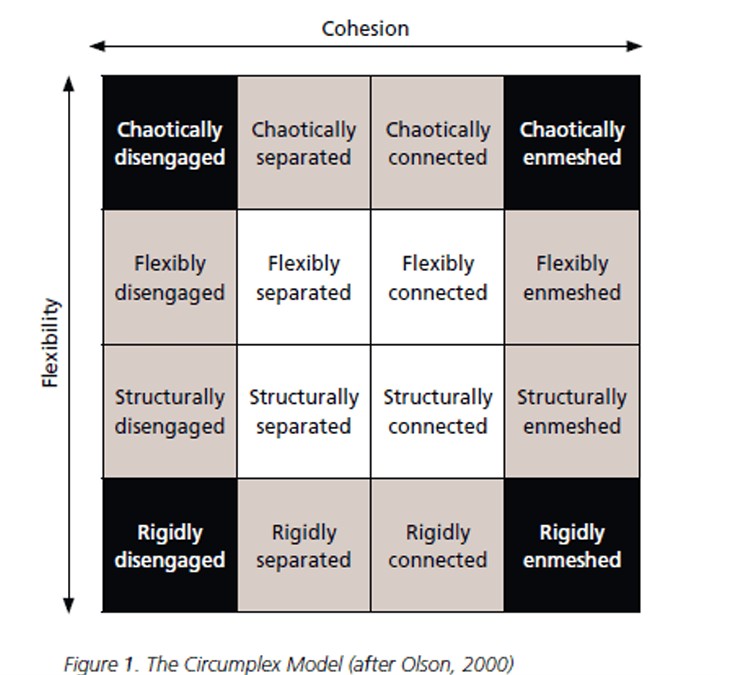
The Olson Circumplex Model is a representation of the family that compares the dimensions of family cohesion, flexibility, and communication. Flexibility ranges from rigid to chaotic, and cohesion ranges from disengaged to enmeshed, with there being four different degrees of each from high to low. Balance is, in general, the goal, and relationships at either end of both spectrums usually have more difficulty. (See figure 1 below.) [1]
Communication includes both listening and speaking skills, including empathy and speaking for oneself. A change in the category the family inhabits can happen when the family experiences a stressful event such as a death or an accident. This model is a helpful tool in reflecting on our families and the ways in which they’ve helped to make us who we are.
There are several ways to become conscious of the patterns, both healthy and unhealthy, that we’ve acquired as part of our own particular family. One way is to cultivate an appreciation for silence. This does not mean shutting down when challenged by a loved one but instead practicing Marianist mindfulness. In this case, silence is not the absence of noise; instead it is a quiet space where we take time to remember who we are, to reach out to our God, to reflect on God’s Word, and to be mindful of God’s presence. When we take time to seek out the quiet in our lives and to embrace it as it exists, it feeds the soul. According to Llewellyn Vaughan-Lee, “Silence draws us inward, away from the clutter and distractions of our outer life, to the deeper roots of our being.” [2]
Another method of developing an awareness of our unhealthy patterns is to use Chaminade’s System of Virtues, particularly the Silences. When one considers the Olson Circumplex model in light of the Silences, it is clear that the practice of silence of words, or paying attention to the language we use in our daily lives, would be a valuable skill. Silence of words is being aware of when to be silent, when to speak, and how to use our words astutely when we do speak. This is such a useful skill in family life!
An example of a time when mindfulness and the Silences were both helpful to me was in working out an inheritance issue in my family of origin. I was crushed when my grandmother’s beautiful round oak table with its sturdy pedestal base wasn’t handed down to me by my mom and dad. That table, stained a dark walnut and varnished to a glossy finish, had stood in my maternal grandmother’s kitchen throughout my childhood. The women in my mom’s family had gathered around it when one of my aunts brought a new baby to visit Grandma. The proud mother would set the infant in the middle, and everyone would lavishly admire the child. After my grandma died, my mom inherited the table. My dad then meticulously sanded it down to the original oak. Thereafter, it had a place of honor in the finished porch of my family of origin’s home, and there we would gather to celebrate birthdays or have family reunions. I wanted to have this piece of furniture in my home so my children could gather around it as we told our own stories.
However, it didn’t work out that way. After my siblings and I worked out what I thought was a fair way of deciding who was to have the table, my dad and my sisters decided that my youngest sister should have it. I wasn’t informed about it until after she had the table in her home. I was angry and hurt, feeling that this was terribly unfair. Whenever I felt slighted by my sister for some small thing, as a way to nurse my pain, I repeated over and over to myself the story of how she had managed to take the table. I thus exaggerated the importance of what had happened, blamed my sister for my feelings of jealousy and rejection, and created a classic grievance story.
Several habits that I’d developed as part of being a lay Marianist helped me resolve what could have festered into an ugly result. One habit was meditating on the Five Silences, especially the silences of passion and silence of the mind. The regular practice of the Silences helps us get in touch with our woundedness, which was also helpful. The second habit was relying on my Marianist community, and the third was drawing on the grace of the Holy Spirit through silence and prayer.
When working through situations such as these, our natural instinct is to protect ourselves from pain by denying that we are hurt or by stuffing a reaction we’d rather not be feeling. But unless we name and meet our own pain, just as Mary did when she met Jesus carrying the cross, we cannot grow and be transformed. The ability to recognize and specify what we feel before we express it is an important life skill and part of the silence of passions. When we experience a feeling we’d rather not have—be it jealousy, shame, or lust—it’s important to pay attention to the energy present and not immediately express the emotion. The feelings that are most prominent are the ones we need to notice first, nurturing the ones we want to be part of our character and processing the ones we find problematic.
When I found out my sister had the table, I felt hurt, angry, and left out because I hadn’t been part of the decision-making process, and I was jealous that my dad had given the table to her. None of these were feelings I wanted or of which I was proud.
However, I had to name them in order to begin the slow process of letting them go. Practicing silence of the mind enabled me to nurture these thoughts and memories that are life giving (such as the memories of admiring my young cousins on my grandma’s table) and to let go of those which crippled me (such as feeling left out). I had no control over who dad decided to give the table to, and it wasn’t helpful to blame my sister for it.
The second step in letting go of my grievance story was processing what had happened with a trusted Marianist community member. In doing so, I realized it was not that I didn’t inherit the table that bothered me the most. It was that my dad had not chosen me as the one to receive it. I had made the table a symbol of his love. I still had all my memories of meals and conversations around the table, which was the inheritance I truly valued. It was only then that I was able to tell myself that it is, after all, “only a table.”
Finally, the habit of spending time in silence each day and praying also was critical to being able to let go of my hurt. In this instance, I meditated on Mary meeting Jesus carrying the cross. I prayed that I would be able to meet the woundedness I felt in not being chosen and embrace my pain. I also envisioned letting go of my hurt feelings so I could reclaim my friendship with my sister. Spending time in silence each day enabled me to get in touch with my deepest self. I eventually did call my sister and told her that I felt left out and jealous, which was not an easy thing to do. It was a difficult and emotional conversation. In the end I was glad, however, that I communicated my wounded feelings to her because we have been able to repair our relationship.
At times, the daily difficulties of dealing with our own shortcomings, as well as those of the ones we love, deflate our spirits. By praying with and using the System of Virtues, we can confront our fears and become aware of our negative patterns. In this process, we embrace our own brokenness. It is then that we meet the woundedness of others and can reach out to them, which enables us to find signs of hope in the coming of God’s Kingdom.
Notes:
- Figure 1 is taken from Catherine Sanders and Jordan Bell, “The Olson Circumplex Model: A Systemic Approach to Couple and Family Relationships,” InPsych, February 2011, no. 1.
- Llewellyn Vaughan-Lee, “A Time for Silence: When We Get Away from the Clutter and Distractions of Our Life, We Can Begin to Sense the Deeper Roots of Our Being,” Transformational Ecology (blog), November, 21, 2017, https://www.garrisoninstitute.org/blog/llewellyn-vaughan-lee-time-for-si....
Bibliography:
- Hakenewerth, Quentin, SM. A Manual of Marianist Spirituality. Dayton, OH: North American Center for Marianist Studies, 2000.
- Hakenewerth, Quentin, SM. Growing in the Virtues of Jesus. Dayton, OH: North American Center for Marianist Studies, 2008
- Lackner, Joseph H., SM. Virtues for Mission. Dayton, OH: North American Center for Marianist Studies, 2003.
- Lee, Bernard J., SM. Habits for the Journey: A Mystical and Political Spirituality for Small Christian Communities. Dayton, OH: North American Center for Marianist Studies, 2000.
- Luskin, Fred. Forgive for Good. New York, NY: HarperCollins Publisher, 2002.
- Nouwen, Henri J. M. The Wounded Healer. New York: Random House, 2010.
- Olson, David H. onlinelibrary.wiley.com/doi/epdf/10.1111/1467-6427.00144, 2000.
- Rupp, Joyce. Your Sorrow Is My Sorrow. New York: The Crossroad Publishing Company, 1999.
- Sanders, Catherine and Bell, Jordan. “The Olson Circumplex Model: A Systemic Approach to Couple and Family Relationships,” InPsych, February 2011, no. 1.
- Vaughan-Lee, Llewellyn. “A Time for Silence: When We Get Away from the Clutter and Distractions of Our Life, We Can Begin to Sense the Deeper Roots of Our Being,” Transformational Ecology (blog), November, 21, 2017, https://www.garrisoninstitute.org/blog/llewellyn-vaughan-lee-time-for-si....
- Vaughn-Lee, Llewellyn. NEW, A Time for Silence. Garrison Institute.