
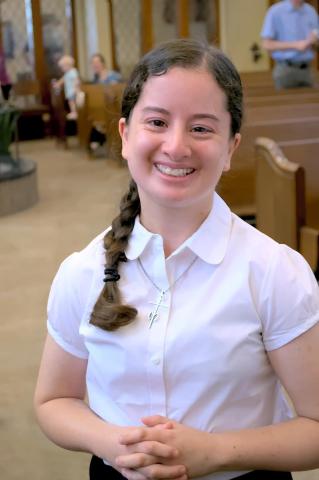
This publication was a culmination of a two-week independent study that Sr. Rose completed in the summer of 2025.
Click here for a downloadable PDF version of this article.
The Visitation (Lk 1:39-45)
In those days Mary set out and went with haste to a Judean town in the hill country, where she entered the house of Zechariah and greeted Elizabeth. When Elizabeth heard Mary’s greeting, the child leaped in her womb. And Elizabeth was filled with the Holy Spirit and exclaimed with a loud cry, “Blessed are you among women, and blessed is the fruit of your womb. And why has this happened to me, that the mother of my Lord comes to me? For as soon as I heard the sound of your greeting, the child in my womb leaped for joy. And blessed is she who believed that there would be a fulfillment of what was spoken to her by the Lord.”
Sister Rose’s Reflection
Toward the end of Mlle de Lamourous, Joseph Stefanelli, SM, the biographer, takes the audience on a detour to a place in Marie Thérèse’s life that few Marianists know about. In this part of the book, we meet Marie Thérèse’s collaborator and ally, Thérèse Rondeau, who was from Laval, a city about 225 miles north of Bordeaux. Thérèse Rondeau was introduced to Marie Thérèse after being asked by the Jesuits to help some repentant prostitutes—something she did not know anything about, but Marie Thérèse did. It was under Marie Thérèse’s tutelage that Thérèse Rondeau’s Miséricorde of Laval modeled itself after the original Miséricorde and succeeded. But the relationship between these two women went far beyond mentorship. In fact, their relationship had Marian roots that go all the way back to the Visitation. There is a particular moment toward the end of Marie Thérèse’s life that is the climax of their friendship and a perfect example of this Marian story. A visit between Thérèse Rondeau and an infirm Marie Thérèse not only mirrors the Visitation’s spirit but also exemplifies for us Marianists how the mother of the lay women’s section of the Bordeaux Sodality and the Marianist lay movement are grounded in Mary’s call to community.
This moment occurs toward the end of sickly Marie Thérèse’s life when the maladies she has suffered throughout her life finally catch up to her. Seemingly near the end, Thérèse Rondeau makes a last attempt to see her friend and mentor. While Rondeau is told initially she cannot see Marie Thérèse because she’s too sick, the Sisters of the Miséricorde of Bordeaux eventually let her visit from the doorway and then visit in person when Marie Thérèse feels better. Stefanelli describes their time together, saying, “Gradually Marie Thérèse also regained her strength, and the two were able to visit at length. Rondeau remained in Bordeaux for about three months.”[1]
If you are like me, you do not have to be a biblical scholar to do a double take about this passage because of its resemblance to Mary’s actions in the Visitation. If we look at Luke’s Gospel, we find that Mary also stayed three months to accompany her cousin, Elizabeth, through the last months of pregnancy. And that is just the most textually obvious parallel. The closer we look, the more we can find—like the fact that Marie Thérèse and Rondeau had an intergenerational relationship, with Marie Thérèse being 40 years older than her mentee; or the fact that Rondeau came to visit Marie Thérèse during a time of need, though instead of giving birth, her mentor and second mother of sorts was preparing for death. The more you look, the harder it is not to see the Marian connection between the two “visitations.” But what do these two sororal tales have to teach us today?
For me, the biggest takeaway in looking at these two “visitations” is the Marianist spirit of community. Looking to Mary in Luke’s Gospel, I see her: thinking of others even amidst such life-changing news; I see joyful promptness in her “hastening” to the hill country; and I see intergenerational sisterhood in the time she shared with her older cousin, Elizabeth. I think that Rondeau possessed all those attributes, too, in her own “hastening” to see Marie Thérèse. Her willingness to leave the business of her own Miséricorde, her timeliness in visiting, and her compassion for her collaborator at the end of her life all mirrored Mary’s spirit. In my own Marianist sisterhood, I try to mirror that same Visitation spirit in visiting our elder sisters, taking time one-on-one with each of my sisters, and anticipating the needs of my community members. But the whole Marianist Family can model these traits. After all, Marie Thérèse may have started her own religious congregation, but that was not her original intent. She was a laywoman for most of her life, and that moment she shared with Rondeau serves as a reminder that sisterhood and fellowship need to be the model in the lay branch, too. Going forward, Mary may have modeled it for us, and the two Thérèses may have renewed its spirit during our founding, but, really, all Marianists are called to live out the spirit of the Visitation in our everyday relationships and encounters with one another.
- Joseph Stefanelli, SM, Mll de Lamourous: A Resource on Marie Thérèse Charlotte de Lamourous (Dayton, OH: NACMS, 1998), 383.