
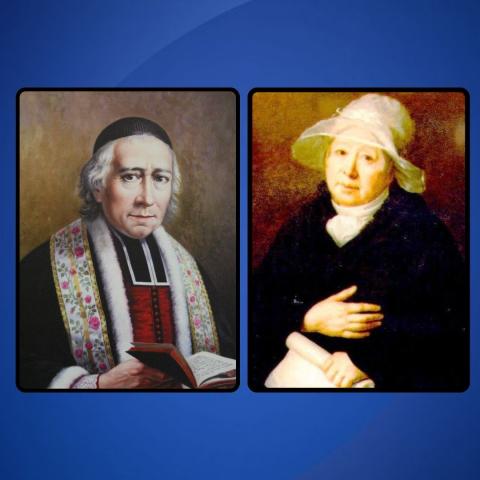
Click here for a downloadable PDF version of this article.
Introduction
Historians of Reverend Father Chaminade and of Mlle de Lamourous all mention their collaboration in the service of the mission. [1] Unfortunately, their personal relationship, which lasted for forty years (1795-1836), is presented only in passing, here and there, as something merely secondary.
As a consequence, the idea presented itself to me to place consecutively the points of encounter of these two servants of God as revealed by the documents at our disposal. I have profited from the biography of Marie Thérèse de Lamourous written by Auguste Giraudin in 1912 and, especially, from the Positio drafted by Father Joseph Verrier (1978). The latter gathers the essential documentation we have on Mlle de Lamourous. Therefore, one will find here no new information, but rather an original perspective spotlighting the collaboration between this man and this woman in the service of the mission.
Abbreviations
- Adèle = Letters of Adèle.
- Legacy = Chaminade Legacy.
- Emilio = Emilio Cárdenas, Itinéraire marial du P. Guillaume Joseph Chaminade. Traduction, edition provisoire.
- Giraudin = Auguste Giraudin, Marie-Thérèse-Charlotte de Lamourous, Bordeaux, 1912.
- Jalons = Joseph Verrier, Jalons, vols. 1, 2.
- Letters = Letters of Chaminade.
- Sodality = Joseph Verrier, La Congrégation mariale de M. Chaminade, Regina Mundi Seminary, 1964.
- Positio = Beatificationis et canonizationis servae Dei Mariae Theresiae Carlae de LAMOUROUS Fundatoris Instituti Sororum a Misericordia Positio super virtutibus ex officio concinnata (Rev. Joseph Verrier, SM), Rome, 1978.
- Other sources used:
- Antoine Bru, Thérèse Rondeau, Fondatrice de la congrégation Notre-Dame de la Miséricorde de Laval, Libraire Siloe, 1981.
- Saint Francis de Sales, Introduction à la vie dévote, Gabalda, Paris, 1928.
- Beatificationis et canonizationis Servi Dei Guilelmi Josephi Chaminade, sacerdotis Fundatoris Societatis Marie, Vulgo Marianistarum, Inquisitio Historica, Rome, 1970.
Beyond the relationship of spiritual director and directée, there existed a friendship based on mutual respect and on an intense collaboration from which two works drew their existence. In 1801 Chaminade was named ecclesiastical Director of the Miséricorde, and Mlle de Lamourous was head of the women’s section of the Sodality of Bordeaux (the “Mother”) from 1801 to 1808. Their collaboration was exceptionally close, while still being open to other collaborations, such as that with Adèle de Trenquelléon. It was also efficacious since it led to the foundation of three religious institutes: the Sisters of the Miséricorde, the Daughters of Mary, and the Society of Mary.
As a laywoman, completely dedicated to God, first without vows, then (1803) with a vow of chastity, Marie Thérèse already lived a consecrated life in the world, serving as a model for members of the State. It is fitting, then, that the members of the Alliance Mariale should see in Marie Thérèse de Lamourous the first prefigure of a Secular Institute.
I. The Paths Cross (Before 1794)
There was nothing to indicate that the paths of Marie Thérèse de Lamourous and William Joseph Chaminade would one day meet. Marie Thérèse belonged to the lesser nobility—the “gentry”—; her family had settled in Barsac, to the south of Bordeaux. William Joseph Chaminade’s father, a haberdasher, had located his store in Périgueux. They do, however, have something in common: a deeply Christian upbringing, provided by an exceptional mother.
Marie Thérèse was born on the first of November, 1754, in Barsac, in the house of her paternal grandparents. She passed her infancy in a rural area, in the midst of the vineyards, sharing in the multiple tasks of a household. In 1767, her father, an attorney at the regional parliament, decided to move his family to Bordeaux. Her brothers would attend college; she would be educated only by her mother. The results appear to have been most acceptable:
Under the direction of her mother, Marie Thérèse Charlotte de Lamourous also developed her intelligence and acquired a good amount of learning: “She knew something of mathematics, of geometry, of astronomy. She learned music and all the arts suitable to her sex. She knew agriculture very well and had a special taste for rural activities. As for religion, it may be said that she was very learned. She knew the Old and New Testaments to a point that would have given honor to a theologian. All of that was guided by a most exquisite judgment. [2]
Marie Thérèse was, therefore, an educated woman with very strong religious convictions, despite the fact of being somewhat tainted with Jansenism.
When the Revolution burst forth in 1789, she was 35 years old. She was unmarried and planned to enter the Carmelites. She lived through the collapse of social and religious structures in the city of Bordeaux. When the persecution broke out, she gave proof of her strong character and her courage; she spared no effort to help the clandestine priests or Christians in difficulty.
In 1794 the law obliged all nobles to leave the coastal areas. She therefore moved to Pian-Médoc, on the property inherited from her maternal family, together with her aged father, her sisters, and their children.
At that time her spiritual director was Father Panetier, a Carmelite. Denounced as a non-juring priest, he was arrested and sentenced to death on the guillotine. After Penitier’s death she entrusted herself to Father Noël Lacroix, vicar at Saint Colomban. He, uncovered by the police, managed to escape and went to Portugal. It was then that she chose as her spiritual director Father William Joseph Chaminade, whom she probably already had met in Bordeaux during his apostolate of reintegrating dissident priests.
Chaminade was born in Périgueux on April 8, 1761, into a numerous family that would give four priests to the Church. He received a good education at the college-seminary of Mussidan, where he also later exercised his functions of steward and teacher. In 1785 he was ordained a priest and continued his activity at Mussidan. Profoundly attached to the pope and to the Church of Rome, he refused, in 1791, to take the oath of fidelity to the civil constitution of the clergy. He then moved to Bordeaux and began a clandestine ministry, often at the risk of his life. It was around the middle of the year 1793 that Mlle de Lamourous placed herself under his direction. They were able to meet both in Bordeaux and at Pian. The extreme prudence which they exercised did not remove the risk of an arrest and, therefore, the guillotine.
II. A Meeting of Paths (1794-97)
Father Chaminade, Spiritual Director of Mlle de Lamourous
Given the distance that separated her from Bordeaux, Marie Thérèse could not meet with her director as often as she might have wished. She therefore communicated with him by letter. The letter that Chaminade addressed to her on May 27, 1796, has been preserved. He took his role as spiritual director very seriously and gave her judicious advice, intending to develop a spiritual freedom in his directee. He recommended a serious and extreme interior abnegation and the practice of mental prayer.
In December 1796, with the agreement of her director, she had offered herself as a victim for the expiation of crimes committed during the Revolution. She renewed her offer on a number of occasions.
A Memorable Retreat
In January 1797, in his small oratory on the Rue Ste Eulalie, Chaminade preached a retreat for several persons of his acquaintance. Marie Thérèse took part in it with her sister Anne Catherine who was nursing her little four-month old André Henri. [3] Chaminade was impressed with the presence of the toddler and became more aware of his mother. He suggested to her that the infant be consecrated to the Blessed Virgin. Two months later, he went to Pian on horseback to visit the family. From then on, he was a close friend of the whole de Lamourous family.
A Farewell Letter
On September 4 (1797) there was a new revolution in Paris. The new government renewed the laws against the priests who had returned from exile. Chaminade found himself on the list though he had never left the country. He had 24 hours to leave France. He notified Mlle de Lamourous of his decision. On September 15 he wrote her a letter filled with serenity and concerned above all with comforting and giving courage to his “daughter.” “We must remain very calm in that faith which, in having us adore the eternal designs of God, assures us that everything turns to the advantage of those who love God.” [4] He sought, above all, to inspire her with confidence: “yes, my dear daughter, the Savior will not abandon you.” She must not imagine that the difficulties which overwhelm her are a punishment for any fault of hers. “The greatest virtues of Christianity are enforced, my dear daughter, in abandoning one’s self into the hands of God.”
Should she seek another spiritual director? Chaminade is quite cautious: “I do not know the priests of Bordeaux well enough to point out those who guide themselves and others only by supernatural prudence.”
Chaminade is well aware that the direction of a soul is a mission confided to him by the Holy Spirit. “I have a complete confidence in God, in whose presence I write this letter, that I have put here only what might please Him and be useful to you.”
A final indication of the trust he had in Mlle de Lamourous is found in this short phrase at the end of his letter: “I would be most grateful to you to take prudent care of my small temporal affairs.” He was no doubt referring to the small property of Saint Laurent of which he was the owner.
Mlle de Lamourous again met with her confessor on September 22. She submitted to him her notebook in which she had transcribed the final recommendations of her spiritual father. From this episode, Father Verrier draws this conclusion: “We can easily imagine how emotional was this final meeting! Standing, master of himself, the priest traces the sign of the cross over his kneeling penitent. Then, pensive and overwhelmed, she watches him leave.” [5]
Chaminade lived by faith. He exercised his spiritual paternity as priest. The expressions my daughter and my dear daughter have as their only purpose to give confidence to his penitent.
Marie Thérèse, having been raised only by her mother, had had a protected adolescence. The daughter was ill-suited for the turmoil’s of the world. Yet, she already manifested that courage that would characterize her whole life. Spiritually, she was still fragile. She experienced scruples and illusions which often led to depression.
Chaminade would lead her along the road to equilibrium, to freedom from her self-centeredness. He would lead her along the road of abandonment to God.
The fact that Chaminade had become a friend of the Lamourous family did not prevent his relationship with Marie Thérèse from being, above all, that of a demanding director with regard to his directee.
III. Separated by Exile (1797-1800)
On October 11, 1797, Chaminade arrived in Saragossa where he would pass three long years of exile. During that time, he continued to direct his penitent, Mlle de Lamourous, by letters which he sent her at least once a month. There are thirty-three letters spread over the thirty-six months of exile. None of the originals has been preserved. Mlle de Lamourous copied into a notebook the sections which concerned her spiritual life. We have, therefore, extracts of 17 letters from Chaminade, but no letters sent by de Lamourous to her director.
Mlle de Lamourous lived at Pian with her two sisters and their five children. She left the main house to the rest of the family, installing herself in the “shepherd’s hut” in a separate small building. She spent her time overseeing the farm and in educating her nephews and nieces. She also exercised important activities in the parish and in Bordeaux, to the extent that she was still needed there. She had not yet found the desired balance or the interior freedom that she would later experience. “She was still living under the almost constant fear of not responding generously enough to what she took to be invitations of divine grace.” [6]
Her director understood this tormented soul very well. In order to fight against scruples, he recommended that she never revisit the past. She lived as a celibate, though she had never taken the vow. Chaminade urged her to think of herself as “the spouse of Christ.” He showed himself as quite demanding: “I shall never leave you in peace until I see you smiling at poverty, sufferings, humiliations.”
However, his severity did not prevent his heart from speaking: “my dear child.” He encouraged her to read other spiritual authors: Saint Vincent de Paul, Saint Teresa of Avila, etc. “Oh, my dear child, how happy I would be to see your heart so fully given over to love, so fully sensitive to the interests of the Well-beloved!” [7] He sought to guard her against excessive activity. Charitable action must not “stifle in her the interior operation of grace.” As she had offered herself as victim, she must not interrupt “a continual abandonment into the hands of God.” “A certain moderation in the exercise of charity often leads to greater good than giving way to activism.” [8]
There are terms of affection, though so discreet. Review his letters: My dear friend (letter no. 16); My dear one (letter no. 17); My dear child (letters nos. 19, 20); Your father loves you dearly (letter no. 21).
In his letter of August 26, 1800, his tone changed. A long preparation was moving toward its end. Now it was question of setting to work. Chaminade spoke of hers, but also of his own:
Take courage: time and years pass; we move forward, my dear Thérèse. We move forward in our destiny, you and I both; we are almost of the same age (de Lamourous at 46, Chaminade at 39). Our bodies are being used up and as yet we have achieved nothing. It is time to begin anew and to do something for the glory of Jesus Christ, our good Master. Think on that; I shall do the same. I believe you would be quite ashamed to die without having doing anything suitable to being offered to your Spouse, etc. [9]
How to interpret this excerpt from a note of October or November 1800, shortly before his return into his own country?
I agree wholeheartedly with the mutual sacrifice which you suggest, and I offer it from this moment to the sacred hearts of JMJ. It will begin with our first meeting. However, nothing should change exteriorly; we can speak between us of matters which should not be delayed. [10]
What was this mutual sacrifice which Marie Thérèse proposed to her director? It might be supposed that she was proposing that they avoid any exterior manifestation of their affections. However that may be, the tone of the letters shows that a true mutual affection had developed over the years. But it was of an exceptionally supernatural quality and completely oriented toward the good Master.
Father Verrier concluded: “That first meeting is outside history, and the civil registries give us only the dramatic ambiance. May we not, though, think that, for the one who had vowed herself to God as an expiatory victim, it was a ray of the sun in a stormy sky and an encouragement descending from on high?” [11]
With regard to this second stage, we notice that the simple relationship of director to directee has evolved into a mutual friendship, charged with sincere affection, respect, and mutual admiration. Marie Thérèse has experienced the depth and clarity of her director’s convictions. Chaminade had noted the progress accomplished by his directee: “I rejoice in the Lord for the good dispositions with which grace has inspired you.” [12]
They were ready to collaborate in the mission for which Providence had destined them.
IV. MEETING AGAIN (1800)
Search for Lodging
Father Chaminade arrived in Bordeaux around the middle of November 1800. He met with the authorities of the diocese and with certain priests and lay persons with whom he had collaborated before his departure into exile.
At that time, Marie Thérèse was living in Pian together with her sister Marguerite-Félicité (widow of J. B. Létu since 1793) with two young boys in her care. But she certainly made many trips to her younger sister, Catherine-Anne, who was living in Bordeaux and whose husband, René de Maignol, was seriously ill. He died on November 29, 1800, leaving a widow and three children (one boy and two girls). Marie Thérèse invited them to come live with her in Pian. Their residence at 7 Rue Arnaud Miqueu was thereby made available. Marie Thérèse placed it at the disposal of Father Chaminade who was seeking a lodging. There he opened his first oratory.
Soon, given the increase of the faithful, the quarters became too small. Chaminade found another location on the same street (no. 36). And when that, in turn, became too small, he installed himself at 16 Rue Saint Siméon, where he remained until 1804 when he was able to move into the Madeleine.
The Beginning of the Young Men’s Sodality
On December 8, 1800, the Feast of the Immaculate Conception, Chaminade brought together a first group of young men and decided, with them, to reconstitute the Sodality of the Immaculate, placing emphasis on formation and on mission. On 2 February 1801, the first eleven sodalists renewed their commitments of baptism, and consecrated themselves to Mary.
Beginnings of the Miséricorde
Chaminade was convinced that the Sodality also could bring its best fruits to the young women of Bordeaux. He most surely had spoken of this with Marie Thérèse, and he counted on her to animate a group of young women. However, she had received a request from an old acquaintance, Germaine Pichon de Longueville, who had gathered together several repentant prostitutes to provide them a residence and professional formation. No longer being able to welcome so many women in difficulty, she asked Marie Thérèse to take over the direction of the work. Under a first spontaneous reaction, she refused categorically: anything but that! How could she, with her bourgeois and deeply Christian education, share her life with that of prostitutes?
Mlle Pichon therefore approached her spiritual director. But Chaminade also was opposed to that proposal; he had plans for Mlle de Lamourous for his own works. They both reflected and prayed; they both desired to accomplish the Divine Will in all things. Finally, Chaminade left the decision to Marie Thérèse. She, after having several times visited the Laplante house where the girls were living, made her decision: she accepted. God had accepted her offering as victim. Had she not written: “Do with me whatever you will and whatever you might choose to make of me and whatever your grace would have me merit. I hold back nothing. I wish only your greater glory, and I open myself to whatever you might wish to give me.” [13] The decision to take over the direction of the prostitutes was diametrically opposed to her personal plans; she wished to become a Carmelite. But, seeing in the circumstances a sign from Providence, she renounced her own preferences, seeking only to accomplish the designs of God.
For Chaminade, too, it was a hard blow. Already, in a letter of January 15, 1799, [14] he had alluded to the future: “In Bordeaux, how many people are abandoned in the temporal as well as in the spiritual! Above all, there are the exposed, exposed to lose eternal happiness, while losing their honor here on earth! Long live humility and charity that leads one to belong no longer to themselves, but to Jesus Christ and his members!” That seems to be a presentiment. In the exchanges he was having with Marie Thérèse at that time, he no doubt repeated the advice that he had given in a letter of April 27, 1799. [15]
“You understand, my dear.... The difficulty of practicing the offering that you have made of yourself as victim. It must be supposed that the more you seek to practice it, the more your nature will experience repugnance; perhaps it will even defend itself as does a victim being strangled.”
Marie Thérèse: Director of the Miséricorde
On January 2, 1801, the decision was made: Marie Thérèse shut herself in for the rest of her life with the prostitutes of whom she will become the “Good Mother.”
She became the director of a house that had neither regulations nor discipline. Before taking her place she wished to have a rule. She approached Chaminade, and they composed a rule together (the text is in her handwriting) which has been preserved. [16] It is dated January 1801, Rue Saint Siméon, where Chaminade was living at no. 15. “It was, therefore, written at his place, that is, under his eyes, in concert with him, profiting from his suggestions, remarks, and observations.” [17] Chaminade would make it public on the day the Miséricorde moved to Cours Fructidor, May 12 or 13, 1801.
In this rule we see Chaminade’s pedagogical experience. For the Miséricorde was seen as a house of education and not a “refuge” or prison for women placed there by a tribunal. The hours of work, of prayer, of reflection, of silence, and of relaxation were judiciously spaced throughout the day. Morning prayer, directed meditation (30 minutes), Mass began the day. We have a report of a police agent who visited the Miséricorde on August 26, 1801. He wrote: “All hours are marked by meditation, prayer, work, meals—not a single instant is lost throughout the day. But the principle proposed was to extirpate the vice from its roots in the heart of these unfortunate women so as to substitute for it the germs of virtue.” [18] The pedagogical method, which was used from the beginning and refined with the passage of years, rested on the respect of freedom and an appeal to a sense of responsibility of the penitents. The Miséricorde (as opposed to the “refuges”) accepted only women who came freely, and they were always free to leave.
Prayer and manual work occupied the greater part of the day. But there also were instructions to improve the mind. Times of silence alternated with times of conversations. Meals and recreations complemented the day’s work. Put studies in place of manual labor, and you have a use of time that differed little from that of College Mussidan. The directors shared the daily life of the girls and were not a separate community. Together with the Good Mother, they sought to create a family atmosphere impregnated with love.
The friendly relations between Chaminade and the Lamourous family grew closer. Marie Thérèse herself [19] recounted how, on the Feast of the Purification (February 2, 1802), she was in prayer in Father Chaminade’s oratory, Rue Saint Siméon, no. 15. She was praying for the cure of her little nephew, André Henri, then five years old. Somewhat later Father Chaminade came to visit the mother of the little ailing child. He tried to comfort her with some words of hope. Marie Thérèse asked him to bless the child and to touch the statue of the Blessed Virgin with the linen used by the child. Chaminade, for his part, organized some other children to pray for the cure of the infant. When the latter was better, he was taken to the oratory. Chaminade welcomed him at the altar where the infant fulfilled the vow made by his mother and his aunt. Later, when the child lost his mother, Marie Thérèse welcomed her nephew at the Miséricorde where he was pleased to meet Chaminade again.
The Female Branch of the Sodality
However, Chaminade had not abandoned his dream of establishing a feminine branch of the Sodality. He knew that Marie Thérèse had all the necessary qualities to lead the young women who wished to consecrate themselves to Mary. She would, therefore, divide her time between the young Christian women of Bordeaux who desired to live out their Baptism and to work at the re-Christianization of France, and the girls whom destitution had led them to wander from the narrow path and who now were seeking to return to the sheepfold. Father Verrier comments: “She was a strong enough woman to face two works as different as a refuge and a Sodality of children of Mary such as Chaminade envisioned them.” [20] On March 25, 1801, nine young women of Bordeaux consecrated themselves to Mary and chose as leader Marie Thérèse de Lamourous, with the title of Mother—which she held until 1809. It is true that she was 47 years old, while the greater number of the young women were younger than 25 years.
V. Unwavering Collaboration (1801-09)
Growth at the Miséricorde
The growth of the Miséricorde is best seen through the choice of successive moves.
- Marie Thérèse, on January 2, 1801, found fifteen penitents installed at the Maison Laplante. She sought the help of a former religious, Jeanne Cordes, also called Mme Adélaïde. The diocesan authority, represented by the vicar-general, Father Boyer, approved the foundation and named Father Chaminade as ecclesiastical superior of the house. Marie Thérèse and Chaminade, working in collaboration, developed a rule. In order to sustain the work financially, Chaminade created a “Committee of Patron Ladies.” However, the house was too small and another place had to be found.
- After a number of efforts, a large house was found on Allée Albert, called the House of Baths. On May 12, 1801, the new location was solemnly inaugurated. Chaminade read the rule publicly and commented on it briefly. He blessed the headdresses and black kerchiefs. The next day he celebrated Mass and placed the Sacred Reserve in the tabernacle. The number of boarders had risen to thirty-five.
- Presented with a crowd of requests for admission, an even larger house had to be found. There was one, on the same Allée Albret, the Guérard house. In the autumn of 1801, another move. Exhausted with all these successive moves, Marie Thérèse took ill; Mme Adélaïde was barely able to maintain discipline in the house.
An Ecclesiastical Bureau
Chaminade decided then to add to the Committee of Patron Ladies an ecclesiastical bureau. Faced with financial difficulties, the bureau decided, on September 15, to dismiss half of the penitents. Marie Thérèse was present at the meeting, “more dead than alive,” in her words. She obtained a delay, but for only a month. When she shared the decision with the penitents, there was a concert of lamentations: not one was willing to leave. Marie Thérèse and all the women began to pray. At the last moment, help arrived and the decision to dismiss was annulled. But the house was again too small, and another had to be sought.
Acquisition of the Former Convent of the Annunciation
Marie Thérèse learned that the former convent of the Annunciation was being put up at auction by the State. During the revolution the Sisters had been dispersed and the convent had been confiscated. Marie Thérèse was attracted by the possibilities which this large property offered. But she had not money. She consulted Chaminade. A dialogue took place such as is found only among saints. This is how the biographer of Marie Thérèse reported it: [21]
Chaminade reflected a moment; meanwhile, a fervent prayer was ascending from Marie Thérèse’s heart. Then suddenly, he said: “before you answer, allow me to ask you two questions, my daughter:
“Do you firmly believe that this work is the work of God?
“Yes, my Father, I believe that very firmly.
“Do you firmly believe that you are being called to this work?
“Yes, my Father, I also believe that very firmly.
“Well, then, buy, buy. But buy the two at the same time, the house and the church.”
In fact, in order to facilitate the sale, the administration had made two separate properties—the one with the house, the other with the church.
On September 2, 1807, the sale at auction took place. Marie Thérèse gained the two lots for the sum of 22,850 francs, to which she had to add 600 francs to compensate the renter who was then occupying a portion of the buildings. Moreover, the whole was in a pitiable condition and required important reparations. On April 8 (1808), she installed her 90 penitents in their new residence. Marie Thérèse had not a penny, but she counted on Providence.
A Memorable Request
At that same time, April 1808, Napoleon was making a visit of Bordeaux. When the Emperor was making a visit to the city, his minister, M. Maret, accompanied by the mayor of Bordeaux, was visiting another part. Passing before the convent of the Annunciation and seeing the piles of debris in the doorway, he inquired of the mayor the nature of this work. The minister asked to visit. He was much impressed. Before leaving, he asked Mlle de Lamourous to write a memo that he would present to the Emperor. “But waste no time, I am leaving tomorrow morning!”
Marie Thérèse asked Father Chaminade to come to the Miséricorde. Meanwhile, she had her daughters pray. And here was Marie Thérèse, a progressive, and Chaminade, known for his royalist opinion, joining hands to draft a report to the Emperor who, for them, was a usurper, to ask him to reduce the debt resulting from the purchase of the convent of the Annunciation in the public domain. But what was most important was that the will of God be accomplished and that the work might succeed. Their complicity succeeded so well that the Emperor not only cancelled the debut but also provided another 1,2000 francs for the current renovations.
The Civil Statutes of the Miséricorde
Matters did not rest there. Before releasing funds, the prefecture of the Gironde, on May 6, 1808, required Mlle de Lamourous to present the statutes of the Miséricorde. With the help of Father Chaminade, she set to work immediately. She drafted a kind of “foundational charter” [22] of twelve points. The statutes described the respective roles of the directress (also called “head”) and her assistants (nos. 1-3), and of the ecclesiastical director, called simply “superior.” The superior was consulted regularly on all important decisions. That shows the importance of the role played in the functioning of the Miséricorde by Chaminade and confirmed by Archbishop d’Aviau in his appointment of the ecclesiastical superior.
Art. 5. The head shall ask of the archbishop for an ecclesiastical superior for the establishment.
Art. 6. No assistant may enter definitively into the establishment except with the consent of the superior and of the archbishop.
Art. 8. Should there ever arise some differences or argumentations for any reason, the decision of the superior, in agreement with the archbishop, decides irrevocably.
Art. 10. The head may not do anything exceptional, whether for the interior or for the exterior of the establishment, except after having conferred with two of her assistants and with the consent of the superior, except in a most pressing situation. [23]
Archbishop d’Aviau gave his approbation on May 23, 1808. The prefect transmitted the document with a favorable opinion to the ministry of the interior. Then there was a year’s silence. The ministry did not give its approval, wanting to assimilate the Miséricorde to refuges already authorized. That situation obliged Marie Thérèse to plan a trip to Paris to plead in favor of her work.
The Female Section of the Sodality
Marie Thérèse had been named head of the female section in 1801, at the time of the creation of that section, with the title “Mother.” She would occupy that position until 1809, when she was replaced by Mlle Félicité Lacombe.
Two of Marie Thérèse’s collaborators at the Miséricorde belonged to the Sodality founded by Chaminade: Mlle Rose Bidon and Mlle Jeanne Plessy. Here is how Father Verrier described the female section.
On May 25 of the same year a female section was organized and the Servant of God, under the name of Mother, took on the responsibility of the group. She then gathered secondary heads. She does a commentary of the rules and directives that she had composed together with Father Chaminade. She advised and she animated.
It was in the oratory of the Miséricorde that the women consecrated to Mary were gathered every first Thursday of the month for their monthly retreat and a preparation for death. Though Mlle de Lamourous was well-gifted for that kind of apostolate, it took some time. Yet she gave herself to it until 1809. [24]
The members were divided into two divisions, each of which had four fractions bearing the name of one of Mary’s mysteries. Each fraction had a particular leader and a substitute, each division, a principal leader. The Mother was responsible for the whole group. [25]
In 1804 Archbishop d’Aviau confided the care of the Madeleine chapel to Father Chaminade. He found lodgings on Rue Lalande, across from the church. The distance from the Madeleine to the Miséricorde was not great, making easy meetings and collaboration.
VI. Foundation of Three Religious Institutes (1808-18)
Marie Thérèse and Adèle de Trenquelléon
In 1808 an incidental encounter had put Mlle de Trenquelléon in touch with Father Chaminade’s Sodality. At that time, Mlle de Lamourous was still Mother of the female section, and as such she wrote letters to the young women of Agen. The first was enclosed in the same envelop with a letter from Chaminade. Those letters have been lost, but we have the reaction of Adèle to the first letter of Marie Thérèse.
An ongoing correspondence developed. In his history of the Sodality, Father Verrier writes:
Mlle de Lamourous enclosed her letters with those of Chaminade, and a devoted sodalist, animated by a great zeal for the glory of God as well as a beautiful spirit of proselytism, was the official charged with communicating all the details which the associates might desire. [26]
Verrier continues:
Letters from Mlle de Trenquelléon to Chaminade, to Mlle de Lamourous, or to Mlle Lacombe have not been preserved; however, we do find their sentiments in her correspondence with her friend Agathe Diché: ‘Well, now! my dear Agathe, what do you think of all the graces which come to us from Bordeaux? How M. Chaminade breathes the air of a holy man! What a charming welcome he gives us! Ah!, let us try to merit the good opinion he has conceived of our Society. And the letter from our Mother, Mme de Lamourous? I find her charming and affectionate. May we be as she is exhorting us to be, helping each other to gain hearts for Jesus Christ and his holy Mother.’ [27]
Since 1809, Mlle Félicité Lacombe had been invested with the role of Mother of the Sodality. She also wrote letters to the Third Division of Agen. Despite that, Mlle de Lamourous remained the Good Mother for Adèle and her companions.
In a letter to Lolotte de Lachapelle of April 25, 1816, we read:
I do not yet know the time of Mlle de Lamourous’s arrival. She has written me a letter, which I am sending you, and the Father a few lines to Mme Belloc. You can see that we cannot yet be sure of the moment of the arrival of our Father and our Mother. [28]
Some days later, in a letter to the same Lolotte, September 16, 1816, “Mother de Lamourous writes us wonderful letters; I am sending you an excerpt from one. Our Father notified us two days ago that the day of our spiritual nuptials is not far off.” [29]
For the daughters at Agen, Chaminade is the father, and Mlle de Lamourous is the mother, the two associated in a common work.
Suppression of the Sodality: The State
Following the subversive activities of certain members of the Sodality in Paris and of H. Lafon, former prefect of the Sodality in Bordeaux, the Emperor decided, on October 26, 1809, to suppress the Sodality throughout France. Mlle Félicité Lacombe at that time was head of the female section. Chaminade continued to serve the chapel of the Madeleine. Though the public meetings of the Sodality were suppressed, he continued to receive the sodalists in private. Among the sodalists, especially among the officers and leaders, several took the vows of religion, constituting a “State of consecrated life lived in the world.”
We know that, since 1803, Mlle de Lamourous had taken a vow of chastity. [30] The offering of herself, which she renewed regularly, consisted of placing herself into the hands of Providence. The vows emitted among the sodalists took the form of a more specific consecration to Mary:
Even the State formed within the sodality is only a more perfect way of fulfilling the full extent of one’s consecration to the Blessed Virgin. Devotion to the Blessed Virgin leads to the practice of the counsels, while the simple sodalist tends to Jesus Christ through the Blessed Virgin only through the practice of the commandments. [31]
Mlle Félicité Lacombe was one among them. [32]
Marie Thérèse’s Trip to Paris
At the Miséricorde, times were hard. Marie Thérèse wanted to make the establishment financially independent. She sought work for her girls: laundry, ironing, sewing, and, since 1812, manufacturing of cigars with a subcontract with Manufacture d’Etat. Unfortunately, on January 1, 1813, the delivery of tobacco was cancelled. She made effort after effort to obtain the annulment of that decision, but in vain. She had to go to Paris to plead her cause before the competent authorities.
In the month of February 1813 she set out for Paris. Chaminade had found lodging for her with a priest friend of his, Jean Baptiste de Lasausse. [33] The purpose of her trip was to obtain an authorization to continue manufacturing cigars, but also to present the statutes of her establishment with a view to obtaining legal recognition. She obtained the authorization to continue making cigars; but she did not obtain the approbation of the statutes. On her return to Bordeaux, she consulted the usual advisors: Chaminade, Archbishop d’Aviau, and other priest friends. She decided that, if she wished to assure the continuation of her work, she had to organize the directors as a religious institute.
Preparation of the Constitutions of the Daughters of Mary, the Society of Mary, and the Sisters of the Miséricorde
At that time (1813), Chaminade had begun work on the constitutions of a religious institute, the “Daughters of Mary,” of which Mlle Lacombe was to be the first superior.
Of Two Religious Congregations: First Draft of the Constitutions 1814 [34]
For this section we shall quote Father Emilio Cárdenas in Itinéraire marial du Père Chaminade.
Let us remember that, in Bordeaux, there is a group of young women similar, more or less, to that of Agen. Moreover, Chaminade, with the suppression of the Sodality in 1809, had prepared a succession of rules for the young religious women living in the world (which we have presented above). At the head of this group was, probably, Mlle Félicité Lacombe on whom Chaminade placed great hopes. Unfortunately, she died in January 1814. With regret and emotion, Chaminade wrote to Adèle: “Never have I encountered a more lively and constant zeal for the salvation of young women.”
He was probably thinking of Mlle Lacombe as a model and a contact for the religious community that was being born at Agen. In fact, in the first response which Chaminade sent to Adèle for the possible formation of a religious order, he had said: “Mlle Lacombe is one of these religious.” [35] Without her, Chaminade was certainly disoriented as he was about to establish a female religious community in Bordeaux. Mlle de Lamourous was busy with the house of the Miséricorde and, for his part, he was not yet satisfied with the remaining members of the group of women in Bordeaux. He placed greater hope in the young men. In any case, he already had prepared for them a draft of constitutions. When he received the letter of Adèle that spoke to him for the first time of her desire to become a religious, he thought at first of sending her the text. However he did not, thinking it not finalized. There was question of a “proposal of an institute of religious sodalists under the title of Daughters of Mary.” [36] It had been drafted in 1814 with the help of his secretary, David Monier. It should be stressed that, based on the same principle, it had a Marian character.
1. The religious called Daughters of Mary are only sodalists called to accomplish in a more perfect way the three great duties of devotion toward the Blessed Virgin, and above all the last by actual imitation of the virtues of Mary. 2. The love of Jesus Christ, Son of God and Son of Mary, inspires in them that ardent charity for the salvation of souls which is the object of all their occupations. Mary’s virtue of zeal and confidence in her powerful protection sustains them against all the difficulties they may experience in the exercise of their vocation. 3. They may make perpetual vows; but only after they have passed five years in the institute: two years of novitiate and three-year vows which are renewed every year on the Conception of the Blessed Virgin. [37]
It is relevant to comment on the following aspects of this text:
- First of all, the naming of the religious, “Daughters of Mary,” which refers to the spirituality used under the spiritual maternity of Mary.
- The nature of the sodalists as religious. That is, they continue to belong to the Marian Sodality and have the same field of activity as the others, but to a “more perfect” degree.
- The three duties of devotion toward the Most Holy Virgin. These three duties should be known by heart by the recipients of the constitutions in question. We see them defined in a document of more-or-less the same period in which Chaminade explains the ends which refer to all the sodalists, though they might be lived with different degrees of commitment.
- “The immediate end (of the sodality) of the habitual exercise of a true and solid devotion to the Blessed Virgin: to honor her, to invoke her, to imitate her.” [38]
These three duties pertain to all states of the Sodality. However, those who embrace the state of the religious life are especially concerned with the third: “that is, the actual imitation of the virtues of Mary.” That principle becomes a source for the spiritual method of Chaminade for the religious, male and female. [39]
The FMI Constitutions
During this time, Adèle had opened her heart to Chaminade, expressing her desire for a community religious life. Félicité Lacombe had died in 1814. It is, therefore, not surprising that Chaminade should be thinking of transferring to Adèle’s community the draft of constitutions previously elaborated. But he realized that that text was too brief and did not send it to Adèle such as it was. On the other hand, he confided to his secretary, David Monier, the task of composing a more extended text: it would be the Grand Institut. The basic text would be complemented with the regulations destined for the various leaders. In 1816, when they had instituted their first community, the Sisters already had a collection of documents suitable for orienting their life.
The SM Constitutions
In 1817, when the first community of men was begun, Chaminade gave them a summary of the Grand Institut, named the Petit Institut, adapted for the men. The definitive rule would not be presented to Rome until 1838.
Constitutions of the Sisters of the Miséricorde
After her return from Paris, Marie Thérèse knew that she had to organize the leaders at the Miséricorde into a religious institute. She consulted a number of foundresses; she read the constitutions of other institutes. She spoke with her constant friend and advisor, Father Chaminade, who was himself occupied with drafting constitutions and regulations for the Sisters and, later, for the Brothers.
Marie Thérèse developed the constitutions slowly, preferring to test everything before codifying it. In 1818 she was able to open a novitiate; at the end of the year, novices pronounced the vow of obedience for a year. The following year, they renewed their vow of obedience and added that of chastity. The third year, they added that of poverty to the other two. [40]
For five years, Chaminade and Marie Thérèse posed the foundations of three religious institutes and prepared constitutions for each. Those for the Miséricorde had to take into consideration the very special situation of the directresses who were responsible for the penitent women. Marie Thérèse acted as foundress and mother of that work; Chaminade as ecclesiastical superior. The Constitutions of the Sisters and of the Marianist Brothers extended the orientation which had already been given to the sodality of lay persons. They had to take into account canon law, practices of the Church, and the situation of French society at that period of history. It was a difficult task and it is understandable that the two founders should have passed many hours in producing a text or finalizing a formula.
Marie Thérèse and Chaminade, Agen, 1816: Foundation of the Daughters of Mary
Historians of Mlle de Lamourous, M. Pouget and, in 1912, M. Giraudin, did not attach much importance to this episode in the life of Marie Thérèse. That is why Father Verrier felt obliged to correct an historical error here.
Little by little, Adèle and her companions let mature among them a proposal of religious life, the cher projet. They wished to belong completely to Jesus, their divine spouse.
Marie Thérèse, as early as 1813, understood that the only way to give continuity to her work was to transform the group of directresses into a religious community. [41]
Chaminade, with the official suppression of the Sodality, had encouraged several young men and women to live a consecrated life while in the world: the State. He had, in fact, already worked at a rule of life for a society of “Daughters of Mary,” whose foundress might have been Mlle Félicité Lacombe, had she not died in 1814.
He saw the suggestions of Adèle as a sign of Providence. He, therefore, felt obliged to share with some young women at Agen his views on the consecrated life: they would be true religious as well as missionaries of Mary, a militia which should crush the head of an infernal serpent. After several delays, the foundation was decided in 1816.
The “refuge” at Agen was leased. It was rearranged as best could be. Here is what Father Verrier has to say on the matter:
But who, in a terrain which none of them had ever yet experienced, would direct the steps of the future religious? Who would judiciously arrange the house in keeping with its new destination? Who, among these assembled well-intentioned persons, would make a family whose members could act and re-act in unison? Who would initiate them practically to a common life, to the exercises of the rule, to the essential virtues of the state which they were about to embrace, point out to them the precautions to be taken, and the errors to be avoided?
Chaminade did not hesitate long: Mlle de Lamourous seemed to him to be the person best qualified to give the impulse most needed for the foundation. [42] She was not an unknown for those who were about to come together in community. Her director had not kept her in ignorance of his ideas relative to the new order being formed. She had had a long experience of feminine psychology, of common life, of the asceticism demanded by the evangelical counsels, of a confident judgment, and (what was certainly not harmful) an extraordinary gift of persuasion.
Mlle de Lamourous owed too much to Chaminade to refuse him the service he was asking of her. Despite her health which at times interfered with her freedom to act, she accepted. On February 19, 1816, Chaminade could write to Mlle de Trenquelléon: “I do not intend to send you a mother superior from here. I do intend to send you Mlle de Lamourous a short time before my departure, to direct you in all the preliminaries of your formation into a community. This demoiselle had had much experience; she has a very active and gracious tact. She seems to me to be very suited to preparing everything so that, on my arrival, I need to occupy myself only on inspiring in you the spirit of your state, etc., etc. The greatest difficulty is that this demoiselle is almost habitually in ill health.” [43]
The penitents (at the Miséricorde) were placed before a fait accompli and Chaminade went in person to tell them the reason for their Mother’s trip. On May 25, 1816, around 9:00 o’clock in the morning, Adèle and her companions arrived at their new residence and, a few hours later, Mlle de Lamourous followed them. They set to work at once and when, on June 8, Father Chaminade arrived, the community already had taken up its rhythm. One difficulty arouse from the disagreement between Chaminade and Bishop Jacoupy, on the nature of the vows which the Sisters were to take. When the moment arrived to designate a superior, Mlle de Lamourous, who had had the opportunity to observe the Sisters for six weeks, warmly recommended to Chaminade to name Mlle de Trenquelléon as first superior of the new community. On June 30, their mission accomplished, Mlle de Lamourous and Chaminade were able to make together the return trip from Agen to Bordeaux.
Mother Marie Joseph de Casteras, in her notes on Adèle de Trenquelléon, makes clear the role of Mlle de Lamourous:
This respectable lady had made the sacrifice of momentarily setting aside the direction of her establishment of the Miséricorde to bring to the Daughters of Mary the orders of their Founder, to prepare the new spouses of Jesus Christ for the consecration they were desirous to make, and to give the first key to the constitutions they were to embrace, parts of which they already had received. [44]
Total trust reigned between Marie Thérèse and Chaminade. In a letter of July 20, 1816, the latter refers to a letter which a young Sister at Agen had written to Mlle de Lamourous and which she, in turn, had communicated to him. They continued to share the concern for the young community at Agen. Adèle named them both in the same breath: “our father and our mother.” [45]
The month of June 1816 must have marked a summit in their friendship. They were outside their walls, outside their usual affairs, both working together at the foundation of a new religious community. One could easily imagine the two of them, an evening, reflecting on the day and preparing the next day, exchanging their observations on the postulants. Nothing can more solidify a friendship that such a frank and disinterested collaboration for the glory of God and the honor of the Blessed Virgin.
VII. The Final Step: A Road of Trials (1818-36)
Mlle de Lamourous to Mlle Rondeau, January 8, 1819
Mlle Thérèse Rondeau had begun, at Laval, a work similar to that of the Miséricorde. She went to Bordeaux to pass, under the direction of Mlle de Lamourous, a period of formation for directing penitent women. There she had the opportunity to meet Chaminade; she wrote him several letters.
Mlle de Lamourous knew well the methods of the work of her friend. She had experienced her patience and her prudence. She wrote to Mlle Rondeau in Laval:
We have heard no news from you since the letter which you addressed to M. Chaminade under date of November 18. I suppose that his many occupations have much differed his response, so I hastened to write to you immediately.
Signs of Trust
In 1819 Chaminade wanted to purchase for the Society of Mary a property belonging to M. Estebenet. He had Marie Thérèse negotiate the matter. When the seller contested the agreement he already had made, she was again the one who represented Chaminade before the bishop to regulate the matter. Chaminade wrote to the bishop:
Your Reverence, it was only yesterday evening that I received the proposal of settling the affair with M. Estebenet, initiated by him. On the seventeenth of this month, all the items of an agreement between M. Estebenet and the Little Society had been written, determined, dated, and signed by Mlle de Lamourous, in the presence of M. Estebenet. That same day, Mlle de Lamourous had brought it to my attention. I accepted everything, without any exception or reservation. [46]
Chaminade knew the competency of Mlle de Lamourous in such matters; he knew he could count on her, and he had complete confidence in her.
In 1823, David Monier was in Franche-Compté to negotiate the sending of a community of religious to Saint Remy. Chaminade wrote him a letter concerning the affairs in progress. He pointed out the works which he wanted done to the house on 3 Rue Lalande in Bordeaux, with the intent of having the Society of Mary’s seminary installed there. He wrote:
Only today did the renter finally leave the house on 3 Rue Lalande. That house is very large. One could house more people there than at Saint Laurent despite the many reparations I had made there last year. I want to prepare it for immediate occupancy. I will give the principle oversight of the work to Mlle de Lamourous. I believe it will be finished before my return. [47]
Marie Thérèse already had directed the reparations of the convent of the Annunciation. She was therefore experienced in that area. Chaminade knew that he could have confidence in her practical sense.
The Trial of Illness
Marie Thérèse’s last twelve years were a long calvary. She was frequently confined to her bed but continued to direct her house with the help of her niece, Laure de Labordère.
The revolution of 1830 brought new concerns. The Miséricorde barricaded itself behind the walls of the convent. On March 10, 1831, Chaminade thought it more prudent to leave the city discreetly and to settle at Agen. From there he continued the formation of the Sisters and Brothers. From Agen he undertook a visit of the communities in the northeast. He left Agen on September 8, 1834, and did not return there until May 1836.
From 1831 until 1836, therefore, Chaminade was not able to meet with de Lamourous. He would see her again only on her deathbed.
As yet, the Constitutions of the Miséricorde were not ready. Marie Thérèse issued a number of regulations which Laure de Labordère carefully recorded. After being elected superior, de Lab ordère shared with Chaminade the notebook in which she had kept the texts left by de Lamourous. When Mlle Rondeau, foundress of the Miséricorde of Laval, asked, with some impatience, that de Labordère send her the constitutions of the house in Bordeaux, she responded:
We are convinced that the Good Mother would have submitted them (to Chaminade) had she been able to see him before her death. But you know that his advanced age makes him move slowly. Patience. [48]
During Chaminade’s absence, it was Father Georges Caillet who took care of current affairs while remaining in contact with him by mail. He gave news about Mlle de Lamourous’ health:
January 14, 1836: Mlle de Lamourous, when I saw yesterday, is as usual: one day worse, another less so. Her feelings for you have not varied. They always are such as you knew them here. She has been very grateful for your kind and gracious remembrance. She told me: Tell him, from me, whatever one might say that is affectionate, sensitive, acceptable, and, above all, constant. [49]
Death of Marie Thérèse: November 14, 1836
Emilio Cárdenas writes:
An unexpected news hastened Chaminade’s return to Bordeaux, where no doubt many other obligations and problems awaited him. But in this case there is question of a very personal event and one which touched his heart. On September 13, 1836, he learned of the final hours of his friend and spiritual daughter, Thérèse de Lamourous, with whom he had exchanged so many letters during his exile in Spain, who had headed from the beginning the female branch of the Sodality, whom he had encouraged to accept the direction of the Miséricorde, who had helped him in founding the Daughters of Mary, and with whom he had collaborated in the foundation of the Sisters of the Miséricorde: the “saint of Bordeaux,” his friend Thérèse, companion of so many important moments of his missionary and Marian itinerary! Chaminade left in haste for Bordeaux. Thérèse de Lamourous died the following day, September 14, at six o’clock in the evening. [50]
VIII. Similarities
In the Positio on Marie Thérèse Charlotte de Lamourous, Father Joseph Verrier gives an impressive synthesis of her virtues. Here we will stress only some of the virtues which she shared with her director, Father Chaminade.
Faith
A. “During her entire life, the servant of God was distinguished for her virtue of faith,” Father Verrier writes. [51] It was with the spirit of faith that she remained attached to the orthodoxy of the Church at the time of the constitutional schism. Her faith was that of the Catholic Church as it had been defined in her catechism. She had the greatest respect for the Church and for its ministers: the pope, the bishops, the priests. However, that did not prevent her from having with them a relationship of frank and friendly collaboration. Her faith expressed itself through a life of intense prayer: adoration of the Blessed Sacrament, the rosary, daily mental prayer.
B. Father Cárdenas concluded his thesis on The Marian Itinerary of Father Chaminade with the chapter: “Chaminade, Man of Faith.” Father Verrier already had used that title in his Mélanges. He quotes Chaminade, “Faith, in fact, consists of seeing God in everything: in authority, in events, in the most ordinary actions.” [52] And a bit further on: “To act by faith, to practice faith, and to live from faith is to regard all natural and supernatural things which present themselves to us with the knowledge that God has of them and which he gives us through faith. And then, to examine them and to judge them according to that light in order to conform our life with them.” [53]
If Marie Thérèse had been impregnated with faith since her infancy, the spiritual direction which she received from Chaminade continued to deepen and to consolidate that faith. Faith was the principal subject of their conversations.
Confidence in Providence
A. The favorite expression of Marie Thérèse was “Seek first the kingdom of God and his justice, and the rest will be given you in abundance” (Mk 6:33).
Constantly without money, she placed her trust in God. On days, when the purse was empty, she said to her Sisters: “We have nothing left and two hundred persons to feed. It is now that we are truly the children of God, expecting all from our God. It is now that we can truly say: Give us this day our daily bread” [54]
B. Chaminade’s abandonment to Divine Providence and his unshakable confidence are too well known to require further comment. “Let us adore the designs of God in all things, without wanting to anticipate anything.” [55]
Father Verrier, in his Inquisitio Historica, p. 191, develops the theme of abandonment to Providence. He writes, “At the very beginning of all the foundations which he undertook, he had the intimate conviction that the work was willed by God and that the circumstances which led to it, often by mysterious ways, were providential.”
In his role as spiritual director, Chaminade certainly contributed to increasing in Marie Thérèse her confidence in Providence. Later, multiple examples of divine intervention, through the intercession of the Virgin Mary or of Saint Joseph, which the Miséricorde experienced, must have confirmed Chaminade in his confidence in Providence when it came to executing his own plans.
Zeal for Souls
A. It was zeal for the salvation of souls that was behind the charity of the servant of God. Her daughters had well understood that when, on her return from Paris, they offered her a tapestry on which the hand of God was seen rescuing a lamb which the wolf was seeking to devour. Her daily concern was to render to her girls their dignity and their honor as children of God.
B. Chaminade felt himself pressed by zeal for the glory of God and the salvation of souls. When drawing up a draft of statutes for the State, he introduced in addition to the three traditional vows of poverty, chastity, and obedience a vow of zeal. He wrote, “Because the salvation of souls is the specific end of the State, each religious shall bring to it all that he shall do, all that he shall suffer, etc.” [56] During his whole life the salvation of souls would be his primary objective.
Concerns of Education
A. Marie Thérèse made the Miséricorde not a prison, but a house of education. During her time in Paris, she fought to keep the original orientation of her work. The directresses were to be educators: the rule had as its only purpose the education of the girls. The work was to teach them a trade so that they could provide for their own needs.
B. Chaminade had no other objective. At first, the religious took a vows of “education in faith and Christian morals.” The first works of the Society of Mary and of the Daughters of Mary would have an educational purpose. The organization of the Marian sodalities, the primary schools, and, later, the secondary schools always had the same objective: integral education of men and women for society and for the Church.
Together, they could have taken as a common slogan: prevent and cure. The Miséricorde welcomed women wounded by life and who needed a cure. Father Chaminade, by his works of education, sought rather to prevent the degradation of lives in vice.
Conclusion
A review of the forty years which William Joseph Chaminade and Marie Thérèse de Lamourous worked together reminds us of the great spiritual friendships which brought together a man and a woman solely for the glory of God. Saint Ambrose and Saint Monica, Saint Francis of Assisi and Saint Clare, Saint Francis de Sales and Saint Jeanne de Chantal, Saint Vincent de Paul and Louise de Marillac, to name some of the more illustrious.
We have reviewed the birth and development and growth of a great friendship entirely devoted to the service of mission. It all began with Marie Thérèse’s search for a spiritual director after the death of Father Panetier on the scaffold. Chaminade, then in the church of Bordeaux as a refractory priest, was the man whom Providence placed in her path. He recognized in the soul of his directee a thirst for the absolute and took on the task of directing her during the years of being separated by exile. They came to know each other better and a holy friendship germinated in their hearts. Far from losing their way in a sterile sentimentality, from 1800 on they became partners for the great mission of the Church. Their collaboration proved itself especially fruitful and they were encouraged by Archbishop d’Aviau who appreciated their apostolic zeal.
Their mutual esteem and trust only grew with the passage of the years. While each had a different mission, they never ceased reflecting and working together. The common denominator was the concern for the education in faith and Christian morals, though applied to very different categories of persons. Marie Thérèse devoted herself to penitents, while Chaminade was preoccupied with the education of youth. Marie Thérèse developed the work of the Miséricorde, while Chaminade created the Sodality of the Immaculate which waiting for his disciples to continue this work through the schools. It was the mission for the “salvation of souls” which stimulated them in their endeavors.
The friendship which united them is one of those that Saint Francis de Sales described in his Introduction to a Devout Life, chapter 19:
O Philothea, love one another with a charitable love, but have friendship only with those who can communicate with you on virtuous matters. And the more exquisite the virtues you put into your relationship, the more perfect will your friendship be.... If your mutual and reciprocal relationship is carried out with charity, devotion, and Christian perfection, Oh God! how precious it will be! It will be excellent because it comes from God; excellent because it tends toward God; excellent because its binding force is God; excellent because it will endure eternally in God.
Such was the friendship between Marie Thérèse Charlotte de Lamourous, Foundress of the Sisters of the Miséricorde and William Joseph Chaminade, Founder of the Marianist Family.
Sources and Notes:
- See Abbeviations section.
- Verrier, Positio, p. 33, notes, p. 19.These “notes,” to which Verrier refers, are a document consisting of notes assembled by a nephew and a niece of Mlle de Lamourous in 1837, after her death.
- See Apôtre de Marie, year 9, no. 88, Aug.-Sept. 1912, 121-27.
- Chaminade, Letters, no. 10, Mlle de Lamourous, Sept. 15, 1797; vol. 1, pt. 1, 49.
- See Chaminade, Letters, no. 10, 50.
- Jalons, I, 256.
- Jalons, I, 257.
- Jalons, I, 258.
- Letters, no. 22, to Mlle de Lamourous, Aug. 26, 1800; vol. 1, pt. 1, 60.
- Letters, no. 24, to Mlle de Lamourous, Oct. or Nov. 1800; vol. 1, pt. 1, 60.
- Verrier, Jalons, I, 274.
- Letters, no. 23, to Mlle de Lamourous , Sept. 6, 1800; vol. 1, pt. 1, 60.
- Positio, 104.
- Letters, no. 13, to Mlle de Lamourous , Jan. 15, 1799; vol. 1, pt. 1, 53.
- Letters, no. 17, to Mlle de Lamourous , Apr. 27, 1799; vol. 1, pt. 1, 57.
- Positio, 114.
- Positio, 114.
- Positio, 127.
- Apôtre de Marie, year 9, no. 88, Aug.-Sept. 1912, 121-27.
- Jalons, I, 289.
- Giraudin, 78.
- Posiio, 144.
- Positio, 162.
- Positio, 110.
- Verrier, La congrégation, 226.
- Verrier, La Congrégation, 253.
- Verrier, La Congrégation, 254; Adèle, Letters, no. 97, to Agathe Diché, Mar. 15, 1809; vol. 1, 113.
- Adèle, Letters, no. 302, to Lolotte de Lachapelle, Apr. 25, 1816; vol. 1, 314; see also, letters 303 and 304.
- Adèle, Letters, no. 308, to Lolotte de Lachapelle, Sep. 16, 1816; vol. 2, 4-5.
- Positio, 113.
- Jalons, 2, 230.
- Verrier, La Congrégation, 356.
- Positio, 173.
- See, The Chaminade Legacy, vol. 5, 4-12.
- Letters, no. 51, to Mlle de Trenquelléon, Aug. 30, 1814; vol. 1, pt 1, 130. The name of Mlle Félicité Lacombe de Puigueraud appears regularly in his letters to Adèle.
- The Chaminade Legacy, vol. 5, 4-7.
- Emilio Cádenas, polycopied edition, p. 59.
- “Of the proximate end of the sodality, or what distinguishes this society from all other religious societies.” The Chaminade Legacy, vol. 1, 328.
- Emilio Cádenas, polycopyed edition, 59.
- Positio, 273.
- [Trans: This is historically incorrect. She was obliged to create a religious institute in order to qualify as recipient of a legacy. See Stefanelli, Mlle de Lamourous.]
- Letters, no. 64, to Mlle de Trenquelléon, Feb. 19, 1816; vol. 1., pt. 1, 151.
- Positio, 359.
- Positio, 364.
- Positio, 373; Adèle, Adèle, Letters, no. 302, to Lolotte de Lachapelle, Apr. 25, 1816; vol. 1, 314.
- Chaminade, Letters, no. 128, to Archbishop d’Aviau, Oct. 23, 1819; vol. 1, pt. 1, 287.
- Letters, no. 237, to David Monier, May 27, 1823; vol. 1, pt. 2, 459-60.
- Positio, 249
- Positio,662
- Emilio, polycopy edition, 166.
- Positio, p. XXXIX
- Mélanges, 16.
- Mélanges, 17.
- Giraudin, 153.
- Letters, no. 1006, to Chevaux; vol 4, 191.
- Legacy, vol. 1, doc. 128.5, 574-75