
Click here for a downloadable PDF version of the article.
Charism 2019
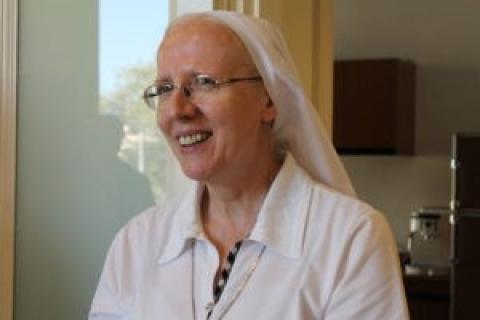
M. FRANCA ZONTA, FMI
Mother General of the Daughters of Mary Immaculate
Vision of the Marianist Family: A New Fulcrum
I don’t know if I will succeed in responding to all the expectations of what we hope for from the presentation of this topic that I was given. I was asked to talk about the family. The first thing that I believe is important to emphasize is that I feel that I am “in the Family” and among members of the Family and not in a university lecture hall. So, I will share with you some reflections knowing that there are open questions about a topic that involves all of us.
Your last General Chapter took this topic very seriously, so much so that it became the guiding thread or guiding idea of the entire Chapter document.
There are three important terms in the title that I was given:
- Vision
- New Fulcrum
- Marianist Family
1. Vision
For me it is a matter of fundamental importance to understand the meaning of the terms well. When we consider the term “vision” it is interesting to note the different meanings that this word can have. And as everyone knows, the term is connected to the verb “to see.” It is the process of perceiving that is stimulated by light; it is the function of seeing and the ability to see.
Vision suggests gaining knowledge, examining something in order to get something new and useful. We look over a book, we read it, we look at a magazine, we speak of the new release of a film– the first look at it – a preview, a “première of a film” we say in French, and so on.
Vision can also be the same as daydreams or things we imagine, distorting reality. It can be connected to a world of extra-sensory perceptions: there are people who succeed in having perceptions, visions extraordinary images which are seen – or believed to have been seen in paranormal states.
In our context we refer to vision in the sense of examining that idea, that vision we have of the Marianist Family. How we imagine, how we see the future of the Marianist Family? As with every idea, the idea we have of the Marianist Family is an idea that is formed by perceptions. In turn, the perceptions are interpretations, processing the stimuli, a development of the sensations by which we form the ideas. The sensations in so far as they are connected to the senses, are objective. The perceptions in so far as they are interpretations of the sensations are subjective.
This making a term precise is not useless, in so far as asking me what vision I have of the Marianist Family, means asking me: what are the stimuli that I am working on? What do I see in the Marianist Family? What do I hear about it? What is my experience of it? It is all this that allows me to tell you what vision I have of the Marianist Family, and how I interpret my experience of the Marianist Family. Objectivity and subjectivity intersect.
I will try, in fact, to tell you what my vision is, not the vision of someone else, even if, obviously, I do not begin at zero. I am aware, though certainly not exhaustively, of the vision others have developed on this topic, what others have formulated about it.
I refer, for example, to Fr. David Fleming who has written a book on this topic, A New Fulcrum, and to Fr. Jose Maria Arnaiz who has spoken about it on many different occasions.
2. Fulcrum
The other important term to clarify is fulcrum.
A fulcrum is what supports and that thing on which something is supported and that makes movement possible. The fulcrum of a presentation is the central idea or ideas of the presentation or of a conference. It is the pivot or axis around which everything else turns.
A New Fulcrum: is there something new at the center of our being a Marianist Family? Is there a new axis around which the Marianist Family turns or ought to turn? What ought to be at the center?
3. Marianist Family
The third point is about the Marianist Family.
Today we talk about a Charismatic Family. What is a Charismatic Family? The expression explains itself; a Family which has a charism as its central point, a family whose identity comes from a charism.
The movement of Charismatic Families is a reality which has been developing since the 1970s.
“By Charismatic Family is meant the encounter between two different realities (religious and lay) which relate to each other in a mutual way, in order to share in a program or project of evangelical life which gives form to a style of life characterized by the spirituality of a founder or foundress. They do not mean only the spiritual vision but also the sense of planning, of analyzing the challenges together, of guiding their choices, of asking themselves how to be 'together' here and now.” [1]
For some years the Charismatic Families have been meeting in an Association; they have an executive committee, they meet twice a year in Rome. The Marianist Family participates through the representatives of our four groups.
How do we become Family? By our commitment to a charism. Therefore, it is not just doing something together, working in the same place, collaborating in the same work that makes us members of a charismatic family.
How many lay collaborators are there in our institutions? They are not necessarily members of the Marianist Family. They are members only when through a pathway of formation they commit themselves to a charism. The sharing of a mission stems from the commitment to a charism.
4. What are my images of the Marianist Family
What are my ideas and images about the Marianist Family?
For a long time, we have spoken of branches. Every term refers back to an image, behind the image there is an idea. The term “branch” refers back to an image we all know: the image of a tree. A tree has one trunk that comes from one seed. It receives all the same nutrients; it grows; it spreads out; it expands on one and the same piece of land. A branch is entirely one with the tree.
It is alive only when it stays attached to the tree. Life comes to it; it grows and spreads out in harmony with the other branches. A branch does not have autonomy on its own; it does not have an identity on its own; it cannot live on its own.
Is the Marianist Family a tree? At the beginning, Yes. In the time of Fr. Chaminade, when he had the final word, when he had complete and real authority over all the branches that he had founded we could say, Yes.
Gradually, however, over time each of the four branches of the Marianist Family came to search for and to obtain their own juridical and institutional autonomy. Today the Marianist family is not made up of branches which are developed from one unique trunk; today we have four trees, but of the same species, that are the same type, of the same family; trees which have the same piece of land in common, the same seed, the same nutrients; or if we like flowers, four varieties of flowers of the same species or type.
There is no doubt about the beauty of a garden where we can admire different kinds of flowers of the same species. In Japan I had the opportunity to see as much diversity of the type of flower called “hortensia” or “hydrangea” as there are. An unforgettable experience. Different colors and shapes but clearly of the same family.
Sometimes I think of the Marianist Family as a constellation of planets. The present time, the one we are living in now, seems to be one of a conjunction of the planets. The conjunction of planets occurs when several planets are aligned. It is a situation that occurs every now and then, but it does not last long, and then each planet continues along its orbit. Sometimes I have the impression that each group of the Marianist Family is this planet that moves along autonomously following its own orbit. In this period, exactly in this very moment in history, these planets seem to be aligned. What can happen? We want to be positive: certainly, something good and beautiful can happen.
If we take the images used by Fr. Chaminade, we find the image of the MILITIA: for him the Marian Sodality (MLC) was a holy militia which advances in the name of Mary; in the Letter to the Retreat Masters of 1839 he again takes up the same idea speaking of the two religious institutes: Mary enlists us in her militia and consecrates us as her apostles.
The term most dear to Fr. Chaminade and to Adèle is certainly that of Family.
The Founder speaks of Family, for example, at the time of the Foundation of the two religious orders, the Daughters of Mary and the Society of Mary. Family is the term that Chaminade is particularly fond of since it contains the idea that was particularly dear to him: We are sons/Children of Mary. Mary adopts us, Mary is truly our mother in the order of grace. A spiritual motherhood which is in no way inferior to physical motherhood – far from it – anything but, just the opposite.
Sons and daughters are not only the religious. They are all who live out the Marianist charism, who consecrate themselves to Mary in order to help her in her mission. All the members of the Marianist Family are sons and daughters of Mary.
5. Historical Origins of the Marianist Family
Different Charismatic Families have developed in the last number of years, above all since the Second Vatican Council. We all agree in our knowledge, and we are quite proud of it, that the Marianist Family has its roots in the thinking of the Founders themselves. It is part of the origins. Thus, different from the greater part of today’s Charismatic Families, where we find religious who begin to share their charism with lay people many years after the foundation, the Marianist Family was born from the lay branch.
Chaminade is, to all appearances, a precursor of the Charismatic Families.
To say that the Marianist Family has its roots in the thought of the Founders does not mean to say that for the Founders everything was perfectly clear from the beginning. Fr. Chaminade was not thinking of religious life (I know that others affirm the opposite – that he was) but when he saw the signs, when he sensed the plan of God, he took it into consideration. It became an integral part of the plan which God had inspired in him, a plan which came to light only gradually. It is the same as what happens with every Founder.
Everyone knows that when we speak of the Marianist Family we are thinking of:
- Marianist Lay Communities (MLC)
- The Marianist Secular Institute (AM – Alliance Mariale)
- The Daughters of Mary Immaculate (FMI)
- The Society of Mary (SM)
The questions I invite you to ask yourselves are:
- How much do I know about the other branches of the Marianist Family?
- How do I see myself in relation to the other branches?
- What can I offer to the Marianist Family?
- What I would like to receive?
- What are the strong points of the Marianist Family?
- What are the weak points of the Marianist Family?
- How do I see the future of the Marianist Family?
It is good to recall a bit of history. How was the Marianist Family formed?
Chaminade’s dream about his return from exile was realized by giving life to the Marian Sodality (MLC) of Bordeaux.
December 8, 1800 marks officially the beginning of a Marian lay movement, destined to reignite the flame of the faith in a France devastated by the French Revolution. It will be on February 2 1801 that the first sodalists will officially make their consecration. It is a lay movement in which persons of every age, sex, and social status come together. Their animator will request and obtain the title of Missionary Apostolic, the only title that the Founder ever requested and desired.
On her part, Adèle de Batz de Trenquelléon also returning from exile in Spain and Portugal, initiated in 1804 a lay association in which young women and even younger ones came together with the sole purpose of living in full the Christian life and of re-Christianizing the rural areas in which they found themselves, to bring to life the “Little Society” Petite Société. Priests were also part of it.
In this way two very similar realities came to birth thanks to the zeal of the two Founders. They will be put into contact with each other in 1808 by a Sodalist, Hyacinth Lafon, whom the mother of Adele met one day at Nerac while she was visiting a convent in the city. This began a very significant exchange of letters between the two Founders.
They will meet in person only after the foundation of the Daughters of Mary in 1816. A year later, in 1817, the Society of Mary will see the light of day.
The seeds of the secular institute had meanwhile already brought forth fruit. From 1808 within the Sodalities there were some who were living their consecration by making vows. After the foundation of the Daughters of Mary, the Third Order Secular would be born, probably from 1817. There were some consecrated persons who dedicated themselves to the external apostolic activities which were prohibited to the religious because of the vow of enclosure.
Then in 1836, the Third Order Regular of the Daughters of Mary would come into existence.
The Marianist charism unites people who live different vocations. The charismatic insight of Adèle and Chaminade brought together lay people, consecrated secular persons, and religious men and women, priests, from the beginning. By beginnings we understand, not one historical date, the same for all, but realities which came about, as we have seen, during the lifetime of the Founders.
All of these different institutions were born thanks to the inspiration and charism of the Founders.
What happened later? Why does it seem that the laity and consecrated persons fell into oblivion for so many decades?
After the Revolution of 1830, the Marian Sodality began to decline. Adèle died in 1828; Chaminade by that time a seventy-year-old, was absorbed in the development of the two religious orders, above all the Society of Mary, which was expanding rapidly. He was busy writing the Constitutions which would receive the famous Decree of Praise in 1839 after which would follow the magnificent Letter to the Retreat Masters of 24 August 1839. He will then be forcibly pushed aside by his own Council which will do everything to prevent the Founder’s completion of his work with his religious. It is the sad last decade of the Founder’s life which we all know about.
The lay activity which the Church had enjoyed during the periods of revolution and post-revolution gradually lost importance, leaving in its place a Church ever more clerical. The laity became an object of the mission and no longer a subject, no longer collaborators in the mission.
The new persecution with the secularization in France at the beginning of the 1900s, Fascism and Communism, and the world wars which spilled a lot of blood in Europe in the last century, gradually prepared the ground for the rebirth of the lay movements.
Among the Marianist Family, from 1950 there will begin to arise groups of laity connected to the Marianist religious institutions. The Marianist lay movement begins from this time, and it will gradually become aware of its own proper identity. Vatican Council II will give a basic stimulus to the lay world which will become ever more active and present in the Church. In the Marianist world something important begins to move. The religious, both men and women commit themselves to bringing about the rebirth of the Marianist Fraternities.
In 1993 they will hold their first international meeting in Chile and take the name MLC, Marianist Lay Community; a President will be named, supported by a council. Thus, an autonomous development will begin in relation to the religious congregations, and in 2000 the MLC will be recognized officially by the Holy See as an International Private Association of the Faithful.
In 1960 the Fraternité Mariale consacrée arose in France. It was a group of consecrated women living the Marianist charism in the world, in their home and work environment. They will take the name of the Alliance Mariale in 1964. This is the birth of the Marianist Secular Institute. A letter from the CIVCSVA (the Roman Dicastery) of last July 4th 2019, gave the authorization for the erection of the Secular Diocesan Institute “Alliance Mariale”. It is, therefore, Cardinal Ricard who, in Bordeaux, approved definitively the new Statutes of the fourth group of the Marianist Family.
The multiplication of contacts, of relationships, and of initiatives among the various components, the point of reference for which was the Marianist charism, resulted in the birth of the World Council of the Marianist Family in 1996, preceded in some places by the setting up of National Councils. All this favored a greater consciousness of the charismatic identity which unites us and our being precisely a Marianist Charismatic Family.
The richness of the charism is seen in full when it is concretized in the complementarity of vocations.
6. Development of the Marianist Family
6.1 From Dependence to Autonomy
Reborn thanks to the commitment and activity of the religious, both men and women, the laity and consecrated seculars have experienced the first years of their revival in the shadow of the religious, FMI and SM, receiving from them animation and guidance. A dependence almost total, including financial.
The official recognition in 2000 confirmed the complete autonomy of the MLC, which now has its own statues, its own council, and some of its own objectives.
The reality is still very different in the different parts of our planet. The road is still long in some places where the MLC continues to be almost completely dependent on the religious institute, either the SM or the FMI.
The Alliance Mariale, which until a few months ago had a spiritual assistant from the Society of Mary, has now total autonomy and no longer needs a spiritual assistant from outside the Institute itself.
It is the same as physical growth: the child at a certain point has to walk by itself and needs to achieve its autonomy. This is part of its biological growth. If this development is not successful, there is an infantilism that continues into adulthood and that damages and obstructs the entire family.
Question: How many of our groups are autonomous?
6.2 From Autonomy to Interdependence
Having become adult and autonomous, maturity brings with it a new way of relating with other members of the family. The mature adult becomes an active member of the nucleus of the family; he or she offers their own contribution, their own support; shares ideas, decisions, and responsibilities. From dependence we come to interdependence.
Giving and receiving are no longer in one direction. There is not one who gives on the one hand, and one who receives on the other. There is not one who is more, and one who is less. Diversity comes from talents, but communion comes when there is a sharing of talents. When there is reciprocity. We are different but complementary.
Question: How many of our groups feel interdependent?
6.3 From Interdependence to Collaboration
A further step occurs when a group arrives at collaboration from interdependence. And for collaboration I understand shared action, an action in which each one participates in all phases: the thinking through of the idea, the planning, the realization or doing, and the evaluation.
Question: How many of our groups collaborate in a shared action or activity in all its phases?
6.4 From Collaboration to Communion
It is not enough to collaborate in a work, in a mission, in order to feel part of the same Family. It is necessary to arrive at communion, and this happens when one is committed from the heart, with the mind, with one’s life, to a project, to an ideal, to a charism.
Question: How many members of our groups truly experience and live out this communion, the commitment from the heart to a charism?
We can do a quick mental exam, to review mentally the groups or the members of the Marianist Family that we know: Are they dependent or autonomous? Are they interdependent or is there one who plans, one who thinks, one limited to carrying out the plan? Is there collaboration or commitment to a mission?
6.5 Common Mission
Much has been said and is said about a common mission. There is a document from the World Council of the Marianist Family on Common Mission.
What is the meaning of Common Mission? The mission is common not because something is done together, but because of commitment to a charism, because it comes from the same inspiration and is at the service of the same project in the Church. [2]
This brings us back to the Vow of Teaching, which our brothers and sisters professed. At the beginning of the religious foundations not everyone took the vow of teaching. For us, the “companion sisters” did not make this fifth vow; only the sisters dedicated to teaching, or who had a particular responsibility, professed it. The companion sisters, no. However, for the working brothers of the SM I do not know. A significant change came with the Constitutions of 1839: all the members of the Institute were called to profess this vow. It was not, in fact, important what kind of mission one had; it was not the particular activity which decided if a religious (of either group) ought to profess the vow of teaching. Everyone professed it because everyone, whatever duty they performed, was working with the objective of fulfilling the end of the Institute: To make Jesus Christ, Son of God, become son Mary, known, loved, and served.
Commitment to the goal of the Institute was what counted, not the kind of service or mission one fulfilled. The vow will be suppressed in 1865 by the SM and in 1869 by the FMI in so far as the vows were in the line of the means. Education in faith was the goal of the Institute and not the means.
7. The Vision of Father Chaminade
We have seen the different steps made by different groups of the Marianist Family during its history. It is fundamental to remember, however, what was the vision of the Founder when we speak of the Marianist Family. Was the idea of the Marianist Family, such as we know it today, really in the mind of the Founder? Is the Marianist Family of today what the Founder had begun?
Returning from exile the Founder went to work immediately organizing the Marian Sodality of Bordeaux, using as his point of reference the Sodalities of the Jesuits. It was something new, a new touch, something different: every Sodalist was an active missionary of Mary. Often, we speak of Saragossa as the place where everything began, where Chaminade had his foundational, founding inspiration. To my way of thinking Saragossa strengthened the Missionary Chaminade already was. His plan may have been confirmed, but it was already present in the Founder.
Mussidan is the key to understand Chaminade. It is here that Chaminade nourished his spirituality and his missionary sense, in the experience of the College of Mussidan.
At Mussidan there was an atmosphere that he breathed in, of a great love for Mary who was venerated under the title of the Immaculate Conception. The community of priests of Mussidan propagated her devotion to her; they defended her title of the Immaculate Conception. Their chapel was dedicated to the Immaculate Conception; a large picture of the Immaculate decorated the meeting room. Conferences about Mary and her role were common and frequent. All of this was before the revolutionary cloud burst open.
During the Revolution the French clergy had the very important experience of the collaboration of the laity. We read:
Lay people are exceedingly valuable for purposes of catechesis. In every age, but especially in times of persecution, the Church has used them most effectively. Therefore, priests will carefully select among the faithful with whom they work those who are strong in faith, full of zeal, well instructed, and who would like to share in their pastoral concern for the salvation of souls.
[Fr. Boyer, Vicar General of Bordeaux, Règles pour l’exercice du ministère sacre, in Commentary on the Rule of Life of the Society of Mary, Mission, page 836 quoting Philippe Pierrel, A Missionary Journey with William Joseph Chaminade, Founder of the Marianists, (Monograph, 33; Dayton, MRC, Dec. 1986)] [French: Dictionnaire de la Règle de Vie Marianiste, p. 562]
Returning from exile in 1800, Chaminade went to work organizing the laity, founding the Marian Sodality. We find the thought of the Founder expressed in his own words in a letter written to Adèle [3]. Last year, when I expressed a strong desire to see you, it was especially for the purpose of acquainting you with a project which, although not altogether the same, greatly resembles it nevertheless. What is the project which is not altogether the same? Adèle is thinking of and pushes for the foundation of a religious community; Fr. Chaminade wants to safeguard the Sodality, the missionary thrust of the laity.
Some years ago, we already started to carry it out. Several young ladies live like religious, take vows, wear a religious habit under their ordinary clothes, etc. Mlle Lacombe was one of those religious. Up to now, I have never allowed the group as a whole to take vows for more than three months, and I did not think it advisable to permit a perpetual profession. I shall have occasion to acquaint you with my motives for this policy. This religious association was made up of the majority of the officers. The sodalists are not aware of its existence.
We find here in embryo what will be in our days the Secular Institute, persons who make vows, but remain in the midst of the people, in the midst of society, working within society. They do not live in community.
Fr. Chaminade continues:
Religious communities, it seems to me, would not fulfill the purpose of this institution.
The idea of religious life was not in the thinking of Fr. Chaminade. It will develop as time goes on.
We shall often come back upon this important purpose. In the meantime, let us continually request the light of the Holy Spirit that we may only do what God wills.
And in the following letter he will write [4]:
The young widow of whom I spoke to you continues to talk to me about religious foundations. She criticizes me for scarcely answering her. She is astonished that I am not going ahead. I am acting in this way purposely to try her. …I have not received your constitutions and I am speaking to Father Laumont about it.
What does Fr. Chaminade want to test, to try her? If the call to found religious orders truly comes from God. Because this is his objective: to follow the movements of the Spirit.
The idea of religious life in community entered slowly into Chaminade’s thinking. Adele’s group had already been thinking of this and Adèle was pushing Fr. Chaminade in this direction. At Saragossa, as I often hear it said, did Fr. Chaminade have the insight or intuition of founding the Marianist Family with its four groups, including Religious Life? I would say, No.
And I am not the only one who would say that; the same Fr. Chaminade when he opened his heart to Adèle revealing what he himself calls the “secret,” the plan he had as he returned to France.
I am going to tell you my whole secret. Could a father still withhold anything from one of his daughters who surrenders herself without reserve to his direction? Fourteen years ago, I returned to France as Missionary Apostolic throughout our unhappy land, subject, however to the approval of various Ordinaries. There is no better way of exercising these functions than by establishing a sodality like the one now existing. Each sodalist, of whatever sex, age, or condition in life becomes a member of the mission. Several sodalists of each branch of the Sodality, though still living in the world, would constitute a little religious society. Men and women officers to run the Sodality would always be found in these societies. A number of these religious men, as well as women, have desired to live together. There was every advantage in this. Right now, several would like to live a regular community life, abandoning all temporal concerns. This inspiration ought to be acted upon, yet care must be taken that it does not essentially change the work of the Sodality, but that it rather helps it along. A few sodalists have entered different religious communities. We noted this with pleasure. When the women officers informed me of it with a certain feeling of regret, I told them, for their consolation, that we are playing “losers winners.” But here we have something quite different: these are sodalist religious, or rather, sodalists who, while remaining active sodalists, wish to live the regular life of the religious. This is why I told Father Laumont that your constitutions was to be carefully drawn up and that I should be very glad to see it. . . . Write to me soon, my dear Child, if your desire to be a religious includes the views and sentiments of a little missionary. [5]
Here we have something quite different, says Chaminade, always attentive to the signs of Providence. The idea of Religious Life was not present in Chaminade’s thinking. Only when he sees that various people in the Sodality of Bordeaux leave the sodality and enter various religious congregations, when above all that he senses that Adèle’s project would be different, They would be religious Sodalists or Sodalist religious, at the service of the Sodality, with a missionary heart, Chaminade senses that he ought to follow this inspiration. But he wants to be sure. Adèle must tell him whether her intention to be a religious comes out of a missionary heart, a desire to be a missionary. The religious life must serve the mission, the Mission of Mary.
And Chaminade’s thought will be clear in the Letter of 1839: what is different is that “we embrace religious life in Mary’s name and for her glory.”
8. Identity Card of the Marianist Charismatic Family
Coming back to our day, we speak today then of a Marianist Charismatic Family. The Association of Charismatic Families invites every Charismatic Family to develop its own Identity Card. Why is it important to have an identity card? Perhaps, thinking that our Marianist Family has, in reality, roots, which go back a long way, we believe we do not need one. I believe that we need one more than ever. The new Charismatic Families are experiencing the very Euphoria and the dynamism of the beginnings of every spiritual group. We are a reality a bit special, different: we have the strength of a tradition, the wisdom of a history that makes our foundations secure, the joy and the hope that come from the rebirth of our lay communities and of the Secular Institute – the Alliance Mariale – but can lack the very dynamism of those who are beginning the journey; the dynamism of the new foundations, of the new ecclesial movements. Tradition and the New intertwine in our Marianist Family. Often it is said that it is easier to begin something new than to renew something old.
How to renew ourselves? Will the Marianist Family be able to respond to the expectations and the needs of today’s world?
Every group, every branch has its Identity Card: Rule of Life, Statutes, Regulations, Plan of Formation, etc. And as a Family? More than ever, therefore, we need to have our Identity Card (ID).
The Identity Card will become a point of reference for each member and will serve to reinforce the sense of belonging to the Charismatic Family. What are the essential elements in an Identity Card?
It is necessary to define in some kind of synthesis:
- Who is a member
- The Charism
- The Spirituality
- The Formation
- The Mission
- The Organization
Whose business is it to formulate the Identity Card?
On the level of the World Council the Statutes of the World Council of the Marianist Family were already developed several years ago. These Statutes are regularly gone over and updated. The last revision was in 2018. The Statutes could be a point of departure for the development of an Identity Card.
Is it opportune that every National or Local Council have its own statutes? Certainly, Yes. This year, for the first time, in the World Council, we were able to see and evaluate the Statutes of the National Council of Togo. A beautiful and interesting initiative. We hope others will follow. This means that the National Councils are becoming something substantial and are having an animating role both nationally and locally.
What is the role of these Councils, either National or World?
Let me restate what was presented recently at the last World Council Meeting:
- The Council promotes the Study and dissemination of the Marianist Charism in the entire Family.
- It has the right to decide certain aspects of the charism in order to clarify them or to set up criteria for interpretation, particularly about what concerns the branches as a whole.
- It is continually updating and deepening its understanding of what the Marianist Family is and what its mission is.
- It promotes collaboration among the branches at every level, in particular at the continental or national level and it specifies the spirit and criteria for that collaboration.
- It encourages occasions for encounters or collaboration with those who, without being members of the Marianist family share its spirit by helping in the works and plans of the different branches.
- It has the authority to welcome new branches which would want to become part of the Family by indicating to them the necessary conditions. [6]
9. Ways for the Future of the Marianist Family
What are the ways to be undertaken to favor the development of the Marianist Family that we all see
or think are desirable?
I will point out 5. The way of :
- Convocation
- Formation
- Prophecy
- Mission
- Communication
9.1 The Way of Convocation
To convoke or convene the different groups that are identified as the Marianist Family, to organize the meetings, assemblies, share themes and ideas; to confront problems and challenges together. To convene does not mean limiting ourselves to celebrating the Marianist World Day of Prayer or celebrating the day of the Founders. It does not mean limiting ourselves to celebrating together what might be a happy or important occasion.
To convene means to call, to invite. This opens up the important topic of Vocation Ministry. It is a large field into which we are called to enter as a team, as Family. In the measure in which we feel ourselves to be truly Family we will understand that only together can we move ahead in vocation ministry. It is not just a question of the practical advantages we might have combining resources. It is a question of presenting ourselves as Family, demonstrating the beauty of the Marianist Charism that can be lived out in the complementarity of different vocations. It is a question of presenting all the vocations present in the Marianist Family, even when in a particular place not all the branches which compose it are present.
There are various experiences in this area in the Marianist world, but too few. Often Brothers and Sisters do something together. The only experience as Marianist Family that I know of is what was done in Peru some years ago thanks to someone who believed firmly in the Marianist Family: the late Brother Philip Melcher.
To do vocation ministry together means to have a team that meets (even by the Web), dialogues, thinks, and plans. The calendar and the different activities are planned together.
To convoke, to convene, means to call the different components of the Marianist Family to meet together. It means to dialogue, share, reflect, and give guidance. The Local and National Councils of the Marianist Family have a big role to play. This is another of the big challenges for the Marianist Family. Here there are also different realities and experiences. Where the four groups or at least three have been present in a place for some time, the Local and National Council have a different history.
But in my opinion, there is a lot to do everywhere. In fact, often we meet only to agree on the big Marianist celebrations that will take place in the course of the year.
The national council is often the place where each branch limits itself to communicating to the other branches how much it has accomplished, what future projects… It is good to be together, we feel all is right because we are experiencing the goodness of family spirit, fooling ourselves that we are truly living family spirit as the Founder understood it. What is Family Spirit according to the intention of Chaminade? This would take me into a long digression off the topic.
9.2 The Way of Formation
This is the biggest and most important challenge we face. It is not enough that at the center of the Marianist Family there is a charism, and that it is the pivot, the fulcrum around which the Marianist family moves. It is important to know the charism. It is important that there be formation in the Family. Become Family! And it is the fruit of a shared formation, of a common formation. Every group will have its specific formation, as is right, but common formation cannot be missing either, if it is true that we are a Charismatic Family, a family that has a charism, a spirituality, a common mission.
Formation, as the Pope says, has to use three kinds of language. It must use the language of the head, the language of the heart, the language of the hands. [7] Head, Heart, Hands. Formation needs to promote a knowledge that reaches the heart and that is transformed into action. How can we fail to notice here one of our favorite and to the point mottoes: to know, to love, and to serve? It is important to invest in formation, a formation where every member of the Family can bring something according to their ability.
Is the topic of the “Marianist Charismatic Family” in the curriculum for initial formation? How much do we know about the other groups of the Marianist Family? We cannot love and serve what we do not know.
9.3 The Way of Prophecy
Living the mission with Mary leads us to support, encourage, proclaim, critique. . . An example of Mary, the Woman standing at the foot of the Cross. In so many Calvaries of our human life Mary continues to be present. As sons and daughters of Mary, as her allies in her mission, our presence cannot be missing in defense of human rights, justice, peace, ecology. An action that cuts across the entire Marianist Family, through the particular vocation of every member of the Family. Not only an action cutting across but also becoming the backbone that gives a skeleton, a framework, a structure to all the rest and that supports all the rest.
9.4 The Way of the Mission
The mission is closely connected to the charism. There is an inescapable bond between charism and mission. There cannot be one without the other. If there is a charism it is for mission. The central core of the charism we can synthesize in this sentence: In alliance with Mary we continue her mission of educating in the faith in order that her Son be known, loved, and served. The Marianist Charism is realized whenever we continue her mission as mother: to give Christ to today’s world. We are committed to this mission – we religious by the vow of stability. For Fr. Chaminade it is a question of making Mary known, loved, and served, as the most certain means of making her Son Jesus known, loved, and served.
The Marianist mission, as has been said at other times, does not consist only in doing. Too often Mission is confused with apostolate or ministry. Certainly, mission must be concretized in definite works that can be different depending on the place, the circumstances, the needs. But the Marianist Mission is essentially to make Mary present, to contribute to making the Marian face of the Church shine brightly. It is the commitment of the heart to a charism.
There wherever there is a Marianist, a Marianist community, is the presence of Mary truly visible? Is there a Marian style that is characteristic of it? Do we breathe Mary? Is it in her name and for her glory that we live and work?
There where we are, have we contributed to making the Marian face of the Church more alive, more attractive, and more known? Is this the particular charismatic contribution to the national and local Church in which we work or is our activity weak, fragmented, or isolated?
The members of the Focolare Movement have created the Mariapolis, the City of Mary. The Servites (a religious congregation) have created the Marianum University. It makes me happy to think of our Marian Library in Dayton, or to think of Notre Dame d’Afrique (Our Lady of Africa) in Abidjan, or to think of the great persons that we have had in our religious family.
I think of Fr. Emil Neubert whose little book My Ideal, Jesus Son of Mary has nourished so many generations of Christians and not only Marianists. In my own life I have met so many brothers and sisters in love with Mary.
I like to think that as the Marianist Family we still have so much creativity to explore and to make Mary visible through activities more incisive and to the point, and more fruitful.
9.5 The Way of Communication
I am not going to develop this, but surely, we need to improve the communication among us. It is a sector open to creativity, and imagination. For the opening of the bicentennial we sent a common circular. Are there other possibilities, other occasions in which we could send to the Family, more often, a common letter, a common message, a common communication? After every World Council we send to the Family a common message, before Christmas. How many of you have read this message? Communication in our digital and global world is a very important key. Is there anything more we should do in this field? The answer is obvious.
10. Dreams
What are my dreams? I dream of the Marianist Family, that comes together, reflects, and organizes
the strategies to make Mary present as a more certain means of making Jesus more present, through:
- Marian Conferences
- Marian Pilgrimages: to go on foot to a Marian Shrine! Who does not know about the pilgrimage of Santiago de Compostella or of Czestochowa in Poland, or the Franciscan march for peace to Assisi?
- Pilgrimages are organized everywhere. How nice it would be if the Marianist Family became promoters of a Marian pilgrimage which became an annual event.
- Symposium on inter-religious dialogue
- Concerts, Contests, Olympics…
- Environmental (ecological) weeks
- Discussions, round tables on Justice, Peace, defense of Human Rights, on the role of women in our societies
I dream that the Marianist Family as Missionaries of Mary be more present in the digital world, the world which has the most visitors today.
Pope Francis repeats that the Church grows through attraction. It is no different for the Marianist Family. If we want true Marianist vocations – these gather around us by being attracted, because it is wonderful to be sons and daughters of Mary, because it is exciting to be at her side, to have an alliance, a close relationship with her, to walk through the streets of the world together with her. And we know she is never alone; Mother and son are inseparable.
Marianist Family: does everything have to be done together? Does everything become common? Common Formation, Common Mission? Common Life? Only one organization? I do not know what the Spirit will cause to spring up in the Future.
For now, I think, it is a question of:
- Revitalizing the role of the National and Local Councils,
- Promoting formation in the Family,
- Carrying forward vocation ministry in the Family,
- Developing places of Marianist presence where the different branches share prayer, formation, celebrations, mission; making an open community, visible and attractive,
- Opening pathways for discernment in common concerning the Marianist Mission. (cf. XXXV, General Chapter SM, 2018, nos. 23-27)
This is not about wiping out or wiping away the differences. We have a common charism, but different vocations. Each one must contribute his or her own originality, his or her own individuality, but inserted as part of a journey as Family, a journey made together. My identity is strengthened by facing or relating to others. No one can or should journey alone.
In the mountains there can be some isolated mountaineers, that is, mountain climbers, but the highest peaks are impossible to climb if the climbers are not roped together, climbing together. By turns there is someone who is in front, who leads the way and opens the path. Also, in a spiritual family, I think, by turns, there is someone who leads the way, who opens the path, who encourages, who stimulates, who supports, who makes more effort, who does much of the hard work. In this way, she or he serves the Family.
I think each group of the Marianist Family is a bit like the earth: the earth moves in different ways, but all the movements happen all at the same time. It rotates on its axis around itself, and at the same time moves around the sun, producing the alternation of the seasons, the diversity of climate depending on the geographical position. But it is not alone, together with the entire solar system it moves within its own proper galaxy and in harmony with the other galaxies as well as with the expansion the whole universe. All at the same time.
Each group of the Marianist Family needs to revolve around its own axis but this is the briefest and shortest movement. It is harmful to stay too long contemplating oneself. It is necessary to look further than oneself. Together with the other groups each one needs to revolve around the sun, the charism, and this is a more involving journey and requires more time.
Therefore: A look inside at one’s own reality, but a common orientation towards the outside, a look focused on the light which comes from the charism around which each one must transit and orbit, without forgetting that we are moving together to something greater called Church that in turn is evolving in close connection with the evolution of the world itself.
We have heard it said so many times in these years it is the hour of the Marianist Family. It is true we are living in this planetary conjunction of which we spoke at the beginning. We hope that each one then does not continue on their own road or in their own orbit.
If I had to choose an icon for this providential moment in the life of the Marianist Family I would choose an icon dear to Fr. Chaminade: the first community of Jerusalem. There the Twelve were gathered with the disciples, the women, the friends of Jesus, the families… and there was Mary the mother of Jesus. They were faithful and persevering in being together.
May the story of our time, the hour we are experiencing find us united together in the diversity of the vocations but in the communion of the ideal to which we are called: full of and moved by the Holy Spirit, spreading courageously, openly, frankly, and freely the joy of witnessing the Son of Mary to the world.
I know that I have not given you answers. My intention was rather to share with you the restlessness of seeking, of the journey. Seeking is good and important just as much as contemplation, as the mystic Julian of Norwich saw. Restlessness, key to holiness and the mission of the Church. [8] Mary is the restless one. [9] May we, as sons and daughters of Mary, live in this holy restlessness.
Sources and Notes:
- R. Cozza, in Rivista Testimoni, 1/2013.
- WCMF, Une Famille charismatique, la Famille Marianiste, Roma, 2019.
- William Joseph Chaminade, Letters, Vol. 1, Pt. 1, number 51; to Mlle de Trenquelléon, 30 August 1814.
- William Joseph Chaminade, Letters, Vol. 1, Pt. 1, number 52; to Mlle de Trenquelléon, 8 October 1814.
- William Joseph Chaminade, Letters, Vol. 1, number 52; to Mlle de Trenquelléon, 8 October 1814.
- WCMF – Une Famille charismatique, la Famille Marianiste, 5c, Rome, WCMF, 2019.
- Pope Francis, Discorso intervista a conclusione del Congresso mondiale sull’educazione, Aula Paolo VI, 21 November 2015.
- Christus Vivit, cf. nn. 34-42.
- cf. Civiltà Cattolica, no 4051, p. 6.