
Click here for a downloadable PDF version of this article.
Preface: In Appreciation of Many Conversations
I have been privileged in my more than 50 years as a Marianist religious to have had multiple rich experiences—as a community member, student, teacher, administrator, and an advocate for social justice. Throughout these experiences, I have pondered the question “What is the future of the Society of Mary and the larger Marianist Family?” As I have presented my partial answers to this question to a variety of Marianist groups, I have come to a much richer appreciation of our Marianist charism and missionary vocation. Conversations with a younger generation of lay and religious Marianists have been both challenging and supportive. In the greater Dayton community, many people have shaped my perspectives on the cycle of poverty and issues of urban injustice. Most importantly, these conversations allowed me to share in the stories and sufferings of families and children who endure the violence of poverty and made me acutely aware of the structural causes of this violence within our urban communities. On several occasions, I have been able to present to scholars versed in the Catholic social tradition my conclusions on the contemporary nature of urban poverty and the role of the Catholic Church in addressing this injustice. These conversations have both enriched my appreciation of the Catholic social tradition and encouraged further exploration of the Church’s response to urban poverty. I deeply appreciate all of these conversations which have enriched, corrected, and directed my exploration of the question about the Marianists’ future.
As you read this essay, you will sense a deep concern about the structural injustices affecting children and families in high-poverty neighborhoods. My conversations on this topic started in 1994 when, as President of the University of Dayton, I co-chaired the Child Protection Task Force for Montgomery County, Ohio. With the assistance of Dick Ferguson, the Assistant to the President for Community and Government Relations, I led the Task Force through an 18-month conversation and debate on how to prevent child abuse and the deaths caused by child abuse. This work inspired a personal inquiry into the plight of children and families in high-poverty neighborhoods. It also gave me a focus for utilizing the principles of social justice from the Catholic social tradition to address this complex set of issues. In 1995, Dick Ferguson and I used this Task Force experience to organize a course we entitled Leadership in Building Community. This course provided students with knowledge of community building in urban neighborhoods integrated with the experience of working with leaders of neighborhood associations to improve the well-being of their neighborhood. This work with Dick Ferguson and with many others led to the Fitz Center for Leadership in Building Community at the University of Dayton. I have continued as one of the instructors in the Leadership in Building Community course for 23 years. With the students, I have continued to learn more about poverty and its influence on families and children as well as the power of citizen engagement to transform injustice into a greater realization of the common good of the neighborhood.
In 2002, I was named the Fr. Ferree Professor of Social Justice at the University of Dayton. Initially this position challenged me to integrate Catholic social tradition, especially Fr. Ferree’s approach to social justice, and my experience of working for justice in high-poverty neighborhoods. In this position, I had the opportunity to be part of a collaborative effort to integrate the Catholic social tradition across the University of Dayton’s curriculum. Dr. Patricia Johnson, the Alumni Chair in the Humanities, was a thoughtful conversation partner in this effort.
The conversation on the Marianist Movement “officially” started on February 19, 2009, when I gave the Fr. Ferree Lecture entitled “The Marianist Movement and the Challenges of Urban Justice and Reconciliation: An Interim Report on a Conversation”[1]. In that lecture, I combined two ideas. First, I used the “lens” of social movements, such as the civil rights movement or the women’s suffrage movement, to consider the origins of Fr. Chaminade’s missionary vision of a new way of being the Church. I asked, “Is it helpful to look at Blessed Fr. Chaminade as a founder of a faith-filled Marian social movement? which I termed the “Marianist Movement.” Second, I explored how the Marianist Movement could address the issues of inequality and urban injustice in metropolitan regions. While the written expression of these two ideas was not a prize of coherence and logic, it captured the imagination of a number of lay and religious Marianists, who encouraged me to continue exploring the ideas expressed in this talk.
In 2010, I began to explore with students and members of the Greater Dayton community the issues of economic and racial segregation in metropolitan regions and the creation of high-poverty neighborhoods. Out of this work, I developed an image that I called “The Fractured City.” The Fractured City illustrates how people in metropolitan regions, over several decades, have “sorted” themselves into disconnected neighborhoods, many of which are high poverty and others that are highly affluent. This fracturing of the city leads to the absence of shared experiences across the metropolitan region. People have neighbors like themselves, recreate and have dinner with people like themselves, go to Church with people like themselves, and most often use the same sources for news and information. This has led to a breakdown in public discourse within the metropolitan region and a lack of capacity to address the issues of injustice. Again, conversations with a wide variety of people in neighborhoods and in local and county governments have shown me the depth and extent of the breakdown in public discourse that has come from this sorting in disconnected neighborhoods.
Conversations with persons and groups within the Catholic Church of the greater Dayton region have indicated that the Fractured City also has consequences for the Catholic Church. The shifting demographics of the Fractured City have seen members of the Church moving to the suburbs at a rate greater than the general population. This movement of Catholics to the suburbs has led the Church to move many of its resources (schools, programs, and personnel) to the suburbs. This movement has had the unintended consequence of the Church abandoning high-poverty neighborhoods in the urban centers — an abandonment that has greatly reduced the Church’s capacity to address the injustice of urban poverty.
This conversation around the Church and the Fractured City has introduced a complex set of questions about the future of the Marianist Movement. Like Chaminade in his time, we have to ask, “What is the Holy Spirit calling the Church to be in North America?” “What type of ecclesiology and ecclesial structures does the Church in metropolitan regions need to be of and for the poor?” “What would be the role of the Marianist Movement in collaborating to create this new ecclesiology and new structures?” Conversations with Professors Kelly Johnson, Vincent Miller, and especially Sr. Angela Ann Zukowski, MHSH of UD’s Religious Studies faculty have been very helpful in inquiry to these questions. In this essay, I provide some preliminary conclusions on how the Church, as a regional Church, can address the injustice of poverty. Building on these questions, I began to explore ways in which the Marianist Movement can be a catalyst in bringing about this new way of being Church.
In 2010, as part of my work on the Catholic social tradition, I met Amy Uelmen, then a law professor at Fordham University and now at Georgetown University Law School. She shared and continues to share with me her experience of the Focolare Movement,[2] a contemporary ecclesial movement. These conversations shifted my inquiry into the ways Chaminade’s original missionary vision and missionary plan, the Institute of Mary, were similar to contemporary ecclesial movements. As I continued to read and study, I found much to enrich my thinking about the Marianist Movement's similarity to contemporary ecclesial movements. I became convinced that Fr. Chaminade was not only a precursor of lay leadership within the Church, but his concept of the Institute of Mary was also a precursor to the contemporary ecclesial movements that have emerged in the post-Vatican II Church.
Many of these contemporary ecclesial movements had a clearly articulated method of evangelization that flows from the charism of the Movement. This realization raised the questions: “Does our Marianist Movement in North American have a clearly articulated and shared method of evangelization?” “Do we, as the Marianist Movement, have a formational curriculum to develop the competencies needed for this method of evangelization?” While strides are being made in this area, we have much more work to do. Articulating a shared method of evangelization and developing the competencies needed to implement this method remain challenges for our Marianist Movement.
On March 13, 2013, I found, as we all have, a new conversation partner—Pope Francis. In the first days of his pontificate, he declared, “I want a poor Church for the poor.” He has continued to challenge the Church to be a community of missionary disciples creating cultures of encounter, dialogue, and mercy, and promoting integral development in all sectors of society. This focus on a poor Church for the poor has shaped Francis’ homilies, addresses, statements, and missionary journeys. His words have challenged me to explore a vision of the Church and of the Marianist Movement that addresses the fragmentation, poverty, and injustice of our metropolitan regions and the role that encounter, dialogue, and mercy would play. It occurred to me that if the Catholic Church were to address the issue of solidarity in the Fractured City, a simple parish-by-parish approach would not suffice. While we need parishes that are vibrant, faith-filled communities with a missionary orientation, we also need an ecclesiology of the regional Church, a new way of how we see the Church and its role in the metropolitan region. This led me to this question: “What is Pope Francis’ vision of the Catholic Church in the metropolitan regions of North America?”
Reflecting on the call of Pope Francis to be a poor Church for the poor led me to explore the similarities between the pontiff's and Chaminade’s visions of the Church and evangelization. In 1800 when Chaminade returned from exile in Saragossa to Bordeaux, he wanted a Church that would witness to Christ and the Gospel as did the early Christians of the Acts of the Apostles. I saw that both men advocated a Marian style of evangelization. The more I pondered these similarities, the more I became convinced that a Marian style of evangelization could be an important contribution that the Marianist Movement could make to the contemporary Church of North America. Again, in the spirit of dialogue, I provide a preliminary outline of the Marian style of evangelization. I believe developing an appreciation of and skills in implementing a Marian style of evangelization is one of the keys to the future of the Marianist Movement in North America.
Over the past eight years, I have had the opportunity to present ideas on the Marianist Movement to ten different groups of the Marianist Family, lay and religious. Each session has challenged me to clarify the presentation and, in turn, has opened me to new questions and broader horizons for thinking about the Marianist Movement. In these conversations, I have focused on the metropolitan regions: “What are the urban justice challenges in the metropolitan regions of North America?” “What is a new way of being Church in the metropolitan regions?” and “How can the Marianist Movement be a partner and a catalyst in creating this new way of being Church?”
I want to express my appreciation to Bro. Brandon Paluch, SM, who has been a constant conversation partner from the beginning of this project. I have greatly benefited from comments coming from conversations with the Family of Mary of St. Louis, the Leadership Teams of the Marianist Lay Community of North America and the Marianist Social Justice Collaborative. I have been both encouraged and enriched by the Nassau Street Marianist Lay Community in Dayton, the Lay Marianists organizing and sustaining the Mission of Mary Cooperative, and the members of the first two cohorts of the Marianist PULSE community. I have received insightful and critical comments from a number of my Marianist brothers — Fr. Ted Cassidy, Fr. James Fitz, Fr. David Fleming, Bro. Thomas Giardino, Bro. Steve Glodek, Fr. James Heft, Bro. Joe Kamis, Bro. Robert Moriarity, Bro. Brandon Paluch, Bro. Bernard Ploeger, and Fr. Marty Solma — that helped to improve the working draft of this essay. My Stonemill-Kiefaber religious community has strongly supported this work and engaged in thoughtful conversations on the working draft. I thank all who have helped me in the development of this essay. The deficiencies remaining are my responsibility.
I express my deep appreciation to Fr. William Ferree, who introduced me to the connection between Fr. Chaminade and social justice. While he would quite often tell me I was asking the wrong questions, he did show the way to search for the right questions and answers on our Marianist charism and social justice. I owe a deep debt of gratitude to Bro. Lawrence Cada, Fr. David Fleming, and Bro. Tom Giardino, Marianists who have been my guides in exploring our Marianist charism.
I express deep appreciation to Deborah McCarty Smith for assistance in clarifying the writing and Judy Keyes for helping me to organize the text.
I. Introduction
This essay is a working summary of my inquiry into the question: “What does the future hold for the Society of Mary (Marianists) and the larger Family of Mary in North America?” In this introductory chapter, I will briefly summarize my reflections on this question by describing the evolution of the Marianist Missionary Narrative and will outline the essay's major chapters and primary audiences.
The Marianist Missionary Narrative
A personal narrative is the collection of stories we tell others and ourselves in order to make sense of our world. Our personal narrative allows us to derive meaning from our ongoing experience and explain how the world works. We can view our Marianist missionary narrative as the shared and evolving set of stories that we, as the Family of Mary, construct to make sense and meaning out of God’s call to mission and our response to this call at particular moments in history. Our Marianist missionary narrative selectively reconstructs our history as a religious movement and anticipates what we want to accomplish in the future. This missionary narrative explains how the Family of Mary, as a religious movement, has come to be and where we are going. It is the story that we tell to the Church, society and ourselves about our missionary intent. The Marianist missionary narrative is dynamic and evolving. Each era of our growth as the Family of Mary adds new themes to the narrative and sometimes diminishes themes that are no longer as important as they were in the past.
As I examined the Marianist missionary narrative at different points in its development, I found it helpful to ask three interrelated questions:
- How Do We See the Signs of the Time?—Given the gift of our Marianist charism and missionary tradition, how do we as the Family of Mary discern and respond to God’s call at this particular time in history?
- What is Our Missionary Vision?—What is the Family of Mary striving to create within the Church and society at this particular time in history?
- What is Our Missionary Plan?—What apostolic goals and strategies is the Family of Mary using to realize its vision at this particular time in history?
These three questions provide a way to reconstruct our Marianist missionary narrative at any point in time and, using them, we can critically examine our current missionary narrative of the Marianist Family.
When I ask members of the Family of Mary, both lay and religious, to describe the Marianist missionary narrative I hear a variety of responses. Most persons can describe the founding of the Marianist Family and the manifestations of the Marianist charism. Some can describe characteristics of the Marianist educational and apostolic organizations. The answers become diffuse in three areas:
- What are the critical signs of the times in North America today that the Family of Mary should be addressing?
- What is our missionary vision for how the Family of Mary will be a catalyst for renewing the Church in North America?
- What is a focused missionary plan that will allow the Family of Mary to be a catalyst for renewal of the Church in North America?
To be a vital presence in the Church and society of North America, we must renew and focus our shared missionary narrative. Throughout the history of the Catholic Church, we have seen a great number of religious movements die and their charism extinguish when the members were not able to adapt their missionary narrative to the new realities of the Church and society. I believe that the next twenty years will be a critical period for the Family of Mary in North America. Will the Family of Mary be able to adapt its missionary narrative so that it becomes a vital ecclesial movement within the Church and the society of North America? Or, will the next twenty years be the story of the flame of the Marianist charism smoldering and eventually dying? If this is a critical moment, then the communities of the Family of Mary in North America must undertake deep discernment about how we will adapt to the signs of the times, critically engage our past and shape a shared missionary narrative that will sustain us into the future as a vital religious movement within the Church of North America.
The Original Marianist Missionary Narrative[3]
Our Marianist missionary narrative begins with episodes of Chaminade’s underground immersion during the bloodiest moments of the French Revolution and his exile in Saragossa that provided a time of prayer, conversation, and reflection at the foot of Our Lady of the Pillar. These two experiences greatly shaped his missionary vision and plan—missionary communities joining Mary in her mission of bringing Jesus Christ into the world. The narrative continues as Chaminade returns to Bordeaux and begins to execute his missionary vision and plan with the founding and rapid expansion of the Bordeaux Sodality and the founding of the two Marianist religious communities.
Chaminade and the early Marianists, both lay and religious, created a new episode in the missionary narrative as they adapted to challenges by implementing innovative approaches to the education of children, especially those most neglected in society. A high point of the early missionary narrative is Chaminade’s vision of an apostolic movement within the Church composed of lay Sodalities, which included all classes, and two religious communities of women and men—which Chaminade called the Institute of Mary. Chaminade worked tirelessly to develop individual and communal practices that would ensure that the flame of the Marianist charism would continue to burn brightly. In Chaminade’s vision of the Institute of Mary, interdependent communities, both lay and religious, would share a common missionary vision and practices, enabling the Institute to expand while maintaining a strong missionary vision. When Chaminade wrote the first Constitutions for the religious communities, he insisted their mission include animating the Sodality communities.
The narrative of our Marianist beginnings continues with episodes from the last years of Chaminade’s life. In the midst of strong internal opposition from trusted collaborators, he continued to insist on the missionary vision that emphasized the universal scope of Mary’s mission of incarnating Jesus into the world. He saw the missionary vision that he received at Saragossa erode when many of his colleagues, during turbulent post-revolutionary times, narrowed their missionary focus to running good schools. At the time of Chaminade’s death, he saw the religious communities lose one of their important missionary tasks: the initiation and animation of Sodalities as an instrument for the renewal of the Church.
The Marianist Missionary Narrative in North America
A key episode in the early missionary narrative was sending members of the Society of Mary — a priest, a teacher, a cook, and a gardener — to North America in 1849. These Marianist religious were to assist in American parishes by creating schools that would sustain the faith of mostly German immigrants. By conducting outstanding educational institutions that formed graduates who were competent and faith-filled contributors to the Church and society, the Marianist missionary story in North America captured part of the original missionary narrative. As the Society of Mary expanded its missionary narrative across the United States, one prominent theme over 160 years has been the story of creating and sustaining a network of elementary and secondary schools and universities incorporating the Marianist educational tradition. The missionary narrative weaves multiple sub-narratives that tell the story of educational institutions striving to form faith-filled leaders who are a leaven of the Gospel in the Church and all sectors of society. In the middle 20th century, this strand of missionary narratives included a modest expansion into parishes and retreat centers. In our time, Sponsorship of Apostolic Organizations has become a new theme in this strand of our missionary narrative. The theme of sponsorship reclaims, in a contemporary form, Chaminade’s focus on developing faith-filled leaders who would assist the Society in maintaining and strengthening the Marianist mission and identity of our sponsored institutions.
The Daughters of Mary began their work in North America in October 1949 in Somerset, Texas, twenty miles outside of San Antonio. With the assistance of Fr. William Lamb, SM, they established a grade school in Somerset and began a missionary presence in the United States. Over time, the Sisters have extended their missionary endeavors to San Antonio, Dayton, Mexico, Toledo, and Cupertino. Today the Sisters collaborate with the Society of Mary and lay Marianists in key Marianist cities of San Antonio and Dayton. They not only involved themselves in educational endeavors, but also carried on the spirit of Fr. Chaminade and Mother Adèle through the initiation and nurturing of Marianist lay communities.
During the middle of the 20th century, a small group within the Society of Mary created another strand of the missionary narrative by reconstructing Chaminade’s focus on initiating and sustaining Sodalities. These Marianist religious began to organize apostolic faith communities within the Marianist schools and universities. These efforts seeded a modest yet expanding growth of Marianist lay persons and communities throughout North America that are committed to living and sharing the Marianist charism and nurturing the faith of their members. In recent years, a number of these lay communities have undertaken initiatives to respond to address the critical needs of our Church and contemporary society. Today we see this diverse network organizing as the Marianist Lay Community of North America. This organization and the many Marianist lay communities are striving to deepen their Marianist commitment and to be catalysts in renewing the Church and society in North America.
A New Moment for the Family of Mary in North America
In the remainder of this essay, I will make the argument that we are at a new moment for the Family of Mary in North America and outline how the Family might respond. At this moment in our Marianist life in North America, three important strands of our Marianist missionary narrative come together:
- The narrative of the Society of Mary with religious communities witnessing to the Marianist charism in key areas of North America and a network of sponsored apostolic organizations that aim to form people and groups in an apostolic faith,
- The narrative of the Daughters of Mary with religious communities witnessing to the Marianist charism and strong missionary collaboration in key areas, and
- The narrative of the Marianist Lay Community of North America, a maturing organization striving to organize Marianist lay communities into an effective presence within the Church.
This essay explores the questions:
- “Is it possible to weave these three narrative strands into a more coherent and powerful missionary narrative of an ecclesial movement, the Marianist Movement?”
- “Can the Marianist Movement create for our time Chaminade’s vision of the Institute of Mary and its impact of renewing the Church?”
- “Is it possible to create a Marianist Movement that is a catalyst and partner in renewing the Church and society of our times?”
I believe it is not only possible, but also necessary if our Family of Mary is to have a vital future as we move through the 21st Century.
An Overview of the Essay
The major assertion of this essay is—The three constitutive communities of the Family of Mary of North America are at new moment where they can become a major ecclesial movement within the Church of North America with the shared missionary vision of being a catalyst and partner in creating a Marian style of evangelization within the Church. Each successive chapter of the essay lays out a set of arguments and conclusions concerning:
- Remembering: What can we learn from the original missionary narrative of the founders of the Family of Mary?—Chapter II: Blessed Chaminade and the Founding Missionary Narrative and Chapter III: Themes in the Founding Missionary Narrative
- Seeing: What are the signs of the times?—Chapter IV: The Marianist Movement and a New Moment in North America, Chapter V: The Fractured City and the Silent Violence of Poverty, and Chapter VI: The Fractured City: The Civic Community and the Regional Church
- Judging: How should the Marianist Movement respond to the signs of the times? Chapter VII: Creating a Poor Church for the Poor: Guidance from the Catholic Social Tradition, Chapter VIII: Creating a Poor Church for the Poor: A Marian Style of Evangelization, and Chapter IX: Creating a Poor Church for the Poor: Some Necessary Transformations.
- Acting: How should we change? Chapter X: Recommendations for the Marianist Movement in North America provides recommendations to the different levels of the Marianist Movement on how to collaborate to renew our Marianist missionary narrative.
In the Chapters II and III of this essay, I use the term Family of Mary to designate the interrelated communities of the Daughters of Mary, Society of Mary, and the Marianist Lay Community of North America. Starting with Chapter IV, I introduce the concept of the Marianist Movement as a more appropriate description of these three interdependent communities and their potential role as an ecclesial movement within Catholic Church of North America.
Part One of the essay is entitled Remembering: Learning from the Original Missionary Narrative. In Chapter II, I present a short narrative on the missionary journey of Father Chaminade. Persons who have an understanding of Chaminade’s biography and missionary accomplishments may choose to skip or skim through this chapter. It is included because many young lay Marianists are not deeply acquainted with Chaminade’s missionary vision and plan, and his journey might provide us with potential lessons as we reflect on this new moment for the Family of Mary.
In Chapter III, I summarize the manifestations of the Marianist charism and some of the practices of Marianist spirituality that Chaminade developed with the early Marianists, which I have classified as practices of discipleship, community building and mission. The concluding reflection in this chapter uses the lens of contemporary leadership and social change theory to identify some of Chaminade’s principles of social analysis and transformation.
Part Two of the essay is entitled Seeing: Noticing and Interpreting the Signs of the Times. Chapter IV provides a reflection on events and trends within the Church, particularly the growth of ecclesial movements that allow us to “see” a new moment for the Family of Mary. Chapter IV describes one possible vision of the future for the Family of Mary as an ecclesial movement within the Church—the Marianist Movement[4] — and its key characteristics. I also share others' reflections on the Family of Mary as a movement in the Church. Chapter IV concludes with a summary of emerging initiatives within the Family of Mary of North America that I believe point to a new moment within the Family of Mary and new breath of life through the Holy Spirit.
In Chapter V, I developed the image of the Fractured City that allows us to “see” the consequences of our racially and economically segregated metropolitan regions of North America. The most critical societal consequence of the Fractured City is the deep injustice of what many have called the “opportunity gap,” i.e., the limiting of opportunities of families and children in high-poverty neighborhoods. The “opportunity gap” is better described as “the silent violence of poverty” because poverty does deep biological, cognitive, and emotion “violence” to children, and it is “silent” because the majority of the metropolitan region is indifferent to this violence.
Chapter VI examines implications of the Fractured City for the civic community and the Catholic Church. The social architecture of the Fractured City sorts neighborhoods into social entities in which there are not only great differences in opportunities, but also different experiences, relationships, cultures and political interests. This sorting by race and economic class has led to increased polarization and breakdown of public discourse on important issues of the region, especially the issues of justice. The Fractured City has serious consequences for the Church. Catholics have moved to the suburbs as fast as or faster than the general population. As the Church has moved its resources to the suburbs, it has greatly diminished its capacity to be present in high-poverty neighborhoods and to address the silent violence of poverty. As Catholics enter into the mainstream culture, ideological polarization has found its way into the Church and has made it difficult for the Church to mobilize a response to injustice. The mainstream culture has also influenced many young adult Catholics to move away from the practices of the Catholic faith. I believe these signs of the times call for a new way of being Church in the metropolitan regions of North America.
Part Three of the essay is entitled Judging: Creating a Poor Church for the Poor. On March 13, 2013, the universal Catholic Church heard a new voice from the South, Pope Francis. Pope Francis has brought a renewed focus on being a poor Church for the poor, a Church of missionary disciples, a Church of encounter, dialogue, and mercy, and a Church advocating integral human development. His bold thinking and challenges provide an impetus to Part III for “judging” a new way of being Church and a new way of being for the Family of Mary in metropolitan regions. Chapter VII looks to the Catholic social tradition for guidance on a new way of being Church in the metropolitan regions of North America that incorporates the best of our past ecclesial presence with innovations that respond to the new challenges of our times. Francis, in the tradition of past pontiffs, has emphasized an integral human development based on the key elements of the Catholic social tradition—humanity dignity, common good, solidarity, and subsidiarity. Pope Francis has also outlined principles of Catholic social practice that can guide the Church in working for integral human development in the metropolitan regions of North America.
In Chapter VIII, I bring the missionary insights of Fr. Chaminade into dialogue with those of Pope Francis. This dialogue yields themes of a Marian style of evangelization that I believe will help the Marianist Movement articulate a renewed missionary vision. This Marian style of evangelization includes: 1) Growing as Missionary Disciples, 2) Multiplying Missionary Communities of Encounter and Dialogue within the Metropolitan Region, 3) Being with the Poor and for the Poor, 4) Living Frugally and Generously, 5) Being a Prophetic Presence in the Metropolitan Region, and 6) Mobilizing Collegial Leadership within the Church. I believe this Marian style of evangelization is a distinctive contribution of the Marianist Movement and will allow it to be a catalyst and partner in bringing forth a new way of being Church in the metropolitan region.
In Chapter IX, I outline a proposal for ways the Church of the metropolitan regions of North America could undertake a transformation that brings it closer to being a poor Church for the poor. This proposal contains three strategies: 1) Creating Solidary within the Regional Church, 2) Becoming a Prophetic Voice in Public Deliberations for the Common Good, and 3) Transforming the Structures of the Regional Church. To bring the message of solidarity to the metropolitan region, the regional Church must witness solidarity among its members and parish communities within the region. While several bishops have spoken of key issues such as poverty and racism, the Catholic Church is often a missing voice in the public deliberations of our metropolitan regions. To be a Church of hope, the Church must be a public voice of justice for all people of the region, especially those at the margins. To be a poor Church for the poor, there must be vital parish communities that challenge their members to grow in the personal and social virtue of solidarity. A personal conversion to solidarity is a necessary condition for the Church to be a witness for solidarity in the region. In addition, the regional Church must create new structures and cultural norms that allow it to be a public actor for justice, peace, and the integrity of creation within the region.
Part Four of the essay is entitled Acting: Implementing Boldly and Learning. In Chapter X, I offer recommendations on the ways the Marianist Movement can implement some of the ideas outlined in this essay. I organize these recommendations at three levels.
At the level of the North American Family of Mary Council, I recommend that the Council:
- facilitate a conversation to develop a set of guiding ideas (Core Beliefs, Vision, Mission, and Strategic Goals) for the Marianist Movement in North America,
- authorize the development of a curriculum on the essential practices that supports the Marianist charism for use in formation of Marianists, persons and communities, throughout the Marianist Movement of North America.
- create a plan to develop the intellectual capital required to sustain the Marianist Movement, and
- explore holding an Assembly of the Leadership of the Marianist Movement in North America within the next five years.
At the level of the metropolitan region, I recommend that Marianist communities in key metropolitan areas of the Marianist Movement:
- initiate and develop a regional Marianist Family Council,
- develop a sustainable project of urban solidarity, and
- develop a regional formation program in the Marianist practices.
At the level of the Society of Mary—Province of the United States, I recommend the Provincial Administration and Provincial Chapter:
- evaluate Vision 2020 and extending our missionary vision to explicitly incorporate the development of the Marianist Movement,
- collaborate with other communities of the Marianist Movement to establish a pilot urban presence that utilizes the two-generation approach to breaking the cycle of poverty, and
- hold conversations on reimagining our missionary narrative.
Chapter XI provides a short summary of the main arguments of the essay. The final words of the essay are a plea to continue to engage in the conversation.
The Audience for the Essay
I have written this essay with a focus on two audiences within the Marianist Family. The first group is the younger members of the Marianist Family, both lay and religious, who are committed to reading the signs of the times and adapting the Marianist missionary narrative in a way that empowers the creation of a vital Marianist ecclesial movement within the Church of North America. This is not a short-term task; it will take a least a couple of decades. The second group consists of people like myself, older, but with experience and some wisdom that can inform the efforts of the younger members to recapture and adapt our Marianist missionary narrative to the realities of the Church and society in the early years of the 21st Century. I leave it up to each reader to decide in which group he or she belongs.
Renewing and adapting the Marianist missionary narrative will take place through ongoing conversations, both informal and formal, that address the difficult discernment of our shared future. Each of the three communities of the Marianist Family must undertake difficult conversations of discernment and together ask how they will recapture Chaminade’s vision of the Institute of Mary, a dynamic ecclesial movement for the renewal of the Church. I hope this essay can be one stimulus for these necessary conversations.
Part One: Remembering - Learning from the Original Missionary Narrative
II. Chaminade’s Missionary Journey[5]
In this chapter, I develop a short narrative of Blessed Chaminade’s life so that we can appreciate some of the similarities and differences in the contexts of post-revolutionary France and our 21st-century North America. Understanding these similarities and differences, I believe, can guide us as we reflect on revitalizing the Marianist Movement and see what potential lessons Fr. Chaminade’s story as Missionary Apostolic can provide for us. While no one can know all the complexities of Father Chaminade’s thinking, I will conclude with a short reflection on what I believe he saw as the full realization of his missionary vision and plan, the Institute of Mary.
Chaminade before the French Revolution (1761-1789)
Before the start of the French Revolution, Fr. Chaminade was the business manager and a member of the administrative team running the successful St. Charles Seminary in Mussidan in southwestern France. As a young man, he had a modest theological education, was making progress in the spiritual life under the direction of his older brother, Jean Baptiste, and was deeply loyal to the Roman Catholic Church. While he was most likely aware of the major problems of the Church in France and of French society, he and his colleagues were working to educate priests in piety and knowledge that would strengthen the Catholic faith in southwestern France.
The French Revolution (1789-1797)
The chaos of the French Revolution disrupted the serenity of St. Charles and changed the way Chaminade thought about his vocation. Chaminade participated in the development of the cahiers de doléances for his region of Périgord that contributed to the agenda for the Estates General that began on May 5, 1789. At this point in his life, Chaminade saw the monarchy as important for the future of the Church in France, yet his behavior demonstrates that his sympathy was with the common people and the lower clergy, and for reform in the State and the Church.
Chaminade, like all French citizens, was caught up in the chaotic events of the eight years of the Revolution. Policies of the Revolutionary government brought about the closing of St. Charles Seminary and forced him to move to Bordeaux and begin an underground priestly ministry. He faced actions of the Revolutionary government with discernment, integrity and faith. He did not accept the Civil Constitution of the Clergy but remained faithful to the pope. Amidst executions of clergy and faithful and despite many clergy leaving the country, he continued to risk his life to serve the faithful Catholics of Bordeaux.
Note the options Chaminade had at this time. He could have chosen to sign the Civil Constitution of the Clergy and be relatively safe, go into exile as many clergy did, or move into underground service to the people of God at great risk to his own life. Through his deep life of faith and prayer, he understood the Gospel’s call to undertake what I like to call “voluntary displacement.” In voluntary displacement, we move from comfort to uncertainty, and from home to journey into the unknown for the sake of the Gospel. As Fr. Chaminade encountered the French Revolution, he chose “voluntary displacement”—not just geographically, but more importantly, psychologically and spiritually. In journeying through this voluntary displacement, the Holy Spirit graced him with the Marianist charism and allowed him to bring this charism to the Church of post-revolutionary France. The voluntary displacement undertaken by Chaminade and the other Marianist founders will be a helpful image as the Marianist Movement renews our Marianist charism and missionary vision in the early 21st century.
Chaminade constantly probed the rapidly changing events of the Revolution in the light of faith, endeavoring to understand how they affected the Church and how he should respond. He discerned how to minister to and strengthen those who remained faithful, and he met many who were strong in their faith. Under the chaotic Revolutionary government, he could sometimes afford to be visible in his ministry, but then, just as quickly, would have to change his approach and conceal and disguise. In this way, he was able to provide the sacraments and words of faith and courage. Often sympathizers of the Revolution disrupted his ministry and caused him to move into hiding. Chaos was everywhere, and he had to adapt quickly. Throughout this experience, Chaminade developed a deeper sense of how the ideas and cultural practices of the Revolution were tearing apart both French society and the French Church.
Exile and Return (1797-1800)
Through bureaucratic mistakes of the Revolutionary government, Chaminade had to accept exile into Saragossa, Spain. In Saragossa there was peace and tranquility and yet, a strangeness. In this community, priests were accepted and honored, yet as émigrés from France, they were not able to participate in the active ministry of the Church. Three years of exile gave Chaminade the opportunity to reflect above the fray of the past eight years and consider what had happened to him, his friends, and associates, and to France and the French Church. The changes of the Revolution happened much faster than anyone expected. Chaminade could see the reality of France and the Church with new eyes. He saw the deep alienation between social classes and the inability of political and social structures to support the changing economy. Louis XVI and Marie Antoinette, the nobles, and many archbishops and bishops lived extravagantly and were exempt from paying a fair portion of taxes. The lower-class people and clergy lived in poor conditions, were subjected to heavy taxation, and were often badly treated by the nobles. The emerging merchant class also experienced a heavy tax burden. Chaminade had a deep appreciation of the polarization and injustice in France.
In addition, there were deep divisions within the Catholic Church. The King of France appointed archbishops and bishops, and while the pope had veto power over these appointments, he rarely exercised it. In some cases, the archbishops and bishops were younger sons of the nobility and, often provided less than exemplary leadership for the Church. The lower-class clergy were often not well educated and were looked down upon by the higher-class clergy. The Revolution brought about a split between those who were loyal to the Catholic Church under the leadership of the pope in Rome, and those who sided with the Revolutionary government and wanted the Church of France to be independent. In Saragossa, Chaminade pondered these realities and searched for ways to create healing and reconciliation within French society and the Church.
Many people in France were alienated from, and indifferent to, the Catholic faith. The onslaught of ideas from the anti-Catholic French Enlightenment and the laxity of practice among many of the clergy, religious, and laity eroded institutional structures and practices of the Church that supported faith. The Revolution created a decade in which most people were uncatechized and were without the ritual practices of the Church. A whole generation in France had only a vague appreciation of the Christian faith, and they were unable to pass on to the next generation the knowledge and practices of faith. Religious indifference and lack of knowledge of the faith needed to be addressed. A new way to evangelize was required if the Church of France was to be rebuilt.
Establishing the Sodality of Bordeaux (1800-1809)
Chaminade returned to Bordeaux with a missionary vision and plan. He wanted to recreate a Church modeled on the early Christian communities of the Acts of the Apostles that could demonstrate to the people of France that Christianity could be lived in the fullness of its spirit. Using the contacts that he developed during his underground work in Bordeaux, he began to gather people in communities of the Sodality of the Immaculate Conception (or the Sodality of Bordeaux).
Fr. Chaminade creatively adapted and expanded the Jesuit model of the Sodality as a critical means of realizing his missionary plan. Instead of membership being strictly men, Chaminade worked with Marie Thérèse de Lamourous to set up groups for women. Instead of drawing membership only from the elite of society, Chaminade wanted to include all of French society, from the well-educated and affluent to coopers and tradesmen; men and women, as well as youth. Devotion to the Immaculate Conception of Mary and formation in faith were central to these Sodality communities. Mary, the Immaculate Virgin, would form members into the likeness of Christ, and members would be her missionaries in confronting the heresy of religious indifference. Chaminade knew that if these communities were to embody the Word of God and to bring forth God’s Kingdom, a solid grounding in the Christian faith was necessary. All were concerned about growing in their faith; those who knew more helped those who knew less. Blessed Chaminade did not assume a deep faith—he created communities that could catechize their members. The communities of the Sodality were to be attractive communities; they needed to embody the Word of God in a way that invited and attracted others.
The Sodality communities met together regularly and had constructive conversations on important issues in the life of the community, in the Church, and in their city. The Sodality communities were effectively and efficiently organized. Roles and responsibilities for lay leadership were explicitly developed. Processes were set up for coordination and communication that allowed the communities to have “union without confusion.” A number of people dedicated themselves to providing leadership for the emerging network of Sodality communities. These Sodality communities were oriented to mission: to multiply relationships and communities that support the Christian practice of faith and gospel service, and that help others to flourish in a more human manner.
There was a dynamism to the Bordeaux Sodality; it grew from a small group of 12 (December 8, 1800) to more than 100 a year later. This success encouraged Archbishop d’Aviau to designate the chapel of the Madeleine as a gathering place for the Sodality communities. By 1809, the various branches of the Sodality numbered nearly 1,000 dedicated and apostolic Christians. Chaminade began to see his missionary vision and plan flourish.
Collaboration with Marie Thérèse and Adèle
Two women collaborators, Marie Thérèse de Lamourous and Adèle de Batz de Trenquelléon, influenced Chaminade’s shaping of the Marianist missionary vision and plan. Just as Chaminade had, both women had experienced voluntary displacement during the years of the French Revolution. Marie Thérèse, like Chaminade, supported the underground Church in Bordeaux. Adèle, at age eight, experienced exile in Spain and later in Portugal with her mother and brother.
In addition to working with Marie Thérèse to establish the women’s section of the Sodality, Chaminade collaborated with her for many years to set up and ensure the success of the Miséricorde, “a home for prostitutes, to give them an education, prepare them for gainful employment in society, and, above all sustain them in living a Christian life.”
Through mutual acquaintances, Adèle and Fr. Chaminade developed a correspondence in which they shared their individual projects for revitalizing the Christian faith in France. While Chaminade’s Sodality communities were urban-centered with frequent meetings, the Adèle Association was made up of small groups in rural areas that stayed in contact through correspondence; both saw similarities in their missionary vision and plans. Over time, Adèle progressively entered more fully into Chaminade’s missionary vision and plan. In turn, she added an innovative orientation to Chaminade’s missionary plan: concern for educating the poor—those at the margins of French society, especially the rural poor.
New Difficulties (1809-1815)
In 1800, Napoleon’s partial reconciliation with the pope allowed Chaminade to initiate his Missionary Project in Bordeaux; in 1809, Napoleon changed policies abruptly and created major roadblocks to Chaminade’s missionary vision and plan. Because the secret police believed that members of the Paris Sodality were promoting a return of the monarchy, Napoleon suppressed all Sodalities in France, including the Sodality of Bordeaux, forcing it underground.
From 1800 to 1815, there was a partial openness within France to exploring deeper forms of dedicated lay life with some taking private vows of poverty, chastity, and obedience. During this time of the suppression, some Bordeaux Sodalists and members of Adèle’s Association began to journey toward discipleship by practicing the evangelical councils. Fr. Chaminade served as spiritual director for many of them and encouraged them to explore the path with prayerful discernment and prudence. This set the stage for some in both men’s and women’s sections of the Bordeaux Sodality to explore living the evangelical councils with a common community life.
Foundations of the Religious Institute (1816 and 1817)
The women in Adèle’s Association followed a path to holiness under the direction of a spiritual mentor and, at the same time, engaged in the corporal and spiritual works of mercy. Beginning in 1810 members of Adèle’s Association began to explore living in religious community under the guidance of Fr. Chaminade. On May 25, 1816, Adèle and some of her associates founded the Daughters of Mary Immaculate and were later joined by women from the Bordeaux Sodality. Father Chaminade guided Adèle in her journey and provided the new community with a preliminary Constitution. At Chaminade’s request, Marie Thérèse went to Agen to assist in the inauguration of the Daughters. “Shortly after Chaminade himself arrived, he met Adèle in person for the first time and gave the community a series of conferences on the ‘the spirit of the Institute, which is the spirt of Mary.’“(Stefanelli, 16)
On May 1, 1817, a sodalist from Bordeaux came to Chaminade and offered to join him in implementing his missionary vision and the promotion of the Sodality communities. Jean Baptiste Lalanne and several sodalists agreed to initiate the Society of Mary. In Chaminade’s mind, the Daughters of Mary and the Society of Mary were one Institute—the Institute of Mary—because they had the same end, the same means, the same organizational patterns, and the same form of governance, as well as the same superior general, Chaminade himself. Members of the Institute were to address the great needs of society, and they were to share in Chaminade’s missionary vision and plan.
In the many efforts to draft the Constitution for the two religious congregations, Chaminade insisted that these congregations be faithful to their roots in the Sodality communities by continuing to focus on the formation and multiplication of Sodality communities. In the spirit of Mary’s command at the wedding feast of Cana, “Do whatever He tells you,” Chaminade also insisted that they remain open to the designs of Providence, as these communities would discern and choose means of realizing the missionary vision and plan.
Mission to the Schools (1817-1830)
Given this openness to Providence, why did Chaminade discern that it was important to launch a project of opening schools? I believe there are at least two reasons. First, many of the early members of the religious institutes had backgrounds in education or could support the work of education. Second, and most important for Chaminade, the institution of education was a vital component in realizing his missionary vision. In the early 19th Century, the institution of education was a fulcrum of change to bring about the missionary vision of rechristianizing French society. In a letter to the pope in which Chaminade sought the approval of the Constitutions of the two religious communities he wrote:
I believed before God that two new religious institutes should be founded, one of young women, the other of young men. They were to prove to the world, by their good example, that Christianity is not an obsolete institution and that the Gospel is as practicable today as it was 1800 years ago. [The branches of the Institute] would wage battle against a thousand and one forms of propaganda, precisely on the field of the schools, by opening classes at every level and of every kind, and particularly classes for the common people, who remain the most numerous and most abandoned.
Schools organized by the two Marianist religious congregations spread throughout southwestern and northeastern France.
The early members of both congregations were innovative in their work reshaping the institution of education. St. Remy, a ministry hub for multiple works that radiated throughout the region, became the first officially recognized private teacher-training college in France and witnessed to the Marianist emphasis on educating teachers.
The Bordeaux Sodality saw great growth for two reasons. Chaminade recruited a group from within the Sodality, called “the State,” who through intensely living the Marianist charism and practices, dedicated themselves to the sustainability of the Sodality communities. Chaminade also insisted that the two religious congregations continue to focus on the formation and expansion of the Bordeaux Sodality, which spread to fifty or more other cities and dioceses. Again, these developments indicated that Chaminade’s missionary vision and plan was becoming a dynamic missionary movement.
Challenges to the Missionary Vision (1830 to 1850)
External events and internal dissention within the Society of Mary caused great trial for Chaminade from 1830 to the end of his life in 1850. Once again, external forces and events disrupted Chaminade’s plans to realize the missionary vision, and he had to adapt. In 1830, backed and manipulated by anti-clerical elements, the July Monarchy came to power under Louis Philippe. The government suppressed the Sodality once again as well as the non-governmental normal schools and closed the Madeleine. Chaminade, as the recognized leader of the Marianists in Bordeaux, thought it best to seek exile in Agen. For the next five years, he remained at Agen or visited the communities in the northeast of France.
We can imagine Chaminade at this point in his life: he was in his seventies, and he had experienced personal tragedies with the deaths of Adèle in 1828 and Marie Thérèse in 1836. He also faced turmoil within the Society of Mary. During the 1830’s, when Chaminade was formulating the Rule of Life of the Society of Mary, there was ambiguity about what life in the Society of Mary was all about. Several founding or early members — who did not share Chaminade’s missionary vision, "Do whatever He tells you,” or his plans for implementation, or who feared future political developments — defected. In the midst of these crises, Chaminade deepened his commitment to his missionary vision through prayer and reflection with others. While leadership was difficult, Chaminade continued to work with others to prepare the religious congregations for times that might be more favorable to the missionary plans.
During the late 1830’s two events helped solidify Chaminade’s missionary vision. In 1838, he forwarded to Rome the Constitutions of the Society of Mary and the Daughters of Mary—which he referred to as “The Institute of Mary.” Chaminade received a Degree of Praise, dated April 12, 1839, which complimented him on the work of the two Institutes and added, “His Holiness had desired the spirit of this pious work be inculcated in the members, so that they may daily advance with joy in the career which they have begun under the auspices of the Blessed Virgin Mary.”
The Degree of Praise gave the Founder great gratitude and joy, and he decided to organize annual retreats to help members of both congregations live the charism of the Institute. In the Letter to the Retreat Masters, we see a man nearly eighty years old taken up with the deep conviction and passion for a missionary vision. In this letter, he emphasizes that two religious communities dedicate themselves by a special vow of stability to Mary and commit themselves to being in mission with her to overcome the heresy of religious indifference and to bring Jesus and his kingdom to this time and place in history. While the language and metaphors are from a different era, this letter still provides me a deep sense of Chaminade’s missionary vision and his commitment and passion for this vision and plan.
Chaminade’s Final Years (1842-1850)
As we know from the outstanding work of Fr. Vincent Vasey, the last eight years of Chaminade’s life involved him in another set of crises. This time the crisis was not caused by an anti-clerical political system or the concerns of parish pastors, but by Chaminade’s own colleagues. These men, who exhibited great human weakness, did not have the ability to appreciate and collaborate in the missionary vision and emerging plan. They often misunderstood Chaminade as he insisted on the integrity of his missionary vision and plan. These misunderstandings caused deep alienation and isolation from the members of Council. In endeavoring to extricate the young Society of Mary from financial debts, Chaminade was advised by legal counsel to resign civilly as Superior General of the Society of Mary. While Chaminade did not believe this was a good move, he undertook it to provide greater ease in adjudicating the debts of the Society.
While this civil resignation allowed the case to be resolved, the long-term consequences caused Chaminade great pain and suffering. Contrary to Chaminade’s understanding of what he had done, his “civil resignation” was interpreted by his councilors as the equivalent of “resignation, pure and simple,” as the Superior General. Chaminade protested to the archbishop, a man unfamiliar with Chaminade’s accomplishments in Bordeaux. The dispute eventually went to the Holy See for resolution: the role of superior general was declared vacant, and the Holy See ordered a Chapter to be held to elect a successor, even though the Constitutions gave Chaminade the right to name his successor.
The Chapter met at St. Remy in 1845 and elected Father George Caillet, SM, as the new superior general. Fr. Caillet had served as Chaminade’s First Assistant and Councilor. Chaminade, ever faithful to the Holy See, declared his submission to the new superior general. Friction grew between the two men. To quote Fr. Stefanelli, “Chaminade fought to preserve the purity and integrity of his vision against what he saw as Caillet’s efforts to limit and even ‘bastardize’ it. (Chaminade’s words).” As Founder, Chaminade exercised his responsibilities to preserve the original inspiration of his missionary vision and plan; as superior general, Caillet saw this as rebellion and an attempt to limit his authority. In these last years of Chaminade’s life, some of his conferees saw him as a bitter and stubborn man, unwilling to accept new authority. Yet the documentation used in Chaminade’s beatification process demonstrated that Chaminade was rightly exercising his role as Founder to keep the Marianist missionary vison and plans alive within the Marianist community and eventually the Marianist Family.
A Missionary Vision: The Institute of Mary
As I have reflected on this narrative of Chaminade’s journey, I have drawn conclusions about Chaminade’s missionary vision and how he adapted his missionary plan to respond to complex and ever-changing situations of post-revolutionary France.
The Sodality communities, creatively adapted from the Jesuit model and incorporating some good insights from the Enlightenment and the French Revolution, were the first adaptation of his missionary plan. As the Sodality of Bordeaux expanded, Chaminade experimented with ways of organizing the communities so that they would maintain dynamism and continue to grow. To develop interior life of the Sodalist, he established the method of the Prayer of Faith and the System of Virtues. To assure a dynamic organization he developed a variety of meeting styles, the three offices of zeal, education, and temporalities as well as different forms of directions for communities. To deepen the missionary orientation, he insisted on multiplication of apostles and apostolic communities.
Two new challenges emerged that required innovative thinking by Chaminade and the lay leaders of Bordeaux Sodality. The first challenge: Who would sustain and animate this missionary enterprise into the future? In response, Chaminade recruited some members of the Sodality to form the “State,” a group who, by intensely living the Marianist charism and practices, would provide stability for these lay communities. The second challenge: Some members of the Bordeaux Sodality, which included Adèle’s Association, desired to pursue a deeper commitment to live the evangelical vows as religious missionaries. This challenge led to the founding of the two religious orders, the Daughters of Mary and the Society of Mary. These early religious communities focused on continuing the development and multiplication of the Sodality communities and, for the most part, creating new educational pathways for some of the most neglected in French society.
The initial Constitutions of the two religious communities were very similar. In fact, Chaminade saw the two religious communities forming one religious institute, the Institute of Mary. Both emphasized the work of education and the continued development of the Sodality Communities.
Chaminade died without seeing his vision of the Institute of Mary fully realized. Several factors contributed to the breakdown of this vision, including the long periods when the French Government outlawed the Bordeaux Sodality and other Sodality groups. While some members of the Sodality went underground, the movement of lay communities faded from the scene. Another factor in the breakdown of the vision was the Vatican’s insistence that a religious superior of men’s religious orders should not have authority over a religious community of women. Creative adaptation could have kept the vision of the Institute of Mary alive, but inept leadership in the Society of Mary led to a rupture in the relationship with the Daughters of Mary. Both orders became immersed in the necessary work of education and became quite good at this ministry. The vision of multiplying missionary disciples and communities was lost for many years.
The question the Marianist Movement faces today is whether Chaminade’s Institute of Mary, suitably adapted for the first half of the 21st century, can provide a framework for revitalizing the Marianist missionary vision and missionary plan. I believe it can, and I will explore this belief in the following chapters
III. Lessons from the Founding Missionary Narrative
In this chapter, I want to draw some lessons from the missionary journey that can help our generation of Marianists construct a future for the Marianist Movement. I will outline Chaminade’s vision for the Church of France, the Marianist charism and it manifestations, and practices that Chaminade developed to keep the Marianist charism alive into the future. To my knowledge, Chaminade never delineated his principles of leadership. I will draw some principles of leading change in the Church that I believe are implicit in Chaminade’s missionary journey. I will conclude this chapter with how Chaminade understood the levers for change in society. We will use these ideas in later chapters to frame our reflections on how we might participate in revitalizing the Marianist missionary vision and plan for the early 21st Century of North America.
Chaminade’s Vision for the Renewal of the Church
From personal experience and many conversations with fellow missionaries, Chaminade was deeply aware of the vast task that he and others faced in revitalizing the Church of France. Even before the Revolution, the practices of the Catholic faith were declining. A number of the philosophes[6] and their many followers argued that faith and religion were detriments to the exercise of enlightened reason. This attack on the Church and the practices of faith had substantially weakened the faith among the middle and aristocratic classes. The Revolution had ripped asunder the structures of the Church and left a generation of young persons without an appreciation of the faith. The practice of the faith was at a low ebb, and little was left of Church structures that would support the rebirth of faith.
Chaminade came back to France with a missionary vision for rechristianizing France and rekindling the flame of faith. To realize this vision, he asked the Holy See and obtained the title of Missionary Apostolic, a title that allowed him greater flexibility in his missionary work. The early Christian communities of the Acts of the Apostles inspired Chaminade’s vision of the Church—communities deeply committed to the faith, even to the point of death, and living as a community of “one heart and one soul” and sharing all in common. Chaminade intended to create a Church built on the foundation of the Catholic tradition and, at the same time, appropriately adapted to the new social and cultural realities of post-revolutionary France.
The Marianist Charism and its Manifestations
During his time in Saragossa, Chaminade’s years of pastoral experience, his study of spiritual theology, especially the French school of spirituality, and most of all, his prayerful reflection on scripture were crystalized into an inspirational gift of the Holy Spirit that we call the Marianist charism. A good summary of the Marianist charism, which is applicable to all branches of the Marianist Movement, is given in Art. 2. Book I of the Rule of Life of the Society of Mary:
In calling us to be Marianist, God asks us to follow in a special way Jesus Christ, Son of God, become Son of Mary for the salvation of all.
Our goal is to be transformed into his likeness and to work for the coming of his kingdom.
This charism is a gift of the Holy Spirit given to Chaminade and his collaborators to revitalize the Church of post-revolutionary France. This charism is a spark from the Heart of God dropped into the heart of Chaminade to illuminate the Gospel through the call of discipleship of Jesus Christ, Son of God, become Son of Mary for the salvation of all. The spark of the charism attracted others and ignited the flame of the early Marianist Family that inspired them to work to rebuild the Church. If the flame of this charism is to continue then this flame must be strong within each Marianist and illumine the future of the Marianist Movement. This can only happen through collaborating with the grace of the Holy Spirit. The flame of the Marianist charism will burn as long as members of the Marianist Movement faithfully adapt it to the changing needs of the Church.
Marianist communities manifest the charism by emphasizing:
- Formation in Faith, especially faith of the heart,
- Alliance with Mary in her mission,
- Building Communities of Faith,
- Developing a Missionary Focus, and
- Creating Unity across Diversity.
Formation in Faith, especially faith of the heart: Clearly, rebuilding the faith in France was critically important to Chaminade’s missionary vision. He understood that the many who wandered from the Church during the time of the Revolution required conversion to the person of Jesus Christ. This conversion would come about by encounters with Christians who were able to witness to the importance of Christ in their life. Conversion requires faith of the heart that comes from a personal encounter with Christ. This encounter with Christ disrupts and reforms one’s inner beliefs and attitudes toward God in the persons of the Trinity, and these changed beliefs and attitudes transform our relationships with ourselves, others, and with God’s creation.
Building on this encounter in Christ, persons could be formed in the mysteries and beliefs of the Catholic faith. In this formation, Chaminade used a variety of ways to deepen the faith of his followers on the articles of the Creed—instruction, reflection, and personal prayer. Sodality communities set up formation processes in which those more mature in faith helped those who were being initiated into the faith. The Sodality communities included processes that allowed those in all stages of faith development to grow into a deeper appreciation of the truths of the Catholic faith.
Faith was central to growth in Christian virtue and becoming a disciple of Christ. Chaminade would insist in his work of direction to both persons and communities that deep faith was central to living as a missionary disciple in a hostile environment. Chaminade would encourage persons to discern personal decisions in the context of faith—how it was that Christ was calling the individual at this time. Chaminade practiced and encouraged others to discern in the light of faith what the call of Providence in a particular situation was.
Alliance with Mary in her Mission: Chaminade’s view of Mary was rooted in the French School of Spirituality and greatly influenced his vision for rechristianizing France. Chaminade saw Mary as one missioned to bring forth the Jesus of history. She forms Christians today, who are members of Christ’s body and his missionaries in the world. For Chaminade, Mary was associated with the mysteries of Christ. In his letters and retreat talks, he emphasized Mary’s role in the events of the life of Christ and the early Church. The Incarnation at the Annunciation, the early childhood at Nazareth, the beginning of his public ministry at Cana, her accompanying Jesus at different points in his ministry, being at the cross to share in the sorrow of his final hours and to receive the mission of being Mother of the Church, and her presence with the Apostles at the coming of the Holy Spirit—all these mysteries were constantly mentioned and reflected upon by Chaminade in his retreats, conferences and correspondence.
There are three important dimensions in Chaminade’s appreciation of Mary. First, she is our spiritual Mother and, just as she formed Christ, she forms us in our journey to be a follower and disciple of Jesus Christ. Chaminade believed that Mary is instrumental in enabling Christians to “rekindle the divine torch of faith,” both in personal conversion and in missionary zeal of the community.
Second, Chaminade saw that Mary had a mission, that she was one who overcame the heresies of each age, as the woman of Genesis, whose heel would crush the head of the devil and his influence in the world. Mary was to help the Church in the aftermath of the French Revolution overcome the heresy of religious indifference that Chaminade saw as pervasive in French society. Mary, the Immaculate Virgin, was to animate the missionary zeal of the Marianist Sodality communities and the Marianist religious communities.
Third, Chaminade saw that the individual Marianist, lay and religious, as well as the Marianist lay and religious communities, shared in Mary’s mission of bringing Christ into the world in their time and place. Chaminade saw this shared mission as an alliance with Mary and recommended to his most fervent sodalists and members of the Marianist religious communities, that they commit themselves to this shared mission through a vow of stability.
Building Communities of Faith: Chaminade appreciated that our relationships are strong determinates of our growth in the life of faith and in following Jesus. Relationships both enrich and constrain our growth in holiness. Many aspects of the culture in post-revolution France were hostile to growth in faith. Chaminade’s Sodality community provided an alternative milieu that would support faith. They brought together Christians in a supporting and challenging environment, reinforcing their commitment to following Christ. These bonds of community would develop a social reality that radiated the attractiveness of the Christian life. Chaminade’s principal apostolic method or strategy of evangelization was the multiplication and deepening of persons of faith and communities of faith.
Developing a Missionary Focus: The communities of faith that Chaminade created were not only intended to gather persons who wish to grow in faith in an environment of support and challenge, but also those who come to see their following of Christ as a missionary discipleship. Chaminade wanted these communities to invite people who had some attraction to the faith and then provide them opportunities to deepen and enrich that faith. Through development in and through the community, their faith would become an apostolic faith that desires to multiply Christians. Chaminade wanted the Marianist communities to gather people to deepen their faith and to become missionaries to the Church and society.
Creating Unity across Diversity: The French Revolution was intent on disrupting the structure of social classes and privilege in France. Chaminade had observed the many dysfunctional aspects of this social structure. The Revolution helped him to see the need for a new way of bringing the different gifts and assets of people together around a shared apostolic vision. He insisted in organizing the different groups of the Bordeaux Sodality—sections of young men and young women, fathers and mothers, different professional groups—because all these entities played an important role in the shared missionary enterprise of re-Christianizing the City of Bordeaux and eventually all of France. Chaminade guided the Bordeaux Sodality and the early religious community in developing processes of shared leadership and coordination, emphasizing developing a missionary enterprise that created unity across diversity—a community where there was “union without confusion.”
Practices of the Marianist Charism
While there are a multitude of Christian spiritualities, each promotes a distinctive insight or way of becoming a disciple of Christ. This distinctive insight comes through a particular focus for reading and appropriating Christian Scriptures and the tradition. Spiritualities also develop sets of practices —structured activities and patterned behaviors, such as methods and times for prayer and reflections, community rituals and celebrations — that promote the distinctive approach to discipleship.
Marianist spirituality has an incarnational focus. Chaminade saw that God chose to renew creation by becoming one like us. Attendant to this decision was God’s choice of Mary as the woman to give birth to and shape the humanity of Jesus, the one who would teach us to be human beings as only God can do. Marianist spirituality seeks to form communities of persons with common purpose of 1) growing personally as disciples of Jesus, under the guidance of Mary as Mother, 2) witnessing as a community to the joy of the Gospel, and 3) working in alliance with Mary to bring Christ into the world. To help individuals and communities realize this common purpose, Fr. Chaminade developed a set of practices within the Catholic spiritual tradition that aid in this transformation into the likeness of Christ. One way to appreciate these practices is organize them into three categories: practices of discipleship, practices of community building, and practices of mission. Below is a brief description of these practices.
Practices of Discipleship: provides discipline and guidance for our transformation as missionary disciples of Jesus Christ.
- The Life of Faith—Faith is the foundation of our growth into the likeness of Christ. Developing a life of prayer, especially faith of the heart that develops a commitment to discipleship. Chaminade insisted that the Marianists constantly deepen their understanding of the basic mysteries of the Catholic faith as expressed in the Creed.
- Mary as Mother and Model—Chaminade saw Mary as the first disciple; a strong woman of faith. We look to Mary for guidance to grow in the likeness of Christ. We ask Mary to mediate the grace of growing into the likeness of her Son.
- The System of Virtues—A set of virtues helps transform our old self of egoism into the new life of Christ. In working with the early Marianists, Fr. Chaminade organized these as preparation virtues, purification virtues, and consummation virtues. The virtues offer a set of reflections on the appropriate behaviors for growing in the likeness of Christ.
- Spiritual Direction—Spiritual direction, or spiritual mentoring, provides the opportunity to seek counsel on how to overcome the barriers and problems we encounter in our life of discipleship and to discern the call of God within a particular situation.
Practices of Community Building: For Chaminade, community provided an alternative milieu for growth as a disciple in the midst of a culture that was indifferent to the life of faith.
- Provide an Attractive Witness to God’s Kingdom—Marianist communities were to embody the word of God by the way they supported and challenged the members to grow as missionary disciples and to provide an attractive witness to the Gospel.
- The Three Offices—The system of three offices, Zeal, Education, and Temporalities, ensures that communities address important concerns of a Marianist charism and missionary vision. The Office of Zeal focuses on the development of the spiritual life of the members of the community. The Office of Education focuses on the development of the intellectual and professional life of the members of the community. The Office of Temporalities focuses on the material dimension of community life, especially the concerns of justice, peace, and integrity of creation.
- Constructive Meetings—Chaminade understood that communities sustain and grow through conversations about their common purposes and the means to realize these purposes. Chaminade believed that effective meetings were critically important in building a missionary community that witnesses to the Gospel and strives to bring forth the Kingdom of God.
- External Direction—Directors or leaders of Marianist communities must not only be concerned with the effective functioning of the community, but also about the personal growth and development of each member. Leaders of Marianist communities take special care for the growth of the members as persons and as missionary disciples.
Practices of Mission: Chaminade saw the Marianist Family as a faith-inspired missionary Movement. His missionary intent was to be a positive catalyst in rebuilding the Church of France.
- Missionary Alliance with Mary—By focusing on the mystery of the Incarnation, Chaminade appreciated Mary’s essential role in bringing Christ to the world. The Marianist Movement is to be in alliance with Mary in her mission of bringing Christ into the world.
- Multiplication of Christians and Christian Communities—Chaminade believed in a process of multiplication, i.e. each member of the community would be a missionary to others and invite them to be part of the community. At a certain point in the community’s growth, the community would take on the task of forming new communities. Over time, there would be the multiplication of communities.
- Prayerful Discernment of Missionary Initiatives—Before undertaking a new missionary initiative, Chaminade and his early followers would spend time in conversation and prayerful discernment so that the initiative they were considering would be responsive to the call of God’s Providence.
Chaminade was inspired at Saragossa with a charism, a gift of the Holy Spirit, which allowed him to develop a missionary vision. He was also a man of great practical wisdom in providing practices that would enable communities to sustain and adapt that missionary vision to the new signs of the times.
In this chapter, we have summarized manifestations of the Marianist charism; inferred some principles of change and transformation and of institutional analysis; and described some of the practices Fr. Chaminade developed to sustain and adapt the Marianist missionary vision into the future. This summary can guide us as we work to keep the flame of the Marianist charism bright in the early decades of the 21st Century.
Principles for Leading Transformation in the Church
Chaminade never explicitly outlined the principles that he used for creating the Marianist Mission Movement. Here I would like to speculate, using the lens of social change, on some principles for transformation that may have been important to him.
Choosing Voluntary Displacement and Receiving a Missionary Vision: Earlier in this essay, I indicated that Chaminade faced a critical decision shortly after the outbreak of the French Revolution. His choices were to: 1) to go into exile as many clergy did, 2) sign the oath of the Civil Constitution and remain relatively unharmed and secure, or 3) move into the underground service of the people of Bordeaux at great risk to his own life. Through his life of faith and prayer, he understood the Gospel’s deep call to “voluntary displacement,” to move from comfort to uncertainty, and from being at home to journeying into the unknown for the sake of the Gospel. He chose “voluntary displacement” — geographically, psychologically and spiritually — which deeply shaped his identity and created a sense of urgency and a missionary vocation. The Holy Spirit graced him with the Marianist charism and allowed him to bring this charism to the Church of post-revolutionary France.
Refining the Missionary Vision through Conversation and Prayerful Discernment: The time in Saragossa pulled Chaminade out of the fray and gave him an opportunity to look at the big picture. To use a phrase from Ronald Heifetz, a Harvard scholar on leadership, exile in Saragossa give Chaminade the opportunity to “move to the balcony” and reflect on the “different patterns on the dance floor.” We know this was a time of intense conversation with other exiles from France. Together they discerned trends in the French Church and society and shared ideas and strategies for how they might rebuild the Church in France.
Chaminade spent many hours of prayerful reflection on his own vocation before the statue of Our Lady of the Pillar, and while we do not know the details of the inspiration and revelation that he received there, we know that it profoundly shaped his missionary identity and vocation. Chaminade and many of his early collaborators with whom he shared the Saragossa experience testified to the importance of this time of discernment and prayer. Chaminade received his missionary vocation through these conversations with fellow missionaries and through prayerful discernment under the guidance and presence of Mary.
Engaging Others in Missionary Conversations: Chaminade provided strong and focused leadership yet was also in constant dialogue with others about how to realize his missionary vision and plan. The origins of the Bordeaux Sodality came from conversations in which he shared his missionary vision and listened to the concerns of those gathered at the Madeline Chapel. Together they planned how they might begin to realize the Marianist missionary vision. Throughout his efforts to implement his missionary vision, Chaminade listened and dialogued with others and wove together ideas for greater apostolic effectiveness. For example, in conversations with Adèle as she shared her “dear project,” Chaminade initially was not in favor of extending education in rural France. However, he changed his mind as he listened to the position Adèle put forth. She enabled him to see the importance of forming faith among the most disadvantaged.
Communicating the Vision: Chaminade consistently, relentlessly, and forcefully communicated the Marianist apostolic vision and plan — through personal and communal directions, through voluminous correspondence, and through orchestrating key events in the life of the Marianist communities. An example of this communication strategy was his orchestration of the retreat of the Daughters of Mary and the Society of Mary in 1839 and his thoughtful articulation of the Marianist missionary vision in the Letter to the Retreat Masters. Even in dealing with mundane affairs of the Marianist communities, Chaminade usually resolved these issues in the context of the Marianist missionary vision and plan.
Engaging Others to Take Broad-Based Action: Chaminade encouraged others to enter into the Missionary vision and plan by encouraging them to take responsibility for key initiatives. Chaminade’s notes on the organization of the Bordeaux Sodality illustrate his efforts to encourage lay leadership and initiative. He saw in the State community an opportunity to develop a group that would work to sustain and enrich the Sodality communities. Working with Marie Thérèse, he provided guidance to Adèle to undertake the foundation and development of the Daughters of Mary. In organizing and developing the Society of Mary, Chaminade entrusted important aspects of the missionary plan to members of the Society. Even knowing some members' liabilities and weaknesses, Chaminade still was willing to delegate tasks and would both support and challenge individuals as they carried them out.
Learning through Experimentation: While Chaminade was prudent and discerning in undertaking projects of the missionary plan, he knew he would encounter surprises and obstacles. Some projects would fail. Yet, he persisted in the midst of difficulties and adapted to the circumstances that he encountered. Through prayerful reflection and discernment, Chaminade was able to read the context of current activities and make the necessary adjustments.
Understanding the Levers of Change
Chaminade was not acquainted with the social sciences, as we know them today, but from his pastoral experience, he learned much about relations and how social systems, like the Church and society, function. Again, I believe we can infer some insights from the actions he took to implement the Marianist missionary vision and plan.
Promoting Missionary Discipleship: Chaminade was convinced that the basis of any transformation of the Church and society started with a journey of the Marianists, both religious and lay, to walk with Jesus as missionary disciples. His insistence on a deep life of faith, nurtured by prayer of the heart, fraternal sharing and reflection, and spiritual direction, was the key to his missionary endeavor. The practices of Marianist spirituality are a means to nurture growth in following Jesus and in building missionary communities.
Transforming the Structure of Society’s Institutions: Chaminade, in my judgment, was a social realist. To realize his missionary vision for the Church and society, he knew he had to get involved in the complexity and messiness of changing institutions and culture. He realized that institutions, like the family, the educational system, and the economy, are social structures that both constrain and enrich human life and the practice of faith. Given the hostility toward the Church and purposeful destruction of Church structures, Chaminade clearly saw that if Marianist communities wanted to rechristianize France, they would have to create new institutions. By creating Sodality communities to support conversation and growth in faith and developing a Marianist approach to education that supported learning to be a citizen of society and growth in apostolic faith, he built new social structures.
Creating Communities with an Alternative Culture: Bro. Steve Glodek in his work on Building a Marianist Educational Culture provides a helpful definition of culture. Culture can be understood as the “learned and shared values, beliefs, and attitudes which shape and influence both perception and behavior.”[7] Chaminade saw the culture was the animating force; we might say the soul, of institutions. Chaminade was aware that the milieu or culture of a community or institution would have a formative influence, both for good and bad. In the Sodality communities, Chaminade wanted to create an alternative culture of faith, especially faith of the heart, to counteract the indifference to faith in much of French society. These communities were to be an attractive witness to the Gospel, inviting people to come and explore their faith. In creating the early schools of the Society of Mary, Chaminade insisted that teachers create a culture that supported the growth of children and the development of a lived faith. Chaminade believe that the culture of the schools could help transform the cultures of families and communities. He wanted the members of the Marianist communities, the missionary disciples, to be a leaven that would transform the culture of the Church and society.
New Fulcrum for Change: Chaminade took seriously the need to develop missionary disciples, rebuilding institutions and creating a culture within them that reinforced a deeper conversion to Christianity. Fr. Dave Fleming organized a series of essays on the contemporary challenges in our Marianist vocation around a key question of Chaminade: “What thoughtful person fails to see that the old levers that once moved the moral world would now somehow need another fulcrum?” Chaminade had to prayerfully discern what the appropriate contemporary fulcrum of change would be, then steadfastly pursue it and adapt it to the opportunities he and the early Marianist communities encountered. While he maintained that the Marianist communities must always be open to the call of Providence, he saw that the formation of Sodality communities and that the ministry of education, especially to the young and the disadvantaged, would be an important fulcrum of change.
In reflecting on Chaminade’s missionary journey, we have discerned his vision of the Church, the Marianist charism and its manifestations and practices. We have also inferred Chaminade’s principles of leadership and his understanding of the levers of change. These ideas and principles will guide us in shaping the future of the Family of Mary.
Part Two: Seeing - Noticing and Interpreting the Signs of the Times
IV. The Marianist Movement and the New Moment in North America
The first sign of the times brings together two important trends: 1) the emergence of ecclesial movements and 2) positive developments within the Family of Mary. This chapter describes the framework of the Marianist Movement; provides an initial image of the Family of Mary as an ecclesial movement within the Church; explores the characteristics of ecclesial movements; and assesses where the Family of Mary stands today. This chapter offers other Marianists’ reflections on how the Family of Mary can be viewed as a vital ecclesial movement or “charismatic family” and summarizes emerging initiatives that I believe point to a new moment for the Family of Mary in North America.
The Family of Mary
In the Rule of Life of the Society of Mary Article 1.1 we read:
One of the main reasons for the foundation of the Society of Mary and the Daughters of Mary Immaculate was to assure the existence and development of a more comprehensive community of Christians of all states of life who recognize their common bond in the Marianist Spirit. This comprehensive community is called the “Family of Mary.”
The Vatican has formally recognized the three communities of the Family of Mary. The Daughters of Mary and the Society of Mary are Institutes of Consecrated Life, and the International Organization of Marianist Lay Communities is a private association of the faithful. This essay explores the question: How can these three communities in North America work interdependently to collaborate in a shared missionary vision and strategy that is a more faithful and dynamic realization of Chaminade’s original missionary vision?
The Family of Mary as an Ecclesial Movement
Since the mid-20th century and accelerating after Vatican Council II, ecclesial movements have grown. Ecclesial movements are groups of faithful Catholics who share the following characteristics: “A charismatic founder, a particular charism, some form of ecclesial reality or expression, a predominantly lay membership, a radical commitment to the Gospel, a form of teaching or training closely linked to its charism, a specific focus and a commitment to bringing its own emphasis or understanding into the life of the Church.”[8]
As the Family of Mary, we match up well on some of the characteristics of an ecclesial movement:
- A common origin in charismatic founders—Fr. Chaminade, Mother Adèle, and Marie Thérèse[9],
- A common Marianist charism which provides a lens on a radical commitment to the Gospel,
In my judgment, the Family of Mary has not fully developed the other characteristics of an ecclesial movement:
- A common set of Marianist practices based on the insights of the Founders designed to keep the flame of the charism alive—practices of spirituality, community building, and mission.
- A common curricular framework of formation in the Marianist charism, the Marianist missionary vision and Marianist practices that is suitably adapted to the situations of each community,
- A public commitment to the mission of their community, and
- A common high-level missionary vision that carries the missionary insights of the Founders to the local Church.
In Chapter VIII, I address how the Family of Mary in North America might develop these elements in a more deliberate fashion.
Why the Marianist Movement?
Why rename the Family of Mary as the Marianist Movement? In the Preface, I outlined the evolution of my thinking on this question. In short, I have two reasons for renaming the Family of Mary. The first is to ignite a missionary dynamism into the work of the Family of Mary. In North America, the Family of Mary has done fairly well at “gathering” Marianist communities of faith and supporting one another in our growth in the likeness of Christ. We have not done so well in the “sending” of these faith communities to bring about the Kingdom of God through works of justice, reconciliation, and the integrity of creation. I believe the Family of Mary needs a new missionary dynamism.
The second reason for renaming is that I believe that viewing the Family as an ecclesial movement would provide greater focus and discipline in developing the practices of Marianist spirituality and building a curriculum of formation that develops these practices. Seeing the Family as an ecclesial movement would help us define more clearly our contribution in renewing the local and global Church.
Other Statements of the Family as a Movement
I am not the first Marianist to describe the Family of Mary as a Movement in the Church. In Fr. Quentin Hakenewerth’s A Manual of Marianist Spirituality (1988), Chapter 11 is titled “Permeating the World as Movement.” This four-page chapter contains this very thoughtful description: “The Marianist Family perhaps can be characterized best as a Movement in the Church. As a Movement, all the various groups are seen as interdependent parts of an organic whole—as autonomous groups of a single Marianist Family.”[10] Fr. Quentin then describes how a common charism, spirituality, and method of organizing can motivate the Movement.
During the July 2017 Assembly of the Marianist Lay Community of North America, Fr. Dave Fleming, SM, presented breakout sessions on the Future of the Marianist Family as a “Charismatic Family.”[11] Fr. Dave and I agree that we are both talking about the same vision for the future of our Family of Mary. Fr. Dave is certainly more familiar with the trends in Europe and the Southern hemisphere than I am. Charismatic Family may be a better term in trying to forge alliances with manifestations of the Marianist charism and missionary vision beyond North America. I am not wedded to the term Marianist Movement. Fr. Dave and I both believe it is highly desirable to agree on a common language to describe this emerging reality of the Family of Mary. In the following chapters, I will consistently use “Marianist Movement.”
The Mission of the Marianist Movement in North America
I see the Marianist Movement in North America as three autonomous but interdependent communities: the Marianist Lay Community of North America, Daughters of Mary, Province of the United States, and Provinces and Region of the Society of Mary in North America. I would also include persons who are associated members of the three communities, such as the Marianist Affiliates and Marianist Educational Associates.
Because each of the constituent communities is autonomous, they have developed their own method of organizing to realize the Marianist charism and the Marianist missionary vision and plan. The major focus of the Marianist Movement is developing, implementing, and sustaining a collaborative missionary vision and a number of missionary projects that involve at least two of the constitutive communities.
In my conversations with different Marianist groups, I have been using the following as a working statement of mission for the Marianist Movement.
The Mission of the Marianist Movement of North America[12]
The communities of the Marianist Movement collaborate to realize three essential
functions:
- Witnessing—Witnessing as persons and communities that strive to live the Marianist charism as missionary disciples of Jesus being formed by Mary and joining her in her mission of bringing Christ into our present world;
- Forming—Multiplying and educating persons and communities in an apostolic faith, as well as in the knowledge and the leadership competencies needed to bring the joy and good news of the Gospel into every sector of society; and
- Transforming—Working in solidarity with those at the margins and other partners to transform the institutions and cultures of society and the Church so there is greater justice, peace, reconciliation and the integrity of creation.
Again, my hope is to stimulate further conversations with this working statement. If there is to be a Marianist Movement in North America, what should its mission be?
The Emerging Organization of the Marianist Movement
A set of coordinating structures is emerging for the Marianist Movement of North America. This development has been incremental, organic, and at several levels.
- North American Level: The Marianist Family Council of North America coordinates the collaborative missionary work of the three constituent communities and seeks to identify emerging issues and coordinate the development of resources at the North American level.
- Regional Level: Family Councils are organizing at the metropolitan regional level. Their mission is to coordinate the collaborative missionary projects of the constitutive communities. The Regional Family Council seeks to identify emerging issues and coordinate the development of resources at the regional level.
- Advocacy: The Marianist Movement in North American has developed a collaborative social justice effort — the Marianist Social Justice Collaborative (MSJC). MSJC is the base for a number of action teams that address and advocate for social justice initiatives.
Again, I offer these statements as a basis for conversation and dialogue.
Why a New Moment?
A number of initiatives and trends indicate that the Holy Spirit is presenting a new moment for the Marianist Movement. Let me list some of the most salient.
New Developments in the Marianist Lay Community of North America. The July 2017 Assembly of the Marianist Lay Community of North America (MLC-NA) provided strong momentum toward a shared missionary vision and new organizational structures. During this Assembly, the Leadership Team of the Marianist Lay Community of North America presented several directives for concrete action. Long-range goals for internal development include hiring a Director for the Marianist Lay Community of North America, reinstituting an Area Representative Structure Leadership Council, and developing a multi-leveled formation process. External goals include stimulating ongoing service projects partnering with people at the margins, expanding lay Marianist-sponsored ministries of justice, and significantly increasing the number of lay Marianists and Lay Marianist communities. These are ambitious goals — yet I sense the commitment and energy to make them happen.
Emergence of Regional Councils. We have seen at least two regional Marianist Family Councils form over the last several years, and I anticipate that we will see more emerge in the coming years. I believe these Councils will create momentum by connecting the people with the energy to extend the missionary vision of the Marianist Movement and create new ways to realize this vision.
Society of Mary, Province of the United States. The Society of Mary’s Sponsorship Program is making excellent progress in educating lay leaders in the Marianist charism and missionary vision. This program has great potential to sustain a strong Marianist mission and culture in the Marianist-sponsored institutions. These institutions will be a valuable resource for the future of the Marianist Movement.
In its strategic planning, Vision 2020, the Society of Mary committed to collaborate with others in the Family of Mary—Goal D—“The Province of the United States in partnership with other communities and individuals of the Marianist Family will promote a network of sponsored apostolic organizations and faith communities in each of the geographical areas of the Province.” While I would like to see more progress on this goal, the Province has taken the first step and committed to being part of a ministry hub focused on the education of Hispanic youth in San Antonio.
Educational Initiatives in Neighborhoods of Poverty and Diversity. Some Marianists groups have realized that it is critical to expand our educational efforts to neighborhoods of poverty and ethnic diversity in order to break the cycle of poverty. Examples include the Mother Seton Academy in Baltimore, a partnership of the Marianist Province of the United States with five other religious communities to provide a high-quality, tuition-free Catholic middle school education aimed at breaking the cycle of poverty. The Meribah Province has established St. Martin de Porres Marianist School in a neighborhood of high racial and economic diversity. The Chaminade Julienne Catholic High School and Our Lady of the Rosary School in Dayton are creating a pathway that will enable students from a high- poverty neighborhood to complete college preparatory work. These educational initiatives point the way for reaching out to the children and families at the margins of society.
Marianist PULSE. The Marianist Partnership in Urban Leadership, Service, and Education, Marianist PULSE, is a post-graduate volunteer program organized by the Marianist Province of the United States. The participants make one- to two-year commitments to live with fellow volunteers in a low-income neighborhood. They work full time in a local nonprofit agency, gaining valuable leadership and career skills. They gather for meals and prayer and live simply in solidarity with the marginalized of the city. They engage in a weekly Marianist formation program and journey with a spiritual mentor. The long-term intent of PULSE is to form lay Marianists with an excitement and passion for working for social justice.
Initiatives of Marianist Universities. For more than a decade, Marianist universities have worked toward the development of Marianist Educational Associates. After a period of formation in the Marianist charism, Marianist spirituality, and the Marianist educational tradition, the Associates make a public commitment to work together with the vowed Marianists to strengthen the Marianist mission and identity of their respective universities. Some Marianist Educational Associates participate in Marianist lay communities. Each of the universities conducts a lay Marianist formation program in which students receive formation in the Marianist charism and spirituality and make a public commitment to continue after graduation as a lay Marianist and participate in a lay Marianist community. Each Marianist university has organized Marianist Student Communities to provide students with the opportunity to learn about and live the Marianist charism during their time in college.
Initiatives of the Lay Marianist Communities. One of the most important indicators of a new moment are the missionary projects that Lay Marianist communities have organized and sustained in recent years.
- The Mission of Mary Cooperative[13] was the initiative of the Nassau Street Lay Marianist Community, a group of University of Dayton graduates, in 2007. The community started its efforts by being present in the urban neighborhood, listening to residents’ needs and identifying the assets of the neighbors and the neighborhood. In 2010, the community organized a 501.c.3 not-for-profit organization—the Mission of Mary Cooperative, which became the first lay Marianist-sponsored organization. The Mission of Mary Cooperative organizes urban agriculture to meet the needs of families in a high-poverty neighborhood of Dayton and acts as a bridge to connect lay and religious Marianist communities with the people of these neighborhoods.
- The Honolulu Reentry to Community Program started when members of the Faith of the Heart Marianist Lay Community began to investigate the critical justice issue of the incarceration of native Hawaiian women. A local foundation and an ecumenical group were concerned about incarcerated women and their difficult journeys back to stable lives after prison. The Lay Marianist Community collaborated with the local groups, and over time, got involved by visiting particular women throughout incarceration, teaching life skills courses, helping obtain suitable clothes for job interviews and attending family picnics and celebrations. The Lay Community connected a Marianist student community at Chaminade University (The Sacred Light Community) and the Office of Native Hawaiian Partnerships at the University to the project. The women in the prison found their interaction with the members of the Marianist Family to be a source of healing and allowed them to rebuild trust. By sharing the stories of these women in prison, the members of the Marianist Lay Community were able to appreciate the plight of these women and the trauma that they often experience.
Each of these initiatives outlined in this chapter indicates that something new is emerging within the Marianist Movement. These initiatives demonstrate some ways the religious and lay communities can work together to address the signs of the times of the early 21st Century to become a Movement that is a catalyst and partner in creating a Church of and for the poor. These initiatives also illustrate the possibility of weaving the educational strands and lay community strands of the Marianist missionary narrative into a single missionary narrative of an ecclesial movement, the Marianist Movement.
V. The Fractured City and the Silent Violence of Poverty
In the previous chapter, I argued that the Marianist Movement is experiencing a new moment because of new developments within the movement itself. In this chapter, I continue reading the signs of the times by exploring the patterns of injustice in our metropolitan regions and develop two images: the Fractured City and the Silent Violence of Poverty. In the next chapter, these images will guide our reflection on the capacities of our regional communities to advance the common good and of the Church to become a poor Church for the poor.
This reading of the signs of the times focuses on metropolitan regions for four reasons. First, metropolitan regions have become the locus of urban life in North America as well as major drivers of the American economy. Second, collaboration across the metropolitan region is required to address the injustice of urban poverty. Third, the focus allows us to articulate a new way of being Church—a metropolitan Church that is a poor Church for the poor in the metropolitan region. Fourth, focusing on metropolitan regions allows us to imagine ways the Marianist Movement can be a catalyst and a partner in creating a regional church that is a poor Church for the poor.
Becoming a Poor Church for the Poor
In the first conversation with journalists the day after his election, Pope Francis stated that he wanted “a poor Church for the poor.” Over the past five years, he has consistently stressed this message. In an address at the Patriarchal Church of St. George in Istanbul, Turkey, he said:
In today’s world, voices are being raised which we cannot ignore, and which implore our Churches to live deeply our identity as disciples of the Lord Jesus Christ.
The first of these voices is that of the poor. In the world, there are too many women and men who suffer from severe malnutrition, growing unemployment, a rising number of unemployed youth, and from increasing social exclusion. These can give rise to criminal activity and even the recruitment of terrorists. We cannot remain indifferent before the cries of our brothers and sisters. These ask of us not only material assistance—needed in so many circumstances—but above all, our help to defend their dignity as human persons, so that they can find the spiritual energy to become once again protagonists in their own lives. They ask us to fight, in light of the Gospel, the structural causes of poverty: inequality, the shortage of dignified work and housing, and the denial of their rights as members of society and as workers. As Christians we are called together to eliminate that globalization of indifference which today seems to reign supreme, while building a new civilization of love and solidarity.[14]
The call of Pope Francis to be a poor Church for the poor provides a focus for reading the signs of the times. In this chapter, I examine the structural and cultural causes of poverty in the metropolitan regions of North America.
The Metropolitan Region as a Social Ecology[15]
The perspective of human ecology views the metropolitan region as a multi-leveled social network that should provide the social, cultural, environmental, and institutional context for the well-being of people and groups within the region. The human ecology perspective sees the region as stratified at different levels: children and families embedded in neighborhoods; neighborhoods within cities; cities and townships within counties; and counties embedded in metropolitan regions. We call this complex set of people, groups, and relationships the “architecture of the region.”
It is important to identify the level of the ecology that is the focus of our analysis. Sometimes we will focus on the development of the child within the family and at other times on the larger ecologies of the neighborhood and the region. While multiple factors outside the metropolitan region impact human flourishing, such as the global economy and federal welfare policies, for example, we will examine factors that can be addressed within the region.
Three concepts are helpful in appreciating the structures of injustice and the task of advancing justice: agency, social structures, especially institutions, and culture.[16]
Agency describes a person’s ability to:
- experience and interpret a particular situation,
- judge what good ends or outcomes are to be realized in the situation and define actions needed to realize these ends,
- act within the situation, and
- learn by reflecting on the consequences of the actions taken.
We see personal agency in variety of situations, in little children exploring their environment, in a young person taking advantage of educational opportunities, and in a single parent trying to feed and care for her children. In most situations, our innate search for meaning and purpose motivates our exercise of agency. Multitudes of influences, from our early experiences in the family and in our social environment, to our formal education and our learning through experience, shape our ability to be agents and our capacity to act.
Social structures refer to the arrangement of social positions, social roles, and the network of relationships between these positions. For example, our public school system is a social structure. Social positions include the school board, the superintendent, the principals, the teachers, and the students. Each of these positions has a specific role to play and is connected to a complex network of relationships.
In this essay, I focus on two social structures: social processes and institutions. Social processes are forms of structured social interaction that occur repeatedly. As social processes develop over time they acquire a distinctive character. For example, the cooperative way a neighborhood identifies problems, creates solutions, and implements these solutions is a social process. This social process of a neighborhood could be characterized in many different ways: organized or disorganized, inclusive or exclusive, etc. Another example of a social process is the competition among grocery store chains to profitably supply high-quality food for people in a neighborhood. Often when there is good competition, customers get high-quality food at affordable prices. The social process of competition can have a negative impact, however, when a grocery chain leaves a neighborhood that lacks buying power and creates a food desert.
Institutions, in a broad sense, are the permanent social structures that organize the persons and groups within the region toward a specific social purpose that transcends the participating persons or groups. The education of youth in a region is an example of an institution. Education, as an institution, is organized around childcare and preschools, the public school system, parochial schools, and charter schools. Education, as an institution, also includes important stakeholders, such as parents, the teachers' union, neighborhoods, businesses, etc. Changing an institution like education requires not only transforming the component organizations but also the relationships of the stakeholders. In the following analysis, I will focus on the role that institutions, like the family, civic associations, educational systems and the economy, play in shaping human agency within the regional ecology.
Culture is another shaper of human agency. Culture describes the learned and shared beliefs and modes of behavior among individuals who face similar place-based circumstances and have the same social networks. Culture manifests itself in shared outlooks, modes of behavior, language patterns, values and skills. Culture is created and shaped by the interactions and shared experience of people in a shared space. A high-poverty neighborhood that has experienced segregation and discrimination will develop a distinctive understanding of how the world works and make decisions based on that understanding. Highly affluent neighborhoods where there is little experience of discrimination or of the negative impacts of segregation will develop a quite different set of perceptions about how the world works and how one makes decisions. Neighborhoods within the regional ecology develop specific cultures that guide their perception and scripts that guide their behavior.
The relationship between agency and structure and culture is an ever-evolving dialectic—where agency shapes structure and culture, and structure and culture, in turn, shape agency. A history of personal and group agency creates the structures and culture of a metropolitan region or a local neighborhood. The structures of and cultures of neighborhoods within the metropolitan ecology present restrictions, opportunities, and incentives for personal or group agency. This interaction of agency with structures and culture will be helpful in describing the dynamic of the Fractured City and its neighborhoods. In later chapters, strategies for the Church and the Marianist Movement to address the injustice of poverty will rely on this dynamic interaction between agency and structural factors like institutions and culture.
The Metropolitan Region as a Fractured City
If we are city dwellers, our place of residence is in an individual neighborhood. Yet, if we examine the patterns of our daily interactions, it becomes clear that our city living involves not only our neighborhoods, but also much of the metropolitan region. We go to the center city for entertainment and perhaps for good restaurants, and to the suburbs to visit friends, shop, or work. In our contemporary, life the metropolitan region has become the context of city living.
An analysis of trends over the past fifty years illustrates that major metropolitan regions in North America have evolved into an architecture that is highly segregated by economic class and race.[17] High-poverty neighborhoods — those with greater than a 40% poverty rate — are usually in the center of metropolitan regions with a high concentration of people of color. More highly affluent, mainly white neighborhoods are in the extended suburbs. Figure 1 illustrates the segregation of the Black (African American) population in high-poverty neighborhoods of several metropolitan counties. The same holds true for the Hispanic population. The metropolitan region as the situation of our urban living has become a “Fractured City.” We will use the image of the Fractured City to identify dimensions of a major injustice that I will call “the silent violence of poverty.”
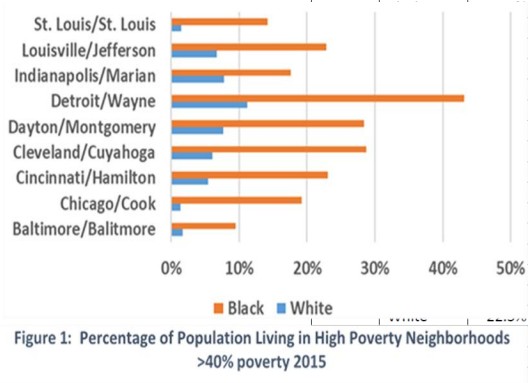
The Opportunity Gap: The Two Neighborhoods of the Fractured City
A number of studies have examined the impact of the Fractured City on opportunities for children and defined “the opportunity gap.”[18] This is the gap between the opportunities available to children in high-poverty neighborhoods and the opportunities available to children in highly affluent neighborhoods who have fewer obstacles and often have supportive networks to assist them with any
roadblocks they encounter. Figure 2 illustrates the growth of childhood poverty in several metropolitan counties. This chapter examines the social ecology of these two neighborhoods and reveals a stark injustice of opportunities for families and children in high-poverty neighborhoods.
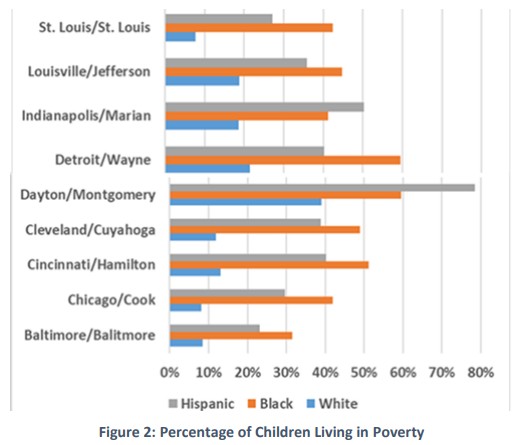
The Neighborhood Experience: Neighborhoods provide an ecology for families and can enhance or detract from the opportunities for children. The ecology of high-poverty neighborhoods presents numerous roadblocks to children's development. If we examine the demographics of high-poverty neighborhoods, we see a high percentage of single-parent families, many of whom lack a post-secondary credential. Parents often do not earn sufficient wages to support their families and must rely on different programs in the welfare system to provide for their children. These neighborhoods experience higher rates of crime, especially violent crimes. In high-poverty neighborhoods, there are fewer adult role models who demonstrate the habits and character traits required for employment and supporting a family. These neighborhoods often lack supportive networks of neighbors and friends, who help families and look out for children. Amenities, such as playgrounds and recreational activities, are lacking. With a high number of renters and abandoned properties, there is often a lack of pride in the upkeep of the neighborhood. Most often, these neighborhoods are “food deserts” without access to high-quality foods, such as fruits and vegetables. The physical environment of high-poverty neighborhoods is unhealthy with poor air quality (and a high percentage of asthma) and the presence of toxic substances such as lead paint. Often families in high-poverty neighborhoods experience isolation, without the bonds of trust and a sense of collective agency needed to work with others to improve the quality of life in the neighborhood.
The demographics of affluent neighborhoods are strikingly different. There is a higher percentage of two-parent families, and many of the parents are college graduates. One or both parents have family- supportive wages. Within families and the neighborhood, there is a high expectation that children will go to college. There are lower rates of crime, especially violent crime. There are adult role models in the extended families and mentors, teachers, and coaches. These neighborhoods offer good options for healthy food and plenty of recreational amenities, such as playgrounds and athletic leagues. The living environment is healthy, with high air quality and the absence of toxic substances.
Learning in the Neighborhoods: Multiple research studies have demonstrated that the quality of a child's early learning environments — in the family, in childcare, and in pre-school — have a major impact on the early brain development.[19] High-quality childcare and early learning opportunities are mostly absent from high-poverty neighborhoods. When parents work multiple jobs just to keep food on the table and a roof overhead, they do not have the resources for quality early learning and must rely on relatives or friends to provide childcare. There are fewer opportunities for enrichment in schools in high-poverty neighborhoods. For a multitude of reasons, parents in high-poverty neighborhoods are disengaged and/or discouraged from participating in their children’s school. Because of declining property values and high tax-delinquency rates, urban school systems have less money to invest in improving the quality of education. The systems, administrators, and the teachers are often not equipped to handle many of the roadblocks to learning that their children face.
In affluent neighborhoods, high-quality childcare and early learning opportunities are readily accessible, and families can afford these opportunities. School districts in affluent neighborhoods have the finances needed to provide high-quality early learning opportunities. The culture of schools in affluent neighborhoods reinforces college participation, and persistence rates (the percentage of students who return to college for a second year) are among the highest in the region.
Parenting in the Neighborhoods: Parents are the first teachers of their children, and parents in high-poverty neighborhoods face severe disadvantages in carrying out this task. Parenting in a high-poverty neighborhood, especially if you are single, is highly stressful because you focus on making sure your family has food and shelter while coping with a difficult work schedule. A parent in a high-poverty neighborhood experiences many roadblocks in accessing welfare benefits. As their income increases, parents often experience the “cliff effect” — a decrease or loss of a benefit such as childcare, which lessens the family's overall financial resources. Parents often cannot afford health insurance for themselves or their children. A major illness often means a major financial setback. Managing this stress gives parents little time to engage in activities that could enhance their children’s intellectual and social-emotional development. Managing the dynamics of a family in poverty puts a great deal of stress on parents in high-poverty neighborhoods and makes it difficult to handle the many roadblocks in caring for their children. This can lead to a sense of hopelessness, depression, and sometimes, substance abuse.
Families in affluent neighborhoods have more resources for nurturing and educating their children. With the predominance of two-parent families, with one or both having a post-secondary degree, there is a strong expectation that their children will go to college. At least one of the parents has employment with a family-supportive wage and health care benefits, enabling them to provide high-quality childcare and early learning. Many of the parents grew up in traditional family households, where supportive and developmental approaches to parenting have been modeled. Often a supportive network of family and friends can provide advice on parenting skills. While family life in affluent neighborhoods presents occasional stressful situations, the parents have the resilience to cope. Parents have more leisure time and can read to their children, assist them in their schoolwork, and provide enrichment activities like music education, travel and athletics.
Childhood in the Neighborhoods: Figures 3 and 4 illustrate the social ecology of the two neighborhoods, one high-poverty and the other affluent. All the above factors contribute to a lack of academic success for children in high-poverty neighborhoods. The stress of poverty negatively impacts the early development of those parts of the brain (executive function), affecting early academic and emotional learning. High-poverty neighborhoods have a higher percent of children who are not kindergarten ready, have higher levels of chronic absenteeism, greater drop-out rates, and a lower percentage who are proficient in third-grade reading and fourth-grade mathematics. Young children in high-poverty neighborhoods have heard markedly fewer words than children from affluent neighborhoods. Children raised in single-parent families, as compared to intact families, are more likely to have emotional and behavioral problems; be physically abused, smoke, drink, and use drugs; be aggressive; engage in violent, delinquent, and criminal behavior; and have developmental delays. Only a few highly resilient students from high-poverty neighborhoods will persist in school to obtain a college degree or a post-secondary credential.
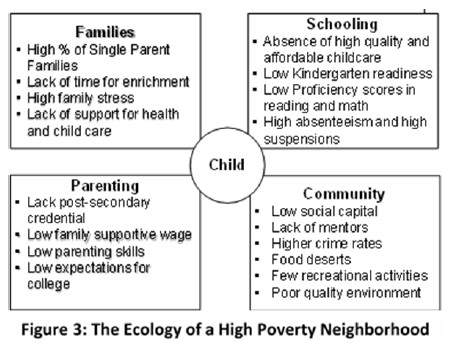
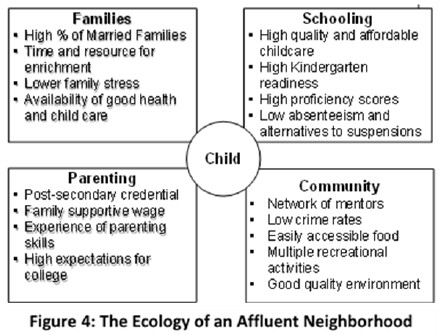
The Opportunity Gap as the Silent Violence of Poverty
Clearly, children in high-poverty neighborhoods face multiple interrelated and complex factors that place roadblocks in their journey to realize the “American Dream.” Qualitative and quantitative research methods have helped identify these factors. When you listen to children and families in high-poverty neighborhoods, you hear narratives of suffering and isolation. Listen to the story of a mother who eats very little, just so she can provide food for her children: this is a story of both generosity and suffering. Consider the story that I heard in a tutoring session where a second grader explained that he could not complete his homework because he hid in fear while his mother’s boyfriend was abusing her. A colleague tells the story about asking third graders what they want to be when they grow up and hearing one young man say his only future was going to jail. When asked why, he replied, “All the men in my family are in jail or have gone to jail.” While working on a community Task Force on Child Protection, a social worker and I visited a woman whose child had been taken into custody by Children’s Services. She had neglected the child because of her alcohol addiction but told us that she deeply wanted to change so she could be reunited her child. When the social worker called the county’s Addiction Services, she was told that this mother could not get services for nine weeks. You could see the pain and suffering in the tears of this mother. These stories of pain, suffering, and alienation tell me that a better name for the opportunity gap is the “silent violence of poverty.” It is “silent” because most people in the metropolitan region are indifferent to it, and it is “violence” because it does long-term physical and psychological harm to children, families, and to the structures of neighborhoods. Maps, graphs, and tables can demonstrate the immensity of the injustice of urban poverty and the opportunity gap; but I believe these narratives of the “silent violence of poverty” are the motivators for advancing the work of urban justice. In the quote that frames this chapter, Pope Francis asks us to listen to the poor to understand their material needs and their suffering and alienation. He also challenges us to listen to the voice of the poor, asking us to partner with them “to fight the causes of poverty: inequality, the shortages of dignified work and housing, and the denial of their rights as a member of society and as workers.”
Structural Sin in the Metropolitan Region
On April 12, 2015, when the Baltimore police approached Freddie Gray, a 25-year-old black man, he ran. As he was captured by police and pinned to the ground, according to a video, he was screaming and asking for help. While being transported in a police van, Gray fell into a coma. The police then transported him to a trauma center. After medical treatment Freddie Gray died. On the day of his funeral, riots broke out in Baltimore. In his homily, responding to the events around these riots, Archbishop William E. Lori said:
“What we do know is that Freddie Gray’s death has brought to the surface longstanding issues of what we call in Catholic moral theology ‘structural sin’—structural sin, or social sin, goes beyond individual wrongdoing. It is the sum of people’s injustice and indifference that end up creating a society where it is difficult, almost impossible, for human beings to flourish, to lead lives that are happy, productive, and secure.”
Social sin manifests itself in policies, laws, and social practices that fail to respect or enhance the dignity of certain groups in society. As we saw in the analysis of the Fractured City, social sin has a major impact on the poor and people of color. Social sin is the result or accumulation of personal sins, such as greed and racial bias, etc.
The dynamics of the region’s social architecture provide us with a lens to understand structural sin. Redlining — the practice of lenders denying mortgages to qualified borrowers, usually people of color, in certain neighborhoods — is an example of structural sin. Loan officers may have a bias against people of color and use the applicant's color and the property's location as the only indications that the person seeking the loan may not be a good credit risk. Redlining started in many communities in the 1930’s and, over the years, has had the impact of decreasing home ownership in neighborhoods, leading to a growing number of rentals and eventually to decreased housing values. Deteriorating housing stock in redlined neighborhoods motivated those that could to move to more affluent neighborhoods.
The practice of blockbusting is a second example of a social sin that has influenced the architecture of our metropolitan region. In blockbusting, real estate agents would sell a house in a predominately white neighborhood to a minority buyer (usually an African American or a Jew). In turn, the agents would then tell the remaining neighbors that a minority group was moving into the neighborhood and, if they did not sell quickly, their house would lose value and they would lose their investment. The real estate agent benefited from this churn of housing sales.
Exclusionary zoning is a third example of a social sin. Some suburbs, in order to control who could move there, would set up zoning regulations that required large lot sizes or other conditions to ensure that only more affluent families, usually white, could build houses in the neighborhood.
These three examples demonstrate the ways that personal sins, such as greed, stereotyping, and racial prejudices, coalesce into social structures and cultures that disadvantage and discriminate against people of color and those trapped in poverty. In North America, the people of color are largely African Americans, Hispanics, and Native Americans. In our analysis, it is clear that poverty affects people of color in a more dramatic way than whites. Personal bias is a set of implicit biases contained in beliefs, assumptions, and behaviors that people of color and people in poverty have inferior human traits, capabilities, and moral character compared to the white population. Family upbringing and one’s social environment are major forces in shaping this set of biases against people of color and those trapped in poverty. For the majority of us who are white, this bias is tacit and unconscious.
Over time, these personal biases influence the way we create structures and cultures in our organizations, institutions, and even our Church. These structures and cultures have set up conditions that disadvantage people of color and people trapped in poverty and provide advantages and opportunities for white persons and persons whose wealth gives them relative comfort. The architecture of our metropolitan regions has created “white privilege” and “wealth privilege.” For most of us who are white and relatively comfortable economically, these privileges are invisible to us. They have been a tacit part of our life. As we explore the response of the Church to the “Fractured City” and the “silent violence of poverty,” we must address the reality that many Catholics benefit from “white privilege” and the “wealth privilege.”
Addressing the social sins of our metropolitan regions is difficult work. Unlike personal sin, social sin is institutional and social, and reconciliation must come through institutional and social transformation. Earlier I identified the “silent violence of poverty” as the social sin that affects the well-being of children and families of our high-poverty neighborhoods. The institutional nature of social sin is difficult to observe; we are not good at analyzing the impact of institutions. We participate in social sin when we, through our actions or omissions, support or exploit the evil of social sin. We can often take refuge in the impossibility or complexity of changing socially sinful conditions and not act at all. To address social sin, we first need personal conversion to the virtue of solidarity, and we need to organize groups and associations that can bring about the necessary social transformation to overturn social sin.
In this chapter, I have outlined how many of our metropolitan regions have developed an architecture of a “Fractured City,” that has resulted in the injustice of the “silent violence of poverty.” In the next chapter, I explore the effect the architecture of the Fractured City has on the ability of the regional community and the Church to address the silent violence of poverty.
VI. The Fractured City: The Civic Community and the Catholic Church
In the previous chapter, I used demographic trends to demonstrate how a majority of metropolitan regions have become Fractured Cities and the how the fracturing of a region has created the silent violence of poverty in high-poverty neighborhoods. In this chapter, I examine how the Fractured City has created a breakdown of civic community and public discourse in the metropolitan region. Then, I discuss the consequences of these trends and cultural assumptions for the Catholic Church’s capacity to address the silent violence of poverty.
The Fractured City and Public Discourse
Excesses of American Individualism and its Consequences[20]: The Declaration of Independence asserted, “We hold these truths to be self-evident, that all men are created equal, that they are endowed by their Creator with certain Unalienable Rights, that among these are Life, Liberty and the pursuit of Happiness.” With these words, the American experiment incorporated a biblically based tradition of a Creator, and republican tradition of citizen rule with the Enlightenment tradition of life, liberty and the pursuit of happiness. Throughout many years of the Republic, these traditions existed in creative tension, providing a force for both unity and progress. The biblical and the republican traditions focus on the common good; and the Enlightenment tradition focuses on a strong individualism.
The individualistic strand of American culture insisted that a person had the freedom to define his or her own identity, as opposed to an outside entity, such as the government or church, defining that identity for them. Individuals had the freedom to pursue their interests using their own talents, abilities, and ambitions. In many respects, this strand of individualism enabled generations to settle the vast expanses of the American frontier. Individualism was responsible for making the United States, in later eras, a leader in innovation on many fronts.
As the biblical and republic traditions faded in the late 20th and early 21st centuries, so did the focus on the common good. Individualism became the predominate strand of American culture, and excessive individualism has shaped contemporary American life. Financial success, security, and status in society became the drivers that provide purpose for one’s life. The shared concern for the common good of neighborhood and city began to fade.
Excessive individualism was a major cultural cause of the regional trends of economic and racial segregation. Families experiencing the financial security of the post-World War II period were free to choose where they would like to live. Spurred by government policies that provided low-cost loans and expanded highways, for example, families could choose larger houses with bigger yards in safer and more secure neighborhoods, populated by people very much like themselves.
Polarization in the Region: As we have seen, the evolution of the social architecture of the metropolitan region has reinforced patterns of isolation and disconnection between neighborhoods of concentrated poverty and affluent neighborhoods. Each of these neighborhoods has developed its own culture, i.e., shared convictions, beliefs, attitudes, and practices. In each of these neighborhoods, residents encounter people just like themselves — people who often use the same media for information and share the same political convictions. In addition, the neighborhoods of the region have become isolated from one another and have few opportunities to share common experiences and stories. Through a variety of media, the poor know about the lives of the more affluent, and the more affluent know about the lives of the poor, often through the reports of failing schools or TV coverage of violence in poor neighborhoods. These stereotypes of each neighborhood keep them isolated from one another. Persons in neighborhoods of concentrated poverty and persons in more affluent neighborhoods have become “strangers” to one another.
As Bill Bishop indicated in 2008;
As people seek out the social settings they prefer—as they choose the group that makes them feel the most comfortable—the nation grows more politically segregated—and the benefit that ought to come with having a variety of opinions is lost to the righteousness that is the special entitlement of homogeneous groups. We all live with the results: balkanized communities whose inhabitants find other Americans to be culturally incomprehensible; a growing intolerance for political differences that has made national consensus impossible; and politics so polarized that Congress is stymied, and elections are no longer just contests over policies, but bitter choices between ways of life.[21]
Breakdown of Public Dialogue: This sorting of neighborhoods has led to polarization in regional governance and public conversations. In this climate of polarization, neighborhoods and political jurisdictions focus on self-interest and not the mutual interests of the whole region, contributing to the fractured nature of the region. Overcoming the silent violence of poverty and advancing justice requires a public space for conversations that can address complex problems and social evils and develop a shared vision for the future, characterized by equitable opportunities for human flourishing by all people and groups within the region. While some metropolitan regions have made progress, isolation and the protection of self-interest have made it difficult to create the necessary public spaces for conversations to promote the region’s common good. As David Brooks notes, “The greatest challenge of our moment is the crisis of isolation and fragmentation, the need to rebuild the fabric of society that has been torn by selfishness, cynicism, distrust and autonomy.[22]
Pope Francis and a Critique of American Culture: In many of his major writings and addresses, Pope Francis has addressed cultural changes that influence the life of the poor. In this chapter, we identify some of these cultural trends pointed out by Pope Francis.
Many persons in contemporary society have a post-modern perspective that rejects belief in universal and objective truth, leading to a rise in relativism. This relativism has led to a strong sense of individualism. Individualism evaluates situations in terms of what is best for the self, not what is best for the common good. The sense of individuality is so strong that many have lost the desire for community and for living in solidarity with others.
Pope Francis has challenged us to consider a culture of prosperity. “The culture of prosperity deadens us; we are thrilled if the market offers us something new to purchase. In the meantime, all those lives stunted for lack of opportunity seem a mere spectacle; they fail to move us.” (EG 54)
Pope Francis has identified three harmful dimensions of the culture of prosperity that also influence the life of the poor:
- the culture of comfort[23] that makes us think only of ourselves;
- the culture of waste[24] that seizes the gifts of the created order, only to savor them for a moment and then discard them; and
- the culture of indifference[25] that desensitizes us to the sufferings of others, no matter how intense, and no matter how sustained.
Individualism and these harmful elements of culture have contributed to a breakdown of concern for the poor and the common good of our metropolitan regions.
The Fractured City and the Catholic Church
Growing economic and racial segregation also has consequences for the Church’s capacity to address the silent violence of poverty in the metropolitan region. The movement of Catholics to the suburbs combined with an outmoded parochial financial strategy has caused the Catholic Church to diminish its presence in the urban core, especially in high-poverty neighborhoods.
Movement to the Suburbs: Catholics, because of their strong family structure and excellent education, most often in Catholic schools, are among the most economically upwardly mobile religious groups. In examining the available data, it also seems that Catholics are moving to the suburbs as fast as or faster than the general population of the metropolitan region. This movement has resulted in the growth of suburban parishes and parish schools. With this growth of prosperity, resources that were once used to maintain a Catholic presence in the urban core have also moved to the suburbs.
Inadequacy of a Parochial Financial Strategy: The Catholic Church faces a major obstacle to address the silent violence of poverty: an outdated and inadequate parochial financial strategy. This financial strategy, which worked well during the early and middle 20th century, places the major responsibility for creating and sustaining a Catholic educational presence on the parents of the children and resources of the local parish. This strategy assumes “If the parish can no longer support the school, based on tuition and parish resources, it is to be closed.” If there is to be a Catholic educational presence, then there must be local resources. For the most part, responsibility for Catholic presence in high-poverty neighborhoods is at the local level. The creation of special inner-city Catholic education funds has been able to prop-up this financial strategy on a temporary basis.
In almost every metropolitan region, this movement to the suburbs, the availability of fewer clergy and a parochial financial strategy are factors that have led to a significant diminishment of the Catholic presence in the urban core, especially high-poverty neighborhoods. There have been widespread closings or consolidations of urban parishes and closings of many urban Catholic schools. Initial research indicates that once a Catholic school is no longer present, a neighborhood experiences deterioration of social capital along with the elevated levels of crime and disorder and suppressed levels of social cohesion.[26]
Polarization within the Church[27]: The Catholic Church in our metropolitan regions is experiencing the same polarization and breakdown in public discourse as that of our civil community. While this breakdown in conversation is often about the application of Church doctrine to specific situations, it also enters conversations about how we might become a “poor Church for the poor.” These conversations not only rely on an appreciation of the Catholic social tradition, but also incorporate perspectives on social change and politics. Because Catholics are dispersed throughout the metropolitan region, their perspectives are diverse and are often shaped by the social and political perspective of their particular neighborhood. We have a greatly diminished capacity to hold constructive conversations that bridge across the parishes of the regional Church.
Erosion of a Public Voice: In some periods of our history as a North America Catholic Church, our collective voice made important contributions to public discourse. While several bishops have made statements on racism and immigration, the voice of the Catholic Church has been noticeably absent in shaping public discourse with in the region, especially in addressing the issues affecting the silent violence of poverty. Today, the Church often lacks the capacity to hold conversations across the parish boundaries that bring the voice of the Church into public discourse. While a number of Churches have entered into ecumenical and faith-based organizing efforts within metropolitan regions, the Catholic Church has not been a major voice in public conversations.
A Dilemma for the Church: As economic and racial segregation have grown, so have the center-city neighborhoods locked in the cycle of poverty. As Catholics have moved to the suburbs and the Catholic Church, consequently, invested its resources to build churches and schools in the suburbs, it has disinvested in the urban neighborhoods. What are the consequences for the Church and her mission to advance justice? Are the members of the Catholic Church willing to address the injustice of high-poverty neighborhoods? Many Catholics in the suburbs have little or no contact or interaction with people in high-poverty neighborhoods nor practical knowledge of the realities of living in poverty. There is a “gap” between the experience of Catholics in the more affluent and middle-class suburbs and the experience of Catholics and others living in high-poverty neighborhoods.
Growing Indifference among Youth and Young Adults[28]: Over the past fifty years, there has been a growing indifference to the Catholic faith. Demographic trends illustrate the growth of this indifference.
- In the past fifty years, the Catholic population in the United States has grown from 48.5 million in 1965 to 74.2 million in 2016 . . . but so has the number of former Catholic adults in the past forty years, from 7.5 million in 1975 up to 30.1 million in 2016. This is a growth of over 300%.
- Almost half of Catholics who are now unaffiliated (48 percent) left Catholicism before reaching eighteen years old . . . an additional three in ten left the Catholic Church as young adults between ages eighteen and twenty-three.
- Only one-fifth who are now unaffiliated (21 percent), and one-third who are now Protestant (34 percent) departed after turning age twenty-four.
Mass attendance is another indicator of indifference to the faith.
- More than three in ten adult Catholics (31.4 percent) are estimated to be attending Mass in any given week.
- Twenty-three percent say they attend Mass every week (once a week or more often.) (Sacraments Today, 2008, Executive Summary, 3).
- The above statistic on weekly Mass attendance is especially true among the “Millennial” generation (roughly those who were born between 1981 and 2000). Only 24 percent of Catholic Millennials attend Mass at least weekly, as compared to 56 percent of Catholics born before 1943.
- Among “Baby Boomers” (those born between 1943 and 1960), only 32 percent attend Mass on a weekly basis (D’Antonio, Dillon, Gautier, American Catholics in Transition: Rowman and Littlefield, 2013, 110).
The Catholic Church in America is experiencing growing indifference, especially among the young. This trend, along with growing individualism and polarization in society, indicates that the Catholic faith in America is experiencing a profound crisis. As I discussed in Chapter II of this essay, Fr. Chaminade founded the Institute of Mary during the chaos of the French Revolution, a time of great religious indifference and chaos in the Church. I do not believe it is stretching the point to claim that the state of religious indifference in North America today is very similar to the religious indifference Father Chaminade faced coming out of the French Revolution. Can the Marianist Movement of our time be a force for the rebuilding of the faith, especially working with youth and the disadvantaged?
Transition: What We See and What it Means
Chapters IV, V, and VI of this essay have attempted to observe and interpret the signs of the times that provide the context for the development of the Marianist Movement in North America in the early 21st century. Chapter VI makes us aware of signs of new life in the Marianist Movement that indicate that we are experiencing a new moment. The initiatives of the lay and religious communities indicate there is developing awareness of how, under the guidance of the Holy Spirt and our patron Mary, we must adapt and change if the Marianist charism and our missionary vocation are to be vital in the 21st Century.
Chapter V outlined what I believe are the major challenges of justice and reconciliation in our times—the fracturing of our metropolitan regions into neighborhoods great inequality of opportunity. We have created neighborhoods within our metropolitan regions where children and families suffer the silent violence of poverty. In Chapter VI, I illustrated that this fracturing of the region has led to isolation between neighborhoods and the polarization of political discourse. We have lost the capability to work toward the common good. Simultaneously the Catholic Church has diminished capacity to be present to those who are suffering the violence of poverty.
In the next part of this essay, I will reflect how the themes and principles of the Catholic social tradition and the Marian style of evangelization of Blessed Father Chaminade and Pope Francis provide us with images and principles for creating a new way of being Church in North America, a “poor Church for the poor.”
Part Three: Judging - Imagining a Poor Church for the Poor
VII. Creating a Poor Church for the Poor: Guidance from the Catholic Social Tradition
In this chapter and the following one, I outline some key themes that will help us imagine a new way of being Church—A poor Church for the poor. This chapter outlines principles and themes from the Catholic social tradition. The next chapter, a Marian style of evangelization, will provide some themes from Fr. Chaminade and Pope Francis that will also guide us. In the final chapter in Part III, I will outline a working proposal for transforming the regional Church into a poor Church of the poor.
In this chapter I want to respond to the question: “What concrete guidance can the principles of the Catholic social tradition provide to help the Church address the silent violence of poverty and to bring peace and reconciliation within our Fractured City?” Many of us are familiar with the key principles and themes of the Catholic social tradition. My purpose in this chapter is to illustrate how these principles and themes provide guidance in mobilizing the regional Church to address the silent violence of poverty in our metropolitan regions.
Respecting the Human Dignity of All
The Catholic social tradition proclaims that human life is sacred and that the dignity of the human person is the foundation of the moral vision of society. The human person is not a static entity but is on a developmental journey becoming who he or she is created and called to be. The Catholic tradition sees the human person as the image of God. As an image of God, who is loving and wise, the human person shows forth dignity through the exercise of freedom in wise and loving ways.
In working for justice in a metropolitan region, it is important to remember that all stakeholders have human dignity and have or can develop the capability of shaping their future and collaborating with others to create a common future. For example, in helping a young child living in poverty to become ready for learning when entering kindergarten, one might be tempted to ignore the role of the single-parent mother. “She doesn’t know how to develop reading skills in her children.” “She doesn’t have time to read to her children.” Given these assumptions, one might develop an approach to kindergarten readiness that relies primarily on subsidized high-quality childcare. Such an approach ignores the role of the mother as the first teacher of the child. An approach that respects the dignity of the mother would be to combine high-quality childcare with opportunities for the mother to develop the knowledge and skills needed to raise her children and support their preparation for kindergarten and to move toward a job that can support her family.
Working to realize the common good in a metropolitan region involves one of the difficult and often conflictual areas of politics, i.e., getting things done through developing public policy, programs and funding streams. In the midst of the conflicts of public conversations, it is important to remember that those who oppose a policy or programs that you advocate are still people with human dignity. In most cases, they have good reasons for supporting their position, and we should respectfully listen to what they have to say. Even in the midst of conflict over ideas and programs, it is important to remember that through conversation and respectful argument, it is possible to develop shared interests in addressing poverty.
Organizing Conversations to Promote the Common Good
Within the metropolitan region, there is a pluralism of opinions about the “human goods” to be pursued, especially when we are addressing poverty. Given this pluralism, is it possible to talk about the common good of the metropolitan region? In the Catholic social tradition, the human person is an image of a Trinitarian God, a God of loving relations among three Divine Persons. As an image of God, then, the human person is relational, and these relationships are to be just and loving. Even in the complex social ecologies of metropolitan regions, it is possible to ask, “Are the relations between and among people and groups of the metropolitan regions just: Do they support the human flourishing of all people and groups within the region?” Following the lead of Pope John XXIII, the common good of the region is the organization of the social architecture (sum total of conditions of social living) that allows all people and groups to have the opportunity to reach their fulfillment more fully and more easily. The common good of the region is an ideal toward which the stakeholders of the region should strive. As we have seen in early chapters of this paper, the current social architecture of our metropolitan regions is far from this ideal.
Given the complexity and pluralism of our metropolitan regions, the question of “How are we to work to realize the common good?” is perplexing. The multiple institutions of society must work together to realize the common good. In the Catholic social tradition, the primary responsibility of the State (multiple levels of government) is to protect and promote the common good. Yet, because the common good is such a multi-faceted reality, the State must collaborate with other institutions and organizations of society—the family, business corporations, educational systems, civic organizations, like the League of Women Voters, and faith communities—that also share the responsibility to advance and promote the common good. To work toward the common good, communities must create spaces for public conversations that bring community stakeholders together to create a vision of the future that is a better realization of the common good and to develop strategies for realizing that vision.
Developing a Consistent Ethic of Solidarity
Solidarity is a communitarian principle and virtue developed in the Catholic social tradition over the last fifty years in response to the growing interdependence and complexity of society. It has integrated traditional concepts of justice and compassion for those on the margins of society. As a moral virtue, solidarity is “a firm and persevering determination to commit oneself to the common good”. That is to say, to the good of all and of each individual, because we are all responsible for all. (SRS 39) Solidarity applies to not only our relationships that are close, such as our extended family and neighbors, but also all relationships at a distance, such as our city, our region, our nation and the world.
In a talk to labor union leaders in Chicago, Cardinal Cupich outlined what he called the Church’s consistent ethic of solidarity “that aims at making sure no one, from the first moment of life to natural death, from the wealthiest community to our poorest neighborhoods, is excluded from the table of life.”[29] The consistent ethic of solidarity is a focus that the Church and its members can bring to the public conversations of the metropolitan region.
Kristen Heyer[30] developed three helpful dimensions of solidarity:
- an incarnational dimension that challenges persons of privilege to develop friendships with those experiencing the silent violence of poverty by engaging in common experiences and by sharing stories,
- an institutional dimension that challenges groups within the Church to work in partnership with governments, civil society, school systems, etc., to transform key systems and processes of the regional social architecture so that there is greater realization of the common good, and
- a conflictual dimension in which the Church and its members must speak prophetic words that disrupt[31] the thinking and action of those who keep systems in place that exacerbate the silent violence and words that rebuild systems so that there is a greater realization of the common good.
The incarnational dimension of this consistent ethic of solidarity challenges the Church to build bridges of friendship between persons in the suburban Church and persons in high-poverty neighborhoods. The institutional dimension requires the Church to mobilize groups to be partners in transforming the social architecture of the region so there is a greater realization of the common good. The conflictual dimension requires a period of disrupting the status quo and then rebuilding a new equilibrium of the social architecture that is a better realization of the common good.
Mobilizing Participation through Subsidiarity
In the Catholic social tradition, subsidiarity is a principle guiding the distribution of authority, responsibility, and accountability within the complex network of various institutions within society. As we saw in our description of a metropolitan region as social ecology, some institutions are part of other institutions; for example, families are part of a neighborhood, and neighborhoods are part of a city, and cities are a part of counties. When examining the responsibility for the common good, the principle of subsidiarity insists that an institution should not take responsibility for the common good of a component institution that is part of the whole, unless that component institution is incapable of carrying out its responsibility for its common good. For example, in Ohio law, the primary responsibility for caring for and educating children lies with the parents in the context of the family. The larger institution, e.g., the child protection system of the county, should intervene in the family only when the family is unable to care for and educate their children. In that case, subsidiarity also requires that the child protection system should work to restore the family’s ability to care for and educate their children as best they possibly can.
In addition, subsidiarity also requires that larger institutions encourage and promote opportunities for the component institutions to participate in shaping the common good of the whole. For example, addressing crime in a city is the responsibility of local law enforcement, yet subsidiarity requires that citizens be engaged and take responsibility for addressing problems. In some cases, when addressing a regional problem of justice, the tendency is to turn the matter over to the technical experts and not involve the citizens framing and addressing the issue. As an example, graffiti may be appearing in neighborhood public spaces. By asking the neighborhood to participate in the solution, the city authorities may find out that the lack of playground space for children and young adults is one cause of the appearance of graffiti. The consistent ethic of subsidiarity requires that those most affected by a problem be involved in framing the problem, developing a solution, and implementing that solution.
The other side of the problem of engagement is citizens not taking responsibility for civic involvement. The pace of modern life for families and the challenges facing working parents—who need to chauffer children to activities, etc.—leave little time for participation in civic life. Yet, we know that one requirement for well-functioning neighborhoods is civic engagement of its neighbors. When we work to alleviate problems in our neighborhoods or cities, the consistent ethic of subsidiarity requires us to engage the people affected and to work with them to define the problem, to craft a satisfactory solution, to implement that solution, and to learn from the experience of defining, crafting, and implementing.
Adopting and Adapting the Virtue of Frugality
You will not find frugality in the typical lists of principles of the Catholic social tradition. Julie Hanlon Rubio[32] has developed the principle of frugality contained in Catholic social teachings of Leo XIII and Benedict XVI. Programs of poverty reduction have emphasized the virtue and skills of frugality through budgeting, savings, and asset building. Rubio has suggested multiple ways that we could develop practices of frugality within our Church community. In Chapter VI, I indicated that the current financial strategy of the Church is a detriment to maintaining a pastoral presence within the poorest neighborhoods of our metropolitan regions. With few exceptions, this financial strategy indicates that if a parish and its ministries cannot be support by revenues generated by the parish, then closure or consolidation of the parish is required. To become a poor Church for the poor, we must develop the means of sharing financial and human resources so that the regional Catholic Church can be an effective partner in addressing the silent violence of poverty. We as Catholics will have to develop the virtue of frugality and develop appropriate methods of sharing our resources for the ministry of the Church.
Promoting Integral Human Development
Building on Pope John XXIII’s Mater et Magistra, Pope Paul VI, in Populorium Progressio laid out a vision of integral human development that outlines both the goals of development and the processes for moving toward these goals. For Pope Paul VI, “Development cannot be limited to mere economic growth alone. In order to be authentic, it must be complete: integral, that is, it has to promote the good of every person and of the whole person”. (PP 14) This concept of integral human development makes clear that a certain level of economic development is necessary for the support of human dignity, but that economic development alone is not integral development.
To paraphrase Pope Paul VI, integral human development in a metropolitan region cannot be limited to mere economic growth alone. In order for a metropolitan region to be authentically human, it must be integral development: it has to promote the good of every person and group in the region and the good of the whole person, that is, all the dimensions of human well-being—physical health, economic sufficiency, social relations, and opportunities for intellectual, cultural, and spiritual growth.
Pope Paul VI’s concept of integral human development was further elaborated by the 1968 Medellin Statement by the Latin American Bishops (Development as Liberation), 1971 Synod of Bishops (Justice in the World), John Paul II (On Social Concerns), and Benedict XVI (Love in Truth).
Kenneth Himes, OFM has thoughtfully summarized this elaboration of integral development as a global aim:
Just development means concern for establishing fairness among the nations of the world. Integral development means achieving the proper balance between material goods and other aspects of human well-being. Participatory development requires that poor people and nations be considered agents capable of self-determination and of advancing their own development. Finally, sustainable development calls attention to fairness between one generation and the next and within generations concerning the use of the earth’s resources given by God to all humankind.[33]
Building on Himes’ description, integral development at the level of a metropolitan region must be:
- just—consisting in relationships, institutions, and cultures that create equity of opportunity for all persons and groups in the region,
- integral—integrates all dimensions of human well-being,
- participatory—engages all stakeholders and gives special preference to engage the disadvantaged as agents in creating the future, and
- sustainable—concerned with integrity of creation and equity between generations.
This elaboration of integral development helps address the injustice of the silent violence of poverty and works toward strategies to create peace and reconciliation within the metropolitan region.
These six themes and principles from the Catholic social tradition are resources for creating a new way of being Church that addresses the silent violence of poverty and works for peace and reconciliation across the Fractured City of the metropolitan region. In the next chapter, I develop a second important resource—A Marian style of evangelization.
VIII. Creating a Poor Church for the Poor: A Marian Style of Evangelization
In this chapter, I outline the key characteristics of a Marian style of evangelization. I endeavor to demonstrate that Fr. Chaminade and Pope Francis have very similar insights in their understanding of Mary’s role in evangelization. I believe this Marian style of evangelization is a gift the Marianist Movement can bring to the transformation of the Church in North America.
A Marian Style of Evangelization
Starting with Pope Paul VI, the Church has renewed its emphasis on evangelization. In Evangelii Nuntiandi, Pope Paul VI stated that the Church “exists to evangelize, that is to say in order to preach and teach, to be the channel of the gift of grace, to reconcile sinners with God, and to perpetuate Christ’s sacrifice in the Mass, which is the memorial of his death and glorious Resurrection.” (EV 14) Pope Paul directed evangelization to those who have not heard the proclamation of Christ and to those of the baptized that no longer practice the faith. Pope St. John Paul II emphasized and introduced the concept of New Evangelization and asked that the Church focus with new intentionality and ardor on preaching the Gospel to those who have lost their sense of faith or no longer belong to the Church. Pope Benedict XVI emphasized the need for evangelization to enter into dialogue with modern culture and to confront the cultural crisis brought on by secularism and relativism.
Building on the work of these pontiffs, we can see that evangelization has four important components:[34]
- Encounter—Encountering Jesus and Ongoing Conversion
- Formation—Growing in Knowledge of the Faith
- Witness—Living the Faith in Community
- Mission—Faith in Service and Transformation of Society
In Evangelii Gaudium, Pope Francis tells us:
There is a Marian “style” to the Church’s work of evangelization. Whenever we look to Mary, we come to believe once again in the revolutionary nature of love and tenderness. In her, we see that humility and tenderness are not virtues of the weak but of the strong who need not treat others poorly in order to feel important themselves.
Contemplating Mary, we realize that she who praised God for “bringing down the mighty from their thrones” and “sending the rich away empty” (Lk 1:52-53) is also the one who brings a homely warmth to our pursuit of justice. (EG 228)
Fr. Chaminade saw Mary as integral to rebuilding the faith in France. From the 1839 Letter to the Retreat Masters, we have:
This, my reverend son, is certainly the distinguishing trait of both our Societies; we are in a special manner the auxiliaries and the instruments of the Blessed Virgin in the great work of reforming morals, of preserving and propagating the Faith, and in fact of sanctifying our neighbor.
Chaminade saw the importance of Mary in what we would call the contemporary Church’s work of evangelization. Fr. Dave Fleming has commented:
A Marian Church will echo what Chaminade sought in his lifetime. It will strive to be a community of faith present to people in the concrete circumstances of life. It will enter into the practical dimensions of everyday human life, seeking a synthesis of faith and today’s culture, whether in laboratories, lecture halls and boardrooms, or in the modest circumstances of urban slums or rural villages.[35]
Both Fr. Chaminade and Pope Francis see Mary as integral to rebuilding the faith within a culture that is indifferent or antagonistic to a commitment to faith. Below we outline some key characteristics of a “Marian style of evangelization.”
Growing as Missionary Disciples
In examining the Marianist charism, we saw that as Marianists, “God asks us to follow in a special way Jesus Christ, Son of God, become Son of Mary for the salvation of all.” The goal of Marianist spirituality is “to be transformed into his likeness and to work for the coming of his kingdom.” (RL Art. 2) From the very beginning, Chaminade insisted that as Marianists, we are missionary disciples of Jesus.
Chaminade emphasized in his direction with the Sodalists and later with Marianist religious, “the essential is the interior.” In the early Rules for his religious congregations, Chaminade insisted the transformation into the likeness of Christ required a sustained effort (a System of Virtues) to put off “the old man” of sin and death and put on “the new man” of Christ. He maintained that a deep and consistent prayer life was necessary for missionary discipleship—“do not neglect prayer, however busy you may be.”
Pope Francis invites us to a personal encounter with Jesus. “I invite all Christians, everywhere, at this very moment, to a renewed personal encounter with Jesus Christ, or at least an openness to letting him encounter them; I ask all of you to do this unfailingly each day.” (EG 3) This encounter with Jesus leads us to be missionary disciples. “Every Christian is a missionary to the extent that he or she has encountered the love of God in Christ Jesus: we no longer say that we are ‘disciples’ or ‘missionaries’, but rather we are “missionary disciples.” (EG 120) It is through an encounter with Jesus, through conversion, reconversion, and proclamation of the Good News that the Holy Spirit transforms us into the likeness of Christ. Both Fr. Chaminade and Pope Francis emphasize an encounter with Jesus that transforms us into missionary disciples.
Multiplying Communities of Encounter and Dialogue
Both Chaminade and Pope Francis stress the necessity of creating communities of genuine relationships and “encounter.” Chaminade understood that to overcome the isolation that many Christians experienced coming out of the French Revolution, it was important to gather people together for mutual support in their journey of missionary discipleship. With the mutual support and challenge of a faith community, a person would find greater strength to grow in following Christ. “The Sodality is defined as ‘a society of fervent Christians … who, in order to imitate the Christian of the primitive Church, try in their frequent meetings to have one heart and one soul, and form only one same family.’”
The union of the first Christians that can exist among sodalists is founded entirely in Charity. Charity is its source and its bond. It has as its model of union the three adorable persons of the Most Holy Trinity. The union of spirits and hearts, which to a certain extent makes them a single soul in different bodies, allows Christians on earth, when they gather to savor the happiness of the blessed, which comes from their being together in the dwelling of glory.[36]
Pope Francis is a strong critic of our contemporary culture and a strong proponent of building a culture of encounter characterized by dialogue.
We live in a culture of conflict, a culture of fragmentation, a culture in which I throw away what is of no use to me, a culture of waste. … [We] must go out to meet them (others), and with our faith we must create a “culture of encounter,” a culture of friendship, a culture in which we find brothers and sisters, in which we can also speak with those who think differently, as well as those who hold other beliefs, who do not have the same faith.[37]
We must create a culture of encounter, and we must go out ourselves, because Jesus calls the Church to be missionary. We create a culture of encounter through a deep faith and in dialogue with others in the midst of differences and even polarization.
Whenever Pope Francis talks to civic leaders, his message always emphasizes dialogue in the public forum. Dialogue must replace conflict and confrontation. Pope Francis believes that dialogue is integral to the growth of individuals, families, and societies. It is only through a culture of encounter where dialogue allows each individual and group, with different perspectives and mindsets, to contribute a gift to the conversation and at the same time learn something by deeply listening to others. Dialogue allows us not only to give, but also to receive.
Being with and for the Poor
Both Chaminade and Pope Francis put an emphasis on serving the poor and those at the margins. In A New Fulcrum: Marianist Horizons Today, Fr. Dave Fleming, SM, has a chapter titled “Marianist Charism: Social Transformation or Middle-Class Conformity?” This chapter explores the early missionary endeavors of the first Marianists and makes the argument that “… I believe it is clear that we [the Marianist Family] were born as a missionary in a time of great social change, aiming not only at the spiritual salvation of prosperous individuals, but also at the renewal of the social order for the benefit of the poor and laboring class.” Fr. Dave continues the argument that “… current concerns for solidarity with the poor and marginalized and for building ‘a society that is just and fraternal’ is part of our fundamental Marianist identity.”[38]
From the very beginning of his Pontificate, Pope Francis has demonstrated through his actions and his speeches that he wants a “Church of and for the Poor.” Pope Francis’s first call to us is to move to the peripheries. He has advocated that the Church move to the existential peripheries of life, which, in the case of our metropolitan regions, are our high-poverty neighborhoods. He has strongly advocated that as members of the Church we should be present to the poor and encounter them in a very personal way. It is important that we take time to share in their experiences and stories. He emphasizes the need to listen to the stories of alienation that come from the “violence of poverty”—the stories of persons who lack food, who are homeless or without decent shelter, who cannot find adequate care for their children. These stories enable members of the Church to touch the flesh of Christ and develop the compassion needed to act in solidarity with the poor and to collaborate with them to undertake the necessary transformations of society.
Living Frugally[39] and Generously
Addressing the silent violence of poverty in our metropolitan regions will require a more just and thoughtful sharing of resources across the metropolitan region. This is a highly complex set of problems without easy answers. If the Marianist Movement in North American is to be a force in addressing the silent violence of poverty, then the Movement will have to develop a spirituality that enables it to live more frugally and generously. This will not be a panacea, but I believe it is important for three reasons. First, it will allow members of the Movement to support its work at the levels of the metropolitan region, North America, and internationally. Having the resources to support its organization and programs is a critical requirement for the Movement to make progress in its missionary vision. Second, living more frugally and generously can help us develop compassion for those who suffer poverty and privation daily. We can listen attentively to the stories of others when we have the discipline of living simply. Third, I believe there will be value in the Movement's witness to living frugally and generously. It demonstrates that persons and families can experience happiness and joy, while not being overly concerned with consumption and comfort.
Fr. Chaminade formulated his thinking on the use of goods and life style within in a French Church deeply affected over many years by the heresy Jansenism. Based on a reading of the works of St. Augustine, Jansenism over-emphasized the impact of original sin and the corrupting influence of the world on the progress of persons in the spiritual life. Fr. Chaminade's writings on poverty reflect an influence of Jansenism, yet there is much more to his concern about poverty and simple living. When Fr. Chaminade was organizing the Madeleine Sodality and later the two religious congregations, he insisted on frugality and simple living as important to our missionary vocation. He offered a number of conferences to the religious communities on the spirit of the vow of poverty, always emphasizing simplicity of life as an essential discipline for following of Christ. As a pragmatic steward, Chaminade knew that financial accountability and viability were crucial for the success of these early enterprises. As a former business manager at St. Charles, Chaminade insisted that good financial management was critical in realizing the missionary vision of the two Marianist religious communities. For our contemporary Marianist Movement, Chaminade helps us understand that living frugally and generously are important conditions for our encounter with Jesus and our growth as missionary disciples as well as for our missionary enterprise of restoring faith in a culture of indifference and comfort.
As we indicated earlier, Pope Francis has given strong personal witness to living frugally and simply. His example is a helpful discipline for us to be more aware of the voices of the poor.
“The Church is Mother, and must never forget the tragedy of her children. She too must be poor, to become fruitful and to respond to so much suffering. A poor Church is a Church that practices a voluntary simplicity in her own life—in her institutions, in the lifestyle of her members—to break down walls of separation, especially those that separate us from the poor.”[40]
Both Chaminade and Pope Francis contribute insights to the importance of frugality and simple living for our contemporary Marianist Movement. Living frugally and generously are characteristics of a Marian style of evangelization. Living frugally and generously help us more deeply encounter Jesus in our journey to become missionary disciples. Living frugally and generously will also allow the Marianist Movement to mobilize resources to address the silent violence of poverty and create a Church and society where there is greater justice, peace, and reconciliation.
Being a Prophetic Presence for Solidarity
Both Chaminade and Pope Francis have demonstrated the importance of prophetic presence in midst of society. In the key events in Fr. Chaminade's journey, we see him speaking strongly against the prevailing culture of Post-revolutionary France. He criticized the ways the philosophes and Enlightenment ideas shaped the secularism of French society that brought a reaction against the Church. He clearly recognized the profound changes taking place within his society and the Church. He was not afraid of naming trends within society that were undermining the faith—moving people away from the Church and the message of God’s kingdom. He reformulated a vision of the Church for his time that would witness that Christianity could be lived in all with the same fever and intensity exhibited by the Church of the Acts of the Apostles. He developed an apostolic method to realize this vision of a new way of being Church—the multiplication of faith-filled missionary communities dedicated to extending Mary’s mission of bringing Christ into the world.
Pope Francis has been a refreshing presence for the Church. He has used his bully pulpit to speak prophetically about the issues of justice on the local, the national, and the global levels. Pope Francis speaks prophetically by his witness to being present to the poor. He visits refugees and washes the feet of prisoners. He speaks prophetically in public forums. During his visit to the United States, in each venue, he spoke in a spirit of dialogue—building on shared values and beliefs—and was able to speak truths that raised questions about practices and structures that inhibited respect for human dignity and justice.
Pope Francis is calling us to be a Church that is able to speak prophetically in a wide variety of settings. He has called members of the Church to reflect on their indifference to the plight of the poor. He has called us to witness to God’s kingdom through our presence and encounter with the poor—listening to their experiences and stories and reflecting on desires and concerns that we share in common.
Pope Francis’s call to a prophetic presence also requires members of the Church to develop a critique of society in which injustices are identified with insight and coherence. A prophetic presence requires members of the Church to disrupt our regional social structure by speaking the truth to the powers that maintain the status quo of injustice. A prophetic presence requires members of the Church to collaborate with others to imagine a more just future and work to realize that future. Given the silent violence of poverty within our regions, the Catholic Church must be a disruptive force for advancing justice and a creative force for building the social architecture that is a greater realization of the common good.
Mobilizing Lay Leadership
Chaminade created lay leadership that was necessary for rebuilding the Church in Post-revolutionary France. One key insight of Fr. Chaminade and our Marianist charism is the realization that the sacrament of baptism bestows upon members, both lay and clerical, the grace and responsibility for building up the Church. The Bordeaux Sodality was an excellent training ground for lay leadership. There existed the multiple levels of faith development, with laity taking responsibility for building the school of faith. There were the multiple roles of responsibility in the leadership of the Sodality—some responsible for zeal, some responsible for instruction, and others for temporalities. The development of this “leadership school” was why Chaminade was recognized as a developer of lay leaders at the time of his beatification.
In addressing the Pontifical Council of the Laity in June 2016, Pope Francis stated his conviction that the responsibility for lay leadership comes from baptism and not from a “delegation from the hierarchy.”
We enter the Church through Baptism, not through priestly or episcopal ordination, we enter through Baptism! And, we have all entered through the same door. It is Baptism that makes every lay faithful a missionary disciple of the Lord, the salt of the earth, the light of the work, the leaven that transforms reality from within.
Pope Francis continues …
We need lay people who are well formed in faith, animated by a clear and sincere faith, whose lives have been touched by personal and merciful encounters with the love of Jesus Christ. We need lay people who will take risks, soil their hands, who are not afraid of making mistakes, who move forward. We need lay people with a vision of the future, who are not enclosed in the petty things of life.
Clearly, both Fr. Chaminade and Pope Francis share a common concern to mobilize the power of the laity in this time of renewed evangelization. For both these men the laity are partners with the hierarchy and collaborate with them to bring forth new life in the Church. The hierarchy is a gift of the Holy Spirit that teaches, sanctifies, and governs the Church in the name and power of Jesus Christ. The hierarchy plays an essential role in building up and maintaining the Church’s life of faith, the living of the Christian life in communion and charity, and the unity of the Church. The laity “seek the kingdom of God by engaging in temporal affairs and directing them according to God’s will.” The initiative of lay Christians is necessary, especially when the matter involves discovering or inventing the means for permeating social, political, and economic realities with the demands of Christian doctrine and life.” (CCC 898 and 899) The hierarchy and the laity work in communion for the good of the Church.
I believe these six characteristics of a Marian style of evangelization provide a distinctive contribution that the Marianist Movement can make to the Church in North America. Building capacity of a Marian style of evangelization informs the new ways of being Church that are developed in the next Chapter.
IX. Becoming a Poor Church for the Poor: Some Strategies for Change
It is important to translate the principles and themes of the Catholic social tradition and the Marianist style of evangelization of Blessed Fr. Chaminade and Pope Francis into a set of strategies for change. I will keep these descriptions of strategies at a more abstract level; tactics can be developed and debated once there is an agreement on strategic directions. I outline these strategies in three areas:
- Creating Solidarity within the Regional Church: How do we come to understand the virtue of solidarity? How do we create an awareness and experience of the silent violence of poverty within the Church of our region? How do we come together in solidarity to address the silent violence of poverty?
- Becoming a Prophetic Voice in Public Deliberations for the Common Good: How can Catholics, individuals and groups become an effective public voice for addressing the silent violence of poverty and the common good? How do we organize to promote the common good?
- Transforming the Culture and Structures of the Regional Church: How do we change the culture and structures of our regional Church, so we embody a poor Church for the poor?
While it will be important to critique, debate, refine, and enrich the strategies, it is imperative for our Church to move boldly forward to address the silent violence of poverty and be a force of justice and reconciliation within our metropolitan regions.
Creating Solidarity within the Regional Church
To be an agent for solidarity and the common good within the metropolitan region, members of the Catholic Church must grow in the practice of the virtue of solidarity—How must I love my neighbor near and far? This growth in the personal virtue of solidarity must lead to healing the fractures within the life of the metropolitan Church—solidarity across parishes. How can we enter into experiences and conversations that enable a shared appreciation of the silent violence of poverty and a deeper practice of solidarity? Below are three strategies that can help create solidarity within our regional Church.
Creating the Practice of Solidarity in Parishes: The parish community is a resource for becoming missionary disciples and for growth in the virtue of solidarity. In the parish community, we have opportunities to break open the Word of God, to celebrate God’s love manifested in the sacraments, and to extend love and care for our neighbor. The parish, especially the small faith communities, provides an ideal setting to bring the Catholic faith into dialogue with the region as a Fractured City and the silent violence of poverty that results. As persons become aware of these structures of sin, they have an opportunity for conversion to the practice of solidarity. “This conversion specifically entails a relationship to God, to the sin committed, to its consequences and hence to one’s neighbor, either an individual or a community.” (SRS 39.) The practice of solidarity is an outgrowth of how our God has loved us and calls us to love our neighbor, near and far. This love is manifested in care for individuals and the exercise of civic responsibility, i.e., care for the multiple communities in which we participate.
The complexity of the Fractured City and the silent violence of poverty and God's call to love our neighbor requires the virtue of solidarity. As St. Pope John II tells us, this virtue is “not a feeling of vague compassion or shallow distress at the misfortunes of so many people, both near and far. On the contrary, it is a firm and persevering determination to commit oneself to the common good; that is to say to the good of all and of each individual, because we are all really responsible for all.” (SRS 38). Growing in the virtue of solidarity allows us to partner with others to create social conditions where all families and children in our region have an opportunity to flourish. A necessary condition for creating solidarity in the region is the presence of vital parishes where the virtue of solidarity can thrive.
Creating a Sustainable Catholic Urban Presence in one or more High-poverty Neighborhoods: In previous chapters, I illustrated that poverty in high-poverty neighborhoods is generational poverty. If the Catholic Church wants to address poverty in an integral and sustainable manner, then it must use best practices of poverty reduction. An emerging best practice for breaking the cycle of poverty is the two-generation model.[41] Two-generation programs are organized in different ways, yet their common thrust is to provide high-quality early learning for children and, at the same time, provide parents with the resources they need to move from poverty to economic self-sufficiency and a better quality of life for themselves and their families. “Research has documented the impact of a parent’s education, economic stability, and overall health on a child’s trajectory. Similarly, children’s education and healthy development are powerful catalysts for parents. Two-generation approaches provide opportunities for and meet the needs of low-income children and their parents simultaneously, helping the two generations make progress together.”[42]
The Catholic Church has been able to maintain some good quality PK-8 education opportunities in high-poverty neighborhoods. In addition, Catholic Charities and Catholic Social Services have good records of providing social services to many of these neighborhoods. By employing thoughtful methods of financing and by creatively aligning current programs, the regional Church would be in an excellent position to create an effective Urban Catholic Presence using a Two-Generation approach to poverty reduction in one or more high-poverty neighborhoods. The Urban Catholic Presence will be a place and programs. The staff of the Catholic Church will organize and collaborate with others to provide an integrated set of programs that:
- help children receive a strong start in early learning and gain access to an excellent PK-8 Catholic school that will prepare them to successfully transition into a Catholic college preparatory high school;
- provide parents of the students with the knowledge and skills needed to build strong families, to support their children’s learning, and to develop economic self-sufficiency;
- partner with the people of the neighborhood in organizing the assets of their neighborhood and developing programs and structures that will improve their quality of life;
- provide an evangelizing outreach to the neighborhood, and
- provide experiences of hospitality and dialogue for the members of the regional Church to develop a shared experience of solidarity across the region.
There are multiple ways to organize this Catholic Urban Presence, yet to realize this venture requires the support of multiple parishes acting as a regional Church. I suggest one approach to organizing and financing the Catholic Urban Presence in the third set of strategies outlined below. A number of publicly funded programs, such as Head Start, work force development, and food pantries, could be effectively integrated into the Catholic Urban Presence.
Bridging and Healing the Fractured Church: Examining the place of the Catholic Church within the architecture of the Fractured City showed the gap of experience that exists between Catholics in suburban parishes and people in high-poverty neighborhoods—both Catholics and people of other faith traditions. One of the first tasks in creating solidarity across the regional Catholic Church is to bring people from these diverse experiences into a setting that allows them to share experiences and stories. Out of these conversations, friendships can grow, providing a starting point for healing, reconciliation, and solidarity. Creating spaces for encounter and dialogue, that bridge diverse experiences, is a critical task for a poor Church for the poor.
The creative linking of our parishes in the metropolitan region with the Catholic Urban Presence is excellent opportunity for providing these spaces of encounter and dialogue. A few examples can illustrate the variety of possibilities. We could use the Urban Catholic Presence to host a series of potluck dinners where people from suburban parishes join with people of the neighborhood to share their experience of urban living, the hopes both groups have for their families, their stories of joy and sorrow. Over time, these dinners can become places of hospitality that welcome diversity and where persons share their experiences. In this context, people can come to a more a compassionate understanding of one another. These conversations could be the start of joint programs or projects that enhance the quality of life for families in the neighborhood.
The Catholic Urban Presence can host retreats where persons from all over the region could come together to reflect and pray over the message of Pope Francis on becoming a poor Church for the poor. The retreat talks could explore the pope’s message from a variety of perspectives, e.g., neighborhood location, ethnic background, etc. Spaces would provide for small group conversations, informal sharing, and meals together. The regional Church could create similar retreat experiences for students in Catholic elementary and high schools. Again, the aim is to promote understanding, compassion and friendship. Some of these retreat experiences may evolve into shared social action projects, like creating play spaces for children, reclaiming and rebuilding houses in the neighborhood, and developing neighborhood gardens. Again, these experiences are opportunities to create awareness, break down stereotypes, and build friendships, all of which are the basis for urban solidarity. The key point is that a vital Catholic Urban Presence, a place and a staff, along with willing persons and clergy of the various parishes can begin to build a strong solidarity in the metropolitan Church.
Becoming a Prophetic Voice in Public Deliberations for the Common Good
Pope Francis has called the Church to be a prophetic voice in public deliberations. The regional Catholic Church must organize structures and processes that allow it to be a prophetic voice in public deliberations that address the Fractured City and the silent violence of poverty. Earlier, I used Bishop McElroy’s apt phrase “disrupt and rebuild” to describe this prophetic voice. To disrupt and rebuild requires Catholics, as individuals and in organized groups, to play an active role in public deliberations that address the silent violence of poverty and advance the common good of the region.
Exercising Roles of Leadership and Service in Public Life: Catholics can advance the common good through their roles in society, e.g., government, business, and the civic sector. Catholics who fulfill a role in public service in government can bring their faith and its social tradition to public deliberation. Whether they are elected or appointed officials, these people will play a key role in public deliberation. Pope Francis has strongly encouraged Catholics to take on the role of public service and leadership.
Regional business leaders not only have responsibility for their business and its contribution to the common good of the region, but also have significant influence in shaping public deliberations. In many metropolitan regions, business leaders have often taken the initiative to address problems of equity and justice and have organized forums for public deliberation. Faith-filled Catholic business leaders who are conversant with the principles of the Catholic social tradition can make major contributions to the public deliberations that address the silent violence of poverty.
Catholic leaders in non-profit organizations, such as universities, hospitals, public schools, and social service agencies, can also make major contributions to public deliberations on the regional common good. These leaders often control critical resources for the common good of the region. Working with others, these leaders play a major role in aligning resources and programs to address the complex issues of justice.
Organizing Forums on the Common Good: Members of the Catholic community often formulate their position on critical issues in the public life of the region based upon information gleaned from selective sources and their close associates in the neighborhood or work setting. Rarely does the Catholic community have an opportunity for conversations that bring the principles of the Catholic social tradition into dialogue with a critical regional issue.
There are times when regional issues come to forefront of public attention and deliberation, such as a levy on human services, a school levy for an under-performing school district, the design of public transportation routes, etc. As part of the attention and deliberation process, it would be important for the regional Church to organize a forum where members of the Church could view the issues from the perspective of the Catholic social tradition and hear differing viewpoints. In the practice of solidarity, it would be critical that those affected by the issue have a voice in the forum, especially those at the margins who rarely have a voice in public deliberation. To organize these forums would require the Church to act as a Regional Church.
Organizing for Change: The community organizer is another important resource in public deliberation. The community organizer works with a group or groups adversely affected by public issues, e.g., crime in a neighborhood, the poor performance of public schools, the lack of affordable housing etc. Together, the organizer and the group work to define the issue the group wishes to address. Engaging stakeholders in the issue, the organizer and the group work to create solutions, policies and programs, which address the concern. Once there is clarity about the issue and solutions, the organizer and group endeavor to use persuasion and the political processes to bring about implementation. Often Catholic community organizing groups can collaborate with ecumenical organizing efforts to address the silent violence of poverty in the region. Here again, to effectively use community organizing to address the silent violence of poverty, the Church will have to act as a regional Church.
Transforming the Culture and Structures of the Church
To become an agent for advancing the regional common good, the Church in metropolitan regions must substantially transform its structures and modes of dialogue and deliberation. I explore four of these transformations.
Develop an ecclesiology of the “both and:” To realize Pope Francis’s vision of a poor Church for the poor, we must develop regional solidarity, which requires both vital parishes and a Church that can act regionally. Vital parishes are the seedbed for a strong faith and a community that grows in the virtue of solidarity. However, vital parishes alone will not address the Fractured City and the silent violence of poverty. In addition, the Church must act as the regional agent in advancing the common good of the region. In my judgment, this will require a transformation of our ecclesial culture to a culture of “both and.” While there is much more to do, in many situations the Church has developed vital parishes. In addition, the regional church must take on the task of building structures and processes that will allow it to be a regional voice of solidarity.
Develop a collegial Church that authentically engages the laity: Most often, when you ask someone in the larger civic community, “Who are the leaders of the Catholic Church?” they will not be able to name someone or point to a cleric within the Church. While clerical leadership will be important in many pastoral dimensions of becoming a poor Church for the poor, it will be equally important to have strong lay leadership involved. Lay leaders have the skills to manage, lead, and develop support for the transformation changes that are needed. Lay leaders will be vital in developing a sustainable Catholic presence in high-poverty neighborhoods as well as designing and implementing the initiatives for the Church to be a regional player in addressing the silent violence of poverty. In my judgment, we have not called for and provided opportunities for our Catholic laity to take significant leadership in our regional Church. To develop lay leadership our regional church must provide opportunities to grow in the practice of solidarity, to deepen their knowledge of the Catholic social tradition, and practice the skills of changing the culture and structures of the regional Church.
Provide bold and visionary leadership from the bishop and clergy: The metropolitan Church's clerical leadership (the bishop or his delegate) and a critical mass of the clergy must embrace the vision of becoming a poor Church for the poor. They must commit to collaborating and engaging with others to design and implement the social innovations needed to realize the vision of a poor Church for the poor. This will require a style of pastoral leadership that engages Catholics in the metropolitan region to reflect seriously on their call to solidarity and motivates them to give priority to and to do more for the poor of the region. Some clergy and, perhaps, some Catholics in more affluent suburban neighborhoods may resist implementing the new social innovations required to become a poor Church for the poor. Overcoming this resistance will require skills of persuasion that allow people to see the social reality of the silent violence of poverty from the lens of solidarity and the option for the poor.
Develop creative methods for leading and organizing the Church: To take on the mission of advancing urban solidarity, the pastoral leadership (the bishop and priests) and their lay collaborators must organize a group with a mandate to design, initiate, and sustain a Catholic social innovation in high-poverty neighborhoods that will help break the cycle of poverty. This group must have membership from the high-poverty neighborhood, the middle-class neighborhood and the more affluent neighborhood. The three neighborhoods must together engage in a constructive public conversation using some version of the rubric of “Observe, Judge, Act, and Reflect” that will allow the Church to practice urban solidarity.
To realize these social innovations will require a post-parochial strategy for resource management. This will require not only strong fund-raising capability, but also for parishes in more affluent neighborhoods to share some of their resources to help fund the social innovation needed to practice regional solidarity and address the silent violence of poverty.
Part Three: Judging - Imagining a Poor Church for the Poor
VII. Creating a Poor Church for the Poor: Guidance from the Catholic Social Tradition
In this chapter, I use the analysis of the previous chapters to organize some recommendations that could provide momentum for the Marianist Movement in North America. I organize these strategies for different levels within the Marianist Movement.
Recommendations for the North American Level of the Movement[43]
The Marianist Family Council of North America brings together leaders from the three constitutive communities of the Movement, the Marianist Lay Community of North America, the Daughters of Mary Immaculate, and the Society of Mary of the United States. I believe this Council can and should be a catalyst for the Marianist Movement in North America.
Developing a Strategic Direction Statement and Plan for the Movement: For the Marianist Movement to be an effective evangelizing presence in North America it must have both a strategic direction and a plan to realize that strategic direction. In Chapter IV, I indicated that a number of emerging trends lead me to believe there is new moment for the Marianist Movement. Each of the constituent communities of the Movement have developed, somewhat independently, plans to address the evolving situations of their presence in North America. This new moment presents an opportunity for the Marianist Family Council of North America to discern a common strategic direction. This common strategic direction can provide an integrative framework for each of the constituent communities as they set their strategic directions.
A strategic direction statement for the Marianist Movement could contain the following elements:
- Core Beliefs: The statements of key principles and commitments of the Marian style of evangelization that motivate and shape the Movement; and
- A Vision Statement: A simple one- or two-sentence statement describing the impact that the Marianist Movement wishes to have on the Church and society;
- A Mission Statement: A concise description of “what the Movement” does;[44]
- Strategic Goals: A limited number of long-range outcomes that the Movement would like to accomplish.
Based on the ideas of previous chapters, I believe the core beliefs of the common strategic direction should include a commitment to a Marian style of evangelization characterized by[45]:
- Growing as Missionary Disciples
- Multiplying Faith Communities of Encounter and Dialogue
- Being With and For the Poor
- Living Frugally and Generously
- Being a Prophetic Presence for Solidarity
- Mobilizing Lay Leadership
I believe the statement of core beliefs should include a commitment to address issues of the metropolitan regions as Fractured Cities, the Church as a Fractured Church, and the existence of the injustice of the silent violence of poverty.
Developing a Strategic Direction Statement along these lines will be a difficult, complex multi-year process. Yet, I believe undertaking this process will help solidify the collaboration of the three constitutive communities in the Marianist Movement becoming an important ecclesial movement[46] in North America.
Recommendation No 1: The Marianist Family Council of North America should lead a multi-year discernment process to develop directional statements (core beliefs, vision, mission, and strategic goals) to guide the development of the Marianist Movement in becoming an important ecclesial movement characterized by a Marian style of evangelization.
Deepening and Adapting Marianist Practices that Enrich the Charism: In Chapter III, I indicated that Fr. Chaminade developed a set of Marianist practices to keep the flame of the Marianist charism alive in succeeding generations and in the face of new challenges. I also suggested that one way to view these practices is to organize them in three clusters:[47]
- Practices of Spirituality—Mary as Mother, Prayer of Faith, System of Virtues, and Spiritual Direction
- Practices of Internal Organizing—Attractive Witness, Three Offices, Constructive Meetings, and External Direction
- Practices of Mission—Missionary Alliance with Mary, Multiplication of Christians and Christian Communities, and Prayerful Discernment of Missionary Initiatives.
Recommendation No. 2: The Marianist Family Council of North America should provide leadership to organize and integrate the many initiatives within the Movement to develop resources and formation programs for deepening and adapting the practices that enliven the Marianist charism.
We keep the flame of our Marianist charism alive by deepening the Marianist practices in our own lives and in the lives of our communities. Multiple resources are available on these Marianist practices, e.g., growing in the likeness of Christ, the role of Mary, principles of Marianist spirituality, faith of the heart, the systems of virtues, Marianist direction, etc. To inspire and energize the Marianist Movement, each of us as Marianists must deepen our use of these practices in our personal growth in the likeness of Christ and in our community development. We cannot share with others what we ourselves have not internalized and made part of our daily practice.
Most of what has been written about the Marianist practices has focused on their context within the vowed religious life. It is important for the growth of the Movement that these practices be adapted and extended to lay spirituality. For example, the Saragossa Experience, a retreat for religious before final vows, has proven to be an excellent means of deepening an appreciation of the Marianist charism and the practices of Marianist spirituality. I believe this experience could be adapted to fit into the lay lifestyle by shaping it for weekend retreats and a series of daily meditations. Bro. Thomas Giardino, SM, has adapted many of the Marianist practices of internal organizing in his book The Promise and the Path: Starting and Sustaining Marianist Communities.[48] It would be beneficial for communities to utilize this book as part of an ongoing formation process and to reflect on how these practices can strengthen the internal workings of the community. Chaminade’s insights on multiplying Christians, a Marianist practice of missioning, can be adapted by using contemporary ideas for faith formation. A Marianist method of social analysis and discernment can utilize the rich tradition of Catholic social tradition’s See, Judge, and Act.
Building Intellectual and Professional Capital: Many of the resources on the Marianist charism and practices have been written by a generation of Marianist religious who have entered or will soon enter into their senior years. If the Marianist Movement is to be an effective ecclesial movement in the Church, then it must continue to develop the intellectual capital needed to sustain it. The Movement should have persons who can deepen and extend the Marianist charism and practices, but also persons skilled in relating the charism to important issues within the Church and society. We need persons with the knowledge to provide a thoughtful social analysis of the signs of the times and to shape appropriate responses to these signs. As the “little Society of Mary,” our plans in this area will have to be modest and realistic, but we cannot neglect developing persons, both lay and religious, who can bring intellectual resources to the Movement.
Recommendation No 3: The Marianist Family Council should create a plan to develop the intellectual resources, both lay and religious, needed to sustain the Marianist Movement in North America.
To be an effective ecclesial movement the Marianist Movement must have people who can competently bring the message of the Gospel and our Marianist charism to all sectors of society. Recently a number of lay Marianist have reflected on ways the Marianist charism and Marianist practices could be utilized in professional settings such as business or public policy. The Marianist Movement needs professional interest groups that can explore critical issues in professional areas and use the Catholic and Marianist tradition to forge responses to these issues. The leadership team of the Marianist Lay Community of North America could facilitate these initiatives by encouraging those interested in this exploration and providing some resources to facilitate conversations. NACMS, working with the Institute for Pastoral Initiatives at the University of Dayton, could set up blogs and video conferencing approaches that would facilitate these conversations.
Recommendation No. 4: The Leadership Team of the Marianist Lay Community of North America should support and encourage champions who wish to organize professional interest groups within the Marianist Movement.
Some members of the Marianist Movement are exploring the formation of Marianist Business Associates, who would reflect on how the Marianist charism and practices could influence the world of economics and business. The development of these professional interest groups will require a champion or co-champion to provide leadership and a number of dedicated persons to be part of a leadership team.
Holding a Leadership Assembly for the Marianist Movement: Both the Society of Mary, United States Province, and the Lay Marianist Community of North America have held periodic assemblies. These assemblies have been of great benefit in reflecting on the past and in reimagining the future. As we move into the future and develop an appreciation of the Marianist Movement, it would be important for the leadership, at different levels of the constituent communities, to meet periodically to reflect on the past and to reimagine the missionary vision of the Marianist Movement.
Recommendation No. 5: The Marianist Family Council of North America should test the feasibility of a Leadership Assembly of the Marianist Movement of North America. This Assembly could bring together the national leadership teams of the three constitutive communities as well as the leaders of regional Marianist Family Councils. The purpose of the Assembly would be to further conversation on the guiding ideas of the Marianist Movement and mutual learning on programs promoting the missionary vision.
Recommendations for the Metropolitan Level of the Movement
For reasons I outlined in Chapter IV of this essay, I have been focusing on the development of the Marianist Movement as reality in a metropolitan region. In major metropolitan regions of North America, there are varieties of configurations of Marianist lay and religious communities and Marianist- sponsored apostolic organizations. Dayton, Honolulu, and San Antonio, for example, have multiple lay and religious communities as well as Marianist-sponsored apostolic works, such as high schools, universities, parishes, etc. At the other end of the spectrum, some regions may have only one lay or religious community. In this section, I outline some key roles and processes for the Marianist Movement in a metropolitan region. The implementation of these recommendations will take time and patience and should emerge in an organic manner. The ideal is not to create a bureaucracy, but a framework for dynamic coordination of a missionary vision.
Regional Marianist Family Council: The Marianist Family Council provides leadership for the Marianist Movement in a metropolitan region by:
- organizing deliberative conversations to prayerfully discern guiding ideas (vision, mission, and core belief statements) and develop plans to realize these guiding ideas;
- authorizing projects and events/celebrations that are integral to the plan and making sure an accountable champion provides leadership;
- providing formational activities in Marianist charism and Marianist practices for members in the region;
- raising resources to support the work of the Council, and
- communicating directions, plans, and activities to Movement members in the region and to the Marianist Family Council of North America.
Activities of the Council: The three offices of Zeal, Education and Temporalities can provide a way of organizing the planning and implementation of the Council. The activities of the Council would be in two general categories: Projects and Events/Celebrations.
Projects are focused activities that bring people and communities together around outcomes related to the regional mission of the Marianist Movement. Projects of the region usually require the collaboration of two or more communities of the Marianist Movement. The Marianist Movement in a region could start out with one project and grow its capacity to organize and collaborate in additional projects. The Mission of Mary Cooperative, in Dayton, and the Reentry to Community from Prison, in Honolulu, are good examples of projects. Committing to a project requires the generosity of availability to be present at regularly scheduled times as well as at unusual times. For example, if a woman making the journey from jail to a more stable quality of life encounters a crisis moment, then the Marianists who are her supports have to make an on-the-spot adjustment to be present with her in that moment.
Events/Celebrations are activities that take place on a specific day or days and are important to the plans of the regional Marianist Movement. An example of an event/celebration would be the hosting of a Founders Day Celebration in the metropolitan region or monthly formation meetings. Again, to pull off these events requires the generosity of volunteers.
Important Roles in the Regional Marianist Movement: To be effective, the Regional Marianist Movement Council must develop role descriptions and recruit people to fulfill these roles. Below is a tentative list of some key roles.
- A Director or Co-Directors: provide leadership for the Council. These positions would be responsible for organizing and delegating the work of the Council. It is important for the Council to have, or develop, a set of guiding ideas (vision, mission, and core belief statements) that are appropriate to the capabilities of the members of the regional Movement and factors in the regional context.
- Champions: Champions are persons responsible for organizing and managing a project or Events/Celebrations within the Movement. For example, the Marianist Manna project in Dayton has a champion that schedules the series of potluck dinners for ongoing formation in Marianist practices. The champion organizes the formation topics and coordinates resources for these dinners.
- Volunteers: To implement a project or an event/celebration, the champion will need to count on persons within the Movement who can provide enthusiastic assistance.
- Weavers (Recruiters): Weavers are an important part of the dynamics of a Movement. Weavers are intentionally curious about people and their interests. The Weaver invites people to the public events of the Movement and invites them to participate in a Marianist Community. Weavers also use these skills to connect people from different communities to be volunteers in Movement projects.
- Accompaniers: The Marianist Movement is a spiritual and religious movement. For the members to grow in conformity to Christ as missionary disciples they ought to be accompanied by excellent spiritual directors. While several Marianist religious have been or are training to be spiritual directors, there is a need for many more people, both lay and religious, who are able to accompany persons on their journey.
As Regional Marianist Movement Councils develop, it will be important to assess their missionary vision and their ability to plan and implement programs that help realize that vision. Regional Marianist Movement Councils will thrive and grow to the extent that they are accountable for the missionary vision and learning through their activities, both the successes and the failures.
Recommendation No. 6: Regional Marianist Movement Councils should periodically review their operations and effectiveness at realizing their missionary vision and mission. The Regional Marianist Movement Council can disseminate their evaluations and effective best practices to other Regional Marianist Movement Councils.
Developing a Sustainable Project of Urban Solidarity: For our Marianist Movement to grow, I believe it is necessary for regional councils to investigate issues of urban poverty and discern how they might be partners with those who are at the margins, and together address critical issues of urban justice. There are multiple ways to undertake this task. The Mission of Mary Cooperative, for example, is a project initiated and sustained by a Marianist lay community. The Honolulu Prison Reentry Program is a partnership with an ecumenical coalition in the community that was addressing the issue of prison reentry. In both these cases, Marianist communities, both lay and religious, in partnership with others and with neighborhoods, provided a bridge for students, faculty and staff at our Marianist-sponsored schools and universities to be present to the realities of people at the margins.
Recommendation No. 7: Regional Marianist Family Councils should periodically review the operation and effectiveness of their urban solidarity project or projects and share these findings with other Regional Marianist Family Councils.
One of the characteristics of a Marian style of evangelization is multiplying communities of encounter and dialogue. As the Marianist Movement establishes a presence in neighborhoods of poverty or with people at the margins, it can use that presence to build a bridge between suburban Catholics and neighbors in high-poverty neighborhoods. Using methods of encounter and dialogue will allow both groups to share their appreciation of the critical issues of justice and equity. Over time, this encounter and dialogue can lead to forging effective responses to the issues.
Presence with those at the margins also will allow the Marianist Movement to develop linkages with non-profit organizations and ecumenical groups. The Mission of Mary Cooperative works to accomplish its mission through collaboration with East End Community Services, a community center, and with New Hope Church, a non-denominational church. The prison reentry project was started by the Marianist lay community joining an ecumenical and public foundation effort in Honolulu.
Through their presence with those at the margins, members and communities of the Marianist Movement can collaborate with others to make sure that the voices of the poor are part of public conversations of the region. Working to bring these voices forward is one way of being a prophetic presence in the region. When important issues are on the ballot, such as a school levy or a human services levy, the members and/or communities could weigh into these conversations by writing op-ed pieces in the local paper and by participating in public meetings on the issues.
Developing Regional Formation Programs: In Chapter III, I briefly illustrated how Fr. Chaminade organized a formation program for the Sodality of Bordeaux and for the two religious communities. These formation programs emphasized an appreciation for the Marianist charism and the practices that support the growth in the charism. One of the key responsibilities for the Regional Marianist Movement Council is to provide an ongoing formation program for the members in the region. This formation program can take many forms in order to adapt it to the different needs and responsibilities of the members, but without a solid formation program, the Movement will flounder.
Recommendations No. 8: Regional Marianist Movement Councils should develop an annual regional plan for formation in the Marianist charism, Marianist practices, and in implementing its missionary vision. These programs could use the formation resources developed at the national level and disseminated through the North America Center for Marianist Studies.
Recommendations for the Society of Mary—Province of the United States
I direct this last set of recommendations to the new Provincial Council of the Society of Mary, Province of the United States. They are assuming leadership at a critical moment in the development of the Marianist Movement in North America. Their ability to animate and collaborate with the other communities of the Marianist Movement will provide great momentum for the Movement.
Evaluate the Progress on Vision 2020 and renew the Strategic Plan: I am assuming that the new Provincial Council will undertake an evaluation of Vision 2020 and then develop a process for setting strategic directions for the Province. Goal D in Vision 2020 states, “The Province of the United States, in partnership with other communities and individuals of the Marianist Family, will promote in each geographical region of the Province a network of sponsored apostolic organizations and faith communities that is animated by the Marianist charism.” While I wrote the draft of Goal D for the Strategic Planning Committee, in retrospect, it is incomplete. It does not answer clearly the question, “Why do we want to organize this network?” In the context of this paper, I believe the “why” is to create the Marianist Movement in a given geographical region that has a Marianist Missionary Vision and is implementing a Plan to realize that vision. In the Province’s new strategic direction statement, I believe we need a goal, like Goal D, that in each geographical region of the Province our communities will collaborate with the Lay Communities of the Movement and the Daughters of Mary Immaculate to create the Marianist Movement in the region.
Recommendation No. 9: One emphasis of the evaluation of Vision 2020 should be on the strengths and weaknesses of the Province in promoting the Marianist Movement. As the Council works on revising the Province strategic directions, it should consider how it would collaborate with other communities in the Movement to realize the Marianist Missionary vision and plan for North America.
Constructive Conversations on Reimagining our Missionary Narrative: The previous Provincial Council held periodic conversations, especially with younger religious, to focus on key issues in the Province. These conversations seem to be of great benefit to participants. At this time of transition, I believed focused conversations at the regional level on our missionary narrative would provide new energy. In Chapter I, I indicated that we could view our Marianist missionary narrative as a selective reconstruction of where we have been as a Missionary movement and where we are going in the future. The missionary narrative is the story we tell to the Church and society, as well as ourselves, about our missionary intent. Given the disruption of our times, nationally, internationally, and in the Church, I believe it is important for members of the Province to have some extended conversation on our missionary narrative. One way to have this conversation is to examine three questions: “Through the lens of our Marianist charism and tradition, how do we read the signs of the times?” “What type of Church does our Marianist charism call us to be a catalyst in creating—our missionary vision?” “What means will we use to work toward our vision—our missionary plan?” To me, it is clear that as we move into the near future, the Province will be smaller, and we will not be able to do all the things we have once done. Nevertheless, we can grow as a vital and attractive community if we can come to some consensus on an exciting missionary narrative—one that builds on our Marianist traditions, presents a coherent reading of the signs of the times and provides a focused Marianist Missionary Vision and Plan.
Recommendation No. 10: The Provincial Council should consider holding periodic regional conversations to focus on re-articulating the Marianist missionary narrative of the Province and its relationship to the missionary narrative of the Marianist Movement in the United States. These conversations should also define the spiritual and organizational resources needed to support the missionary narrative in the different regions of the Province.
Collaborate on a Sustainable Urban Presence:[49] In our early history as the Society of Mary in North America, we responded to needs of families and communities that were at the margins of society, especially newly arrived immigrants and struggling working-class families in urban areas. In Chapter IX, I briefly outlined a two-generation approach to poverty reduction that I called the Catholic Urban Presence. The primary intent of the Catholic Urban Presence is to break the cycle of poverty by providing high-quality learning for children while also providing parents with the resources they need to move to economic self-sufficiency and a better quality of life for their families. A secondary intent of the Catholic Urban Presence is to be a place for programs that create relationships and build bridges of solidarity among families and children from suburban parishes and the center city. The Urban Catholic Presence can be a vital strategy for creating solidarity within the metropolitan region.
Recommendation No. 11: As part of its strategic planning, the Provincial Council should seriously consider partnering with the other communities of the Marianist Movement and other groups to establish a Sustainable Urban Presence in one of the neighborhoods of a key geographical areas of the Province.
No doubt undertaking this initiative is complex and risky. Yet, I am convinced that it is doable. It will require multi-year planning, strong doses of creativity, collaborating with others, and the ability to raise resources to sustain this Catholic Urban Presence. Most of all, I believe the challenge of Pope Francis to be a “poor Church for the poor” requires us to take on a project of this magnitude and complexity. In my judgment, religious communities in today’s Church must be communities of courage and hope that are willing to undertake risky initiatives for the sake of justice, peace, and reconciliation in our metropolitan regions.
In this chapter, I offer recommendations that I believe can provide substantial momentum for the Marianist Movement of North America in the middle decades of 21st Century. Again, I offer them in a spirit of constructive conversation where we debate, clarify, correct, enrich, and eventually decide on bold actions to be catalysts and partners in creating a “poor Church for the poor.”
XI. A Summary and Continuing the Conversation
A Summary of the Arguments
This essay provides a summary of ideas and conclusions I have drawn from multiple conversations on the Marianist Movement. In the Introduction (Chapter I), I indicated the question that has shaped this inquiry, “What does the future hold for the Society of Mary (Marianists) and the larger Marianist Family?” I introduced the concept of the Marianist missionary narrative and briefly outlined what I see to be Blessed Fr. Chaminade’s original Marianist missionary narrative—the Institute of Mary—a dynamic network of apostolic faith communities aimed at renewing the Church of post-revolutionary France. I suggested that as the Society of Mary came to the United States that missionary narrative shifted to becoming a creator and sustainer of a network of excellent Catholic educational institutions and related means of evangelization, especially focused on formation in faith. In my judgment, what was lost in this narrative is the importance of building leadership for lay communities of faith that were to be missionaries to the contemporary Church. I concluded this introduction by asking whether we can recapture for our day Chaminade’s Institute of Mary by introducing the image of the Marianist Movement, an ecclesial movement known for its Marian style of evangelization.
Part One: Remembering—Learning from the Original Missionary Narrative endeavors to give a brief overview of Father Chaminade’s original missionary narrative (Chapter II) and some lessons we can draw from this missionary narrative for our inquiry question (Chapter III). In Chapter III, I have endeavored to identify important ideas and principles that drove the dynamism of the Marianist communities in the early years. I suggest that if the Marianist charism and the Marianist Family is to be a dynamic institutional resource for the renewal of the Church, then we must find innovative ways to revitalize these ideas, principles and practices in the early decades of the 21st Century.
Part Two: Seeing—Noticing and Interpreting the Signs of the Times identifies three trends or developments that I believe are important for Marianists, lay and religious, to notice and analyze. In Chapter IV, I introduce the concept of an ecclesial movement as a lens for examining the current state and potential future of the Marianist Family. The Marianist Family has several characteristics of an ecclesial movement, yet is underdeveloped in some important areas, such as a common formation curriculum, formation practices, and defined levels of commitment. This chapter concludes by summarizing trends within the current Marianist Family that, I believe, indicate that we are experiencing a New Moment—a time for the Marianist Family to become the Marianist Movement—a vital spiritual and apostolic movement within the Church of North America.
Chapter V - The Fractured City and the Silent Violence of Poverty utilizes Pope Francis’s challenge to become a poor Church for the poor as a lens to read the social inequalities of opportunity that exist in the metropolitan regions of North America. These social inequalities, as well as institutional racism, have created a Fractured City with high-poverty neighborhoods, usually in the urban center of the region, and highly affluent neighborhoods mostly on the periphery of the region. The structure and culture of these high-poverty neighborhoods present numerous obstacles to the flourishing of families and children. Families and children in high poverty neighborhoods suffer “a silent violence of poverty.” It is violent because living in high poverty causes deep physical, cognitive, and social emotional harm, especially for children. It is silent because many of us in the region and the Church have grown indifferent to this violence. This silent violence of poverty results from social sin, i.e., individual sinful acts of greed, bias, and indifference that over time has become embedded in structures—into polices, practices and procedures that work much better for white people than for people of color and much better for the affluent then for people in poverty.
Chapter VI—The Fractured City: The Civic Community and the Catholic Church illustrates how the fracturing of the metropolitan region has diminished its capacity for civil discourse to address the silent violence of poverty. The fracturing of the region into highly different neighborhoods has also diminished the capacity of the Catholic Church to address the silent violence of poverty. Catholics have moved to the suburbs faster than the general population of the region. This movement of population has resulted in a movement of resources, new churches and schools, to suburban neighborhoods and the closing of parishes and schools in neighborhoods of high poverty. This movement to the suburbs has diminished the presence of the Catholic Church in high-poverty neighborhoods and its capacity to address the silent violence of poverty. Parallel to these trends has been the movement, shaped by culture, of a younger generation of Catholics away from participation in the institutional Church.
Part Three: Judging—Imagining a Poor Church for the Poor starts by identifying themes and principles that can be used to Imagine and create a poor Church for the poor. The final chapter of this part concludes with a set of strategies for creating this new way of being Church. Chapter VII looks to the Catholic social tradition for themes and principles that can provide guidance for responding to the “signs of the times” by creating a new way of being Church that can be an important public actor in addressing the fractured nature of our metropolitan regions and the silent violence of poverty.
Chapter VIII outlines six characteristics of a Marianist style of evangelization. These characteristics come from examining some of the similarities between Fr. Chaminade’s and Pope Francis’s approach to evangelization. Fr. Chaminade’s mission was to renew the Church coming out of the French Revolution. Pope Francis is seeking to renew the Church in our contemporary global situations of growing inequality, escalating violence, and degradation of our common home. Both men were looking to rebuild the Church in a time of intense turmoil within the culture and the structures of society. Both men looked to Mary to develop a style of evangelization appropriate to the times. I believe this Marian style of evangelization is a distinctive gift that the Marianist Movement can bring to the renewal of the Church in the early 21st Century.
Building on the Catholic social tradition and a Marian style of evangelization, Chapter IX provides three strategies for creating a new way of being Church in the early 21st Century — a Church that can effectively respond to the injustices of the Fractured City and the silent violence of poverty; a poor Church for the poor. The first set of strategies “Creating Solidarity within the Regional Church” aims to deepen within the members of the Church an appreciation of the silent violence of poverty within the region and the complexity in addressing this violence. This strategy includes establishing or strengthening a sustainable presence of the Church in high-poverty neighborhoods, which will enable leaders of the Church to create opportunities for bridging parishes and healing differences within the regional Church. These opportunities would include a common experience of the violence of poverty and common efforts in building solidarity among all in the region, especially with those at the margins. The second set of strategies “Becoming a Prophetic Voice in Public Deliberations for the Common Good” aims to engage Catholics in all sectors of society to work for the common good, to create forums on the common good, and to promote and sponsor effective community organizing efforts. The third set of strategies aims to transform the structure and culture of the regional Church by developing an ecclesiology of “both and,” developing collegial leadership that engages both clerical and lay members in mutually supportive roles, and developing creative methods for leading and organizing the Church.
Part Four: Acting—Boldly Implementing New Strategies, the last section of the essay, outlines recommendations to the different levels of organization within the Marianist Movement of North America. At the level of the Marianist Family Council of North America, recommendations aim to build on and strengthen the current momentum within the Marianist Movement. Recommendations in this section include the importance of: initiating a multi-year conversation on the guiding missionary ideas for the Marianist Movement (its vision, mission, and core beliefs); developing and adapting practices of the Marianist charism that will sustain the Movement into the future; building the intellectual capital needed to sustain the Movement; and bringing the leadership of the Movement together in a productive assembly. A second set of recommendations aims to strengthen and promote the Marianist Movement within selected metropolitan regions. I believe organizing and strengthening the Movement at the regional level is the most important challenge facing the Marianist Movement in the first half of the 21st Century. Recommendations include ways to strengthen and, where necessary, initiate Marianist Movement Councils in key metropolitan regions, the development of a sustainable project of solidarity, and the development of regional programs of formation in the practices of the Marianist charism. The third and the final set of recommendations is directed to the new Provincial Administration of the Society of Mary. In the review and restructuring of the Province’s strategic plan, Vision 2020, it will be important to assess and strengthen the Province’s commitment to developing the Marianist Movement. In addition, it will be important to hold conversations that will help members clarify the shared missionary narrative of the Province, see the role they have in this narrative and strengthen their commitment to live and contribute to this narrative. While the Province has limited resources as we move into the future, a final recommendation asks the Province leadership to explore, with the other communities of the Movement, the establishment of a sustainable urban presence[50] in a high-poverty neighborhood of a key region for the Movement. This sustainable urban presence would utilize a two-generation approach to poverty reduction, play a role in organizing the neighborhood, be a presence for an evangelizing outreach to the neighborhood, and assist in creating a consistent ethic of solidarity in the region.
Continuing the Conversation
In this essay, I endeavor to summarize ideas, arguments and conclusions that have come to me from multiple conversations within the Marianist Movement, the Church, and the larger society of North America. As I review the final draft of this essay, I realize that there are elements of the arguments that require further clarification and development. I offer this essay, not as a finished product but as a summary of a multiple conversations at this point in 2018. These conversations must continue as we strive to clarify our shared Marianist missionary narrative. I invite members of the Marianist Movement to review, challenge, and correct the arguments contained in this essay.
In addition to continuing the conversation, I believe it is important for the Marianist Movement in North America to undertake some bold initiatives that adapt and extend the Marianist missionary narrative into the remaining decades of the 21st Century. Coming out of the French Revolution, Fr. Chaminade created a missionary narrative for rebuilding the Church that motivated him to undertake bold moves to realize that narrative’s vision. In this boldness, he encountered difficult situations and made mistakes, yet inspired by Mary and guided by the Holy Spirit, he courageously persisted in his missionary project. If the Marianist Movement is to have a future as we move into the middle decades of the 21st Century, then we must deepen our appreciation of the Marianist charism and spirituality, clarify our missionary narrative, and undertake bold moves to realize and adapt this missionary narrative to the realities of our times. Inspired by Mary and guided by the Holy Spirit, let us exercise both boldness and practical wisdom as we create a future for the Marianist Movement.
Notes & Citations:
- This essay can be accessed through the Fr. Ferree Professor of Social Justice Website at the University of Dayton.
- Thomas Masters and Amy Uelmen. Focolare: Living the Spirituality of Unity in the United States. New City Press, Hyde Park, NY. 2010.
- Chapter II will provide a more detailed description of the early part of the Marianist missionary narrative.
- In the first three chapters of this essay, I use the term “Family of Mary” to describe the interrelated Marianist communities—two religious communities and the large network of lay communities. Starting with Chapter IV I will use the term “Marianist Movement” as a more appropriate description of these interdependent communities.
- This outline follows Joseph Stefanelli, SM,. Chaminade: A Pragmatist with a Vision. North American Center for Marianist Studies, Dayton, Oh. 2000, and relies heavily on his development of Chaminade’s life.
- Philosophes, French for philosophers of the Enlightenment that had major influence in France before the Revolution.
- Stephen Glodek, SM,. Marianist Praxis: Building Marianist Educational Culture. Dayton, OH: North American Center for Marianist Studies. 2012, p 2.
- Charles Whitehead, “The Role of Ecclesial Movements and New Communities in the Life of the Church,” in New Religious Movements in the Catholic Church, ed. Michael A. Hayes (London and New York: Burns & Oates, 2005), 18.
- Some Marianist scholars do not include Marie Thérèse de Lamourous as one of the Founders. I include her because she was an important partner with Fr. Chaminade in the growth of the Bordeaux Sodality and assisted in the deliberations of Fr. Chaminade and Mother Adèle in the founding of the Daughters of Mary. Marie Thérèse also responded to a critical urban issue, the rehabilitation of women in the sex trade.
- Quentin Hakenewerth, SM, A Manual of Marianist Spirituality, North American Center for Marianist Studies, Dayton, OH. 2000.
- Fr. Dave builds on the statement of Pope Francis. “Indeed, around each religious family, every Society of Apostolic Life and every Secular Institute, there is a larger family, a “charismatic family”, which includes a number of Institutes, which identify with the same charism, and especially lay faithful who feel called, precisely as lay persons, to share in the same charismatic reality.” Letter of Pope Francis for the Year of Consecrated Life, November 21, 2014.
- Bro. Brandon Paluch, SM, suggested this format for the mission statement.
- Details about the Mission of Mary Cooperative can be found at http://www.missionofmary.org/.
- Address of Pope Francis at the Patriarchal Church of St. George, Istanbul, Turkey http://w2.vatican.va/content/francesco/en/homilies/2014/documents/papa-francesco_20141130_divina-liturgia-turchia.html.
- In Chapter Four of Laudato Si’, Pope Francis recommends that our social analysis use the perspective of integral ecology. This chapter presents a preliminary view of metropolitan regions as an integral ecology.
- The description of social structures and culture follows William Julius Wilson, More Than Just Race: Being Black and Poor in the Inner City, W. W. Norton, New York, 2009, Chapters 1 and 2.
- Paul A. Jagowsky, The Architecture of Segregation: Civil Unrest, the Concentration of Poverty, and Public Policy (New York: The Century Foundation, 2015). https://tcf.org/content/report/architecture-of-segregation/ (accessed February 22, 2018).
- Robert D. Putnam, Our Kids: The American Dream in Crisis (New York, NY: Simon & Schuster, 2015) is an excellent summary of the opportunity gap.
- For a good summary, see Poverty in Early Childhood, https://www.cssp.org/policy/2016/Poverty-in-Early-Childhood-Fact-Sheet.pdf (Accessed on June 6, 2018).
- See especially the “Introduction to the Updated Edition” of Bellah, Robert N., et al. Habits of the Heart: Individualism and Commitment in American Life. University of California Press, 1996.
- Bill Bishop. The Big Sort: Why the Clustering of Like-Minded American is Tearing Us Apart. Houghton Mifflin Harcourt Publishing Company, New York, New York. 2008.
- David Brooks, “The Death of Idealism.” New York Times, September 30, 2016, A27, accessed May 1, 2018, https://www.nytimes.com/2016/09/30/opinion/the-death-of-idealism.html.
- See the Homily during the Visit to Lampedusa in 2013, http://www.vatican.va/holy_father/francesco/homilies/2013/documents/papa-francesco_20130708_omelia-lampedusa_en.html.
- See the Meeting with Members of the General Assembly of the United Nations Organization in 2015, http://w2.vatican.va/content/francesco/en/speeches/2015/september/documents/papa-francesco_20150925_onu-visita.html.
- See the Meeting with the World of Labor in 2015, http://w2.vatican.va/content/francesco/en/speeches/2015/november/documents/papa-francesco_20151110_prato-mondo-del-lavoro.html.
- Margaret Brinig & Nicole Garnett, Lost Classroom, Lost Community: Catholic Schools’ Importance in Urban America, Chicago: University of Chicago Press, 2014.
- See the essays in Konieczny, Mary Ellen, et al eds. Polarization in the US Catholic Church: Naming the Wound, Beginning to Heal, Collegeville, Minnesota, Liturgical Press, 2016
- These statistics were provided in the Participant Guidebook and Journal for the 2017 Convocation of Catholic Leaders: The Joy of the Gospel in America.
- Address to Chicago Federation of Labor, November 11, 2015. See also Cardinal Blaise Cupich, “Witnessing to the Signs of the Times: A Consistent Ethic of Solidarity,” Commonweal, June 2, 2017, pp 12-16.
- Kristin E Heyer, Kinship Across Borders: A Christian Ethic of Immigration, (Washington, D.C. Georgetown University Press, 2012), pp 114-122.
- I have borrowed the phase “disrupt and rebuild” from a speech of Bishop McElroy of San Diego to the US World Regional Meeting of Popular Movements, February 18, 2017.
- Julia Hanlon Rubio. Hope for Common Ground: Mediating the Personal and the Political in a Divided Church. (Washington, DC Georgetown University Press. 2016) 132-134.
- Kenneth Himes, OFM, 101 Questions and Answers on Catholic Social Teaching, 2nd Edition, (Mahwah, NJ, Paulist Press, 2013) 116, italics added.
- The Bishops’ Committee on Evangelization and Catechesis views the process of evangelization as 1) Encounter, 2) Accompany, 3) Community, and 4) Sent.
- David J. Fleming SM. A New Fulcrum: Marianist Horizons Today. (Dayton, Oh, North American Center for Marianist Studies, 2014), pp 13-14.
- These quotes are found in Eduardo Benlloch, Chaminade’s Message Today, (Dayton, OH: North American Center for Marianist Studies, 2001), pp 51-53.
- Pope Francis, Vigil of Pentecost with the Ecclesial Movements, May 18, 2013.
- David J Fleming, SM,. A New Fulcrum: Marianist Horizons Today. (Dayton, OH: North American Center for Marianist Studies, 2014), p 38.
- Susan Vogt, a member of the Marianist Lay Community Leadership Team, has written an excellent book on living simply -- Susan Vogt. Blessed by Less: Clearing Your Life of Clutter by Living Lightly. (Chicago: Loyola Press, 2013).
- General Audience, June 3, 2013.
- A major resource for two-generation models for breaking the cycle of poverty is Ascend at the Aspen Institute. Ascend is the hub for breakthrough ideas and collaborations that move children and their parents toward educational success and economic security -- http://ascend.aspeninstitute.org/.
- Anne Mosle, Nisha Patel, and Jennifer Stedron, PhD. Top Ten for 2Gen: Policy Ideas & Principles to Advance Two-Generation Efforts, The Aspen Institute. Washington, D.C., 2014.
- I realize that I am introducing ambiguity by mixing the use of Marianist Family and Marianist Movement. I will use Marianist Family when I am describing a present reality and use Marianist Movement when I am describing the future of the Marianist Family.
- See page 36 for a working draft of a mission statement used throughout the conversations.
- See Chapter VIII for a fuller description of the Marian style of evangelization.
- A description of an ecclesial movement is given in Chapter IV, pp. 33-34.
- See Chapter III pages 26 to 28 for a fuller description of these clusters.
- Thomas Giardino, SM,. The Promise and the Path: Starting and Sustaining Marianist Communities. (Dayton, OH: North American Center for Marianist Studies, 2011).
- For a detailed description of the Catholic Urban Presence and its role in bridging and healing the Fractured Church, see pages 77f.
- An outline of a sustainable urban presence is provided on p. 76f.